

What Is Commercial Property Valuation?
Commercial Property Valuation is the process of estimating the value of an income-producing or commercial real estate asset at a specific valuation date, using relevant market evidence, property characteristics, income, expenses, and assumptions.
Commercial properties can include office buildings, retail centers, industrial buildings, warehouses, larger multifamily properties, mixed-use assets, hotels, development sites, and special-purpose properties.
For landlords, valuation is different from simply asking, “What did I pay for it?”
A property purchased for $2 million several years ago may now be worth more or less depending on changes in:
- Rental income
- Operating expenses
- Occupancy
- Market rents
- Tenant quality
- Lease expiration risk
- Property condition
- Capital expenditures
- Comparable sales
- Market yields or cap rates
- Interest-rate and capital-market conditions
- Development potential
Value is tied to a purpose
A valuation should be interpreted in context.
A buyer may want to know what an asset is worth for acquisition. A lender may need a valuation for financing. An owner may want an updated estimate for portfolio reporting or a potential sale.
Those assignments may use different assumptions, documentation requirements, and bases of value.
That is why “the value” is not always a single context-free number.
The Appraisal Foundation identifies USPAP as the generally recognized ethical and performance standard for appraisal in the United States, with compliance requirements applying in specified federally related real-estate transactions.
Investor estimate vs. professional appraisal
A landlord can build a preliminary valuation using NOI, cap rates, comparable sales, or a DCF model.
That can be extremely useful for acquisition screening.
It is not automatically equivalent to a professional appraisal.
A professional assignment may require a defined scope of work, market evidence, property inspection, analysis of relevant data, reconciliation, and reporting consistent with the applicable assignment requirements.
Why Does Commercial Property Valuation Matter to Landlords?
A valuation is useful because property price and property economics are connected.
For investors, the value affects acquisition decisions, equity, financing, return calculations, and potential exit proceeds.
For owners, an updated valuation can help answer questions such as:
- Is the current asking price reasonable?
- Am I overpaying for this property?
- Has the property been appreciated?
- How much equity may exist?
- Would refinancing make sense?
- Is a sale worth considering?
- How does this property compare with another investment?
- Does the current rent justify the property’s price?
- Which improvements might create measurable value?
Buying
A buyer can use valuation analysis to compare the seller’s asking price with an income-based or market-based indication of value.
For example, suppose a property produces stabilized NOI of $240,000.
At a hypothetical 6% market cap rate:
$240,000 ÷ 0.06 = $4,000,000
If the asking price is $4.8 million, the buyer has a reason to investigate why the seller expects a higher price.
The answer could be perfectly reasonable—perhaps rents are substantially below market, a major lease renewal is already negotiated, or the property has redevelopment potential.
The valuation analysis tells you what assumption needs to be investigated, rather than automatically telling you whether to buy.
Selling
A seller can use valuation analysis to understand how buyers may interpret:
- Current NOI
- Rent growth
- Lease quality
- Vacancy
- Cap rate
- Physical condition
- Comparable transactions
Refinancing
Lenders may use appraisals as part of underwriting. A valuation that is lower than the owner’s expectation can affect the amount of financing available, depending on the loan structure and lender requirements.
Investment analysis
Valuation also provides the denominator for several important investment metrics.
For example:
Cap Rate = NOI ÷ Property Value
That means changes in value can change the property’s indicated yield even when NOI remains unchanged.
Taxes and 1031 exchanges
Tax treatment is a separate issue from valuation methodology.
For example, a qualifying Section 1031 exchange applies to eligible real property held for investment or productive use in a trade or business, subject to detailed IRS requirements. Section 1031 is a tax mechanism, not a property-valuation method.
State and local property-tax assessments also follow jurisdiction-specific rules, so a tax assessment should not automatically be treated as identical to a market-value appraisal.
What Are the Main Commercial Property Valuation Approaches?
The three broad approaches are the income approach, sales comparison/market approach, and cost approach. JPMorgan’s commercial real-estate guide describes these as the three main approaches, while The Appraisal Foundation’s valuation guidance also discusses the distinct foundations of the three approaches.
| Approach | Core question | Often useful for |
| Income | What is the property’s income stream worth? | Income-producing properties |
| Sales comparison | What are similar properties selling for? | Assets with reliable comparable evidence |
| Cost | What would it cost to obtain equivalent utility? | Newer or specialized properties |
The important distinction
These are approaches, not necessarily individual formulas.
Under the income approach, for example, you may use:
- Direct capitalization
- Discounted cash flow
Other specialized methods include:
- Profits method
- Residual method
- Depreciated replacement cost
Current professional valuation education from RICS distinguishes several of these methods and techniques, illustrating why “three approaches” and “five or six methods” can both appear in commercial valuation discussions.
Which approach should a landlord start with?
For a stabilized, income-producing rental property, the income approach is often the most practical starting point.
But it should not automatically be the only check.
A strong preliminary analysis may compare:
Income indication + comparable-sales evidence + property-specific considerations
The final weight placed on each approach depends on the asset and assignment.
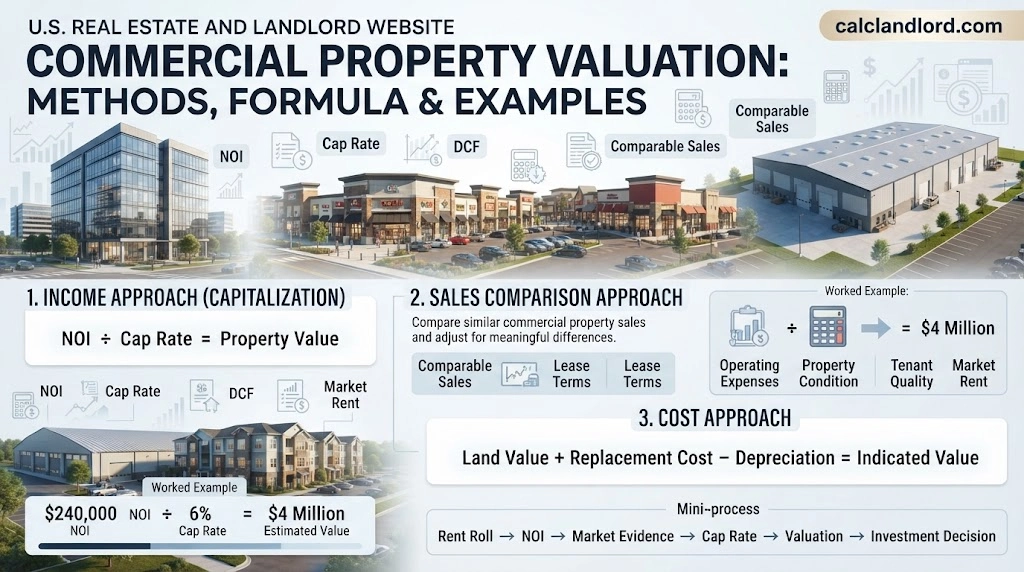
How to Value Commercial Property With the Income Approach
The income approach converts the property’s expected economic benefits into an indication of present value.
For a stable asset, the simplest version is direct capitalization:
Property Value = NOI ÷ Cap Rate
Suppose:
- Stabilized NOI = $300,000
- Market cap rate = 6.5%
Then:
$300,000 ÷ 0.065 = $4,615,385
The estimated value is approximately $4.62 million.
The calculation itself is easy.
The difficult questions are:
- Is $300,000 actually sustainable NOI?
- Is the property stabilized?
- Is 6.5% an appropriate market cap rate?
- Are the comparable properties truly comparable?
- Are future lease expirations likely to change income?
- Are unusual expenses distorting current NOI?
- Are significant capital improvements coming?
Altus Group makes a similar point: the cap-rate formula is simple, but the underlying analysis becomes considerably more complex when cash flow is unstable, the property requires capital improvements, or vacancy and tenant costs need to be modeled.
When direct capitalization works best
Direct capitalization is most informative when:
- NOI is reasonably stable
- The property is substantially leased
- Market cap-rate evidence is available
- The property has a relatively predictable income profile
When it becomes less reliable
Be cautious when:
- The property has significant vacancy
- Major tenants are expiring soon
- Rents are far below or above market
- Large capital projects are pending
- Income is rapidly changing
- The property is being repositioned
- A development or redevelopment plan is central to value
In those cases, DCF or another method may better capture the timing of future cash flows.
How to Calculate NOI and Cap Rate for a Commercial Property
Net Operating Income (NOI) is one of the most important inputs in income-based valuation.
A common underwriting framework is:
Effective Gross Income − Operating Expenses = NOI
Effective Gross Income can include:
- Base rent
- Additional Rent
- Parking
- Service income
- Other property income
It can be adjusted for:
- Vacancy
- Collection loss
- Concessions
- Other income leakage
Operating expenses can include:
- Property taxes
- Insurance
- Management
- Repairs and maintenance
- Utilities paid by the owner
- Landscaping
- Certain association costs
- Other recurring operating expenses
What usually does not belong in NOI?
Under a common investment-analysis convention, NOI excludes financing items such as:
- Mortgage principal
- Mortgage interest
Income taxes and depreciation are also not normally treated as operating expenses in the NOI calculation.
Capital expenditures are generally analyzed separately because replacing a roof or HVAC system is economically different from recurring operating maintenance.
Exact treatment can vary by underwriting convention, lease structure, and appraisal assignment, so consistency matters.
Worked NOI example
Suppose a small retail property has:
| Item | Annual Amount |
| Scheduled rent | $360,000 |
| Vacancy/collection loss | -$18,000 |
| Other income | $8,000 |
| Effective gross income | $350,000 |
| Operating expenses | -$110,000 |
| NOI | $240,000 |
Now assume comparable evidence supports a 6.0% cap rate.
Value = $240,000 ÷ 0.06
Value = $4,000,000
Cap-rate formula
Once value is known:
Cap Rate = NOI ÷ Property Value × 100
A property producing $240,000 NOI and worth $4 million has:
$240,000 ÷ $4,000,000 × 100 = 6%
Why the cap rate deserves scrutiny
A cap rate should not simply be chosen because it “looks good.”
Market cap rates can vary with:
- Location
- Property type
- Tenant quality
- Lease duration
- Vacancy
- Building condition
- Growth expectations
- Liquidity
- Market conditions
The current CalcLandlord Cap Rate Calculator can support the arithmetic, while market evidence is still needed to decide whether the selected cap rate is reasonable. CalcLandlord currently provides a Cap Rate Calculator and Market Comparison Calculator among its tools.
How Does DCF Valuation Work for Commercial Real Estate?
Discounted cash flow (DCF) valuation estimates today’s value by projecting future property cash flows and discounting them back to the present.
Unlike direct capitalization, DCF does not compress the entire forecast into one year’s NOI and one cap rate.
A simplified concept is:
Present Value = Σ Future Cash Flow ÷ (1 + Discount Rate)^t
The model can include:
- Annual rental income
- Rent growth
- Vacancy
- Lease expirations
- Renewal assumptions
- Operating expenses
- Tenant improvements
- Leasing commissions
- Capital expenditures
- Sale proceeds
- Exit cap rate
- Discount rate
Altus describes DCF as a method that projects property revenue, expenses, and cash flows across the holding period and can also support NPV and IRR analysis.

Example
Imagine an office building with a large tenant whose lease expires in Year 3.
A direct-cap approach based only on today’s NOI may miss the possibility that:
- The tenant leaves.
- The space remains vacant for 12 months.
- The owner spends money on improvements.
- The new tenant receives concessions.
- Market rent then increases.
A DCF can explicitly model those events by year.
DCF terminal value
At the end of the modeled holding period, analysts often estimate an exit value.
A simplified version is:
Terminal Value = Forward NOI ÷ Exit Cap Rate
For example:
- Year-10 forward NOI = $450,000
- Exit cap rate = 7%
$450,000 ÷ 0.07 = $6,428,571
That future value would then be discounted back to today’s dollars.
DCF’s biggest weakness
DCF is powerful because it is detailed.
That is also its weakness.
A model with dozens of assumptions can create a highly precise-looking answer that is still highly sensitive to small changes in:
- Rent growth
- Vacancy
- Discount rate
- Exit cap rate
- Capital expenditures
- Leasing costs
A good DCF therefore includes sensitivity analysis, not just a single output.
How Does the Sales Comparison Approach Work?
The sales comparison approach estimates value by analyzing transactions involving similar properties.
The basic process is:
- Identify relevant comparable sales.
- Verify the transaction information.
- Compare each property with the subject.
- Adjust for meaningful differences.
- Reconcile the indications into a value conclusion.
Relevant comparison factors may include:
- Location
- Size
- Age
- Condition
- Property type
- Quality
- Tenant profile
- Occupancy
- Lease terms
- Income
- Transaction date
- Sale conditions
The Appraisal Foundation emphasizes that comparability analysis is central to sales comparison and also underpins comparison inputs used within income and cost approaches.
Simple example
Suppose three comparable industrial properties sold for:
- $175 per square foot
- $185 per square foot
- $195 per square foot
The simple average is $185 per square foot.
Now suppose your subject property:
- has a newer roof,
- has longer remaining leases,
- has better truck access,
- but has a slightly inferior location.
A professional analysis should not simply average the three sale prices.
It should determine how those differences affect the evidence.
Price per square foot is not enough
Two buildings can both sell for $200 per square foot while having very different:
- NOI
- Lease structures
- Tenant credit
- Remaining lease term
- Capital requirements
- Vacancy profiles
For income-producing properties, price-per-square-foot evidence is therefore best interpreted alongside income and lease information.
When sales comparison is especially useful
This approach becomes particularly valuable when reliable recent transactions are available.
It can also help check an income-based valuation.
Construction Capital and Altus both emphasize the difficulty of finding truly comparable commercial transactions because commercial assets can vary substantially in tenant quality, lease terms, physical characteristics, and location.
When Does the Cost Approach Make Sense?
The cost approach asks a different question:
What would it cost to obtain an asset with equivalent utility, considering the land and relevant depreciation or obsolescence?
A simplified framework is:
Land Value + Replacement Cost − Depreciation/Obsolescence = Indicated Value
The approach can be useful for:
- Newer properties
- Special-purpose assets
- Unique buildings
- Properties with limited comparable transactions
- Situations where income evidence is weak
JPMorgan describes the cost approach as separating land value from building replacement cost while considering factors such as age, size, condition, and other property characteristics.
Example
Suppose:
- Land value = $1,000,000
- Replacement cost of improvements = $3,500,000
- Depreciation/obsolescence = $700,000
Then:
$1,000,000 + $3,500,000 − $700,000 = $3,800,000
That creates an indicated value of $3.8 million.
Why landlords should be cautious
The cost approach does not automatically tell an investor what the market will pay.
A property can be expensive to build but produce weak income.
Likewise, a property’s replacement cost can rise while its investment value remains constrained by weak rents, high vacancy, or poor location.
For that reason, income-producing commercial properties often require additional income and market analysis.
Which Other Commercial Property Valuation Methods Matter?
Beyond the three broad approaches, commercial valuation can involve several specialized methods.
Direct capitalization
This is the familiar:
Value = NOI ÷ Cap Rate
It is most useful when income is sufficiently stable.
Discounted cash flow
DCF explicitly models future cash flows and timing.
It becomes valuable when income is expected to change materially.
Profits method
Certain trade-related properties can be influenced heavily by the operating business conducted from the property.
Examples can include:
- Hotels
- Certain restaurants
- Golf facilities
- Leisure properties
- Other specialized operating assets
The method focuses on sustainable trading potential rather than treating the building as a generic leased box.
RICS includes the profits method among specialist commercial valuation methods.
Residual method
The residual method can be used for development land.
A simplified concept is:
Gross Development Value − Development Costs − Required Profit = Residual Land Value
A real development model can also involve:
- Construction timing
- Financing costs
- Planning assumptions
- Sales rates
- Holding periods
- Contingencies
- Marketing
- Professional fees
- Developer profit
Depreciated replacement cost
This method estimates the land and the depreciated cost of a modern equivalent asset.
It can be particularly useful for specialized properties where comparable transactions are limited.
Why method selection matters
A method is not valuable merely because it produces a precise number.
The method must fit the property and assignment.
Professional valuation education emphasizes selecting methodology according to the specific property scenario rather than automatically applying the same technique to every asset.

What Factors Increase or Decrease Commercial Property Value?
Commercial property value is influenced by both current performance and future expectations.
Location
Location influences:
- Tenant demand
- Rental rates
- Vacancy
- Accessibility
- Visibility
- Labor access
- Traffic
- Competition
- Future development
A strong building in a weak location can still struggle.
NOI
Under a direct-cap model, a higher sustainable NOI generally produces a higher indicated value when the cap rate is held constant.
For example:
At a 6% cap rate:
$200,000 NOI ÷ 0.06 = $3.33 million
But:
$250,000 NOI ÷ 0.06 = $4.17 million
That $50,000 NOI difference creates an indicated value difference of about $833,333 under the same cap-rate assumption.
Property condition
Large future capital requirements can reduce the amount a buyer is willing to pay.
Examples include:
- Roof replacement
- HVAC replacement
- Structural repairs
- Parking-lot replacement
- Electrical upgrades
- Plumbing work
- Environmental remediation
Market rent
A building below market rent may have upside, but that upside is not automatically equal to immediate value.
The investor must consider:
- When leases expire
- Whether tenants renew
- Costs of re-leasing
- Tenant improvement allowances
- Leasing commissions
- Vacancy periods
Interest rates and capital markets
Financing conditions can affect buyer behavior and required investment returns.
However, avoid turning a general market movement into a fixed valuation rule. A property’s value remains dependent on its income, market evidence, risk, and asset characteristics.
Supply and demand
New construction can increase competition for tenants.
Conversely, limited available space can support stronger rents when tenant demand is healthy.
ESG and sustainability
Sustainability factors have become a more visible part of professional commercial property valuation.
RICS’s fourth edition of its global ESG and sustainability standard became effective April 30, 2026, and provides guidance on considering significant sustainability factors and related cost information in commercial-property valuation. It is a global professional standard and does not mean every U.S. valuation is governed by RICS.
For U.S. landlords, the practical takeaway is to consider potentially material factors such as:
- Energy costs
- Building efficiency
- Required upgrades
- Climate or physical risks
- Insurance considerations
- Tenant preferences
- Regulatory exposure
The key word is material. Do not assume an ESG label automatically adds or subtracts a fixed percentage from value.
How Do Leases, Tenants, Vacancy, and Operating Expenses Affect Value?
The physical building is only one part of an income-producing property’s economics.
The lease structure can materially affect the value of the income stream.
Remaining lease term
A long lease with reliable contractual income may produce a different risk profile from a property whose largest tenant can leave soon.
Tenant credit quality
A lease to a financially strong tenant may have a different risk profile than a lease to a financially weaker tenant.
The point is not that one tenant category is universally better.
The point is that the probability and timing of future cash flows matter to valuation.
Lease expiration
Suppose a property has:
- $500,000 current NOI
- A major tenant occupying 40% of the building
- Lease expiration in 18 months
A basic cap-rate calculation could value the property using $500,000 NOI.
A more detailed analysis may ask:
- Will the tenant renew?
- At what rent?
- How long could the space remain vacant?
- What tenant improvements will be needed?
- What leasing commission could be incurred?
- Is market rent higher or lower?
- Will the tenant’s departure affect other tenants?
Those assumptions may justify a DCF rather than relying on a single-year capitalization.
Vacancy
Vacancy affects value through lost income and potentially additional leasing costs.
The important point is that vacancy should be based on a credible market and property assumption—not an arbitrary percentage selected just to make the investment look attractive.
Operating expenses
A property with high gross rent can still have disappointing NOI if operating expenses are substantial.
That’s why:
Gross Rent ≠ NOI
Two properties with identical gross rent can have substantially different values if their operating economics are different.
Lease structure
Expense recovery provisions can also matter.
For example, two retail properties may have the same headline rent but different arrangements for:
- Taxes
- Insurance
- Common-area maintenance
- Utilities
- Maintenance responsibilities
A serious valuation should examine the actual lease economics, not just the advertised base rent.
How Does Valuation Differ by Commercial Property Type?
Different property types produce different income profiles and valuation considerations.
| Property type | Important valuation considerations |
| Office | Occupancy, tenant concentration, lease rollover, work-space quality, capital needs |
| Retail | Tenant mix, visibility, traffic, leases, parking, location |
| Industrial | Access, loading, clear height, yard space, tenant quality, lease term |
| Multifamily | Unit rents, occupancy, expenses, unit mix, market rent |
| Mixed-use | Separate income streams, use restrictions, allocation between components |
| Hotel | Revenue, occupancy, operating performance, brand/management structure |
| Special-purpose | Utility, replacement cost, specialized use, limited comparable evidence |
Office
Office valuation can be especially sensitive to:
- Lease expirations
- Tenant concentration
- Vacancy
- Tenant improvements
- Building amenities
- Capital expenditures
Retail
For retail properties, the tenant mix and location can be central.
An anchor tenant leaving can affect the property differently from the loss of a small tenant.
Industrial
Industrial properties may be evaluated using factors such as:
- Clear height
- Loading capacity
- Truck access
- Yard area
- Location
- Building functionality
- Lease duration
Multifamily
For larger multifamily investments, valuation commonly depends heavily on:
- Rental income
- Occupancy
- Market rents
- Operating expenses
- Unit mix
- Capital requirements
Hotels and other operating properties
For hospitality and certain operating properties, the property’s value can be more closely tied to the economics of the business operated from it.
This is one reason the profits method can be relevant for specialist trade-related assets.
Mixed-use property
Mixed-use assets require care because the office, retail, residential, and other components may have different:
- Rent levels
- Lease structures
- Expenses
- Risks
- Comparable evidence
A blended valuation should not hide meaningful differences between the components.
How to Estimate Commercial Property Value Step by Step
A landlord can build a practical preliminary valuation before commissioning a professional appraisal.
Step 1: Define the purpose
Start by asking:
Why am I valuing this property?
Possible purposes include:
- Acquisition
- Sale
- Refinancing
- Portfolio review
- Investment analysis
- Estate planning
- Partnership decisions
- Tax-related work
- Financial reporting
The purpose affects the relevant assumptions and required level of documentation.
Step 2: Establish the valuation date
Property markets change.
A valuation should be tied to a specific date.
Step 3: Build the rent roll
Collect:
- Tenant
- Space
- Current rent
- Lease commencement
- Lease expiry
- Options
- Escalations
- Recoveries
- Concessions
- Security deposits where relevant
Step 4: Normalize income
Separate:
Recurring and sustainable income
from:
Temporary, unusual, or non-recurring income
A one-time fee should not automatically be treated as recurring NOI.
Step 5: Normalize expenses
Review:
- Taxes
- Insurance
- Management
- Repairs
- Utilities
- Maintenance
- Other operating expenses
Look for unusually low expenses that may not be sustainable.
Step 6: Calculate NOI
Use a consistent formula:
Effective Gross Income − Operating Expenses = NOI
Step 7: Research comparable evidence
Look for relevant:
- Sales
- Rents
- Cap rates
- Price-per-square-foot figures
But do not assume every nearby property is a useful comparable.
Step 8: Select a reasonable cap rate
Use market evidence rather than a generic national benchmark.
Ask:
- Are the comparables genuinely similar?
- Were they recently sold?
- Are lease terms comparable?
- Is tenant quality comparable?
- Does the subject have more or less risk?
Step 9: Calculate an income indication
Value = NOI ÷ Cap Rate
Step 10: Cross-check with other evidence
Consider:
- Comparable sales
- Price per square foot
- DCF
- Cost approach
- Replacement cost
- Development potential
Step 11: Stress-test the value
Test what happens if:
- NOI falls 5%
- Vacancy increases
- Cap rate rises
- Rent growth slows
- Major CapEx arrives
- A tenant leaves
For example:
So $240,000 NOI at 6% = $4.00 million
$240,000 NOI at 6.5% = $3.69 million
$240,000 NOI at 7% = $3.43 million
A 1-percentage-point change in cap rate can therefore create a significant change in indicated value.
Step 12: Separate value from investment return
A property may have a reasonable market value but poor financing terms.
That is why a landlord should examine valuation alongside:
- Cash flow
- Cap rate
- Cash-on-cash return
- ROI
- Debt service
- Capital requirements
CalcLandlord already provides dedicated ROI, cap-rate, cash-flow, and other investment calculators that can be used after the preliminary valuation has been established.
A practical valuation audit
Before relying on a valuation, ask five questions:
1. What is the valuation date?
2. What NOI was used?
3. How was the cap rate selected?
4. What comparable properties support the assumptions?
5. What happens if the biggest assumptions are wrong?
This five-question audit is one of the simplest ways for an investor to identify an apparently precise valuation that rests on weak assumptions.
What Does a Professional Valuation Cost and What Should the Report Include?
There is no single nationwide commercial appraisal fee.
The cost can depend on:
- Property size
- Property type
- Number of tenants
- Complexity
- Location
- Availability of market evidence
- Valuation purpose
- Reporting requirements
- Property inspection requirements
- Deadline
A small single-tenant commercial property and a large multi-tenant office complex can require dramatically different amounts of analysis.
Before hiring an appraiser
Ask for a written engagement proposal covering:
- Purpose of valuation
- Intended users
- Property identification
- Valuation date
- Basis of value
- Scope of work
- Inspection requirements
- Reporting format
- Fee
- Delivery date
- Assumptions and limiting conditions
What should you expect in a valuation report?
The exact format varies, but a professional report may explain:
- Property identification
- Ownership or interest being valued
- Purpose
- Valuation date
- Market and property analysis
- Property characteristics
- Income information
- Comparable evidence
- Methodology
- Key assumptions
- Reconciliation
- Final value opinion
For U.S. professional appraisal assignments, USPAP provides generally recognized ethical and performance standards, and the Appraisal Foundation notes that its standards apply across appraisal disciplines including real property.
When should a landlord use a professional?
A professional valuation becomes especially important when the number has meaningful consequences for:
- Financing
- Sale negotiations
- Partnership disputes
- Litigation
- Estate planning
- Formal reporting
- Other situations where a defensible valuation is required
An online calculator is best viewed as a decision-support tool, not a universal substitute for professional valuation work.
People Also Ask
A: For a stabilized income-producing property, a simplified direct-capitalization formula is:
Property Value = NOI ÷ Cap Rate
Example:
$300,000 NOI ÷ 6% = $5 million
This is an illustrative estimate, not automatically a professional appraisal.
A: A vacant property may be more difficult to value using a simple cap-rate calculation because there may be no stabilized NOI.
The analysis may instead rely more heavily on:
Comparable sales
Market rent
Expected lease-up
Vacancy period
Tenant improvements
Leasing commissions
DCF
Cost or development analysis
A: “Valuation” is the broader concept of determining or estimating value.
An appraisal is a professional valuation assignment performed within applicable standards, requirements, and scope.
In the United States, USPAP is the generally recognized professional standard for appraisal practice.
A: Market-value appraisal and property-tax assessment are not necessarily the same thing.
Assessment systems are governed by applicable state and local rules and may use jurisdiction-specific methods.
A: No.
Commercial valuation often requires greater emphasis on income, leases, operating expenses, tenant risk, market yields, and investment characteristics.
The appropriate methodology also depends on the type and purpose of the valuation.
Common Commercial Property Valuation Mistakes
Mistake 1: Using gross rent as NOI
A property with high gross rent can still have weak NOI when expenses are high.
Mistake 2: Picking a cap rate from a generic article
Cap rates should be supported by relevant market evidence and property characteristics.
Mistake 3: Ignoring lease expirations
A property with a major tenant expiring soon may require a more detailed cash-flow analysis.
Mistake 4: Treating every comparable as equal
Location, condition, tenants, leases, size, and transaction circumstances can materially differ.
Mistake 5: Ignoring CapEx
A roof replacement or major mechanical upgrade can have a meaningful economic effect even though it is not treated the same way as recurring NOI expenses.
Mistake 6: Confusing valuation with investment return
A property’s value and an individual investor’s return are different questions.
Mistake 7: Relying on one scenario
A valuation should be tested against reasonable changes to cap rates, NOI, occupancy, rents, and capital expenditures.
Mistake 8: Treating an automated estimate as a formal appraisal
Automated and calculator-based estimates can be useful for screening, but they do not automatically replace an assignment performed by a qualified professional.
A Simple Landlord Decision Framework
Before using a commercial property valuation to make a real investment decision, work through this sequence:
Property → Rent Roll → NOI → Market Evidence → Cap Rate → Value → Financing → Cash Flow → Risk → Decision
Do not stop at the valuation number.
A $5 million property may be worth $5 million and still be a poor acquisition at $5 million under a particular financing structure.
Likewise, a property’s value may be below an owner’s original purchase price without necessarily meaning the underlying investment strategy has failed.
The decision should connect value, income, financing, future cash flow, risk, and the investor’s objectives.
Conclusion
Commercial Property Valuation is not simply a matter of taking annual rent and dividing it by an arbitrary percentage.
The strongest preliminary analysis begins with accurate property data, a realistic rent roll, normalized operating expenses, sustainable NOI, relevant market evidence, and clearly stated assumptions.
For a landlord or investor, the most useful question is not merely:
“What is this property worth?”
It is:
“What value is supported by the property’s current income, future cash flows, market evidence, physical characteristics, lease risk, and the purpose of this valuation?”
That question produces a much more useful foundation for buying, selling, refinancing, or holding a commercial property.
Key Takeaways
- Commercial property valuation estimates the value of an asset for a defined purpose and valuation date.
- The three broad approaches are income, sales comparison/market, and cost.
- The simplified income formula is Value = NOI ÷ Cap Rate.
- NOI must be calculated consistently and should not be confused with gross rent.
- Cap-rate selection is a market-analysis problem, not merely a calculator input.
- DCF becomes particularly useful when future income, vacancy, leasing costs, or capital expenditures are expected to change materially.
- Comparable sales should be adjusted for meaningful differences rather than simply averaged.
- Lease terms, tenant quality, occupancy, expenses, and property condition can materially affect value.
- U.S. investors should distinguish an informal investment estimate from a formal professional appraisal.
- Current 2026 valuation practice is also paying increasing attention to material sustainability and ESG factors, although the applicable professional and legal requirements depend on the jurisdiction and assignment.
