

How to Calculate Rental Property Taxes and Maximize Landlord Tax Deductions (2026 Guide)
If you own a rental property and only write off mortgage interest and the property manager’s fee. You’re almost certainly overpaying the IRS. Most landlords I talk to are missing at least one major deduction — usually depreciation done incorrectly. Or the newer QBI deduction they’ve never even heard of.
This guide walks through the actual math: how rental income gets taxed. How to calculate every major deduction with real numbers. And which 2026 law changes (courtesy of the One Big Beautiful Bill Act. Or OBBBA) actually affect what lands in your pocket. No filler, no vague “consult a professional” hand-waving without substance first — just the calculations and the reasoning behind them.
Quick answer: Rental property income and expenses are reported on Schedule E, not Schedule C. You start with gross rental income, subtract operating expenses (mortgage interest. Property taxes, insurance, repairs, management fees, and more), subtract depreciation, and the result is your taxable rental income or loss. Landlords typically save the most through three levers: full and correctly calculated depreciation. The 20% QBI deduction under Section 199A, and — for larger portfolios — a cost segregation study paired with 100% bonus depreciation.
Every calculation below pairs with our rental property depreciation calculator and cash flow calculator so you can run your own numbers as you read.
How Rental Income Is Actually Taxed
Rental real estate is passive income by default, and it’s reported on Schedule E (Form 1040), not Schedule C. That matters because Schedule E income isn’t subject to self-employment tax, but it also means rental losses face passive activity loss limits (more on that below) unless you qualify as a real estate professional.
Two things determine how much tax you owe on a rental: your accounting method and your net income after deductions.
Cash basis is what almost every individual landlord uses. You report income when you receive it and expenses when you pay them. Accrual basis — recognizing income when earned and expenses when incurred, regardless of when cash changes hands — is mostly relevant to landlords who also run a larger real estate business or hold property inside a corporation. If you’re managing your own one-to-a-few-property portfolio, stick with cash basis unless your CPA tells you otherwise.
Step-by-Step: Calculating Your Rental Property Taxes
Here’s the actual sequence, in the order the IRS expects it.
Step 1: Add Up Your Gross Rental Income
This isn’t just rent checks. Gross rental income includes:
- Monthly rent payments received
- Advance rent (rent paid for a future period — taxable in the year received, not the year it covers)
- Security deposits you keep because a tenant broke the lease or damaged the unit
- Any expenses a tenant pays on your behalf in lieu of rent (e.g., they pay a plumber and you reduce their rent accordingly — you report both the “income” and the expense)
- Lease cancellation payments
Security deposits you’re holding but haven’t forfeited are not income. Don’t report them.
Step 2: Identify Every Deductible Expense
We cover the full list in the next section, but at a high level you’re gathering: mortgage interest, property taxes, insurance, repairs and maintenance, management fees, travel, professional fees, utilities you pay, and any other ordinary and necessary expense of operating the rental.
Step 3: Calculate Depreciation (This Is Where Most Landlords Leave Money on the Table)
Depreciation is the deduction for the wear and tear on your property over time — and it’s non-cash, meaning you get the write-off without spending a dollar in the current year. Here’s the full walkthrough.
The basic rule: Residential rental buildings are depreciated straight-line over 27.5 years. Commercial property is depreciated over 39 years. You can only depreciate the building — not the land underneath it, since land doesn’t wear out.
Worked example — single-family rental:
| Step | Calculation | Amount |
| Purchase price | — | $300,000 |
| Closing costs added to basis (title, recording fees, legal) | — | $4,000 |
| Total cost basis | Purchase price + closing costs | $304,000 |
| Land value (per county assessor’s ratio, often 15–25% of value) | 20% of $304,000 | $60,800 |
| Depreciable building basis | Total basis − land value | $243,200 |
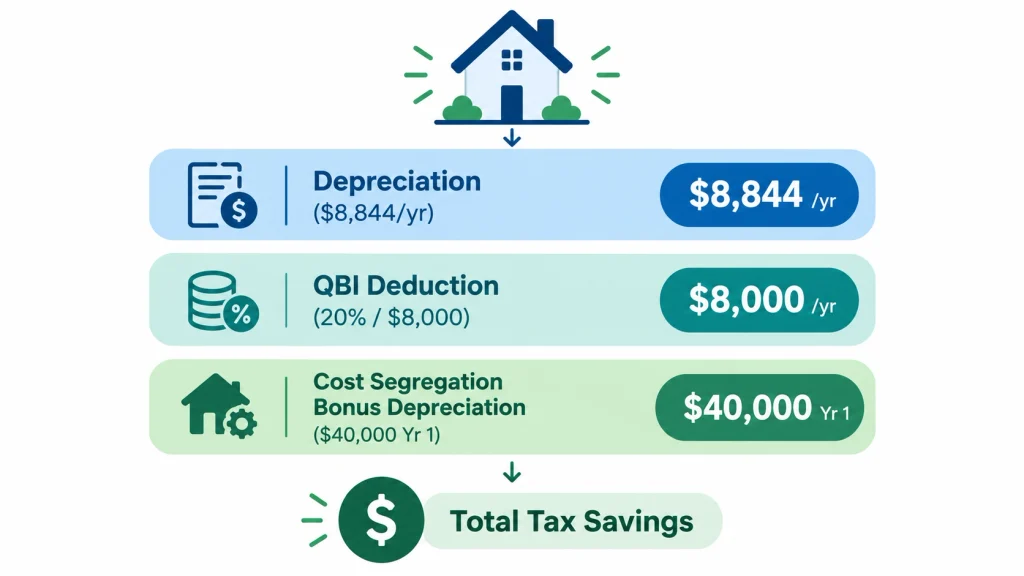
| Annual depreciation | $243,200 ÷ 27.5 years | $8,844/year |
At a 24% marginal tax rate, that’s roughly $2,123 in tax savings every single year — for 27.5 years — just from a deduction that costs you nothing out of pocket. This is why depreciation, not mortgage interest, is usually the single biggest tax benefit of owning rental property.
A few details that trip people up:

Land allocation matters.
- If you guess low on land value, you inflate your depreciation deduction — and the IRS can challenge it. Use your county property tax assessment’s land-to-building ratio as a defensible starting point, or get an appraisal that breaks it out.
- The mid-month convention applies. You don’t get a full year of depreciation in the year you buy or sell. The IRS treats the property as placed in service (or disposed of) in the middle of the month, so your first and last year’s depreciation is prorated.
- Depreciation is not optional in practice. Technically, you could choose not to claim it, but the IRS taxes you on “allowed or allowable” depreciation when you sell — meaning you’ll pay depreciation recapture tax on the deduction whether you claimed it or not. Always claim it.
If you forgot to depreciate in prior years, you don’t amend three years of returns one at a time. You file Form 3115 (Application for Change in Accounting Method) with your current-year return, which lets you claim the entire missed depreciation as a catch-up deduction in one year (a Section 481(a) adjustment). This is a case where getting a CPA involved is worth the fee — the form is unforgiving of mistakes.
Step 4: Apply the Passive Activity Loss Rules
If your rental runs at a loss on paper (very common once depreciation is factored in), the IRS limits how much of that loss you can use to offset other income — unless you actively participate and meet the income thresholds below.
- The $25,000 special allowance: If you actively participate in managing the property (approving tenants, setting rent, approving repairs — you don’t need to swing a hammer yourself) and your modified adjusted gross income (MAGI) is $100,000 or less, you can deduct up to $25,000 of rental losses against your other income (W-2 wages, other business income, etc.).
- The phaseout: Between $100,000 and $150,000 MAGI, that $25,000 allowance phases out by 50 cents for every dollar of MAGI over $100,000. Above $150,000 MAGI, the special allowance is gone entirely, and losses are suspended and carried forward to future years (or until you sell the property, at which point suspended losses become fully deductible).
- MAGI for this purpose is your AGI before subtracting IRA contributions, student loan interest, and a handful of other add-backs — for most landlords without those items, it’s essentially the same as AGI.
- Real Estate Professional Status (REPS) removes the passive loss limitation entirely, letting losses offset any income including W-2 wages. To qualify, you must spend more than 750 hours per year in real estate trades or businesses and more than half of your total working hours across all jobs must be in real estate. This is a high bar — it generally rules out anyone with a full-time job outside real estate — and the IRS scrutinizes REPS claims closely, so keep a contemporaneous time log.
Step 5: Net It Out
Gross rental income, minus operating expenses, minus depreciation, minus any passive loss limitation adjustment = your taxable rental income (or your allowed loss). This flows to Schedule 1 of your Form 1040.
Step 6: Report on Schedule E
Schedule E has a column for each property, with specific line items: rents received, then separate lines for advertising, cleaning and maintenance, insurance, legal and professional fees, management fees, mortgage interest, repairs, supplies, taxes, utilities, depreciation (from Form 4562), and an “other” line for anything that doesn’t fit a category. If you have losses limited by the passive activity rules, Form 8582 calculates the allowed and suspended amounts, which then flow back to Schedule E.
The Complete List of Landlord Tax Deductions (2026)
| Deduction | What It Covers | Key 2026 Note |
| Mortgage interest | Interest on loans used to acquire or improve the property | No dollar cap for rental property (the $750,000 cap applies to personal residences, not Schedule E rentals) |
| Property taxes | Real estate taxes on the rental | Fully deductible on Schedule E as a business expense — not subject to the personal SALT cap at all (see below) |
| Depreciation | Building basis over 27.5 (residential) or 39 (commercial) years | Land is never depreciated |
| Repairs and maintenance | Fixing what’s broken to keep the property in working condition | Fully deductible in the year paid — see repairs vs. improvements below |
| Insurance | Landlord policy, flood, umbrella liability | Fully deductible |
| Property management fees | Typically 8–12% of collected rent | Fully deductible |
| Travel and mileage | Driving to the property for management, repairs, showings | 72.5¢/mile through June 30, 2026; 76¢/mile from July 1, 2026 onward, after a mid-year IRS adjustment |
| Home office | A space used exclusively and regularly for managing your rentals | Must be your principal place of business for the rental activity — a spare bedroom you also use for personal stuff doesn’t qualify |
| Professional fees | CPA, attorney, bookkeeper | Fully deductible |
| Utilities you pay | Water, gas, electric, trash, internet if you cover them | Fully deductible |
| Advertising and tenant screening | Listing fees, background checks | Fully deductible |
| Supplies and small tools | Cleaning supplies, small hand tools, smoke detectors | Fully deductible; larger tools/equipment may need to be depreciated |
| HOA dues and assessments | Regular dues | Fully deductible; special assessments for capital improvements are usually capitalized instead |
Repairs vs. Improvements — the Distinction That Actually Matters
This is the single most misunderstood rule on this list, and it’s worth a real explanation instead of the one-line mention most guides give it.
A repair keeps the property in ordinary operating condition — you deduct the full cost the year you pay it. An improvement makes the property better than it was, restores it after significant damage, or adapts it to a new use — you add the cost to your basis and depreciate it over time instead.
The IRS test (from the tangible property regulations, §1.263(a)-3) asks whether the work results in a betterment, restoration, or adaptation:
- Betterment: Fixes a pre-existing defect, adds a material addition, or materially increases capacity or quality. Example: replacing a few cracked roof shingles = repair. Replacing the entire roof = betterment (improvement).
- Restoration: Returns the property to working condition after it’s fallen into disrepair, or replaces a major component. Example: patching a section of drywall = repair. Replacing the entire HVAC system = restoration (improvement).
- Adaptation: Changes the use of the property to something not originally intended. Example: converting a garage into a rentable bedroom = adaptation (improvement).
The de minimis safe harbor gives you an easier path for smaller items: if you have an applicable financial statement, you can immediately expense items costing $5,000 or less per invoice/item; without one (true for most individual landlords), the threshold is $2,500 per item or invoice. A $1,800 refrigerator replacement can be expensed immediately under this safe harbor even though a new appliance would technically be a “betterment” — you just need a written accounting policy in place at the start of the year and to apply it consistently.
Quick decision guide:
| Question | Repair (deduct now) | Improvement (depreciate) |
| Does it fix something broken back to its original condition? | Yes | — |
| Does it replace an entire system or major component? | — | Yes |
| Does it add new value, capacity, or function that wasn’t there before? | — | Yes |
| Is it under $2,500 per item/invoice and you have a de minimis policy on file? | Yes | — |
Advanced Tax Strategies to Maximize Deductions
Once you’ve got the basics locked in, these are where the real money is.
Cost Segregation: Front-Loading Your Depreciation
Normally, everything in your rental depreciates over the same 27.5 years as the building. But a rental property isn’t just one asset — it’s a building shell plus carpeting, cabinetry, certain electrical and plumbing components, fencing, and land improvements like driveways and landscaping, each of which the IRS actually allows to depreciate on a much shorter schedule (5, 7, or 15 years) under MACRS.
A cost segregation study — an engineering-based analysis, typically done by a specialized firm — identifies and reclassifies these components. And here’s why it matters more in 2026 than it used to: any component with a recovery period of 20 years or less that’s reclassified this way is eligible for 100% bonus depreciation, permanently, under the OBBBA, for property acquired and placed in service after January 19, 2025.
Worked example: On a $500,000 rental property (building basis, land excluded) where a cost segregation study reclassifies 25% of the basis — $125,000 — into 5-, 7-, and 15-year components, that entire $125,000 can potentially be deducted in year one via bonus depreciation, instead of trickling out over 27.5 years. At a 32% marginal rate, that’s a $40,000 tax reduction in the first year alone, compared to roughly $4,545 you’d have gotten from ordinary first-year depreciation on that same portion.
Studies typically cost $5,000–$15,000 for a single property, so the math tends to work in your favor on properties over roughly $300,000–$400,000 in basis — below that, the study fee eats too much of the benefit relative to a simpler approach. One important nuance competitors often blur: bonus depreciation doesn’t apply to the 27.5-year residential structure itself. It only applies to the shorter-life components a cost segregation study carves out. If someone tells you they’re taking 100% bonus depreciation on the whole house, that’s not how the rule works.
The QBI Deduction (Section 199A): 20% Off Net Rental Income
Under Section 199A, you may be able to deduct up to 20% of your qualified business income from a rental activity — but rental income doesn’t automatically qualify. Your rental has to rise to the level of a “trade or business,” which is a facts-and-circumstances test the IRS has never precisely defined.
To sidestep that ambiguity, the IRS created a safe harbor (Rev. Proc. 2019-38): if you keep separate books and records for each rental enterprise, perform 250 or more hours of rental services per year (you, your employees, or your contractors — this includes advertising, negotiating leases, collecting rent, and coordinating repairs, but not time spent on financial or investment activities like arranging financing or reviewing statements), and attach a signed statement to your return, your rental income is automatically treated as QBI.
The OBBBA made the §199A deduction permanent — the sunset that was originally scheduled for the end of 2025 is gone. It also added a $400 minimum QBI deduction for 2026 for taxpayers with at least $1,000 of active QBI, and inflation-adjusted the income phase-in thresholds that apply once QBI limitation rules kick in for higher earners.
Worked example: A landlord with $40,000 in net rental income who clears the safe harbor gets a $8,000 QBI deduction (20% of $40,000). At a 24% marginal rate, that’s about $1,920 in tax savings — on top of everything else.
A practical tip most guides skip: keep a simple time log — date, task, hours — for every hour you or your contractors spend on rental services. If you’re ever asked to substantiate the 250-hour threshold, a spreadsheet with dates and specific tasks is what actually holds up; a rough estimate at tax time does not.
More Explore: https://calclandlord.com/compare-rental-yields-across-states/Real Estate Professional Status (REPS)
Covered under Step 4 above, but worth restating as a strategy: if one spouse in a married-filing-jointly household can genuinely meet the 750-hour and more-than-half-of-working-hours tests (a spouse who doesn’t work outside real estate is the most common way this works in practice), REPS unlocks unlimited passive loss deductions against ordinary income — not just the capped $25,000 allowance. This is a high-value strategy for households actively growing a portfolio, but it’s also one of the more frequently challenged positions on audit, so documentation (a contemporaneous log, not a reconstruction after the fact) is essential.
1031 Exchanges: Deferring Gains and Recapture
If you sell a rental and reinvest the proceeds into a “like-kind” replacement property through a qualified intermediary, following strict timelines (45 days to identify a replacement, 180 days to close), you can defer both the capital gains tax and the depreciation recapture tax that would otherwise be due on the sale. This doesn’t eliminate the tax — it defers it, and your basis carries over into the new property — but done repeatedly over a career, it’s how many landlords build much larger portfolios than they could have by paying tax at every sale.
Depreciation Recapture: What Happens When You Sell
When you sell, the depreciation you claimed (or should have claimed) gets “recaptured” and taxed at a maximum rate of 25% under the unrecaptured §1250 gain rules — separate from, and generally higher than, the long-term capital gains rate on your appreciation. Three common ways landlords manage this: a 1031 exchange (deferral), an installment sale (spreading the gain, and the tax, over multiple years as payments come in), or simply holding the property until death, at which point heirs receive a stepped-up basis to fair market value and the deferred gain and recapture disappear entirely for income tax purposes.
Special Situations
Mixed-use and vacation properties: If you rent out a property you also use personally, §280A’s vacation home rules kick in. Rent it for 14 days or fewer per year and the income is entirely tax-free (no deductions either) — a niche but real strategy for properties near major events. Beyond that, if your personal use exceeds the greater of 14 days or 10% of the days it’s rented, the property is treated as a personal residence for tax purposes, and expenses are allocated between personal and rental use, with deductible rental losses capped at rental income (no loss carryforward advantage).
Short-term rentals (Airbnb, VRBO): If the average guest stay is 7 days or less (or 30 days or less with significant personal services like daily cleaning or meals), the activity is generally not treated as a “rental activity” for passive loss purposes at all — it may be reported on Schedule C, or on Schedule E without the passive activity limitation, depending on your level of material participation. This is a genuinely complicated area where the rules diverge sharply from long-term rentals, and it’s worth a dedicated conversation with a CPA who specifically works with short-term rental hosts.
Record-Keeping and Audit-Proofing
Keep these, organized by property, for at least 3 years from filing (the standard statute of limitations), but 6 years if you might have underreported income by more than 25%, and indefinitely for records tied to your basis (purchase documents, capital improvements, depreciation schedules) since you’ll need them to calculate gain when you eventually sell:
- Purchase closing statement and any appraisal breaking out land vs. building value
- Every receipt and invoice for repairs, improvements, and supplies
- Mileage log with dates, destinations, and business purpose
- QBI safe harbor time log (250-hour tracking)
- Bank statements showing rent received and expenses paid
- Prior years’ depreciation schedules (Form 4562)
Common audit triggers to be aware of: rental losses that exceed the $25,000 special allowance without REPS documentation to back it up, home office deductions that don’t clearly meet the exclusive-use test, and travel/meal deductions that look more like personal trips than property management. None of these mean don’t claim the deduction — they mean document it well enough that the deduction survives a closer look.
2026 Tax Law Changes Landlords Should Know
- Bonus depreciation is 100% and permanent for qualifying components of property acquired and placed in service after January 19, 2025 (OBBBA) — most relevant to landlords through cost segregation studies, not the building’s core 27.5-year basis.
- The SALT cap increased to $40,000 for 2025, indexed for inflation to $40,400 for 2026, phasing down for taxpayers with AGI above roughly $500,000. This is a Schedule A (itemized personal deduction) change — it does not affect rental property taxes, which are already fully deductible as a Schedule E business expense regardless of this cap.
- The QBI deduction (§199A) is now permanent, with a new $400 minimum deduction for 2026 and inflation-adjusted phase-in thresholds.
- The standard mileage rate started in 2026 at 72.5¢/mile, then the IRS issued a mid-year increase to 76¢/mile effective July 1, 2026 — make sure your mileage log (or tracking app) reflects the correct rate for the correct half of the year.
Tax rules can vary by state, and state conformity to federal changes like OBBBA isn’t automatic everywhere — some states decouple from federal bonus depreciation or QBI rules. Check your state’s specific treatment before assuming a federal change flows through to your state return.
People Also Ask
Yes. Rental property taxes are a Schedule E business expense, not an itemized Schedule A deduction — they’re fully deductible regardless of whether you itemize or take the standard deduction personally.
Practically, yes. Depreciation isn’t legally mandatory, but the IRS taxes you on depreciation “allowed or allowable” when you sell, whether or not you actually claimed it. Skipping it just means you pay recapture tax on a deduction you never got the benefit of.
No. Only the interest portion of your mortgage payment is deductible. Principal payments reduce your loan balance and increase your equity, but they’re not a deductible expense — they simply reduce your basis calculation isn’t relevant either, since principal was never added to basis in the first place (the original purchase price was).
Most closing costs (title fees, recording fees, legal fees, transfer taxes) are added to your basis and recovered through depreciation over time rather than deducted immediately. Loan origination points, however, are typically amortized over the life of the loan.
A much lower bar than material participation — approving tenants, setting rental terms, and approving repairs and capital expenditures is generally enough, even if a property manager handles day-to-day operations.
Next Steps
Run your own numbers with our rental property depreciation calculator to see your annual write-off. Or use the cash flow calculator to see how these deductions affect your actual after-tax return. If you’re weighing a cost segregation study. Our ROI calculator can help you estimate the break-even point before you pay for one.
For anything involving REPS documentation. A 1031 exchange, or a cost segregation study. This is genuinely the point where hiring a CPA who specializes in real estate pays for itself . The strategies above are powerful. But they’re also the ones the IRS scrutinizes most closely. And getting the paperwork right the first time is cheaper than fixing it later.

Pingback: Rental Property Depreciation: The 27.5-Year Secret