
How Rental Property Depreciation Works (And How to Calculate It Correctly)
Here’s an uncomfortable number: most landlords underclaim rental property depreciation by thousands of dollars—not because they’re careless, but because the formula everyone quotes online is incomplete. “Divide by 27.5” is only step one. Skip the land allocation, the placed-in-service date, or the IRS’s mid-month convention, and you’ll either shortchange your own deduction or set up a nasty surprise at tax time. This isn’t a theoretical tax concept — it’s real money sitting in your rental income right now. Below is the exact formula, corrected for the parts most guides leave out, plus a worked example with real numbers.
If you own a rental property, depreciation is probably your single largest tax deduction—and the one most landlords understand the least. You’re not writing a check for it. You’re not even losing cash flow because of it. Yet it can turn a profitable rental into a “paper loss” on your tax return, which is exactly why the IRS lets you take it.
Here’s the quick version before we go deep: the IRS treats a residential rental building as an asset that wears out over 27.5 years, even if your property is actually appreciating in the real world. You get to deduct a portion of the building’s cost — not the land — every year you own it. Get the basis wrong, get the timing wrong, or mix up repairs and improvements, and you either leave money on the table or set yourself up for an ugly correction later.
This guide walks through the real calculation, not just the formula every other article quotes. Once you’ve got your numbers, run them through our rental property depreciation calculator to get an instant first-year and ongoing schedule.
What Is Rental Property Depreciation?
Depreciation is the IRS’s way of letting you recover the cost of an income-producing asset over its “useful life,” rather than deducting the whole purchase price in year one.
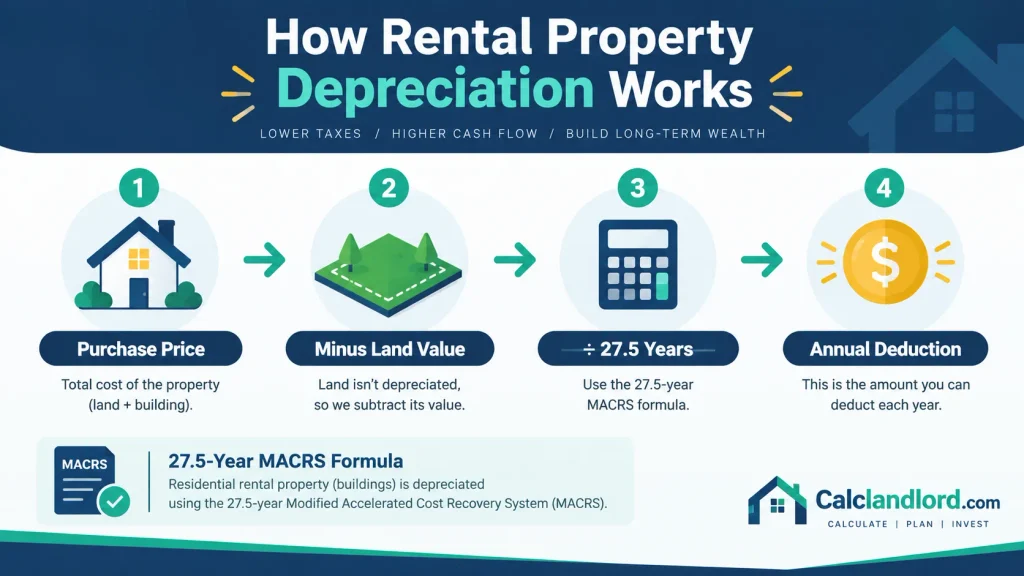
For tax purposes, a residential rental building is assumed to have a useful life of 27.5 years under the Modified Accelerated Cost Recovery System (MACRS). Every year, you deduct roughly 1/27.5 of your depreciable basis against your rental income.
Three things matter here, and it’s worth separating them clearly:
- Depreciation is a tax concept, not a market-value estimate. Your property can go up in value every year while you’re still depreciating it. The IRS isn’t tracking what your house is worth — it’s tracking cost recovery on a fixed schedule.
- It’s a non-cash deduction. You don’t spend any money to get it. It reduces your taxable rental income without touching your bank account, which is why so many profitable rentals show a loss on Schedule E.
- It only applies to the building, never the land. Land doesn’t wear out, so the IRS excludes it from the calculation entirely. This is the single most common place landlords miscalculate.
The Rental Property Depreciation Formula
The core formula for a residential rental property under the General Depreciation System (GDS) is:
Annual Depreciation = Depreciable Building Basis ÷ 27.5
So if your building basis (after removing land value) is $275,000:
$275,000 ÷ 27.5 = $10,000 per year
That’s your full-year number. The catch — and the reason most online calculators produce a slightly different figure than your tax software — is that your first and final years are almost never full years. The IRS uses the mid-month convention, which we’ll cover in detail below, so your actual first-year deduction will be less than the clean $10,000 figure.
| Input | Example |
| Purchase price | $350,000 |
| Capitalizable acquisition costs | $7,000 |
| Pre-rental improvements | $18,000 |
| Total initial basis | $375,000 |
| Allocated land value | −$75,000 |
| Depreciable building basis | $300,000 |
| Full-year depreciation ($300,000 ÷ 27.5) | $10,909.09 |
Who Can Claim Depreciation on a Rental Property?
You can generally depreciate a rental property when all of the following are true:
- You own the property. You don’t have to hold the deed free and clear — a mortgaged property still qualifies, because depreciation is based on cost basis, not equity.
- You use it to produce income. It has to be rented out, or genuinely available and marketed for rent.
- It has a determinable useful life longer than one year. Buildings qualify; land does not.
- It’s placed in service. The property has to be ready and available for its intended rental use, not just purchased.
A detail that trips people up constantly: your mortgage has nothing to do with your depreciable basis. Whether you put 5% down or paid cash, whether your loan is $280,000 or $0, your depreciation deduction is based on the property’s tax basis — not your financing structure and not the amount of cash you personally put in at closing.
What You Can (and Can’t) Depreciate
| Depreciable | Not Depreciable |
| The building/structure itself | Land |
| Capital improvements (new roof, new HVAC system) | Routine repairs and maintenance |
| Appliances, carpeting, and certain fixtures (often on shorter schedules) | The value of your own labor |
| Major renovations completed before renting | Personal-use portions of a property |
Appliances, flooring, and certain equipment frequently don’t follow the building’s 27.5-year schedule at all — they can qualify for shorter recovery periods (often 5 or 7 years) as separate personal property, which is part of what a cost segregation study is designed to identify. We cover this in more detail further down.
How to Calculate Your Depreciable Basis
This is the step almost every competing guide oversimplifies. Your depreciable basis is not your purchase price. It’s built in layers:
Step 1 — Start with your purchase price.
Step 2 — Add capitalizable acquisition costs. Certain closing costs get added to your basis rather than deducted immediately, including title-related legal fees, recording fees, transfer taxes, title insurance, and some survey or abstract fees. Costs like loan origination fees and prepaid interest generally are not added to basis — they’re treated differently, so don’t lump every closing-statement line item together without checking.
Step 3 — Add qualifying improvements made before the property was placed in service. A new roof or a full kitchen remodel done before your first tenant moves in gets added to basis. A repair to a leaking faucet generally does not.
Step 4 — Subtract the allocated land value. This is where most landlords guess instead of calculate. You have four realistic ways to allocate value between land and building:
- County property tax assessment — often the simplest and most defensible starting point, since it’s an independent third-party allocation.
- A formal appraisal — more accurate, especially useful for unusual properties.
- The purchase contract allocation — valid if the buyer and seller genuinely negotiated separate land/building values at arm’s length.
- A cost segregation or engineering study — the most precise, and usually worth the cost only on larger or more expensive properties.
Avoid the shortcut of picking an arbitrary percentage (like “20% land, 80% building”) with no support behind it. If you’re ever questioned, you’ll want a documented basis for the allocation you used.
Step 5 — What’s left is your depreciable building basis.
| Item | Amount |
| Purchase price | $350,000 |
| Capitalizable acquisition costs | $7,000 |
| Pre-rental improvements | $18,000 |
| Total initial basis | $375,000 |
| Allocated land value (per county assessment) | −$75,000 |
| Depreciable building basis | $300,000 |
Your basis isn’t frozen forever, either. It changes over time with capital improvements, casualty losses, insurance reimbursements, and the depreciation you’ve already claimed (adjusted basis matters most when you eventually sell — more on that below).
When Does Depreciation Begin? (The Placed-in-Service Rule)
This is the second most common mistake after land allocation: landlords assume depreciation starts on the closing date or the date a tenant moves in. Neither is correct.
Depreciation begins when the property is ready and available for its intended rental use — not necessarily rented, just genuinely ready and being marketed as a rental.
A few practical scenarios:
- You close on a property, and it needs no work. If it’s immediately advertised and available for rent, depreciation typically starts that month.
- You close and spend two months renovating before listing it. Depreciation generally doesn’t start until renovations are complete and the unit is actually ready and available for tenants — not on the closing date.
- You have a temporary vacancy between tenants. As long as the property remains available for rent, a vacancy period doesn’t necessarily stop depreciation.
- You convert your personal residence into a rental. Your depreciable basis becomes the lesser of your adjusted cost basis or the property’s fair market value on the date of conversion — a rule that surprises a lot of accidental landlords.
MACRS, GDS, and ADS: Which Recovery Period Applies
MACRS (Modified Accelerated Cost Recovery System) is the depreciation system the IRS requires for property placed in service after 1986. Within MACRS, there are two systems:
- GDS (General Depreciation System) — the default for almost every residential landlord. Residential rental real estate uses a 27.5-year straight-line recovery period.
- ADS (Alternative Depreciation System) — required in specific situations (for example, certain foreign-use property or when electing out of certain bonus depreciation rules) and generally uses 30 years for residential rental property placed in service after 2017.

| Property Type | Typical GDS Recovery Period |
| Residential rental real estate | 27.5 years |
| Nonresidential (commercial) real property | 39 years |
| Residential rental property under ADS (post-2017) | 30 years |
Unless you have a specific reason to use ADS, most landlords use GDS with the 27.5-year straight-line method.
The Mid-Month Convention and First-Year Depreciation
Here’s the part every “quick formula” article skips, and it’s the reason your first year’s deduction is never a clean division by 12.
The IRS mid-month convention treats any property placed in service during a given month as if it were placed in service in the middle of that month — regardless of whether you closed on the 1st or the 28th. That means your first-year deduction only covers a half-month for the month you started, plus the remaining full months of the year.
Example: Property placed in service in March
A full-year deduction of $10,000 works out to $833.33 per month. Under the mid-month convention, March counts as a half-month, so the first year captures roughly 9.5 months of depreciation (half of March plus April through December) instead of a full 12 — producing a first-year deduction noticeably below the full-year figure.
Example: Property placed in service in October
The same $10,000 full-year property placed in service in October only captures roughly 2.5 months in year one — a much smaller first-year deduction than a March start date, even though it’s the identical property with the identical basis.
This is exactly why two landlords with the same $300,000 building basis can have completely different first-year deductions depending on their placed-in-service date — and why a calculator that ignores the mid-month convention will overstate your actual allowed deduction.
The same logic applies in reverse in your final year of ownership: whatever month you dispose of the property, you again only get a half-month of depreciation for that month.
Step-by-Step: Calculating Your Annual Depreciation
Put it all together, and the process looks like this:
- Determine your total initial tax basis (purchase price plus capitalizable costs plus pre-service improvements).
- Subtract the allocated land value to isolate your building basis.
- Identify any components that should be depreciated separately on shorter schedules (appliances, certain flooring, etc.).
- Confirm you’re using GDS (27.5 years) unless a specific rule requires ADS.
- Identify your exact placed-in-service month.
- Apply the IRS mid-month convention percentage for that month in year one.
- Use the straight full-year formula (basis ÷ 27.5) for every year after the first through the second-to-last year.
- Track your adjusted basis every year — you’ll need it when you sell.
Worked Examples
Example 1 — Full-year single-family rental
Building basis: $247,500. Placed in service in a prior year, so this is a standard full year. $247,500 ÷ 27.5 = $9,000 per year, every year, until the basis is fully depreciated or the property is sold.
Example 2 — First-year partial depreciation
Building basis: $275,000, placed in service in June. Full-year rate: $275,000 ÷ 27.5 = $10,000/year, or $833.33/month. Under the mid-month convention, June counts as a half-month, capturing roughly 6.5 months of the first year — producing a first-year deduction well below the $10,000 full-year figure. Your tax software or CPA will apply the exact IRS percentage table for the June placed-in-service date.
Example 3 — Converted personal residence
A landlord bought a home for $310,000 several years ago (now with an adjusted basis of $295,000 after minor capital improvements) and converts it to a rental when its fair market value is $340,000, with a $70,000 land allocation on conversion. Because the IRS basis for a converted property is the lesser of adjusted cost basis or fair market value at conversion, the landlord uses $295,000, not $340,000, as the starting basis — then subtracts land to find the depreciable amount.
Example 4 — Duplex with different unit values
A duplex is purchased for $420,000, with a total depreciable building basis (after land allocation) of $336,000. Depreciation is calculated on the full building the same way as a single-family property — $336,000 ÷ 27.5 = $12,218.18 per year — since both units are part of the same rental building. A landlord living in one unit and renting the other would instead need to allocate the basis and depreciate only the rented portion.
Repairs vs. Improvements vs. Cost Segregation
This is a major gray area, and it’s where a lot of landlords either overpay in taxes or set themselves up for problems later.
Repairs and maintenance — things that keep the property in ordinary operating condition without materially adding value or extending its life — are generally currently deductible in the year you pay for them. Think: fixing a leaking faucet, patching drywall, repainting a room.
Capital improvements — things that add value, restore the property, or adapt it to a new use — generally have to be capitalized and depreciated instead of deducted immediately. A new roof, a room addition, or replacing a full HVAC system typically falls here.
Where it gets more useful: not every improvement is stuck on the building’s 27.5-year schedule. Appliances, carpeting, certain fencing, and some site improvements can often be depreciated over much shorter recovery periods (commonly 5, 7, or 15 years) as separate assets. Identifying these separately — rather than lumping everything into the building basis — can meaningfully accelerate your deductions.
A cost segregation study is a formal engineering-based analysis that breaks a property into its parts to maximize the amount depreciated on shorter schedules. It’s rarely worth the cost on a single small rental, but it can produce a real tax benefit on larger acquisitions or heavier renovation projects.
Bonus depreciation and Section 179 rules can also apply to qualifying shorter-life components, but these rules change frequently with new tax legislation — confirm the current-year rules with a CPA rather than relying on a general guide for the exact percentage or limit in effect this year.
How Depreciation Affects Your Taxes
Depreciation reduces your Taxable Rental Income, not your actual cash flow. That distinction is why a property can generate positive cash flow every month while still showing a loss on your tax return.
But that “paper loss” isn’t automatically usable against all your other income. A few rules limit it:
- Passive activity loss rules. Rental real estate is generally treated as a passive activity, and passive losses can typically only offset passive income, with any excess suspended and carried forward.
- The active participation allowance. Landlords who actively participate in managing their rental may be able to deduct up to a limited amount of rental losses against other income each year, subject to income phase-outs at higher earnings levels.
- Real estate professional status. Taxpayers who qualify as real estate professionals under IRS rules may be able to treat rental losses as non-passive, which can significantly change the tax picture — but the qualification bar (material participation, hours requirements) is high.
- At-risk rules. Your deductible loss can also be limited to the amount you actually have at risk in the investment.
If none of these currently apply to you, unused losses don’t disappear — they generally carry forward to offset future passive income or gain on sale.
How to Report Rental Property Depreciation
Depreciation flows through a specific set of forms:
- Form 4562 — used to calculate and first report depreciation, particularly in the year the property is placed in service.
- Schedule E — where your annual rental income, expenses, and depreciation deduction are reported.
- Form 1040 — where your net rental result flows into your overall tax return.
Keep a running depreciation schedule for every property (and every separately depreciated asset within it) — most tax software generates this automatically, but you’ll want your own copy for as long as you own the property, plus several years after you sell.
One rule that surprises people: the IRS applies an “allowed or allowable” standard when you sell. That means depreciation recapture applies based on what you could have claimed, even if you forgot to claim it. If you’ve been skipping depreciation on a property, talk to a CPA about correcting it (often through a Form 3115 accounting method change) rather than simply starting to claim it going forward — the fix is different from a normal amended return.
Depreciation Recapture When You Sell
Depreciation isn’t free — the IRS expects some of it back when you sell, and this is the section most competing guides gloss over.
When you sell a rental property:
- Calculate your adjusted basis — original basis, plus any capital improvements, minus all depreciation allowed or allowable over your ownership period.
- Determine your total gain — sale price (minus selling costs) minus adjusted basis.
- Separate the recapture portion. The portion of your gain attributable to depreciation you claimed (or could have claimed) is generally taxed as unrecaptured Section 1250 gain, at a rate that can run up to 25% for eligible individual taxpayers — notably higher than typical long-term capital gains rates.
- The remaining gain — attributable to actual appreciation beyond the depreciation recapture — is generally taxed at standard long-term capital gains rates if you’ve held the property longer than a year.
A 1031 exchange can defer recognition of both the capital gain and the depreciation recapture when you roll proceeds into a replacement property — but it defers the issue; it doesn’t erase it. The deferred depreciation and recapture liability generally carries over into the new property’s basis.
If you used cost segregation to accelerate depreciation on shorter-life components, be aware that those components can trigger their own separate recapture treatment at sale, distinct from the building’s 1250 recapture.
Common Rental Property Depreciation Mistakes
- Depreciating the land. The single most frequent and costly error — always separate land value before calculating.
- Using the closing date instead of the placed-in-service date. These are only the same date if the property needed zero preparation before renting.
- Confusing the mortgage balance with depreciable basis. Your loan amount is irrelevant to your depreciation calculation.
- Expensing capital improvements as repairs (or vice versa). This creates real audit exposure and can distort your numbers for years.
- Skipping depreciation because “the property is appreciating.” Depreciation is a tax mechanism, not a reflection of market value — you can and should claim it regardless of appreciation.
- Ignoring the mid-month convention. A calculator that simply divides your annual figure by 12 and prorates by days will overstate your actual first-year deduction.
- Not tracking improvements separately. Lumping every improvement into one basis number makes it far harder to allocate shorter recovery periods later.
- Assuming skipped depreciation avoids recapture. Under the “allowed or allowable” rule, you can owe recapture tax on depreciation you never actually claimed.
- Trusting an online calculator’s assumptions blindly. Always check whether a tool is using straight full-year math or the actual IRS first-year percentage tables.
People Also Ask
Subtract your land value from your total basis to get your depreciable building basis, then divide by 27.5. Your first and last years are prorated using the IRS mid-month convention rather than a clean 1/27.5 split.
It starts there, but purchase price alone isn’t your basis. You add certain capitalizable closing costs and pre-rental improvements, then subtract the land allocation to arrive at your actual depreciable basis.
No. Land is never depreciable because it doesn’t wear out or get used up. Only the building and qualifying improvements are depreciated.
It’s not optional in the sense that matters most: under the “allowed or allowable” rule, the IRS calculates recapture based on what you could have claimed, whether or not you actually did. There’s little upside to skipping it.
When the property is ready and genuinely available for rental use — not necessarily on your closing date, and not necessarily when a tenant moves in.
Generally yes, as long as the property remains available for rent and you’re actively trying to lease it. A property held vacant with no intent to rent doesn’t qualify.
GDS is the standard system most residential landlords use, with a 27.5-year recovery period. ADS applies in specific situations and generally uses 30 years for residential property placed in service after 2017.
Generally yes, and typically starting from a stepped-up basis equal to the property’s fair market value at the date of the original owner’s death — a materially different starting point than a purchased property.
Rental Property Depreciation Checklist
- [ ] Confirm ownership and income-producing use
- [ ] Document purchase price and closing statement
- [ ] Separate land value from building value (and document your method)
- [ ] Identify capitalizable acquisition costs
- [ ] List any pre-rental improvements
- [ ] Confirm your exact placed-in-service date
- [ ] Confirm GDS vs. ADS
- [ ] Apply the mid-month convention for year one
- [ ] Separate any shorter-life components (appliances, flooring, etc.)
- [ ] Record depreciation on Form 4562 and Schedule E
- [ ] Track adjusted basis every year going forward
- [ ] Plan for recapture before you list the property for sale
Depreciation is one of the most valuable tools available to landlords, but it only works in your favor when the basis, timing, and classification are right from day one. Run your actual numbers through our rental property depreciation calculator to get a first-year and full-schedule estimate, and pair it with our guides on 1031 exchanges and depreciation recapture before you plan an exit. As always, this article is for general education — confirm your specific numbers with a licensed CPA or tax professional before filing.
