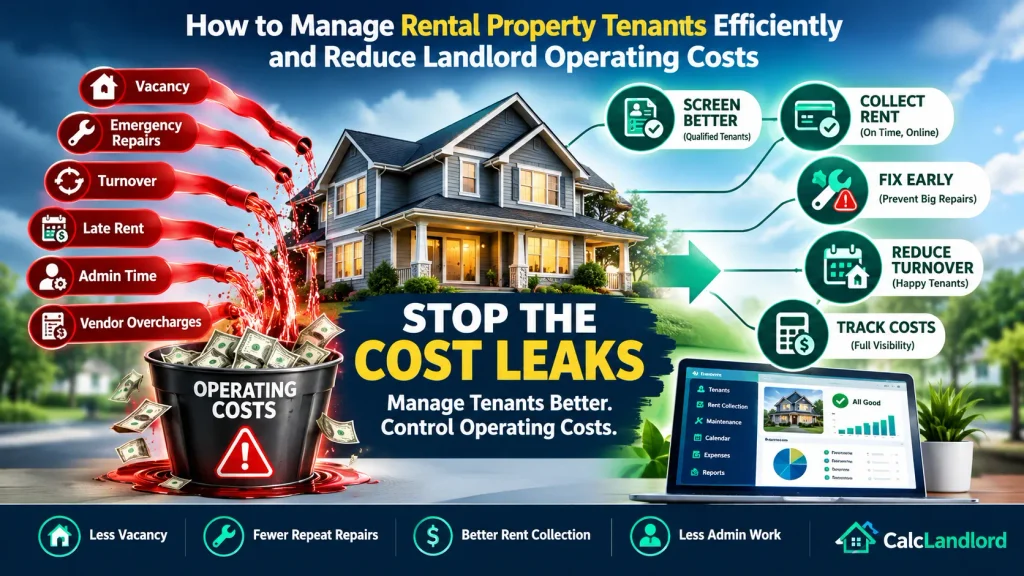
How to Manage Rental Property Tenants Efficiently and Reduce Landlord Operating Costs
Managing rental property tenants efficiently starts with better systems, not simply lower expenses. Clear screening, predictable rent collection, faster maintenance triage, preventive upkeep, and consistent communication can reduce avoidable vacancy, repairs, administrative work, and owner time. This guide shows you how to build that system from application to move-out. You’ll learn how to calculate true operating costs, reduce tenant turnover, control vendors and utilities, automate repetitive tasks, and decide when self-management may no longer make economic sense. You’ll also get practical formulas, examples, KPIs, and a 30-day plan to make tenant management more organized, measurable, and cost-conscious.
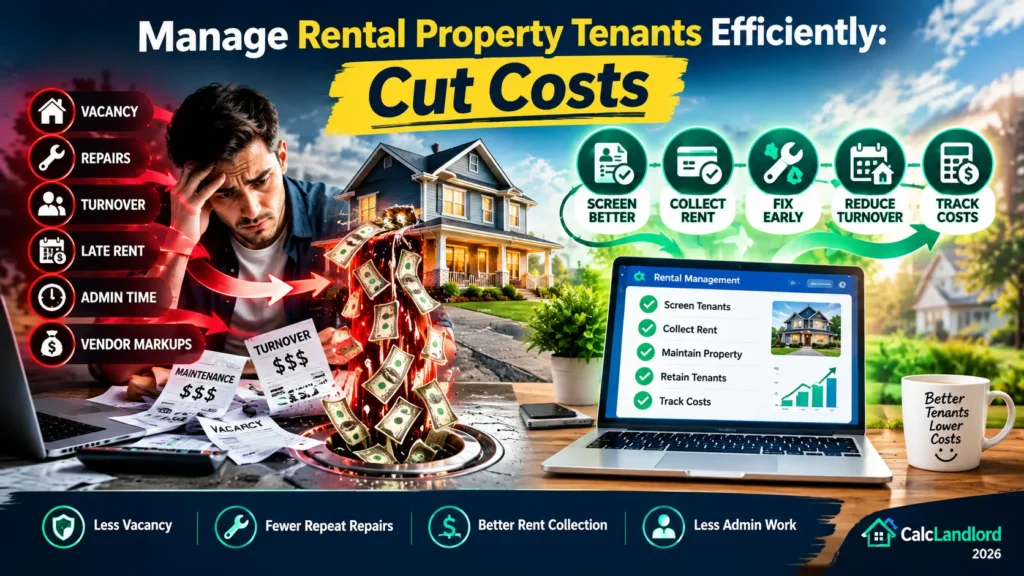
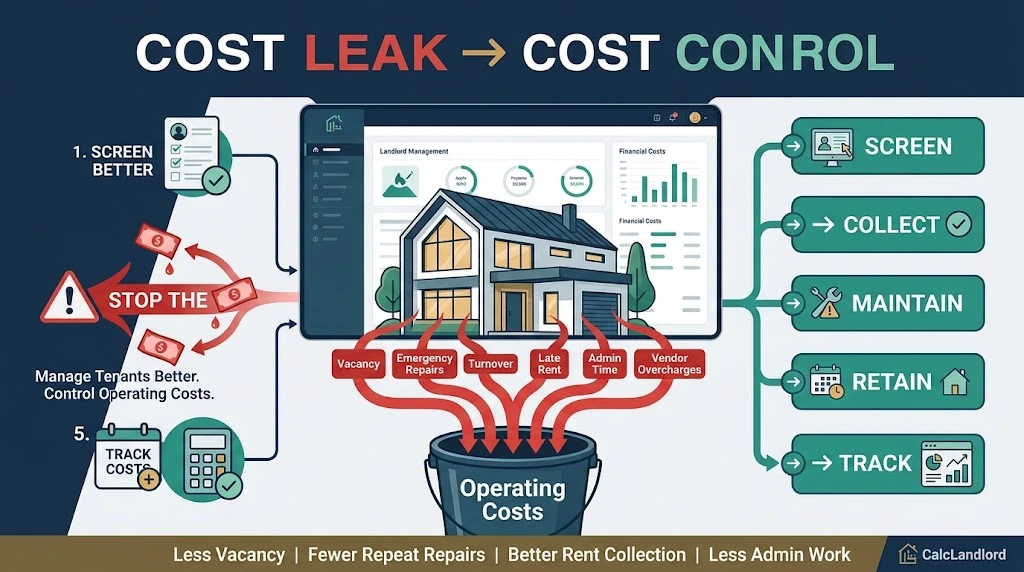
Managing rental property tenants efficiently is not about cutting every possible expense or avoiding contact with tenants. It is about building repeatable systems that reduce wasted time, prevent avoidable repairs, improve rent collection, reduce vacancy, and protect the property.
For landlords, the biggest operating-cost problems often come from small process failures: inconsistent screening, unclear tenant communication, delayed maintenance, poor vendor control, avoidable turnover, and expenses that are never reviewed against a budget.
A better approach is to treat tenant management like an operating system.
The goal is simple:
Deliver a reliable rental experience while reducing avoidable administrative work, property expenses, vacancy losses, and owner time.
This guide shows how to build that system from tenant screening through move-out, including practical formulas, examples, maintenance workflows, KPIs, and a 30-day implementation plan.
Quick Answer: How Can Landlords Manage Tenants Efficiently and Lower Operating Costs?
The most effective approach is to standardize the tenant lifecycle:
- Use consistent, lawful screening criteria.
- Start every tenancy with a clear lease and documented move-in condition.
- Make rent collection predictable and easy to track.
- Establish clear communication and maintenance procedures.
- Separate emergency, urgent, and routine repairs.
- Use preventive maintenance to catch problems early.
- Reduce vacancy by preparing for turnover before the old lease ends.
- Control utilities, vendors, insurance, and recurring expenses.
- Automate repetitive administrative tasks.
- Track operating costs, vacancy, collections, repairs, and turnover every month.
The key is not simply spending less. A very cheap repair, slow response, or poor-quality tenant placement can become more expensive later.
What Efficient Tenant Management Actually Means
Efficient tenant management means creating a predictable process for everything that happens between application and move-out.
That includes:
- Marketing the rental accurately
- Screening applicants consistently
- Preparing and signing the lease
- Collecting rent
- Handling maintenance requests
- Communicating with tenants
- Managing vendors
- Documenting important events
- Preparing for renewals
- Handling turnover
- Reviewing property-level financial performance
A landlord should be able to answer basic questions quickly:
- How much rent is due?
- Which tenants are behind?
- Which maintenance requests are open?
- Which repairs are recurring?
- When does each lease expire?
- How much did the property spend on maintenance last month?
- How much did the last turnover actually cost?
- Which vendors are costing the most?
- How much time is the property consuming?
When those answers require searching through text messages, emails, paper receipts, and multiple spreadsheets, management is usually becoming inefficient.
The objective is to create one repeatable workflow.
1. Calculate Your True Rental Property Operating Costs
One of the first mistakes landlords make is looking only at rent minus mortgage payment.
That can hide the actual cost of operating the property.
For a cleaner analysis, separate expenses into operating expenses, capital expenditures, financing costs, and owner-management costs.
Operating Expenses
Typical rental operating expenses can include:
| Expense | Examples |
| Maintenance | Routine repairs, service calls, minor replacements |
| Insurance | Landlord, hazard, liability coverage |
| Property taxes | Real estate taxes and local assessments |
| Utilities | Water, sewer, gas, electric, trash, internet when landlord-paid |
| Landscaping | Lawn care, snow removal, common-area maintenance |
| Pest control | Scheduled and responsive pest treatment |
| Advertising | Rental listings, photography, marketing |
| Management | Property manager or leasing fees |
| Payment processing | Online rent payment and banking fees |
| Professional services | Accounting, legal, bookkeeping |
| Vacancy | Lost rental income during unoccupied periods |
| Bad debt | Rent that is billed but not collected |
The IRS identifies common rental expenses such as advertising, cleaning and maintenance, insurance, management fees, mortgage interest, repairs, taxes, utilities, and professional fees. Tax treatment depends on the specific expense and the owner’s circumstances.
Capital Expenditures
Large improvements should be analyzed separately from routine repairs.
Examples include:
- Roof replacement
- Major HVAC replacement
- Significant plumbing replacement
- Structural work
- Large-scale flooring replacement
- Kitchen modernization
- Bathroom renovation
- Major electrical upgrades
For U.S. tax purposes, the IRS distinguishes repairs and maintenance from improvements that generally must be capitalized. Keep accurate records rather than automatically treating every large expenditure as a current repair deduction.
Financing Costs
Financing should also be separated from property operations.
Examples include:
- Mortgage principal
- Mortgage interest
- Loan fees
- Refinancing costs
A property can have acceptable operating performance while still having weak cash flow because of its financing structure.
Your Time Has a Cost
Owner time is often ignored.
Track the hours you spend on:
- Tenant messages
- Rent collection
- Property showings
- Maintenance coordination
- Inspections
- Vendor calls
- Bookkeeping
- Lease preparation
- Renewal negotiations
- Complaint resolution
A useful management calculation is:
Total Management Cost
= Direct Management Expenses + Value of Owner Time
This matters when comparing self-management with professional property management. The underlying research recommends including owner time when determining the true cost of self-management.
2. Build a Property-Level Operating Budget
Do not treat every property as one large pool of income and expenses.
Create a separate operating budget for each property.
A simple monthly structure could look like this:
| Budget Category | Practical Method |
| Routine maintenance | Review property age, condition, and historical repairs |
| Vacancy reserve | Estimate expected vacancy and local leasing conditions |
| Capital reserve | Set aside money for future major replacements |
| Utilities | Use historical bills and seasonal patterns |
| Insurance | Convert annual premium into a monthly budget |
| Property taxes | Convert annual tax obligation into a monthly amount |
| Management | Include management, software, bookkeeping, and administration |
| Emergency reserve | Maintain separate liquidity for unexpected events |
Then compare actual spending with the budget every month.
Expense variance formula
Expense Variance
= Actual Expense – Budgeted Expense
Suppose you budget $400 per month for maintenance but spend $850 for three consecutive months.
The correct question is not simply:
“Should I increase the maintenance budget?”
Ask instead:
“Why is maintenance spending consistently above budget?”
Possible causes include:
- Aging HVAC equipment
- Repeated plumbing failures
- Water leaks
- Poor-quality previous repairs
- Deferred maintenance
- Tenant-caused damage
- Incorrect vendor pricing
- A property component reaching the end of its useful life
Repeated variances are signals to investigate.
3. Create a Consistent Tenant Screening Process
Tenant screening is one of the highest-leverage parts of rental management because a poor placement can create additional work through payment problems, property damage, disputes, turnover, and collection activity.
The solution is not “screen as aggressively as possible.”
The solution is consistent, documented, lawful screening.
A written screening policy might address:
- Identity verification
- Income or ability to pay
- Employment or business information
- Rental history
- References
- Credit information
- Relevant court or eviction information where permitted
- Occupancy information
- Intended move-in date
- Other tenancy-related criteria applied consistently
Before reviewing applications, establish the criteria you intend to use.
That helps reduce inconsistent decision-making.
Fair Housing Requirements Matter
Federal fair housing law prohibits discrimination in housing because of race, color, national origin, religion, sex, familial status, and disability. State and local laws may provide additional protections.
Your screening criteria should therefore be related to legitimate tenancy requirements and applied consistently.
Avoid subjective rules such as:
- “I don’t like this type of tenant.”
- “That neighborhood feels better.”
- “I prefer people like my existing tenants.”
A documented process is easier to administer and easier to audit.
Using Tenant Screening Reports
Tenant screening and credit reports can fall under the Fair Credit Reporting Act.
The FTC explains that tenant background reports are consumer reports when used for housing decisions, and landlords have FCRA responsibilities when obtaining and using them.
If a landlord takes an adverse action based on information in a tenant screening report, federal law can require an adverse-action notice with information about the reporting company and the applicant’s rights.
A simple screening workflow is:
- Publish clear rental criteria.
- Use the same application process for applicants.
- Obtain required authorization for screening reports.
- Verify relevant information.
- Apply your written criteria consistently.
- Document the decision.
- Send the appropriate approval or adverse-action communication.
- Store records securely.
Do not rely blindly on an automated tenant score. Understand what information the report contains and whether your process complies with applicable federal, state, and local requirements.
4. Create a Clear Lease and Tenant Onboarding System
A good lease is more than a rent amount and expiration date.
It should clearly explain responsibilities and procedures while complying with applicable law.
Depending on the property and jurisdiction, address topics such as:
- Monthly rent
- Due date
- Accepted payment methods
- Late-payment procedures
- Security deposit
- Maintenance responsibilities
- Emergency procedures
- Entry and notice requirements
- Utility responsibilities
- Occupancy
- Pets
- Subletting
- Noise and conduct
- Renewal
- Termination
- Insurance requirements where lawful
- Move-in and move-out procedures
Do not assume that a lease can legally transfer every property responsibility to the tenant.
Landlord obligations can exist independently of lease wording.
Use a Move-In Checklist
Before possession:
- Photograph rooms and major fixtures.
- Record existing damage.
- Record utility meter readings where applicable.
- Test relevant safety systems.
- Confirm keys and access codes.
- Provide emergency contact information.
- Explain how maintenance requests should be submitted.
- Provide payment instructions.
- Obtain the signed condition report where applicable.
Good onboarding reduces repeated questions and creates a baseline record of property condition.
U.S. Lead-Based Paint Requirement
For most pre-1978 housing, federal law requires landlords to disclose known lead-based paint and lead hazards and provide required information before the lease is signed. EPA also specifies disclosure and recordkeeping requirements under the federal Lead-Based Paint Disclosure Rule.
This is one example of why your lease package should be based on the property’s age, location, and applicable legal requirements.
5. Make Rent Collection Predictable
Rent collection should not depend on remembering to text every tenant on the first of the month.
Build a standard process.
Useful practices include:
- Offer convenient electronic payment methods.
- Send automated reminders.
- Provide payment confirmation.
- Maintain a rent ledger.
- Monitor unpaid balances.
- Contact tenants promptly when rent is missed.
- Apply late fees only when permitted.
- Follow a consistent written arrears procedure.
- Keep rental funds and personal spending organized.
The goal is early identification.
A rent problem caught immediately is generally easier to address than a balance that grows unnoticed for several weeks.
Sample Late-Rent Message
Hello [Tenant Name], our records show that the rent due on [date] has not yet been received. The outstanding amount is [amount]. Please make the payment through [payment method] by [deadline]. If there is an issue affecting payment, please contact us so we can discuss the next steps permitted under the lease and applicable law.
Keep payment communications factual and professional.
6. Use a Simple Tenant Communication Framework
Poor communication creates operating costs.
A tenant who does not know where to send a maintenance request may send the same message through text, email, voicemail, and a social platform.
That creates duplicate work.
At move-in, tell tenants:
- Which communication channel to use
- How to report maintenance
- What qualifies as an emergency
- How quickly they should expect acknowledgment
- How to submit photographs or videos
- How property access will be coordinated
- Who to contact after hours
Suggested Management Response Targets
These are internal service targets, not universal legal requirements.
| Request | Management Target |
| Fire, major flooding, gas concern, serious security issue | Emergency instructions and urgent professional response |
| Major water leak or loss of essential service | Same-day or next-available response |
| Broken appliance or non-urgent leak | Prompt acknowledgment and scheduled service |
| Cosmetic issue | Add to maintenance queue and provide expected timing |
| General question | Reply within one business day |
Always follow applicable habitability, repair, entry, and emergency requirements in the property’s jurisdiction. Treat response times as management targets rather than universal legal rules.
7. Triage and Track Maintenance Requests
A maintenance inbox should not operate on a first-message-first-served basis.
Classify the issue.
Emergency Maintenance
Examples may include:
- Fire
- Suspected gas leak
- Major flooding
- Serious electrical danger
- Severe structural damage
- Immediate security or habitability threats
Give the tenant appropriate emergency instructions and contact the qualified professional or emergency service required.
Urgent Maintenance
Examples include:
- Significant water leak
- Broken exterior lock
- Serious plumbing blockage
- Complete loss of an essential service
- Heating or cooling failure requiring urgent attention under the circumstances
Routine Maintenance
Examples may include:
- Dripping faucet
- Loose handle
- Minor appliance problem
- Cosmetic damage
- Cabinet hardware
- Minor paint issues
Every Maintenance Request Should Become a Ticket
Track:
| Field | Example |
| Ticket number | #2026-014 |
| Property | 123 Main St |
| Tenant | Tenant name |
| Category | Plumbing |
| Priority | Urgent |
| Reported | Sept. 17 |
| Vendor | ABC Plumbing |
| Estimated cost | $275 |
| Approval | Owner approved |
| Completed | Sept. 18 |
| Final cost | $310 |
| Invoice | Attached |
| Photos | Before/after |
This makes recurring problems visible.
Suppose the same toilet has required four repairs in 12 months. Looking at each repair independently may make every invoice appear reasonable. Looking at the full year may show that replacement is the more rational decision.
8. Use Preventive Maintenance to Reduce Emergency Costs
Preventive maintenance gives landlords more control over timing, vendors, and budgeting.
It also reduces the chance that a small problem develops into a larger one.
Monthly or Quarterly
Check:
- Visible plumbing leaks
- Utility consumption
- Exterior areas
- Common areas
- Locks and lighting
- Safety equipment
- Open maintenance tickets
- Signs of moisture or pests
Seasonally
Review:
- HVAC servicing
- Gutters and drainage
- Window and door seals
- Plumbing fixtures
- Water heaters
- Landscaping and irrigation
- Weather-related risks
Annually
Review:
- Insurance coverage
- Vendor contracts
- Roof and exterior condition
- Aging appliances
- Major replacement needs
- Capital improvement plans
- Income and operating expenses
Use qualified professionals for electrical, gas, structural, roofing, and other work that requires specialized expertise.
Cutting a $200 repair bill is not a saving if it creates a $2,000 problem later.
9. Reduce Tenant Turnover and Vacancy Costs
Tenant turnover can create several expenses simultaneously.
These may include:
- Lost rent
- Cleaning
- Painting
- Repairs
- Marketing
- Showings
- Screening
- Leasing commissions
- Utility bills
- Administrative time
- Concessions
A useful turnover formula is:
Turnover Cost
= Lost Rent
+ Repairs
+ Cleaning
+ Marketing
+ Leasing Costs
+ Utilities
+ Owner Time
Example
Suppose a property rents for $2,400 per month.
The tenant moves out and the property remains vacant for 20 days.
Estimated lost rent:
$2,400 × (20 ÷ 30) = $1,600
Now add:
| Turnover Expense | Example |
| Lost rent | $1,600 |
| Cleaning | $250 |
| Repairs | $600 |
| Marketing | $100 |
| Leasing cost | $500 |
| Utilities during vacancy | $100 |
| Total example turnover cost | $3,150 |
This is an illustration, not a typical national cost.
The important point is that turnover is rarely just “one vacant month.”
How to Reduce Turnover
Start retention work before the lease expires.
Useful strategies include:
- Keep rent reasonably aligned with comparable properties.
- Respond to important maintenance requests promptly.
- Fix recurring problems permanently.
- Communicate renewal timelines early.
- Explain rent changes clearly.
- Keep the property safe and functional.
- Ask tenants what improvements matter to them.
- Maintain a professional move-out process.
A small improvement can sometimes provide more value than a permanent rent discount.
10. Start the Next Leasing Cycle Before the Tenant Leaves
When a tenant gives notice, do not wait until the property is completely vacant before planning.
Subject to local law and tenant privacy requirements:
- Review current market rent.
- Determine what repairs are needed.
- Schedule lawful inspections.
- Prepare marketing materials.
- Take accurate photographs.
- Publish an honest listing.
- Respond to inquiries quickly.
- Pre-screen applicants consistently.
- Prepare the lease package.
- Complete the move-in condition process.
The objective is to reduce the gap between tenants without rushing decisions.
Accurate marketing also reduces wasted showings because applicants understand the property’s actual features before they visit.
11. Control Utilities and Recurring Property Expenses
Utilities can quietly reduce rental cash flow, especially when the landlord pays water, sewer, gas, electricity, trash, or common-area services.
Start with a utility audit.
Ask:
- Which utilities does the landlord pay?
- Which utilities does the tenant pay?
- Are meters separate?
- Are bills based on actual readings?
- Are there unusual seasonal increases?
- Could leaks be causing higher usage?
- Are old systems consuming excessive energy?
- Are common-area costs being allocated properly?
Practical Cost-Control Measures
Consider:
- LED lighting
- Repairing leaking faucets and toilets
- Efficient water fixtures
- Door and window sealing
- HVAC maintenance
- Water-efficient landscaping
- Better irrigation controls
- Clear tenant instructions for reporting leaks
Where landlords pay utilities, the lease and billing arrangement should clearly explain responsibility.
Do not shift charges to tenants in a way that conflicts with state or local law.
12. Manage Vendors Like a Business
Vendor management becomes increasingly important as your property count grows.
Avoid choosing contractors based solely on the lowest quote.
A better vendor system includes:
- Qualified vendor lists
- Licensing verification where applicable
- Insurance verification
- References
- Written scopes of work
- Multiple quotes for appropriate non-emergency jobs
- Clear completion expectations
- Itemized invoices
- Before-and-after documentation
- Quality tracking
For recurring work, negotiate service pricing where practical.
For example, instead of repeatedly calling different contractors for landscaping, you may be able to negotiate a clearly defined recurring agreement.
But do not assume the cheapest vendor is the cheapest long-term option.
A contractor who charges $100 less but repeatedly performs incomplete repairs may have a higher total cost.
13. Automate Repetitive Tenant Management Tasks
Technology should reduce work rather than create another administrative burden.
Useful automation can include:
- Online rental applications
- Screening workflows
- Digital lease signatures
- Rent reminders
- Payment receipts
- Maintenance requests
- Tenant messaging
- Expense tracking
- Inspection reminders
- Renewal reminders
- Document storage
- Owner reporting
Use technology when it reduces repetitive work and improves record accuracy rather than adding subscriptions simply for the sake of automation.
Calculate Software ROI
A simple way to evaluate software is:
Software ROI
=
(Time Saved + Avoided Errors + Recovered Income – Software Cost)
÷ Software Cost
Example
Suppose software costs $60 per month.
You estimate that it:
- Saves $120 of owner time
- Prevents $40 in administrative errors
- Recovers $50 of otherwise missed or delayed income
Then:
($120 + $40 + $50 – $60) ÷ $60
= 2.5
The example produces a 250% return relative to the subscription cost under those assumptions.
For a single property with little activity, however, a disciplined spreadsheet and cloud filing system may be enough.
14. Decide What to Self-Manage and What to Outsource
Self-management is not automatically cheaper.
Consider:
- Number of units
- Distance from the property
- Your available time
- Emergency response ability
- Vendor relationships
- Tenant communication volume
- Accounting complexity
- Compliance requirements
Self-Management May Make Sense When
- You own a small number of nearby properties.
- You have reliable vendors.
- You can respond consistently.
- You understand the applicable landlord-tenant requirements.
- Your records are organized.
- Tenant communication does not interfere with your primary responsibilities.
Professional Management May Make Sense When
- The property is far away.
- You own many units.
- Your workload is becoming disruptive.
- Maintenance requests consume substantial time.
- Leasing and renewals are becoming difficult to manage.
- Administrative mistakes are increasing.
- Vacancy or collection performance is deteriorating.
Compare total economic cost rather than just the management percentage.
Net Cost of Self-Management
=
Direct Expenses
+ Owner Time
+ Errors
+ Vacancy Impact
A professional manager charges a fee, but may also reduce administrative workload or improve processes.
Likewise, an organized local landlord may achieve better economics through self-management.
The right answer depends on the property’s actual operating results.
15. Track Rental Property Management KPIs
You cannot systematically reduce costs if you do not measure them.
A simple monthly dashboard can include:
| KPI | Formula | What It Shows |
| Occupancy Rate | Occupied days ÷ available days × 100 | Income-producing use |
| Vacancy Rate | Vacant days ÷ available days × 100 | Cost of empty units |
| Collection Rate | Rent collected ÷ rent billed × 100 | Collection performance |
| Operating Expense Ratio | Operating expenses ÷ gross operating income × 100 | Operating efficiency |
| Maintenance Cost per Unit | Maintenance expense ÷ units | Repair cost trend |
| Response Time | Total response hours ÷ requests | Communication efficiency |
| Completion Time | Total completion days ÷ completed requests | Repair resolution |
| Renewal Rate | Renewed leases ÷ expiring leases × 100 | Tenant retention |
| Turnover Cost | Total turnover expense ÷ move-outs | Financial impact of turnover |
| NOI | Rental income − operating expenses | Operating performance before financing |
Do Not Optimize the Wrong KPI
A lower maintenance expense is not automatically better.
For example:
- Delaying a roof repair can lower this month’s expenses.
- Ignoring a tenant’s maintenance report can reduce immediate contractor calls.
- Using cheap materials can reduce an invoice.
- Avoiding property inspections can reduce management time.
But those actions can create larger future costs.
Your dashboard should identify waste and preventable losses without encouraging you to sacrifice safety, habitability, service quality, or legal compliance.
A Practical Monthly Landlord Dashboard
For each rental property, review these numbers once per month:
Gross Rent Billed
– Rent Collected
= Outstanding Rent
Gross Rental Income
– Operating Expenses
= Net Operating Income
Vacant Days
Maintenance Cost
Turnover Cost
Renewals
Open Maintenance Tickets
Average Response Time
Owner Management Hours
Then compare the current month with the previous month and the same period from the previous year when enough data exists.
Look for trends rather than isolated numbers.
A $900 repair is not necessarily a problem.
Three $900 repairs for the same system may be.
The 30-Day Rental Property Management Improvement Plan
You do not need to rebuild the entire management operation in one weekend.
Use a staged approach.
Days 1–7: Audit Your Current Operation
Document:
- All recurring property expenses
- Maintenance costs
- Vacancy
- Rent arrears
- Owner management hours
- Current vendors
- Lease expiration dates
- The three largest avoidable expenses
Separate operating expenses, capital improvements, and financing costs.
Days 8–14: Standardize Tenant Processes
Create:
- Written screening criteria
- Move-in checklist
- Rent-payment instructions
- Maintenance procedures
- Emergency instructions
- Standard rent-reminder message
- Standard maintenance acknowledgment
- Renewal reminder
- Organized tenant files
Days 15–21: Improve Maintenance and Vendor Control
Review the previous 12 months of repair invoices.
Identify:
- Repeat repairs
- Expensive vendors
- Emergency calls
- Deferred maintenance
- Aging equipment
- Contracts worth renegotiating
Then create a preventive-maintenance calendar.
Days 22–30: Automate and Measure
Set up:
- Rent reminders
- Digital payment records
- Maintenance requests
- Renewal reminders
- Expense tracking
- Monthly KPI reporting
At the end of the month, identify one process to improve next month.
Operational improvements become powerful when they become routine.
Example: Two Different Ways to Manage the Same Rental
Consider a single-family rental producing $2,500 per month in rent.
Landlord A
- Responds to issues manually through text
- Has no preventive-maintenance calendar
- Does not track owner hours
- Uses different screening practices
- Reviews expenses only during tax preparation
- Calls the first available contractor
- Starts marketing after the property becomes vacant
Landlord B
- Uses written screening criteria
- Has one maintenance channel
- Tracks every repair
- Reviews expenses monthly
- Maintains a vendor list
- Plans major replacements
- Tracks lease expiration dates
- Starts turnover planning early
Neither landlord necessarily spends less on every individual repair.
But Landlord B has more information.
That matters.
When you know where the money, time, and problems are going, you can improve the operation deliberately instead of reacting to whatever goes wrong next.
Common Landlord Management Mistakes That Increase Costs
1. Choosing Tenants Without Written Criteria
Inconsistent decisions create operational and legal risk.
2. Treating All Maintenance as an Emergency
This wastes contractor time and makes scheduling more expensive.
3. Treating Every Repair as a One-Time Event
Recurring failures often indicate a larger replacement problem.
4. Ignoring Owner Time
A rental that generates $500 of monthly cash flow but consumes 20 hours of management may not be performing as well as it appears.
5. Waiting Until Move-Out to Think About the Next Tenant
This can increase vacancy.
6. Failing to Review Vendor Pricing
Long-term vendor relationships are useful, but pricing and quality should still be reviewed.
7. Mixing Repairs and Capital Improvements
For accounting and tax purposes, those categories can receive different treatment. The IRS specifically advises landlords to separate repairs from improvements and maintain accurate records.
8. Using Cheap Materials in High-Wear Areas
The lowest purchase price does not always produce the lowest lifecycle cost.
9. Delaying Communication
Small unanswered questions often become larger complaints.
10. Cutting Costs That Protect the Property
Safety equipment, qualified repairs, insurance, legal compliance, and habitability should not be treated as optional cost centers.
How to Know Whether Your Operating Costs Are Actually Improving
Do not judge improvement by one month.
Track at least:
- Operating expense ratio
- Maintenance cost
- Vacancy days
- Turnover cost
- Collection rate
- Renewal rate
- Owner management hours
- Average maintenance response time
- Recurring repair frequency
- Net operating income
For example, suppose annual maintenance falls from $12,000 to $9,500.
That looks positive.
But if vacancy increases by $4,000 because maintenance was delayed and a tenant left, the overall result may be worse.
This is why expense reduction should always be evaluated alongside income and service performance.
How Tenant Management Affects Rental Property Cash Flow
Tenant management is closely connected to cash flow.
A simplified operating calculation is:
Gross Rental Income
– Vacancy Loss
– Operating Expenses
= Net Operating Income
Then financing can be considered separately:
Net Operating Income
– Debt Service
= Cash Flow Before Taxes
This helps explain why two properties with identical rents can produce very different investment results.
One might have:
- Lower vacancy
- Fewer repairs
- Better utility control
- Lower management costs
- Stronger tenant retention
The other might have the same rent but significantly higher operating leakage.
For deeper analysis, landlords can combine operating-cost tracking with rental cash flow, ROI, cap rate, and cash-on-cash calculations.
What Landlords Should Measure Before Hiring a Property Manager
Do not compare management fees in isolation.
Build a simple annual comparison.
Self-Management
Owner Time
+ Software
+ Leasing Costs
+ Maintenance Coordination
+ Bookkeeping
+ Travel
+ Administrative Errors
+ Vacancy Impact
= Estimated Self-Management Cost
Professional Management
Management Fees
+ Leasing Fees
+ Additional Service Charges
+ Owner Responsibilities
= Estimated Outsourcing Cost
Then compare the expected service and operating results.
This approach is more useful than asking, “What percentage does the property manager charge?”
Important U.S. Legal and Compliance Considerations
Landlord-tenant law is not uniform across the United States.
State and local rules can affect:
- Security deposits
- Notice periods
- Entry
- Repairs
- Habitability
- Late fees
- Rent increases
- Screening
- Eviction procedures
- Utility billing
- Required disclosures
- Recordkeeping
Federal requirements can also apply.
For example:
- The Fair Housing Act prohibits housing discrimination based on specified protected characteristics.
- Tenant screening reports can trigger FCRA responsibilities.
- Adverse actions based on consumer reports can require specific notices.
- Federal lead-based paint disclosure requirements apply to most pre-1978 housing subject to the rule.
This article provides general educational information, not legal or tax advice. Before changing a lease, screening policy, fee structure, eviction process, utility allocation, or disclosure procedure, verify the current requirements in the property’s state and local jurisdiction.
More Explore : https://calclandlord.com/rental-property-depreciation/
People Also Ask
Start by removing waste rather than cutting essential services.
Focus on reducing unnecessary vacancy, improving preventive maintenance, controlling vendor pricing, fixing recurring problems, automating administration, and managing utilities efficiently.
Do not delay important repairs or use low-quality materials simply to reduce the current month’s expense.
Reliable maintenance and clear communication are strong foundations.
Competitive rent, fair treatment, a clean and safe property, early renewal discussions, and targeted improvements can also improve retention.
Before offering a rent discount, compare the cost of the incentive with the expected cost of vacancy and turnover.
There is no single nationwide inspection schedule that applies to every rental.
The appropriate frequency depends on property type, lease terms, state and local law, and the circumstances of the tenancy.
Inspections should be conducted lawfully, with required notice and respect for tenant privacy.
Software can be worthwhile when it reduces meaningful administrative work.
Look at whether it improves:
Rent collection
Maintenance tracking
Document management
Accounting
Renewal reminders
Communication
Compare the subscription cost with the time saved and errors avoided.
Use preventive maintenance, respond promptly to reported problems, maintain good vendor relationships, document repairs, and analyze repeated failures.
A maintenance history is especially valuable because it shows whether you are paying repeatedly for the same underlying problem.
Tenant Management Checklist
Use this as a simple recurring checklist.
Before Leasing
- Define written screening criteria
- Verify applicable fair housing requirements
- Prepare rental advertising
- Prepare application process
- Establish screening workflow
- Prepare lease documents
- Complete required disclosures
Move-In
- Photograph property condition
- Record existing damage
- Record utility information
- Deliver keys/access information
- Provide maintenance instructions
- Confirm rent-payment method
- Complete condition report
During Tenancy
- Monitor rent collection
- Track maintenance requests
- Respond according to urgency
- Keep vendor records
- Perform lawful inspections
- Complete preventive maintenance
- Track property expenses
- Maintain organized documentation
Before Renewal
- Review tenant payment history
- Review maintenance history
- Compare market rent
- Estimate turnover cost
- Contact tenant early
- Plan needed improvements
- Prepare renewal documents
Move-Out
- Follow required notice procedures
- Document property condition
- Record final utility information
- Identify repairs
- Complete cleaning
- Market the property
- Review turnover cost
- Prepare the next tenant’s move-in
Final Takeaway
Efficient tenant management is not about doing fewer things.
It is about doing the important things consistently.
A strong rental operation has a repeatable tenant process, predictable rent collection, documented communication, maintenance triage, preventive maintenance, controlled vendor relationships, organized records, and monthly financial review.
The biggest cost-saving opportunities often come from preventing avoidable losses:
- fewer vacancy days,
- fewer recurring repairs,
- fewer collection problems,
- fewer administrative errors,
- better vendor control,
- and less owner time spent fixing the same problems repeatedly.
Start by measuring what the property is actually costing you.
Then improve the process that creates the largest avoidable expense.
That is how tenant management becomes an investment system rather than a constant stream of emergencies.
