

Credit Approval Process: Steps, Requirements & What Landlords Should Know
If you plan to buy a rental property, refinance an existing property, or expand your real estate portfolio, understanding the Credit Approval Process can help you prepare financially and avoid preventable delays.
The credit approval process is the lender’s evaluation of your application, credit history, income, debts, assets, property, and ability to repay the proposed financing. For rental-property investors, the analysis can also involve rental income, property expenses, reserves, occupancy type, and the investment property’s characteristics.
While some applications can move through automated underwriting quickly, investment-property financing may require detailed documentation and additional analysis. Current Fannie Mae guidance, for example, requires lenders to assess factors such as credit history, liquid reserves, recurring income, equity investment, and the combined effect of risk factors.
This guide explains how credit approval works, what lenders review, how rental properties change the analysis, what can cause delays or denials, and how landlords can prepare.
What Is the Credit Approval Process?
The credit approval process is the series of steps a lender follows to determine whether an applicant qualifies for financing and, if so, under what terms.
For a landlord or real estate investor, the process may look like this:
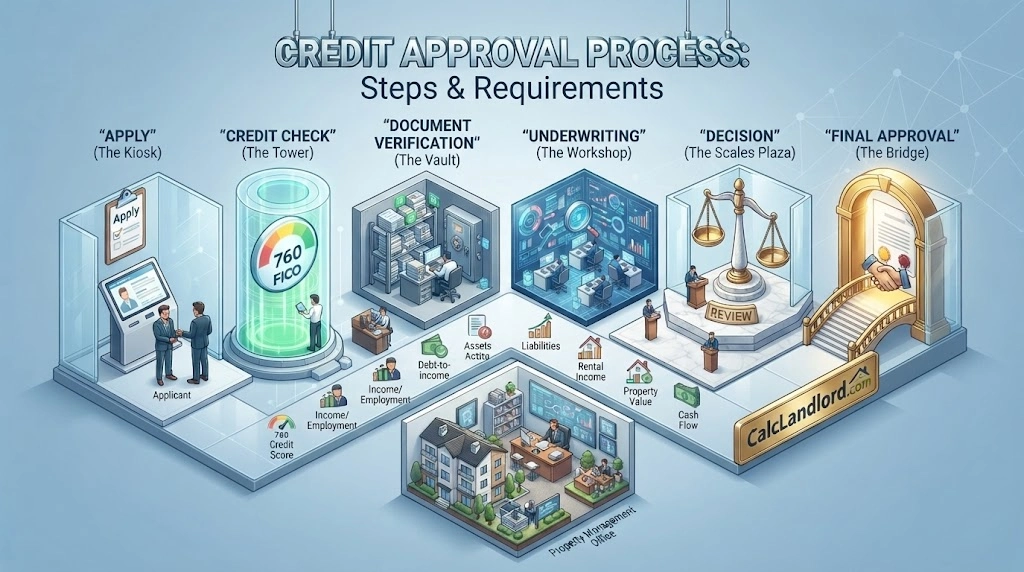
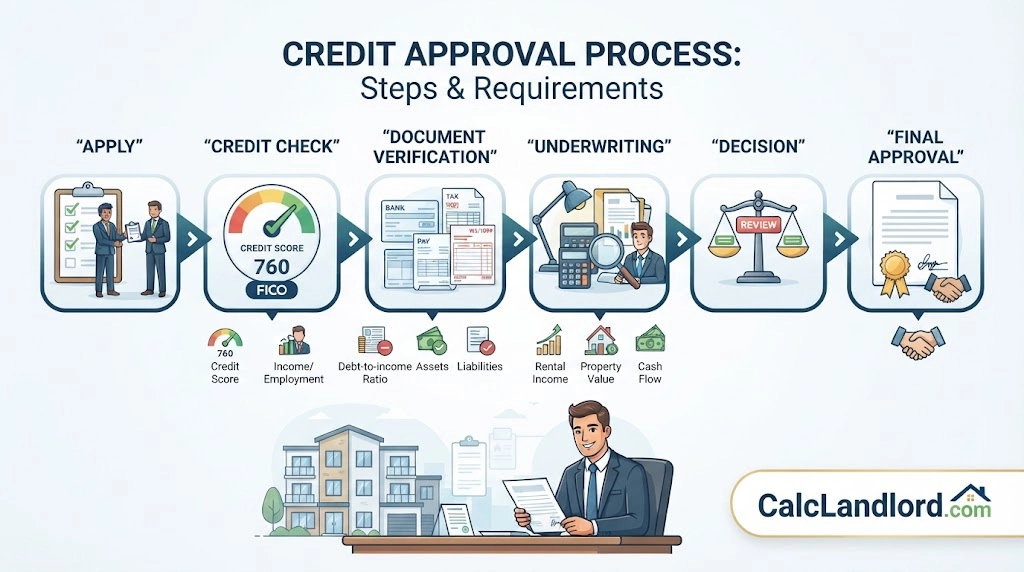
Application → Credit Check → Income & Asset Verification → Property Analysis → Underwriting → Decision → Conditions → Final Approval → Closing/Funding
The exact process varies according to the lender, loan program, property type, borrower profile, and financing purpose.
A credit decision generally isn’t based on one number. Credit scores are useful indicators of credit behavior, but lenders can also consider income, debt, assets, reserves, property information, and other risk factors. The CFPB notes that consumers do not have just one universal credit score; scores can differ depending on the scoring model, data source, product, and timing.
For landlords, this distinction matters because a strong credit score does not automatically make a rental-property loan financially or underwriting-eligible.
How Does the Credit Approval Process Work?
Although every lender has its own procedures, a typical rental-property financing process follows several connected stages.
| Stage | What happens | What landlords should prepare |
| Initial qualification | Basic eligibility is reviewed | Income, debts, estimated property price |
| Application | Formal credit application is submitted | Personal and financial information |
| Credit review | Credit reports and scores are examined | Review credit reports beforehand |
| Verification | Income, assets and liabilities are documented | Statements, tax records, pay stubs |
| Property analysis | Property value, rent and expenses may be evaluated | Lease/rent information and property details |
| Underwriting | Overall repayment risk is assessed | Complete and consistent documentation |
| Decision | Application is approved, conditioned, countered or declined | Review proposed terms |
| Final approval | Outstanding conditions are satisfied | Requested documents |
| Closing/funding | Loan is finalized and proceeds are provided | Closing documents and required funds |
For mortgage lending, current Fannie Mae guidance describes a comprehensive risk assessment that includes the borrower’s credit history, liquid reserves, reliable recurring income, equity investment, and the cumulative effect of relevant risk factors.
The important point is that credit approval is a process, not simply a credit-score test.
What Are the Main Steps in the Credit Approval Process?
1. Prequalification or Initial Review
The first stage may involve a preliminary discussion with a lender.
You may provide approximate information about:
- Income
- Credit profile
- Existing debt
- Available cash
- Desired purchase price
- Expected rental property
- Down payment
A preliminary assessment can help you understand the approximate financing you may qualify for.
However, don’t confuse an initial indication with final loan approval.
2. Formal Credit Application
The next step is submitting the formal application.
For an investment property, information may include:
- Personal identification
- Employment
- Income
- Assets
- Liabilities
- Existing mortgages
- Property ownership
- Requested loan amount
- Property information
- Expected rental income
3. Credit Report and Score Review
The lender may obtain your credit report and applicable credit score.
The CFPB explains that lenders commonly use hard inquiries when evaluating applications for new credit, while soft inquiries generally do not affect credit scores.
4. Financial Verification
The lender verifies information used to qualify you.
Depending on the loan, this can include:
- Pay stubs
- W-2s
- Tax returns
- Bank statements
- Investment account statements
- Mortgage statements
- Business financial records
- Rental-property records
5. Property and Rental-Income Review
For an investment property, the lender may analyze the property itself.
This can include:
- Property Value
- Property type
- Expected rent
- Existing lease
- Operating expenses
- Property taxes
- Insurance
- Mortgage payment
- Market rent
- Occupancy
Current Fannie Mae guidance includes specific documentation and calculation requirements for qualifying rental income from one- to four-unit investment properties.
6. Underwriting
The underwriter evaluates the overall risk of the proposed loan.
This is where the different pieces of information are brought together.
7. Credit Decision
The lender can reach different outcomes, such as:
- Approval
- Conditional approval
- Counteroffer
- Referral for additional review
- Denial
8. Conditions and Final Approval
If conditions remain, the borrower must satisfy them before closing.
9. Closing and Funding
Once final requirements are satisfied, the loan can proceed to closing and funding according to the applicable loan program and lender process.
What Do Lenders Check During Credit Approval?
Lenders can evaluate many factors when deciding whether to extend credit.
For landlords, the most important categories often include credit, income, debt, assets, reserves, property characteristics, and repayment capacity.
Credit History
Your credit history provides information about how you have managed previous obligations.
A lender may review:
- Payment history
- Outstanding debt
- Credit utilization
- Age and types of accounts
- Recent applications
- Collections
- Public-record information where applicable
Income
The lender needs to establish whether your income supports the proposed obligations.
Income may come from:
- Employment
- Self-employment
- Business activity
- Existing rental properties
- Other eligible sources
Existing Debt
Existing obligations affect how much additional debt you can reasonably carry.
Mortgage payments, installment debt, revolving debt and other recurring obligations can therefore matter during underwriting.
Assets and Reserves
Cash and liquid assets can demonstrate financial capacity and may be important for down payment, closing costs and required reserves.
Property
For investment-property financing, the property itself becomes part of the underwriting analysis.
The lender may consider:
- Property type
- Occupancy
- Value
- Loan-to-value ratio
- Marketability
- Rental income
- Property condition
- Appraisal information
Fannie Mae’s current investment-property guidance distinguishes investment properties from principal residences and applies specific underwriting requirements to investment-property mortgages.
What Credit Approval Requirements Should Borrowers Prepare For?
There is no universal checklist for every loan.
Requirements depend on the lender and financing program, but landlords should generally be prepared to provide several categories of information.
Personal Financial Documents
Potential documents include:
- Government-issued identification
- Recent pay statements
- W-2s
- Federal tax returns
- Bank statements
- Investment account statements
Property Documents
Depending on the transaction:
- Purchase contract
- Appraisal
- Property insurance
- Lease agreements
- Rental documentation
- Property-tax information
- Existing mortgage information
Rental-Property Documents
If rental income is being used for qualification, additional documentation may be required.
Current Fannie Mae guidance, for example, sets specific requirements for documenting qualifying rental income and may require items such as lease agreements, rental schedules, appraisal information, or tax-return documentation depending on the circumstances.
Business Documents
If you operate rentals through a business entity, the lender may request additional business information.
That could include:
- Business tax returns
- Profit-and-loss statements
- Bank statements
- Formation documents
- Ownership information
- Business debt information
The exact requirements should always be confirmed with the lender.
How Do Credit Score, Income, Debt, and Cash Flow Affect Approval?
These factors work together rather than independently.
Credit Score
A credit score is a statistical prediction based on information in a credit report. The CFPB says credit scores are used for decisions involving mortgages and other credit products and can also influence interest rates and credit limits.
A higher score can make qualification easier in many circumstances, but there is no single credit score that guarantees approval.
Income
A lender needs evidence that the borrower has sufficient qualifying income to support the debt.
Debt
Existing monthly obligations reduce the amount of cash available for new debt payments.
Cash Flow
Rental-property investors should also examine whether the property itself produces enough income to support its operating costs and financing.
A simple rental-property cash-flow calculation is:
Cash Flow = Rental Income − Operating Expenses − Debt Service
For example:
- Monthly rent: $2,500
- Operating expenses: $700
- Mortgage payment: $1,400
Monthly cash flow = $2,500 − $700 − $1,400 = $400
This is a simplified investor calculation. Actual lender underwriting can use different income adjustments and documentation rules.
For example, Fannie Mae’s current guidance for certain subject investment properties uses 75% of gross monthly rent in its rental-income calculation before subtracting the property’s PITIA in specified circumstances.
That means your personal cash-flow calculation and the lender’s qualifying-income calculation may not be identical.
What Is Underwriting and How Does It Affect Credit Approval?
Underwriting is the detailed risk-assessment stage of the credit approval process.
The underwriter examines the information collected during the application and determines whether the proposed credit meets applicable eligibility and risk requirements.
For mortgage financing, Fannie Mae describes comprehensive risk assessment as considering factors including:
- Credit history
- Equity investment
- Liquid reserves
- Reliable and recurring income
- Other relevant risk factors
- Accuracy and completeness of borrower information
For a landlord, underwriting can therefore answer questions such as:
Can the borrower repay the loan?
Does the property support the proposed financing?
Is the requested loan amount appropriate?
Does the borrower have sufficient funds and reserves?
Is the rental income being documented and calculated according to the applicable program?
This is why preparing complete documentation before applying can be valuable.
Automated vs. Manual Credit Approval: What’s the Difference?
Credit decisions can involve automated systems, manual review, or both.
Automated Underwriting
Automated underwriting uses software, predefined eligibility criteria and financial data to assess a loan application.
Potential benefits include:
- Faster processing
- Consistent application of rules
- Efficient document review
- Rapid preliminary decisions
Fannie Mae’s Desktop Underwriter (DU), for example, is an automated underwriting system used within applicable mortgage-lending workflows. Current Fannie Mae guidance describes DU underwriting and associated requirements for eligible loans.
Manual Underwriting
Manual underwriting involves additional human analysis.
It can become relevant when an application requires more detailed review or does not fit a straightforward automated path.
For investors, this can occur when financial circumstances are more complicated, documentation requires interpretation, or the loan program calls for additional review.
Why This Matters
An automated result should not be interpreted as a universal guarantee of closing.
Additional verification and conditions can still apply.
How Long Does the Credit Approval Process Take?
There is no universal credit approval timeline.
A straightforward application can move relatively quickly, while a complex investment-property loan can take considerably longer.
Factors that can affect timing include:
- Loan type
- Lender workload
- Application completeness
- Credit complexity
- Income verification
- Property appraisal
- Rental-income documentation
- Business documentation
- Additional underwriting questions
- Title or insurance requirements
- Closing conditions
A useful way to think about the timeline is:
Simple application + complete documents = potentially faster process
Complex property + incomplete documents + additional review = potentially longer process
For landlords, one of the most practical ways to reduce avoidable delays is to organize financial and property documentation before the lender requests it.
What Are the Possible Credit Approval Outcomes?
Not every application ends with a simple “approved” or “denied.”
Approved
The lender has determined that the application meets applicable requirements, subject to any remaining closing requirements.
Conditionally Approved
The lender is willing to proceed if specified conditions are satisfied.
For example, the lender may request additional documentation or clarification.
Counteroffer
The lender may offer different terms from those originally requested.
A counteroffer could involve a different:
- Loan amount
- Interest rate
- Product
- Credit limit
- Repayment structure
Referred for Review
The application requires additional evaluation before a final decision.
Denied
The lender decides not to extend the requested credit.
For U.S. consumers, applicable adverse-action rules can require creditors to provide reasons for negative credit decisions or information about how to obtain those reasons.
The CFPB also provides model adverse-action and credit-application forms covering consumer and business credit situations.
Why Is a Credit Application Denied or Delayed?
A credit application can be delayed or denied for many reasons.
Common issues include:
- Insufficient qualifying income
- High existing debt
- Credit-history problems
- Insufficient reserves
- Incomplete documentation
- Inconsistent information
- Property valuation issues
- Rental-income documentation problems
- Loan-to-value concerns
- Failure to satisfy program requirements
- Additional underwriting questions
Why Applications Get Delayed
A delay does not necessarily mean the application will be denied.
For example, an underwriter may simply need:
- Another bank statement
- Clarification about a deposit
- Updated income documentation
- A missing lease
- Property insurance information
- An explanation of a financial transaction
Why Investors Should Pay Attention
Rental-property financing can involve more moving parts than a basic consumer credit application.
A borrower may have:
- Multiple properties
- Several mortgages
- Rental income
- Business income
- Multiple bank accounts
- Depreciation on tax returns
- Different property expenses
Keeping financial records organized can make these situations easier to document.
If a U.S. credit application is denied, the CFPB explains that the applicant may receive an adverse-action notice containing the principal reasons for the decision or instructions for obtaining them. When the decision is based on a credit report, additional information may be required.
How Does Credit Approval Work for Rental Property Financing?
For landlords, credit approval becomes particularly important when financing an investment property.
The lender may evaluate both the borrower and the property.
Think of the process as two connected questions:
Borrower: Can you responsibly support the financing?
Property: Does the property and its documented income fit the applicable lending requirements?
For example, a rental property might have:
- $2,800 monthly gross rent
- $800 monthly operating expenses
- $1,500 monthly mortgage-related payment
A basic investor cash-flow estimate would be:
$2,800 − $800 − $1,500 = $500 monthly cash flow
But a lender may calculate qualifying rental income differently.
Under current Fannie Mae guidance, certain qualifying-rental-income calculations use 75% of gross monthly rent and then account for the property’s PITIA in specified situations.
That distinction is important:
Investor cash flow and lender qualifying income are not necessarily the same calculation.
Rental Income Documentation
Depending on the transaction, documentation may include:
- Lease agreements
- Appraisal rental schedules
- Tax returns
- Schedule E
- Market-rent information
- Evidence of rental payments
Fannie Mae’s current guidance specifies different documentation rules depending on circumstances, including whether the investment property is newly acquired and how rental income is being established.
Investment Property vs. Primary Residence
An investment property is different from a principal residence for mortgage underwriting purposes.
Fannie Mae identifies investment properties as properties owned but not occupied by the borrower and applies specific requirements to investment-property mortgages.
Therefore, don’t assume that the financing process for your personal home will be identical to financing a rental.

How Does Business Credit Approval Affect Landlords and Real Estate Investors?
Landlords who operate through an LLC or other business structure may encounter both personal and business financial considerations.
Business credit approval can involve:
- Business revenue
- Business cash flow
- Business debts
- Ownership
- Business credit history
- Personal credit
- Personal guarantees where applicable
- Property collateral
- Tax returns
- Financial statements
The exact process varies significantly between lenders and loan products.
For example, a small landlord seeking financing for one rental property may have a very different underwriting process from an investor seeking financing for a larger portfolio.
What Should Investors Prepare?
Create a financing folder containing:
- Personal financial statement
- Recent bank statements
- Tax returns
- Property schedules
- Current leases
- Mortgage statements
- Insurance information
- Property-tax records
- Rental income records
- Business financial statements where applicable
This organization can make lender requests easier to handle.
How Can You Prepare for a Faster and Smoother Credit Approval?
Preparation cannot guarantee approval, but it can reduce avoidable problems.
1. Review Your Credit
Check your credit reports before applying.
Look for:
- Incorrect balances
- Accounts you don’t recognize
- Incorrect payment history
- Outdated information
- Duplicate accounts
The CFPB explains that consumers can dispute inaccurate information with the credit reporting company and the company that supplied the information.
2. Organize Your Financial Records
Have your commonly requested documents ready.
3. Know Your Existing Debt
Calculate your recurring monthly obligations before applying.
4. Analyze the Rental Property
Don’t focus only on the purchase price.
Estimate:
- Rent
- Vacancy
- Property taxes
- Insurance
- Maintenance
- Property management
- Utilities paid by the owner
- Capital expenditures
- Mortgage payment
5. Maintain Adequate Liquidity
Don’t use every dollar available for the down payment.
Rental properties can experience vacancies, repairs and unexpected expenses.
6. Keep Rental Records Organized
For existing properties, maintain:
- Lease agreements
- Rent records
- Expense records
- Tax records
- Mortgage statements
7. Respond Quickly to Lender Requests
If the lender asks for clarification, delaying your response can create unnecessary processing time.
8. Don’t Misrepresent Information
Application information should be accurate and supported by documentation.
People Also Ask
A: The credit approval process is the lender’s evaluation of an applicant’s creditworthiness, income, debt, assets, property and other relevant information before deciding whether to extend credit.
A: The common stages are application, credit review, verification, underwriting, decision, conditions, final approval and closing or funding.
A: Depending on the product, lenders may examine credit history, credit score, income, debt, assets, reserves, property information, collateral and repayment capacity.
A: No. A credit score is only one part of a credit assessment. The CFPB notes that credit decisions can involve multiple factors and that consumers can have different credit scores depending on the scoring model and circumstances.
A: There is no universal timeline. The time depends on the lender, credit product, application complexity, documentation, property and underwriting requirements.
Conclusion
The Credit Approval Process is more than a review of your credit score. For landlords and real estate investors, lenders may evaluate your credit history, income, existing debt, assets, reserves, rental income, property characteristics, and overall ability to repay the proposed financing.
The key process to remember is:
Prepare → Apply → Verify → Credit Check → Underwrite → Decision → Satisfy Conditions → Final Approval → Close or Fund
Before applying for rental-property financing, review your credit, organize your financial documents, understand your existing debt, and analyze the property’s expected rental income, expenses, debt service, and cash flow. Remember that your personal investment calculations may differ from the income calculations a lender uses for underwriting.
If you’re evaluating a rental property, use the appropriate CalcLandlord calculator to estimate cash flow, ROI, cap rate, mortgage payments, or cash-on-cash return before making a financing or investment decision.
Most importantly, don’t judge a rental property’s financing potential from one number alone. Look at the borrower, property, loan terms, cash flow, reserves, and risks together. A well-prepared application and realistic property analysis can help you approach the credit approval process with a clearer understanding of what lenders may need and what the financing means for your investment.
