
Broker Price Opinion (BPO): Process, Cost, Examples & Rental Property Guide
A Broker Price Opinion (BPO) is a real estate professional’s estimate of a property’s probable selling price based on factors such as comparable properties, property condition, neighborhood characteristics, and current market conditions.
For landlords and real estate investors, a BPO can provide useful information about what a rental property may sell for. That can help when evaluating a potential purchase, reviewing an existing property, considering a sale, or understanding how a property compares with similar homes in the local market.
However, a BPO is not automatically the same as a formal appraisal. The purpose, legal use, professional qualifications, methodology, and assignment requirements can differ.
This guide explains how a broker price opinion works, what a BPO report contains, how it compares with an appraisal, CMA, and AVM, what it can cost, how investors can use it, and what limitations landlords should understand.
What Is a Broker Price Opinion (BPO)?
A broker price opinion, commonly abbreviated as BPO, is an estimate of a property’s probable selling price prepared by a real estate broker, agent, or salesperson.
The analysis may consider:
- Recent comparable sales
- Current competing listings
- Property size
- Property condition
- Location
- Neighborhood characteristics
- Property amenities
- Market conditions
- Visible improvements
- Other factors affecting marketability
In practical terms, a BPO answers a question such as:
“Based on the available market evidence and the property’s characteristics, what price could this property reasonably be expected to sell for?”
Federal law defines a BPO as an estimate prepared by a real estate broker, agent, or salesperson that addresses probable selling price and may include information about condition, market, neighborhood, and comparable sales. The federal definition specifically distinguishes a BPO from an automated valuation model.
For a landlord, the important point is that a BPO provides a pricing opinion, not a guaranteed sale price.
Why does a BPO matter to landlords?
Suppose you own a rental property currently worth approximately $425,000.
If similar properties have recently sold for $390,000 to $415,000, your assumptions about equity, refinancing, selling, or portfolio value may need to be reconsidered.
A BPO can provide another source of market evidence.
But landlords should avoid using the BPO number alone to determine whether an investment is good.
A property can have a strong BPO value and still produce weak rental cash flow.
Likewise, a property with a lower estimated sale price can potentially produce attractive rental returns.
Property value and investment performance are related, but they are not the same thing.
How Does a Broker Price Opinion Work?
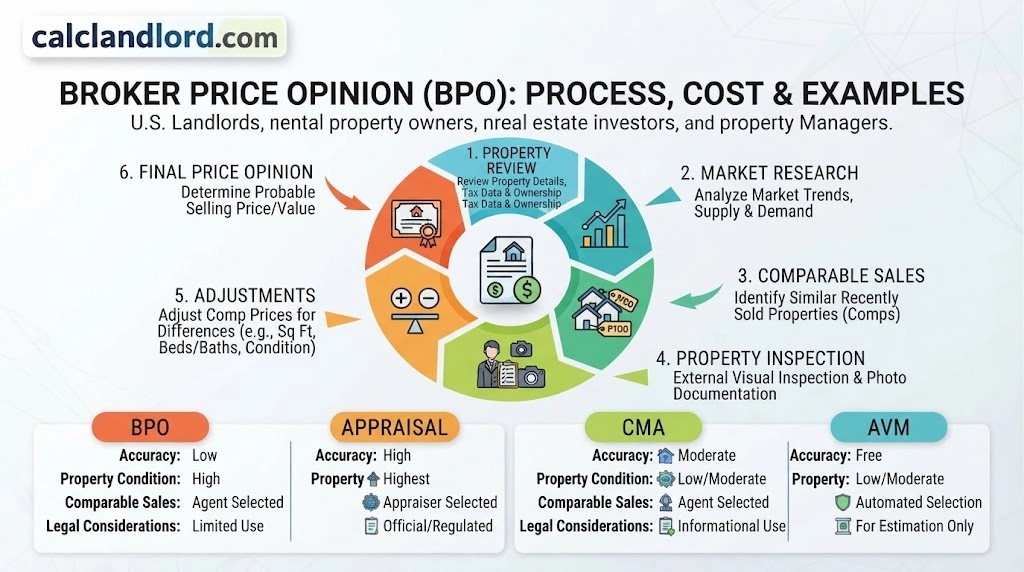
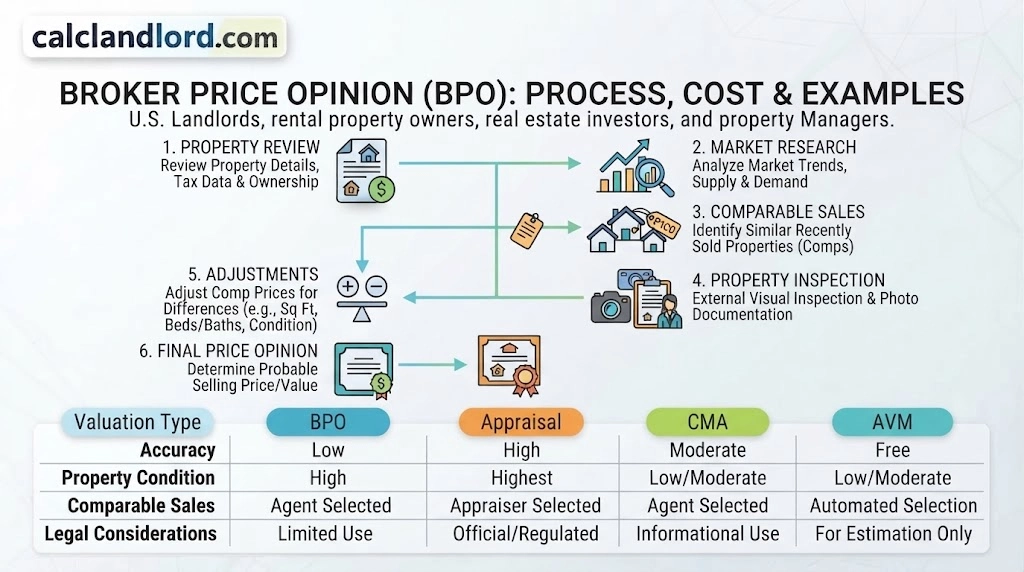
A typical BPO involves gathering property information, researching the local market, evaluating comparable properties, considering the property’s condition, making appropriate adjustments, and reconciling the evidence into a final price opinion.
BPO industry training materials identify activities such as property inspection, market evaluation, comparable evaluation, adjustments, appreciation/depreciation analysis, reconciliation, and final price submission as components of BPO preparation.
Step 1: Identify the subject property
The broker begins with the property being evaluated.
Information can include:
- Address
- Property type
- Square footage
- Lot size
- Bedrooms and bathrooms
- Year built
- Garage or parking
- Property amenities
- Occupancy
- Recent renovations
- Other relevant characteristics
For a rental property, additional information may include:
- Current rent
- Lease status
- Unit count
- Tenant occupancy
- Property management arrangements
- Recent capital improvements
Not every BPO assignment will request all of this information.
Step 2: Research the local market
The broker researches the surrounding market to understand current pricing conditions.
Potential sources include:
- MLS data
- Public records
- Recent sales
- Active listings
- Neighborhood information
- Local market trends
The quality of the final opinion depends partly on the quality and relevance of the underlying data.
Step 3: Inspect the property
Depending on the assignment, the broker may conduct an exterior-only inspection or an interior and exterior inspection.
The inspection may consider:
- Exterior condition
- Interior condition
- Maintenance
- Renovations
- Property appeal
- Visible defects
- Amenities
- Neighborhood characteristics
Step 4: Select comparable properties
The broker identifies properties that provide useful evidence about the subject property’s probable selling price.
Good comparable properties generally share important characteristics with the subject, such as:
- Location
- Property type
- Size
- Age
- Condition
- Bedroom and bathroom count
- Lot characteristics
- Amenities
There is no universal rule that every BPO must contain the exact same number of comparable properties.
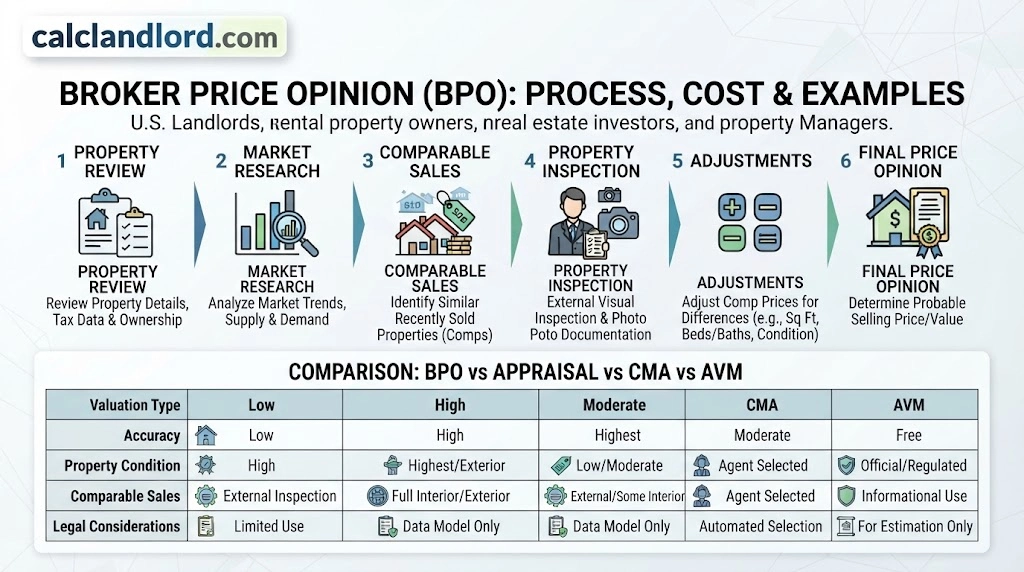
Step 5: Analyze differences
The subject property and comparable properties rarely match perfectly.
The broker may therefore consider differences involving:
- Size
- Condition
- Location
- Lot
- Garage
- Renovations
- Bedrooms
- Bathrooms
- Other amenities
BPO training materials specifically address comparable evaluation, adjustments, paired-sales analysis, and superior/inferior/equal comparable analysis.
Step 6: Reconcile the evidence
The broker considers the different indications produced by the comparable properties and other market information.
The final opinion should be supported by the evidence rather than simply being an unexplained number.
Step 7: Prepare the report
The broker submits the completed BPO according to the client’s requested format.
Some BPO reports are relatively short, while assignment requirements can vary considerably.
What Is Included in a BPO Report?
There is no single universal BPO report that every broker must use for every assignment.
The requested form, client, property, assignment purpose, and applicable state requirements can affect the report.
A BPO may contain:
| Report Element | What It May Show |
| Property information | Address, type, size and characteristics |
| Market conditions | Local pricing and market activity |
| Neighborhood analysis | Location and surrounding market |
| Property condition | Exterior and/or interior observations |
| Comparable sales | Recently sold similar properties |
| Active listings | Current competing properties |
| Photographs | Property and neighborhood images |
| Adjustments | Differences between subject and comps |
| Pricing analysis | Indicated price or range |
| Final opinion | Probable selling price |
| Comments | Factors affecting marketability |
NABPOP’s published BPO materials identify property information, inspections, comparable evaluation, adjustments, calculations, reconciliation, and common BPO fields as areas involved in BPO preparation.
What should a landlord look for in a BPO?
If you’re using a BPO to help evaluate an investment property, don’t immediately jump to the final number.
First examine:
- Which comps were selected?
- How recent are the sales?
- How close are the properties geographically?
- Are the properties genuinely comparable?
- How does the condition differ?
- Were major renovations considered?
- Are current listings moving up or down?
- Are there unusual property characteristics?
The supporting evidence can be more useful than the headline number.
What Are the Different Types of Broker Price Opinions?
The two broad residential BPO formats commonly discussed are exterior BPOs and interior BPOs.
Exterior BPO
An exterior BPO, sometimes called a drive-by BPO, evaluates the property primarily from the outside.
The broker may observe:
- Exterior condition
- Curb appeal
- Lot characteristics
- Neighborhood
- Visible maintenance issues
- Nearby properties
- Comparable sales
Because the broker generally does not inspect the interior, important information can remain unknown.
Interior BPO
An interior BPO includes an evaluation of the inside of the property as well as its exterior.
This may allow the broker to evaluate:
- Kitchen condition
- Bathrooms
- Flooring
- Interior renovations
- Layout
- Maintenance
- Damage
- Interior amenities
Experian describes external BPOs as exterior-focused evaluations and internal BPOs as evaluations that include both interior and exterior characteristics.
Exterior vs. interior BPO
| Factor | Exterior BPO | Interior BPO |
| Exterior observation | Yes | Yes |
| Interior inspection | Generally no | Yes |
| Interior condition | Limited | Directly considered |
| Access required | Usually no interior access | Interior access |
| Information depth | More limited | More detailed |
| Potential usefulness | Quick market assessment | More property-specific analysis |
For a rental property, an interior inspection can be particularly useful when major renovations, deferred maintenance, tenant damage, or interior upgrades could materially affect pricing.
Broker Price Opinion vs. Appraisal: What’s the Difference?
A BPO and an appraisal are different valuation products.
A BPO is prepared by a real estate broker, agent, or salesperson within the scope permitted by applicable law and the assignment.
An appraisal is performed by an appraiser under the applicable appraisal framework.
The distinction matters because the two products can have different purposes, standards, legal requirements, and intended users.
The CFPB identifies both appraisals and BPOs as types of property valuation and explains that different valuations can produce different results because they may use different comparable properties, occur at different times, or serve different purposes.
BPO vs. appraisal
| Factor | BPO | Appraisal |
| Typical preparer | Broker/agent/salesperson | Licensed/certified appraiser |
| Primary output | Probable selling/price opinion | Appraiser’s opinion of value |
| Comparable analysis | Common | Common |
| Physical inspection | Assignment-dependent | Assignment-dependent |
| USPAP | Not automatically a USPAP appraisal | Appraisal framework may require USPAP |
| Legal use | Depends on purpose and jurisdiction | Governed by applicable appraisal laws |
| Cost | Often lower, but varies | Generally more extensive |
| Intended use | Depends on assignment | Depends on appraisal assignment |
Can a BPO replace an appraisal?
Not in every situation.
Federal law states that, in conjunction with purchasing a consumer’s principal dwelling, a BPO may not be used as the primary basis for determining property value for originating a residential mortgage loan secured by that property.
That means landlords and investors should not assume that a BPO can simply substitute for an appraisal whenever a lender, government program, or other transaction requires an appraisal.
Always verify the specific transaction and applicable state and federal requirements.
Broker Price Opinion vs. CMA vs. AVM: How Do They Compare?
BPOs are often discussed alongside comparative market analyses (CMAs) and automated valuation models (AVMs).
Although all three can provide information about property pricing, they are not identical.
BPO
A broker prepares a professional estimate using property and market information.
CMA
A comparative market analysis is commonly prepared by a real estate professional to help evaluate a listing or offering price using comparable properties.
AVM
An automated valuation model uses computer-based models and data to generate a property estimate.
The CFPB explicitly identifies BPOs, appraisals, and AVMs as different types of property valuation.
| Feature | BPO | CMA | AVM |
| Human professional analysis | Yes | Yes | No direct broker analysis required |
| Comparable data | Usually | Usually | Often |
| Automated model | No | No | Yes |
| Property inspection | May occur | May occur | Usually no physical inspection |
| Local market judgment | Strong potential role | Strong potential role | Model-dependent |
| Report format | Assignment-dependent | Agent-dependent | Model-generated |
| Legal treatment | Varies | Varies | Varies |
Which one should a landlord use?
That depends on the question you’re trying to answer.
If you’re trying to understand a property’s probable selling price, a BPO may provide useful professional market input.
When you’re preparing a listing strategy, a CMA may be appropriate.
If you want a quick data-driven estimate, an AVM may be useful as an additional reference.
If a lender or transaction requires a specific valuation product, use the product that satisfies that requirement.
When Do Landlords and Real Estate Investors Use a BPO?
A BPO can be useful to a landlord when the investor needs a better understanding of a property’s likely market price.
Possible situations include:
Evaluating a potential rental purchase
Suppose you’re considering buying a rental property for $400,000.
A BPO might indicate a probable selling-price range around $385,000 to $410,000 based on comparable properties.
That information can help you question whether the asking price is supported by the local market.
But you should combine the valuation with:
- Expected rent
- Vacancy
- Property taxes
- Insurance
- Repairs
- Maintenance
- Management
- Financing
- Capital expenditures
Reviewing an existing rental
An owner may want to understand how the property’s estimated sale price has changed since purchase.
For example:
Purchase price: $300,000
Estimated current price: $390,000
Mortgage balance: $235,000
Approximate gross equity:
$390,000 − $235,000 = $155,000
That is a simplified equity calculation and does not account for selling costs, taxes, liens, or other obligations.
Considering a sale
A landlord preparing to sell may use market evidence to evaluate whether an asking price is reasonable.
Reviewing portfolio value
Investors with multiple properties may use valuation information to monitor their portfolio.
Evaluating refinance assumptions
A BPO may provide useful market information, but whether a lender accepts it for a specific refinance depends on the lender, loan program, transaction, and applicable rules.
Analyzing sale-versus-rent decisions
A landlord could compare estimated property value with expected rental performance.
For example:
Estimated property value: $450,000
Annual gross rent: $36,000
Gross rent yield:
$36,000 ÷ $450,000 × 100 = 8%
This is not the same as cap rate or ROI. It ignores vacancy and operating expenses.
For a complete investment analysis, use a rental-property financial model rather than relying on the BPO alone.
How Much Does a Broker Price Opinion Cost?
There is no single nationwide BPO price.
Cost can vary according to:
- Exterior vs. interior inspection
- Property location
- Property type
- Travel requirements
- Report requirements
- Complexity
- Turnaround time
- Client
- Local market
- BPO provider
Recent published sources show substantial variation. For example, one 2026 consumer-facing source reports residential BPO costs commonly ranging from about $30 to $300 depending on assignment characteristics, while another published 2026 fee schedule lists a $125 fee for an exterior-only BPO. These figures illustrate why a universal “BPO cost” should not be presented as a fixed national rate.
Some consumer sources report BPOs around $100 or less in certain situations, while other assignments can cost more.
What makes an interior BPO more expensive?
An interior assignment can require:
- Property access
- More inspection time
- More photographs
- Additional property-condition analysis
- More report detail
- Additional travel or coordination
BPO cost vs. investment value
For an investor, the fee should be evaluated relative to the decision being made.
If you’re considering a $500,000 rental acquisition, spending money to obtain better property information may be reasonable when it reduces uncertainty.
But a BPO should not be treated as a guarantee that the property will sell for the reported amount.
How Accurate Is a Broker Price Opinion?
A BPO is an estimate, not a guaranteed sale price.
Its usefulness can depend on:
- Comparable selection
- Data quality
- Property condition
- Market conditions
- Local expertise
- Inspection quality
- Adjustment methodology
- Unusual property characteristics
- Effective date of the analysis
The CFPB explains that different property valuations can produce different results because they may use different comparables, occur at different times, or be prepared for different purposes.
Example of why two BPOs could differ
Imagine two brokers analyze the same rental property.
Broker A uses:
- Three nearby recent sales
- Similar property condition
- Similar square footage
Broker B uses:
- Older sales
- Larger properties
- More distant neighborhoods
- Different condition assumptions
Their conclusions could differ without either number automatically proving that one report is correct.
How landlords can evaluate BPO quality
Look beyond the final price.
Ask:
Are the comps actually comparable?
Are the sales recent enough?
Does the property condition match?
Are important renovations considered?
Are neighborhood differences meaningful?
Does the final opinion logically follow the evidence?
A BPO becomes more useful when the underlying reasoning is transparent.
How Are Comparable Properties Selected for a BPO?
Comparable properties, commonly called comps, are central to many BPOs.
The broker looks for properties that provide useful evidence about what buyers are paying for similar real estate.
Important comparable characteristics
A broker may consider:
- Geographic proximity
- Property type
- Living area
- Lot size
- Age
- Bedrooms
- Bathrooms
- Condition
- Renovations
- Garage
- Amenities
- Market timing
Why the closest property isn’t always the best comp
Imagine your rental property is a renovated 2,000-square-foot house.
The house next door sold for $350,000, but it was:
- 1,500 square feet
- Poorly maintained
- Without a garage
- Unrenovated
A property one mile away might actually provide better evidence if it has:
- 1,950 square feet
- Similar renovation quality
- Similar age
- Similar lot
- Similar amenities
Geographic proximity matters, but comparability matters too.
Sold comps vs. active listings
Sold properties show what buyers actually paid.
Active listings show what sellers are currently asking.
Those are not the same thing.
An active listing at $500,000 does not prove that the property will sell for $500,000.
This is one reason a strong BPO should consider multiple types of market evidence.
Adjustments
If the subject property differs from a comparable, the broker may consider an adjustment.
For example:
| Feature | Subject | Comparable |
| Living area | 2,000 sq. ft. | 1,800 sq. ft. |
| Garage | 2-car | 1-car |
| Renovation | Updated | Average |
| Sale price | — | $430,000 |
The broker would consider how those differences affect the comparable’s usefulness.
BPO training resources specifically identify comparable evaluation, feature adjustments, time adjustments, paired-sales analysis, and appreciation/depreciation analysis.
Who Can Prepare a Broker Price Opinion?
BPO qualifications are not identical in every U.S. jurisdiction.
Federal law defines a BPO in terms of an estimate prepared by a real estate broker, agent, or salesperson, but state law can establish additional requirements concerning licensing, permitted activities, disclosures, education, experience, or supervision.
For example, Pennsylvania has specific statutory provisions governing BPOs, including required language stating that the analysis is not an appraisal.
Texas also has rules addressing BPOs and CMAs and distinguishes them from appraisals.
Is BPO certification required?
There is no universal nationwide certification requirement that every BPO practitioner must satisfy.
NABPOP offers BPO education and certification, but its private certification should not be confused with a universal statutory licensing requirement in every state.
What should a landlord check?
Before relying on a BPO, consider:
- Is the preparer properly licensed where required?
- Does the person have experience with similar properties?
- Does the broker understand the local market?
- Is the assignment purpose clearly defined?
- Are the required disclosures included?
- Does the BPO comply with applicable state requirements?
For state-specific questions, consult the relevant state real estate regulator or qualified professional.
How to Get a Broker Price Opinion for a Rental Property
If you’re a landlord or investor considering a BPO, start with the decision you are trying to make.
Step 1: Define your purpose
Are you trying to:
- Evaluate a purchase?
- Review your property’s value?
- Prepare for a sale?
- Analyze portfolio equity?
- Evaluate a refinance?
- Support a short-sale process?
- Review an investment decision?
The purpose can affect the type of valuation you need.
Step 2: Determine the appropriate report
Ask whether an:
- Exterior BPO
- Interior BPO
- CMA
- Appraisal
- AVM
- Other valuation
is appropriate for your situation.
Step 3: Find a qualified local professional
Look for someone with experience in:
- Your property type
- Your neighborhood
- Rental properties
- Comparable-sales analysis
- BPO assignments
Step 4: Provide accurate property information
Useful information can include:
- Address
- Property type
- Square footage
- Renovation history
- Current condition
- Unit count
- Current rent
- Lease information where appropriate
- Photos
- Access details
Step 5: Review the BPO critically
Don’t just look at the final number.
Review:
- Comparable properties
- Property condition
- Market commentary
- Adjustments
- Photographs
- Assumptions
- Final price opinion
Step 6: Connect the valuation to your investment analysis
This is where CalcLandlord can provide additional value.
A BPO tells you about a property’s probable selling price.
Your investment analysis should answer:
“Does this property make financial sense at this price?”
That requires additional numbers such as rent, operating expenses, financing costs, vacancy, capital expenditures, cash flow, and return metrics.
Broker Price Opinion Example: How the Valuation Works
Consider a hypothetical rental property.
Subject property
- Property type: Single-family rental
- Size: 2,000 square feet
- Bedrooms: 3
- Bathrooms: 2
- Condition: Good
- Estimated current market rent: $2,800/month
The broker identifies three hypothetical comparable sales.
| Comparable | Sale Price | Key Difference |
| Comp A | $415,000 | Smaller and slightly inferior condition |
| Comp B | $435,000 | Similar size and condition |
| Comp C | $455,000 | Larger and more upgraded |
The broker should not simply calculate:
($415,000 + $435,000 + $455,000) ÷ 3 = $435,000
That average can be a useful mathematical reference, but it does not automatically represent the property’s value.
Instead, the broker evaluates the differences.
Suppose the analysis supports an illustrative BPO conclusion of:
$438,000
That figure is a hypothetical example, not a market valuation.
Now consider the landlord’s investment analysis
Annual scheduled rent:
$2,800 × 12 = $33,600
Suppose annual operating expenses excluding debt service are $11,600.
Estimated NOI:
$33,600 − $11,600 = $22,000
Illustrative cap rate:
$22,000 ÷ $438,000 × 100 = 5.02%
This demonstrates an important principle:
The BPO and investment analysis answer different questions.
The BPO helps estimate the property’s probable selling price.
The cap-rate calculation helps evaluate the property’s operating return relative to its price.
A landlord should not assume that a BPO itself tells them whether a property is a good investment.
What Are the Benefits, Risks, and Limitations of a BPO?
A BPO can be useful, but it has limitations that landlords and investors should understand.
Benefits
Local market perspective
A broker can incorporate knowledge of local buyers, listings, sales activity, and neighborhood conditions.
Comparable-sales analysis
A BPO can provide property-specific market evidence rather than relying entirely on an automated estimate.
Potentially faster process
Some BPO assignments are designed to provide a quicker pricing opinion than a full appraisal.
Useful for property decisions
Depending on the assignment, a BPO can help inform pricing, investment review, portfolio monitoring, and other permitted decisions.
Risks and limitations
It is an estimate
A BPO cannot guarantee a future sale price.
Comparable selection matters
Weak comps can weaken the analysis.
Condition may be difficult to evaluate
This is especially relevant for an exterior-only BPO.
Legal use varies
A BPO that is useful for one purpose may not satisfy the requirements of another.
It is not automatically an appraisal
A BPO should not be represented as a formal appraisal merely because both involve property valuation.
Market conditions can change
A valuation prepared several months ago may not reflect today’s market.
The landlord’s practical rule
Treat a BPO as one piece of evidence, not the entire investment decision.
For a rental-property purchase, combine the valuation with:
- Rent
- Vacancy
- Operating expenses
- Financing
- Taxes
- Insurance
- Repairs
- Capital expenditures
- Cash flow
- ROI
- Cap rate
- Cash-on-cash return
- Expected appreciation
- Exit assumptions
BPO Legal and Regulatory Considerations in the U.S.
BPO regulations can involve both federal requirements and state-specific rules.
At the federal level, 12 U.S.C. § 3355 defines a broker price opinion as an estimate by a real estate broker, agent, or salesperson concerning a property’s probable selling price, including varying levels of information about condition, market, neighborhood, and comparable sales.
The same federal statute states that, in conjunction with purchasing a consumer’s principal dwelling, a BPO may not be used as the primary basis for determining property value for originating a residential mortgage loan secured by that property.
Federal banking guidance also distinguishes a BPO from an appraisal and describes circumstances in which a BPO may be used for monitoring collateral value on an existing loan when appropriate.
State requirements can be more specific.
For example, Pennsylvania law requires specific language in BPOs and expressly states that a BPO is not an appraisal.
What this means for landlords
Don’t assume:
“A BPO is cheaper, so I can use it instead of an appraisal.”
That conclusion can be incorrect.
Instead ask:
- What is the purpose of the valuation?
- Who is requesting it?
- What property is involved?
- Is this a principal residence or investment property?
- What does the lender require?
- What state law applies?
- Does the transaction require an appraisal or another valuation product?
- Does the BPO provider satisfy applicable licensing requirements?
BPO legal disclaimer
This article provides general educational information, not legal, tax, accounting, appraisal, or financial advice. Real estate laws and professional requirements can vary by state and transaction. Consult the applicable state regulator or qualified professional when a specific legal or valuation question affects a transaction.
People Also Ask
A: A broker price opinion is an estimate of a property’s probable selling price prepared by a real estate broker, agent, or salesperson using information such as comparable sales, property characteristics, condition, and market factors.
A: No. A BPO and an appraisal are different valuation products with different professional, legal, and assignment requirements.
A: There is no universal national price. Fees vary by property, location, report type, inspection requirements, provider, and assignment. Recent published 2026 sources show BPO fees ranging from relatively low-cost exterior reports to several hundred dollars for more involved assignments.
A: A BPO is an estimate. Its usefulness depends on comparable selection, property data, condition analysis, market conditions, and the expertise of the person preparing it.
A: An exterior BPO evaluates the property primarily from outside and generally does not include an interior inspection.
Final Takeaways
A Broker Price Opinion (BPO) is a professional estimate of a property’s probable selling price based on market evidence and property-specific information.
For landlords and rental-property investors, a BPO can be useful for understanding:
- Potential property value
- Comparable sales
- Market positioning
- Portfolio equity
- Possible sale pricing
- Investment-property market conditions
But a BPO is not an investment analysis by itself.
The most useful approach is to combine the BPO with the numbers that actually determine rental-property performance:
Property value + rent + operating expenses + financing + vacancy + capital expenditures + expected returns
For example, a BPO may suggest that a property is worth $450,000. That number alone doesn’t tell you whether purchasing the property makes sense.
You still need to calculate the property’s:
- Cash flow
- Cap rate
- Cash-on-cash return
- ROI
- Debt service
- Operating expenses
- Long-term equity potential
For that reason, a BPO should be treated as a valuation input, while a rental-property calculator or investment model should be used to evaluate the overall financial decision.
Important: Federal and state rules can affect how BPOs may be prepared and used. Always verify the requirements that apply to your particular property and transaction.
