

A Personal Guarantee is a legal promise that makes an individual responsible for a business, loan, lease, or other obligation if the primary borrower or tenant fails to meet its commitments.
For landlords and real estate investors, this matters because an investment property may be owned by an LLC, while the lender may still require the owner to personally guarantee the debt. In that situation, the property and LLC structure do not tell the entire story about your financial exposure.
A personal guarantee can appear in rental-property financing, commercial real estate loans, business financing, and commercial leases. The exact risk depends on the wording of the guarantee, the underlying agreement, the collateral, applicable law, and the circumstances of a default.
If you are considering signing one, the most important question is not simply “Does this loan require a personal guarantee?”
It is:
“Exactly what am I guaranteeing, how much could I personally owe, what triggers my liability, and when does that liability end?”
What Is a Personal Guarantee?
A personal guarantee is a contractual promise by an individual—known as the guarantor—to satisfy specified obligations of another party if that party fails to perform.
In real estate, the arrangement might look like this:
ABC Rental LLC → Borrower
Bank → Lender
Property → Collateral
Investor → Personal Guarantor
The LLC may be the entity borrowing the money, but the investor separately signs an agreement promising to support some or all of the obligation.
This distinction is important because forming an LLC and signing a personal guarantee are two separate legal concepts. NCUA guidance explains that owners of LLCs and certain other entities generally are not personally liable for the entity’s debts simply because they own the entity, but personal liability can arise when the owner separately agrees to guarantee the obligation.
A guarantee can cover different obligations depending on the contract, including:
- Loan payments
- Principal
- Interest
- Certain fees
- Lease payments
- Operating obligations
- Completion obligations
- Costs associated with a default
- Other specifically defined liabilities
The scope matters more than the label.
A document called a “Personal Guarantee” could create substantially different exposure from another guarantee with the same title.
Guarantee vs. guarantor
These terms are easy to confuse.
Guarantee: The contractual promise.
Guarantor: The individual making that promise.
For example, if you own an LLC and personally sign the guarantee, your LLC is the borrower while you are the guarantor.
How Does a Personal Guarantee Work?
A personal guarantee generally connects an individual to an obligation that otherwise belongs to a business or other entity.
Consider a simplified rental-property transaction.
You create Main Street Rentals LLC and purchase a property for $600,000.
You contribute:
- $150,000 equity
- $450,000 loan
The LLC signs the loan documents.
The lender also requires you to sign a personal guarantee.
The structure is therefore:
LLC → owes the debt
Property → secures the loan
You → personally guarantee the specified obligation
If the LLC makes its payments and satisfies the loan agreement, the guarantee may never become an issue.
If the LLC defaults, the lender’s rights depend on the loan agreement, guarantee, collateral, applicable law, and enforcement process.
The guarantee could become relevant if there is an unpaid obligation after the lender exercises available remedies.
Why lenders use guarantees
From the lender’s perspective, a newly formed LLC may have:
- Limited operating history
- Limited credit history
- Few assets
- Limited liquidity
- No established repayment history
A personal guarantee can provide another source of repayment and align the owner’s interests with the property’s performance.
NCUA describes personal guarantees as an important risk-mitigation tool in lending to privately held entities, including investor real-estate borrowers.
The important takeaway
A personal guarantee doesn’t necessarily mean the lender immediately owns your personal assets after a missed payment.
It means you have entered into a contractual commitment that can create personal liability under specified circumstances.
That distinction is critical.
Why Do Lenders Require Personal Guarantees From Investors?
Lenders generally want to reduce the risk that they will lose money if the borrower cannot repay.
For a rental property, the property itself may serve as collateral. But property value and rental income can change.
For example, suppose an investor purchases a multifamily property for:
$2,000,000
with:
$1,500,000 debt
and:
$500,000 equity
If the property later declines in value to $1.35 million, the lender has a very different risk position.
A lender may therefore evaluate several layers of protection:
- Property collateral
- Borrower entity
- Rental-property cash flow
- Borrower’s creditworthiness
- Investor liquidity
- Personal guarantee
- Other negotiated security or guarantees
A guarantee can therefore be viewed as part of the lender’s overall risk-management strategy.
What strengthens your negotiating position?
An investor may have more leverage when the transaction has:
- Strong property cash flow
- Conservative leverage
- High-quality collateral
- Strong DSCR
- Significant equity
- Strong liquidity
- Experienced management
- Stable tenancy
- Strong credit history
- Demonstrated investment experience
The exact underwriting criteria vary by lender and loan product.
Don’t judge financing by the interest rate alone
Suppose Lender A offers:
7.00% interest + unlimited personal guarantee
while Lender B offers:
7.25% interest + limited guarantee
The second loan isn’t automatically better.
But neither is the first automatically better because the interest rate is lower.
You need to evaluate:
Financing cost + repayment risk + personal exposure + flexibility.
For a landlord, the guarantee can be an important part of the true economic cost of financing.
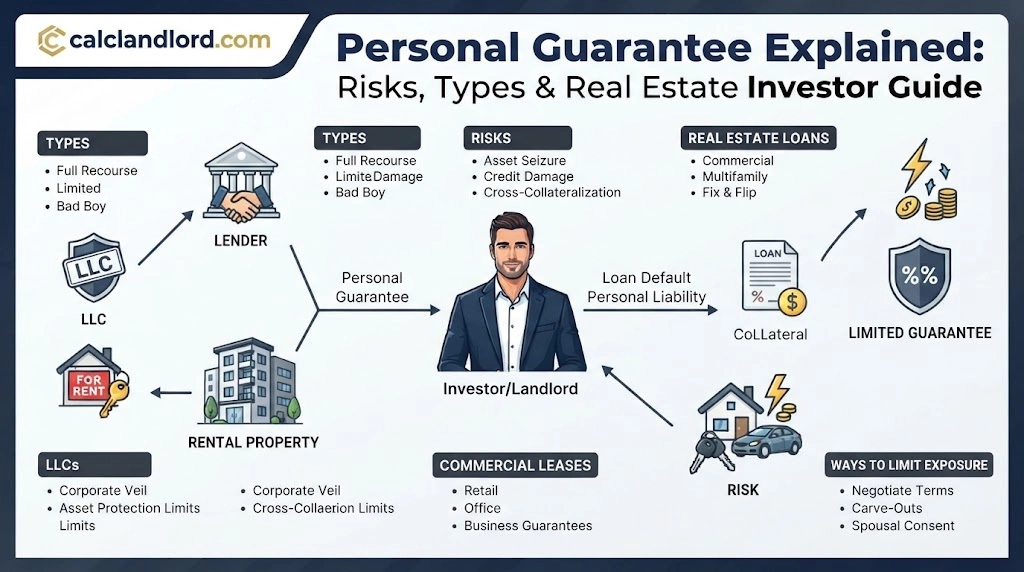
Does an LLC Protect You From a Personal Guarantee?
An LLC can provide liability separation, but it does not erase an obligation you voluntarily guarantee.
This is one of the most important concepts for rental-property investors.
Imagine:
Property owned by LLC
Loan borrowed by LLC
Investor personally guarantees loan
The LLC remains the borrower.
But the investor has also accepted a separate contractual obligation.
NCUA’s guidance makes this distinction directly: an owner of an LLC generally isn’t personally liable for the LLC’s debts merely because of ownership, but personal liability can arise when that person separately agrees to guarantee the business’s obligations.
LLC without a personal guarantee
The basic structure might be:
LLC → debt
The owner’s personal liability may be more limited, subject to the applicable legal and contractual circumstances.
LLC with a personal guarantee
The structure becomes:
LLC → debt
Owner → guarantee
The owner’s personal exposure is therefore potentially broader.
What investors should not assume
Don’t assume:
“The property is in my LLC, so my personal assets can never be involved.”
Instead, ask:
“What obligations have I personally signed?”
That question is far more useful.
LLC protection is not the same as non-recourse financing
These concepts should also be kept separate.
LLC: A legal entity structure.
Personal guarantee: A contractual promise.
Non-recourse financing: A financing structure generally designed to limit lender recovery to specified collateral, subject to exceptions.
They can interact, but they are not interchangeable.
What Types of Personal Guarantees Exist?
Personal guarantees can be structured in different ways.
The most important distinction for investors is whether the guarantee is broad, limited, conditional, or tied to specific events.
Unlimited personal guarantee
An unlimited guarantee can potentially cover the full amount of the obligations specified in the agreement.
This can create substantial personal exposure.
NCUA describes an unlimited guarantee as potentially covering the borrower’s entire indebtedness under the relevant arrangement.
Limited personal guarantee
A limited guarantee establishes a defined boundary.
For example:
Loan: $1,000,000
Personal guarantee cap: $250,000
The investor’s contractual exposure could be limited to the specified amount, depending on the agreement.
Percentage guarantee
The guarantee may cover a percentage of an obligation rather than the entire amount.
Payment guarantee
A payment guarantee focuses on the borrower’s obligation to make required payments.
Completion guarantee
Construction and development financing may involve guarantees related to completing a project.
Carve-out guarantee
A carve-out guarantee can create personal liability when specifically defined events or actions occur.
Commercial real-estate transactions can contain provisions sometimes described as “bad-boy” or non-recourse carve-outs. The actual triggering events depend on the documents.
Burn-off guarantee
A burn-off provision can reduce the guarantor’s exposure when specified conditions are met.
For example, a guarantee might decrease after:
- A period of successful payments
- Stabilization
- Principal reduction
- Achievement of a specified DSCR
- Completion of improvements
- Other negotiated milestones
Good-guy guarantee
Commercial leases can also use structures sometimes called good-guy guarantees, which may limit personal exposure when the tenant satisfies specified conditions before vacating.
The precise legal effect varies by lease and jurisdiction, so the actual language matters more than the label. Current commercial-lease guidance identifies caps, burn-offs, and good-guy structures as important areas for negotiation.
Personal Guarantee vs. Collateral: What’s the Difference?
Collateral and a personal guarantee are not the same thing.
Collateral is a specific asset pledged to support an obligation.
A personal guarantee is a contractual promise made by an individual.
| Feature | Personal Guarantee | Collateral |
| What is it? | Personal contractual promise | Specific pledged asset |
| Who provides it? | Guarantor | Borrower/owner |
| Typical real-estate example | Investor guarantee | Rental property |
| Main purpose | Additional repayment support | Secures debt |
| Can both exist together? | Yes | Yes |
| Risk depends on | Guarantee language | Security documents and collateral |
Example
Suppose a rental property secures a $700,000 loan.
The property is collateral.
The owner personally guarantees the loan.
There are therefore two different layers of protection for the lender.
The property may be subject to the lender’s security rights.
The guarantor may have personal obligations under the guarantee.
Why this matters
Investors sometimes focus heavily on the property’s loan-to-value ratio while ignoring their personal guarantee.
That can produce an incomplete risk analysis.
Consider:
Property value: $1,000,000
Loan: $700,000
LTV: 70%
A 70% LTV may look reasonable.
But you should still ask:
What happens if the property’s value falls to $650,000?
The answer depends on the loan structure, collateral rights, guarantee language, and applicable law.
That’s why leverage and personal guarantee exposure should be analyzed together.
Personal Guarantee vs. Recourse and Non-Recourse Debt
The terms recourse, non-recourse, and personal guarantee are related but different.
Recourse debt
Recourse financing can allow a lender to pursue sources beyond the collateral when permitted by the agreement and applicable law.
Non-recourse debt
Non-recourse financing generally limits the lender’s recovery to specified collateral, subject to contractual exceptions.
Personal guarantee
A personal guarantee is an agreement in which an individual accepts specified responsibility for another party’s obligations.
A loan can therefore have:
- Full personal recourse
- Limited personal guarantee
- Non-recourse structure with carve-outs
- Other negotiated combinations
Simple comparison
| Structure | General concept |
| Personal guarantee | Individual promises to support specified obligations |
| Recourse debt | Additional recovery may be available beyond collateral |
| Non-recourse debt | Recovery generally limited to collateral, subject to exceptions |
| Carve-out guarantee | Personal exposure can arise from specified events |
The wording of the documents is critical.
A loan marketed as “non-recourse” may still contain carve-outs that create personal liability under certain circumstances.
What investors should ask
Before signing, ask the lender:
- Is this loan fully recourse?
- Is my guarantee unlimited?
- Is there a guarantee cap?
- Are there carve-outs?
- What actions trigger personal liability?
- Does the guarantee decrease over time?
- When is it released?
- Does it survive a sale or refinance?
Those questions can reveal more about your actual risk than the phrase “non-recourse” alone.
- Explore More: https://calclandlord.com/dscr-for-rental-properties/

Personal Guarantees on Rental Property Loans
Personal guarantees are particularly important for landlords because rental properties are frequently purchased through LLCs.
An investor may create an entity for ownership and then seek financing for the property.
The lender may still require the investor to guarantee the loan.
This is not necessarily contradictory.
The LLC may own the property while the individual separately guarantees the financing.
Example: Single-family rental
Suppose:
Purchase price: $400,000
Down payment: $100,000
Loan: $300,000
Monthly debt service: $2,000
Monthly rent: $3,000
The investor might calculate property-level cash flow and determine that the deal appears viable.
But the guarantee introduces another question:
If the property performs poorly, how much personal financial exposure am I accepting?
Stress-test the property
Don’t only analyze the base case.
Consider:
Base case
- 95% occupancy
- Expected rent
- Normal repairs
Moderate downside
- Higher vacancy
- Unexpected maintenance
- Lower rent growth
Severe downside
- Extended vacancy
- Major repair
- Property value decline
- Refinancing difficulty
The personal guarantee becomes more important as the downside scenario becomes harder for the property itself to absorb.
Investor takeaway
When evaluating a rental-property loan, analyze:
Property economics + financing terms + guarantee exposure.
Not just the interest rate.
Personal Guarantees for DSCR and Portfolio Loans
DSCR financing is especially relevant to rental-property investors because the property’s income-producing ability plays an important role in underwriting.
But a DSCR-based loan does not automatically mean there is no personal guarantee.
Current 2026 investor-lending resources continue to discuss personal guarantees alongside DSCR financing, including distinctions between recourse, non-recourse, and carve-out structures.
What DSCR means
A simplified DSCR formula is:
DSCR = Net Operating Income ÷ Debt Service
For example:
NOI = $60,000
Annual debt service = $50,000
DSCR = 1.20
A 1.20 DSCR means the property’s NOI is 1.20 times its annual debt service.
But DSCR is a property-level measure.
It doesn’t automatically tell you how much personal liability you have accepted.
Why this matters
Consider two loans with identical:
- Loan amount
- Interest rate
- DSCR
- Property value
But:
Loan A: Unlimited personal guarantee
Loan B: Limited guarantee
The property-level numbers may look identical.
The investor’s personal risk is not.
Portfolio investors
For investors with several rental properties, guarantees can create cumulative exposure.
Suppose you personally guarantee:
- Property A: $300,000
- Property B: $500,000
- Property C: $700,000
That does not necessarily mean you owe $1.5 million today.
But your personal balance sheet may be supporting obligations totaling that amount.
This is why experienced investors should track guaranteed debt exposure, not just total property debt.
Personal Guarantees in Commercial Real Estate and Leases
Personal guarantees aren’t limited to real-estate loans.
They can also appear in commercial leases.
For example, a business might lease retail, office, industrial, or other commercial space through an LLC.
The landlord may require the business owner to personally guarantee some or all of the lease obligations.
Commercial-lease guidance published in 2026 highlights the importance of understanding the scope of the guarantee, including rent, other covered obligations, release provisions, caps, and burn-off structures.
Why landlords request them
A new business may have:
- Limited assets
- Little operating history
- Weak credit history
- No established rent-payment record
The landlord may therefore want additional security.
What a commercial lease guarantee may cover
Depending on the contract, it could potentially address:
- Rent
- Additional rent
- Certain operating expenses
- Damages
- Other lease obligations
- Enforcement costs
The actual contract controls.
Landlord perspective
If you’re a commercial landlord considering a personal guarantee, evaluate:
- Tenant financial strength
- Business history
- Security deposit
- Lease term
- Tenant improvements
- Personal financial strength of the guarantor
- Guarantee scope
- Release conditions
Tenant perspective
If you’re the business owner signing the guarantee, consider negotiating:
- A dollar cap
- Number of months of rent
- A burn-off
- A good-guy structure
- Release after assignment
- Release after a specified period
- Additional security instead of an unlimited guarantee
A personal guarantee should never be treated as a routine signature without understanding its scope.
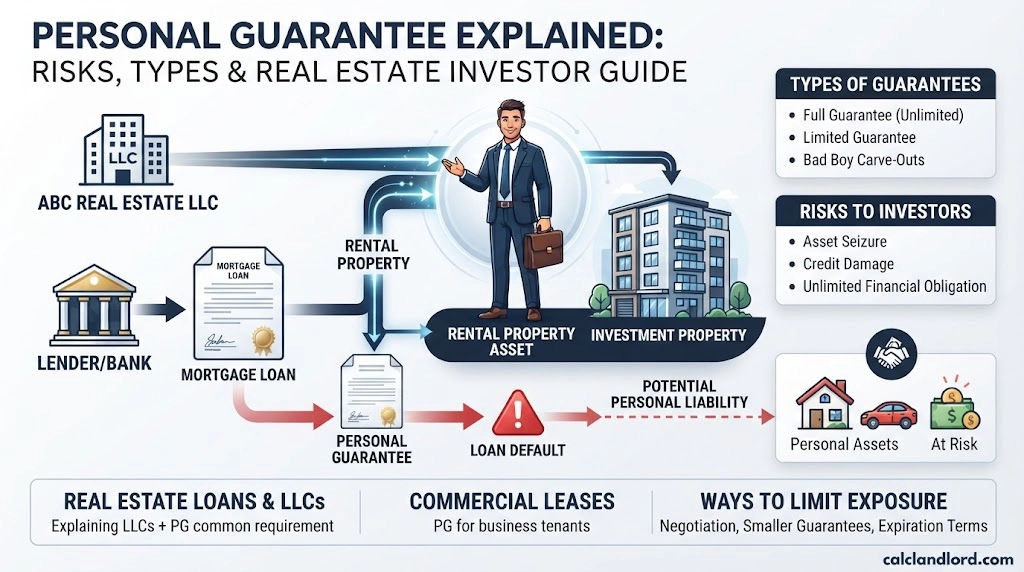
What Happens When a Personally Guaranteed Loan Defaults?
A default does not automatically mean that a lender immediately takes a specific personal asset.
The actual process depends on the contract, collateral, applicable law, and enforcement procedures.
A simplified scenario may look like this:
Step 1: The borrower defaults
The LLC fails to make required payments or violates another relevant loan provision.
Step 2: The lender exercises contractual rights
The lender follows the remedies provided in the loan documents and applicable law.
Step 3: Collateral may be pursued
If the loan is secured by real estate, the lender may have rights against the property.
Step 4: A deficiency may remain
If the collateral doesn’t satisfy the covered obligation, a deficiency can potentially arise depending on the transaction and applicable law.
Step 5: The guarantee becomes relevant
If the personal guarantee covers the relevant obligation, the lender may seek recovery from the guarantor to the extent permitted.
This is why a guarantee should be analyzed before default rather than after a financial problem occurs.
Example
Suppose:
Loan balance: $800,000
Property recovery: $700,000
Potential shortfall: $100,000
The $100,000 isn’t automatically the guarantor’s liability.
You still need to determine:
- What the guarantee covers
- Whether the debt is recourse
- Whether a deficiency can be pursued
- Whether the guarantee is capped
- Whether exceptions apply
- What state law provides
- What remedies are available
That is why investors should never estimate guarantee exposure solely from property value.
What Personal Assets Could Be at Risk?
A personal guarantee can create exposure beyond the assets owned by the borrowing LLC.
Depending on the agreement and applicable law, a creditor’s enforcement options may potentially involve personal assets such as:
- Cash
- Bank accounts
- Investment assets
- Real estate interests
- Other non-exempt assets
But there is an important distinction:
A personal guarantee does not automatically mean every personal asset can immediately be seized.
Enforcement depends on the contract, judgment procedures, exemptions, bankruptcy law, state law, ownership structures, and other circumstances.
Personal balance-sheet analysis
A landlord should calculate more than net worth.
Consider:
Personal net worth
minus
Existing guaranteed obligations
plus/minus
Available liquid assets
and then evaluate the potential downside.
For example:
| Item | Amount |
| Personal liquid assets | $300,000 |
| Investment assets | $250,000 |
| Other net assets | $450,000 |
| Estimated net worth | $1,000,000 |
| Personally guaranteed debt | $800,000 |
The $800,000 figure doesn’t mean the investor will necessarily lose $800,000.
It does mean the investor should understand how much debt their personal balance sheet is supporting.
Portfolio concentration matters
An investor with ten properties may have a stronger overall portfolio than an investor with one property.
But if every property carries a personal guarantee, a broad property downturn could create significant personal exposure.
That is why diversification should include financing and guarantee exposure, not just property locations.
How to Limit or Negotiate a Personal Guarantee
One of the most valuable things an investor can learn is that a guarantee may not always be an all-or-nothing negotiation.
Depending on the transaction, lender, landlord, and circumstances, you may be able to negotiate the amount, duration, triggers, or release conditions.
Current commercial-lease guidance specifically identifies caps, burn-offs, time limits, and alternative security arrangements as potential negotiation points.
1. Negotiate a dollar cap
Instead of guaranteeing the entire obligation, negotiate a maximum amount.
Example:
Total loan: $1,000,000
Guarantee: capped at $250,000
This changes the maximum contractual exposure, subject to the exact drafting.
2. Negotiate a percentage
The guarantee could cover a defined percentage of the obligation.
3. Request a burn-off
A burn-off reduces the guarantee after agreed milestones.
For example:
Year 1: 100%
If Year 2: 75%
Year 3: 50%
If Year 4: 25%
Year 5: Released
Those numbers are only an illustration. The actual structure must be negotiated.
4. Negotiate a time limit
The guarantee might apply only for a defined period.
5. Negotiate release conditions
Possible conditions might include:
- DSCR target achieved
- Loan balance reduced
- Property stabilized
- Certain period of timely payments completed
- Refinance
- Sale
- Replacement guarantor approved
6. Consider alternative credit support
Depending on the transaction, alternatives may include:
- Larger equity contribution
- Larger security deposit
- Letter of credit
- Additional collateral
- Corporate guarantee
- Prepaid Rent
- Other negotiated security
Negotiation principle
Don’t simply ask:
“Can you remove the personal guarantee?”
Ask:
“What would you need from me to reduce, cap, or eventually release the guarantee?”
That creates a more constructive financing conversation.
Personal Guarantee Example: Calculate the Potential Exposure
Let’s use a hypothetical rental-property investment.
Property purchase
Purchase price: $1,000,000
Investor equity: $250,000
Loan: $750,000
Assume the investor personally guarantees the loan.
Now consider three scenarios.
Scenario A: Property performs normally
Property value:
$1,050,000
Loan balance:
$730,000
The property has substantial equity and continues producing income.
The guarantee may never be called upon.
Scenario B: Property value declines
Property value:
$650,000
Loan balance:
$730,000
The property is now worth less than the outstanding loan.
That does not automatically mean the guarantor owes $80,000.
The actual outcome depends on:
- Loan structure
- Collateral rights
- Recourse provisions
- Guarantee terms
- Applicable law
- Sale or foreclosure proceeds
- Other obligations
Scenario C: Limited guarantee
Suppose the loan is $750,000 but the guarantee is capped at $150,000.
The investor’s contractual guarantee exposure may be materially different from an unlimited guarantee.
A useful risk formula
For internal investment analysis, you can think of potential personal exposure as:
Potential Exposure = Covered Obligation − Available Recovery, subject to Guarantee Limits
This is a conceptual framework rather than a legal formula.
For an actual transaction, you must use the contract and applicable law.
Don’t forget cash flow
You should also stress-test the property.
A useful rental-property framework is:
NOI = Rental Income − Operating Expenses
Then:
DSCR = NOI ÷ Annual Debt Service
And:
Cash Flow Before Tax = NOI − Debt Service − Other Cash Expenses
The goal is to understand whether the property can support the debt before personal resources become necessary.
For CalcLandlord, this is where a DSCR Calculator or Rental Property Cash Flow Calculator can provide meaningful additional value.
Personal Guarantee Checklist for Landlords and Investors
Before signing a personal guarantee, work through this checklist.
Understand the parties
- Who is the borrower?
- Who is the lender?
- Who is the guarantor?
- Is the LLC correctly identified?
Understand the scope
- What exactly am I guaranteeing?
- Does it cover principal?
- Interest?
- Fees?
- Costs?
- Lease obligations?
- Future advances?
To Understand the limit
- Is it unlimited?
- Is there a dollar cap?
- Is there a percentage cap?
- Is there a time limit?
Understand the triggers
- What constitutes default?
- Are there financial covenants?
- Are there cross-default provisions?
- Are there carve-outs?
- Can specific actions create personal liability?
Understand the exit
- When does the guarantee terminate?
- Does it burn off?
- Can it be released after refinancing?
- Does it survive a property sale?
- Does it survive a change in ownership?
- Is a written release required?
To Understand the property
Calculate:
- Loan-to-value
- DSCR
- NOI
- Cash flow
- Vacancy sensitivity
- Maintenance reserves
- Interest-rate exposure
- Refinancing risk
Understand your personal balance sheet
Ask:
- How much guaranteed debt do I already have?
- How much liquid capital do I have?
- Could I withstand a prolonged vacancy?
- Could I withstand a major property repair?
- Could I withstand a refinancing failure?
- Would another property be affected by the same lender relationship?
Get professional review
For a significant transaction, have a qualified U.S. real-estate attorney review the actual guarantee and related loan or lease documents.
Do not rely on a general article to determine the legal effect of your specific contract.
People Also Ask
A: No. Collateral is a specific asset pledged to secure an obligation. A personal guarantee is an individual’s contractual promise to satisfy specified obligations.
A: An LLC can provide liability separation, but it does not eliminate an obligation you personally agree to guarantee. The guarantee creates a separate contractual commitment.
A: Some do and some don’t. Requirements vary by lender, loan product, borrower structure, property, leverage, and transaction. Investor real-estate lending can involve personal guarantees.
A: Yes, depending on the transaction. Potential structures include dollar caps, percentage limits, time limits, burn-offs, and specified triggering events.
A: Often, yes. Negotiation may address the guarantee amount, duration, triggers, burn-off provisions, release conditions, or alternative forms of security.
Conclusion
A Personal Guarantee can change the risk profile of a rental-property or commercial-real-estate investment because it connects an individual to an obligation that may otherwise belong to an LLC or other entity.
For landlords and investors, the most important factors are not simply whether a guarantee exists, but:
- What does it cover?
- How much can you owe?
- What triggers personal liability?
- Is the guarantee limited?
- Can it burn off?
- When is it released?
- What happens after default?
- How much personally guaranteed debt are you already carrying?
Before accepting financing, evaluate the guarantee alongside DSCR, cash flow, LTV, property value, vacancy risk, maintenance costs, refinancing risk, and your personal liquidity.
A property can look attractive on paper while still creating uncomfortable personal exposure.
The better approach is to evaluate the property, financing, and personal guarantee as one complete investment decision.
For a practical next step, use a DSCR or rental-property cash-flow analysis to determine how much debt the property can realistically support before relying on your personal balance sheet.

Pingback: Split Pay Rent Fairly: 5 Ways to Stop Roommate Fights
Pingback: Lender Due Diligence Checklist for Commercial Real Estate