

A property can sell for $450,000 and put only $208,500 in the seller’s bank account on closing day. For a landlord, roughly $38,000 of that cheque can still belong to the IRS. The gap between the headline price and what you actually keep is your net proceeds. Working it out accurately is the single most important calculation in any property sale.
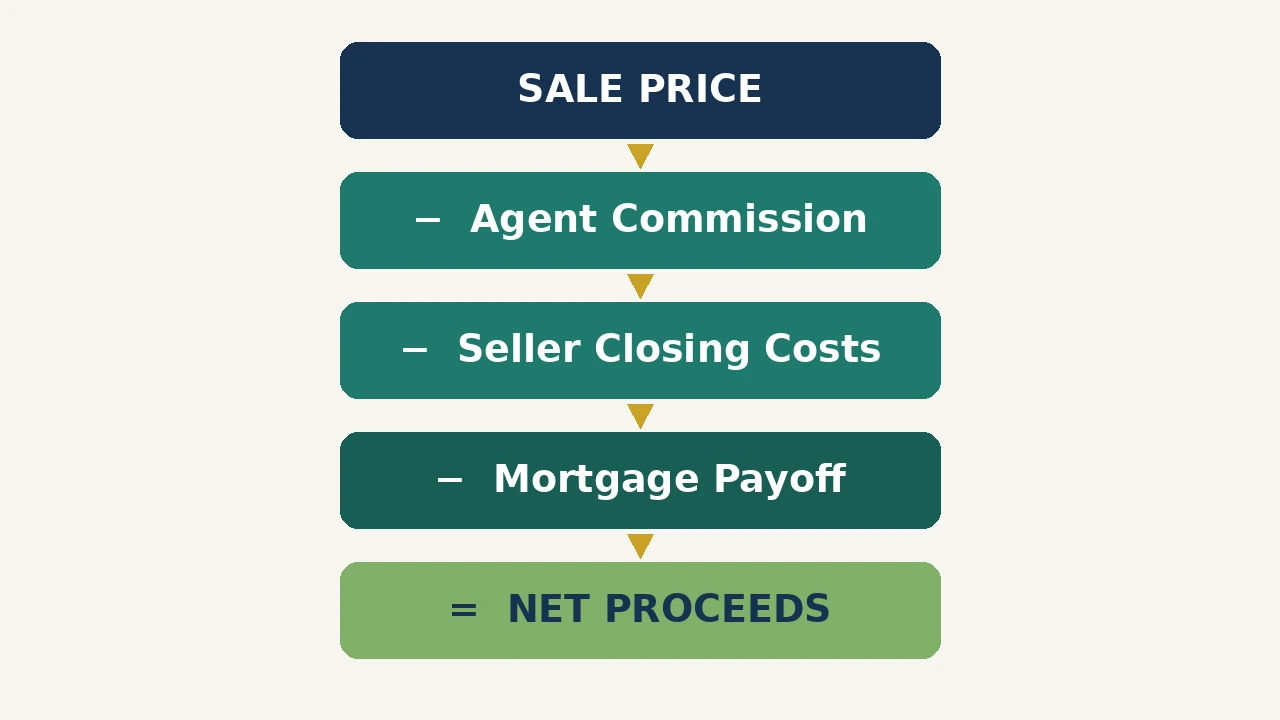
The formula every seller net proceeds calculator uses is:
Net Proceeds = Sale Price − Agent Commission − Seller Closing Costs − Mortgage Payoff
This guide walks through that formula line by line, the way a careful seller — and especially a landlord selling a rental — actually needs it. It covers how to calculate your net proceeds in six steps, every cost that comes off the price, and a full commission section covering the post-2024 rules. It also gives one complete worked example, carried past the closing cheque to the after-tax number most calculators never show you. That last step matters. For a rental property, the tax on capital gains and depreciation recapture applies to a completely different figure (your gain) than the one on your closing statement (your proceeds). Confusing the two is the most expensive mistake sellers make.
What Are Seller Net Proceeds?
Seller net proceeds are the cash a seller actually receives from a sale after you deduct every amount owed at closing from the sale price. That amount includes the agents’ commission, the seller’s closing costs, and the payoff of every loan secured by the property. Net proceeds are what is left of your equity once you have paid for the sale itself.
Sellers constantly confuse three neighbouring numbers with net proceeds. Keeping them separate is the foundation of everything that follows:
- Sale price is the contract price the buyer pays. It is the starting point of the calculation, not the result.
- Gross equity is the sale price minus what you owe on the property. It ignores the cost of selling, so it always overstates what you will receive.
- Profit (taxable gain) is the sale’s amount realised minus your adjusted basis in the property. It is a tax figure, not a cash figure — you can have a large profit and modest proceeds, or healthy proceeds and, after depreciation recapture, a surprisingly large tax bill.
Think of it as a chain of three numbers: sale price → net proceeds (the closing cheque) → after-tax proceeds (what you keep). Most online calculators stop at the second number. If you are selling a home you live in, that may be close to the whole story. If you are selling a rental, the third number decides whether the sale was worth doing. It is the number this article builds to.
The Net Proceeds Formula, Line by Line
Each term in the formula hides detail that changes the result. So it pays to understand exactly what goes into each line, and what stays out of it.
Sale price. Use the contract price from an accepted offer, not your list price and not an optimistic valuation. If you are still deciding on an asking price, use a broker price opinion or comparable-sales analysis. That gives you a defensible estimate to run the numbers with before you list.
Agent commission. You pay the listing brokerage and, where agreed, the buyer’s brokerage a total percentage, calculated on the final sale price. This is normally the largest single deduction. At 5.5% on a $450,000 sale, it is $24,750. Since August 2024 it is also the most negotiable line on the sheet. It gets its own full section below.
Closing costs, payoff and exclusions
Seller closing costs. Everything else the seller pays at closing besides commission and loan payoffs falls into this group. They include the owner’s title insurance policy (in many states), escrow or settlement fees, and attorney fees where used. They also include recording fees and transfer taxes where your jurisdiction charges them. Prorated property taxes or HOA dues owed up to the closing date also come off the price. As a planning estimate, these commonly run about 1–3% of the sale price. The range is an estimate, not a rule. Itemise your own rather than trusting a percentage.
Mortgage payoff. The full amount needed to clear every loan on the property on the closing date. That means first mortgage, second mortgage, and any home equity line of credit. This is the lender’s official payoff figure. It is not the balance printed on your last statement. A later section covers it in full, because getting it wrong distorts everything downstream.
Two things are deliberately not in the formula. Do not deduct costs you have already paid before closing a second time at closing — repairs you completed last month, staging you paid for upfront. They belong in a separate column of your worksheet (see the worksheet section below). Income tax is not in the formula at all, because the tax applies to your gain, not to your proceeds. The tax section handles it as the final layer of the chain.
How to Calculate Your Net Proceeds in Six Steps
Step 1 — Fix your expected sale price. Start from evidence: recent comparable sales, an appraisal, or a broker price opinion. Every other line in the calculation is either a percentage of this figure or checked against it, so an inflated price poisons the whole sheet.
Step 2 — Get the real payoff figures. Contact each lender and request an official payoff statement for your expected closing date. Add every loan that must be cleared — a HELOC with a zero statement balance can still carry a balance by closing if you have drawn on it, and it must be closed out at the sale regardless.
Step 3 — Agree and enter the commission. Use the total rate from your listing agreement, plus any buyer-agent compensation you have agreed to offer. If nothing is signed yet, run the sheet at two or three rates (for example, 5%, 5.5% and 6%) so you can see exactly what each half-point costs you — on a $450,000 sale, each half-point is $2,250.
Costs, concessions and reconciliation
Step 4 — Itemise your other closing costs. List the title policy, escrow/settlement, attorney, recording and transfer charges, and your prorated taxes and HOA amounts to the closing date. Ask your agent or closing attorney for a preliminary seller’s net sheet — agents prepare these routinely, and comparing their sheet against yours is a free accuracy check.
Step 5 — Add any seller concessions. If you have agreed to credit the buyer for repairs, closing costs, or a rate buydown, that credit comes off your proceeds just like a fee. Concessions are the most commonly forgotten line in the whole calculation, and they are the main reason a higher offer sometimes nets less than a lower one (see the offer-comparison section).
Step 6 — Subtract, then reconcile before closing. Sale price, minus commission, minus closing costs and concessions, minus total payoffs: that is your estimated net proceeds. Then, at least three business days before closing, compare your estimate line by line against the seller’s side of the Closing Disclosure — the official closing document the CFPB requires to be provided in that window. The Closing Disclosure, not any calculator (including this worksheet), is the authoritative set of figures, and a discrepancy found three days early can still be fixed; one found at the closing table usually cannot.
Seller Closing Costs: Every Non-Commission Cost That Comes Off the Price
Commission gets the attention. The remaining seller closing costs on a $450,000 sale at 1.5% are $6,750. That is real money. It is also the part of the sheet sellers estimate worst. Here is what the line typically contains.
Owner’s title insurance policy. In many states, the seller customarily pays for the policy that insures the buyer against title defects. Custom varies by state and even by county, so confirm who pays in your market rather than assuming.
Escrow, settlement and attorney fees. The company or attorney running the closing charges for it. In some states, an attorney closing is standard; in others, a title company handles it. Either way, there is a fee, and the buyer sometimes shares it.
Recording fees and transfer taxes. Governments charge to record the deed. Many states, counties and cities also charge a transfer tax or documentary stamp tax on the sale. Local rules set the rates. They range from nothing in some jurisdictions to a meaningful percentage in high-tax cities. There is no national figure. Look up your own state and county rate instead of borrowing one from a calculator’s default settings.
Prorations, concessions and prep costs
Prorations. You settle property taxes, HOA dues, and similar charges you have prepaid or owe to the closing date. If you prepaid the year’s taxes, you may actually receive a credit back here. If you are behind the instalment schedule, you will owe the stub period. Prorations can move the final number in either direction by hundreds or thousands of dollars.
Seller concessions and credits. Not a fee, but a deduction all the same. Any amount you agreed to credit the buyer reduces your proceeds dollar for dollar. That covers repairs, their closing costs, or a warranty.
Prep costs (handle with care). Repairs, cleaning, staging, and landscaping done before listing are real costs of selling. If you have already paid them, they are gone from your bank account, not from your closing cheque. Deduct them in your planning worksheet’s “already paid” column. Then you can see your true all-in result. Never subtract them again inside the net proceeds formula.
As a cross-check on the whole line: sellers often estimate total selling costs including commission at roughly 8–12% of the sale price. Treat that purely as a rule-of-thumb sanity range. Your itemised sheet is the estimate worth trusting. Build it from your listing agreement, your payoff statement, and your local fees.
Agent Commission: The Formula, the Split, Who Pays, and the Post-2024 Rules
Commission is the highest single cost of selling, and since 2024 it is also the line that changed most. This section gives it the full treatment it gets nowhere else in a net proceeds guide. It covers the formula, how it splits, and who actually pays it now. It also covers what current data says about rates, and how to run the numbers at real price points.
The formula and a worked split
Commission is simple arithmetic:
Commission = Sale Price × Commission Rate
Calculate it on the final contract sale price, not the list price. On a $450,000 sale:
| Total rate | Total commission | If split evenly (per side) |
|---|---|---|
| 5.0% | $22,500 | $11,250 |
| 5.5% | $24,750 | $12,375 |
| 6.0% | $27,000 | $13,500 |
Historically, U.S. home sales commonly used a total commission in the 5–6% range, split roughly evenly between the listing side and the buyer’s side. Treat those figures as commonly observed ranges, never as a standard you are obliged to pay: no law sets any rate, and commission has always been negotiable.
Two current data points are more useful than any rule of thumb. Redfin’s analysis of its closed sales put the average U.S. buyer’s agent commission at 2.42% in Q3 2025 (2.52% on homes under $500,000, 2.22% on homes of $1M or more) — actual transaction data, though drawn from Redfin’s own and referred deals. A Clever Real Estate survey of agents (August 2026) estimated the average total commission at 5.46% (about 2.76% listing side and 2.70% buyer side) — a survey of typical quoted rates, so an estimate, not closed-sale data. At that survey average, a $300,000 sale carries about $16,380 of commission. The practical takeaway: at a $450,000 price, each percentage point of commission is $4,500, which is why this line rewards negotiation more than any other on the sheet.

Who pays — and what changed on August 17, 2024
Traditionally, the seller paid both sides out of the sale proceeds, and listings advertised the buyer’s agent’s compensation in the MLS. The National Association of REALTORS® (NAR) settlement, effective August 17, 2024, restructured that practice:
- The MLS no longer allows offers of compensation. A seller may still agree to compensate a buyer’s broker off-MLS, and may offer general buyer concessions through the MLS, but those concessions cannot be conditioned on paying a specific broker.
- Buyers must sign a written buyer agreement before touring a home. The agreement states the agent’s compensation as a specific, objective amount or rate, caps what the agent can collect at that amount, and must conspicuously state that broker fees and commissions are fully negotiable and not set by law.
- Because the buyer’s obligation is now contractual, a buyer can end up paying some or all of their own agent’s fee if the seller does not cover it — which makes buyer-agent compensation a live negotiating term in every offer, not a fixed cost. (The settlement’s final approval was affirmed by the U.S. Court of Appeals for the Eighth Circuit in August 2026, so these are the settled rules of the market, not a trial arrangement.)
Working rules for your net sheet
For your net sheet, the working rules are: enter the listing-side commission you signed for, enter buyer-side compensation only as actually agreed in the contract in front of you, and never let a calculator’s default 6% substitute for your own negotiated numbers.
Alternatives to a full percentage commission
Flat-fee MLS listings (you pay a fixed fee for the listing and handle more of the work yourself), discount brokerages, tiered or listing-only arrangements, and selling without an agent (FSBO) all exist and can cut this line substantially. Weigh them honestly: the saving is certain, while the effect on sale price, time on market, and legal exposure depends on your market and your own capacity — and you still have to answer any buyer-agent compensation question in the contract. For a tenanted rental, also factor in showing logistics and your obligations to the sitting tenant, which an experienced local agent may genuinely earn their fee managing.
One tax note, developed fully in the tax section below: commission you pay is a selling expense — under IRS Publication 523 it reduces the amount you realise from the sale, and therefore reduces your taxable gain. The commission line lowers both your cheque and your tax bill; it is never also a separate deduction on top.
Your Mortgage Payoff Is Not Your Statement Balance
The most common reason a seller’s estimate is wrong — optimistically wrong — is using the mortgage balance from their last statement as the payoff. The payoff is higher for mechanical reasons:
- Interest accrues daily. Your statement balance is a snapshot from the statement date. The payoff statement adds interest from that date to the closing date (lenders usually issue payoff quotes with a per-diem interest figure and a “good through” date).
- Small closing items ride along. Depending on the loan, the payoff can include recording or release fees and, on some loans, a prepayment penalty. The lender settles your escrow account balance, if any, separately — do not net it against the payoff in your head; confirm how and when the lender refunds it.
Two working rules follow. First, always calculate from an official payoff statement ordered for your closing date, and re-check the good-through date if closing slips — an expired payoff quote understates what you owe. Second, clear every loan on the property with the payoff line: first mortgage, second mortgage, and HELOCs alike. Landlords carry second liens and equity lines far more often than owner-occupiers — a line you drew on for a roof three years ago and half-remember is exactly the deduction that ambushes a net sheet. If a loan exists on the title, you pay it at closing, or the sale does not close.
Worked Example: Net Proceeds on a $450,000 Rental Sale
Here is the full calculation for a landlord selling a rental property. The sale-side numbers come first; the same example continues into basis and tax in the sections after this one, so you can watch one property travel the whole chain from price to after-tax proceeds.
The sale: a long-held rental sells for $450,000. The listing agreement sets total commission at 5.5%. Other seller closing costs (title, escrow, recording, transfer, and prorations) are estimated at 1.5%. One mortgage remains, with an official payoff of $210,000.
| Line | Calculation | Amount |
|---|---|---|
| Sale price | — | $450,000 |
| Agent commission | $450,000 × 5.5% | − $24,750 |
| Other seller closing costs | $450,000 × 1.5% | − $6,750 |
| Mortgage payoff | per payoff statement | − $210,000 |
| Net proceeds (cheque at closing) | $450,000 − $24,750 − $6,750 − $210,000 | $208,500 |
Total selling costs are $31,500 — exactly 7.0% of the sale price — and the seller’s cheque is $208,500, about 46 cents of every dollar of the headline price. That is a correct net proceeds calculation, and it is exactly where every competitor calculator stops.
But this seller does not get to keep $208,500 free and clear. The seller bought the property for $320,000 a decade ago and depreciated it ever since, which means a significant part of the sale is taxable gain — and the tax authority will want its share of the cheque. The next two sections compute that share from first principles: the property’s adjusted basis, and the two-part tax (depreciation recapture plus capital gains) that applies to it. The spoiler, so you can hold the shape of it: the estimated federal tax on this sale is about $38,048, leaving after-tax proceeds of about $170,452.
Net Proceeds Are Not Profit: Adjusted Basis Explained
Here is the distinction the entire tax layer turns on — and the one no top-5 competitor page explains. Your net proceeds answer the question “how much cash reaches me at closing?” Your profit, for tax purposes, answers a different question: “how much did I gain on this asset?” The IRS computes that gain as the amount realised from the sale minus your adjusted basis (IRS Topic No. 409). Notice what is missing from that formula: your mortgage. The loan affects your cash, not your gain.
Amount realised is the sale price minus your selling expenses (commission and seller closing costs). In our example: $450,000 − $24,750 − $6,750 = $418,500.
Adjusted basis starts with what you paid for the property, adds capital improvements, and subtracts the depreciation you were entitled to take while it was a rental. Residential rental buildings are depreciated straight-line over 27.5 years (nonresidential property over 39 years); the land portion is never depreciated. Our example property:
| Basis line | Amount |
|---|---|
| Purchase price (10 years ago) | $320,000 |
| — of which building (depreciable) | $256,000 |
| — of which land (never depreciated) | $64,000 |
| Depreciation per year ($256,000 ÷ 27.5) | ≈ $9,309 |
| Accumulated depreciation over 10 years | ≈ $93,091 |
| Adjusted basis ($320,000 − $93,091) | $226,909 |
Reconstruct your depreciation
If you do not know your accumulated depreciation, reconstruct it before you list — CalcLandlord’s Depreciation Calculator runs exactly this building-value-over-27.5-years calculation, and our guide to rental property depreciation explains how basis is built and reduced year by year.
The allowed-or-allowable rule
One rule surprises landlords every time: depreciation allowed or allowable reduces your basis (IRS Publication 523). In plain terms, the IRS reduces your basis by the depreciation you were entitled to claim whether or not you actually claimed it. Skipping depreciation deductions during your holding years does not shrink your tax bill at sale — it only means you gave up deductions along the way and still face the same recapture. Claim it every year, and keep the records.
So our example seller holds two very different numbers: a $208,500 cheque and a taxable gain of $418,500 − $226,909 = $191,591. The next section prices that gain.
The Tax Layer: Capital Gains and Depreciation Recapture
Because the seller held the example property for more than one year, its gain is long-term — but a rental sale’s gain comes in two parts, taxed differently (IRS Topic No. 409):
Part 1 — depreciation recapture (unrecaptured Section 1250 gain). Tax applies at a maximum rate of 25% to the portion of your gain equal to the depreciation you took (or were entitled to take). On the example: $93,091 × 25% ≈ $23,273.
Part 2 — the remaining capital gain. Long-term capital gains rates of 0%, 15% or 20% apply to the rest of the gain ($191,591 − $93,091 = $98,500), depending on your taxable income. Per IRS Topic No. 409, the rate is 0% at lower incomes, no higher than 15% for most individuals, and 20% above the top thresholds (for tax years beginning in 2025, the IRS page states the 0% rate runs up to $48,350 of taxable income for single filers and $96,700 for married filing jointly, with the 20% rate applying above $533,400 single / $600,050 joint). These thresholds are inflation-adjusted, so check the current-year figures before relying on them. Applying 15% to the example’s remaining gain: $98,500 × 15% ≈ $14,775.
Estimated federal tax: $23,273 + $14,775 ≈ $38,048. Which completes the chain:
| The three numbers | Amount |
|---|---|
| Sale price | $450,000 |
| Net proceeds (cheque at closing) | $208,500 |
| After-tax proceeds ($208,500 − $38,048) | ≈ $170,452 |
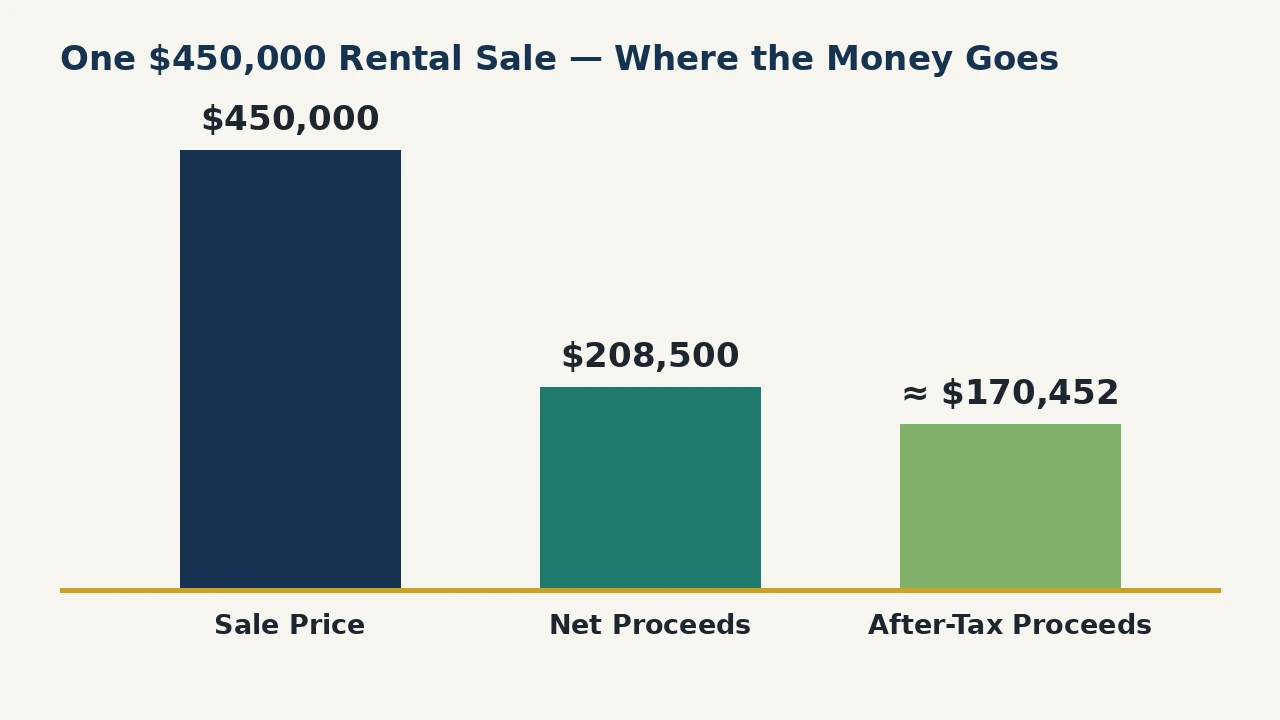
The after-tax figure is roughly $38,000 below the cheque and roughly $280,000 below the headline price. That gap — invisible in every standard net proceeds calculator — is the real answer to “how much do I make selling my rental?”
Three qualifications on the estimate
Three qualifications belong on the record. First, this is an illustrative estimate with stated assumptions: a single blended 15% rate on the non-recapture portion. Your actual bill depends on your total income for the year, your filing status, and how the gain stacks against your other income — the same gain can straddle two brackets.
Second, the example excludes state income tax, which many states apply to capital gains, and excludes the 3.8% net investment income tax (NIIT), which under IRS Topic No. 559 applies to net investment income — including gains from real estate dispositions, subject to the passive-activity rules — above modified adjusted gross income thresholds of $200,000 (single/head of household), $250,000 (married filing jointly) and $125,000 (married filing separately). Either can add thousands. Third, the rental portion of a sale is reported on Form 4797 with the gain flowing to Schedule D — this is a return you want a tax professional to prepare or at least review, particularly in a year with a six-figure gain. For the deductions side of landlording in ordinary (non-sale) years, see our guide to rental property taxes and landlord deductions.
The $250,000/$500,000 Home-Sale Exclusion — and Why a Pure Rental Misses It
Home sellers often assume the famous home-sale exclusion will shelter their rental sale. It will not, and the reason is mechanical. Under Section 121 (IRS Publication 523), you may exclude up to $250,000 of gain ($500,000 if married filing jointly) on the sale of your main home, provided you meet both tests over the five years before the sale: you owned the home, and you lived in it as your main home, for at least 24 months (730 days) — and you generally cannot use the exclusion more than once in two years.
A property held purely as a rental fails the residence test outright: nobody lived in it as their main home. So for a straightforward long-term rental, budget for the full gain to be taxable, as the worked example does.
Properties that changed roles
The honest nuance: partial and proration rules in Publication 523 govern properties that changed roles — a former main home converted to a rental, or a rental you later moved into — and the rules can sometimes still exclude part of a gain. One part stays taxable in any configuration: you must recapture the portion of gain equal to post-May 6, 1997 depreciation regardless. If your property has a lived-in chapter in its history, do not assume zero exclusion and do not assume full exclusion — that is a specific, documentable calculation, and it is worth professional advice because the dollars at stake are large.
Comparing Offers: Why the Highest Price Can Net You Less
Once you can run a net sheet, you can do the thing the best paid tools charge for: compare offers by what they net, not what they promise. Concessions, credits, and who-pays-what terms move the bottom line as surely as price does.
Say our example seller receives a second offer, $5,000 higher at $455,000 — but it asks for a $10,000 seller credit toward the buyer’s costs, on otherwise identical terms:
| Line | Offer A ($450,000) | Offer B ($455,000) |
|---|---|---|
| Sale price | $450,000 | $455,000 |
| Commission at 5.5% | − $24,750 | − $25,025 |
| Other closing costs at 1.5% | − $6,750 | − $6,825 |
| Seller concessions | $0 | − $10,000 |
| Mortgage payoff | − $210,000 | − $210,000 |
| Net proceeds | $208,500 | $203,150 |

The “higher” offer nets $5,350 less. Price is only the first line of the sheet; every term after it is negotiable money.
Financing certainty matters too.
Net is not the only dimension, either. Weigh financing certainty (a cash or strongly pre-approved buyer versus a fragile loan), appraisal risk (an over-ask price that fails appraisal re-opens negotiation), inspection and repair-credit exposure, and closing timeline against your payoff quote’s good-through date and, for a tenanted property, the lease. The right comparison is net proceeds adjusted for the probability the deal actually closes on those terms.
The Net-Sheet Worksheet: Never Double-Count a Cost
The cleanest way to keep your own calculation honest is the two-column worksheet agents’ net sheets imply but rarely show. Put every dollar in exactly one column:
Column 1 — Deducted at closing (these go in the formula): commission; owner’s title policy; escrow/settlement and attorney fees; recording fees and transfer tax; prorated taxes/HOA to the closing date; seller concessions and credits; and the payoff of every loan, taken from payoff statements.
Column 2 — Already paid before closing (these do not go in the formula): repairs and prep work already completed and paid for; staging already invoiced; marketing or flat-fee listing charges already paid; any pre-listing appraisal or inspection you bought.
Your net proceeds come from Column 1. Together, the two columns produce your true all-in cost of selling — the figure to use when you judge whether the sale beat your alternatives. Mixing the columns is how sellers double-count a $6,000 roof repair, understate their proceeds, and occasionally walk away from a good offer for an arithmetic reason.
Whatever your worksheet says, reconcile it twice: once against your agent’s preliminary net sheet when you list, and once against the seller’s side of the Closing Disclosure, which the CFPB requires to reach you at least three business days before closing. Your estimate is a planning tool; that document is the transaction.
Common Net Proceeds Mistakes Landlords Make
- Using the statement balance as the payoff. It understates what you owe by the interest accrued to closing day. Always use an official payoff statement.
- Forgetting a second lien or HELOC. Every loan on the title must clear at closing. Landlords hold equity lines far more often than homeowners do — check, don’t remember.
- Double-counting prep costs. Paid before closing means paid. Keep them in Column 2 of the worksheet.
- Letting a calculator default set your commission. A preset 6% is nobody’s research. Enter your signed listing rate and the buyer-side terms actually agreed, especially under the post-2024 rules.
- Assuming the home-sale exclusion covers a rental. It covers a main home. A pure rental fails the residence test, and the depreciation portion of any gain is never excludable.
- Ignoring depreciation recapture — or assuming unclaimed depreciation escapes it. Depreciation allowed or allowable reduces your basis. Recapture arrives either way; the only question is whether you collected the deductions on the way.
- Treating the cheque as spendable profit. In the worked example, $38,048 of the $208,500 cheque is an estimated federal tax bill. Park the tax share until you file the return.
- Skipping the reconciliation. If your net sheet and the Closing Disclosure disagree, the time to find out is three business days before closing, not at the table.
Keep the Cash or Defer the Tax? The 1031 Exchange Decision
Your after-tax number frames the real endgame question. If roughly $38,000 of your proceeds is heading to the IRS, you have three broad paths: pay the tax and keep the remaining cash; pay the tax and reinvest what’s left in something new; or defer the entire tax bill with a Section 1031 exchange — selling the rental and rolling the proceeds into a replacement investment property under the exchange rules, so the exchange defers the gain (including the recapture) instead of recognising it now.
An exchange is not a loophole you can improvise after the fact: it has to be structured in advance, with strict identification and exchange deadlines and a qualified intermediary holding the funds — our full guide to using a 1031 exchange to defer capital gains on a rental property walks through the rules, deadlines and costs. To size the benefit before you commit, run your own figures through CalcLandlord’s 1031 Exchange Calculator: enter your original purchase price, current market value, current loan balance and tax bracket, and it estimates your unrealised gain and the tax an exchange would defer — the same inputs this article taught you to compute, pointed at the opposite decision.
The decision rule
The decision rule is simple to state and personal to apply: an exchange makes sense when you intend to stay invested in real estate, and the deferred tax is large enough to justify the deadlines and costs; taking the cash makes sense when you are genuinely exiting. Either way, decide before you list, because only one of the paths is still available after the sale closes. (Whether to sell at all, versus keeping the property and renting it — that is the prior question, and it has its own decision framework; this article’s job is to make sure that whichever way you go, you go with the real numbers.)
People Also Ask
Start with the sale price and subtract, in order: the agent commission, your other seller closing costs (title, escrow, recording, transfer tax, prorations), any seller concessions, and the payoff of every loan on the property. What remains is your net proceeds. Landlords then take one more step most calculators skip: subtract the estimated tax on your gain to reach your after-tax proceeds.
It takes your sale price, commission rate, closing costs, and mortgage payoff, and returns your estimated net proceeds — usually with total selling costs shown as a percentage of the price and an itemised breakdown. Standard calculators stop there: they show the closing cheque only, not the after-tax figure, which is why rental sellers should pair any calculator result with the basis and recapture calculation in this guide.
Including commission, total selling costs are commonly estimated at roughly 8–12% of the sale price — a rule-of-thumb range, not an official statistic. In this article’s worked example, the itemised total came to exactly 7.0% ($31,500 on a $450,000 sale) because the commission was negotiated to 5.5% and non-commission costs were lean. Your own itemised net sheet is the only estimate worth trusting.
Typically: the agent commission (as agreed in the listing agreement and contract, including any buyer-side compensation the seller has agreed to), the owner’s title policy in many states, escrow/settlement or attorney fees, recording fees and any transfer tax your jurisdiction charges, prorated property taxes and HOA dues to the closing date, any agreed seller concessions — and the full payoff of every mortgage, second loan and HELOC on the property.
Both sides pay their own. Buyers pay for their loan and an appraisal, and their own title policy; sellers pay the items listed in the answer above. The split of specific items — the owner’s title policy is the classic example — follows local custom and the contract, so nearly every line is ultimately a negotiated term, and since the August 2024 NAR practice changes, buyer-agent compensation is an explicit negotiated term as well.
It depends on your gain (amount realised minus adjusted basis), how much of that gain is depreciation recapture (taxed at up to 25%), where the rest falls in the 0%/15%/20% long-term brackets for your income and filing status, plus possible state tax and the 3.8% net investment income tax at higher incomes. In this article’s worked example, a $191,591 gain produced an estimated federal tax of about $38,048. Your figure requires your own basis and income — there is no safe percentage shortcut.
While you owned the rental, depreciation reduced your taxable income each year — and reduced your basis by the same amount. At sale, the portion of your gain equal to that accumulated depreciation is “recaptured”: it is taxed at a maximum rate of 25% (the IRS calls it unrecaptured Section 1250 gain). In the example, $93,091 of accumulated depreciation produced about $23,273 of the tax bill. Estimate your accumulated depreciation by dividing the building’s depreciable value by 27.5, then multiplying by the years held.
Only to a main home. The Section 121 exclusion requires that you owned the property and lived in it as your main home for at least 24 months (730 days) in the five years before the sale. A property held purely as a rental fails that use test. Converted properties (part home, part rental over their history) follow proration rules in IRS Publication 523, and the depreciation portion of the gain can never be excluded in any case.
Yes. Basis is reduced by depreciation that was allowed or allowable — the depreciation you were entitled to take, whether or not you claimed it (IRS Publication 523). Not claiming it costs you the annual deductions and saves you nothing at sale, which is why landlords should claim depreciation every year and keep the records.
No. Net proceeds are cash: price minus selling costs minus loan payoffs. Profit (taxable gain) is the amount realised minus adjusted basis, and the mortgage plays no part in it. In the worked example the cheque was $208,500 while the taxable gain was $191,591 — different numbers, answering different questions, and the second one sets your tax bill.
It must be paid off and closed out at the sale, in full, from your proceeds — every loan secured by the property has to clear for title to transfer. Include the official payoff figure for each loan in your net sheet, including a HELOC you believe is at or near zero; the payoff statement, not your memory or your app balance, is the number that closes.
Yes — a properly structured Section 1031 exchange defers the entire gain, including the depreciation recapture, when you roll the proceeds into a replacement investment property. It must be set up before the sale closes, uses a qualified intermediary, and runs on strict identification and exchange deadlines, so it is a plan you make while listing, not after closing. Our 1031 exchange guide covers the rules and deadlines, and the 1031 Exchange Calculator estimates the tax you would defer.
Key Takeaways
A sale has three numbers, not one: the price, the cheque, and what survives tax. Itemise your net sheet instead of estimating it (payoff statements, your signed commission terms, your local fees); treat commission as the negotiable line it became in August 2024; build your adjusted basis before you list so the recapture bill is a plan, not a surprise; and reconcile everything against the Closing Disclosure three business days out. Then make the endgame decision with real figures — take the after-tax cash, or defer the whole tax bill through a 1031 exchange using CalcLandlord’s 1031 Exchange Calculator and the companion 1031 guide.
Your next steps, in order: order payoff statements for every loan, reconstruct your depreciation history (the Depreciation Calculator does the arithmetic), run your net sheet at two or three commission rates, and — if the projected gain is large — talk to a tax professional before the listing goes live, while every option is still open.
Disclaimer: This article is for educational and informational purposes only and does not constitute legal, tax, accounting, or financial advice. Tax rates, thresholds, and laws vary by jurisdiction and change over time, and individual circumstances differ. The worked examples are hypothetical illustrations with stated assumptions, not predictions of any reader’s result. Consult a qualified professional for advice about your specific situation.
