
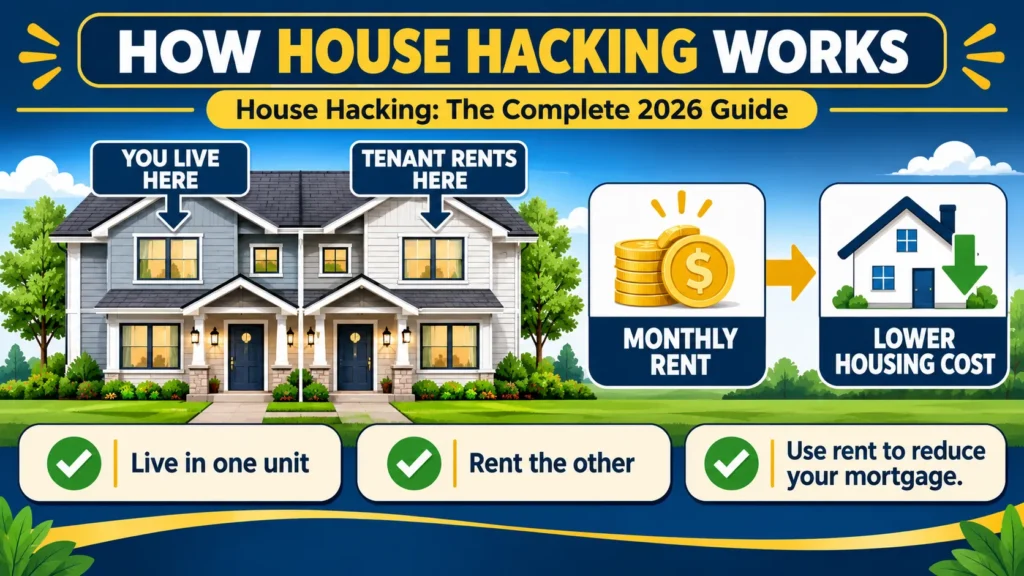
House Hacking: The Complete Guide to Lower Housing Costs & Build Wealth
Your monthly housing payment can feel like money that disappears. House hacking offers another approach: buy a property, live in one part, and rent out the rest to help cover ownership costs. A duplex, spare bedroom, or permitted accessory dwelling unit may create rental income—but the numbers need to work before you buy. You must account for the mortgage, taxes, insurance, repairs, vacancy, financing rules, and local rental laws. This guide shows how house hacking works, compares practical strategies, and walks through a sample deal so you can judge whether the potential savings justify the responsibilities and daily management work.
House hacking is a real estate investment strategy that allows you to live in a property while renting out part of it to generate income and reduce your monthly housing expenses. Instead of paying the entire mortgage yourself, you use rental income from roommates, separate units, or an accessory dwelling unit (ADU) to offset the cost of ownership.
For first-time real estate investors, house hacking can provide an opportunity to enter the rental property market while living in the property they own. Experienced investors can also use it to build equity, develop landlord experience, and potentially convert an owner-occupied property into a long-term rental.
However, a successful house hack requires more than finding tenants who can pay rent. You need to evaluate purchase price, financing, rental demand, operating expenses, property condition, local rental regulations, and your ability to manage tenants while living on-site.
This guide explains how house hacking works, compares the most practical strategies, examines financing options, walks through a realistic duplex investment example, and provides a framework for deciding whether your first house hack makes financial sense.
1. What Is House Hacking and How Does It Work?
House hacking is a real estate strategy in which you purchase or own a property, live in part of it, and rent out the remaining space to generate income.
The rental income helps cover your mortgage and other housing expenses. Rather than purchasing a traditional investment property that you never occupy, you combine your primary residence with a small rental business.
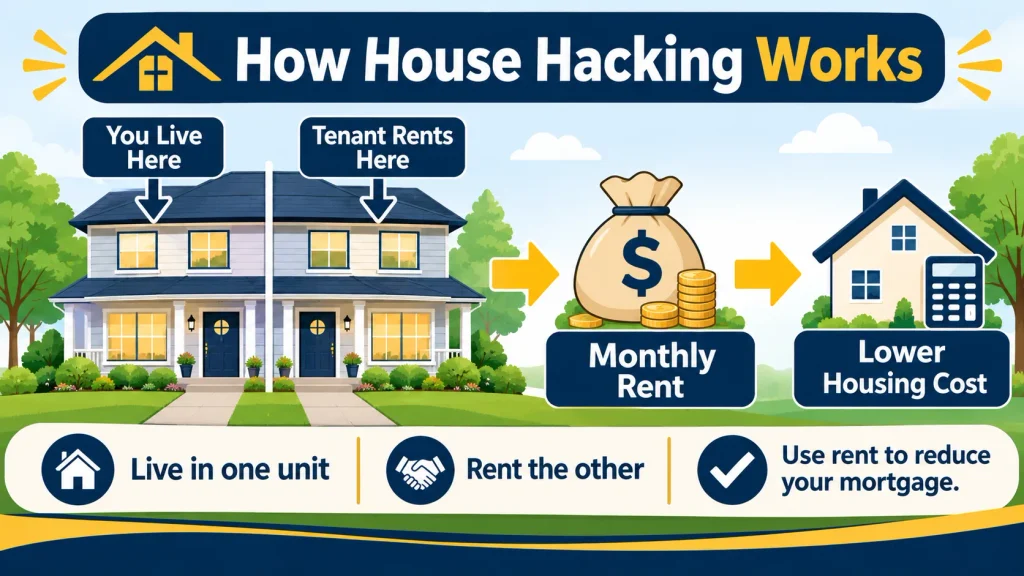
For example, imagine purchasing a duplex with two separate apartments. You move into the first apartment and rent the second apartment to a tenant. The tenant’s monthly rent helps pay the mortgage, insurance, property taxes, and maintenance.
How the house-hacking strategy works
The process generally follows five steps:
- Purchase a property that allows owner occupancy and your intended rental arrangement.
- Move into one unit, bedroom, or designated living space.
- Rent the remaining legal living space to tenants.
- Collect rent and apply the income toward property expenses.
- Manage the property, maintain financial records, and monitor your housing costs.
The objective is to reduce your personal housing expenses while building equity in an asset.
Example of house hacking
Suppose you purchase a duplex with the following monthly expenses:
| Expense | Monthly cost |
| Mortgage principal and interest | $2,400 |
| Property taxes | $400 |
| Insurance | $150 |
| Maintenance reserve | $200 |
| Utilities | $150 |
| Total | $3,300 |
You rent the second unit for $1,600 per month.
Your effective monthly housing cost becomes:
\[ \$3,300-\$1,600=\$1,700 \]
You are effectively reducing your monthly housing expense from $3,300 to $1,700 before considering any omitted expenses or adjustments.
This is the central principle behind house hacking.
Is house hacking the same as traditional rental investing?
No. Traditional rental investing generally involves purchasing a property to generate income from tenants without living there.
House hacking combines two purposes:
- Providing housing for the owner.
- Generating rental income from the remaining property.
This distinction matters because the owner’s living expenses should not be confused with the rental property’s actual investment profitability.
Important: House hacking does not automatically mean living for free. A tenant may cover only part of the mortgage, and you remain responsible for unexpected repairs, vacancies, and other ownership expenses.
2. How to Start House Hacking as a Beginner
Starting a house hack requires more planning than simply purchasing a property and finding a roommate.
Your first goal should be to identify a property that fits your financial situation, lifestyle, financing eligibility, and local rental regulations.
Step 1: Determine your house-hacking objective
Decide what you want to accomplish.
Possible objectives include:
- Reducing monthly housing expenses.
- Building equity through property ownership.
- Learning how to manage tenants.
- Purchasing your first multifamily property.
- Creating a future long-term rental.
- Building a foundation for a larger real estate portfolio.
Your objective influences which property and rental strategy make sense.
For example, someone who values privacy may prefer a duplex with separate entrances, while someone focused on maximizing rental income might consider a fourplex.
Step 2: Evaluate your financial position
Before searching for properties, calculate how much money you can realistically invest.
Consider:
- Available down payment.
- Closing costs.
- Mortgage qualification.
- Credit history.
- Monthly income.
- Existing debts.
- Emergency savings.
- Initial repair expenses.
- Moving expenses.
Do not use every dollar of savings toward the down payment.
A house hacker needs reserves because a vacant rental unit does not stop the mortgage payment.
Step 3: Research rental demand
Study the rental market in your target neighborhood.
Compare properties with similar:
- Bedroom and bathroom counts.
- Square footage.
- Property conditions.
- Parking arrangements.
- Amenities.
- Locations.
- Lease terms.
Do not assume that an advertised rental price represents the rent you will actually collect.
Look for comparable properties that have recently rented, rather than relying exclusively on asking prices.
Step 4: Get financing preapproval
Contact lenders who understand owner-occupied multifamily properties.
Ask about FHA, VA, and conventional financing options, including:
- Minimum down payment.
- Credit requirements.
- Occupancy rules.
- Mortgage insurance.
- Required reserves.
- Whether projected rental income can help you qualify.
- Property eligibility.
Obtain a written estimate of your expected monthly payment.
Step 5: Evaluate the property before making an offer
Inspect the building and confirm that the intended rental arrangement is legally permitted.
Review the roof, foundation, plumbing, electrical system, HVAC, appliances, entrances, parking, and other important components.
Also confirm whether the property has unauthorized conversions or unpermitted rental units.
Step 6: Prepare for landlord responsibilities
Before moving in, establish:
- Written rental agreements.
- Tenant screening procedures.
- Rent collection methods.
- Maintenance arrangements.
- Emergency contact procedures.
- Property insurance.
- Recordkeeping systems.
Beginner tip: Your first house hack should be manageable, not unnecessarily complicated. A property with one separate rental unit may be a better learning experience than a large building with multiple tenants and extensive maintenance requirements.
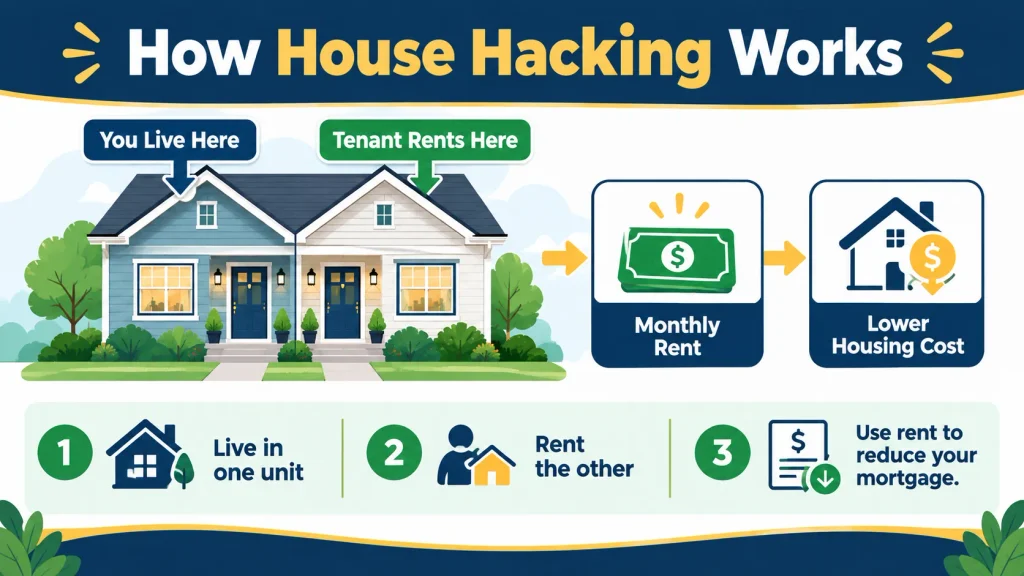
3. What Are the Best House Hacking Strategies for Real Estate Investors?
There is no single house-hacking strategy that works for every investor.
The best approach depends on available capital, property layout, rental demand, privacy preferences, local regulations, and the amount of work you are willing to handle.
4429 Sterling St Unit A and B, Houston, TX 77051 | Redfin
Student Apartments for Rent Near Northeastern Universitywith Short-Termm Lease – Off-Campus Housing | Northeastern University
ADU Rules in Fullerton: Simple Guide for Homeowners | Zach Mickelson
10
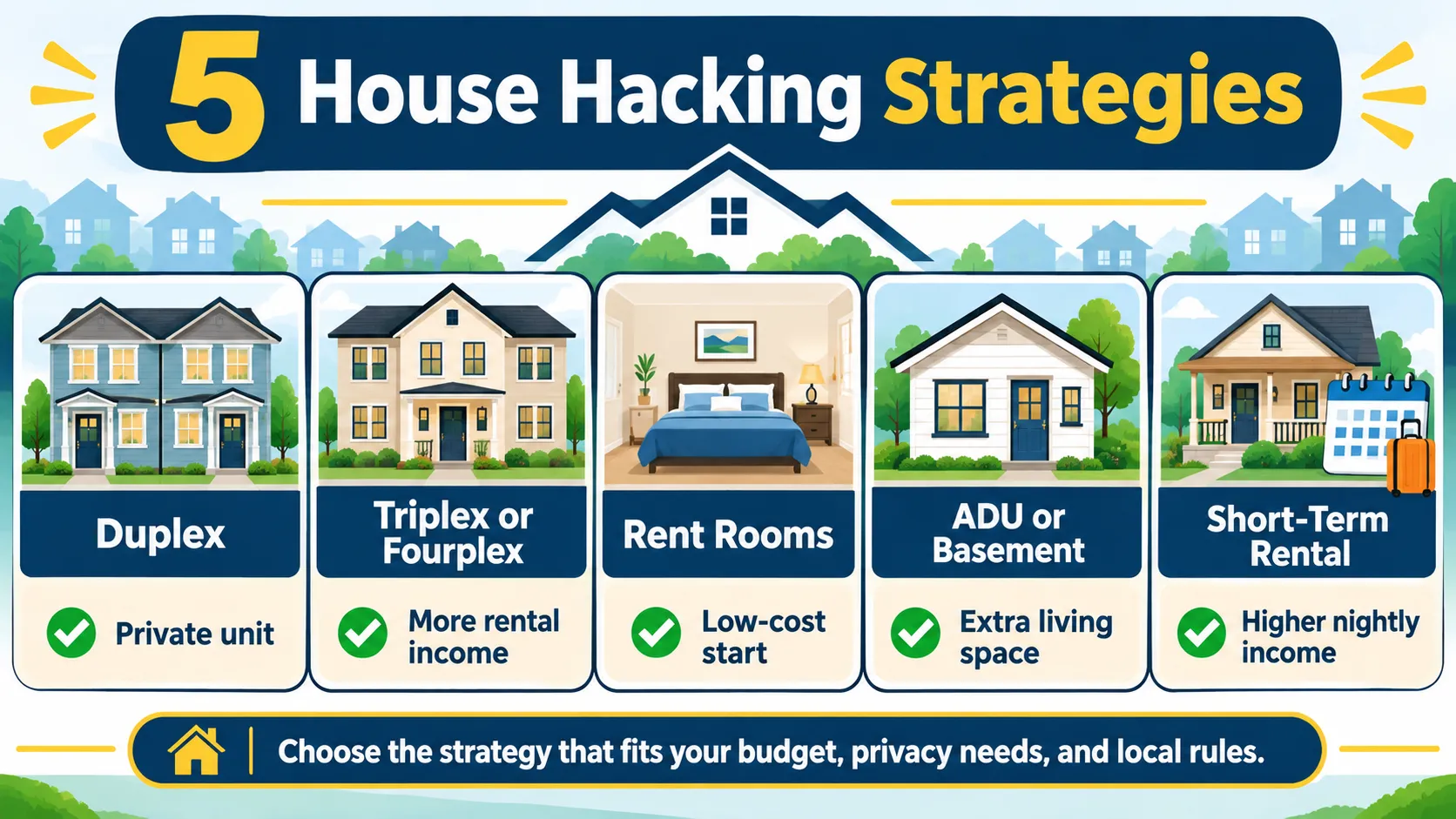
1. Duplex house hacking
A duplex contains two separate residential units.
You live in one unit and rent the other.
Advantages:
- Greater privacy than renting individual bedrooms.
- Separate living arrangements.
- Easier rental-income tracking.
- Potential to convert both units into rentals later.
Limitations:
- Only one rental unit may be available to offset expenses.
- A vacancy can eliminate most rental income.
- Repairs can affect both households.
Best for: First-time investors who want a relatively straightforward owner-occupied rental property.
2. Triplex and fourplex house hacking
A triplex contains three units, while a fourplex contains four.
You occupy one unit and rent the remaining units.
For example, a fourplex could generate rental income from three separate households.
Advantages:
- Multiple rental-income sources.
- Reduced dependence on one tenant.
- Greater potential to offset housing expenses.
Limitations:
- More tenant-management responsibilities.
- Higher maintenance exposure.
- More complicated financing and property underwriting.
- Greater vacancy and repair coordination.
Best for: Investors with stronger financial reserves and an interest in multifamily ownership.
3. Renting spare bedrooms
You purchase a single-family home and rent individual bedrooms to roommates.
This can work well when a property has multiple bedrooms, shared common areas, and sufficient demand for room rentals.
However, you must consider privacy, shared utilities, parking, occupancy limits, and roommate compatibility.
Best for: Buyers who want to start with a conventional single-family home rather than purchasing a multifamily property.
4. ADU and basement house hacking
An accessory dwelling unit (ADU) is a separate residential living space located on the same property as the primary home.
Examples include:
- Detached backyard cottages.
- Converted garages.
- Basement apartments.
- Attached in-law suites.
An ADU can provide a separate rental space without requiring you to share your kitchen or living room.
However, zoning, permits, building codes, utility arrangements, and legal occupancy must be verified.
Best for: Homeowners with suitable additional space and sufficient renovation capital.
5. Short-term rental house hacking
You rent an eligible room or separate unit to guests for short stays.
This approach can work in markets with suitable tourism or business-travel demand.
However, nightly rental income should never be calculated using full occupancy throughout the year.
Consider:
- Seasonal demand.
- Cleaning costs.
- Furnishing.
- Booking platform charges.
- Guest communication.
- Local short-term rental restrictions.
- Additional insurance requirements.
Best for: Owners who are comfortable with hospitality operations and local laws permit the activity.
6. Renting parking, storage, or garage space
Some homeowners can earn supplemental income from unused parking spaces, garages, sheds, or storage areas.
This may involve less tenant interaction than renting a bedroom, although zoning, insurance, access, security, and local restrictions still matter.
Best for: Homeowners who want additional income without sharing their living space.
House hacking strategy comparison
| Strategy | Privacy | Management | Income potential |
| Duplex | High | Moderate | Moderate |
| Triplex/fourplex | High | Higher | Potentially higher |
| Room rental | Lower | Moderate | Depends on rooms |
| ADU | High | Moderate | Depends on local rent |
| Short-term rental | Variable | High | Highly variable |
| Parking/storage | High | Low to moderate | Supplemental |
Income potential is market-dependent, not guaranteed by property type.
4. How to Choose the Right Property for House Hacking
A successful house hack starts with buying the right property at the right price.
A property may look attractive because of its low purchase price, but expensive repairs, weak rental demand, or restrictive zoning can make it financially unsuitable.
Evaluate the neighborhood
Research the factors that influence tenant demand:
- Employment opportunities.
- Public transportation.
- Schools and educational institutions.
- Hospitals and healthcare facilities.
- Shopping and grocery stores.
- Local amenities.
- Neighborhood safety information.
- Access to major roads.
Do not assume that population growth automatically creates rental demand. Confirm what tenants are actually paying for comparable housing.
Compare property characteristics
Before purchasing, evaluate these features:
| Property feature | Why it matters |
| Separate entrance | Improves tenant privacy |
| Separate utilities | Simplifies expense allocation |
| Parking | Can increase rental appeal |
| Sound insulation | Reduces household conflicts |
| Laundry facilities | Improves convenience |
| Functional layout | Makes space easier to rent |
| Property condition | Helps control maintenance costs |
| Legal unit status | Reduces regulatory risk |
Use comparable rental properties
Rental comparables help estimate what your available unit could reasonably earn.
For example:
| Comparable property | Monthly asking rent |
| Similar one-bedroom apartment A | $1,450 |
| Similar one-bedroom apartment B | $1,525 |
| Similar one-bedroom apartment C | $1,475 |
| Average asking rent | $1,483 |
This suggests an initial estimated rent of approximately $1,483.
However, asking rent is not the same as achieved rent. Check recently leased properties and adjust for condition, location, amenities, and lease terms.
Inspect the property carefully.
A professional inspection can help identify problems that may not be visible during a property showing.
Pay particular attention to:
- Roof condition.
- Foundation movement.
- Water damage.
- Plumbing leaks.
- Electrical safety.
- Heating and cooling systems.
- Drainage.
- Pest damage.
- Fire safety.
- Unpermitted alterations.
Practical advice: Never purchase a house hack based solely on projected rental income. Verify the property condition, rental comparables, financing, and legal use before committing.
5. How to Finance a House Hack With FHA, VA, and Conventional Loans
Financing is one of the most important parts of house hacking because owner-occupied mortgage programs may offer different terms from conventional investment-property financing.
However, lower down payments do not automatically make a property affordable.
Your lender must evaluate your eligibility, income, credit, debts, reserves, property type, and occupancy plans.
FHA financing
The Federal Housing Administration insures qualifying mortgages through FHA-approved lenders.
HUD states that eligible FHA borrowers may qualify for down payments as low as 3.5% on qualifying one-to-four-unit properties. This is subject to borrower, property, loan-limit, and program requirements.
hud.gov+1
For example:
| Purchase price | 3.5% down payment |
| $250,000 | $8,750 |
| $300,000 | $10,500 |
| $350,000 | $12,250 |
| $400,000 | $14,000 |
These amounts represent down payments only. They exclude closing costs, prepaid expenses, required reserves, repairs, and other cash needed to complete the purchase.
FHA loans also involve mortgage insurance requirements.
Important four-unit financing consideration: FHA financing for three- to four-unit properties includes a self-sufficiency rental-income test. HUD’s handbook describes calculating eligible net rental income using appraiser-estimated market rents and a vacancy and maintenance adjustment. The resulting amount must satisfy the applicable property payment test. Verify the current handbook and lender interpretation before making an offer.
hud.gov+1
VA financing
Eligible veterans, active-duty service members, and certain surviving spouses may qualify for VA-backed home loans.
VA financing can be relevant to house hackers purchasing a qualifying multifamily property when the borrower occupies one unit.
The borrower must satisfy VA eligibility, occupancy, lender underwriting, and property requirements. Multifamily underwriting can also involve additional reserves and evidence that the borrower can manage the property.
knowva.ebenefits.va.gov+1
VA loans may offer no-down-payment financing to eligible borrowers, subject to entitlement, appraisal, lender approval, and other applicable requirements.
Conventional financing
Conventional mortgages may offer another route for owner-occupied duplexes, triplexes, and fourplexes.
The down payment and qualification requirements depend on the loan program and transaction.
Some conventional programs also have specific requirements concerning rental-income documentation.
For example, Fannie Mae provides guidance for using rental income from qualifying two- to four-unit principal residences and certain ADUs when determining borrower eligibility.
Fannie Mae+1
Financing comparison
| Financing option | Potential advantage | Important consideration |
| FHA | Down payments can start at 3.5% for eligible borrowers | Mortgage insurance and occupancy requirements |
| VA | Potential zero-down financing | Military eligibility and underwriting |
| Conventional | Multiple owner-occupied financing options | Program-specific down payment and qualification rules |
| Renovation financing | May help finance eligible improvements | Additional property and renovation requirements |
What should you ask your mortgage lender?
Before selecting a financing program, ask:
- Can I purchase this specific property type?
- Must I occupy the property as my primary residence?
- How long must I satisfy the occupancy requirement?
- Can projected rental income help me qualify?
- What mortgage insurance will apply?
- How much money must I keep in reserves?
- Are there special requirements for a three- or four-unit property?
- What happens if the property needs repairs?
Never assume that a financing program permits a particular arrangement simply because another investor successfully used it.
6. How to Calculate House Hacking Cash Flow and Monthly Housing Costs
Understanding the numbers is essential before purchasing an owner-occupied rental property.
A house hack can significantly reduce your monthly housing costs, but you should distinguish between your effective housing cost and the property’s investment cash flow.
These are not interchangeable measurements.
House hacking monthly housing-coformulamul.a
A simple formula is:
EffectiveHousingCost=TotalMonthlyPropertyCosts-CollectedRentalIncome
Total monthly property costs should include relevant ownership and operating expenses, such as:
- Mortgage principal and interest.
- Property taxes.
- Insurance.
- Mortgage insurance.
- Utilities.
- Maintenance.
- Capital expenditure reserves.
- Vacancy allowance.
- HOA fees, where applicable.
Calculate the rent-offset percenta..ge
The rent-offset percentage shows how much of your monthly property cost is covered by rental income.
RentOffset=MonthlyRentalIncomeTotalMonthlyPropertyCosts100
For example, if monthly rental income is $1,600 and total monthly costs are $3,200:
\[ \frac{1600}{3200}\times100=50\% \]
Your rental income offsets 50% of the monthly property costs.
House hacking example
Consider a hypothetical duplex purchased for $400,000.
The owner lives in Unit A and rents Unit B.
Assume the lender’s quoted monthly principal and interest payment is $2,450.
| Expense | Monthly amount |
| Mortgage principal and interest | $2,450 |
| Property taxes | $450 |
| Insurance | $150 |
| Mortgage insurance allowance | $200 |
| Utilities and shared costs | $150 |
| Maintenance reserve | $200 |
| Capital expenditure reserve | $150 |
| Vacancy allowance | $90 |
| Total monthly costs | $3,840 |
| Rent from Unit B | $1,800 |
| Effective housing cost | $2,040 |
The owner pays an effective $2,040 per month toward housing after rental income.
The rent-offset percentage is:
\[ \frac{1800}{3840}\times100=46.875\% \]
46.9% rent offset
This example illustrates how rental income can reduce the cost of living in an owner-occupied property.
It does not mean the property produces $1,800 in investment profit. The owner still consumes one unit as personal housing.
What happens if the tenant leaves?
Suppose the rental unit remains vacant for two months.
During that period, the owner must cover the full monthly property costs of $3,840, assuming no other expenses change.
Two months of vacancy would require:
\[ \$3,840\times2=\$7,680 \]
This is why emergency reserves are essential.
Compare different rental-income scenarios
| Monthly rent | Effective housing cost |
| $1,400 | $2,440 |
| $1,600 | $2,240 |
| $1,800 | $2,040 |
| $2,000 | $1,840 |
| $2,200 | $1,640 |
The table assumes all other monthly expenses remain unchanged.
When should you use a calculator?
A rental property cash flow calculator can help you test income and expenses, while a mortgage calculator can estimate financing payments.
For a house hack, use both to understand the full picture.
Include conservative rent estimates, vacancy, insurance, maintenance, taxes, and mortgage costs rather than relying on gross rent alone.
7. House Hacking Example: Analyzing a Duplex Investment
A duplex is one of the most straightforward properties to evaluate when considering house hacking.
However, the best purchase is not necessarily the property with the highest advertised rent. You should evaluate the purchase price, financing, expected rental income, operating expenses, and future investment potential together.
Example: Comparing two duplex opportunities
Suppose you are evaluating two properties.
| Financial factor | Property A | Property B |
| Purchase price | $350,000 | $400,000 |
| Monthly rent from other unit | $1,400 | $1,800 |
| Monthly property costs | $3,200 | $3,840 |
| Effective housing cost | $1,800 | $2,040 |
| Rent-offset percentage | 43.75% | 46.88% |
Property A has a lower effective housing cost of $1,800, while Property B provides a slightly stronger rental-income offset.
Which is better?
It depends on your objectives.
- Property A may suit someone prioritizing lower monthly housing expenses.
- Property B may appeal to someone who values a higher rental-income contribution and potentially stronger rental demand.
However, these figures alone do not establish which property is the better investment.
You still need to compare property condition, neighborhood quality, future repairs, financing costs, and the market value of each unit.
Calculate the property’s future investment performance.
An important consideration is what happens when you eventually move out.
Suppose both units in Property B can generate $1,800 per month.
Potential gross annual rental income would be:
\[ \$1,800\times2\times12=\$43,200 \]
However, this is gross income, not profit.
You must subtract:
- Vacancy.
- Property management.
- Repairs and maintenance.
- Insurance.
- Property taxes.
- Utilities paid by the owner.
- Capital expenditure reserves.
- Other operating expenses.
You must also account for the mortgage payment when calculating the property’s cash flow after financing.
Perform a sensitivity analysis
Before purchasing, test three situations:
| Scenario | What to evaluate |
| Expected case | Realistic rent and normal expenses |
| Conservative case | Lower rent and higher maintenance |
| Stress case | Extended vacancy and unexpected repairs |
For example, if the expected rent is $1,800, test whether the property remains affordable when rent falls to $1,620.
That represents a 10% rental-income reduction.
If the property becomes financially unmanageable after a modest income reduction, you may be taking on too much risk.
Investor takeaway: A successful house hack should make sense as both a place to live and a property you could potentially operate as a rental after moving out.
8. How to Find Profitable House Hacking Opportunities in Your Market
Finding a profitable house hack requires more than searching online listings for duplexes and fourplexes.
You need to identify properties where rental demand, purchase price, property condition, and financing work together.
Research local rental markets
Start by identifying neighborhoods where tenants are actively searching for housing.
Research:
- Recent rental listings.
- Recently leased comparable properties.
- Typical vacancy periods.
- Rental prices by bedroom count.
- Local employment opportunities.
- Transportation access.
- Property tax levels.
- Insurance costs.
- New residential construction.
Pay attention to differences between advertised rents and actual signed leases.
Use a rental comparable analysis
Rental comparables help estimate the realistic income of a property.
For example, imagine you are evaluating a duplex with a two-bedroom rental unit.
You find three similar properties:
| Rental comparable | Monthly rent |
| Comparable A | $1,650 |
| Comparable B | $1,700 |
| Comparable C | $1,750 |
| Average | $1,700 |
The initial market-rent estimate is $1,700 per month.
However, you should adjust this estimate for differences in property condition, parking, laundry, location, and utilities.
A property with outdated appliances and no parking may not achieve the same rent as a renovated comparable.
Where to find house hacking properties
Consider the following sources:
- Multiple Listing Service (MLS) listings through a real estate agent.
- Real estate websites with duplex and multifamily filters.
- Local investor networks.
- Real estate investment associations.
- Direct conversations with property owners.
- Local real estate agents specializing in multifamily properties.
- Neighborhood research and property-owner outreach.
What should you look for in a deal?
Prioritize properties with: Legally separate rental units.
- Legal separate rental units.
- Reasonable purchase prices.
- Strong rental demand.
- Manageable maintenance requirements.
- Suitable financing eligibility.
- Adequate parking.
- Functional layouts.
- Sustainable property taxes and insurance.
Avoid purchasing a property simply because the seller advertises it as an income-producing opportunity.
Verify the rental history and property condition independently.
Calculate your maximum affordable purchase price
Work backward from your target monthly housing cost.
For example, suppose you can comfortably afford an effective housing expense of $1,800 and expect to collect $1,600 in monthly rent.
Your maximum total monthly property cost would be:
\[ \$1,800+\$1,600=\$3,400 \]
This gives you a preliminary affordability target.
You can then work with a mortgage lender and use local tax, insurance, and maintenance estimates to determine an appropriate purchase-price range.
9. What Legal Requirements Should You Check Before House Hacking?
House hacking involves both homeownership and rental operations.
That means you must understand the rules governing the property before renting out any portion of it.
A property can be physically suitable for tenants but legally unsuitable for the rental arrangement you intend to use.
Check zoning and permitted property use
Local zoning regulations may determine:
- Whether a property can contain multiple dwelling units.
- Whether basement apartments are permitted.
- Whether garage conversions are allowed.
- Whether an ADU can be constructed.
- How many unrelated occupants can live in a home.
- Whether short-term rentals are permitted.
Contact the local planning or zoning department before purchasing.
Verify permits and legal unit status.
A converted basement or garage does not automatically qualify as a legal rental unit.
Check whether the property has the necessary:
- Building permits.
- Electrical approvals.
- Plumbing approvals.
- Occupancy approvals.
- Fire and safety compliance.
- Required inspections.
Unpermitted units can create problems with insurance, financing, resale, and local enforcement.
Review HOA and condominium restrictions.
If the property belongs to a homeowners association or condominium association, examine its governing documents.
Restrictions may apply to:
- Rental permissions.
- Minimum lease periods.
- Tenant registration.
- Short-term rentals.
- Parking.
- Shared spaces.
- Occupancy.
Do not assume that purchasing a property gives you unrestricted rental rights.
Understand landlord-tenant requirements
Rental laws vary by state and locality.
Depending on the jurisdiction, you may need to follow requirements involving:
- Written lease agreements.
- Security deposits.
- Deposit return deadlines.
- Rent increases.
- Entry notices.
- Habitability.
- Repair responsibilities.
- Eviction procedures.
- Required rental registrations.
- Local inspection requirements.
The Fair Housing Act also prohibits housing discrimination based on protected characteristics, including race, color, national origin, religion, sex, familial status, and disability. Apply lawful screening standards consistently.
hud.gov+1
House hacking legal checklist
| Requirement | What to verify |
| Zoning | Rental use is permitted |
| Building permits | All conversions are approved |
| Occupancy | Legal occupancy limits are satisfied |
| HOA | Rental activity is permitted |
| Insurance | Policy covers owner-occupied rental use |
| Lease | Agreement complies with local law |
| Fair housing | Screening and advertising are nondiscriminatory |
| Short-term rentals | Local licensing and restrictions are satisfied |
Important: Federal requirements do not replace state and local housing rules. Consult the relevant local authorities and a qualified real estate attorney when the property’s legal status is uncertain.
10. How to Manage Tenants While Living in Your Rental Property
Managing tenants is one of the biggest differences between ordinary homeownership and house hacking.
You are not simply sharing a building. You are operating a rental arrangement while maintaining your own private living space.
Good management practices can reduce disputes, protect the property, and make the experience more manageable.
Establish clear tenant screening standards
Before approving an applicant, establish a consistent screening process.
Depending on applicable laws and consent requirements, this may include:
- Identity verification.
- Income verification.
- Rental history.
- Credit history.
- References.
- Lawful background checks.
- Ability to meet lease obligations.
Apply the same lawful standards to every applicant.
Do not make rental decisions based on protected characteristics or inconsistent personal preferences.
Use a written rental agreementt
A written lease should explain:
- Monthly rent.
- Payment due date.
- Security deposit.
- Lease duration.
- Utility responsibilities.
- Maintenance obligations.
- Parking arrangements.
- Shared-space rules.
- Pet policies.
- Entry procedures.
- Notice requirements.
For room rentals, clearly identify which spaces are private and which are shared.
Establish personal boundaries
Living next to tenants can create situations that do not occur with traditional off-site rentals.
For example, tenants may approach you whenever they see you outside, even when they have a nonurgent maintenance request.
Create clear communication procedures.
You can establish:
- A dedicated email address.
- A tenant maintenance request process.
- Emergency contact instructions.
- Defined communication hours.
- Written rules for shared spaces.
Explain which situations qualify as genuine emergencies.
Maintain the property professionally.
Respond to legitimate maintenance requests promptly and comply with applicable habitability requirements.
Keep records of:
- Repair requests.
- Work completed.
- Contractor invoices.
- Inspections.
- Lease communications.
- Rent payments.
A maintenance log can help identify recurring problems and protect you when questions arise.
Should you hire a property manager?
A property manager may be helpful if you have several tenants, limited time, or difficulty managing disputes.
However, management fees reduce rental income.
For a simple duplex house hack, some owners prefer self-management. Others value the convenience of professional assistance.
Choose the approach that fits your schedule, experience, and financial model.
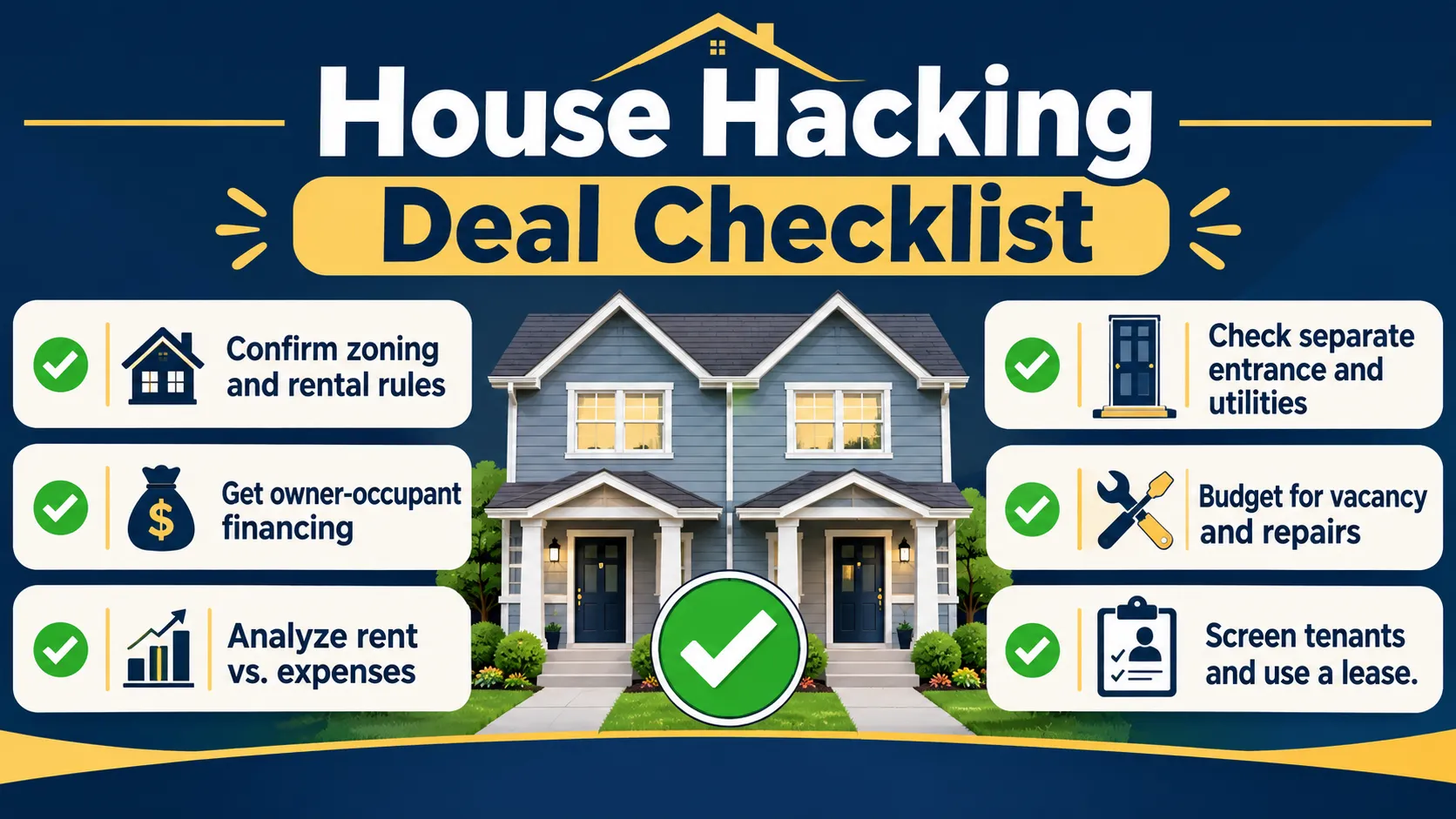
11. What Expenses and Taxes Should House Hackers Expect?
House hacking creates rental income, but it also introduces expenses that ordinary homeowners may not encounter.
You need to track these expenses carefully because your actual financial outcome depends on the amount of income remaining after eligible costs.
Common house-hacking expenses
| Expense | Why it matters |
| Mortgage interest | Financing cost |
| Property taxes | Recurring ownership expense |
| Insurance | Property and liability protection |
| Maintenance | Routine repairs |
| Capital improvements | Major long-term property upgrades |
| Utilities | Shared or owner-paid services |
| Vacancy | Lost rental income |
| Property management | Professional management fees |
| Advertising | Finding new tenants |
| Legal and professional services | Compliance and business support |
Remember that a capital improvement is not necessarily deductible in the same way as an ordinary repair. Tax treatment depends on the nature of the expense.
How is house-hacking rental income taxed?
In the United States, rental income is generally reportable for federal income-tax purposes.
However, when you rent part of your personal residence, the IRS requires appropriate allocation between personal and rental use.
For example, if you rent a separate unit in your duplex while living in the other unit, certain expenses may need to be allocated between the two uses.
Depending on the circumstances, allocation may involve square footage, usage, or another reasonable method.
The IRS discusses mixed personal and rental use, rental expenses, and applicable limitations in IRS Publication 527.
Internal Revenue Service+1
What expenses may be deductible?
Depending on the circumstances, eligible rental expenses may include:
- Rental portion of mortgage interest.
- Rental portion of property taxes.
- Insurance.
- Repairs.
- Utilities.
- Advertising.
- Property management.
- Eligible depreciation.
- Other ordinary and necessary rental expenses.
You generally cannot deduct personal living expenses as rental-business expenses.
Understanding rental property depreciation
Depreciation allows qualifying property owners to recover the cost of eligible depreciable property over an applicable recovery period.
However, a house hacker cannot simply depreciate the entire property while personally occupying part of it.
The rental portion must be properly determined, and land is not depreciable.
For many residential rental properties, the general federal recovery period is 27.5 years under the applicable rules.
Your basis, placed-in-service date, rental-use percentage, improvements, and other circumstances affect the calculation.
Keep organized financial records.
Maintain separate records for:
- Rental payments.
- Security deposits.
- Repairs.
- Insurance.
- Property taxes.
- Mortgage interest.
- Utility bills.
- Improvements.
- Professional services.
- Rental-related mileage where applicable.
Use a bookkeeping system that distinguishes personal expenses from rental expenses.
Tax tip: If you plan to move out and convert your former residence into a full rental property, discuss the tax consequences with a qualified CPA before making major decisions.
12. What Are the Biggest House Hacking Risks and Mistakes to Avoid?
House hacking can reduce housing costs, but it does not eliminate the financial risks of property ownership.
The biggest problems often occur when buyers underestimate costs, overestimate rental income, or purchase a property without understanding their legal and financing obligations.
1. Overestimating rental income
A property may be advertised with projected rent that is higher than what comparable units actually achieve.
Use recently leased properties to develop realistic rental assumptions.
Do not base your purchase decision on optimistic listing descriptions.
2. Underestimating maintenance
A property can require expensive repairs even when it appears well maintained.
Roof replacement, HVAC failure, plumbing problems, and water damage can create substantial costs.
Maintain separate reserves for routine maintenance and major capital expenditures.
3. Ignoring vacancy risk
A tenant may leave unexpectedly, fail to pay rent, or require eviction through the applicable legal process.
Your mortgage and ownership expenses continue during vacancy.
Make sure you can afford the property without assuming rent will arrive every month.
Explore More: https://calclandlord.com/passive-activity-loss-rules-rental-property/
4. Failing to verify legal rental status
An unpermitted basement apartment or garage conversion can create serious problems.
Verify legal occupancy and permitted use before purchasing.
5. Ignoring insurance requirements
A standard homeowners insurance policy may not automatically provide the coverage you need for rental activities.
Tell your insurer how the property will be used and obtain appropriate coverage.
6. Mixing personal and rental finances
Combining rental receipts, repair payments, and personal expenses can make tax reporting and financial analysis difficult.
Keep organized records and clearly separate rental transactions.
7. Ignoring privacy and lifestyle considerations
Your rental property is also your home.
Noise, shared entrances, parking disputes, and maintenance requests can affect your quality of life.
Choose a property layout that provides reasonable separation.
House hacking risk assessment
| Risk | Potential impact | Prevention |
| Vacancy | Reduced income | Maintain reserves |
| Repairs | Unexpected costs | Inspect and budget |
| Tenant disputes | Stress and legal costs | Use clear leases |
| Legal violations | Fines or restrictions | Verify local requirements |
| Insurance gaps | Financial exposure | Confirm rental coverage |
| Financing violations | Loan-related consequences | Follow occupancy requirements |
| Weak rental demand | Lower achievable rent | Research comparable leases |
The 10% rent-reduction test
Suppose you expect to collect $1,800 monthly.
Test a lower-rent scenario:
\[ \$1,800\times0.90=\$1,620 \]
Your property should remain affordable if rental income falls to $1,620.
Also test a period of complete vacancy.
If you cannot cover the full property payment temporarily, reconsider the purchase price, increase your reserves, or select a more affordable property.
13. What Are the Pros and Cons of House Hacking?
House hacking offers a combination of housing and investment benefits, but it also introduces responsibilities that traditional homebuyers may not expect.
Whether it is worthwhile depends on your financial position, lifestyle, and long-term investment goals.
Advantages of house hacking
1. Reduced housing expenses
Rental income can offset mortgage payments, property taxes, insurance, and other ownership costs.
2. Opportunity to build equity
Your mortgage payments may reduce the loan principal over time, while the property may appreciate. Neither equity growth nor appreciation is guaranteed.
3. Owner-occupied financing options
Eligible buyers may access financing programs designed for primary residences rather than relying exclusively on investor-property loans.
4. Practical landlord experience
You gain direct experience with leases, tenant communication, rent collection, maintenance, and property operations.
5. Future rental investment potential
After satisfying your financing and occupancy obligations, you may eventually move out and operate the entire property as a rental.
Disadvantages of house hacking
1. Reduced privacy
Tenants may live next door, upstairs, downstairs, or inside the same house.
2. Management responsibilities
You must deal with maintenance, rental agreements, tenant communication, and possible disputes.
3. Financial uncertainty
Vacancies, repairs, insurance increases, and changing rental demand can affect affordability.
4. Financing restrictions
Owner-occupied loans have eligibility and occupancy conditions.
5. Legal complexity
Local rental laws, zoning rules, and occupancy requirements may restrict your intended strategy.
House hacking versus traditional rental investing
| Factor | House hacking | Traditional rental investing |
| Owner occupancy | Yes | Usually no |
| Main objective | Reduce housing costs and build equity | Generate investment income |
| Tenant interaction | Often on-site | Usually off-site |
| Financing | May qualify for owner-occupied options | Investment-property financing |
| Privacy | Potentially reduced | Owner lives elsewhere |
| Personal housing benefit | Yes | No direct occupancy benefit |
| Future rental potential | Yes, subject to conditions | Already operated as rental |
Who should consider house hacking?
It may be suitable for:
- First-time homebuyers comfortable with tenants.
- Investors with sufficient emergency savings.
- People willing to manage a small rental operation.
- Homeowners with unused space.
- Buyers who want to reduce their housing costs.
It may be unsuitable for:
- People who strongly value complete privacy.
- Buyers with insufficient reserves.
- Individuals unwilling to handle landlord responsibilities.
- Buyers relying on unrealistic rental-income projections.
- Anyone planning to disregard financing or local rental requirements.
The right decision depends on the complete financial picture, not simply the possibility of collecting rent.
14. How to Turn Your House Hack Into a Long-Term Rental Investment
One of the attractive features of house hacking is the possibility of keeping the property after you move out.
Instead of selling your first home, you may eventually convert it into a traditional rental investment.
However, a property that is affordable while you occupy one unit may not be profitable when you become responsible for the entire building.
Step 1: Review your mortgage and occupancy obligations
Before moving out, examine your original mortgage documents and confirm that you have satisfied applicable occupancy requirements.
Do not assume that a particular number of months automatically satisfies every loan program.
Speak with your lender or loan servicer if you are uncertain about your obligations.
Step 2: Calculate the rent from every unit
Suppose your duplex has two units, each expected to rent for $1,800.
Your potential gross monthly rental income would be:
\[ \$1,800+\$1,800=\$3,600 \]
Annual gross rental income:
\[ \$3,600\times12=\$43,200 \]
This is only the starting point.
Step 3: Calculate operating expenses
Assume the property has the following hypothetical annual operating expenses:
| Expense | Annual cost |
| Property taxes | $5,400 |
| Insurance | $1,800 |
| Maintenance | $2,400 |
| Property management | $3,456 |
| Vacancy allowance | $2,160 |
| Other operating expenses | $1,200 |
| Total | $16,416 |
Net operating income:
NOI=GrossRentalIncome-OperatingExpenses
\[ NOI=\$43,200-\$16,416 \]
\[ \boxed{NOI=\$26,784} \]
The property generates $26,784 in annual net operating income under these assumptions.
Explore More: https://calclandlord.com/schedule-e-rental-property/
This calculation excludes mortgage principal and interest, income taxes, depreciation, and certain other financing or ownership considerations.
Step 4: Calculate the cap rate
Suppose the property is currently valued at $400,000.
The capitalization rate is:
CapRate=AnnualNOIPropertyValue100
=26,784400,000100
\[ \boxed{6.70\%} \]
This gives you a preliminary unleveraged property-performance measure.
Step 5: Calculate cash flow after financing
Suppose the annual mortgage debt service is $22,800.
Then:
AnnualCashFlow=NOI-DebtService
\[ =\$26,784-\$22,800 \]
\[ \boxed{\$3,984} \]
The property produces a hypothetical annual cash flow of $3,984 after the assumed debt service.
That equals:
\[ \$3,984\div12=\$332 \]
The estimated monthly cash flow is $332.
This is before income taxes and any additional costs not included in the assumptions.
Step 6: Decide whether to hold, refinance, or sell
After converting your house hack into a rental, evaluate three potential strategies:
| Strategy | When it may make sense |
| Hold | Sustainable cash flow and long-term investment potential |
| Refinance | Improved financing terms or a suitable capital strategy |
| Sell | Better alternative investment opportunities or an unfavorable rental outlook |
A refinance is not automatically beneficial. Consider closing costs, new interest rates, loan terms, and the effect on monthly cash flow.
Likewise, selling may create tax consequences that require professional advice.
Investor takeaway: Your house hack should ideally have a future rental strategy from the beginning. Do not purchase a property that only makes sense while you are living in it if your objective is to build a long-term rental portfolio.
15. Is House Hacking Worth It? How to Evaluate Your First Deal
House hacking can be a worthwhile strategy when rental income meaningfully reduces housing costs and the property remains affordable under realistic financial assumptions.
However, a lower monthly housing payment does not automatically make a property a good investment.
Before purchasing, evaluate the complete financial and practical picture.
Use this house-hacking decision framework
| Evaluation factor | What a good opportunity looks like |
| Purchase price | Supported by comparable sales |
| Rental income | Supported by realistic local rents |
| Monthly housing cost | Affordable after rental income |
| Property condition | No major unbudgeted repair issues |
| Financing | Meets lender and occupancy requirements |
| Rental legality | Intended use is permitted |
| Emergency savings | Can cover vacancy and repairs |
| Future potential | Can operate as a rental if you move |
Five questions to answer before buying
1. Can I afford the full mortgage without rental income?
You should understand how much of the payment you can cover if your tenant stops paying or moves out.
2. Is the rental income realistic?
Use recently leased comparable properties, not optimistic advertisements.
3. Can I manage the property?
Consider your schedule, tenant-management experience, maintenance responsibilities, and privacy preferences.
4. Is the property legally suitable?
Verify zoning, occupancy, building permits, insurance, and local landlord requirements.
5. Will the property make sense after I move out?
If you intend to become a long-term investor, analyze the entire building as a rental property.
Recommended CalcLandlord tools
Use these tools to evaluate the financial side of your decision:
- Cash Flow Calculator: Estimate rental income against recurring expenses.
- Mortgage Calculator: Estimate monthly principal and interest payments.
- ROI Calculator: Evaluate investment returns under defined assumptions.
- Cap Rate Calculator: Compare unleveraged rental-property performance.
- Depreciation Calculator: Explore potential depreciation calculations.
The most important number is not how much rent you collect. It is how much the property costs you, what risks you assume, and whether the investment remains financially sustainable.
Final recommendation
For a first-time house hacker, a legally compliant duplex with manageable maintenance, realistic rental demand, and affordable financing may be a sensible starting point.
A larger property is not automatically better. More rental units can mean more income, but also more tenants, expenses, and management responsibilities.
Choose the property that fits your financial capacity and lifestyle rather than chasing the highest advertised rental income.
People Also Ask: House Hacking
House hacking can be a useful entry point for beginner investors because it combines homeownership with rental income. However, success depends on purchase price, financing, rental demand, expenses, and the owner’s ability to manage tenants.
Yes. Eligible borrowers may use FHA financing for qualifying one-to-four-unit properties, provided they meet occupancy, borrower, property, and lender requirements. The minimum FHA down payment can be 3.5% for qualifying borrowers.
hud.gov+1
Yes. You can rent spare bedrooms, a legally permitted basement apartment, or an ADU. You may also rent eligible parking or storage space, subject to local rules.
There is no universal amount. Your required funds depend on the purchase price, financing program, down payment, closing costs, prepaid expenses, repairs, and emergency reserves.
A low-down-payment mortgage does not eliminate the need for additional cash.
Yes. Eligible borrowers may purchase a qualifying four-unit property, occupy one unit, and rent the remaining units. FHA financing has additional requirements for three- and four-unit properties, including a self-sufficiency test.
Key Takeaways
- House hacking combines owner-occupied housing with rental income.
- Duplexes, triplexes, fourplexes, bedrooms, and ADUs offer different opportunities.
- FHA, VA, and conventional financing may provide eligible buyers with owner-occupied financing options.
- Rental income should be based on realistic comparable properties.
- Mortgage payments are only one part of the total ownership cost.
- Vacancy, maintenance, insurance, and legal compliance must be included in your analysis.
- Rental income can reduce housing costs without necessarily producing positive investment cash flow.
- A future rental conversion should be considered before purchasing.
What to do next
Before making an offer, calculate your expected monthly payment, verify comparable rental prices, inspect the property, confirm its legal rental status, and maintain sufficient emergency savings.
