
Passive Activity Loss Rules for Rental Property: The Complete 2026 Guide
A rental property can show a tax loss on paper—even when it brings in rent every month. But can you use that loss to reduce your W-2 income? The answer depends on IRS passive activity loss rules, your income, your level of participation, and whether you qualify for an exception. This guide explains how the $25,000 special allowance works, when real estate professional status may change the result, and what happens to losses you cannot deduct this year. You’ll also learn about Form 8582 and common recordkeeping mistakes. Understand the rules before claiming a rental loss on your tax return.
A rental property can lose money on paper without giving its owner an immediate tax deduction. For many U.S. landlords, this happens because of the passive activity loss rules under Internal Revenue Code Section 469.
These rules generally prevent rental property losses from offsetting W-2 wages, salaries, and other nonpassive income. However, certain exceptions may allow landlords to deduct qualifying losses through the $25,000 rental real estate allowance, real estate professional status, short-term rental treatment, or passive income from other investments.
Understanding passive activity loss rules for rental property can make a significant difference when you own multiple rentals, claim depreciation, earn employment income, or plan to sell an investment property.
This guide explains how the rules work, who qualifies for exceptions, how to use Form 8582, and what happens to suspended losses when a rental property is sold or exchanged.
Quick answer: Most long-term rental property losses are passive and generally cannot offset W-2 income. Eligible landlords who actively participate may qualify for a special allowance of up to $25,000, subject to income limitations. Unused passive losses generally carry forward until they can offset passive income or qualify for release under the disposition rules.
2026 tax-year note: This guide reflects Internal Revenue Code Section 469 as in effect in 2026 and the latest detailed IRS publications and form instructions available in the source research, which are for tax year 2025. Check the final 2026 IRS forms and instructions before filing a 2026 return in 2027.
1. What Are Passive Activity Loss Rules for Rental Property?
Passive activity loss (PAL) rules determine when landlords and real estate investors can deduct losses from rental properties against other types of income.
Under Section 469, a passive activity loss generally occurs when allowable deductions from passive activities exceed passive income for the tax year. Any disallowed amount is generally carried forward rather than deducted immediately.
The basic calculation is:
PassiveActivityLoss=PassiveActivityDeductions-PassiveActivityIncome
For example, suppose a landlord receives $20,000 in annual rent but has $29,000 in allowable rental deductions, including depreciation.
\[ \$20,000-\$29,000=-\$9,000 \]
The property produces a $9,000 tax loss before considering the passive activity limitations.
However, this does not automatically mean the landlord can deduct $9,000 from employment income.
If no exception applies and the landlord has no other passive income to absorb the loss, the $9,000 generally becomes a suspended passive activity loss.
Tax loss versus cash flow
An important distinction for rental property investors is that a tax loss is not necessarily a cash loss.
Consider these differences:
| Financial item | Cash flow treatment | Tax treatment |
| Rental income | Cash received | Generally taxable rental income |
| Mortgage principal | Cash paid | Generally not deductible |
| Mortgage interest | Cash paid | Generally deductible, subject to applicable rules |
| Property taxes | Cash paid | Generally deductible as a rental expense |
| Repairs | Cash paid | Generally deductible when eligible |
| Depreciation | No current cash payment | Generally a noncash tax deduction |
| Capital improvements | Cash paid | Generally capitalized and recovered through depreciation or other applicable rules |
A landlord might generate positive cash flow while reporting a tax loss because depreciation reduces taxable rental income without creating an equivalent current cash expense.
This distinction matters when evaluating your property’s actual financial performance and tax position.
2. Why Are Most Rental Property Losses Considered Passive?
The IRS generally treats rental real estate as a passive activity, even when the landlord personally manages the property.
This is one of the most misunderstood aspects of rental property taxation.
For example, you might personally:
- Advertise a vacant rental property.
- Approve new tenants.
- Collect rental payments.
- Coordinate repairs.
- Communicate with tenants.
- Arrange property maintenance.
- Review rental income and expenses.
Although these responsibilities demonstrate involvement, self-management alone does not automatically make a traditional rental activity nonpassive.
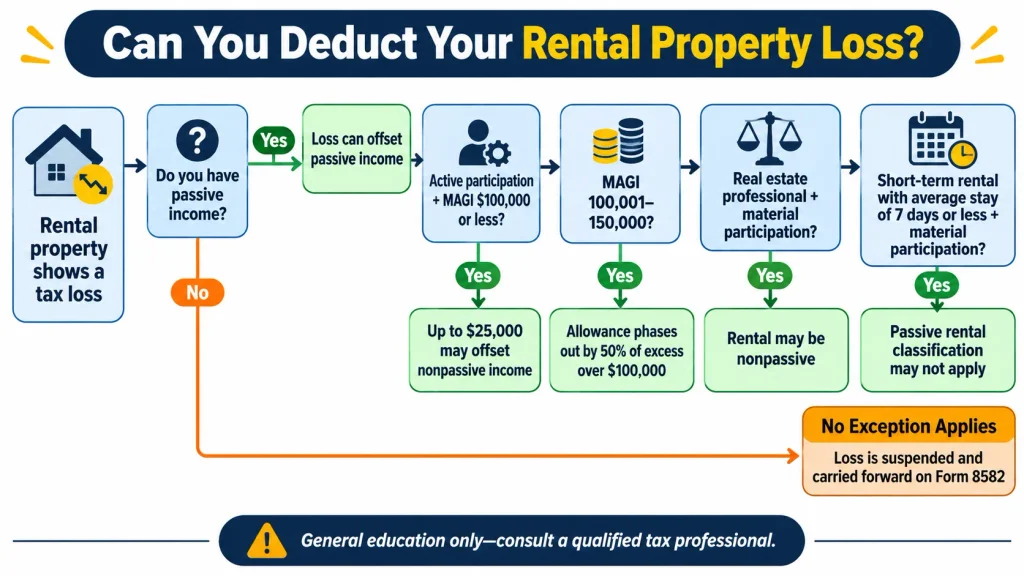
The general IRS classification
| Property or activity | General passive-loss treatment |
| Traditional long-term residential rental | Passive |
| Single-family rental property | Generally passive |
| Traditional multifamily rental | Generally passive |
| Rental managed by a property management company | Generally passive |
| Rental managed personally by the owner | Generally passive |
| Qualifying rental activity of a real estate professional who materially participates | Nonpassive |
| Certain short-term rental activities | Determined under the applicable exceptions and participation tests |
The distinction is important because passive classification restricts which income rental losses can offset.
A landlord earning $85,000 from employment, for example, cannot automatically use a $15,000 rental loss to reduce employment income.
The landlord must first determine whether a qualifying exception applies.
3. What Income Can Passive Rental Losses Offset?
Passive rental property losses generally offset income from other passive activities, not every source of income on an individual’s tax return.
The IRS distinguishes passive income from active and portfolio income.
| Income source | Can passive rental losses generally offset it? |
| Net income from another passive rental | Yes |
| Income from a passive business | Generally yes |
| Qualifying passive income from a partnership | Generally yes |
| W-2 employment wages | Generally no |
| Salary and bonuses | Generally no |
| Active self-employment income | Generally no |
| Bank interest | No |
| Stock dividends | No |
| Capital gains from ordinary investment securities | Generally no |
| Qualifying gain from disposing of a passive activity | Generally yes, subject to applicable rules |
Example: Using one rental’s loss against another rental’s income
Suppose an investor owns two long-term rental properties.
| Property | Annual rental result |
| Property A | $8,000 loss |
| Property B | $11,000 profit |
| Combined result | $3,000 profit |
Assuming both activities are subject to the relevant passive activity rules and no special allocation or other limitation changes the result, the $8,000 loss can generally offset the $11,000 passive income.
The investor has $3,000 of remaining net passive income.
Why W-2 income is different
Employment wages are generally nonpassive income.
Therefore, a traditional landlord cannot simply combine a $20,000 rental loss with $90,000 of W-2 wages and claim that taxable income automatically becomes $70,000.
The $25,000 rental real estate allowance and other qualifying exceptions must be considered separately.
Practical advice: Before assuming a rental loss will reduce your federal income tax, identify the source of your other income and determine whether it is classified as passive, active, or portfolio income.
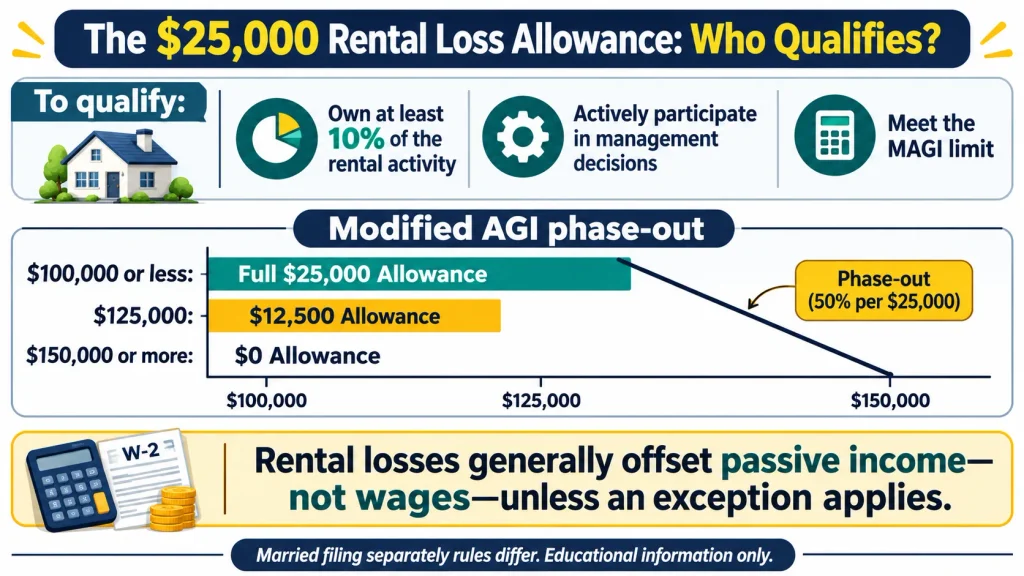
4. How Does the $25,000 Rental Real Estate Loss Allowance Work?
The $25,000 special allowance is one of the most important exceptions for individual rental property owners.
It may allow eligible landlords who actively participate in rental real estate to deduct up to $25,000 of qualifying rental losses against nonpassive income, including employment wages.
However, the allowance is subject to ownership, participation, filing-status, and modified adjusted gross income requirements.
Who can qualify?
Generally, you must:
- Be an eligible individual taxpayer or qualifying estate.
- Actively participate in the rental real estate activity.
- Own at least 10% of the activity by value during the relevant year, including a spouse’s interest where applicable.
- Meet the applicable modified adjusted gross income requirements.
- Satisfy the other relevant statutory and filing conditions.
Limited partners generally cannot use active participation to qualify for this allowance.
How the MAGI phase-out works
For eligible single taxpayers and married couples filing jointly, the maximum allowance is $25,000.
The allowance begins decreasing when modified adjusted gross income exceeds $100,000.
It is reduced by 50 cents for every dollar of MAGI above $100,000 and generally disappears at $150,000.
| Modified adjusted gross income | Maximum potential allowance |
| $90,000 | $25,000 |
| $100,000 | $25,000 |
| $110,000 | $20,000 |
| $120,000 | $15,000 |
| $125,000 | $12,500 |
| $130,000 | $10,000 |
| $140,000 | $5,000 |
| $145,000 | $2,500 |
| $150,000 or more | $0 |
These amounts represent the potential maximum special allowance, not guaranteed deductions. Your qualifying rental losses and other passive income also affect the result.
Formula for calculating the phase-out
For MAGI between $100,000 and $150,000:
\[ \text{Maximum Allowance} = \$25,000- [0.50\times(\text{MAGI}-\$100,000)] \]
For example, assume your modified adjusted gross income is $130,000.
\[ \$130,000-\$100,000=\$30,000 \]
\[ \$30,000\times50\%=\$15,000 \]
\[ \$25,000-\$15,000=\$10,000 \]
Your maximum potential special allowance is $10,000.
What happens if you file married filing separately?
Different limits apply.
A married taxpayer filing separately who lived apart from their spouse throughout the year generally has a maximum allowance of $12,500.
The phase-out begins at $50,000 of MAGI and ends at $75,000.
A married taxpayer filing separately who lived with their spouse at any time during the year generally cannot claim this special allowance.
Check the applicable IRS instructions before applying these thresholds to your return.
Landlord takeaway: Do not assume that earning less than $150,000 guarantees a rental loss deduction. You must satisfy the other eligibility requirements and calculate your MAGI under the special IRS rules.
5. What Is the Difference Between Active Participation and Material Participation?
Active participation and material participation are two separate standards under the passive activity loss rules.
Confusing them can lead to an incorrect rental loss deduction.
Active participation is the less demanding standard associated with the $25,000 rental real estate allowance.
Material participation is a stricter standard used to determine whether an activity is nonpassive under the applicable business activity rules and whether a qualifying real estate professional can treat rental real estate losses as nonpassive.
Active participation examples
A landlord may demonstrate active participation by:
- Approving a new tenant.
- Deciding the rental price.
- Approving lease terms.
- Authorizing major repairs.
- Choosing contractors.
- Making significant management decisions.
You do not have to personally perform every maintenance task or tenant-related responsibility.
Comparison of the two standards
| Factor | Active participation | Material participation |
| Main purpose | Potential $25,000 rental allowance | Determine whether a business activity is nonpassive |
| Participation level | Less demanding | More demanding |
| Hours requirement | No specific minimum-hour test | At least one applicable material participation test |
| Management decisions | Important evidence | May count depending on the applicable test |
| Rental real estate | May qualify for special allowance | Required for real estate professional treatment |
| Tax benefit | Limited deduction against nonpassive income | May allow qualifying losses to offset other nonpassive income |
Important example
Suppose a landlord owns 25% of a rental property and regularly approves tenants, lease terms, and significant repair expenses.
The landlord might satisfy active participation requirements.
However, that involvement alone does not establish material participation or real estate professional status.
This is why the IRS evaluates these standards separately.
6. How Does Real Estate Professional Status Change the Rules?
Real estate professional status can provide an important exception to the general passive classification of rental real estate.
If a taxpayer qualifies as a real estate professional and materially participates in a rental activity, that rental activity is generally treated as nonpassive for passive-loss purposes.
However, simply working in real estate or owning several rental properties does not establish this status.
The two real estate professional tests
You must satisfy both requirements for the tax year.
Test 1: More than 750 hours
You must perform more than 750 hours of services during the year in qualifying real property trades or businesses in which you materially participate.
Test 2: More than half of your personal services
More than half of the personal services you perform in all trades or businesses during the year must be performed in real property trades or businesses in which you materially participate.
Qualifying real property businesses can include:
- Property development.
- Property construction.
- Property acquisition.
- Rental operations.
- Property management.
- Real estate leasing.
- Real estate brokerage.
The IRS also has specific rules for employee services. For example, employee services generally cannot be counted for the professional-status tests unless you meet the applicable 5% ownership requirement in the employer.
Example: A full-time employee with rental properties
Suppose an investor works 2,000 hours annually in a non-real-estate job and spends 800 hours managing rental properties.
The investor satisfies the more-than-750-hour requirement.
However, the investor generally fails the more-than-half-of-personal-services requirement because most working hours are in a non-real-estate occupation.
Therefore, meeting the 750-hour test alone is insufficient.
Do you need to materially participate in each rental?
Yes.
Real estate professional status does not automatically make every rental loss nonpassive.
You must also materially participate in the rental activity.
By default, each rental real estate interest is treated separately for this purpose. A qualifying real estate professional may elect to treat multiple rental interests as one activity under the applicable IRS rules.
That election has continuing consequences and should be evaluated before filing.
Important spouse rule: One spouse cannot combine both spouses’ hours to satisfy the real estate professional qualification tests on a joint return. However, a spouse’s participation can generally count when determining material participation in an activity.
That distinction is important for married real estate investors.
7. What Are the Seven Material Participation Tests?
The IRS provides seven alternative tests for determining whether someone materially participates in a business activity.
You generally need to satisfy at least one applicable test.
| Test | General requirement |
| 1. More than 500 hours | You participate for more than 500 hours during the year. |
| 2. Substantially all participation | Your participation represents substantially all participation by individuals involved in the activity. |
| 3. More than 100 hours | You participate for more than 100 hours and at least as much as any other individual. |
| 4. Significant participation activities | You participate in significant participation activities for more than 500 combined hours. |
| 5. Five of ten years | You materially participated in the activity for any five of the preceding ten tax years. |
| 6. Three prior years | You materially participated in a qualifying personal service activity for any three preceding tax years. |
| 7. Facts and circumstances | Your participation is regular, continuous, and substantial, subject to additional restrictions. |
Which tests are most relevant to rental investors?
The 500-hour and 100-hour tests are often important for investors who personally operate a short-term rental or an eligible non-rental business activity.
For example, assume an investor spends 140 hours managing a qualifying activity during the year.
A property manager spends 90 hours performing services for the same activity.
The investor may satisfy the third test because they worked more than 100 hours and participated at least as much as any other individual.
However, there are specific limitations regarding management time, investor activities, and the type of activity being tested.
An important restriction on the seventh test
The facts-and-circumstances test requires more than 100 hours of participation.
Your management participation generally cannot count under this test if another person is compensated for managing the activity or another individual spends more hours managing it than you do.
Passive investors also cannot automatically count time spent merely reviewing financial statements or monitoring investments in a nonmanagerial capacity.
Practical advice: Keep a credible record of the actual work you perform. Do not count commuting, personal activities, or routine investment monitoring as qualifying participation without checking the applicable IRS rules.
8. How Do Short-Term Rental Rules Affect Passive Losses?
Short-term rentals can receive different passive activity treatment from traditional long-term rental properties.
Under the IRS rules, an activity is generally not treated as a rental activity for passive-loss purposes when the average period of customer use is seven days or less.
Another exception applies when the average period is 30 days or less and significant personal services are provided.
These rules are particularly relevant to properties rented through platforms such as Airbnb and Vrbo.
The seven-day average-stay test
The basic calculation is:
AverageCustomerStay=TotalRentalDaysNumberofRentalPeriods
Suppose a vacation rental has the following annual booking activity:
Explore More: https://calclandlord.com/retail-property-due-diligence-checklist/
| Booking information | Amount |
| Total rental days | 140 |
| Number of separate bookings | 20 |
| Average customer stay | 7 days |
14020=7
The property meets the seven-day average period exception.
However, passing this test only means the activity is not classified as a rental activity under this particular passive-loss rule.
It does not automatically make the loss nonpassive.
You generally still need to establish material participation under one of the applicable tests.
What about the 30-day rule?
A rental activity with an average customer use period of 30 days or less can also fall outside the rental classification when significant personal services are provided.
The IRS evaluates the nature, frequency, and amount of services.
Routine repairs, maintenance, and cleaning services similar to those commonly provided with long-term rentals generally do not qualify as significant personal services for this exception.
Short-term rental investor checklist
Before using the short-term rental exception, review:
- Average customer stay across the relevant rental activity.
- Booking dates and actual rental periods.
- Applicable customer-use calculations.
- Personal services provided.
- Your own participation hours.
- Work performed by co-hosts and property managers.
- Ownership and entity structure.
- State and local lodging requirements.
Use the CalcLandlord STR Calculator to assess rental revenue, operating expenses, cleaning costs, management fees, and other short-term rental economics.
The calculator can help with financial analysis, but it does not establish your federal tax classification.
9. How Do Basis, At-Risk, and Excess Business Loss Limits Work?
The passive activity loss rules are not the only restrictions that can affect a rental property deduction.
Several tax limitations may apply before a loss reaches your federal income tax return.
The general sequence for relevant pass-through business losses is:
1. Basis limitation
Determines whether your tax basis supports the allocated partnership or S corporation loss.
2. At-risk limitation
Determines how much of the investment you are considered economically at risk for.
3. Passive activity loss limitation
Determines whether the allowable loss can be deducted against the taxpayer’s available income.
4. Excess business loss limitation
May further restrict allowable losses for noncorporate taxpayers.
Basis limitations
Basis limitations are particularly important when rental properties are held through partnerships or S corporations.
For example, an investor may receive a Schedule K-1 showing a $30,000 business loss but have insufficient tax basis to deduct the entire amount.
The disallowed portion may have to be carried forward under the applicable basis rules.
At-risk limitations
The at-risk rules generally limit deductible losses to amounts the taxpayer has at risk in the activity.
Certain financing arrangements may affect this calculation, so mortgage debt should not automatically be treated as an amount at risk.
Taxpayers who are subject to these limitations may need Form 6198.
Excess business loss limitations
Even after basis, at-risk, and passive activity restrictions have been considered, a noncorporate taxpayer may face the excess business loss limitation.
Form 461 is used to calculate this additional limitation where applicable.
Why this matters: A taxpayer might qualify for the $25,000 rental real estate allowance but still be unable to deduct the entire amount because another loss limitation applies first.
10. How Does IRS Form 8582 Calculate Rental Losses?
IRS Form 8582, Passive Activity Loss Limitations, helps eligible taxpayers determine how much passive activity loss they can deduct during the tax year.
The form considers current-year passive income, rental losses, previously suspended losses, qualifying exceptions, and applicable limitations.
What does Form 8582 help calculate?
It generally helps taxpayers:
- Explore More: https://calclandlord.com/schedule-e-rental-property/
- Identify passive activity income and deductions.
- Include prior-year unallowed passive losses.
- Calculate the relevant passive activity results.
- Apply the special rental real estate allowance where applicable.
- Determine the deductible amount.
- Calculate the remaining suspended loss.
What information should landlords prepare?
| Information | Why it matters |
| Schedule E | Identifies rental income and allowable expenses |
| Depreciation schedule | Supports depreciation deductions |
| Prior-year Form 8582 | Shows suspended losses from earlier years |
| Property income statements | Supports rental activity calculations |
| Ownership records | Helps establish eligibility |
| MAGI information | Determines special allowance phase-out |
| Schedule K-1 | Reports allocated partnership or S corporation amounts |
| Form 6198, when applicable | Addresses at-risk limitations |
Does every landlord need Form 8582?
No.
The IRS provides an exception for certain taxpayers whose only passive activities are qualifying rental real estate activities in which they actively participated.
Generally, the exception requires, among other conditions:
- No prior-year unallowed passive losses.
- Total qualifying rental loss not exceeding $25,000, or $12,500 for eligible separate filers.
- MAGI not exceeding $100,000, or $50,000 for eligible separate filers.
- No other passive activities or unallowed passive credits.
- Satisfaction of the applicable filing-status and ownership conditions.
If these requirements are not met, Form 8582 may be required to calculate the permitted loss.
Corporate taxpayers subject to the passive activity rules generally use Form 8810 rather than Form 8582.
Important: Form 8582 is a tax-compliance form, not a simple calculation of your property’s operating profit. Its worksheets should be completed using the current applicable IRS instructions.
11. Example: How Much Rental Loss Can a W-2 Landlord Deduct?
A worked example makes the $25,000 rental allowance easier to understand.
Consider an investor who works full-time and owns two long-term residential rental properties.
The investor actively participates in both properties and meets the applicable ownership requirement.
Assume the following hypothetical figures:
| Financial information | Property A | Property B |
| Rental property tax loss | $9,400 | $3,200 |
| Total rental loss | $12,600 |
Additional assumptions:
- Modified adjusted gross income: $141,200.
- No other passive income.
- No prior-year suspended losses.
- Both properties meet the active participation requirements.
- No basis, at-risk, or other limitation reduces these losses.
Step 1: Calculate total rental losses
\[ \$9,400+\$3,200=\$12,600 \]
The investor has $12,600 in qualifying rental real estate losses.
Step 2: Calculate the MAGI phase-out
The maximum allowance is $25,000, with phase-out beginning at $100,000.
\[ \$150,000-\$141,200=\$8,800 \]
The remaining amount is multiplied by 50%.
\[ \$8,800\times0.50=\$4,400 \]
Therefore, the investor’s maximum potential special allowance is $4,400.
Step 3: Determine the deductible rental loss
Since the total qualifying rental loss is $12,600:
\[ \$12,600-\$4,400=\$8,200 \]
The result is:
| Tax treatment | Amount |
| Total rental losses | $12,600 |
| Potential current deduction under special allowance | $4,400 |
| Suspended passive losses | $8,200 |
Step 4: Illustrative property-level allocation
Assuming a simple proportional allocation for this example:
| Property | Original loss | Approximate suspended amount |
| Property A | $9,400 | $6,117 |
| Property B | $3,200 | $2,083 |
| Total | $12,600 | $8,200 |
The actual allocation must follow the applicable Form 8582 worksheets and activity records.
What does this example teach landlords?
The investor does not lose the remaining $8,200 merely because it cannot be deducted immediately.
The unused passive loss generally carries forward and may become deductible against future passive income or through a qualifying disposition.
That makes accurate property-level and activity-level loss tracking especially important.
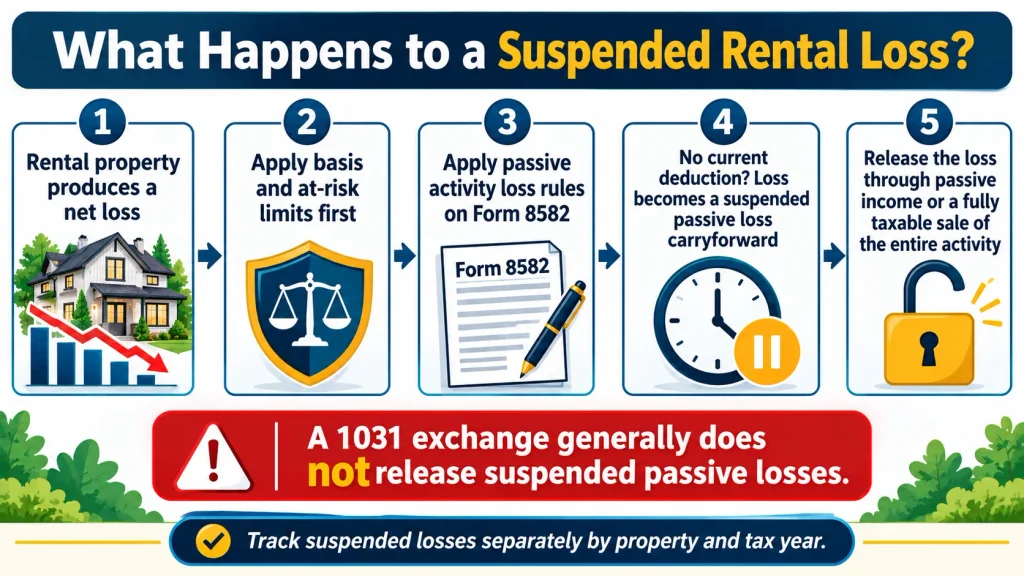
12. How Do Suspended Passive Losses Carry Forward?
A suspended passive activity loss is a loss that is currently disallowed under the passive activity rules.
It is generally carried forward to the next tax year and treated as a deduction from the same activity in that year.
People Also Ask: Passive Activity Loss Rules for Rental Property
Generally, rental property losses are passive and cannot offset W-2 wages. However, eligible landlords may deduct up to $25,000 under the special rental real estate loss allowance, subject to active participation, ownership, income, and filing-status requirements.
It is a special IRS tax provision that allows qualifying landlords who actively participate in rental real estate activities to deduct up to $25,000 of rental losses against nonpassive income. The allowance generally phases out when modified adjusted gross income exceeds $100,000 and disappears at $150,000.
Generally, no. Suspended passive losses carry forward to future tax years until they can offset eligible passive income or qualify for another deduction under IRS rules. A qualifying fully taxable sale of the entire activity may also release the remaining losses.
No. Personally collecting rent, approving tenants, and arranging repairs does not automatically make traditional rental real estate nonpassive. However, active participation may help you qualify for the $25,000 special allowance.
Active participation is a relatively lower standard used for the special rental real estate loss allowance. Material participation requires meeting at least one of seven IRS tests and is relevant to determining whether certain business activities are nonpassive.
Conclusion
Passive activity loss rules play an important role in determining how much rental property loss a landlord can deduct each year. Even when a rental property generates a tax loss through mortgage interest, operating expenses, repairs, and depreciation, that loss does not automatically reduce your salary or other nonpassive income.
The good news is that the IRS provides several ways eligible real estate investors may use these losses. The $25,000 special rental real estate allowance, real estate professional status, qualifying short-term rental activities, passive income, and certain fully taxable property sales can all affect when losses become deductible.
Key Takeaways
- Traditional rental property losses are generally classified as passive.
- Eligible landlords may qualify for the $25,000 special rental real estate allowance.
- The allowance generally phases out between $100,000 and $150,000 of modified AGI.
- Active participation and material participation are different IRS standards.
- Real estate professional status requires meeting both the 750-hour and more-than-half tests.
- Qualifying short-term rentals may receive different passive activity treatment.
- Suspended passive losses generally carry forward until they can be deducted.
- A qualifying fully taxable sale may release remaining suspended losses.
- A 1031 exchange generally does not automatically release suspended passive losses.
