

How to Rent Out a Duplex: A Landlord’s Guide to Renting Both Units
To rent out a duplex successfully, treat it as two small rental businesses under one roof. Price each unit on its own merits. Sign a separate lease for each unit. Put a written plan in place for any shared meter. And screen every applicant against the same written criteria. Do those four things in the right order, and both units can earn within one leasing cycle. Skip them, and the classic duplex problems follow. One is a blended rent that overprices one unit and gives the other away. Another is a utility dispute with no lease clause to settle it. A third is a single vacancy that quietly wipes out half the property’s income.
This guide follows the order a duplex owner actually works in. First, it sets each unit’s rent. Then it stress-tests the whole property with one unit empty. Next, it confirms the building is legal to rent. After that, it prepares both units and the spaces they share. Insurance, leases, es and utilities come next. Marketing, screening, deposits, and move-in follow. Finally, the guide explains the special rules if you live in one unit yourself. It also explains the tax split. And it explains the systems that keep two tenancies running side by side. Every dollar figure is a worked example with its assumptions stated. Duplex rents and costs vary too much by market for any national number to mean anything.
Set the Rent for Each Unit Separately
Each unit gets its own price. You build that price from its own comparable rentals. You do not divide the building’s total rent need by two. Units in the same duplex routinely differ in bedrooms, floor area, laundry, parkingg, ng and outdoor space. The market pays for those differences unit by unit. Work through recent comparable listings and rented units. Match each side on beds, baths,ths and size. Take the middle figure. Then adjust for the specific unit’s features.
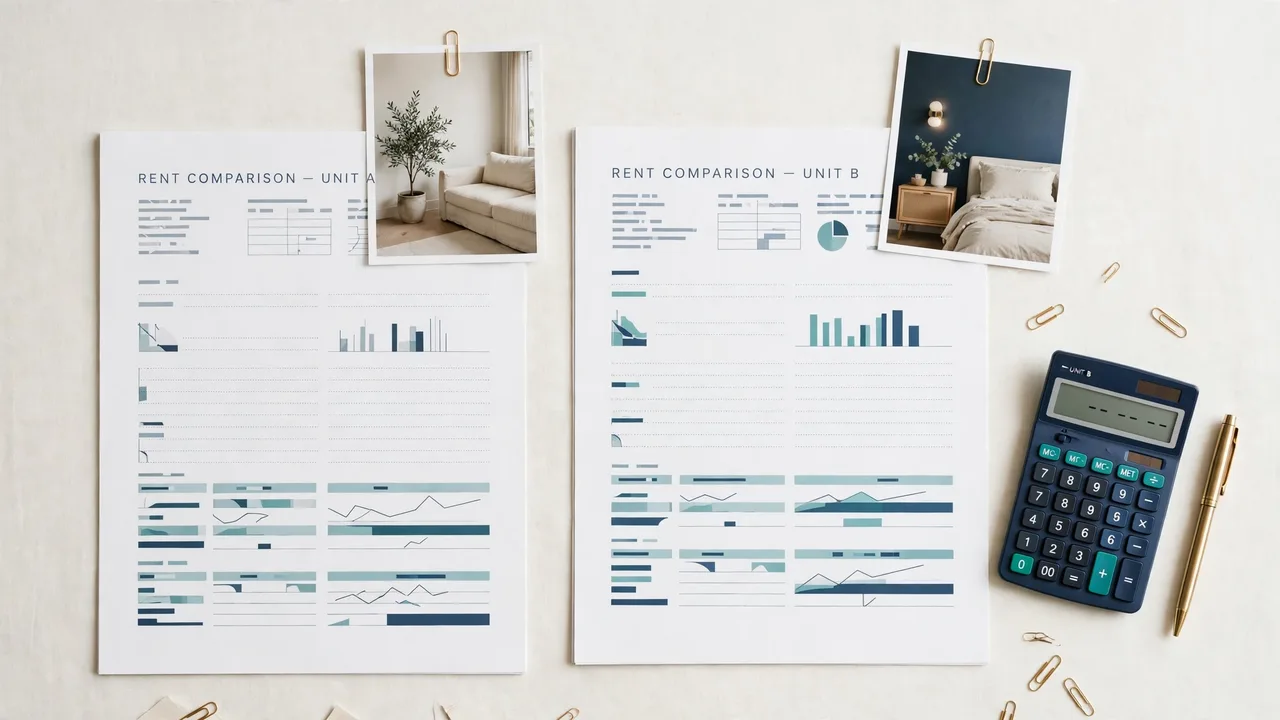
A Worked Rent Example
Here is a worked example, with hypothetical numbers. Recent 3-bedroomm comps for Unit A (about 1,100 sq. ft.) cluster at $1,595, $1,650 and $1,700. So the median is $1,650. In-unit laundry, which the comps lack, supports roughly a $50 premium. That gives a list rent of $1,700. Unit B (2 bedrooms, about 850 sq. ft.) has comps at $1,275, $,1,300 and $1,350. That is a $1,300 median. Deduct about $25 because it has no private yard access. That gives $1,275. Combined scheduled rent: $2,975 a month. Split the same $2,975 evenly at $1,487.50 per unit instead. Unit B would sit nearly $200 above its market. Unit A would sit below its market. The overpriced unit lingers vacant. That is the most expensive outcome a duplex can produce.
Use HUD Fair Market Rents for the area as a sanity check on your comp work. Do not use them as a target. They are area benchmarks, not a pricing instruction. The method matters more than any single figure. See our guide to building a rent figure from comparable listings and free data. It is the Rentometer-free approach to checking market rent. It walks through the comp-gathering step in detail. Re-run the comps for each unit at every renewal and turnover; the two units’ markets drift independently.
Check the Duplex Still Works With One Unit Empty
A duplex has a structural weakness no spreadsheet can remove: one vacancy is 50% of the building’s units standing empty. Before advertising either unit, run the whole property with one side dark. See whether the numbers still hold. Or at least see how deep the hole is. And see how long you can fund it.
Worked example, assumptions stated. Take the duplex from the previous section. You bought it for $310,000 with 20% down. You took a $248,000 loan at 7% over 30 years. It costs $1,649.95 a month in principal and interest. Property taxes add $400 a month. A landlord insurance policy adds $200 a month. Owner-paid water and sewer add $150 a month. A vacancy allowance adds $149 a month (5% of scheduled rent). Finally, a maintenance reserve adds $149 a month.
Total carrying cost: $2,697.95 a month. With both units rented at $2,975, the property clears about $277 a month. Break-even occupancy is 90.7%. You divide carrying costs by scheduled rent to get it. The building needs almost every rent dollar just to stand still. Now empty the smaller unit. Income falls to Unit A’s $1,700. The property runs about $998 a month short. Empty the larger unit instead. The shortfall is about $1,423 a month. That is the duplex trade in one line. Two rents cover the costs with a thin margin. One rent does not.
Hold a Reserve for the Empty Unit
The practical responses are boring and effective. Hold a reserve sized to the shortfall. In this example, roughly $8,100 covers three months of full carrying costs. Treat speed at turnover as a financial decision, not an administrative one. Every empty month costs a full unit’s rent. See our guide to per-unit economics for small multifamily properties. It gives the formula-level treatment of per-unit income, costs, ts and break-even occupancy. It covers small multifamily properties.
Confirm the Duplex Is Legal to Rent Before You Advertise
Renting out a unit that is not legally rentable is the one mistake that can unwind everything else. So verify status before a single listing goes live. Confirm the property is a legal two-unit building. Check zoning that permits the duplex use. Check for a certificate of occupancy where your locality requires one. Confirm each unit has its own separate address and entrance. Many cities and some counties also require rental licensing, registration or periodic inspection. A tenant may not occupy a unit until you meet those requirements. The requirements, fees and inspection standards are entirely local. So check with your city or county housing office. Do not rely on any general rule.
If you bought the duplex recently with an FHA loan, check your loan’s occupancy commitment. Do this before renting out the unit you were supposed to live in. Under FHA program rules (HUD Handbook 4000.1), FHA single-family loans cover one-to-four-unit properties. The borrower occupies one unit as a principal residence. The borrower rents out the other units. See HUD’s FHA programme information for the programme framing. The occupancy commitment generally requires moving into one unit within 60 days of closing. It also requires living there as your principal residence for at least a year. Renting out the whole property in breach of that commitment can put the loan itself at risk. One FHA rule need not worry you as a duplex owner. The FHA self-sufficiency test applies only to three- and four-unit properties. It does not apply to duplexes.
Prepare Each Unit — and the Spaces Both Tenants Share
Prepare each unit to the same standard you would apply to a standalone rental. Fit working smoke and carbon monoxide detectors Fit secure locks with keys accounted for. Check heating, plumbing and appliances function. Leave no outstanding habitability issues. A defect in one unit is one tenancy’s problem. A defect in a shared system is both tenants’ problem at once. Shared systems include the roof, the boiler and the main water line. So inspect shared systems before the first lease is signed. Do not wait until after the first complaint.
If the building was built before 1978, a federal duty applies before any lease is signed. You must give the tenant the EPA pamphlet “Protect Your Family From Lead in Your Home”. You must disclose any known lead-based paint and lead-based paint hazards. This includes records from any building-wide evaluation covering common areas and the other unit. You must include the required lead warning statement in the lease. You must keep the compliance records for three years. The EPA’s statement of the landlord disclosure duty sets the requirement out in full. The federal rule requires disclosure, not testing or removal, although some states and cities go further.
Then settle the shared spaces in writing before anyone moves in. These are the friction points of duplex life. Decide which part of the yard belongs to which unit. Decide who mows and shovels. Agree how the laundry room is scheduled. Agree where each unit parks. And agree where bins and storage live. Whatever you decide goes into both leases identically, so neither tenant is working from a different set of rules.
Switch to a Landlord Insurance Policy Before Anyone Moves In
Insurers write a standard homeowners policy for an owner-occupied home. Renting out a unit changes the risk the insurer agreed to cover. Before the first tenant moves in, tell your insurer the property is being rented. Move the rented exposure onto a landlord (dwelling fire) policy. This is a disclosure step, not an optional upgrade. A claim arising from a tenancy the insurer never knew about is a claim you may be fighting about.
On the landlord policy itself, price three elements. First, the dwelling cover on the building as a rental. Second, loss-of-rent cover replaces rental income while a unit is uninhabitable after a covered event. On a two-unit property, one fire can take out both income streams at once. That makes the coverage worth its line in the premium. Third, choose liability coverage adequate for two households’ worth of visitors, deliveries and shared-space accidents. An umbrella policy on top is worth a quote for the same reason. Finally, require each tenant to carry their own renters insurance as a term of the lease. It covers their belongings and their own liability. It costs the landlord nothing.
Use a Separate Lease for Each Unit
The standard duplex structure is a separate lease for each unit. The adults who live in that unit sign it. Keep it that way unless your situation is genuinely one of the edge cases. Two unrelated households in two units are two separate legal relationships. They have separate rents, separate deposits, separate notices and separate remedies if one tenancy goes wrong. Folding them into one combined arrangement ties their obligations together in ways that help nobody. One household’s late rent becomes entangled with the other’s tenancy. Ending one occupancy becomes far harder than it should be.
The combined structures exist for different facts. One is a single household renting the whole building on one lease. The other is an investor master-leasing the entire property to one operator. Neither describes the ordinary duplex with a household in each unit, so neither should be your template. What each unit’s lease must spell out, beyond the standard terms, is the duplex layer. That layer includes the utility arrangement from the next section. Shared-space rights and duties follow (yard, laundry, parking, storage). Quiet hours that respect the household on the other side of the wall follow too. Finally, the lease must spell out how tenants make maintenance requests.
State law and sometimes city law set security deposit amounts and the deadlines for returning them. Notice periods work the same way. They vary widely. So take the figures from your own state’s current rules rather than from any example. And have a local landlord attorney review the finished lease before first use.
Decide How Utilities and Meters Will Be Split — and Write It in the Lease
First, start with the hardware. Does each utility have a separate meter for each unit? Or does one meter serve the building? With separate meters, the clean answer is an account in each tenant’s own name. In that case, the lease simply says so. However, the difficult — and dispute-prone — case is the shared meter. In addition, a shared meter with no written plan is one of the most reliable sources of duplex conflict.
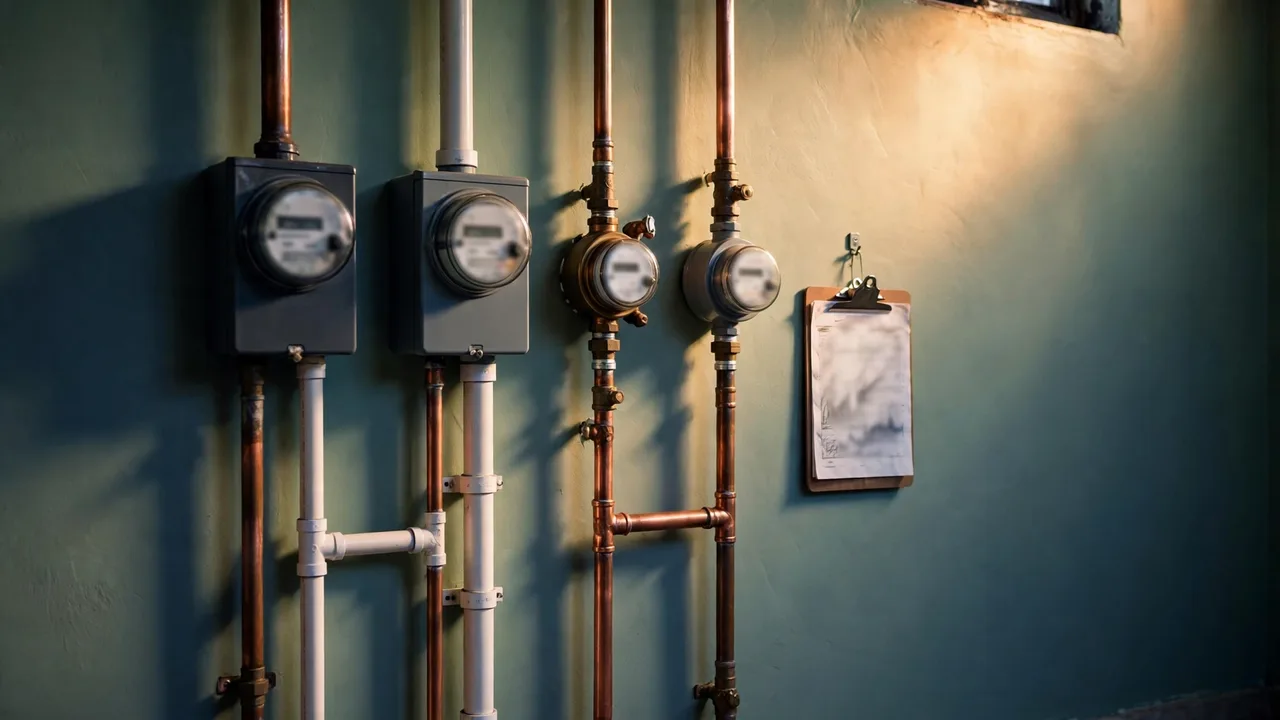
There are three workable arrangements for a shared meter. Include the utility in the rent: price the expected cost into each unit’s rent. Also, make the comp adjustment openly, as in the rent-setting section. Then carry the account yourself. This is simplest to administer, but you absorb usage spikes. Sub-metering: a sub-meter measures each unit’s actual use of, say, water. Therefore, each tenant pays for what they used. This is fairest, but it costs money to install. Ratio utility billing (RUBS): divide the bill by a fixed formula. For example, use square footage, number of occupants, or number of bedrooms. On a $180 monthly water bill, the three RUBS-style splits look like this:
| Split method | Unit A (1,100 sq. ft., 3 occupants) | Unit B (850 sq. ft., 2 occupants) |
|---|---|---|
| Equal split | $90.00 | $90.00 |
| By square footage | $101.54 | $78.46 |
| By occupants | $108.00 | $72.00 |
Write the Split Into Both Leases
Whichever method you choose, you must write the method itself into both leases before signing. In other words, do not use a vague “tenant pays a share of utilities”. Instead, write how and when you will bill the amounts. One locality caveat matters here. For example, some states and cities restrict or regulate passing shared-meter utility costs through to tenants. Similarly, some require specific disclosures. So confirm your local rules allow the arrangement you have chosen. Do this before the lease depends on it.
Market Each Unit on Its Own Listing
Write a separate listing for each unit, with its own photographs and its own honest description. For example, “Unit B, upper floor, two bedrooms, private entrance at the rear, shared laundry in the basement” tells an applicant exactly what is on offer. In contrast, a single listing for “the duplex” invites applicants who picture the wrong unit. It also invites showings that waste everyone’s time. In addition, photograph the unit itself, its entrance, its outdoor space, and the shared facilities it comes with. Then price the listing at the figure your comp work produced for that unit. Do not price it for its neighbour.
Landlords commonly list duplexes where they list any rental. For example, they use the major listing platforms and local channels. So the differentiator is accuracy, not reach. For the general end-to-end process of taking a property to market, see our guide. Our guide on how to rent your house covers the same ground for a whole single-family home. However, the duplex difference is running that process twice, in parallel, once per unit. One etiquette point has legal weight. Once a tenant occupies one unit, showings of the other unit are showings of a building someone lives in. Therefore, never enter the occupied unit as part of a tour. In addition, give the sitting tenant proper notice of viewings near shared spaces. Your lease and state law require that notice. Finally, keep tours to the vacant unit and the exterior.
Screen Every Applicant Against the Same Written Criteria
First, write your screening criteria down before the first application arrives. Then apply the same criteria, in the same order, to every applicant for both units. A written standard covers the income,rental history, andd credit-history tests you will apply, whatever levels you set for them. Such a standard makes two decisions defensible instead of two decisions that merely look different. Our guide to the rental application and screening process sets out what a complete application should collect. Before you rely on gut feeling for the final call, run the numbers. In addition, compare what one bad placement costs against what screening costs. Use the tenant screening impact calculator for that comparison.
Two federal frameworks govern this step. Under the Fair Credit Reporting Act, reports from tenant-screening services count as consumer reports, not just credit-bureau files. If you deny an applicant based in any way on a consumer report, FCRA §615(a) requires an adverse action notice. Similarly, the same applies if you impose a burden you do not impose on everyone. For example, this includes requiring a co-signer, a larger deposit, or higher rent. The FTC walkthroughs consumer reports as a landlord is the official walk-through. The notice must name the consumer reporting agency, with address and phone. It must state that the agency did not make the decision. Applicants must learn they may get a free copy of the report within 60 days. They must also learn they may dispute inaccurate information. Finally, if a credit score was used, additional score disclosures apply.
Fair Housing Boundaries
Fair housing law sets the outer boundary. The federal Fair Housing Act protects seven classes. They are race, color, national origin, religion, sex, disability,y and familial status. You can find them listed on HUD’s housing discrimination page. In addition, many states and cities protect more. Owner-occupants sometimes ask about the exemption for buildings of four or fewer units where the owner lives in one. That exemption is real but narrow. For example, it never covers discriminatory advertising. Race discrimination is never permitted under it. A broker’s involvement can lose it. However, state or local law may offer no equivalent. The safe posture, and the one this guide recommends, is to follow the full federal rules regardless. Therefore, use the same written criteria for every applicant. Treat the exemption as a question for a local attorney. Do not treat it as a working tool.
Handle Deposits, Move-In Inspections and Keys Separately for Each Unit
Everything at move-in happens twice, once per unit, in separate paperwork. First, take each unit’s security deposit separately. Then record it against that unit’s tenancy. Also, handle it under your state’s deposit rules. Caps on the amount vary by state and sometimes by city. Similarly, where you must hold the money also varies. In addition, the deadline and itemisation for returning it also vary. So work from your own state’s current figures rather than anyone’s example.
Before the tenant takes the keys, walk that unit with them. Then complete a written condition report, room by room. Also, back it with dated photographs. Cover walls, floors, appliances, fixtures, and the state of any shared facilities they will use. Both parties sign it. Do the same for the second unit, in its own file, even if the two move-ins happen on the same day.
Next, rekey or re-code each unit’s locks between tenancies. Hand over only that unit’s keys. Also, keep the access arrangements for shared spaces as set out in the lease. Those spaces include basement, laundry and storage. From day one, keep a separate rent ledger for each unit. Therefore, every payment, charge and balance then belongs to exactly one tenancy. Our guide to keeping a rent ledger shows the per-unit ledger structure. It includes a worked example with separate ledgers for Unit A and Unit B of a duplex.
Living in One Unit: The Rules and Boundaries That Change
Renting out the other half of the building you live in changes two things: your obligations and your boundaries. On obligations, if you bought with an FHA loan, the occupancy commitment from the legality section runs from your closing. It does not run from your tenant’s move-in. That commitment means move in within 60 days. It also means living in your unit as your principal residence for at least a year. Insurers and tax rules likewise treat the building as part home, part rental from the day the tenancy starts. The insurance and tax sections of this guide cover that treatment.

Set Boundaries for Living Next Door
On boundaries, the working rule is simple. Be a landlord who happens to live next door. Do not be a neighbour who happens to collect rent. Enter the rented unit only as your lease and state law allow. Give proper notice for proper reasons, emergencies excepted. Resist the informality that proximity invites. The knock on the door “while I was passing” is how privacy disputes start. Keep business communication in writing. Send maintenance requests, notices, and rent matters by email, portal,l or letter. Then both sides have the same record. Set the shared-space ground rules in both leases before move-in. Cover quiet hours, yard division, laundry schedule, parking allocation and snow clearing. Rules agreed in advance are administration. Rules invented mid-dispute feel like favouritism, whichever way they fall.
When you later move out, your old unit becomes an ordinary rental. Price it on its own comps like any other unit. Insure the building as fully rented. Expect the narrow owner-occupied fair-housing position discussed in the screening section to fall away once you no longer live there. That is another reason the follow-the-full-rules posture is the durable one.
Split the Taxes Correctly When You Live in One Half
If you live in one unit and rent the other, the IRS sets a limit. It does not let you treat the building as either fully personal or fully rental. Under IRS Publication 527, Residential Rental Property, you must divide the expenses of the whole property. Divide them between rental use and personal use by any reasonable method. The two most common are by number of rooms and by square footage. For a duplex with two equal units, the split is typically 50/50. IRS Topic No. 414 is the IRS’s own summary of the rental income and expense rules. It points to Publication 527 for the details.
The Tax Split in Numbers
In numbers, on this guide’s example duplex, suppose shared mortgage interest for the year is $13,600. Suppose property taxes are $4,800. Report the rental half of each on Schedule E. That is $6,800 of interest and $2,400 of taxes. You may deduct the personal half of the interest and taxes on Schedule A if you itemise. Do not split expenses that belong only to the rented unit at all. Repainting the rental unit for $850 is one example. Spending $ 12 on 0 advertising is another. Deduct both fully on Schedule E.
Depreciate only the rental portion of the building. On a $310,000 purchase where $62,000 is land, the building basis is $248,000. The rental portion is $124,000. Depreciate residential rental property straight-line over 27.5 years. That is about $4,509 a year on these figures. The IRS’s own depreciation guidance for rental property confirms the framework. If you rent out both units, none of this splitting applies — the whole property is rental. One warning: the days-based tests in IRS Topic No. 415 govern renting out a home for part of the year. A duplex unit rented full-time uses the Publication 527 split above. That is a different rule. Do not blend the two.
Manage Two Tenancies Day to Day
Two tenancies means two of everything administrative. The systems that work keep them separate while sharing the building sensibly. Keep a separate ledger and file per unit. Cover rent, deposits, condition reports, notices, es and correspondence. Then you can answer any question about either tenancy from its own record. Coordinate maintenance across the shared building. One roof, one boiler and one water main serve both households. So schedule shared-system work once. Notify both units together. Log which costs are building-wide and which belong to a single unit. Your tax records need that distinction.
Stagger the two leases’ end dates if you can. Set the second unit’s initial term a few months longer or shorter than the first. Then both units never turn over in the same month. Simultaneous turnover doubles your vacancy exposure at exactly the wrong moment. Two empty units is 100% of income gone. It also means two lots of cleaning, repairs and re-letting at once. Use a simple renewal calendar. Review it quarterly. It keeps expiries, inspections and seasonal shared-space jobs visible for both units. Those jobs include gutters, snow arrangements and laundry servicing.
Finally, decide honestly whether you self-manage or hire a manager. Two tenancies is the smallest portfolio there is. Many owners handle it themselves with the systems above. A manager earns their place when your time, distance from the property, or the local compliance workload says otherwise. Make that call on your hours and your market’s rules. If you hire, interview for duplex experience specifically. The shared-building judgment calls in this guide are the job.
People Also Ask
Under IRS Publication 527, divide shared expenses between rental and personal use by any reasonable method — most commonly square footage or number of rooms, which for two equal units is typically 50/50. The rental share of mortgage interest and property taxes goes on Schedule E; the personal share may be deducted on Schedule A if you itemise, and expenses that apply only to the rental unit are fully deductible on Schedule E. Only the rental portion of the building is depreciated over 27.5 years.
Use a separate lease for each unit. Two households in two units are two separate legal relationships, and separate leases keep their rent, deposits, notices, es and remedies independent — one tenancy can be renewed, enforced, ed or ended without entangling the other. A single lease covering both units only fits different facts, such as one household renting the whole building, not the ordinary duplex arrangement.
Choose one arrangement and write it into both leases: fold the expected cost into the rent, install sub-meters so each unit pays for its actual use, or bill by a fixed ratio such as square footage or number of occupants (a ratio utility billing system). The one option that reliably causes disputes is a shared meter with no written method. Some states and cities restrict passing shared-meter costs to tenants, so check your local rules first.
Yes — set one written set of criteria and apply it identically to every applicant at both units. Consistent criteria are the practical core of fair-housing compliance and of defensible decisions. If a consumer report drives a denial, or heavier conditions such as a co-signer or larger deposit, FCRA requires an adverse action notice naming the reporting agency and the applicant’s right to a free copy of the report within 60 days and to dispute inaccuracies.
A narrow federal exemption exists for buildings with living quarters for no more than four families where the owner lives in one unit, but it never covers discriminatory advertising, never permits race discrimination, can be lost when a broker is used, and state or local law may be stricter or have no exemption at all. The safe approach is to follow the full fair-housing rules regardless and discuss the exemption with a local attorney rather than relying on it.
It works well when the landlord relationship stays formal despite the proximity: enter the rented unit only with proper notice as the lease and state law require, keep all business communication in writing, and put shared-space rules — quiet hours, yard, laundry, parking, snow — in both leases before move-in. Problems start when arrangements stay informal, so agree the rules in advance and apply them evenly.
Key Takeaways
- Price each unit on its own comparable rentals and adjust for its own features — never split one blended rent down the middle; in the worked example, $1,700 and $1,275 per unit beat $1,487.50 each.
- One empty unit is 50% of a duplex’s income: in the worked example, break-even occupancy is 90.7%, one vacancy means a shortfall of roughly $1,000–$1,400 a month, and a reserve of about three months’ carrying costs (roughly $8,100 there) is the cushion.
- Confirm legal two-unit status, any local licensing or inspection, and — if you bought as an owner-occupant with an FHA loan — the 60-day move-in and one-year occupancy commitment before you advertise.
- Give pre-1978 tenants the EPA lead pamphlet and disclosures before the lease is signed, switch to a landlord insurance policy before move-in, and require renters insurance in each lease.
- Use a separate lease for each unit, and write the duplex layer into both: shared spaces, parking, yard duties, quiet hours, and the exact utility-split method.
- Screen every applicant against the same written criteria, and send the FCRA adverse action notice whenever a consumer report drives a denial or heavier conditions.
- If you live in one half, split shared expenses by a reasonable method (50/50 for equal units) under IRS Publication 527: rental share on Schedule E, rental-only expenses fully deductible, and 27.5-year depreciation on the rental portion only.
- Run two tenancies on separate ledgers and files, coordinate shared-building maintenance once for both units, and stagger lease end dates so both units never turn over at on
Tonces article is educational and informational only and is not legal, tax, accounting, or financial advice. Laws and rules vary by state, locality and individual circumstances — check your state and city requirements and consult a qualified professional before acting.

Pingback: Retail Property Due Diligence Checklist: 12 Costly Traps to Avoid - CalcLandLord