

How to Rent Your House: The Complete Landlord Guide
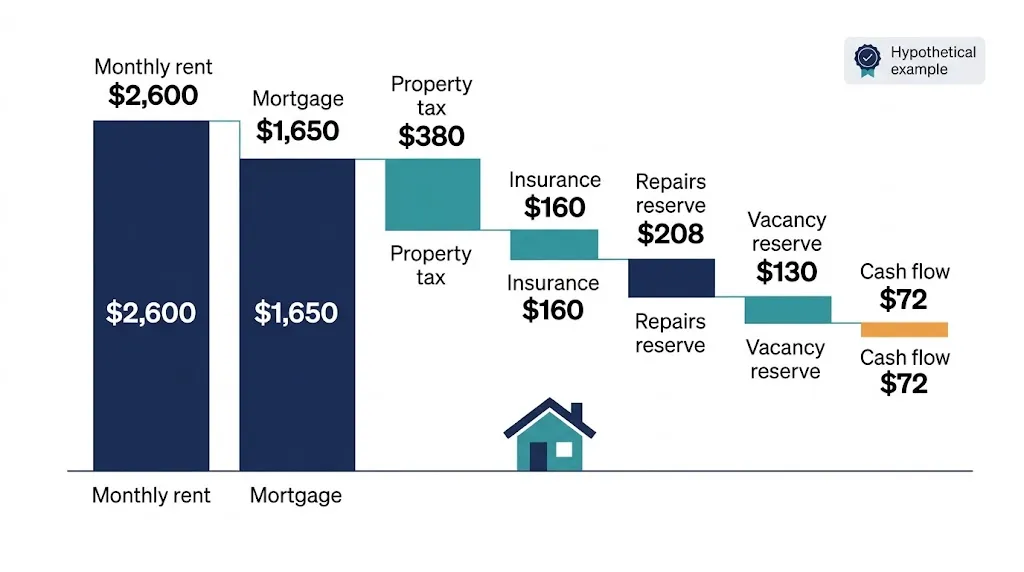
Say your mortgage is $1,650 and a renter will pay $2,600. That looks like $950 of profit a month. You list the house and wait for the checks. Then property taxes, landlord insurance, repairs, and vacancy arrive, and the profit shrinks to $72. That’s the gap that trips up most first-time landlords. It’s also fixable. This guide shows you how to check your mortgage and HOA rules, run the real numbers, price from comparables, screen tenants fairly, and sign a lease that protects you. Do it in order, and you’ll know whether renting beats selling before you spend a dollar.
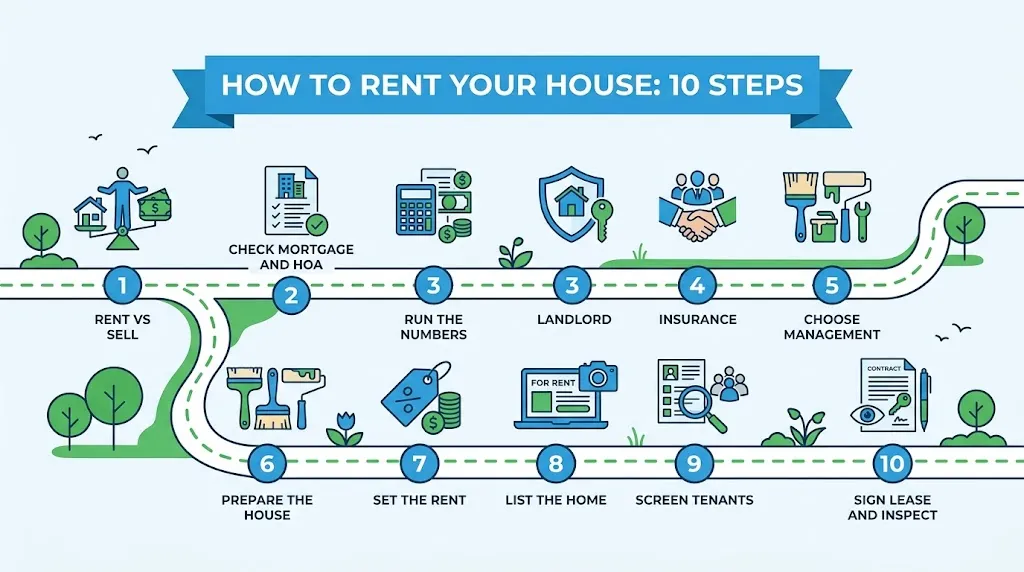
You can rent your house in about 6 to 10 weeks if you do things in the right order. Check your mortgage, HOA, and local rules first. Then run the real numbers, insure the property, prepare it, price it from comparable rentals, screen applicants by written criteria, sign a lease, and document the move-in.
Most people who fail at this fail at the front end. They list the home before they know whether they’re allowed to, or before they know whether the rent covers the costs. This guide puts the decisions in the order you’ll actually face them.
Quick Answer: How to Rent Your House in 10 Steps
- Decide whether renting beats selling or keeping the house empty.
- Check your mortgage, HOA, and city rules before you advertise.
- Run the numbers, including reserves for repairs and vacancy.
- Get landlord insurance. Don’t count on your homeowners policy.
- Decide who manages it: you or a property manager.
- Make the house rental-ready, with safety items first.
- Set the rent based on nearby comparable rentals, not your mortgage payment.
- List the home with strong photos and complete details.
- Screen applicants against written criteria you apply to everyone.
- Sign a lease, collect the deposit, and document the move-in condition.
The rest of this article explains each step with numbers and examples.
Should You Rent Your House, Sell It, or Keep It Empty?
Start here, because everything else depends on it. Renting is an investment decision, even if it feels like a housing decision.
The mistake I see most often is comparing rent to the mortgage payment. The better question is what return your equity earns as a rental compared with what you’d get from selling and investing the proceeds.
| Your situation | Usually points toward |
|---|---|
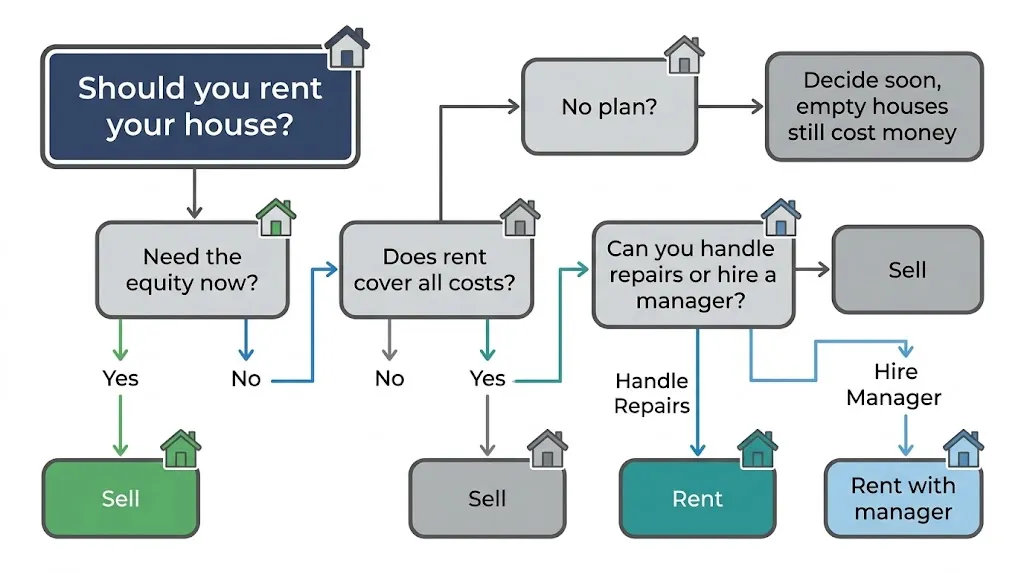
| You need the equity for a down payment or other goal | Selling |
| The house cash-flows after all costs and you want to keep it | Renting |
| You plan to move back within a few years | Renting, if you can handle vacancy and upkeep |
| You live far away and can’t respond to repairs | Renting with a property manager, or selling |
| Realistic rent doesn’t cover the costs | Selling, or renting only if you accept a monthly loss |
| The home is vacant and you have no plan | Either rent or sell. Empty houses still cost money. |
A tax detail that affects the rent-or-sell decision
If the house has been your primary residence, you may qualify to exclude a large part of the gain when you sell. Under IRS Section 121, you generally must have owned and lived in the home for at least 2 of the 5 years before the sale. Once you move out and rent it, that 5-year window starts running out.
Renting for a few years doesn’t automatically kill the exclusion, but waiting too long can. Depreciation you claim while renting also isn’t covered by the exclusion. Talk to a CPA before you commit to a long hold. IRS Publication 523 covers the rules.
Compare your equity, not just your payment
Here’s a simple way to test the decision. Take your equity and compare what it earns as a rental with what it could earn if you sold.
Annual return on equity = (annual cash flow + principal paydown + expected appreciation) ÷ equity
Appreciation is a guess, so run the formula twice: once with zero appreciation and once with a modest assumption. You’ll see how much of the “return” depends on a number nobody controls. The worked example below does exactly this.
Check Your Mortgage, HOA, Insurance, and Local Rules First
Do this before you take a single photo. A few phone calls can save you from a loan violation or a fine.
Your mortgage. Many conventional loans require you to occupy the home as your primary residence for a period after closing, commonly the first year. Read your loan documents or call your servicer. Renting early can breach that clause. If you’ve lived there past that period, many lenders allow renting, but ask whether you need to notify them.
Your HOA. Some associations cap the number of rentals, require board approval, set minimum lease terms, or ban short-term rentals. Get the current rules in writing.
Your city and county. Some places require a rental license, a registration, a safety inspection, or a certificate of occupancy before you can legally lease the property. Call the local housing or code-enforcement office.
State landlord-tenant law. Security deposit limits, notice rules, late-fee caps, entry requirements, and eviction procedures all vary by state and sometimes by city. Your state attorney general or housing agency usually publishes a plain-language landlord guide.
Fair housing law. The federal Fair Housing Act prohibits discrimination based on race, color, national origin, religion, sex, familial status, and disability. Many states and cities add more protected categories, such as source of income. HUD’s fair housing pages explain the federal rules.
Rules differ widely by state and city. Treat this guide as a framework and confirm local requirements with a licensed local attorney, your housing authority, or a landlord association.
Run the Numbers Before You List
A house can look profitable on paper and lose money in real life. The gap is almost always costs people forgot.
Costs to include
| Category | What to include |
|---|---|
| Debt | Principal and interest on the mortgage |
| Fixed costs | Property taxes, landlord insurance, HOA dues |
| Variable costs | Repairs and maintenance, utilities you pay, lawn or snow service |
| Reserves | Vacancy reserve, larger repair reserve (roof, HVAC, appliances) |
| Management | Property manager fee, if you use one |
| One-time costs | Cleaning, repairs before listing, advertising, screening reports, legal review of the lease |
| Ongoing admin | Accounting, licensing, rent-collection software |
For deeper coverage of the costs people miss, see our guide to hidden rental property expenses.
Worked example: the “$950 profit” that isn’t
This is a hypothetical scenario with rounded numbers to show the method. Your figures will differ.
Imagine a single-family home worth $400,000 with a $250,000 mortgage, so $150,000 of equity. You could rent it for $2,600 a month.
| Monthly item | Amount |
|---|---|
| Mortgage principal and interest (about 7% rate) | $1,650 |
| Property taxes | $380 |
| Landlord insurance | $160 |
| Repairs reserve (8% of rent, a planning assumption) | $208 |
| Vacancy reserve (5% of rent, a planning assumption) | $130 |
| Total cost, self-managed | $2,528 |
| Monthly cash flow, self-managed | $72 |
| Property manager at 8% of rent | $208 |
| Monthly cash flow, with manager | −$136 |
Rent minus mortgage looks like $950. After taxes, insurance, and reserves, it’s $72. With a manager, it’s negative.
The break-even rent is about $2,520 self-managed and about $2,770 with a manager. If local comparables put your house closer to $2,400, you’d be losing money every month.
The reserve percentages are rules of thumb, not statistics. An older house needs bigger reserves. Use your own repair history and local vacancy patterns.
Now test the return on equity
Assume about $2,400 of principal paid down in year one, and annual cash flow of $864 (the self-managed case: $72 × 12).
- With zero appreciation: ($864 + $2,400) ÷ $150,000 = about 2.2%
- With 3% appreciation as an assumption ($12,000 on a $400,000 house): ($864 + $2,400 + $12,000) ÷ $150,000 = about 10.2%
Most of that second number is appreciation, which you can’t count on. If you’d be uncomfortable with the 2.2% outcome, think hard before renting. Compare it with what the equity could earn if you sold, after selling costs and taxes. Depreciation will also change your after-tax picture, which we cover below.
You can plug in your own figures with our rental property cash flow calculator, and check the property’s return with the cap rate and cash-on-cash return tools.
Get Landlord Insurance
A standard homeowners policy is written for an owner-occupied home. Once a tenant lives there, many insurers treat it differently, and a claim can be denied if the policy doesn’t allow rental use. Tell your insurer you’re renting and ask what they’ll write.
A landlord (dwelling fire) policy generally covers the structure and liability. Many carriers offer optional loss-of-rent coverage. It typically does not cover your tenant’s belongings.
Before move-in:
- Replace or convert your homeowners policy with a landlord policy.
- Ask about loss-of-rent coverage and what triggers it.
- Require tenants to carry renters insurance, and put that in the lease.
- Ask whether an umbrella liability policy makes sense for your situation.
- Keep a copy of your declarations page with the lease file.
Some owners also hold rentals in an LLC for liability separation. That’s a legal and tax question with real tradeoffs, including lender consent. Ask an attorney who knows your state before you move the title.
Decide: Self-Manage or Hire a Property Manager
Both work. The right choice depends on your time, distance, and temperament.
| Option | Good fit | Tradeoff |
|---|---|---|
| Self-manage | You live nearby, can handle calls, and like organizing systems | Your time, and 2 a.m. emergencies |
| Full-service manager | You live far away or just don’t want the work | A fee, usually a percentage of rent, plus possible leasing and renewal charges |
| Hybrid | You want control but need help with leasing or maintenance | You still need clear roles and a backup plan |
If you’re getting quotes, ask for the full fee schedule in writing: monthly fee, leasing fee, renewal fee, maintenance markup, and cancellation terms. Then put the real number in your cash-flow math. Our tenant management guide covers what good management looks like day to day.
Make the House Rental-Ready
You’re not renovating for a showpiece. You’re making the house safe, clean, and easy to say yes to.
Safety and habitability first.
- Working smoke and carbon monoxide detectors
- Secure exterior locks, rekeyed before move-in
- No active leaks, electrical hazards, or mold issues
- Working heat, hot water, and plumbing
Then function.
- Repair appliances, faucets, flooring, doors, and windows
- Service the HVAC system and replace filters
- Check gutters, roof condition, and drainage
Then appearance.
- Deep clean everything, including carpets and windows
- Repaint worn walls in neutral colors
- Clean up the yard and entry
Pre-1978 homes. Federal law requires landlords to give tenants a lead-based paint disclosure and the EPA pamphlet before the lease is signed. Check the EPA’s rules if your home was built before 1978.
Take photos of the house before you do anything else. They help your listing and your move-in records, and they protect you later.
Set the Right Rent
Tenants compare your house with other homes, not with your mortgage. Your costs matter for deciding whether to rent. They don’t determine what the market will pay.
How to price it:
- Find 5 to 10 comparable rentals nearby, matched on bedrooms, bathrooms, square footage, and property type.
- Record asking rent, lease terms, pet policy, and how long each has been listed.
- Adjust for differences: garage, updated kitchen, yard, laundry, school zone, condition.
- Cross-check against HUD’s Fair Market Rent data for your area as a sanity check.
- Price to attract qualified applicants quickly.
A house priced slightly under the market and rented in two weeks often beats one priced high and empty for two months. If you’re unsure, our market comparison tool helps you structure the comps.
Write a Listing That Attracts Qualified Applicants
A good listing answers a renter’s questions before they ask.
Include:
- Bedrooms, bathrooms, square footage, and neighborhood
- Rent, security deposit, and lease length
- Move-in date
- Pet, smoking, and parking policies
- Included utilities and appliances
- Laundry, yard, and storage
- Clear application instructions and your screening criteria
- Bright photos of every room and the exterior
Keep it honest. Don’t overpromise on features or location. Misleading listings produce wasted showings and early disputes.
Be careful with wording. Avoid phrases that suggest a preference for or against any protected group.
Sample listing:
3-bedroom, 2-bath home for rent in [neighborhood]
About [sq ft] square feet with [key feature] and [second feature]. Includes [appliances], [parking], and [yard/outdoor space].
Rent: $[amount]/month. Security deposit: $[amount]. Available [date]. 12-month lease. Pets: [policy]. Application requirements and screening criteria below. To schedule a showing, [contact method].
Post where your tenants search: major rental sites, local community groups, and a yard sign if allowed. Wider exposure gives you more applicants, which lets you be pickier by your written standards.
Screen Tenants Fairly and Consistently
Tenant selection is the highest-leverage decision you’ll make. A good tenant makes a mediocre property work. A bad one makes a good property expensive. Our tenant screening guide goes deeper, and the eviction cost calculator shows what a bad placement can cost.
Write your criteria before you get applications
Decide your standards first, put them in writing, and apply them to every applicant. Common criteria include:
- Income: many landlords require monthly income of about 3 times the rent. It’s a common rule of thumb, not a legal standard, and some jurisdictions restrict how it’s applied.
- Rental history: on-time payments, no major lease violations
- Credit and background: reviewed through a proper screening service, with the applicant’s written consent
- Employment verification: pay stubs, an employer contact, or tax documents
- Complete application from every adult who will live there
Know the legal guardrails
- Fair Housing: apply the same criteria, documents, and process to everyone. Never decide based on a protected characteristic.
- Fair Credit Reporting Act (FCRA): if you deny an applicant or charge more because of something in a consumer report, you generally must give an adverse action notice. The CFPB and FTC publish plain-language guidance.
- Local limits: some places restrict how you can use criminal history or source of income. Check yours.
Red flags
- Incomplete or inconsistent application
- Income you can’t verify
- A prior landlord who can’t be reached, or who suddenly sounds suspiciously glowing
- Pressure to skip steps or move in immediately
- Reluctance to sign the application or consent to screening
Show the Property Safely
Screen first by phone or message, then show. Let people see the whole house. Never promise side deals verbally. Anything you agree to goes in the lease.
Safety basics: don’t show alone if you can avoid it, let someone know where you’ll be, and keep personal information off the listing.
Write a Lease That Prevents Disputes
The lease is the operating manual for the tenancy. A vague one invites arguments.
A solid residential lease generally covers:
- All adult tenants and the property address
- Start date, end date, and renewal terms
- Rent amount, due date, grace period, and accepted payment methods
- Late-fee terms, where your state allows them
- Security deposit amount, where it’s held, and return conditions
- Who pays which utilities
- Maintenance responsibilities and how to report problems
- Rules on pets, smoking, guests, and subletting
- Your entry rights and notice requirements
- Insurance requirements
- Required disclosures, such as lead-based paint for pre-1978 homes, plus any your state requires
Use a lease template written for your state, not a generic national form. If anything is unusual, have a local attorney review it. Both sides sign, and both keep a copy.
Collect the Deposit and Complete a Move-In Inspection
Deposit. Follow your state’s rules on the maximum amount, where it must be held, and how quickly it must be returned. Don’t treat it as extra income. Normal wear and tear usually can’t be deducted from it.
Move-in inspection. Walk the house with the tenant before they move in. Photograph or video every room with timestamps. Note existing marks, stains, and damage. Have both parties sign the written checklist.
What to document:
- Walls, floors, ceilings, and doors
- Kitchen cabinets, counters, and appliances
- Bathrooms and fixtures
- Windows, blinds, and locks
- HVAC and filters
- Yard, fence, garage, and exterior
- Smoke and CO detectors
This record is your best protection if there’s a dispute about damage versus normal wear at move-out.
Set Up Rent Collection and Maintenance Before You Need Them
Build these systems before the first problem.
Rent collection: use a method that creates a record, such as online payments or bank transfer. State the due date and grace period in the lease. Apply late fees consistently and only as the lease and local law allow.
Maintenance: give tenants one official channel for requests. Respond fast to anything affecting safety or habitability: no heat, active leaks, electrical hazards, security problems. Keep a short list of trusted plumbers, electricians, HVAC techs, and handymen, and schedule seasonal maintenance.
Records: keep every lease, payment, repair, receipt, notice, and message. You’ll need them at tax time and in any dispute.
Handle Late Rent and Lease Violations the Legal Way
Late rent will happen eventually. Handle it calmly and by the book.
- Check the lease and local law.
- Confirm the payment really is late.
- Send any required written notice.
- Document every contact.
- Follow the formal legal process if it continues.
Never change the locks, remove belongings, shut off utilities, or threaten a tenant outside the court process. Self-help evictions are illegal in most places and can expose you to liability. If eviction becomes necessary, follow your state’s procedure exactly. Mistakes can restart the process. Our landlord legal and compliance resources explain more.
Understand the Tax Side of Renting Your House
Rental income is generally taxable, but so are the deductions. The IRS covers this in Publication 527 (Residential Rental Property) and reports it on Schedule E. State and local rules vary, so confirm with a CPA.
Income and deductions. You generally report rent received. Deductible expenses commonly include mortgage interest, property taxes, insurance, repairs, management fees, advertising, and certain travel and professional costs. Repairs and improvements are treated differently, so read the IRS guidance.
Depreciation. Residential rental property is generally depreciated over 27.5 years. When you convert a home to a rental, your depreciable basis is generally the lower of your adjusted basis or the property’s fair market value on the conversion date, and land isn’t depreciable. Walk through the math in our rental property depreciation guide.
Passive loss rules. If your rental shows a tax loss, passive activity rules may limit how much you can deduct. There’s an allowance of up to $25,000 for owners who actively participate, but it phases out at higher incomes. Unused losses can generally be carried forward.
Selling later. Depreciation you claimed (or were allowed to claim) is generally “recaptured” when you sell, and that portion can be taxed at a different rate than ordinary gain. Combine that with the Section 121 timing rules above, and you can see why the sale date matters. Investors sometimes defer gains with a 1031 exchange, but a former residence converted to a rental has specific requirements, so get advice first.
For more, see our landlord taxes guide.
Common Mistakes First-Time Landlords Make
- Listing before checking the mortgage, HOA, and local rules.
- Pricing from the mortgage payment instead of comparable rentals.
- Skipping reserves for repairs, vacancy, and turnover.
- Keeping the homeowners policy and assuming it covers a tenant.
- Taking the first applicant without verifying income and rental history.
- Screening inconsistently, which creates fair-housing risk.
- Using a vague or out-of-state lease.
- Skipping the move-in inspection and photos.
- Delaying small repairs until they become expensive ones.
- Mixing personal and rental money, which complicates taxes and records.
More to Explore Article People Also Ask
Check your mortgage, HOA, and local rules. Then calculate all costs, insure the property properly, prepare the house, price it from comparable rentals, screen applicants by written criteria, sign a compliant lease, and document the move-in condition.
Often yes, but check your loan terms first. Many mortgages require you to live in the home for a set period, commonly the first year. Your lender may also have notice or insurance requirements.
Base it on similar nearby rentals, adjusted for size, condition, and amenities, not on your mortgage payment. Use your costs to decide whether renting makes sense, not to set the price.
In most cases, yes. A homeowners policy often isn’t written for a tenant-occupied home. Landlord insurance is designed for it, and many policies offer optional loss-of-rent coverage. Ask your insurer directly.
No. Plenty of landlords self-manage well. A manager makes more sense if you live far away, lack time, or don’t want to handle repairs and tenant calls.
It depends on your equity, your cash flow, your tax situation, and your goals. Renting can make sense if the house cash-flows and you want to keep it. Selling can make more sense if you need the equity or the rent can’t cover costs.
Generally, yes. Rental income is usually taxable, but you can deduct eligible expenses and claim depreciation. See IRS Publication 527 and talk with a CPA, because state rules vary.
Yes, in most places. You can list it yourself, screen tenants, and use a state-specific lease. Some states regulate property managers and leasing agents, so check local rules if you hire help.
Final Checklist
Before you list
- Confirm mortgage, HOA, city, and state requirements
- Run cash flow with reserves
- Switch to landlord insurance
- Repair, clean, and safety-check the home
- Research comparable rents
- Take photos and write the listing
Before move-in
- Screen every adult applicant against the same written criteria
- Sign a state-specific lease with required disclosures
- Collect the deposit and first month’s rent
- Rekey locks and reset access codes
- Complete a signed move-in inspection with photos
After move-in
- Collect rent through a documented method
- Respond quickly to maintenance requests
- Keep clean records of payments, repairs, and messages
- Review your numbers each year
Conclusion
Renting your house works best when you treat it like a small business from the start. Check what you’re allowed to do, know your real numbers, protect yourself with the right insurance and a solid lease, and choose your tenant by written standards.
Run your own figures with the rental property cash flow calculator before you commit. If the numbers are thin, selling may be the better move. If they work, a careful setup now saves you most of the problems later.
This article is educational and not legal, tax, or financial advice. Landlord-tenant, tax, and fair-housing rules vary by state and locality. Confirm requirements with a qualified local professional.

Pingback: Rent Ledger: 7 Costly Mistakes Every Landlord Must Avoid
Pingback: What Credit Score Is Needed to Rent? The Honest 620 Answer
Pingback: Move-In & Move-Out Inspection Checklist for Landlords: 15 Essential Steps