

Difference Between Cap Rate and Discount Rate: Key Differences Explained
If you’re evaluating a rental property, cap rate and discount rate are related but they do not answer the same question.
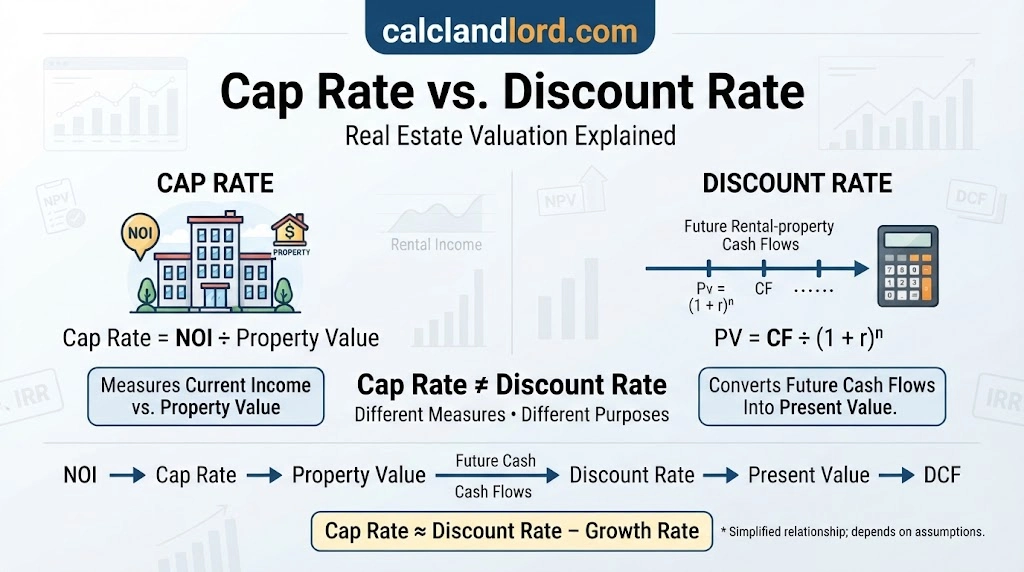
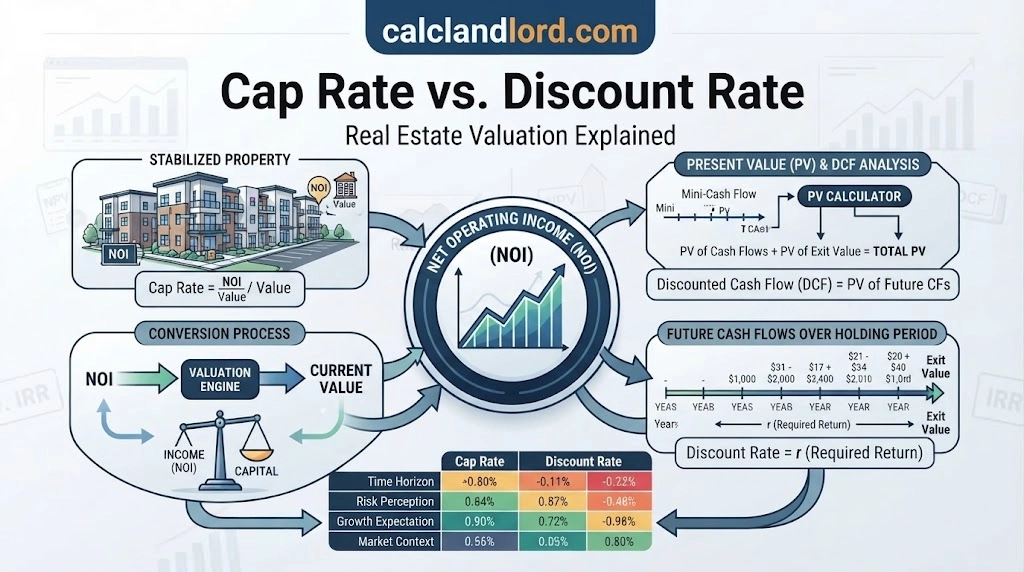
The Cap Rate measures a property’s NOI relative to its current value or purchase price. The discount rate is used to convert a series of expected future cash flows into today’s value through discounted cash flow analysis.
In simple terms:
Cap rate tells you how the property’s current or stabilized income compares with its value. Discount rate tells you how much future cash flows are worth today after accounting for time and required return.
This distinction matters when a landlord is deciding whether a rental property is fairly priced, comparing two investment properties, or building a multi-year investment model.
What Is the Difference Between Cap Rate and Discount Rate?
The biggest difference is time horizon and purpose.
A cap rate generally uses one year’s NOI:
Cap Rate = NOI ÷ Property Value
A discount rate is applied to future cash flows:
PV = CF ÷ (1 + r)ⁿ
where:
- PV = present value
- CF = future cash flow
- r = discount rate
- n = number of periods
A cap rate therefore provides a relatively simple, point-in-time income measure. A DCF uses a discount rate to analyze multiple future cash flows over a holding period. Altus Group makes the same distinction, describing capitalization as a point-in-time approach and DCF as a method that evaluates the property’s projected cash flows over the investment period.
Quick comparison
| Factor | Cap Rate | Discount Rate |
| Main purpose | Capitalize income into value | Discount future cash flows |
| Typical horizon | One/stabilized income period | Multiple future periods |
| Main input | NOI and property value | Projected cash flows |
| Common method | Direct capitalization | DCF |
| Growth explicitly modeled? | Usually no | Yes |
| Cash-flow timing | Limited | Explicit |
| Exit value | Can be calculated using an exit cap | Discounted back to present |
| Risk consideration | Reflected indirectly in market pricing | Explicitly considered in required return |
| Typical use | Stabilized properties | Properties with changing cash flows |
For a landlord, the important takeaway is that a 7% cap rate is not automatically a 7% investment return.
Mortgage payments, capital expenditures, future NOI, appreciation, selling costs, taxes and the eventual sale price can all change the actual investment outcome.
What Is a Cap Rate in Real Estate?
The capitalization rate, or cap rate, is a measure of a property’s annual NOI relative to its value.
The basic formula is:
Cap Rate = Annual NOI ÷ Property Value × 100
Suppose you purchase a rental property for $400,000 and its annual NOI is $28,000.
$28,000 ÷ $400,000 = 7%
The property has a 7% cap rate.
This means the property’s annual NOI equals 7% of its purchase price.
However, that does not mean the landlord receives a 7% cash return after financing.
For example, mortgage payments are not included in NOI. Neither are an owner’s income taxes or principal repayments. Current PropertyMetrics guidance likewise emphasizes that cap rate is based on NOI and should not automatically be interpreted as total investment return.
What goes into NOI?
Depending on the property and calculation method, NOI generally starts with property income and subtracts operating expenses.
Typical operating considerations include:
- Rent
- Other property income
- Vacancy and collection losses
- Property taxes
- Insurance
- Repairs
- Maintenance
- Utilities paid by the owner
- Property management
- Other operating expenses
NOI generally does not include:
- Mortgage principal
- Mortgage interest
- Owner income taxes
- Personal expenses
- Major capital expenditures in the conventional NOI calculation
The exact treatment can vary by valuation or underwriting methodology, so landlords should use a consistent definition when comparing properties.
How to Calculate Cap Rate: Formula and Example
The basic formula is:
Cap Rate = NOI ÷ Property Value
To estimate value from NOI:
Property Value = NOI ÷ Cap Rate
Example 1: Calculate the cap rate
Suppose a rental property has:
- Annual rental and other income: $48,000
- Operating expenses: $16,000
- NOI: $32,000
- Purchase price: $400,000
Then:
Cap Rate = $32,000 ÷ $400,000
Cap Rate = 8%
Example 2: Estimate property value
Suppose another property produces:
NOI = $36,000
Comparable properties indicate an appropriate cap rate of:
6%
Then:
Value = $36,000 ÷ 0.06
Value = $600,000
The calculation is simple, but the difficult part is deciding whether the NOI and cap rate are appropriate.
Why this matters for landlords
Two properties may both advertise an 8% cap rate, but that doesn’t necessarily mean they are equally attractive investments.
One might have:
- Stable tenants
- Newer systems
- Low expected capital expenses
- Strong rental demand
The other might have:
- Deferred maintenance
- High vacancy risk
- Upcoming roof replacement
- Uncertain rent growth
The headline cap rate does not tell the entire story.
What Is a Discount Rate in Real Estate?
A Discount Rate is the rate used to convert future cash flows into their present value.
The concept comes from the time value of money.
Receiving $10,000 today and receiving $10,000 five years from now are not economically identical because money available today can potentially be invested and future cash flows carry uncertainty.
In a rental-property DCF, you might forecast:
- Year 1 rental income
- Year 2 rental income
- Vacancy
- Operating expenses
- Repairs
- Capital expenditures
- NOI
- Sale proceeds
- Selling costs
The discount rate is then used to translate those future amounts into present dollars.
RICS defines the discount rate as the rate used to derive the NPV of expected future cash flows and notes that it commonly represents the property’s target or expected rate of return in investment analysis.
Example
Suppose you expect to receive $50,000 one year from now.
At an 8% discount rate:
PV = $50,000 ÷ 1.08
PV ≈ $46,296
So the present value of that future $50,000 is approximately $46,296 under an 8% discount rate.
The further into the future the cash flow occurs, the more periods of discounting may apply.
How to Calculate a Discount Rate in a DCF
Unlike a cap rate, there isn’t one universal formula that tells every landlord what discount rate to use.
A discount rate represents a required or target return appropriate to the investment and its risk.
One conceptual framework is:
Discount Rate ≈ Risk-Free Rate + Risk Premiums
The risk premium can reflect characteristics such as:
- Property type
- Location
- Tenant quality
- Vacancy risk
- Lease stability
- Expected growth
- Capital expenditure requirements
- Liquidity
- Market conditions
- Investment risk
RICS notes that discount rates can be supported by property-market or financial-market evidence and can incorporate a risk-free rate and risk premium; approaches can also include models such as CAPM or WACC depending on the valuation context.
For a small landlord, however, you should avoid pretending that a single formula produces a universally correct discount rate.
Instead, document your assumption and test how the property’s valuation changes when the rate changes.
Example
Assume your projected five-year cash flows produce a present value of $500,000 at a 7% discount rate.
If you increase the discount rate to 9%, the present value will generally decline, assuming everything else remains unchanged.
That’s why discount-rate sensitivity is so important.
Cap Rate vs. Discount Rate: Key Differences Compared
| Question | Cap Rate | Discount Rate |
| What does it measure? | Income relative to value | Required return used to discount future cash flows |
| Main calculation | NOI ÷ value | PV of future cash flows |
| Time period | Usually one year/stabilized period | Entire projected holding period |
| Uses future cash flows? | Not explicitly | Yes |
| Models growth? | Usually implicit | Yes |
| Used for terminal value? | Yes, as an exit cap | No; it discounts terminal value |
| Used in DCF? | May help establish exit value | Core DCF input |
| Affected by risk? | Yes, through market pricing | Yes, explicitly through required return |
| Good for stabilized property? | Often useful | Can be useful |
| Good for changing cash flows? | Limited | Often more appropriate |
| Equals total investment return? | No | No |
A simple way to remember it
Cap rate:
“What’s the property’s income yield relative to its value?”
Discount rate:
“What is the present value of the property’s future cash flows at my required return?”
Are Cap Rate and Discount Rate the Same?
No—not generally.
There are special circumstances where mathematics can make capitalization rate and discount rate equivalent.
RICS explains that under simplified assumptions involving constant income, no growth, and appropriate cash-flow timing, a yield can function as the discount rate. But those assumptions are often not appropriate for real-world investments with changing cash flows.
For a typical rental-property investment, cash flows can change because of:
- Rent increases
- Vacancy
- Lease turnover
- Repairs
- Property taxes
- Insurance
- Capital improvements
- Property appreciation
- Selling costs
That is why you should not automatically take a property’s cap rate and label it the discount rate.
Example
Suppose:
- Purchase price = $500,000
- NOI = $30,000
- Cap rate = 6%
The cap rate tells you:
$30,000 ÷ $500,000 = 6%
But suppose NOI is projected to grow by 3% annually.
Now the future income stream is different from today’s income.
A DCF can model that growth explicitly. The cap rate by itself cannot.
How Are Cap Rate and Discount Rate Related?
Cap rate and discount rate can be related through growth expectations.
Under a simplified constant-growth model:
Cap Rate ≈ Discount Rate − Growth Rate
Therefore:
Discount Rate ≈ Cap Rate + Growth Rate
For example:
- Cap rate = 6%
- Long-term growth = 2%
Then:
Discount rate ≈ 8%
This relationship is useful for understanding valuation theory, but it should not be treated as a universal rule.
RICS presents the simplified relationship between capitalization rate, target/discount rate and expected growth, while also showing that more complicated lease and growth patterns require a more detailed analysis.
- Explore More: https://calclandlord.com/commercial-property-valuation/
Why growth matters
Imagine two properties both have a 6% cap rate.
Property A is expected to have almost no NOI growth.
Property B is expected to experience sustained NOI growth.
The two properties can have different expected returns and values even though their initial cap rates are identical.
This is why a landlord should look beyond the first-year cap rate.
What Is the Gordon Growth Relationship Between Cap Rate and Discount Rate?
The Gordon Growth model helps explain the mathematical relationship.
A simplified growing-perpetuity formula is:
Value = CF₁ ÷ (r − g)
where:
- CF₁ = next-period cash flow
- r = discount rate
- g = long-term growth rate
Since:
Cap Rate = CF₁ ÷ Value
the relationship becomes:
Cap Rate = r − g
or:
r = Cap Rate + g
Example
Suppose:
- Next year’s NOI = $30,000
- Property value = $500,000
- Expected perpetual growth = 2%
First:
Cap Rate = $30,000 ÷ $500,000 = 6%
Then, under the simplified Gordon Growth assumptions:
Discount Rate ≈ 6% + 2% = 8%
Important limitation
Real rental properties rarely produce perfectly constant growth forever.
A property might have:
- 2% rent growth for several years
- a major lease renewal
- a vacancy period
- a large repair
- a property-tax increase
- changing insurance costs
- a different exit cap rate
RICS specifically cautions through its DCF examples that the simple cap-rate-plus-growth relationship depends on assumptions about the timing and pattern of income growth.
So use the Gordon Growth relationship as an intuition-building shortcut, not as a replacement for a detailed DCF when the cash flows are complicated.
How Do Cap Rates Affect Rental Property Value?
Cap rates and property values have an inverse relationship when NOI stays constant.
The formula is:
Property Value = NOI ÷ Cap Rate
Suppose a rental property has:
NOI = $40,000
Then:
| Cap Rate | Implied Value |
| 5% | $800,000 |
| 6% | $666,667 |
| 7% | $571,429 |
| 8% | $500,000 |
| 9% | $444,444 |
| 10% | $400,000 |
Notice what happens:
Higher cap rate → lower implied value
Lower cap rate → higher implied value
This doesn’t mean a lower cap rate automatically makes a property a better investment.
A lower cap rate may reflect stronger location, better tenants, lower perceived risk, better growth prospects, or other market characteristics.
Likewise, a higher cap rate can reflect greater risk or weaker expected income.
Current PropertyMetrics guidance emphasizes that cap rates reflect more than a simple interest-rate comparison and can incorporate property, market, growth, tenant and risk characteristics.
Landlord takeaway
When comparing properties, don’t ask only:
“Which one has the higher cap rate?”
Also ask:
- How reliable is the NOI?
- Is the NOI normalized?
- How much maintenance is coming?
- How stable are the tenants?
- What rent growth is realistic?
- What is the property’s vacancy history?
- What will the property be worth at exit?
How Does the Discount Rate Affect Property Value?
The discount rate has an inverse relationship with present value.
All else equal:
Higher discount rate → lower present value
Lower discount rate → higher present value
Suppose you expect to receive $100,000 five years from now.
At 6%:
PV = $100,000 ÷ (1.06)⁵
At 10%:
PV = $100,000 ÷ (1.10)⁵
The approximate values are:
- At 6%: $74,726
- At 10%: $62,092
The same future $100,000 has a lower present value when discounted at the higher rate.
Why landlords should care
Suppose you’re evaluating a property that depends heavily on future appreciation.
A DCF can expose how sensitive your valuation is to:
- Your discount rate
- Rent growth
- Vacancy
- Operating expenses
- Exit cap rate
- Sale price
This is much more informative than looking at a single cap rate.
Altus Group similarly notes that the discount rate is a core DCF input and that higher-risk properties generally warrant higher discount rates.
Cap Rate vs. Discount Rate vs. IRR and NPV
These four concepts are frequently mixed together, but they have different roles.
Cap rate
A cap rate is primarily a single-period income capitalization metric.
Cap Rate = NOI ÷ Value
Discount rate
A discount rate is a DCF assumption used to convert future cash flows to present value.
NPV
Net Present Value (NPV) compares the present value of future cash flows with the initial investment.
Conceptually:
NPV = Present Value of Future Cash Flows − Initial Investment
A positive NPV means the modeled future cash flows have greater present value than the initial investment at the selected discount rate.
IRR
Internal Rate of Return (IRR) is the rate that makes the investment’s NPV equal to zero for the specified cash-flow sequence.
Altus Group describes the relationship directly: the discount rate is an input into NPV analysis, while IRR is the rate at which NPV reaches zero.
The easiest comparison
| Metric | Main Question |
| Cap rate | What is current/stabilized NOI relative to value? |
| Discount rate | What rate should discount future cash flows to present value? |
| NPV | How much value remains after discounting cash flows and subtracting investment? |
| IRR | What return is implied by the complete cash-flow stream? |
Why this matters to landlords
Suppose two rentals both have an 8% cap rate.
That doesn’t guarantee that both have the same IRR.
One could have strong rent growth and appreciation.
The other could require major capital expenditures and have weak future income.
The initial cap rate is identical, but the complete investment cash flows can be very different.
Going-In Cap Rate vs. Exit Cap Rate in a DCF
A going-in cap rate describes the property’s income yield at acquisition.
An exit cap rate is used to estimate the property’s value at the end of the holding period.
Going-in cap rate
Going-In Cap Rate = Year-1 NOI ÷ Purchase Price
Suppose:
- Purchase price = $500,000
- Year-1 NOI = $35,000
Then:
$35,000 ÷ $500,000 = 7%
Exit value
Suppose year-five NOI is expected to be:
$45,000
and your assumed exit cap rate is:
7.5%
Then:
Exit Value = $45,000 ÷ 0.075
Exit Value = $600,000
That $600,000 is a future value, not today’s value.
To include it in a DCF, you discount the terminal value back to the present.
RICS calls the capitalization rate applied at the terminal date the exit yield and identifies terminal value as a key component of DCF analysis.
Why exit cap rate matters
A small change in the exit cap rate can substantially change terminal value.
For the same $45,000 NOI:
| Exit Cap Rate | Exit Value |
| 6% | $750,000 |
| 7% | $642,857 |
| 7.5% | $600,000 |
| 8% | $562,500 |
| 9% | $500,000 |
This is why landlords should not blindly assume that today’s cap rate will remain unchanged at sale.
Worked Rental Property Example: Cap Rate and Discount Rate
Let’s put the concepts together using a hypothetical U.S. rental property.
Assume:
- Purchase price: $400,000
- Year-1 gross rental income: $48,000
- Operating expenses: $16,000
- Year-1 NOI: $32,000
- Expected NOI growth: 3% annually
- Holding period: 5 years
- Exit cap rate: 7.5%
- Illustrative discount rate: 9%
These are hypothetical assumptions, not a recommendation or market forecast.
Step 1: Calculate the going-in cap rate
Cap Rate = $32,000 ÷ $400,000
Cap Rate = 8%
So the property has an 8% going-in cap rate based on these assumptions.
Step 2: Project NOI
With 3% annual NOI growth:
| Year | Projected NOI |
| 1 | $32,000 |
| 2 | $32,960 |
| 3 | $33,949 |
| 4 | $34,967 |
| 5 | $36,016 |
Step 3: Estimate the exit value
Using year-five NOI and a 7.5% exit cap rate:
Exit Value = $36,016 ÷ 0.075
Exit Value ≈ $480,213
This is the estimated sale value before considering selling costs.
Step 4: Discount the future cash flows
The five annual NOI amounts and the terminal sale proceeds are future cash flows.
Each is discounted using:
PV = CF ÷ (1 + 0.09)ⁿ
For example, year-five NOI is discounted five periods:
PV of Year-5 NOI = $36,016 ÷ (1.09)⁵
The terminal value is also discounted for five periods.
Step 5: Include other investment cash flows
A real landlord analysis should also consider appropriate items such as:
- Vacancy
- Leasing costs
- Major repairs
- Capital expenditures
- Selling expenses
- Financing cash flows
- Taxes, depending on the purpose of the analysis
This is where a DCF becomes more informative than a simple cap-rate calculation.
What the example demonstrates
The 8% cap rate describes the relationship between current NOI and the $400,000 acquisition price.
The 9% discount rate is an illustrative required-return assumption used to discount future cash flows.
The 7.5% exit cap rate estimates the property’s terminal value.
Those three percentages perform different jobs.
Common Mistakes and Best Practices for Using Cap and Discount Rates
Understanding the formulas isn’t enough. The assumptions behind them matter just as much.
Mistake 1: Treating cap rate as total return
An 8% cap rate does not mean an investor will earn exactly 8%.
Actual investment results can differ because of:
- Financing
- NOI changes
- Appreciation
- Capital expenditures
- Selling costs
- Holding period
Best practice: Treat cap rate as one property-level valuation metric, not the entire investment return.
Mistake 2: Using gross rent instead of NOI
Cap rate normally uses NOI rather than gross scheduled rent.
Best practice: Normalize income and operating expenses before calculating cap rate.
Mistake 3: Ignoring vacancy
A property that appears profitable at 100% occupancy may have a very different NOI at realistic occupancy.
Best practice: Use a defensible vacancy and collection-loss assumption.
Mistake 4: Ignoring major capital expenditures
A building may have strong NOI while simultaneously needing a roof, HVAC system, parking lot or other major capital improvement.
Best practice: Keep NOI and capital-expenditure analysis conceptually separate and include appropriate capital needs in the broader investment model.
Mistake 5: Assuming cap rate equals discount rate
This is one of the most common conceptual errors.
Best practice: Ask whether you’re capitalizing one income period or discounting an entire future cash-flow stream.
Mistake 6: Using the Gordon Growth equation blindly
Cap Rate ≈ Discount Rate − Growth
is useful under simplified assumptions.
It isn’t a universal valuation shortcut for every rental property.
Best practice: Use a full DCF when cash flows, lease events, expenses or growth patterns are complicated.
Mistake 7: Ignoring exit assumptions
A DCF can be highly influenced by terminal value.
Best practice: Test multiple exit-cap-rate assumptions.
Mistake 8: Focusing on one percentage
A property shouldn’t be judged from cap rate alone.
Best practice: Review:
- Cap rate
- Cash flow
- Cash-on-cash return
- NOI
- Debt service
- DCF value
- NPV
- IRR
- Exit assumptions
- Capital expenditure requirements
The exact metrics needed depend on the investment question.
A Practical Landlord Decision Framework
When evaluating a rental property, move through the analysis in this order.
1. Normalize the income
Determine realistic:
- Rent
- Other income
- Vacancy
- Collection losses
2. Calculate NOI
Subtract appropriate operating expenses.
3. Calculate the going-in cap rate
Use:
NOI ÷ Purchase Price
4. Examine the property’s future
Ask:
- Will rent grow?
- Are expenses rising?
- Are leases expiring?
- Is major maintenance coming?
- Is vacancy likely to change?
5. Build future cash flows
Project the property’s income and expenses over the intended holding period.
6. Choose and document a discount-rate assumption
Consider the property’s risk and the purpose of the analysis.
7. Estimate terminal value
Use an appropriate exit cap-rate assumption.
8. Discount the cash flows
Calculate present values.
9. Evaluate NPV and IRR where appropriate
These can help you understand the investment’s modeled economics.
10. Run sensitivity analysis
Change important assumptions.
For example:
- Lower rent growth
- Higher vacancy
- Higher expenses
- Higher discount rate
- Higher exit cap rate
- Lower exit cap rate
If the investment only works under one optimistic scenario, that is important information.
People Also Ask
A: No. A cap rate generally capitalizes one period of NOI into property value, while a discount rate is used to convert future cash flows into present value through DCF analysis.
A: No. A higher cap rate can accompany greater risk, weaker property characteristics, less stable income, or different market conditions. Compare the cap rate with the property’s income quality, expenses, growth prospects and risk.
A: There is no universal cap rate that is appropriate for every U.S. rental property. Cap rates vary with property type, location, income quality, market conditions, growth expectations and risk. A cap rate should be evaluated against comparable properties and the assumptions behind NOI.
A: Cap Rate = NOI ÷ Property Value × 100
If NOI is $30,000 and value is $500,000, the cap rate is 6%.
A: The discount rate is used in the present-value formula:
PV = CF ÷ (1 + r)ⁿ
The appropriate rate itself is an analytical assumption or derived rate rather than a number generated by this formula alone.
Conclusion
The Difference Between Cap Rate and Discount Rate becomes much easier to understand once you separate their purposes.
Cap rate is primarily a capitalization measure:
Cap Rate = NOI ÷ Property Value
It tells you how a property’s current or stabilized NOI compares with its value.
Discount rate is a DCF valuation input:
PV = Future Cash Flow ÷ (1 + Discount Rate)ⁿ
It helps convert future rental-property cash flows and terminal value into today’s dollars.
The two rates can be mathematically related under simplified growth assumptions:
Discount Rate ≈ Cap Rate + Growth Rate
But this relationship depends on assumptions about growth, timing, cash flows and terminal value. Professional valuation guidance specifically shows that more complex income patterns can make the simple relationship inadequate.
For a landlord, the most useful framework is:
Cap rate → current/stabilized income relative to value
Discount rate → present value of future cash flows
Exit cap rate → estimated value at the end of the holding period
NPV → value created or lost at a selected discount rate
IRR → return implied by the investment’s cash-flow stream
The biggest mistake is making an investment decision from one percentage alone. A rental property should be evaluated using realistic NOI, vacancy, expenses, capital expenditures, financing, growth assumptions and exit conditions.
For a simple property, start with NOI and cap rate. For a property whose future cash flows are expected to change materially, move toward a DCF and sensitivity analysis.
CalcLandlord’s Cap Rate Calculator would be the natural next step for checking the initial capitalization calculation, while a cash-flow or investment-return tool can help extend the analysis when those tools are available on the site.

Pingback: Green Bonds in Real Estate: 7 Things Investors Need to Know