

How Green Bonds Work in Real Estate: The Complete 2026 Guide
What if a real estate company could raise large-scale debt while directing the proceeds toward energy-efficient buildings, retrofits, renewable energy, and other eligible green projects? That is the basic idea behind green bonds—but the details matter. A green label does not automatically mean cheaper financing, guaranteed environmental results, or lower investment risk. Issuers must define eligible projects, establish a framework, track proceeds, and report allocation and environmental impacts. For landlords, REITs, developers, and property investors, understanding this process can reveal both opportunities and hidden costs. This guide explains how green bonds work in real estate and what to evaluate before relying on them.
Green bonds in real estate are debt securities designed to raise money for projects or assets with defined environmental benefits. In practice, they can help finance or refinance energy-efficient buildings, major property retrofits, renewable-energy systems, water-efficiency projects, and other eligible green investments.
But an important distinction exists between a bond labeled green and a building that merely has sustainable features.
A green bond generally comes with a documented framework explaining what qualifies, how projects are selected, how proceeds are tracked, and how the issuer will report environmental outcomes. The International Capital Market Association’s Green Bond Principles describe these as four core components: use of proceeds, project evaluation and selection, management of proceeds, and reporting. The 2025 edition also reinforces transparency and disclosure around green credentials.
For a small landlord, issuing a public green bond may be unrealistic. For a large multifamily owner, REIT, developer, financial institution, or property portfolio with substantial capital needs, however, green bonds can be a specialized financing route.
This guide explains how green bonds work in real estate from beginning to end, what qualifies, how the issuance process works, what it costs, what the greenium really means, how investors evaluate these bonds, and when green financing may or may not make sense.
Quick answer: A real estate green bond works much like other corporate debt, but the issuer commits to allocating an amount equal to the bond’s net proceeds to eligible green projects and reporting on that allocation and, where feasible, its environmental impact. The issuer still has to meet its ordinary debt obligations; the green designation does not eliminate credit risk.
What Are Green Bonds in Real Estate and How Do They Work?
A real estate green bond is a fixed-income security used to raise capital for defined environmental projects or assets connected to real estate.
The key difference from a conventional bond is the use-of-proceeds commitment.
Under the ICMA Green Bond Principles, the framework centers on four areas:
| Component | What it means in real estate |
| Use of proceeds | Defines which property projects, assets or expenditures qualify |
| Project evaluation and selection | Explains how the issuer decides what qualifies |
| Management of proceeds | Shows how bond proceeds are tracked until allocated |
| Reporting | Provides allocation and environmental-impact information |
The principles are voluntary market guidelines. They do not create one universal certification threshold that every property issuer must follow. Eligibility criteria therefore need to be read from the specific issuer’s framework and transaction documents.
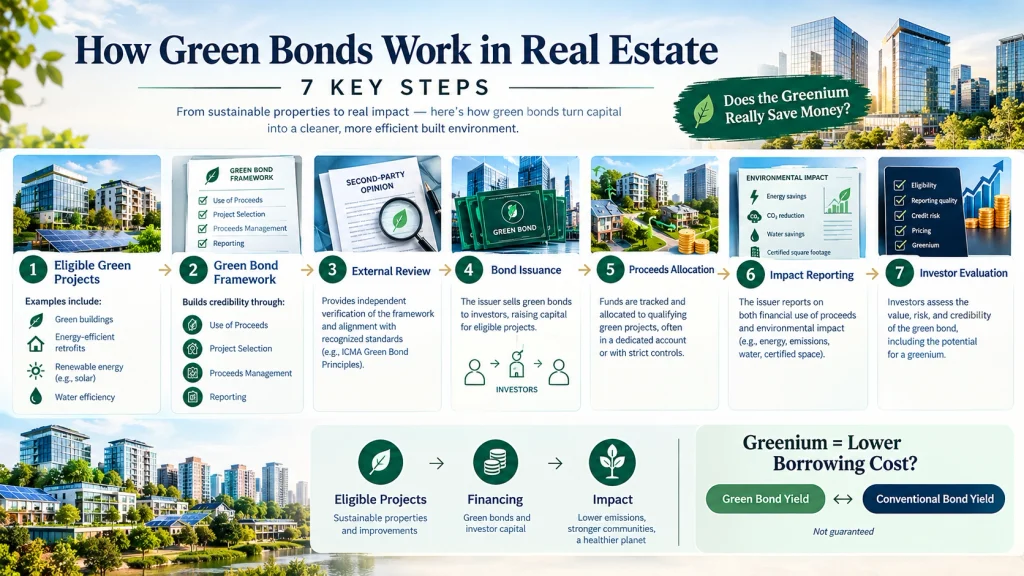
A simple way to visualize the process is:
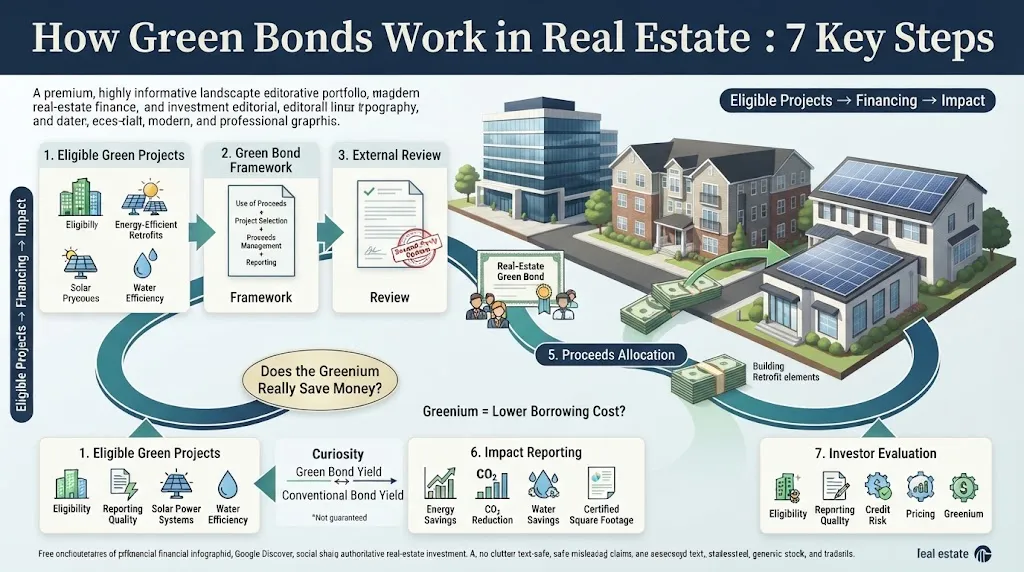
Eligible property projects → Green Bond Framework → External review → Bond issuance → Proceeds allocation → Impact reporting
The bond itself may be secured or unsecured depending on the transaction. Many corporate green bonds are conventional corporate debt obligations backed by the issuer rather than by a single property. That means the “green” label primarily addresses the use of capital, not a guarantee that the underlying property will outperform or that the bond is safer than ordinary debt.
Consider a hypothetical REIT that issues a $300 million green bond.
The company might establish a framework allowing proceeds for:
- qualifying high-efficiency buildings,
- major energy retrofits,
- renewable-energy installations,
- sustainable water systems,
- or eligible refinancing of qualifying projects.
The company then identifies projects, documents why they qualify, allocates the proceeds, and reports what was financed.
For investors, the important question is not simply:
“Is this building green?”
It is:
“What exactly qualifies, how is the money controlled, and how does the issuer prove what happened to it?”
That distinction is central to understanding real-estate green bonds.
Why Are Real Estate Companies Using Green Bonds?
Real estate companies use green bonds for both capital-markets access and environmental investment.
The traditional argument is straightforward: buildings require substantial capital, and improving the environmental performance of those buildings can require substantial upfront spending. A green bond creates a mechanism for connecting part of that financing need with investors seeking labeled green debt.
Potential benefits include broader investor engagement, financing for large retrofit programs, internal sustainability discipline, and the possibility of better pricing.
But none of these benefits is automatic.
The U.S. REIT market illustrates that green bonds remain a specialized financing tool rather than a universal replacement for conventional debt. S&P Global reported that five U.S. equity REITs issued green bonds totaling $4.25 billion in 2024. In 2025, green-bond issuance by U.S. REITs slowed, with all reported offerings coming from data-center REITs.
That means an owner should not assume:
“Green financing is always cheaper.”
A better question is:
“Does my property pipeline, investor base, reporting capability and capital requirement justify this structure?”
There can also be strategic benefits.
A large portfolio owner may already be spending millions on HVAC replacement, building-envelope improvements, lighting upgrades, solar installations, water efficiency, or green certification. A green bond framework can turn those projects into a clearly governed financing program.
It may also create repeatable processes. Once the issuer has a framework, internal eligibility criteria, data systems, reporting procedures and external-review relationships in place, later transactions may be operationally easier.
For smaller landlords, however, the answer can be different.
If you own one or two rental properties, setting up a bond framework, arranging institutional debt, paying external review costs and managing annual reporting may make little sense. Property-level green loans, conventional financing, utility-efficiency programs or targeted retrofit financing may be more practical.
What Real Estate Projects Qualify for Green Bond Financing?
Not every property with solar panels, efficient appliances, or an ESG policy automatically qualifies.
The project must fit the issuer’s stated eligibility criteria.
Common categories found in real-estate green-finance frameworks include:
| Project type | Examples |
| Green buildings | New or existing buildings meeting defined certification or energy-performance criteria |
| Energy efficiency | HVAC upgrades, lighting, controls, insulation and major efficiency improvements |
| Renewable energy | Solar PV and other renewable systems serving eligible assets |
| Water efficiency | Systems that materially reduce water consumption |
| Sustainable transport | Charging or other infrastructure where appropriately connected to the property’s environmental objectives |
| Refinancing | Refinancing existing eligible green assets or projects, subject to the framework |
Real-estate frameworks commonly reference building certifications, energy performance and measurable efficiency criteria, but thresholds vary by issuer and market. Examples in the sector have included certifications such as LEED and BREEAM and defined energy-performance requirements.
Fannie Mae provides a useful U.S. example. Its multifamily green bond program includes properties with qualifying green-building certifications and properties that will undergo post-closing improvements targeting energy and/or water reductions. Fannie Mae also requires annual ENERGY STAR and water-performance reporting for participating properties.
This is an important lesson:
Eligibility is criteria-driven, not marketing-driven.
Suppose a 1980s apartment building is advertised as an “eco-friendly property” because the owner installed LED lighting.
That alone may not satisfy a green bond framework.
Now suppose the same building undergoes a documented retrofit involving HVAC replacement, building controls, insulation, and water-efficiency measures, with measured performance improvements that meet the framework’s requirements.
That is a much stronger candidate.
New construction vs. existing buildings
A green bond can support both new development and existing properties.
New construction may qualify when the project is designed to meet specified certification or performance standards.
Existing properties can qualify through substantial energy-efficiency or environmental improvements, provided the framework permits that category.
The practical lesson for landlords is simple:
Do not begin with the label. Begin with the eligibility test.
How Does a Green Bond Framework Work for Property Projects?
The Green Bond Framework is the issuer’s operating rulebook.
It tells investors what the issuer considers green and how the issuer intends to manage the money.
The ICMA framework structure revolves around the four core components:
1. Use of proceeds
The issuer identifies eligible project categories and explains the environmental objectives.
For a property company, that might include:
- green-certified buildings,
- energy-efficiency improvements,
- renewable energy,
- sustainable water management,
- or other defined environmental investments.
The framework should also explain whether proceeds may support new financing, refinancing, or both.
2. Project evaluation and selection
The issuer explains who determines eligibility.
Possible participants include sustainability teams, finance departments, investment committees or other internal governance bodies.
A strong framework does not simply say:
“Management will identify green projects.”
It explains what evidence management will review.
For example:
- certification documentation,
- energy assessments,
- engineering studies,
- property-level utility data,
- project budgets,
- technical specifications,
- or other eligibility evidence.
3. Management of proceeds
The issuer establishes a mechanism to track the proceeds.
Under the 2025 ICMA Principles, net proceeds should be credited to a sub-account, moved to a sub-portfolio, or otherwise tracked in an appropriate manner, with the tracked balance adjusted as allocations occur.
4. Reporting
The issuer provides ongoing information about where the money went and, where feasible, what environmental impact the financed projects are expected to produce or have produced.
A framework is therefore more than a marketing brochure.
It creates a governance system connecting:
money → projects → eligibility → evidence → reporting
That is why investors often inspect the framework before looking at the property narrative.
What Is the Green Bond Issuance Process Step by Step?
Issuing a real estate green bond is a multi-stage process rather than simply printing a “green” label onto an ordinary debt offering.
Step 1: Build the eligible-project pipeline
The issuer identifies properties and projects that may qualify.
This might involve hundreds of assets for a large REIT.
The finance team may start by building a property-level data set containing:
- location,
- property type,
- certification,
- energy data,
- water data,
- renovation status,
- project cost,
- financing status,
- and eligibility category.
Step 2: Develop the Green Bond Framework
The issuer defines the four core components described above.
This framework becomes the operating foundation for the issuance.
Step 3: Obtain external review
Issuers commonly engage an external reviewer to assess the framework and its alignment with the stated principles.
The ICMA external-review guidance covers different types of reviews, including pre-issuance and post-issuance assessments, and recommends that relevant external review reports be made publicly accessible where appropriate.
BXP, for example, states that its Green Bond Framework governs allocation, definitions of eligible green projects, tracking and reporting, and that DNV provided a second-party opinion reviewing the framework.
Step 4: Prepare the financing
The issuer works with underwriters, legal advisers and other capital-markets professionals.
The transaction will address the normal bond terms:
- principal amount,
- maturity,
- coupon,
- denomination,
- offering structure,
- credit rating where applicable,
- covenants and legal documentation.
The “green” component sits alongside the ordinary debt mechanics.
Step 5: Market the bond
The issuer communicates the transaction to investors.
The investor presentation may include:
- property portfolio information,
- green-project pipeline,
- environmental targets,
- framework,
- external review,
- allocation methodology,
- expected impact metrics.
Step 6: Price and issue the bond
Investors submit orders, the issuer and underwriters determine pricing, and the transaction closes.
The actual interest rate is driven by market conditions and the issuer’s credit characteristics, not simply by the existence of a green label.
Step 7: Allocate the proceeds
After issuance, the issuer allocates the net proceeds or an amount equivalent to them to eligible projects according to the framework.
Step 8: Track environmental impact
The issuer collects information on:
- energy savings,
- carbon reductions,
- water savings,
- certified square footage,
- renewable capacity,
- or other appropriate metrics.
Step 9: Publish allocation and impact information
The issuer continues reporting until the required allocation obligations are satisfied and updates disclosures when material developments occur.
This post-issuance stage is where the credibility of the transaction becomes much easier for investors to evaluate.
How Are Green Bond Proceeds Managed and Tracked?
A green bond does not mean investors put money directly into one specific building bank account.
The issuer needs a system for tracking an amount equal to the bond’s net proceeds against eligible projects.
ICMA’s 2025 principles allow approaches such as sub-accounts, sub-portfolios or other internal tracking mechanisms. They also contemplate periodic adjustment of the tracked balance as allocations occur.
Example
Imagine a REIT issues a hypothetical:
$200 million green bond
Its eligible project pipeline contains:
- $80 million of multifamily energy retrofits
- $50 million of certified office properties
- $40 million of renewable-energy projects
- $30 million of other eligible building improvements
The issuer can track the allocation against those projects.
What happens if the projects cannot immediately absorb the full $200 million?
The green-bond framework should explain how temporarily unallocated proceeds are managed. ICMA recommends disclosure of the intended temporary placement for unallocated proceeds.
This matters because an investor should be able to reconcile:
Amount raised → amount allocated → amount remaining → projects financed
Bond-by-bond or portfolio approach
ICMA also recognizes that proceeds can be managed on a bond-by-bond basis or through an aggregated portfolio approach for multiple green bonds.
For a repeat issuer, portfolio management can make operational sense.
For investors, however, transparency remains important.
A useful allocation report should make it possible to answer:
Which categories received the money?
How much was allocated?
What was the project type?
So what impact is expected or measured?
What Reporting and Impact Metrics Do Investors Expect?
Reporting is one of the most important differences between simply calling financing “green” and operating a credible green-bond program.
ICMA recommends that issuers keep up-to-date information on use of proceeds until full allocation, renew reporting annually, and provide details such as project descriptions, amounts allocated, and expected impact. Where practical, quantitative impact metrics and the key methodology or assumptions behind them should also be disclosed.
Real estate makes this particularly interesting because buildings produce measurable operational data.
Useful metrics can include:
| Metric | Example |
| Energy use | kWh or energy intensity |
| Carbon impact | tCO₂e avoided or reduced |
| Water | Gallons or percentage reduction |
| Certified space | Square feet under eligible certification |
| Renewable energy | Installed or contracted capacity |
| Building performance | ENERGY STAR or other relevant metrics |
| Project allocation | Dollars allocated by category |
Fannie Mae’s green financing program, for example, tracks annual ENERGY STAR performance and water-related data for qualifying properties.
Fannie Mae also publishes projected impact information for green-bond issuances. Its 2024 green-bond reporting included projected average utility-cost savings for participating housing and reported that 92,000 single-family and multifamily units were retrofitted or green-building-certified in connection with the relevant green-bond programs. Fannie Mae cautions that projected savings are estimates and are not guaranteed to occur at every property.
That last point is critical.
A projected environmental benefit is not the same thing as a measured outcome.
Better reporting asks five questions
- What was financed?
- How much was allocated?
- How was eligibility determined?
- What methodology produced the impact estimate?
- Which results are projected versus actually measured?
That distinction makes green-bond reporting much more useful to investors.
How Much Does It Cost to Issue a Green Bond?
The total cost of a green bond consists of both ordinary debt-issuance costs and green-specific costs.
Ordinary financing expenses can include:
- underwriting,
- legal work,
- ratings,
- documentation,
- listing or transaction expenses,
- investor marketing,
- and other capital-markets costs.
Green-specific expenses may include:
- framework development,
- external review,
- data collection,
- internal tracking,
- ongoing impact measurement,
- reporting,
- and potentially post-issuance verification.
The exact cost varies significantly by issuer, transaction size, complexity, reporting requirements, and whether the organization already has sustainability systems in place.
Rather than using an unsupported universal dollar estimate, it is better to model the incremental green cost against the expected financing benefit.
A simple break-even formula
Net green-financing benefit = gross interest savings − incremental green-program costs
Suppose a hypothetical $100 million bond receives a pricing advantage of 0.10%, or 10 basis points.
Annual interest savings:
$100,000,000 × 0.001 = $100,000
Over five years:
$100,000 × 5 = $500,000
Now suppose the additional green-related costs total $350,000 over the framework and reporting period.
Hypothetical gross benefit:
$500,000 − $350,000 = $150,000
This is only an illustration.
It does not mean every green bond will save 10 basis points, and it does not include taxes, reinvestment effects, debt refinancing, opportunity costs,s or changes in market rates.
The more defensible way to evaluate the transaction is to build a sensitivity table.
| Greenium assumption | Annual savings on $100M | 5-year gross savings |
| 0 bps | $0 | $0 |
| 5 bps | $50,000 | $250,000 |
| 10 bps | $100,000 | $500,000 |
| 20 bps | $200,000 | $1,000,000 |
This lets an issuer ask a much better question:
“How much pricing benefit do I need before this structure pays for itself?”
What Is the Greenium and Does It Lower Real Estate Borrowing Costs?
The greenium refers to the possibility that investors accept a lower yield on a green bond than they would on an otherwise comparable conventional bond.
A lower yield means a lower borrowing cost for the issuer.
But the greenium is not guaranteed.
Academic evidence is mixed across time periods, markets, and issuer types. A 2024 Journal of Banking & Finance study by Caramichael and Rapp found that green corporate bonds had, on average, a yield spread 3 to 8 basis points lower than comparable conventional bonds at issuance, depending on the specification.
A later 2025 study also found significant variation over time and across market conditions, emphasizing that the size of any greenium should not be assumed to be constant.
Another important finding is that the greenium may be concentrated among particular issuer types rather than being equally available to every borrower. Caramichael and Rapp found stronger effects among large, investment-grade issuers and in developed markets.
That is highly relevant for real estate.
A large investment-grade REIT with:
- a recognized brand,
- strong investor demand,
- a mature sustainability program,
- repeat issuance,
- and substantial eligible assets
may approach the market very differently from a small private property company.
Do not put the greenium into your base case automatically
A conservative underwriting approach is:
Base case: conventional financing cost
Upside case: modest greenium
Downside case: no pricing advantage plus additional reporting costs
That keeps your investment analysis from becoming dependent on an uncertain financing benefit.
Green Bonds vs Green Loans vs Sustainability-Linked Loans
These structures sound similar but work differently.
| Feature | Green Bond | Green Loan | Sustainability-Linked Loan |
| Capital structure | Bond/debt security | Loan | Loan |
| Use of proceeds restricted? | Yes, for eligible green projects | Yes, for eligible green projects | Generally no |
| Sustainability KPI required? | Usually environmental project/impact reporting | Green-project criteria | Yes |
| Suitable for | Larger financing needs and capital-market access | Property-level or smaller financing needs | Borrowers managing broader sustainability targets |
| Investor/capital-market process | More extensive | Generally simpler | Loan-based |
| External review | Common | Common/encouraged depending on structure | Common in many transactions |
| Reporting | Allocation and impact | Allocation and/or impact | KPI performance |
The key distinction is:
Green bonds and green loans are generally tied to what the money finances.
Sustainability-linked loans are generally tied to whether the borrower achieves specified performance targets.
For example:
A landlord borrows $20 million specifically to retrofit a qualifying multifamily portfolio.
That is conceptually closer to a green loan.
A large REIT raises $500 million through a bond and commits the equivalent proceeds to qualifying green assets and projects.
That is a green bond.
A property company receives a pricing adjustment if its portfolio achieves certain sustainability KPIs, while the borrowed funds are not restricted to specific green projects.
That is closer to a sustainability-linked loan.
The right structure depends on the financing need, asset pipeline, investor base, transaction size and reporting capabilities—not simply on which label sounds most sustainable.
Can Green Bonds Finance Existing Building Retrofits and Refinancing?
Yes. Existing buildings can be an important part of green-finance programs.
This matters because the biggest opportunity for reducing the environmental impact of a property portfolio may not always be a new “green” building.
It may be an older property with:
- inefficient HVAC,
- outdated lighting,
- poor building controls,
- inefficient water systems,
- inadequate insulation,
- aging equipment,
- or other upgrade opportunities.
Fannie Mae’s U.S. green-financing programs explicitly contemplate properties that will be retrofitted after closing, as well as properties that already meet qualifying certification requirements.
Refinancing is different from creating new environmental improvement
A framework may permit refinancing existing eligible green assets.
That does not necessarily mean the issuer is creating a new environmental improvement equal to the bond proceeds.
This is why investors should distinguish:
New financing: money supports new eligible green spending.
Refinancing: money replaces or refinances previous financing associated with an eligible project.
ICMA recognizes refinancing as an eligible use category but encourages issuers to provide an estimate of the proportion of financing versus refinancing where applicable.
Practical investor question
If a REIT says:
“We used $100 million of green-bond proceeds for green buildings,”
an investor should ask:
How much funded new upgrades, and how much refinanced assets that were already green?
That answer can materially change how the transaction’s environmental impact should be interpreted.
What Are the Biggest Green Bond Risks and Greenwashing Pitfalls?
Green bonds have their own risks, and the green label does not eliminate ordinary credit or market risk.
1. Eligibility risk
The project may not meet the framework’s exact requirements.
An asset described as “sustainable” in marketing materials may fail a stricter technical eligibility test.
2. Reporting risk
Poor-quality data makes impact reporting less reliable.
For a property portfolio, that can happen when:
- meters are inconsistent,
- utility records are incomplete,
- assets use different measurement systems,
- certifications have expired,
- or portfolio data is not centralized.
3. Greenwashing risk
Greenwashing concerns arise when environmental claims create a stronger impression than the underlying evidence supports.
A credible program should therefore distinguish:
certified vs. uncertified
projected vs. measured
new financing vs. refinancing
target vs. achieved result
4. Eligibility drift
A project’s status can change after issuance.
For example, a property may lose a certification, change ownership, or undergo a modification that affects eligibility.
A strong governance process should include ongoing monitoring rather than a one-time screening.
5. Credit risk
A green bond is still debt.
If the issuer experiences financial stress, the bond can be affected by the issuer’s credit quality.
Environmental labeling does not eliminate:
- interest-rate risk,
- refinancing risk,
- liquidity risk,
- issuer credit risk,
- duration risk,
- foreign-exchange risk,
- or market risk.
6. Pricing risk
The expected greenium may not appear.
A transaction can carry additional green-related administrative costs without producing a sufficient pricing benefit.
7. Environmental-impact risk
Projected energy or carbon benefits may not materialize exactly as estimated.
Fannie Mae, for example, explicitly states that projected savings are estimates and that actual results are not guaranteed at individual properties.
The best defense against greenwashing
For investors and issuers, the most useful safeguards are:
clear eligibility rules + external review + documented tracking + transparent reporting + measurable assumptions
That combination is much stronger than a sustainability claim alone.
Who Can Issue Green Bonds in the Real Estate Market?
Green bonds are generally associated with organizations large enough to access the bond market, establish governance systems, ms and support the required documentation.
Potential real estate issuers include:
REITs
REITs can use green bonds to finance eligible property projects across a portfolio.
The U.S. market has examples across data centers, hospitality, office, and single-family rental housing.
Large developers
Developers may use green bonds to fund eligible development pipelines where projects have clearly defined sustainability criteria.
Real estate companies
Private or public real estate companies with sufficiently large financing requirements may use green debt, depending on market access and transaction structure.
Financial institutions
Banks and housing-finance institutions can issue green bonds and use the proceeds or collateral structures to support green mortgages, multifamily financing,g and other property-related lending.
Fannie Mae is a particularly useful U.S. example, with dedicated single-family and multifamily green bond frameworks and second-party opinions.
Why the typical individual landlord is different
Suppose you own:
One single-family rental worth $350,000.
A public green bond is probably not the natural financing tool.
Now consider:
A green-bond framework can become much more economically relevant.
This is one of the most important practical lessons in the topic:
Green bonds are primarily a capital-markets financing solution, not a standard mortgage product for individual landlords.
Smaller owners should typically compare green mortgages, energy-efficiency financing, conventional loans, ns and property-level retrofit financing before considering institutional-style debt structures.
How Do Investors Evaluate a Real Estate Green Bond?
An investor should evaluate both the bond and the green framework.
Looking only at the environmental label is not enough.
1. Start with the issuer
Review:
- credit quality,
- leverage,
- debt maturity profile,
- interest coverage,
- liquidity,
- refinancing needs,
- and portfolio fundamentals.
The green label does not replace ordinary bond analysis.
2. Read the framework
Ask:
What exactly qualifies?
Do not settle for phrases such as “environmentally beneficial projects.”
Look for measurable criteria.
3. Examine the external review
Was an external reviewer engaged?
What did it actually assess?
Was the review:
- framework-level,
- pre-issuance,
- post-issuance,
- allocation-focused,
- impact-focused,
- or some combination?
ICMA’s external-review guidance emphasizes clear disclosure of the scope and role of the external reviewer.
4. Test project quality
For a property-backed or property-focused program, investors can examine:
- building certification,
- energy data,
- retrofit scope,
- project budget,
- expected savings,
- renewable-energy contribution,
- and asset-level evidence.
5. Separate allocation from impact
An issuer can allocate every dollar correctly and still have environmental outcomes that differ from projections.
Therefore:
Allocation success ≠ guaranteed environmental impact
Both should be evaluated.
6. Compare the pricing
Compare the green bond with similar conventional debt from the same issuer where possible.
Look at:
- maturity,
- seniority,
- currency,
- structure,
- credit spread,
- market conditions,
- and investor demand.
Do not attribute every yield difference to the green label.
7. Watch repeat issuance
Repeat issuers can provide useful evidence about the consistency of their framework, reporting quality, and project pipeline.
Digital Realty is a useful current example. The company reported $1.2 billion of green bonds issued in 2025 and has separately disclosed substantial sustainability metrics including renewable-energy coverage, certified square footage and other environmental measures.
U.S. REIT issuance also shows how sector-specific these programs can become. S&P Global reported that all U.S. REIT green-bond offerings in 2025 were issued by data-center REITs, illustrating that green-bond activity can cluster in property types with large energy-efficiency and infrastructure investment requirements.
Is a Green Bond Right for Your Real Estate Strategy?
The answer depends on the size of the financing need, the quality of the eligible project pipeline, investor demand, reporting capacity, and expected economics.
For an issuer, the decision can be organized into five questions.
Question 1: Do you have enough eligible projects?
Question 2: Can you prove eligibility?
You should have evidence, not just intentions.
Examples include:
- certifications,
- engineering assessments,
- utility data,
- technical specifications,
- project budgets,
- property records,
- and documented internal approvals.
Question 3: Can you report every year?
A green bond is not simply an issuance-day exercise.
The company needs systems for tracking allocation and communicating impact after the transaction.
Question 4: Does the economics work without assuming a greenium?
Build the financing model using the ordinary debt case first.
Then test possible greenium scenarios.
For example:
Conventional financing cost: 5.50%
Hypothetical green financing cost: 5.40%
Principal: $100 million
Difference:
0.10% × $100 million = $100,000 annual gross interest difference
Then subtract incremental green-related costs.
That gives you a more defensible economic test.
Question 5: Is a bond actually the right instrument?
A green loan may be more practical when:
- the project pipeline is smaller,
- financing is tied to a specific property,
- the borrower does not need capital-market scale,
- or the organization wants a simpler execution.
A sustainability-linked structure may make more sense when the company’s sustainability strategy is broader than specific use-of-proceeds projects.
A practical decision matrix
| Situation | Financing structure worth evaluating |
| One or two rental properties | Property-level green/conventional financing |
| Single major retrofit | Green loan or specialized retrofit financing |
| Multifamily portfolio with multiple eligible projects | Green loan or programmatic green financing |
| Large REIT with sizable eligible portfolio | Green bond |
| Large company with measurable sustainability KPIs but flexible capital use | Sustainability-linked financing |
| Weak green-project pipeline | Conventional financing may be more straightforward |
The most important principle is:
For a landlord or investor evaluating a retrofit, use property-level calculations first.
For example:
Annual utility savings + operating savings + other measurable benefits
compared with:
Retrofit cost + financing cost + maintenance/data/reporting costs
That turns sustainability from a vague concept into an investment decision.
People Also Ask
A real estate green bond raises debt capital while committing an amount equal to the net proceeds to eligible green projects or assets. The issuer typically defines eligibility in a framework, explains how projects are selected, tracks the proceeds,s and reports allocation and environmental impact.
Yes, depending on the structure and eligibility criteria. U.S. housing-finance programs such as Fannie Mae’s green financing framework support qualifying single-family and multifamily properties and property improvements.
Yes. Existing-building retrofits can qualify when they meet the applicable green-finance criteria. Fannie Mae’s multifamily program, for example, includes properties that will be retrofitted after closing to improve energy and water efficiency.
Sometimes, but not always. Research has found greenium effects in some corporate bond markets, while also showing that the magnitude varies by issuer, market conditions, and time period.
A second-party opinion is an external review that assesses a green-bond framework or transaction against relevant sustainability principles or criteria. ICMA recommends transparency about the review’s scope and role.
No. A green bond remains a debt security, so investors still face issuer credit risk and other normal bond-market risks.
There is not one universal U.S. market definition that makes every bond automatically “green.” Market participants frequently use voluntary principles such as ICMA’s Green Bond Principles, along with issuer-specific frameworks and applicable securities and disclosure requirements. ICMA describes its Green Bond Principles as voluntary process guidelines.
Key Takeaways and Next Steps
Green bonds in real estate work by linking debt capital to defined environmental uses while requiring governance around eligibility, proceeds management,t and reporting.
The four concepts to remember are:
1. Eligibility: A property is not automatically green-bond eligible just because it has sustainable features.
2. Governance: The issuer needs a clear framework explaining how green projects are selected and monitored.
3. Economics: A possible greenium can reduce borrowing costs, but it should be treated as a scenario rather than a guaranteed benefit.
4. Evidence: Strong allocation and impact reporting make it easier for investors to evaluate whether the green designation means what the issuer says it means.
For a property owner, the best starting point is not the bond label.
Start with the property economics.
Estimate the cost of the upgrade. Estimate realistic savings. Determine which projects meet recognized eligibility criteria. Then compare the available financing structures.
A CalcLandlord ROI Calculator can be useful at the property-analysis stage because the first question is whether the underlying real-estate investment makes financial sense before adding the complexity of specialized financing.
