

Commercial Title Insurance: The Complete 2026 Guide for U.S. Real Estate Investors
You can have strong rent projections, a promising cap rate, and financing lined up—and still discover a problem that changes the deal.
The issue may be buried in the property’s title history.
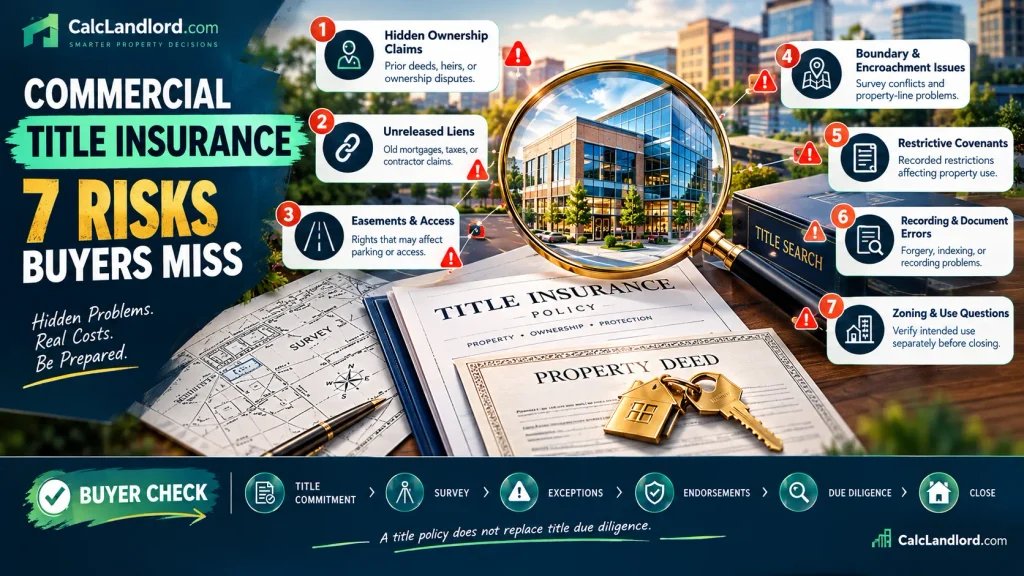
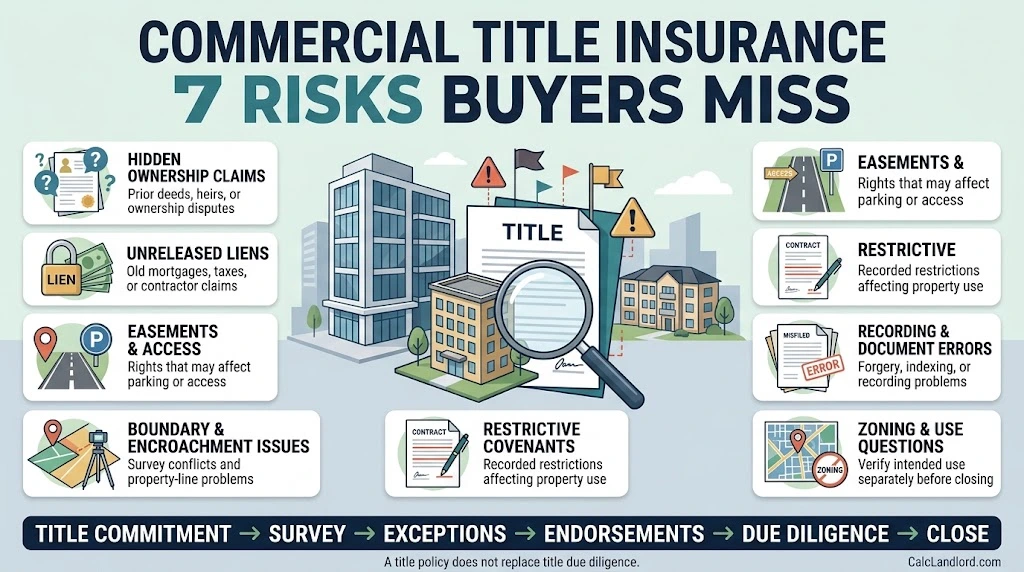
A recorded easement could affect access. An old lien could delay closing. A boundary issue could complicate future improvements. A restrictive covenant could interfere with your intended use.
That is why commercial title insurance matters.
But buying a policy is not the whole story. You also need to understand the title commitment, exceptions, endorsements, surveys, and unresolved defects before you close.
This guide shows you what to check, what questions to ask, and how title risk can affect your investment.
Buying a commercial property is not only a question of price, rent, cap rate, or financing. You also need confidence that the ownership interest being purchased is actually what the seller says it is.
That is where commercial title insurance fits into the transaction.
Commercial title insurance is designed to protect an owner or lender against covered title risks, such as certain undiscovered ownership claims, liens, encumbrances, or other defects that can affect the insured interest in the property. The policy is different from ordinary property insurance because the risk it addresses is primarily connected to title and ownership rights rather than future physical events such as fire or storms. State insurance regulators explain that the policy terms control what is covered, excluded, or excepted.
For a rental-property investor, the issue is bigger than paperwork.
A title problem can affect the ability to finance, lease, sell, develop, access, or fully use a property. A recorded easement may affect expansion plans. A lien may have to be resolved before closing. A boundary issue can change what land you actually control. A restriction may affect a planned use. And an exception in the title commitment may leave a particular risk outside the insurance coverage.
The goal of this guide is not simply to tell you to “get title insurance.” It is to show you how commercial title insurance works, what it does not do, how to read the title commitment, how to evaluate title defects, how costs are calculated, and how to decide which issues deserve further investigation before you close.
Quick answer: Commercial title insurance transfers certain title-related risks from the buyer or lender to the title insurer, subject to the policy’s terms, exclusions, exceptions, limits, and endorsements. The title search and survey help identify problems; the insurance policy provides contractual protection against covered risks that remain after closing.
1. What Is Commercial Title Insurance and Why Does It Matter?
Commercial title insurance is a policy associated with the ownership or financing of real property. In a typical transaction, the title company examines available records and issues a title commitment describing the proposed insurance, requirements, and exceptions. After closing and satisfaction of the applicable requirements, the final policy is issued.
The key concept is risk transfer.
A title search is an investigation.
A title commitment is a statement of what the insurer is prepared to insure and what must happen first.
So A title policy is the actual insurance contract.
Why this matters to landlords and investors
Imagine you buy a $3 million multifamily property.
The financial model looks attractive:
- Purchase price: $3,000,000
- Annual NOI: $240,000
- Going-in cap rate: 8%
But during or after closing, a title issue appears involving an old ownership interest or lien.
Your property may still be physically standing. Tenants may still be paying rent. But your ability to freely use, finance, transfer, or defend the insured ownership interest may be affected.
That means title risk can become an investment risk.
What commercial title insurance is really protecting
Depending on the policy, title insurance may protect an owner’s insured interest or a lender’s lien position against covered risks. The policy can also provide a defense against certain covered claims and payments for covered losses, subject to its terms. State insurance guidance specifically emphasizes that coverage depends on the policy, including its exceptions and exclusions.
What makes commercial transactions different?
Commercial properties frequently involve more complicated issues than a simple residential purchase:
- Multiple parcels
- Existing leases
- Easements
- Access arrangements
- Restrictive covenants
- Development rights
- Multiple ownership entities
- Construction liens
- Complex financing
- Larger policy amounts
- Surveys and zoning review
- More extensive lender requirements
The OCC’s commercial real estate lending guidance, for example, treats the title policy, survey, mortgage, leases, tenant estoppels, tax records, and property descriptions as documents that need to align in a CRE financing transaction.
The investor takeaway
Think of commercial title insurance as one layer in a broader acquisition-risk system.
It does not replace:
- A title search
- A survey
- Zoning due diligence
- Physical inspections
- Environmental diligence
- Lease review
- Legal review
- Financial underwriting
Instead, it works alongside them.
2. How Does Title Insurance Work in a Commercial Real Estate Transaction?
Commercial title insurance usually enters the deal during due diligence rather than magically appearing at the closing table.
A simplified transaction can look like this:
Purchase Agreement → Title Order → Title Search → Title Commitment → Survey & Document Review → Objections/Cure → Endorsements → Closing → Final Policy
The exact process varies by state, transaction structure, title company, lender, and purchase agreement.
Step 1: The title examination begins
The title company examines available records to determine matters affecting the property and the seller’s interest.
Depending on the jurisdiction and transaction, the search can involve deeds, mortgages, judgments, tax matters, liens, easements, restrictions, probate records, and other recorded documents. California’s Department of Insurance describes title examination as part of the process used to identify liens, claims, and encumbrances and produce a preliminary report or commitment.
Step 2: The title commitment is issued
The commitment gives the parties a pre-closing view of:
- The proposed insured
- The property
- The estate or interest being insured
- Requirements that must be completed
- Exceptions to coverage
Practical Law describes the title commitment as a document that identifies the proposed insured, land, insured interest, requirements, and Schedule B exceptions.
Step 3: The buyer reviews the exceptions and requirements
This is where inexperienced buyers often make a mistake.
They look at the property.
They look at the purchase price.
He look at the rent roll.
But they do not carefully review the documents affecting title.
A recorded easement could be harmless—or could materially interfere with your plan.
A restrictive covenant could be routine—or could limit a future development strategy.
A lien might be easily cured—or could delay the closing.
Step 4: Problems are addressed
The parties may:
- Pay off liens
- Obtain releases
- Correct legal descriptions
- Obtain affidavits
- Resolve ownership issues
- Request deletion or modification of exceptions
- Provide a new survey
- Request endorsements
- Change the transaction documents
- Negotiate a credit
- Extend the due-diligence period
Step 5: The final policy is issued
Once the applicable conditions are satisfied, the transaction closes, and the final title policy is issued.
The policy, not your assumptions about the transaction, determines the actual coverage.
Why the sequence matters
Suppose your commercial rental strategy depends on:
- Parking access
- A shared driveway
- A second parcel
- A planned addition
- A particular legal use
- A specific loan structure
You should identify title-related restrictions before the deal becomes irreversible.
3. What Does Commercial Title Insurance Actually Cover?
The simplest answer is:
It covers covered title risks described by the policy, subject to the policy’s exclusions, exceptions, conditions, limits, and endorsements.
That answer is more accurate than saying title insurance covers “anything wrong with the property.”
Examples of risks that may be covered
Depending on the policy and jurisdiction, examples can include:
- Ownership claims
- Forged documents
- Recording errors
- Undisclosed liens
- Prior conveyance defects
- Certain tax or assessment issues
- Certain encumbrances
- Certain defects in the chain of title
- Certain legal-access risks
- Certain claims by others asserting rights in the property
State regulators give examples of title risks including errors in public records, unknown liens, missing heirs, forgeries, undiscovered encumbrances, and unknown easements.
The phrase that matters: “covered risk”
Suppose a buyer discovers an easement after closing.
That does not automatically mean:
“The title company must pay.”
The first question is:
Is the issue a covered risk under the policy, or is it an exception/exclusion?
Then you need to consider:
- The policy language
- The date of the policy
- The amount of insurance
- Existing exceptions
- Endorsements
- Conditions
- Whether the issue was known
- Whether the loss falls within the policy
What about zoning?
Zoning deserves special caution.
A standard title policy should not be described as a blanket guarantee that the property’s zoning, permitted use, building code status, or development potential is correct.
ALTA maintains specific zoning endorsements for particular forms of zoning risk, including the 3-series.
That means:
Title insurance and zoning due diligence are not the same thing.
You still need to verify the property’s intended use with the appropriate local authority and your legal advisers.
What about environmental contamination?
Environmental risk should also be separated from title risk.
A property can have environmental problems without those problems automatically becoming insured title claims.
A title policy may address certain recorded environmental liens through a specific endorsement, but that is not the same as broad environmental cleanup insurance.
Coverage limit matters
An owner’s policy generally has a stated amount of insurance.
A lender’s policy is designed around the lender’s insured interest.
That means the policy amount and structure matter when evaluating a high-value investment.
A useful landlord test
Before relying on the policy, ask:
What exact risk am I worried about?
Then ask:
Where in the policy or endorsement is that risk addressed?
That is a much stronger approach than simply buying the policy and assuming every property-rights problem is covered.
4. Owner’s vs. Lender’s Title Insurance: What’s the Difference?
This distinction is critical.
There are two different economic interests:
- The owner’s equity and ownership interest
- The lender’s security interest
An owner’s policy and a lender’s policy are designed around those different interests.
Owner’s title insurance
The owner’s policy is intended to protect the insured owner’s interest in the property against covered title risks.
For an investor, that can matter because your economic exposure can include:
- Down payment
- Equity
- Ownership rights
- Transaction value
- Potential property value
The CFPB explains that lender’s title insurance protects the lender, while owner’s title insurance is intended to protect the buyer’s financial investment.
Lender’s title insurance
A lender’s title policy protects the lender’s interest in the loan secured by the property.
The OCC’s commercial real estate lending guidance identifies title insurance as part of the documentation associated with CRE lending and emphasizes consistency among the title policy, survey, mortgage, assignments, and property description.
Side-by-side comparison
| Feature | Owner’s Policy | Lender’s Policy |
| Primary protected party | Property owner | Mortgage lender |
| Main concern | Owner’s insured title/equity interest | Lender’s lien/security interest |
| Policy amount | Based on the insured owner’s interest | Generally tied to the insured loan interest |
| Main purpose | Transfer certain title risks away from owner | Protect lender’s collateral position |
| Typical transaction role | Buyer protection | Financing requirement in many transactions |
| Continues with ownership/loan | Governed by policy terms | Governed by policy and loan structure |
The exact requirements and available coverages vary by state, insurer, transaction type, and policy form.
Why the distinction matters for a landlord
Suppose you buy a rental building for $2 million with a $1.4 million loan.
You have roughly:
$600,000 of equity before transaction costs and other adjustments.
A lender’s policy is primarily protecting the lender’s $1.4 million interest.
That does not mean your $600,000 economic stake receives the same protection.
This is why investors need to understand the difference between:
Protecting the loan
and
Protecting the owner’s insured interest.
The practical question
Do not ask only:
“Does the lender require title insurance?”
Also ask:
“What protection does my ownership interest have?”
5. What Is a Commercial Title Commitment and How Do You Read It?
A commercial title commitment is one of the most important documents in the transaction.
Think of it as the title insurer’s pre-closing roadmap.
It tells you what is being insured, what conditions must be satisfied, and what matters may remain outside coverage.
First American describes a title commitment as a preview of the final title policy, including information about the property, requirements, and exceptions.
Start with Schedule A
Schedule A generally identifies the central facts of the proposed insurance, such as:
- Proposed insured
- Property
- Insured interest
- Effective date
- Policy amount
- Legal description
Practical Law likewise identifies Schedule A as the section describing the proposed named insured, land, and interest to be insured.
Then move to the requirements.
Requirements are the items that must be completed before the policy can be issued as contemplated.
Examples may include:
- Release of existing liens
- Proper execution of documents
- Recordation requirements
- Evidence of authority
- Payoff of mortgages
- Corrective documents
The exact structure depends on the applicable commitment form and state.
Then study the exceptions
This is where the risk analysis becomes more meaningful.
An exception identifies a matter that may be outside the policy’s coverage.
Practical Law defines a Schedule B exception as a title matter listed as an exception to coverage.
Common examples can include:
- Easements
- Restrictive covenants
- Mineral rights
- Certain taxes
- Certain survey matters
- Rights of parties in possession
- Other recorded instruments
A five-question method
For every material exception, ask:
1. What is it?
Read the underlying recorded document, not only the short description.
2. Where is it?
Is it across the building, parking area, access road, utility area, or another portion of the property?
3. Who benefits from it?
A utility provider? Neighbor? Government entity? Association? Prior owner?
4. Does it affect my business plan?
Could it restrict:
- Parking?
- Expansion?
- Signage?
- Access?
- Leasing?
- Construction?
- Financing?
- Future sale?
5. Can it be removed, modified, insured over, or accepted?
That question should involve the appropriate title professional and, when material, legal counsel.
Example
Suppose you are buying a strip-center property with six tenants.
The title commitment identifies a recorded access easement.
At first glance, that may sound routine.
Then you discover that the easement cuts through the rear service area used by three tenants for deliveries.
The issue has changed from:
“There is an easement.”
to:
“This easement may affect property operations.”
That is the kind of information gain a strong due diligence process should surface.
6. Title Search vs. Title Insurance vs. Survey: What’s the Difference?
These three concepts are often mixed together, but they perform different functions.
| Tool | Primary Purpose | Main Question |
| Title search/examination | Investigate title records | What recorded title matters exist? |
| Title commitment | Describe proposed insurance and conditions | What will the insurer insure, and what must be resolved? |
| Survey | Identify physical/location information about land and improvements | Where are the boundaries, improvements, easements, and physical relationships? |
| Title policy | Transfers specified title risks | What covered losses are protected after closing? |
Title search
The search examines available records to identify title matters.
It is an investigation—not insurance.
Title commitment
The commitment translates the title examination into a proposed insurance structure.
It tells the parties:
- What is being insured
- What must happen before issuance
- What remains excepted
Survey
A survey can provide information about:
- Boundaries
- Improvements
- Encroachments
- Easements
- Rights-of-way
- Physical relationships between improvements and property lines
ALTA and the National Society of Professional Surveyors published 2026 Minimum Standard Detail Requirements for ALTA/NSPS Land Title Surveys, effective February 23, 2026. ALTA currently identifies the 2026 standards in its published resources.
Why investors need all three
Consider an apartment property with a detached parking structure.
The title records may show the property legally exists.
The survey may reveal that part of the structure crosses a boundary or easement area.
The title policy may provide coverage for certain risks—but only according to the policy and endorsements.
No single document answers every question.
The investor rule
Never use title insurance as a substitute for a survey.
And do not assume a survey replaces legal title analysis.
Practical Law’s commercial real estate materials specifically integrate title commitments, surveys, objection procedures, endorsements, and post-closing review as related parts of the commercial transaction.
7. Which Commercial Property Title Defects Should Buyers Watch For?
Not every title defect is catastrophic.
Some are easily cured.
Others can materially affect the economics or feasibility of the deal.
The key is to classify the problem by impact, not merely by how complicated the legal document looks.
Common commercial title issues
Unreleased mortgage or deed of trust
A previous loan may have been paid, but the recorded lien was never properly released.
Often, this is a curative issue.
But it still needs to be addressed before closing.
Mechanic’s liens
Construction or improvement work can create lien exposure.
This is especially important for:
- Recently renovated properties
- Development projects
- Value-add acquisitions
- Properties with ongoing construction
Do not assume that paying the seller automatically eliminates every lien issue.
Easements
Easements can affect:
- Driveways
- Utilities
- Parking
- Access
- Construction
- Drainage
- Shared facilities
The existence of an easement is not automatically bad.
The question is how it affects your intended use.
Access problems
A property may have physical access, but a different question may exist regarding legal access.
For a rental property, this can matter greatly.
A parcel that lacks reliable legal access may have financing, development, leasing, or resale implications.
Restrictive covenants
Restrictions can affect:
- Property use
- Signage
- Development
- Exterior modifications
- Tenant activities
- Parking
- Construction
Boundary and encroachment issues
A structure, fence, parking improvement, wall, or other improvement can cross a property boundary or easement.
This is one reason survey review matters.
Ownership defects
Examples may include:
- Improperly executed prior deeds
- Missing interests
- Forged documents
- Probate-related issues
- Unknown heirs
- Entity-authority problems
State insurance guidance lists several of these categories among potential title defects.
A practical severity matrix
| Issue | Potential Investor Impact | Typical Next Question |
| Old unreleased lien | Closing delay | Can it be released before closing? |
| Minor easement | Low to moderate | Does it affect use? |
| Major access issue | High | Is legal access insured and documented? |
| Boundary encroachment | Moderate to high | What does the survey show? |
| Restrictive covenant | Moderate to high | Does it limit intended use? |
| Ownership defect | High | Can title be cured and insured? |
| Development restriction | High | Does it change the project plan? |
| Unknown lien/claim | Potentially high | Is it covered, cured, or excepted? |
Important correction to “risk rankings”
There is no universal national table showing that one defect type is always “high risk” and another always “low risk.”
A small easement can be devastating to one property and irrelevant to another.
A boundary issue may be inexpensive to resolve in one transaction and deal-changing in another.
The property’s business plan determines the significance of the title issue.
8. What Are Title Exceptions, Exclusions, and Endorsements?
These terms are easy to confuse.
They should be separated.
Exceptions
An exception is a matter the policy does not insure against as stated in the policy or commitment.
The Practical Law definition of a Schedule B exception specifically describes it as a title matter excluded from the insurance coverage contemplated by the commitment.
Exclusions
Exclusions are categories of risk the policy does not cover under the policy terms.
The exact exclusions depend on the policy form.
Endorsements
Endorsements modify, expand, clarify, or otherwise alter the policy’s coverage for a specific purpose, subject to their wording and conditions.
ALTA maintains a broad library of policy forms and endorsements and notes that its forms are generally voluntary unless required by law, with parties able to agree to different terms.
Why endorsements matter in commercial transactions
A commercial property can have risks that are not adequately addressed by a basic policy alone.
For example, an investor may need to discuss:
- Zoning coverage
- Access and entry
- Restrictions, encroachments, and minerals
- Contiguity for multiple parcels
- Survey-related matters
- Development-specific coverage
- Loan-specific endorsements
Example ALTA categories
ALTA’s published materials include:
3-series: Zoning-related endorsements.
9-series: Restrictions, encroachments, and minerals.
17-series: Access and entry.
19-series: Contiguity and multiple-parcel situations.
22-series: Location-related endorsements.
The available form, applicable policy, version, and underwriting requirements matter.
Do not buy endorsements by checklist
A common mistake is thinking:
“More endorsements = better deal.”
Not necessarily.
Instead ask:
“Which material risk in my transaction does this endorsement address?”
For example, a multi-parcel acquisition might make contiguity more relevant.
A development property might make access and zoning considerations more important.
A property with complicated recorded restrictions may require closer analysis of the applicable restrictions/encroachments/minerals coverage.
A better endorsement test
For every requested endorsement, identify:
Risk → Property-specific exposure → Coverage requested → Required evidence → Cost → Remaining exceptions
This turns endorsements into a decision process rather than a shopping list.
9. Which ALTA Endorsements May Matter for Commercial Property?
ALTA endorsements are not interchangeable, and not every endorsement applies to every property.
The current ALTA materials show that endorsement forms have specific purposes and versions, and that the 2021 policy-form collection includes updated commercial and transaction-related forms.
Zoning endorsements
Zoning endorsements can address specified zoning-related risks depending on the applicable form.
Examples in the ALTA 3-series include:
- Zoning for certain unimproved land
- Zoning for completed structures
- Zoning-related coverage for land under development
- Non-conforming-use situations
- No-zoning-classification situations
ALTA’s endorsement chart identifies these distinct 3-series purposes.
For investors, the question is not simply:
“Does this building have zoning?”
It is:
“Does the insured zoning-related coverage match the use I am actually buying?”
Restrictions, encroachments, and minerals
ALTA’s 9-series addresses specified restrictions, encroachments, and mineral-related risks under applicable policies and versions.
This may become important where:
- Improvements cross easement areas
- Encroachments exist
- Recorded restrictions affect development
- Mineral rights create concerns
- Property improvements interact with recorded rights
Access and entry
Access matters particularly for:
- Retail centers
- Industrial properties
- Development land
- Properties dependent on private roads
- Properties with shared drives
ALTA maintains access-and-entry forms in its endorsement collection, including the ALTA 17 series.
Contiguity
For a property assembled from multiple parcels, contiguity can become important.
Suppose your acquisition includes:
- Parcel A
- Parcel B
- Parcel C
You may think of them as one development site.
The legal and title analysis still needs to establish the relationship among them.
ALTA maintains contiguity endorsements addressing multiple-parcel situations.
The 2026 development
ALTA is also actively working on newer commercial access-and-entry concepts. In July 2026, it announced public comment on proposed ALTA 17.3, an access-and-entry endorsement for land under development. That is a useful reminder that endorsement availability and industry forms evolve.
The investor takeaway
Do not copy an endorsement list from another investor’s deal.
Instead, build the endorsement request around:
- Property type
- Number of parcels
- Intended use
- Existing improvements
- Financing structure
- Survey findings
- Recorded exceptions
- Development plans
- State-specific practice
10. How Much Does Commercial Title Insurance Cost?
There is no reliable nationwide commercial-title-insurance percentage that should be applied to every property.
That is one of the biggest problems with simplistic title-insurance articles.
Commercial pricing can vary by:
- State
- Policy amount
- Property type
- Transaction structure
- Underwriter
- Title complexity
- Endorsements
- Simultaneous policies
- Filed rate structures
- Negotiated fees
- Other closing services
For example, the California Department of Insurance states that title insurers must file rates and forms and explains that title premiums are based on the amount of coverage, with local practices affecting allocation of costs between buyer and seller.
A better commercial title insurance cost formula
Instead of using a national percentage, estimate:
Total Title-Related Cost = Base Title Premium + Endorsement Charges + Search/Examination Fees + Closing/Settlement Fees + Other Transaction-Specific Charges
The components and billing structure vary.
Hypothetical example
Suppose a commercial rental property has this illustrative quote:
- Base title premium: $15,000
- Endorsements: $4,000
- Search/examination-related charges: $2,000
- Other title/closing charges: $1,500
Illustrative total = $22,500
This is a hypothetical example, not a national pricing benchmark.
The correct number for your transaction is the quote from the relevant title company or agent under the applicable state rules and transaction structure.
Why policy amount matters
Suppose your owner’s policy is:
$2,500,000
and your lender’s policy is:
$1,800,000
The two policies protect different interests and may not cost the same way.
Title costs and rental-property returns
Title insurance is usually treated as a transaction cost rather than an operating expense when analyzing rental property performance.
That means you should avoid confusing:
NOI
with
cash actually invested in the acquisition.
For example:
Purchase price: $2,000,000
Down payment: $500,000
Illustrative title and other acquisition costs: $25,000
Total cash invested before additional reserves:
$525,000
Suppose first-year cash flow after debt service is:
$42,000
Cash-on-cash return before the additional acquisition cost:
$42,000 ÷ $500,000 × 100 = 8.4%
Including the extra $25,000 in invested cash:
$42,000 ÷ $525,000 × 100 = 8.0%
The cap rate does not automatically change simply because title insurance costs exist. Cap rate is based on NOI relative to the relevant property value or purchase-price convention being used.
But your cash-on-cash return can change because your actual cash invested changes.
That distinction is useful for landlords who model acquisition returns.
2026 market context
There is also current evidence that title activity remains meaningful in commercial real estate.
On September 23, 2026, ALTA reported $5.3 billion in title insurance premiums during Q2 2026, up from $4.5 billion in Q2 2025. ALTA said the increase was driven largely by continued strength in commercial real estate transactions. This is industry-wide premium volume, not a commercial-only pricing statistic.
For the first six months of 2026, ALTA reported title premium volume up 16.1% year over year and nearly $327 million in claims paid during the first half of 2026.
How to budget intelligently
Before underwriting a purchase, request an actual estimate showing:
- Base premium
- Owner’s policy
- Lender’s policy
- Endorsements
- Search/examination fees
- Closing or settlement fees
- Survey cost, if applicable
- Recording charges
- Any state-specific taxes or charges
This gives you a much more reliable acquisition-cost estimate than multiplying the purchase price by a generic internet percentage.
11. Who Pays for Commercial Title Insurance and Can You Negotiate It?
There is no single nationwide commercial rule saying the buyer or seller always pays every title-related cost.
The allocation is commonly addressed in the purchase agreement and can also be shaped by state custom, local practice, lender requirements, and negotiation.
Commercial title-company guidance likewise emphasizes that payment arrangements can be negotiated between buyer and seller and should be clearly documented.
Common arrangements
| Arrangement | Owner’s Policy | Lender’s Policy | Comment |
| Buyer pays | Buyer | Usually buyer/loan side | Common negotiated structure |
| Seller pays owner’s policy | Seller | Buyer/loan side | Negotiated seller contribution |
| Split costs | Shared | Negotiated | Useful in balanced negotiations |
| Seller credit | Credit toward costs | Negotiated | May be structured through contract |
These are examples of deal structures, not universal legal rules.
When negotiating, focus on total economics
Imagine the seller offers:
$20,000 toward closing costs
That may be more valuable to you than simply asking for a small price reduction if your primary concern is cash required at closing.
But the best structure depends on:
- Financing
- Loan-to-value
- Seller’s position
- Property competitiveness
- Inspection findings
- Title defects
- Your liquidity
- Contract terms
Negotiate before the closing crisis
Title-related economics should ideally be addressed in the purchase agreement or other transaction documents, not for the first time on closing morning.
Better negotiation language
Instead of:
“I don’t want to pay title insurance.”
A more useful commercial negotiation is:
“The buyer will review the title commitment and survey during due diligence. The seller will be responsible for curing liens and title defects created by or attributable to the seller’s ownership, while the parties will negotiate the allocation of owner’s-policy, lender-policy, and endorsement costs as specified in the purchase agreement.”
That wording is only a sample negotiation concept, not legal language for a particular state.
Have counsel adapt the agreement to the actual transaction.
The most valuable negotiation is not always premium
Sometimes the bigger issue is getting a problematic exception:
- Removed
- Modified
- Cured
- Narrowed
- Insured over
A $3,000 premium difference may matter less than an exception that affects your access or development rights.
12. How Should Investors Review Title During Commercial Due Diligence?
Title review should begin early enough that the investor still has options.
A strong workflow is:
Order → Review → Investigate → Object → Cure/Insure → Recheck → Close
Step 1: Order the title commitment early
Do not wait until every other diligence item is complete.
You want title information while you still have the contractual ability to investigate and negotiate.
Step 2: Confirm identity and legal description
Compare the property description across:
- Purchase agreement
- Title commitment
- Survey
- Tax records
- Mortgage/deed of trust
- Other transaction documents
The OCC specifically emphasizes that these documents should describe the same parcel in a CRE lending transaction.
Step 3: Build a title issue log
Create a simple table:
| Item | Location | Impact | Action | Status |
| Easement | Rear parking | Possible delivery impact | Review recorded document | Open |
| Old mortgage | Entire parcel | Closing condition | Obtain release | Open |
| Restriction | Building exterior | May affect signage | Legal review | Open |
| Boundary issue | Side lot | Potential expansion impact | Survey review | Open |
This turns a 100-page title package into a manageable decision file.
Step 4: Read the underlying documents
A short exception description may hide the real significance.
Do not rely only on:
“Easement as outlined in Instrument…”
Find the actual instrument.
Step 5: Compare the title commitment with the survey
Ask:
- Where is the easement?
- Where are improvements?
- Are any improvements located in an easement area?
- Do access points match the documents?
- Are parcels contiguous?
- Does the legal description match the survey?
- Are there visible conflicts?
Step 6: Verify intended use
Title insurance should not replace zoning or land-use verification.
Confirm your planned use with the relevant local authority and qualified advisers.
This is especially important for:
- Conversions
- Additions
- New construction
- Mixed-use properties
- Industrial properties
- Short-term rental strategies
- Redevelopment
- Change of use
Step 7: Give objections a deadline
Your purchase agreement may specify a title-objection period.
Do not assume you can object whenever you discover something.
Step 8: Recheck before closing
Commercial title work is not necessarily finished when the first commitment arrives.
Updated title information, new recordings, survey changes, or curative documents may affect the final transaction.
Practical Law’s commercial title-and-survey materials describe a workflow involving title ordering, objection to unacceptable matters, corrections, endorsements, updated title information, and closing/post-closing review.
A landlord-specific checklist
Before closing, verify:
Correct ownership entity
☐ Correct legal description
☐ Correct policy amount
Required liens addressed
☐ Easements reviewed
☐ As-is restrictions reviewed
Access verified
☐ Survey reviewed
• If intended use confirmed independently
☐ Material title exceptions evaluated
• So required endorsements requested
☐ Lender requirements satisfied
☐ Final title documents reviewed
13. What Happens When a Commercial Title Problem Appears After Closing?
Discovering a title problem after closing can be stressful, but the first step is not to assume that the claim is covered or denied.
The first step is to read the policy and notify the title insurer according to its requirements.
State regulators explain that title policies can provide defense and payment for covered claims, while also emphasizing exclusions and exceptions.
A practical claim workflow
1. Preserve the evidence
Collect:
- Title policy
- Commitment
- Survey
- Recorded documents
- Closing documents
- Relevant correspondence
- Current notice or claim
- Purchase agreement
2. Notify the insurer
Use the claim-notice procedure in the policy.
Do not wait unnecessarily.
3. Identify the alleged title problem
Ask:
- What right is being claimed?
- When did it arise?
- Is it recorded?
- Does it affect the insured property?
- Is it an ownership claim, lien, easement, restriction, or another issue?
4. Review coverage
The critical questions are:
- Is the risk covered?
- Is it an exception?
- Is it excluded?
- Is there an endorsement?
- Is there a policy condition that affects the claim?
- What is the policy limit?
5. Follow the insurer’s instructions
Depending on the circumstances, the insurer may investigate, defend, resolve, or otherwise respond under the policy.
What title insurance does not mean
It does not mean:
“Every title problem will be paid.”
The policy is the contract.
The exact wording matters.
Example
Imagine a landlord discovers that a third party claims a prior ownership interest.
The owner should not immediately decide:
“My title insurance definitely covers this.”
Instead:
Claim → Policy review → Coverage determination → Defense/resolution process
Why early reporting matters
Insurance policies can contain notice and cooperation requirements.
For that reason, once you reasonably identify a potential claim, review the policy promptly and consider professional legal advice.
2026 claims context
ALTA reported that title insurers paid nearly $327 million in claims during the first six months of 2026, compared with about $336 million in the same period of 2025. Those figures demonstrate that title claims are a real part of the industry, although they do not predict whether a particular property or policy will generate a claim.
14. How Should Landlords and Investors Decide Whether a Title Issue Is a Deal-Breaker?
This is arguably the most useful part of the entire process.
Not every title exception means:
“Walk away.”
Not every exception means:
“Ignore it.”
The right response depends on the property’s business plan and the ability to cure, insure, restructure, or accept the risk.
Use the six-part decision framework.
1. What exactly is the issue?
Describe it in plain English.
Not:
“Instrument 4582 creates an easement.”
Instead:
“A recorded easement gives another party access across the rear loading area.”
2. What part of the property does it affect?
Map it.
Is it:
- Front access?
- Parking?
- Building footprint?
- Rear service area?
- Development pad?
- Utility corridor?
3. What happens to the investment if the issue remains?
Estimate the impact.
Could it affect:
- Rent?
- Occupancy?
- Repairs?
- Development?
- Financing?
- Resale?
- Insurance?
- Tenant operations?
4. Can the problem be cured?
Possible solutions can include:
- Release
- Corrective deed
- Lien payoff
- Easement modification
- Boundary agreement
- Affidavit
- Additional documentation
- Seller indemnity
- Revised transaction structure
The appropriate remedy depends on the actual legal problem.
5. Can the risk be insured?
Talk to the title company about:
- Exception modification
- Deletion
- Endorsement
- Specific coverage
- Other underwriting solutions
Do not assume the insurer will provide a requested endorsement.
6. Does the investment still work?
This is where your rental-property analysis matters.
Suppose a title issue requires:
$30,000 of additional legal, survey, or transaction costs.
Your original expected cash investment:
$500,000
Revised cash investment:
$530,000
If annual cash flow is:
$42,000
Original cash-on-cash:
42,000 ÷ 500,000 × 100 = 8.4%
Revised:
42,000 ÷ 530,000 × 100 ≈ 7.9%
The issue is not automatically a reason to reject the property.
Instead, the investor now has a measurable economic trade-off.
A four-category decision matrix
| Situation | Appropriate Focus |
| Minor issue, easily cured | Verify cure and proceed if economics remain sound |
| Material issue, insurable | Confirm exact coverage and remaining exceptions |
| Material issue, curable but costly | Reprice or renegotiate based on documented impact |
| Material issue affecting core property use | Escalate to attorney/title professionals before closing |
When a title issue deserves extra caution
Pay particular attention when the issue affects a feature that is essential to the investment thesis.
Examples:
- The only driveway
- The only legal access
- A planned development parcel
- Required parking
- A building expansion area
- A key tenant’s operations
- A multi-parcel assemblage
- A major financing condition
The key principle
A title issue is financially important when it changes the value, use, financing, transferability, or risk profile of the property.
That is a much better decision rule than simply counting how many exceptions appear in the title commitment.
15. Commercial Title Insurance FAQs: Costs, Coverage, Claims, and Closing
Is commercial title insurance legally required?
There is no single nationwide rule making owner’s title insurance mandatory for every commercial property purchase.
Financing requirements are different. A commercial lender may require a lender’s title policy as part of its lending conditions, and commercial title requirements can vary according to the transaction, lender, property, location, and policy structure. The OCC’s CRE lending guidance identifies title insurance among the documents used in commercial real estate lending, while commercial title checklists note that specific requirements vary by transaction and state.
Is owner’s title insurance worth buying on a cash purchase?
A cash buyer does not have the same lender-driven title-policy requirement.
But removing the lender from the transaction does not remove the underlying title risk.
The relevant question becomes:
How much of my ownership risk am I willing to retain myself?
An investor purchasing a large rental property should consider the property’s value, title complexity, legal exposure, financing plans, and ability to absorb a title loss before deciding.
Does title insurance cover every easement?
No.
An easement may be listed as an exception or may receive specific treatment under the policy or endorsement.
You must review:
- The actual easement
- The commitment
- The policy
- Applicable endorsements
- The property’s physical layout
Does title insurance guarantee zoning compliance?
No.
Zoning is a specialized area requiring independent verification, and ALTA offers specific zoning-related endorsements for defined risks.
A landlord should verify the property’s legal use with the relevant local authority rather than assuming the title policy proves zoning compliance.
Is title insurance the same as a title search?
No.
A title search investigates title records.
Title insurance transfers specified risks under a policy.
A title commitment sits between those steps by describing the proposed insurance, requirements, and exceptions.
Is a survey included in title insurance?
Not automatically.
A survey is a separate professional product used to identify physical and land-related information. A title company may use survey information in underwriting, and certain coverage may depend on an acceptable survey or other evidence. The 2026 ALTA/NSPS survey standards became effective February 23, 2026.
Who chooses the title company?
The answer depends on the transaction and applicable law.
Title-company selection and fee practices can vary by state. For residential transactions, CFPB guidance discusses consumers shopping for title services and choosing providers in many situations; commercial transactions have their own contractual and state-law considerations.
For commercial investors, check the purchase agreement, lender requirements, and state-specific rules before assuming who controls the selection.
Can commercial title insurance costs be negotiated?
The allocation of costs between buyer and seller can often be negotiated through the transaction documents.
The actual premium structure may also be affected by state rate regulation, discounts, transaction characteristics, and the title provider.
California, for example, regulates filed title-insurance rate schedules, illustrating why a simple nationwide price formula can be misleading.
Should I buy every available endorsement?
No.
Request endorsements based on the property’s actual risks.
An endorsement that makes sense for a multi-parcel development site may not be important for a stabilized single-parcel rental property.
What is the biggest mistake buyers make with commercial title insurance?
One of the biggest mistakes is treating the title commitment as administrative paperwork instead of a risk document.
The commitment can reveal:
- What is being insured
- What must be cured
- What may remain outside coverage
- What issues require legal review
- What the lender may require
Can title insurance increase my rental property’s ROI?
Not directly.
Title insurance is generally an acquisition-related cost.
It can reduce cash-on-cash return in the short term by increasing the amount of cash invested.
However, the purpose is risk management—not return generation.
A sensible investor should model the cost rather than pretend it does not exist.
What should I ask the title company before closing?
Ask:
- What exactly is being insured?
- What are the current policy limits?
- Which Schedule B exceptions will remain?
- Which requirements are still outstanding?
- Which requested endorsements are available?
- What underwriting evidence is required?
- Are there survey issues affecting coverage?
- Are there material recorded easements or restrictions?
- Are there unresolved liens?
- What should my attorney review?
What should I ask my attorney?
Ask your attorney to focus on whether a title issue:
- Changes your ownership rights
- Restricts intended use
- Creates material liability
- Conflicts with the purchase agreement
- Creates financing problems
- Should be cured before closing
- Should be addressed through an endorsement or contractual protection
What should a landlord do before signing the final closing documents?
Use this final sequence:
Confirm the commitment → review exceptions → compare the survey → clear requirements → verify endorsements → confirm lender requirements → review final policy/pro forma as appropriate → close.
The exact process depends on the transaction and state.
Conclusion: Make Title Insurance Part of the Investment Analysis
Commercial title insurance is not simply another line item buried in the closing statement.
It is part of the broader process of determining whether the property you are buying can safely support the investment strategy you designed.
The most important lessons are straightforward:
Title search is not title insurance.
The search investigates title; the policy provides contractual protection against specified covered risks.
Owner’s and lender’s policies protect different interests.
A lender’s policy is designed around the lender’s security interest, while an owner’s policy protects the owner’s insured interest.
A title commitment deserves serious review.
Schedule A, requirements, exceptions, legal descriptions, and underlying recorded documents can materially affect a commercial acquisition.
A survey is not a substitute for title insurance.
It provides different information, and current 2026 ALTA/NSPS survey standards are now in effect.
Commercial title insurance costs are transaction-specific.
Avoid treating an internet percentage as a universal U.S. rule. State regulation, policy amount, transaction structure, endorsements, and other fees can materially change the actual cost.
Endorsements should be risk-driven.
Request coverage based on the actual property, intended use, survey, financing, parcel structure, and title exceptions—not because another investor used the same list. ALTA maintains multiple endorsement families for different commercial risks.
The most important question is not “Is this title issue bad?”
It is:
“How does this issue affect my property’s use, value, financing, cash flow, resale, and overall investment thesis?”
For landlords and investors, that is the point where title review becomes real investment analysis.
Recommended Next Step
Before closing your next commercial rental-property acquisition, build a simple acquisition model that includes:
Then connect that model with your title and due diligence findings.
For example, CalcLandlord’s ROI, Cap Rate, and Cash-on-Cash Return resources can help you evaluate the investment economics after you have gathered the actual transaction numbers.

Pingback: Green Bonds in Real Estate: 7 Things Investors Need to Know - CalcLandLord
Pingback: Legal Due Diligence Checklist for Commercial Real Estate