
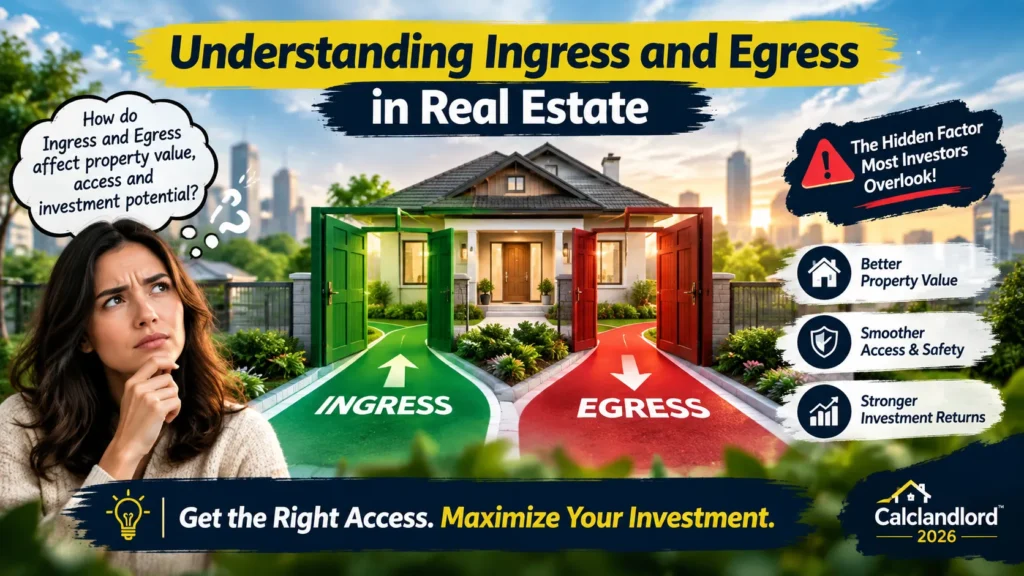
Understanding Ingress and Egress in Real Estate
A property can look easy to reach and still have an access problem that costs time, money, or even a deal. In real estate, ingress means the legal right to enter property, while egress means the legal right to leave it. The real issue is whether that access is documented, physically usable, and suitable for the property’s intended use. A visible driveway is not always proof of legal access, and an easement for access may not automatically cover trucks, construction, or future development. This guide explains the key access rights, easement risks, survey and title checks, and buyer questions you should answer before closing.
A rental property can look perfectly accessible and still have a serious access problem hiding in its title documents.
A visible driveway does not automatically prove that you have the legal right to use it. A road shown on a map does not necessarily mean it is publicly maintained. And an easement that allows “access” may not automatically cover delivery trucks, construction equipment, future development, or every other use an owner may have in mind.
So, what is ingress and egress in real estate? Ingress generally means the legal right to enter property, while egress means the legal right to leave it. Together, the terms describe access rights to and from land, often through an easement, deed provision, right-of-way, shared-driveway agreement, or another recognized legal basis.
For landlords and real estate investors, this matters because access can affect property usability, financing, development potential, operating costs, marketability, and resale risk. Physical access and legal access are not always the same.
Quick Answer
Ingress is the right to enter property.
Egress is the right to leave property.
An ingress and egress easement is a legal right allowing someone to travel across another person’s land to reach and leave a benefited property.
For a rental-property buyer, the important question is not simply whether a driveway exists. The better question is:
Who can use the route, where does it run, what vehicles and activities are allowed, who maintains it, and does it provide lawful access to a public road?
1. What Do Ingress and Egress Mean in Real Estate?
In real estate, ingress means entering a property, while egress means leaving it. U.S. federal right-of-way regulations define access rights in terms of the right of ingress to and egress from property to a public way.
For a simple residential example, imagine a rental house located behind another parcel:
Public Road → Neighbor’s Land → Driveway → Rental Property
If the rear property owner has a legal right to travel across the neighbor’s land:
- Entering the rental property is ingress.
- Leaving the rental property is egress.
- The legal right allowing the travel may be an access easement or right-of-way.
This distinction becomes more important when property ownership and property access are separated. An owner can hold title to land but still depend on someone else’s land for a lawful route to the public road.
An easement generally gives a person or property a limited right to use another person’s land without transferring ownership of that land. Cornell’s Legal Information Institute describes an easement as a nonpossessory property interest that permits the holder to use another person’s land for a defined purpose.
That is why the words ingress and egress frequently appear in:
- deeds,
- easement agreements,
- right-of-way documents,
- shared-driveway agreements,
- subdivision documents,
- title reports, and
- property surveys.
2. Ingress vs. Egress: What Is the Difference?
The two terms are closely related, but they describe opposite directions of movement.
| Term | Meaning | Typical Real Estate Example |
| Ingress | Right to enter property | Driving into a rental property |
| Egress | Right to leave property | Driving out to a public road |
| Ingress and egress | Combined entry-and-exit access | Shared driveway easement |
An important practical point is that access rights are defined by their legal source, not by the label alone.
For example, an agreement might permit:
- pedestrian access but not vehicle access,
- passenger cars but not heavy trucks,
- residential access but not commercial traffic,
- ordinary use but not construction,
- access to an existing home but not future subdivision.
That is why a buyer should not stop after seeing the words “ingress and egress.” The next step is to read the actual document.
The relevant questions are:
Who has the right? Where is the route? What uses are permitted? What limitations apply? Who pays for maintenance?
Those details can materially change the value and usefulness of a property.
3. Why Ingress and Egress Rights Matter to Property Owners
Access is a basic part of property usability, but it also creates legal, operational, and financial considerations.
Legal usability
If a rental property is reached by crossing another owner’s land, the investor needs to know the legal basis for that access. Ownership alone does not necessarily grant the right to cross a neighbor’s parcel.
A recorded easement may provide evidence of that right, but the wording and applicable state law still matter.
Landlocked-property risk
A parcel can become difficult to use when there is no practical and legally secure connection to a public road. This is a major buyer-risk issue, particularly where a property appears accessible but lacks documented rights.
Financing and title review
Title searches may reveal access rights, easements, and other title exceptions. The American Bar Association notes that title searches can identify matters such as easements and neighbor access rights and recommends attorney review of title issues.
Property value
Reliable, legally documented access can support usability and marketability. By contrast, disputed, seasonal, narrow, or poorly maintained access can create additional costs and reduce the attractiveness of the property.
Emergency and building safety
Land access and building egress are not the same issue. A parcel may have a lawful driveway easement while the building still fails applicable requirements for emergency exits, accessible egress, fire access, or other safety standards.
For landlords, the key lesson is simple:
Access should be analyzed as both a title issue and a practical property-management issue.
4. What Is an Ingress and Egress Easement?
An ingress and egress easement is a legal right to cross another person’s land to enter and leave a benefited property.
The terminology can sound complicated:
- Dominant estate: the property benefiting from the easement.
- Servient estate: the property burdened by the easement.
- Easement holder: the person or entity entitled to use the easement.
- Easement area: the defined portion of land over which the right runs.
Cornell LII explains that the dominant estate benefits from the easement while the servient estate carries the burden.
An easement normally does not mean the easement holder owns the road or strip of land.
Instead, the holder receives a particular use right.
Example
Suppose:
- Parcel A is a rental home.
- Parcel B is the neighbor’s parcel.
- Parcel A has no direct public-road connection.
- A recorded easement allows Parcel A to cross a 20-foot-wide strip of Parcel B.
Parcel A is the dominant estate.
Parcel B is the servient estate.
The easement is the legal mechanism that allows access from Parcel A through Parcel B.
That structure is common in landlocked and shared-access situations.
5. How Ingress and Egress Rights Are Created
Access rights can arise through different legal mechanisms. The exact rules differ by state, so a buyer should not assume that one legal theory works the same way everywhere.
Express easement
An express easement is created through a written instrument such as:
- a deed,
- easement agreement,
- right-of-way agreement,
- shared-driveway agreement,
- subdivision declaration, or
- development agreement.
An express document is often easier to analyze because it can state the route, permitted uses, maintenance obligations, duration, and related rights.
Easement by necessity
Some jurisdictions recognize an easement by necessity when land was divided in a way that leaves a parcel without necessary access.
Cornell explains that traditional easement-by-necessity doctrines can involve prior unity of ownership and necessity at the time of severance, although jurisdictional rules differ.
A buyer should not assume that buying a landlocked parcel automatically creates a broad roadway right.
Easement by implication
An easement can sometimes be implied from prior use, surrounding circumstances, subdivision history, or the parties’ apparent intent.
These claims are highly fact-specific.
Prescriptive easement
Some jurisdictions recognize easements acquired through qualifying long-term use without permission. Cornell notes that requirements, including the required time period, vary by state.
For a buyer, an unrecorded prescriptive-access claim can create uncertainty even when no obvious access easement appears in the title file.
Public-road access
A parcel touching a public road may still have access complications.
Issues can include:
- driveway permits,
- curb cuts,
- barriers,
- traffic requirements,
- road openings,
- local access standards, or
- restrictions on the location of an entrance.
So “the parcel touches the road” is not always the end of the analysis.
6. What Can an Ingress and Egress Easement Allow?
An easement should be treated as a defined legal right, not as a blank check to use the underlying property however the holder wants.
Depending on the document and applicable law, an access easement may address:
- pedestrians,
- passenger vehicles,
- delivery vehicles,
- contractors,
- construction equipment,
- agricultural machinery,
- tenants,
- guests,
- customers,
- utility providers,
- emergency responders,
- parking or loading,
- gates,
- maintenance,
- drainage, or
- snow and debris removal.
The scope matters.
A right allowing access to a single-family home may not automatically answer whether the same route can support:
- a four-unit apartment property,
- a warehouse,
- restaurant deliveries,
- construction traffic,
- a subdivision,
- a commercial parking area, or
- substantially higher traffic volumes.
This scope question is one of the most important to get right.
Read the actual language
Words such as access, right-of-way, ingress, and egress should trigger further review, not end it.
Look for language about:
- route location,
- width,
- permitted users,
- vehicle types,
- maintenance,
- gates,
- changes in use,
- construction,
- utilities,
- relocation, and
- termination.
The legal title of the document is less important than the rights it actually grants.
7. Recorded vs. Unrecorded Access: What Buyers Should Know
A recorded easement is generally easier to identify through the public land records and title search process.
An unrecorded arrangement may instead depend on:
- verbal permission,
- historical use,
- informal neighbor cooperation,
- an old private agreement,
- a path visible on satellite images, or
- an arrangement that was never properly recorded.
The danger is not simply that the route might disappear tomorrow. The larger issue is proof and enforceability.
A neighbor’s current permission may not provide the same certainty as a properly documented property right.
The American Bar Association explains that title searches can identify easements and access rights, while commercial survey work can reveal issues that may not be obvious from title documents alone.
Practical rule for investors
If access is essential to the property’s intended use, treat undocumented access as a due-diligence issue that must be resolved before you become fully committed to the transaction.
That can mean obtaining:
- a recorded easement,
- a corrective instrument,
- a maintenance agreement,
- title-insurance protection,
- a survey,
- or a legal opinion.
8. How to Verify Legal and Physical Access Before Buying
This is where ingress-and-egress research becomes real investment due diligence.
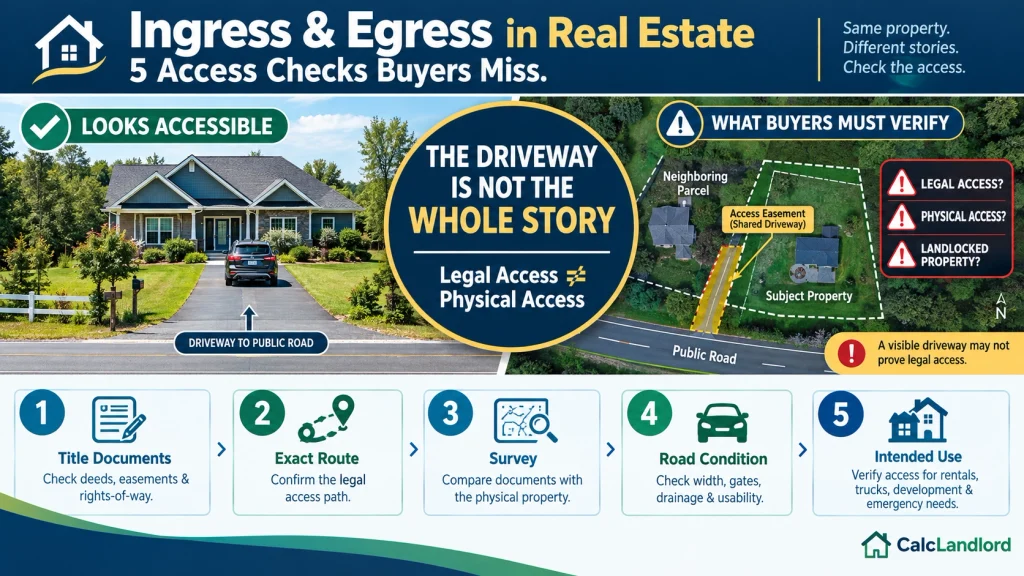
A thorough buyer workflow covers each of these steps: determine intended use, review title documents, compare the legal route with a survey, inspect physical access, verify road status, confirm planning requirements, ask the lender and title insurer detailed questions, and resolve defects before closing.
Step 1: Define the intended property use
Start with the use you actually plan.
Ask:
- Is this a single-family rental?
- Multifamily?
- Commercial property?
- Development land?
- Short-term rental?
- Farm or rural property?
Access standards can change with use.
A driveway that works for one house may not work for a higher-traffic operation.
Step 2: Collect title documents
Request and review:
- current deed,
- prior deeds where relevant,
- title commitment or title report,
- recorded easements,
- rights-of-way,
- declarations,
- restrictive covenants,
- private-road agreements,
- maintenance agreements,
- amendments, and
- relevant subdivision documents.
Do not rely only on the summary page. Read the underlying recorded instrument when access is important.
Step 3: Compare the documents with a survey
A survey can help show whether the legal description and physical situation actually line up.
Look for:
- the easement location,
- route width,
- route connection,
- encroachments,
- fences,
- walls,
- buildings,
- driveway placement,
- gaps between the easement and public road,
- and access over the correct parcel.
The American Bar Association notes that surveys can help confirm access, boundaries, easements, encroachments, and other matters affecting use and marketability.
For commercial deals, the 2026 ALTA/NSPS Land Title Survey Standards became effective February 23, 2026 and provide current minimum standards for relevant survey work in commercial transactions.
Step 4: Inspect the route physically
Do not inspect access only from a map.
Where practical, examine it under different conditions and check:
- road surface,
- width,
- drainage,
- flooding,
- mud,
- steep grades,
- turning space,
- gates,
- bridge or culvert limits,
- debris,
- neighbor obstructions,
- and emergency access.
Your legal right may be perfect on paper while the physical route remains inadequate for your investment strategy.
Step 5: Verify public-road status
Ask the relevant local authority whether the connecting road is:
- public or private,
- open to traffic,
- publicly maintained,
- subject to planned changes,
- approved for the intended access point, or
- subject to driveway or curb-cut requirements.
A road shown on a map does not automatically prove the practical condition or maintenance status you need.
Step 6: Confirm zoning, planning, building, and fire requirements
For development or higher-density use, check whether authorities require:
- minimum road width,
- emergency access,
- fire-truck access,
- turning radii,
- multiple routes,
- accessible paths,
- driveway approvals,
- visibility standards,
- traffic analysis,
- or road improvements.
This is particularly important for investors who plan to add units or change the property’s use.
Step 7: Ask the title insurer and lender specific questions
Do not simply ask:
“Does this property have access?”
Ask:
- Is the access legally documented?
- Is it vehicular?
- Is it pedestrian?
- Does it connect to a public street?
- Is the street physically open and maintained?
- Are there access gaps?
- Are there apparent or unrecorded easement concerns?
- Does the coverage fit the intended commercial or development use?
The ABA notes that title-policy access protection can be more limited than a buyer may assume and may not guarantee a particular route, condition, width, or maintenance situation.
Step 8: Resolve defects before closing
Potential solutions can include:
- recording a new easement,
- correcting an existing easement,
- obtaining neighbor consent,
- creating a road-maintenance agreement,
- relocating a fence,
- obtaining a road-opening approval,
- buying a strip of land,
- obtaining appropriate title coverage,
- renegotiating the transaction, or
- making closing conditional on access resolution.
Your purchase contract and local legal advice should determine the safest approach.
9. What Is a Landlocked Property and Why Is It Risky?
A landlocked property generally lacks a direct, legally usable connection to a public road.
That does not automatically make the property worthless. But it increases the importance of verifying the legal route and understanding the legal theory supporting access.
The risks can include:
- difficulty obtaining reliable access,
- disputes with neighboring owners,
- development limitations,
- higher legal costs,
- maintenance uncertainty,
- financing complications,
- insurance or title concerns,
- and reduced resale flexibility.
An easement by necessity may exist in some jurisdictions, but Cornell notes that the elements and standards vary, and the doctrine may require specific facts such as prior unity of ownership and necessity at severance.
Investor example
Imagine two rural lots priced at $120,000 each.
Property A
- Direct road frontage
- Clear driveway access
- No shared route
Property B
- Lower asking price
- Access over a neighbor’s land
- Old easement document
- Narrow route
- Unclear maintenance responsibility
So Property B is not automatically a bad investment.
But its lower price may be compensating for:
- legal work,
- maintenance obligations,
- access risk,
- financing uncertainty,
- or future resale challenges.
The correct underwriting question is not:
“Which parcel is cheaper?”
It is:
“Does the discount adequately compensate for the access-related risk and cost?”
10. What Should an Ingress and Egress Easement Include?
A strong access agreement should remove avoidable ambiguity.
Several terms deserve special attention, including exact location, permitted users, vehicle types, maintenance, gates, utilities, development intensity, relocation, and termination.
1. Exact location
Use a survey, legal description, or clearly marked exhibit.
An expression such as “over the existing driveway” may create uncertainty if the driveway later moves or changes.
2. Permitted users
Clarify whether the right includes:
- owners,
- future owners,
- tenants,
- guests,
- customers,
- employees,
- contractors,
- delivery services,
- utility providers,
- and emergency responders.
3. Vehicle types
State whether the route supports:
- cars,
- SUVs,
- vans,
- delivery vehicles,
- trucks,
- farm equipment,
- or construction vehicles.
4. Maintenance
Clarify responsibility for:
- resurfacing,
- potholes,
- drainage,
- snow,
- debris,
- gates,
- lighting,
- retaining structures,
- and damage caused by unusually heavy use.
5. Cost sharing
If multiple properties use the road, identify:
- how costs are split,
- who selects contractors,
- how major repairs are approved,
- and what happens if one owner refuses to pay.
6. Gates
Address:
- keys,
- access codes,
- opening hours,
- automatic gates,
- emergency entry,
- and who pays for repairs.
7. Utilities
Do not assume that an access easement automatically grants utility rights.
Utilities may require separate or express rights for:
- electricity,
- gas,
- water,
- sewer,
- telecommunications,
- drainage,
- and related infrastructure.
8. Development and increased use
This is especially important for rental-property investors.
The document should be reviewed for potential changes involving:
- additional units,
- subdivision,
- commercial use,
- increased traffic,
- construction,
- new parking,
- delivery activity,
- or public access.
A right adequate for one rental home may not be adequate for a future multifamily development.
11. Who Is Responsible for Access Road Maintenance and Repairs?
Maintenance disputes are among the most practical problems created by shared access.
The person who owns the underlying road is not necessarily the only person responsible for every repair. The easement document and applicable law may allocate costs differently.
Possible arrangements include:
- one owner pays all maintenance,
- users split expenses,
- costs are divided proportionally,
- specific owners handle snow or drainage,
- or local law fills gaps where the document is silent.
What landlords should document
For a rental property using a shared driveway or private road, clarify:
Routine maintenance: Who handles normal wear?
Major repairs: Who pays for resurfacing or reconstruction?
Damage: Who pays if heavy vehicles cause unusual deterioration?
Drainage: Who is responsible for culverts and runoff?
Seasonal access: What happens during flooding, snow, or severe weather?
Decision-making: Who decides when repairs are necessary?
A written agreement can reduce uncertainty between neighboring owners.
This is not merely a legal concern. For landlords, delayed repairs can also affect:
- tenant access,
- contractor access,
- inspections,
- deliveries,
- emergency response,
- and property operating costs.
12. How Ingress and Egress Affect Property Value, Financing, and Marketability
Access can influence investment economics without appearing as a separate line item in your initial property analysis.
Think of the impact through four categories:
| Factor | Question for the Investor |
| Usability | Can I use the property as intended? |
| Risk | Can access be challenged, restricted, or obstructed? |
| Cost | What will legal, road, drainage, or maintenance issues cost? |
| Marketability | Will future buyers and lenders accept the access arrangement? |
The practical effect is property-specific.
A documented, reliable shared driveway may be perfectly workable.
A disputed access route with unclear legal rights may create a large risk even if the property is otherwise attractive.
The ABA notes that survey and title issues can affect the marketability and future use of commercial real estate.
Financing considerations
Lenders may examine access because access problems can affect the usefulness and resale of collateral.
This does not mean there is one universal lender rule requiring the same documentation on every transaction.
Instead, ask your lender exactly what it requires.
Title insurance considerations
Title insurance can address certain title risks, but coverage is policy-specific.
For example, the ABA discusses ALTA 17.1-06, an indirect-access endorsement designed for certain transactions involving easement access to a public street. The endorsement addresses specified access-related risks subject to its requirements and policy terms.
The lesson for an investor is:
Do not treat “insured” as meaning “every physical and legal access problem is covered.”
Review the actual commitment, exceptions, endorsements, and survey requirements.
Investment analysis
When comparing properties, include access-related items such as:
- legal review,
- survey cost,
- road maintenance,
- repair reserves,
- drainage work,
- access upgrades,
- permit costs,
- potential development limitations,
- and resale risk.
A lower purchase price is not enough by itself to make a property financially attractive.
For broader investment analysis, CalcLandlord’s Market Comparison Calculator can be useful when comparing otherwise similar properties after you quantify any access-related cost or value differences. It should not be used to determine the legal validity of an easement.
13. Ingress and Egress for Commercial and Multifamily Properties
Commercial and multifamily properties generally require a more detailed access review because the number and intensity of users can be much greater.
A buyer should consider:
- customers,
- employees,
- residents,
- delivery trucks,
- service vehicles,
- waste collection,
- emergency responders,
- parking circulation,
- loading areas,
- fire lanes,
- construction traffic,
- and future expansion.
A shared driveway serving a duplex is a very different situation from a shared driveway serving:
- an apartment complex,
- retail center,
- warehouse,
- restaurant,
- medical office,
- or logistics facility.
Commercial example
Suppose you buy a commercial parcel with a recorded easement stating that the property has access to the premises.
At first glance, that sounds sufficient.
But later you discover:
- the route is too narrow for certain trucks,
- the loading area is difficult to access,
- the agreement does not clearly address increased traffic,
- and neighboring owners object to expanded use.
The issue is not whether access exists.
The issue is whether the scope and physical characteristics of the access support the intended business operation.
Current commercial real estate practice also places substantial emphasis on coordinated title and survey review. The 2026 ALTA/NSPS standards are now the current national survey framework for applicable commercial land-title survey work.
For multifamily properties, also verify:
- resident circulation,
- visitor access,
- moving trucks,
- maintenance contractors,
- waste vehicles,
- accessible routes,
- and emergency access.
A development can have lawful property access and still face separate planning, fire, accessibility, or building-code requirements.
14. Property Egress vs. Building-Code Means of Egress
This distinction is easy to miss.
Property-law egress
Property-law egress concerns the legal right to leave land, often by crossing a private access route.
Building-code means of egress
Building-code egress concerns the safe and regulated route occupants use to leave a building or space.
The U.S. Access Board explains that a means of egress is an unobstructed path for leaving buildings, structures, and spaces and identifies three components:
- Exit access
- Exit
- Exit discharge
The Access Board also explains that accessible means of egress connect occupants from accessible portions of a building toward an area of refuge, another compliant destination, or a public way, subject to the applicable requirements.
Why the distinction matters
A rental property could have:
Excellent legal driveway access + inadequate building egress
or:
Compliant internal building exits + inadequate legal property access to the public road
Those are two different problems.
For landlords and investors, the access review should therefore involve the appropriate professionals when circumstances require it:
- real estate attorney,
- title professional,
- surveyor,
- building professional,
- fire or life-safety authority,
- and local planning authority.
Do not assume that a property-law easement solves a building-code issue.
15. Common Ingress and Egress Problems and How to Resolve Them
Access problems become expensive when they are discovered after closing instead of during due diligence.
| Problem | Why It Matters | Potential Response |
| Property appears landlocked | No reliable legal route | Secure documented access before closing |
| Driveway crosses wrong parcel | Physical route may not match legal rights | Obtain corrective documentation or new easement |
| Easement is pedestrian-only | Vehicles may not be authorized | Review and amend rights where legally possible |
| Route is too narrow | Fire, delivery, or construction use may fail | Investigate approvals or redesign |
| Neighbor maintains road informally | Future maintenance may become disputed | Record maintenance and cost-sharing terms |
| Access is seasonal | Route may become unusable | Investigate drainage and alternative access |
| Easement ends at a private road | No clear connection to public way | Trace the entire route |
| Development increases traffic | Existing scope may not support new use | Obtain express rights and approvals |
| Easement conflicts with improvements | Use may create encroachment or removal risk | Resolve title/survey issue before closing |
| Gate blocks access | Entry may be delayed or restricted | Clarify gate rights, keys, hours, and emergency access |
The five-question access test
Before buying a property, answer these five questions:
1. Is the access legal?
Identify the deed, easement, right-of-way, or other legal source.
2. Is the access physical?
Confirm the route actually exists and can be used.
3. Is the access sufficient?
Check width, vehicles, turning, drainage, gates, and emergency requirements.
4. Is the access durable?
Understand who maintains it and what happens when ownership changes.
5. Is the access adequate for the intended use?
A residential route may not be enough for commercial, multifamily, or development activity.
People Also Ask
Not exactly. Ingress specifically refers to entering property. “Access” is broader and is often used to describe the combined ability to reach and leave property.
Not always. Property-law egress concerns the right to leave land, while building-code means of egress refers to a regulated path occupants use to leave a building safely.
Not necessarily. When access requires crossing another person’s land, the legal right should be established through an applicable easement, deed provision, public right, or other recognized legal basis.
Only to the extent the easement language and applicable law support that use. The wording should be reviewed carefully, especially where trucks, construction equipment, or increased traffic are involved.
No. An easement generally creates a limited use right rather than transferring ownership of the underlying land.
No. Easement-by-necessity rules differ by jurisdiction and can depend on specific historical and legal facts.
No. Physical use and legal entitlement are separate issues. A driveway can exist without a properly documented right to use it.
The answer depends on the easement terms and applicable law. The agreement may assign costs to one owner, divide them among users, or leave certain issues to local law.
Conclusion: What Landlords and Buyers Should Remember
Ingress and egress are fundamental real estate access concepts, but the real investment question goes beyond the dictionary definition.
Ingress is the right to enter.
Egress is the right to leave.
An ingress and egress easement can provide lawful travel across another person’s land.
But the existence of an easement does not automatically answer whether the route is:
- wide enough,
- physically usable,
- properly connected to a public road,
- suitable for vehicles,
- adequate for development,
- properly maintained,
- or sufficient for emergency and building requirements.
Your due-diligence workflow should therefore be:
More Explore :https://calclandlord.com/rent-zestimate-explained/
Identify the intended use → review title documents → trace the legal route → compare it with a survey → inspect the physical route → verify public-road and local requirements → confirm lender/title expectations → resolve defects before closing.
For rental-property investors, access should be treated as an underwriting issue as well as a legal issue. A seemingly small access defect can create legal fees, road expenses, project delays, financing complications, or resale problems.
The goal is not simply to find a property that you can physically reach today.
The goal is to verify that you have a legally secure, physically usable, and appropriately scoped route for the property’s intended use.
Relevant CalcLandlord Tool
When access concerns affect how two properties compare financially, use the CalcLandlord Market Comparison Calculator after estimating the associated costs, risks, and value differences. A calculator can support the investment analysis, but it cannot determine whether an easement is legally valid.
Final Buyer Checklist
Before purchasing a property that depends on private or shared access, verify:
- Legal access to a public road
- Full chain of relevant title documents
- Exact easement location
- Pedestrian and vehicle rights
- Rights for tenants, customers, contractors, and emergency responders
- Road width and physical condition
- Maintenance and repair obligations
- Gate and access-code rules
- Utility and drainage rights
- Construction and development rights
- Public-road status
- Planning, zoning, fire, and building requirements
- Survey findings
- Title-insurance exceptions and endorsements
- Lender requirements
- Neighbor agreements or consents where required
- A written solution for every material access defect

Pingback: Legal Due Diligence Checklist for Commercial Real Estate