

Rent Zestimate: Complete Guide for Landlords, Investors, and Renters
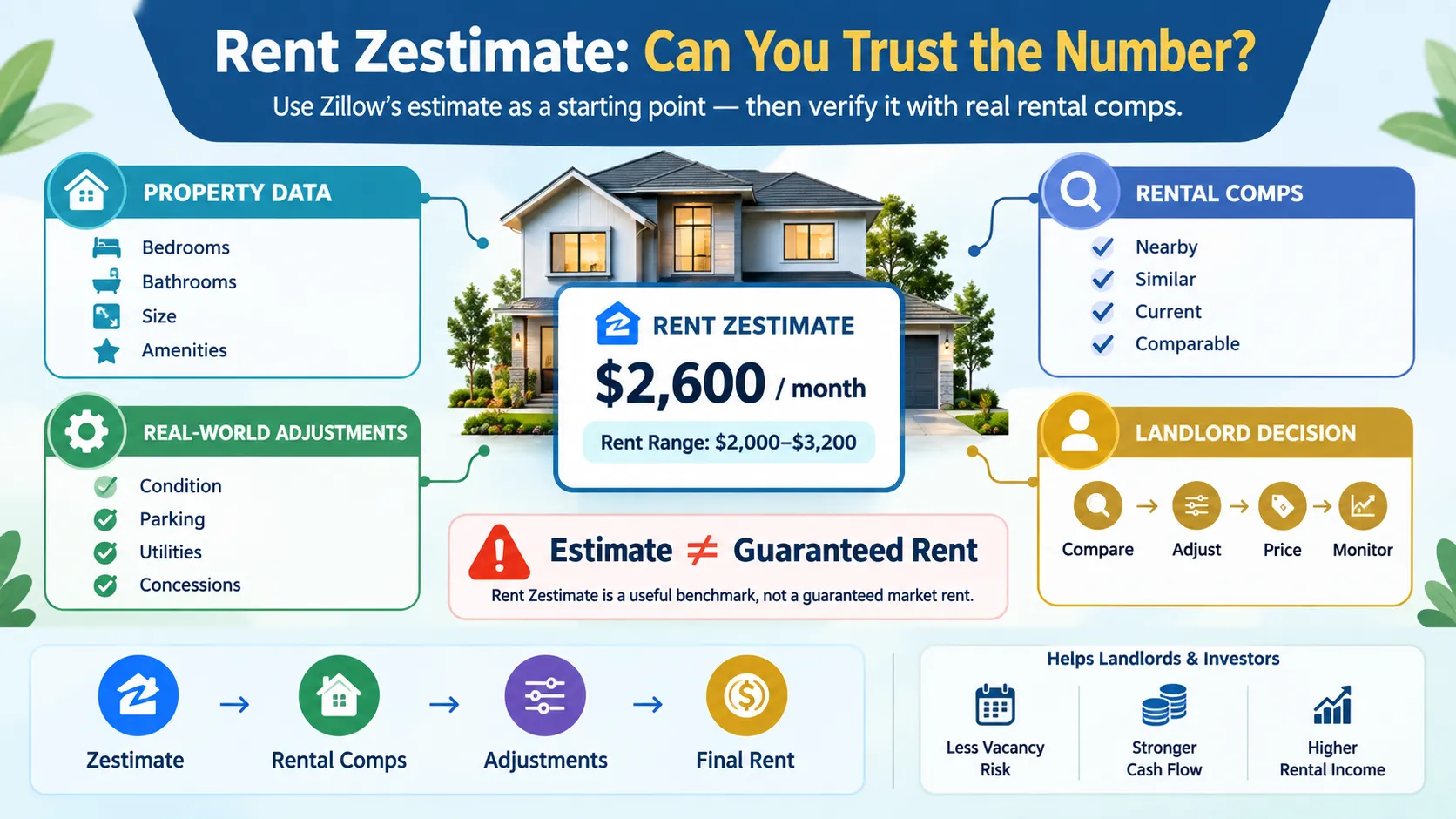
A Rent Zestimate can give you a useful starting point—but should you trust that number when setting rent? Zillow’s estimate uses available property information and rental-market data, yet the final rent a tenant actually pays can differ. Property condition, parking, amenities, concessions, utilities, lease terms, and changing local demand can all shift the result. For landlords and investors, the biggest mistake is treating one automated estimate as the answer. Instead, use the Rent Zestimate as a benchmark, then compare it with similar rental properties. This guide explains what the number means, where it can miss, and how to price well.
A Rent Zestimate is Zillow’s estimated monthly rental price for a particular residential property. It can give a landlord, investor, or renter a useful starting point, but it should not automatically be treated as the property’s final market rent.
Zillow says the Rent Zestimate is generated from public property information and similar local properties listed for rent. Zillow also makes clear that special features, location-specific factors, changing market conditions, negotiations, incentives, and lease length can cause the actual rent to differ from the estimate.
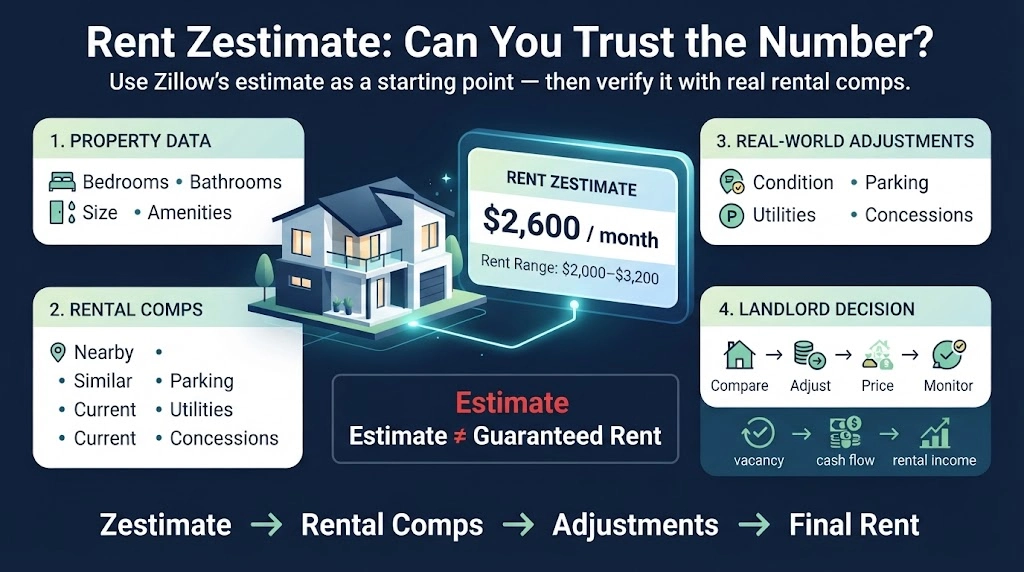
Quick answer: Use a Rent Zestimate as a benchmark. Then verify the number against current, genuinely comparable rentals, property condition, fees, concessions, vacancy risk, and local market conditions.
For landlords, that distinction matters because the highest estimated rent is not always the best economic rent. A slightly lower price that produces faster leasing and fewer vacant days can sometimes generate more annual collected rent than an aggressive asking price.
For investors, the distinction matters even more. A rent assumption flows directly into projected rental income, cash flow, return metrics, and sometimes the maximum price you are willing to pay for a property.
1. What Is a Rent Zestimate?
A Rent Zestimate is Zillow’s estimate of the monthly rent a particular home may command based on the information available to Zillow.
Zillow describes it as a starting point for determining potential monthly rental price. Its current materials say the estimate uses public property data, comparable local rental properties, owner-updated home facts, and other available information. Zillow currently states that it provides Rent Zestimates for approximately 125 million homes.
The important distinction is between an estimate and an executed lease.
A Rent Zestimate is not the same thing as:
- the landlord’s asking rent;
- the rent a tenant eventually negotiates;
- the net effective rent after concessions;
- the rent actually collected;
- or a guarantee that the property will lease at that amount.
For example, imagine Zillow shows:
| Item | Example |
| Rent Zestimate | $2,600 |
| Rent Range | $2,000–$3,200 |
| Current comparable listings | $2,500–$2,750 |
| Subject property condition | Recently renovated |
| Parking | Included |
The $2,600 estimate is useful, but it is not the end of the analysis.
A landlord could reasonably conclude that the property should be marketed somewhat above or below that number after examining the actual competition.
That is the central idea behind using Rent Zestimate correctly:
Estimate first. Validate second. Price third.
2. How Does Zillow Calculate a Rent Zestimate?
Zillow does not publish the complete current formula behind the Rent Zestimate. It describes the system as a proprietary formula that uses available public information and rental-market data.
Zillow identifies several important inputs, including physical property characteristics, amenities, comparable rental properties, owner-updated facts, and other public data.
Property characteristics
The available information can include factors such as:
- bedrooms;
- bathrooms;
- square footage;
- property type;
- air conditioning and other amenities;
- location;
- building and lot characteristics;
- owner-supplied corrections;
- publicly available property records.
The quality of that information matters.
A property with an outdated bedroom count, incorrect square footage, or missing features can produce an estimate that is less useful because the model is working with incomplete inputs. Zillow specifically notes that correcting home facts may affect the Rent Zestimate.
Comparable rental properties
Rental listings are another important component.
A comparable rental, or rental comp, should ideally resemble the subject property in meaningful ways.
Useful comparison factors include:
| Factor | Why it matters |
| Neighborhood | Rents can vary dramatically between nearby areas |
| Bedrooms | Changes expected tenant demand |
| Bathrooms | Adds functional value |
| Square footage | Helps explain rent differences |
| Condition | Renovated units may command premiums |
| Parking | Often has measurable rental value |
| Amenities | Laundry, outdoor space, pool, gym, etc. |
| Utilities | Included costs change the effective price |
| Lease terms | Different terms can produce different pricing |
| Availability | Current competition matters more than stale listings |
Zillow’s research on Rent Zestimates has also described the model as learning relationships between rental listing prices and property attributes.
Public and historical information
Rental-estimate models can benefit from a large amount of property and market data.
But more data does not mean every individual estimate is equally reliable.
A property in a dense rental market may have many comparable listings available. A unique home in a thin market may have very few meaningful comparisons.
That difference is one reason the Rent Range can be important.
3. What Does the Rent Range Mean?
The Rent Range shows a high and low estimate around the Rent Zestimate.
For example:
Rent Zestimate: $2,600
Rent Range: $2,000–$3,200
Zillow explains that a wider range can indicate less available data or greater volatility, while a narrower range generally reflects more information available for similar properties.
The range should therefore be treated as a signal about uncertainty, not merely decoration around the central number.
A narrower range
A relatively narrow range may indicate:
- more comparable properties;
- more available property information;
- a more typical property type;
- stronger local rental-data coverage.
It does not guarantee that the estimate is correct.
A wider range
A wider range can indicate:
- fewer comparable rentals;
- unusual property characteristics;
- limited local rental data;
- greater market volatility;
- uncertainty in the available information.
For investors, a wide range should trigger scenario analysis.
Instead of underwriting the property only at the midpoint, consider:
Conservative rent → Base rent → Optimistic rent
For example:
| Scenario | Monthly Rent | Annual Gross Rent |
| Conservative | $2,450 | $29,400 |
| Base | $2,600 | $31,200 |
| Optimistic | $2,750 | $33,000 |
The purpose is not to predict exactly what will happen.
The purpose is to determine whether the property still works financially if the rent comes in below your preferred assumption.
4. Is Rent Zestimate Accurate for Rental Properties?
The most accurate answer is:
It can be useful, but accuracy varies by property, market, and data quality.
Zillow itself says the amount of information available affects Rent Zestimate accuracy. It specifically points to factors such as the number of rental listings in an area and the completeness of property information.
That means there is no single percentage you should blindly apply to every property.
Situations where caution is especially important
Be more careful when:
- the property is in a low-density rental market;
- there are few genuinely comparable listings;
- the property is unusually large or small;
- the home is highly renovated;
- the property has unusual amenities;
- the home facts are incomplete;
- the market has moved rapidly;
- asking rents include significant incentives;
- nearby properties differ materially in quality.
A major mistake is to see a Rent Zestimate and assume:
“That must be the market rent.”
A better interpretation is:
“That is one data point in my market-rent analysis.”
Do not borrow Zestimate accuracy statistics
Zillow publishes accuracy statistics for its home-value Zestimate. Those numbers relate to estimated sale values, not Rent Zestimate.
For example, Zillow’s current Zestimate page publishes median error information for home-value estimates and explains that those figures relate to the Zestimate home-value model. They should not automatically be presented as Rent Zestimate accuracy.
That distinction is important because sale-price estimation and rental-price estimation involve different outcomes and market data.
5. Why Can a Rent Zestimate Be Too High or Too Low?
A Rent Zestimate can differ from the rent you eventually achieve for several practical reasons.
The first is simple:
The model does not personally inspect your property.
Incorrect property data
Check:
- bedroom count;
- bathroom count;
- square footage;
- parking;
- garage;
- basement;
- laundry;
- heating and cooling;
- renovations;
- furnishings;
- amenities.
An incorrect data field can affect the comparison.
Property condition
Two homes can have identical bedroom counts and similar square footage while renting for very different amounts.
One might have:
- a new kitchen;
- premium appliances;
- updated bathrooms;
- new flooring;
- better lighting.
The other might have:
- dated finishes;
- deferred maintenance;
- older appliances;
- poor natural light.
A model can incorporate available features, but the landlord’s direct market evidence may reveal differences that are difficult to capture completely.
Asking rent versus achieved rent
A listing at $2,700 does not prove that a tenant will sign at $2,700.
The final lease may be:
$2,600 monthly
after negotiation.
Or the advertised rent could look lower while the tenant also pays mandatory fees.
Therefore, compare like with like.
Concessions
Consider:
- one month free;
- reduced deposit;
- waived application fee;
- free parking;
- free utilities;
- short-term promotions.
A $2,700 listing with a significant concession may produce less economic rent than a $2,600 listing with no concession.
Market timing
Rental markets can move quickly.
New employers, university calendars, changes in inventory, migration, new construction, and shifting tenant demand can affect pricing.
Zillow itself notes that market conditions and special circumstances may not always be fully captured by the estimate.
6. What Property Details Can Change Your Rent Zestimate?
Property details influence the rental profile of a home because tenants do not compare properties using rent alone.
They compare the entire package.
Important details include:
Bedrooms and bathrooms
A change from two bedrooms to three can substantially change the competitive set.
Bathrooms can also influence tenant demand, especially for larger households.
Square footage
Size helps identify comparable properties, but it should not be used alone.
A well-designed 1,500-square-foot home may compete differently from an awkwardly configured 1,700-square-foot home.
Parking
Parking can be especially important in dense urban areas or locations with limited street parking.
Laundry
In-unit laundry may create meaningful value compared with shared or off-site facilities.
Outdoor space
Private yards, balconies, patios, and terraces can affect marketability.
Renovation quality
A renovated property should usually be compared with other renovated properties rather than with average older units.
Furnishings and utilities
A furnished unit and an unfurnished unit are not necessarily equivalent.
Likewise:
$2,500 with utilities included
is economically different from:
$2,500 plus $250 of typical required monthly costs.
Zillow has also been introducing clearer Total monthly price displays that combine base rent with fixed required monthly fees in qualifying listings, which reinforces the importance of evaluating a rental based on the tenant’s total recurring cost rather than only the headline rent.
Before relying on an estimate, verify the property facts that most directly affect your competitive set.
7. How to Find the Rent Zestimate for a Property
Finding a Rent Zestimate is generally straightforward.
A practical process is:
- Search for the property on Zillow.
- Open the property page.
- Look for the rental estimate or Rent Zestimate.
- Review the Rent Range.
- Check the listed property facts.
- Compare the estimate with current nearby rental listings.
Zillow also says owners who have claimed an off-market home may be able to view Rent Zestimate history through the Your Home area.
What if there is no Rent Zestimate?
The absence of an estimate does not automatically mean something is wrong with the property.
Automated valuation systems need enough usable information to produce an estimate.
For Zillow’s home-value Zestimate, Zillow explains that estimates may be unavailable when there is insufficient reliable data or when the model determines uncertainty is too high.
Rental availability can likewise vary by property and location.
When no estimate is available, use another pricing process:
Current rental comps → property adjustments → market conditions → vacancy considerations
That process can often provide more actionable information than forcing a number from an automated tool.
8. How Should Landlords Use Rent Zestimate to Set Rent?
The most useful landlord workflow is:
Rent Zestimate → rental comps → adjustments → pricing test → real-world response
Step 1: Verify the property facts
Before interpreting the estimate, verify the home’s:
- bedrooms;
- bathrooms;
- size;
- parking;
- laundry;
- amenities;
- renovations;
- utility responsibility.
Step 2: Build a comp set
Look for several current properties that are as similar as possible.
Give higher weight to:
- the same building;
- the same development;
- the same neighborhood;
- similar size;
- similar condition;
- similar amenities.
Step 3: Calculate your comp baseline
Suppose your strongest comparable rents are:
$2,450
$2,500
$2,575
$2,650
$2,700
The median is:
$2,575
That is a useful market baseline.
Notice that the baseline is not automatically the highest listing and not automatically the Zillow estimate.
Step 4: Adjust for the subject property
Suppose your subject property has:
- covered parking;
- renovated kitchen;
- slightly smaller size.
You might reasonably adjust the baseline upward for parking and renovation while adjusting downward for size.
The purpose is not mathematical precision.
The purpose is to make your pricing logic explicit.
Step 5: Consider vacancy risk
Suppose you can charge:
$2,800 per month
but the property sits vacant for one month.
Annual collected rent would be:
$2,800 × 11 = $30,800
At:
$2,600 × 12 = $31,200
the lower monthly rent produces more annual scheduled/collected rent under this simplified scenario.
This is why a landlord should think about annual collected rent, not just monthly asking rent.
Zillow’s own rental-pricing guidance warns that pricing too high can leave a property unoccupied while pricing too low can reduce the income generated by the investment.
Step 6: Watch the listing response
After listing, monitor:
- inquiries;
- showing requests;
- applications;
- applicant quality;
- days on market;
- tenant feedback;
- competing listings;
- price reductions from competitors.
The market’s response becomes another piece of evidence.
9. How to Build Better Rental Comps for Pricing
Good rental comps are often more useful than a large spreadsheet full of weak comparisons.
The goal is not to collect the most listings.
The goal is to collect the most relevant listings.
Use a comp hierarchy
Start with:
Tier 1: Same building or immediate complex
Tier 2: Same neighborhood and similar property type
Tier 3: Nearby neighborhood with similar tenant profile
Tier 4: Broader market data only when stronger comps are unavailable
Record the important details
Create a simple comp sheet:
| Comp | Rent | Beds | Baths | Size | Condition | Parking | Utilities | Days Listed |
| A | $2,450 | 2 | 2 | 1,050 | Older | No | Tenant | 21 |
| B | $2,550 | 2 | 2 | 1,100 | Good | No | Tenant | 13 |
| C | $2,700 | 2 | 2 | 1,090 | Renovated | Yes | Tenant | 8 |
| D | $2,750 | 2 | 2 | 1,200 | Renovated | Yes | Partial | 5 |
Now the differences become visible.
A $2,750 listing is not automatically evidence that your $2,500 property should also rent for $2,750.
You need to ask:
What does the tenant receive for the extra $250?
Separate asking rent from economic rent
When comparing comps, record:
- advertised rent;
- required monthly fees;
- utilities;
- parking;
- concessions;
- lease length;
- furnished status.
This creates a more useful effective rent comparison.
A practical formula is:
Effective monthly housing cost = base rent + required recurring fees + tenant-paid services
For a landlord’s revenue analysis, then separately consider concessions and expected vacancy.
10. Rent Zestimate vs. Asking Rent vs. Achieved Rent
These three numbers are easy to confuse.
| Measure | Meaning | Best use |
| Rent Zestimate | Automated rental estimate | Starting benchmark |
| Asking rent | Price advertised to tenants | Competitive-market observation |
| Achieved rent | Amount agreed in the lease | Real-world outcome |
Rent Zestimate
It gives you a standardized starting point.
Asking rent
It tells you what landlords are requesting right now.
But a listing price is not proof of successful leasing.
Achieved rent
This is the number that matters most when evaluating actual transaction performance.
Unfortunately, achieved rent can be harder to observe than asking rent.
That is why experienced landlords often combine multiple evidence sources instead of treating one number as definitive.
Net effective rent matters too
Suppose:
Listing A: $2,700 with one month free on a 12-month lease
Approximate first-year base collection:
$2,700 × 11 = $29,700
Average monthly equivalent:
$29,700 ÷ 12 = $2,475
Now compare:
Listing B: $2,550 with no concession
Annual base collection:
$2,550 × 12 = $30,600
Listing B may therefore generate more first-year base rent despite having a lower advertised monthly price.
That is why landlords should look beyond headline rents.
11. Rent Zestimate vs. Zestimate: What’s the Difference?
The names are similar, but the purpose is different.
| Tool | Estimates | Typical use |
| Zestimate | Home market value | Buying, selling, valuation analysis |
| Rent Zestimate | Potential monthly rent | Rental pricing and income assumptions |
Zillow describes the Zestimate as an estimate of a home’s market value, while the Rent Zestimate is an estimated monthly rental price.
This distinction matters for investors.
Suppose:
Zestimate = $400,000
Rent Zestimate = $2,600/month
Annual estimated gross rent:
$2,600 × 12 = $31,200
A simple gross-rent-to-value ratio would be:
$31,200 ÷ $400,000 = 7.8%
But that is not a cap rate.
Cap rate uses net operating income, not gross rent.
You would still need to account for relevant operating expenses such as:
- property taxes;
- insurance;
- maintenance;
- management;
- utilities paid by the owner;
- vacancy;
- other operating costs.
For a deeper return analysis, use the appropriate CalcLandlord return calculator rather than treating Rent Zestimate alone as an investment-return metric.
12. How Vacancy, Concessions, and Lease Terms Affect Rent
A rental price is only valuable if tenants are willing to accept it under realistic terms.
That makes vacancy one of the most important adjustments to a headline Rent Zestimate.
Vacancy
Consider two pricing strategies:
| Strategy | Monthly Rent | Vacancy | Approx. Annual Collected Rent |
| Higher price | $2,800 | 1 month | $30,800 |
| Competitive price | $2,600 | 0 months | $31,200 |
This simplified example ignores other costs, but it shows why monthly rent alone can be misleading.
Concessions
A landlord may advertise:
$2,800/month
with:
1 month free
The economic result is different from a simple $2,800 × 12 calculation.
Always calculate the actual cash collected under the lease terms.
Lease length
Different lease structures can produce different pricing.
A property may command one monthly price for:
- a 12-month lease;
- a six-month lease;
- a month-to-month arrangement;
- a furnished arrangement.
Zillow itself notes that lease length and incentives can contribute to differences between a Rent Zestimate and the rent ultimately charged.
Total tenant cost
A renter may care about:
Rent + required fees + utilities + parking + other recurring costs
more than the headline monthly rent.
Zillow’s current rental-pricing transparency work increasingly emphasizes showing total monthly price, including base rent plus fixed required monthly fees in qualifying listings.
For landlords, that means pricing should be competitive not only on the advertised number but also on the total value proposition.
13. Rent Zestimate Example: From Estimate to Listing Price
Consider a hypothetical two-bedroom rental.
Step 1: Zillow estimate
Rent Zestimate:
$2,600
Rent Range:
$2,000–$3,200
Step 2: Current comps
You find:
- $2,450 older unit without parking;
- $2,550 similar unit;
- $2,700 renovated unit with parking;
- $2,750 larger unit with better amenities.
Step 3: Evaluate the subject
Your property has:
- a renovated kitchen;
- parking;
- average square footage;
- average building amenities;
- good condition.
It is stronger than the $2,450 comp but not as differentiated as the $2,750 unit.
Step 4: Establish a reasonable starting point
A landlord might consider a range around:
$2,575–$2,675
The exact list price depends on the local market, timing, tenant demand, and the landlord’s vacancy tolerance.
Step 5: Test the market
Suppose the property is listed at:
$2,650
During the first week:
- many qualified inquiries arrive;
- multiple showings occur;
- applications begin;
- comparable properties remain available.
That response provides evidence that the price is competitive.
But suppose there are almost no serious inquiries after a reasonable marketing period.
That may suggest the price, property presentation, terms, or some combination needs adjustment.
The important point is that the Rent Zestimate was not “wrong.”
It simply was never intended to replace the entire pricing process.
14. When Should You Trust, Adjust, or Ignore a Rent Zestimate?
Think of the Rent Zestimate as a confidence-weighted starting point.
Use it more confidently as a starting benchmark when:
- the property facts are complete;
- the home is fairly typical;
- there are many nearby rental listings;
- comparable properties are genuinely similar;
- the local market is relatively stable;
- the Rent Range is reasonably narrow.
Adjust it aggressively when:
- your property has major renovations;
- your home has unusual amenities;
- you have better or worse condition than nearby properties;
- parking is materially different;
- utilities are included;
- the market has changed quickly;
- concessions are common;
- competing listings have moved significantly.
Be especially cautious when:
- the property is unusual;
- the market has few comparable rentals;
- the Rent Range is very wide;
- property information appears incomplete;
- the estimate conflicts strongly with several high-quality current comps.
A practical decision framework
Ask these five questions:
1. Is the property data correct?
If not, fix the inputs first.
2. What are the best current comps?
Do not compare against random properties.
3. How does this property differ from those comps?
Adjust for meaningful features.
4. What will the tenant actually pay?
Consider required fees, utilities, parking, and concessions.
5. What happens if the property sits vacant?
Compare annual collected rent, not just monthly asking rent.
The result becomes a defensible pricing decision rather than a guess based on one automated number.
For investors, take the process one step further.
Run conservative, base, and optimistic rent assumptions through your rental-property cash-flow model. That allows you to see whether the deal still works when the Rent Zestimate does not match the final lease.
15. Rent Zestimate PAA: Cost, Updates, History, and Investing
Zillow provides a free Rent Zestimate tool as a starting point for rental pricing. Zillow’s current Rent Zestimate pages direct users to its rental pricing tools and emphasize that the estimate is a starting point rather than a fixed amount.
No.
A Rent Zestimate is an automated estimate.
Market rent is better evaluated using current comparable properties, property-specific features, local conditions, and the terms tenants are actually accepting.
Accuracy varies.
Zillow states that the amount and quality of available data affect Rent Zestimate accuracy. Markets with more rental listings and more complete property information provide more data for the model.
property condition;
renovations;
parking;
utilities;
special amenities;
lease terms;
incentives;
negotiations;
rapidly changing market conditions.
Zillow explicitly notes that these types of factors can create differences between the estimate and actual rental pricing.
You generally do not manually choose the Rent Zestimate.
However, Zillow says homeowners can update incorrect home facts, and better information may affect the estimate.
The estimate can change as Zillow receives new information and updates its modeling and data.
For an active pricing decision, check the current property page instead of relying on an old screenshot or previously saved number.
Zillow says owners who have claimed an off-market home may be able to view Rent Zestimate history through the Your Home area.
Is Rent Zestimate an appraisal?
No.
It is an automated rental estimate designed to help determine potential monthly rental pricing. It should not be treated as a substitute for property-specific professional valuation or market analysis.
Should investors use Rent Zestimate in rental-property analysis?
Yes, as one input, not the only input.
A rental-property investor should validate the rent assumption using current comps and then test conservative, base-case, and optimistic scenarios.
Rent affects:
Gross rental income → operating income → cash flow → return metrics
That makes the quality of the rent assumption important to the entire investment analysis.
What is the best way to use Rent Zestimate?
Use this sequence:
That process is much more defensible than copying the Zestimate directly into an investment spreadsheet.
Final Takeaway
Rent Zestimate is useful because it gives landlords, investors, and renters a fast property-specific benchmark.
But the number becomes much more valuable when you understand its limitations.
The strongest rental-pricing process combines:
- the Rent Zestimate;
- the Rent Range;
- accurate property facts;
- current rental comps;
- property condition;
- parking and amenities;
- utilities and recurring fees;
- concessions;
- lease terms;
- vacancy risk;
- local market conditions;
- and the property’s actual market response.
For a landlord, the goal is not simply to find the highest possible asking rent.
The goal is to choose a rent assumption that is supported by evidence and makes sense for the property’s financial and operational objectives.
For an investor, the goal is even clearer:
Do not underwrite a property from one automated rent estimate. Underwrite it from a range of realistic rent outcomes.
CalcLandlord Next Step
Use the Market Comparison Calculator to compare your property against relevant rental-market evidence.
Then use the Cash Flow Calculator, where appropriate, to see how different rent assumptions affect projected cash flow.

Pingback: "How to Build a Commercial Real Estate Marketing Plan in 2026"