

SIOR: Meaning, Requirements, Benefits & Real Estate Guide
If you’ve seen **“SIOR” after a commercial real estate broker’s name, you may wonder what those four letters actually mean.
SIOR stands for Society of Industrial and Office REALTORS®, a professional organization and designation associated primarily with experienced commercial real estate professionals working in industrial and office markets.
For landlords, property owners, and real estate investors, understanding SIOR can be useful when evaluating a broker for a commercial property sale, acquisition, leasing assignment, or other advisory work.
But SIOR is not a substitute for researching a broker’s actual market experience. A useful evaluation should also consider the broker’s property specialization, recent transactions, local knowledge, communication, and experience with assignments similar to yours.
This guide explains what SIOR means, how the designation works, its requirements, GFI, specialties, costs, benefits, and how landlords and investors can evaluate an professional.
What Is SIOR in Real Estate?
SIOR is the Society of Industrial and Office REALTORS® and the professional designation associated with qualified commercial real estate practitioners.
The organization focuses heavily on industrial and office commercial real estate. NAR describes designees as commercial specialists in industrial and office markets and identifies six specialist categories: Industrial, Office, Industrial & Office Dual, Sales Management, Executive Management, and Advisory Services.
In practical terms, when you see “SIOR” after a broker’s name, it indicates that the professional has met the applicable qualification and membership requirements.
For a landlord or investor, the important distinction is that SIOR is a professional designation, not simply another word for a real estate license.
A person may be licensed to practice real estate without holding SIOR.
What Does SIOR Stand For?
SIOR stands for:
Society of Industrial and Office REALTORS®
The name reflects the organization’s historical and continuing connection with commercial real estate, particularly industrial and office property.
You may see the designation written after a professional’s name, for example:
Jane Smith, SIOR
The designation can signal that the professional belongs to a specialized commercial real estate organization and has satisfied applicable qualification requirements.
SIOR’s current materials describe its network as spanning more than 4,000 members in more than 50 countries, although organization-wide membership figures can change over time.
What Does SIOR Mean After a Broker’s Name?
When SIOR appears after a broker’s name, it means the individual holds the SIOR designation.
For a property owner, this can provide useful information about the professional’s commercial real estate background, but it should not be interpreted as a guarantee of a particular transaction outcome.
For example, an designation does not automatically tell you:
- How well the broker knows your specific neighborhood
- Whether the broker specializes in your exact property type
- How many comparable properties they recently sold
- Whether they have represented landlords like you
- Whether they have experience with your transaction size
- What commission structure they offer
- Whether their communication style fits your needs
Therefore, SIOR can be one qualification in your broker-selection process, rather than the only factor.
For a significant commercial property decision, compare the designation with the professional’s actual track record and experience.
What Is an SIOR Broker and What Do They Do?
An SIOR broker is a commercial real estate professional who has earned the SIOR designation.
Depending on their specialty and practice, an professional may work with:
- Industrial properties
- Office buildings
- Warehouses
- Distribution facilities
- Manufacturing properties
- Commercial leases
- Investment sales
- Tenant representation
- Landlord representation
- Commercial property acquisitions
- Commercial property dispositions
- Advisory assignments
- Brokerage management
For example, a landlord preparing to lease a large warehouse may want a broker with recent industrial leasing experience.
An owner selling an office building may instead prioritize a professional with a strong record of office investment sales.
The designation provides useful professional context, but assignment-specific experience still matters.
Who Can Earn the SIOR Designation?
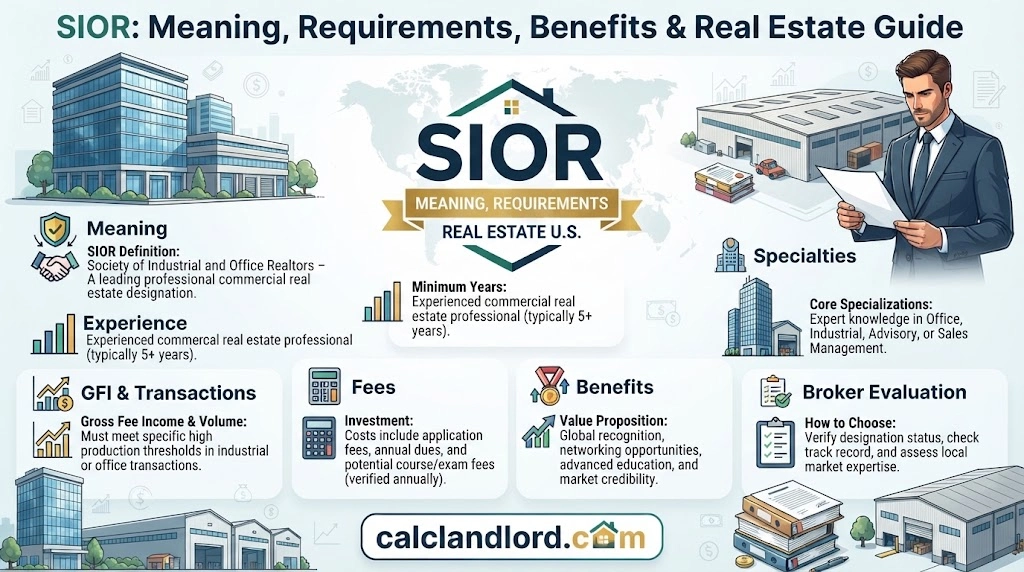
SIOR is designed for established commercial real estate professionals rather than people who are just beginning their careers.
For the standard U.S., Canada, and Mexico designation paths, SIOR currently states that applicants generally need at least five years of active engagement in commercial real estate as full-time practitioners. Production requirements also apply and are measured through GFI and transaction activity according to the applicable chapter and specialty.
The requirements can differ depending on:
- Specialty
- Geographic market
- Membership category
- Experience
- Production
- Chapter
- Applicant location
This is one reason it is risky to copy an old requirements article and assume its numbers are still current.
SIOR’s official application page instructs prospective applicants to review the requirements applicable to their designation path before applying.
What Are the SIOR Designation Requirements?
SIOR requirements generally cover several major areas.
| Requirement | What it generally involves |
| Experience | Established commercial real estate experience |
| Production | Demonstrated transaction and fee production |
| GFI | Gross Fee Income requirements |
| Transactions | Applicable transaction activity |
| Education | Required education depending on path |
| Ethics | SIOR ethical standards and applicable training |
| Endorsements | Required SIOR member endorsements for applicable paths |
| Chapter | Membership and chapter requirements |
| Application | Documentation and formal application process |
For North American applicants, SIOR currently describes five years of active commercial real estate experience as a general requirement for several designation paths. Production requirements are established by local chapters and vary by market.
SIOR’s current application process also requires applicants to review applicable production, education, ethics, and membership requirements before submitting an application.
Important:
Do not treat one SIOR requirement number as universal.
The correct requirement depends on the applicant’s specialty and market.
How Much Commercial Real Estate Experience Does SIOR Require?
For several North American SIOR designation paths, applicants generally need at least five years of active commercial real estate experience.
The experience requirement is intended to ensure that the designation is associated with established practitioners rather than entry-level professionals.
For example, a person who has recently obtained a real estate license may have excellent potential but generally would not immediately satisfy the standard five-year experience requirement.
SIOR also provides a Member Associate pathway for eligible professionals earlier in their careers.
The U.S./Canada/Mexico Member Associate pathway allows qualifying professionals to build toward the full designation while meeting specified experience, production, education, ethics, conference, and chapter requirements.
This creates an important distinction:
Real estate license → commercial experience → production → applicable SIOR requirements → designation
The exact path depends on the professional’s circumstances.
What Are the SIOR GFI and Transaction Requirements?
One of the most important concepts is Gross Fee Income, or GFI.
SIOR defines GFI as the amount of fee income directly attributable to the applicant that the applicant’s firm receives before internal splits.
For team-based professionals, SIOR’s current guidance says the GFI credited to the applicant should reflect their internal team split.
The current GFI document uses a trailing 48-month qualifying period and evaluates applicable production over four consecutive 12-month periods.
Why does GFI matter?
GFI helps SIOR evaluate professional production rather than relying solely on years of experience.
For example, two brokers could both have five years of experience, but their transaction activity and attributable fee production could be very different.
SIOR therefore uses production requirements as part of the qualification process.
Current North American GFI example
SIOR’s current published GFI schedule shows market thresholds that can vary by location. The published document also identifies different requirements for certain specialty and membership paths.
For one current example, the published 2025 threshold is $500,000, while previous qualifying periods in that document show lower thresholds. The exact requirement depends on the applicant’s market and path.
Because SIOR updates requirements, applicants should verify their exact GFI requirement directly with SIOR before applying.
What Education and Ethics Requirements Does SIOR Have?
SIOR does not rely solely on production.
Education and ethical standards are also part of the designation process.
The designation requirements include demonstrating applicable professional knowledge through education and agreeing to uphold SIOR’s ethical standards.
The current application process directs applicants to review education and ethics requirements applicable to their designation path.
This matters to property owners because a designation combines multiple dimensions of professional qualification rather than simply measuring the number of years someone has worked in real estate.
Education
Education Requirements can depend on the designation path.
Ethics
Applicants must agree to uphold SIOR’s Code of Ethical Principles and Standards of Professional Practice and complete applicable ethics requirements.
Endorsements
Applicable designation applicants may also need formal endorsements from SIOR members.
For North American industrial and office applicants, SIOR currently describes endorsement requirements involving Active Individual Members, with specific exceptions and conditions.
What Are the Different SIOR Specialties?
SIOR has several specialist categories.
| SIOR specialty | General focus |
| Industrial | Industrial transaction specialization |
| Office | Office transaction specialization |
| Industrial & Office Dual | Both industrial and office transactions |
| Advisory Services | Commercial real estate consulting/advisory work |
| Sales Management | Management of sales or leasing professionals |
| Executive Management | Senior management responsibilities |
NAR currently lists these six specialist categories as part of the designation structure.
Industrial Specialist
An industrial specialist may focus on properties such as:
- Warehouses
- Distribution centers
- Manufacturing facilities
- Logistics facilities
- Industrial investment properties
Office Specialist
An office specialist may work with:
- Office buildings
- Corporate facilities
- Medical office properties
- Office leasing
- Office sales
- Tenant representation
Industrial & Office Dual
A dual specialist works across both industrial and office property.
Advisory Services
An advisory specialist focuses on consulting or advisory services rather than necessarily being limited to traditional transaction brokerage.
Sales Management
This path focuses on management of sales or leasing professionals.
Executive Management
This category addresses higher-level management responsibilities within commercial real estate organizations.
How Much Does SIOR Membership Cost?
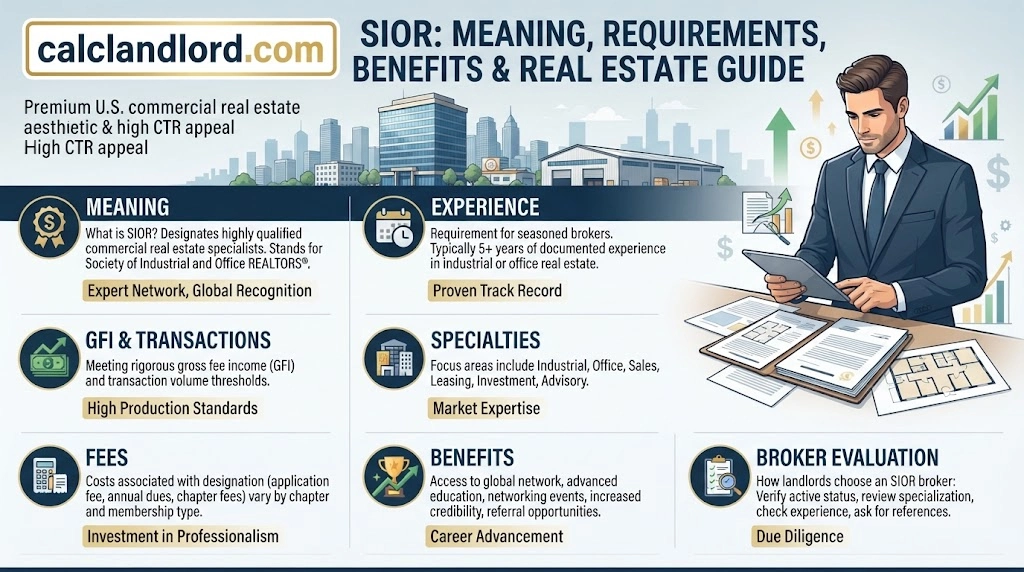
SIOR costs depend on the applicant’s membership type, geographic market, chapter, and applicable education or other fees.
For current U.S., Canada, and Mexico industrial or office specialist applicants, SIOR currently lists:
- $175 application fee
- $725 one-time initiation fee
- $1,518 annual dues, with first-year dues prorated
- Applicable chapter dues
- Additional applicable education or course costs
These figures are current SIOR-published amounts and can change, so prospective applicants should verify the latest schedule before applying.
There may also be other costs depending on the applicant’s path.
For example, SIOR’s published materials identify education-related expenses separately from the basic membership fees.
Why should landlords care about this?
They generally don’t need to pay SIOR membership costs themselves simply because they are hiring an SIOR broker.
Instead, the relevant question is whether the professional’s experience and expertise justify considering them for the assignment.
What Are the Benefits of the SIOR Designation?
The benefits can be considered from both the professional’s perspective and the client’s perspective.
Professional networking
SIOR provides a network of commercial real estate professionals that can facilitate relationships across markets.
Industry education
Members have access to educational opportunities, conferences, and professional development.
Commercial specialization
The designation is closely associated with industrial and office commercial real estate.
Professional recognition
The designation can distinguish a professional who has satisfied SIOR’s applicable qualification requirements.
Referral relationships
A network spanning multiple markets can be useful when transactions involve clients, properties, or opportunities across different geographic areas.
NAR identifies credibility, professional development, connectivity, and deal-generation opportunities among the benefits associated with SIOR membership.
However, these benefits should not be interpreted as a guarantee that every SIOR broker will deliver the same results in every market.
SIOR vs. CCIM vs. REALTOR®: What’s the Difference?
SIOR, CCIM, and REALTOR® are related to real estate but represent different things.
| Credential/organization | General emphasis |
| SIOR | Industrial and office commercial real estate specialists |
| CCIM | Commercial and investment real estate education and designation |
| REALTOR® | Membership in NAR and adherence to applicable REALTOR® standards |
| Real estate license | Legal authorization to practice real estate under applicable state law |
The SIOR vs. CCIM
SIOR is strongly associated with industrial and office commercial brokerage and related specialties.
CCIM is a separate commercial real estate designation with a strong emphasis on commercial investment analysis and related education.
A professional can hold both SIOR and CCIM.
Therefore, these credentials do not necessarily need to be treated as mutually exclusive.
SIOR vs. REALTOR®
A REALTOR® and an SIOR are not interchangeable terms.
REALTOR® refers to applicable membership in the National Association of REALTORS® and its professional standards.
SIOR identifies a specialized professional organization and designation focused on commercial real estate.
NAR lists SIOR among its affiliated organizations and identifies SIOR as a professional organization serving industrial and office real estate professionals.
How Should Landlords, Investors, and Property Owners Evaluate an SIOR Broker?
This is where SIOR becomes particularly relevant to CalcLandlord readers.
Suppose you own a commercial rental property and need to select a broker.
Don’t stop at:
“Does this broker have SIOR?”
Instead, build a broader evaluation.
1. Check property specialization
Does the broker regularly work with your property type?
For example:
- Warehouse
- Industrial building
- Office building
- Multifamily commercial investment
- Owner-user property
2. Check local market experience
Ask:
- How long have you worked in this market?
- Which submarkets do you cover?
- What comparable properties have you recently handled?
3. Review recent transactions
Recent comparable transactions can be more informative than general claims about experience.
Ask for examples involving:
- Similar property size
- Similar location
- Similar tenant profile
- Similar asset class
- Similar transaction value
4. Understand the assignment
Different assignments require different skills.
Selling a vacant industrial building is not the same as leasing an occupied office property.
5. Ask how the broker will market the property
A good evaluation should include the broker’s proposed process.
Ask about:
- Marketing channels
- Buyer or tenant outreach
- Comparable analysis
- Pricing strategy
- Negotiation process
- Reporting
- Timeline
6. Evaluate communication
Commercial property transactions can involve substantial financial consequences.
Ask how often the broker will communicate and what information will be provided.
7. Review fees and conflicts
Understand:
- Commission
- Other fees
- Agency relationship
- Potential conflicts
- Representation structure
- Explore More: https://calclandlord.com/commercial-construction-loans/
A practical broker-selection checklist
| Factor | Question |
| SIOR | Does the professional hold the designation? |
| Specialization | Does their specialty match the property? |
| Local market | Do they know the specific market? |
| Track record | What comparable deals have they completed? |
| Strategy | How will they approach the assignment? |
| Communication | How will progress be reported? |
| Fees | What will the total cost be? |
| References | Can they provide relevant references? |
| Analysis | Can they explain their pricing or valuation assumptions? |
SIOR itself has published guidance emphasizing the importance of carefully selecting a commercial real estate broker rather than relying solely on personal likeability or relationships.
How to Find the Right SIOR Professional for a Commercial Property
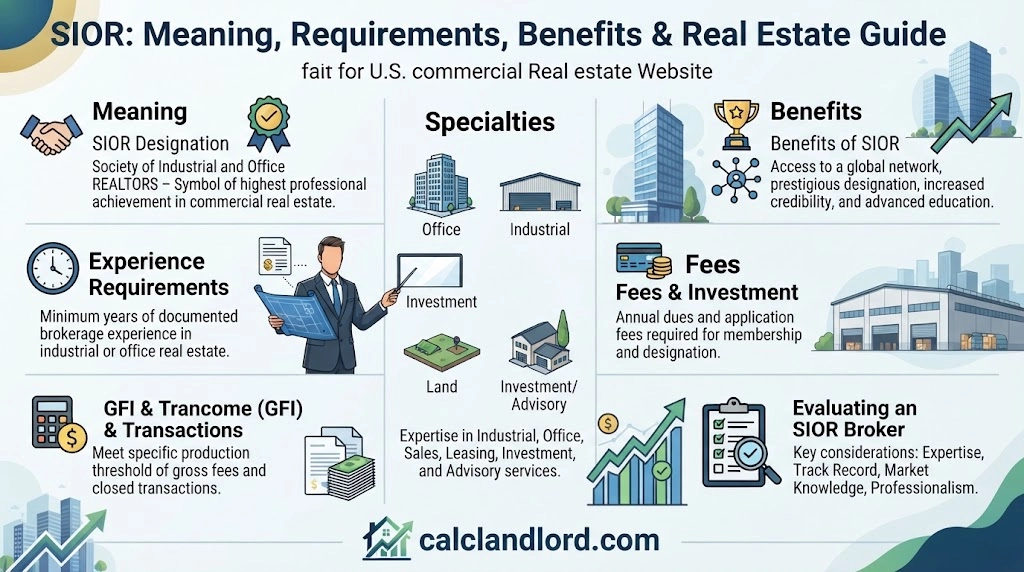
Finding an SIOR professional should begin with the property and assignment—not simply the credential.
Step 1: Define the property
Write down:
- Property type
- Location
- Size
- Occupancy
- Current rent
- Lease expiration
- Asking price, if applicable
- Investment objective
Step 2: Define the assignment
Are you trying to:
- Sell?
- Lease?
- Buy?
- Refinance?
- Find a tenant?
- Analyze an acquisition?
- Evaluate a disposition?
- Obtain market advice?
Step 3: Search for relevant SIOR professionals
Use SIOR’s official resources and chapter directories to identify professionals in the relevant market.
Step 4: Shortlist professionals by specialization
A landlord with an industrial warehouse should investigate industrial experience.
An office owner should investigate office-market experience.
Step 5: Compare actual transaction experience
Ask each candidate for relevant examples rather than accepting generic statements.
Step 6: Compare the proposed strategy
Look for a clear explanation of:
- Pricing
- Marketing
- Target buyers or tenants
- Timeline
- Negotiation
- Reporting
Step 7: Compare the economics
Review commissions, expected transaction costs, and the potential financial effect of the proposed strategy.
Step 8: Verify assumptions
If a broker provides a valuation or projected financial outcome, understand the assumptions behind the number.
This is where CalcLandlord’s investment-analysis resources can complement the broker’s market expertise.
People Also Ask
A: SIOR stands for Society of Industrial and Office REALTORS®.
A: SIOR refers to a professional commercial real estate organization and designation associated primarily with industrial and office real estate professionals.
A: An SIOR broker is a commercial real estate professional who has earned the SIOR designation.
A: It identifies the professional as an SIOR designee who has satisfied the applicable SIOR qualification and membership requirements.
A: For several North American designation paths, SIOR currently requires at least five years of active commercial real estate experience. Specific requirements depend on the designation path and market.
Final Takeaway
SIOR stands for Society of Industrial and Office REALTORS® and represents a professional designation associated with qualified commercial real estate practitioners, especially in industrial and office markets.
For professionals, earning the designation involves more than simply completing a course. Applicable paths can involve experience, production, GFI, transaction activity, education, ethics, endorsements, and chapter requirements.
For landlords and investors, the most useful way to interpret SIOR is as one professional qualification to consider when evaluating a commercial real estate broker.
It does not replace due diligence.
Before hiring a broker, compare:
- Property specialization
- Local market knowledge
- Recent comparable transactions
- Experience with similar assignments
- Proposed marketing strategy
- Communication process
- Fees
- Potential conflicts
- Financial assumptions
For a major commercial property decision, the strongest evaluation combines the professional’s credentials with evidence of relevant experience and a clear understanding of your property’s specific circumstances.
Use SIOR as one part of the evaluation—not the entire evaluation.
