
Commercial Real Estate Marketing Plan: The Complete 2026 Guide
A Commercial Real Estate Marketing Plan is a structured roadmap for promoting a commercial property, reaching qualified tenants or buyers, generating inquiries, nurturing prospects, and converting marketing activity into measurable leasing or sales opportunities.
Unlike residential real estate, commercial real estate decisions can involve multiple stakeholders, longer transaction cycles, detailed financial analysis, specialized property requirements, brokers, investors, tenants, and business owners.
That means posting a listing and waiting for inquiries is rarely enough.
A strong commercial real estate marketing plan connects:
Property → Audience → Positioning → Assets → Channels → Leads → Follow-up → Measurement
This guide explains how to build that system, choose marketing channels, create a budget, market different property types, track KPIs, and execute a practical 30-60-90 day campaign.
What Is a Commercial Real Estate Marketing Plan?
A commercial real estate marketing plan is a documented strategy that explains what property or service is being marketed, who should see it, what message will be used, where the message will appear, how much will be spent, and how results will be measured.
The objective might be to:
- Lease vacant office space
- Find tenants for retail property
- Market an industrial building
- Sell an investment property
- Attract owner-user buyers
- Generate investor inquiries
- Reduce property vacancy
- Promote a development
- Attract qualified commercial tenants
- Build a brokerage’s pipeline
- Generate property tours
- Increase qualified leads
The key is to start with the business objective, not with a list of social media platforms.
For example, if the goal is to lease 25,000 square feet of industrial space, the campaign should be designed around finding businesses that actually need that type of space.
A generic campaign might generate visibility.
A properly targeted campaign is designed to generate relevant commercial opportunities.
Why Commercial Real Estate Marketing Requires a Different Strategy
Commercial real estate marketing is different because the person seeing the advertisement is not always the person making the final decision.
A property may need to appeal to:
- Tenants
- Business owners
- Investors
- Developers
- Property owners
- Asset managers
- Brokers
- Corporate decision-makers
- Franchise operators
- Property managers
Each audience can evaluate the same property differently.
For example, an industrial tenant may care about:
- Clear height
- Loading docks
- Truck access
- Yard space
- Building size
- Parking
- Power
- Zoning
- Transportation access
- Lease economics
An investor may instead focus on:
- NOI
- Cap rate
- Occupancy
- Lease rollover
- Tenant quality
- Operating expenses
- Market rent
- Capital expenditures
- Comparable properties
- Potential future income
Therefore, one property can require multiple messages.
The three-audience framework
A useful starting point is to separate prospects into three broad groups.
Occupiers:
Businesses looking for space that works operationally.
Investors and buyers:
People evaluating the property’s financial and strategic characteristics.
Brokers and referral partners:
Professionals who can distribute the opportunity to their own networks.
Your marketing should make it easy for each audience to find the information relevant to its decision.
What Should a Commercial Real Estate Marketing Plan Include?
A complete CRE marketing plan should normally include eight major components.
| Component | Main Question |
| Objective | What outcome are we trying to achieve? |
| Market research | What is happening in the local market? |
| Audience | Who can realistically transact? |
| Positioning | Why should they consider this property? |
| Assets | What information do prospects need? |
| Channels | Where will qualified prospects be reached? |
| Budget | How much should each activity receive? |
| Measurement | How will results be evaluated? |
1. Objective
Define a measurable commercial objective.
Instead of:
Increase exposure.
Use:
Generate 20 qualified tenant inquiries within 60 days.
The second goal provides a basis for evaluating performance.
2. Market research
Study:
- Competing properties
- Asking rents
- Sale prices
- Vacancy
- Available inventory
- Recent transactions
- New developments
- Transportation
- Local business activity
- Tenant demand
- Buyer demand
3. Target audience
Identify the businesses, investors, or organizations most likely to transact.
4. Positioning
Explain why the property deserves attention using specific and verifiable characteristics.
5. Marketing assets
Prepare the information prospects need.
Examples include:
- Property website
- Brochure
- Offering memorandum
- Photography
- Floor plans
- Site plans
- Maps
- Video
- Virtual tours
- Fact sheets
- Market data
6. Distribution
Select channels based on the audience and property.
7. Budget
Allocate spending according to campaign priorities rather than automatically dividing money equally.
8. Measurement
Track the journey from visibility to actual commercial opportunity:
Impression → Visit → Inquiry → Qualified Lead → Tour → Proposal → Negotiation → Lease/Sale
This final stage is important because a campaign can generate substantial traffic without generating meaningful business.
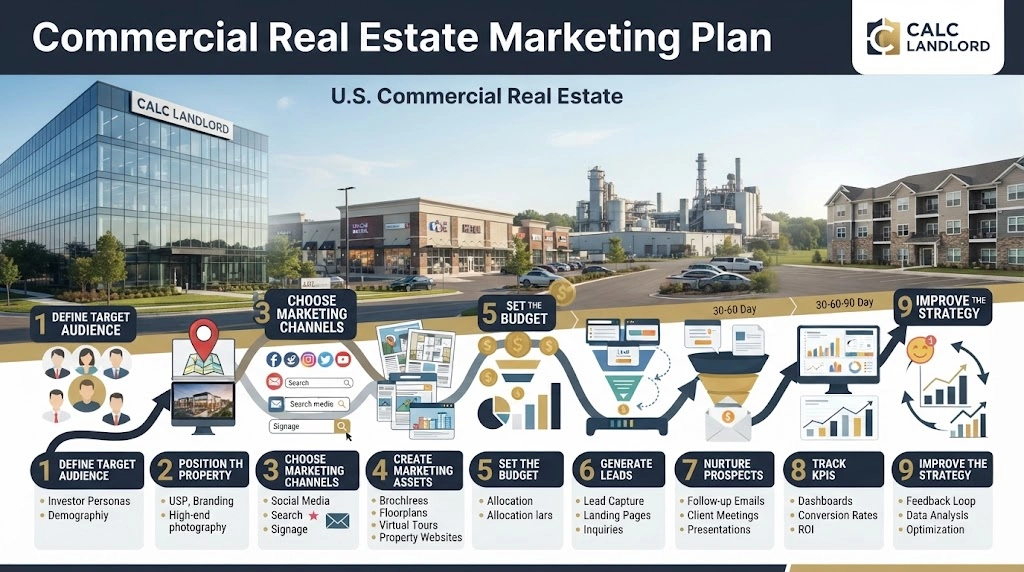
How to Create a Commercial Real Estate Marketing Plan Step by Step
Step 1: Define the property and objective
Create a one-page campaign brief.
Include:
- Property name
- Address
- Property type
- Available space
- Transaction type
- Target market
- Target audience
- Campaign start date
- Target transaction date
- Primary conversion
- Budget
For example:
Property: 40,000-square-foot industrial facility
Objective: Lease vacant space
Audience: Logistics and distribution companies
Primary conversion: Qualified tour request
Campaign period: 90 days
This gives the campaign a measurable foundation.
Step 2: Analyze competitors
Create a comparison table.
| Factor | Your Property | Competitor A | Competitor B |
| Location | |||
| Available Space | |||
| Asking Rent | |||
| Parking | |||
| Access | |||
| Amenities | |||
| Condition | |||
| Target User | |||
| Differentiator |
The goal isn’t to copy competitors.
The goal is to identify what the market already communicates and where your property has a credible point of differentiation.
Step 3: Define the target audience
Avoid defining the audience simply as:
Businesses.
Instead ask:
- What industry?
- What company size?
- What geographic area?
- What space requirement?
- What budget?
- What operational needs?
- Who makes the decision?
- What problem are they trying to solve?
The more specific the audience, the easier it becomes to choose appropriate channels and messaging.
Step 4: Create the positioning
Use a simple formula:
For [audience], [property] provides [benefit] because [evidence].
Example:
For regional distribution companies, this industrial property provides flexible warehouse capacity with existing loading infrastructure and convenient transportation access.
The important word is evidence.
Avoid unsupported phrases such as:
- Best location
- Amazing opportunity
- Unbeatable property
- Perfect investment
- Incredible value
Unless the claim can actually be demonstrated, specific facts are more useful.
Step 5: Build the marketing assets
Before promoting the property heavily, prepare the information prospects need.
At minimum, consider:
- Property description
- Professional photographs
- Floor plans
- Site plan
- Property specifications
- Location map
- Contact information
- Inquiry form
- Property landing page
For an investment sale, add appropriate financial and market information.
Step 6: Select channels
Divide channels into:
Primary:
Highest expected relevance to the target audience.
Secondary:
Supporting visibility and credibility.
Experimental:
Channels being tested with a defined hypothesis.
This approach prevents a marketing budget from being spread across every possible platform.
Step 7: Build the lead-follow-up system
Marketing doesn’t end when someone submits a form.
Create a process for:
- Capturing the lead
- Recording the source
- Qualifying the prospect
- Responding
- Scheduling a call or tour
- Sending relevant information
- Tracking the opportunity
- Updating the CRM
- Measuring the eventual outcome
Step 8: Measure and optimize
Review performance regularly.
If traffic is high but inquiries are low, investigate the property page and offer.
When inquiries are high but qualification is poor, investigate targeting.
If tours occur but proposals do not, investigate property fit, pricing, presentation, or qualification.
The goal is not simply to produce more activity.
The goal is to improve the quality and progression of commercial opportunities.
- Explore More: https://calclandlord.com/ccim-designation/
How to Define Your CRE Target Audience and Positioning
Audience segmentation is one of the most important parts of a commercial real estate marketing plan.
Office
Potential audiences include:
- Professional services
- Technology companies
- Financial firms
- Healthcare businesses
- Corporate users
- Startups
Potential decision factors include:
- Location
- Transportation
- Parking
- Floor efficiency
- Amenities
- Building quality
- Employee experience
- Flexible space
Retail
Potential audiences include:
- Restaurants
- Retailers
- Medical users
- Service businesses
- Franchise operators
- Local entrepreneurs
Important factors can include:
- Visibility
- Traffic
- Access
- Parking
- Signage
- Trade area
- Nearby businesses
- Tenant mix
Industrial
Potential audiences include:
- Manufacturers
- Logistics companies
- Distributors
- E-commerce companies
- Contractors
- Warehouse users
Relevant specifications can include:
- Clear height
- Loading
- Dock configuration
- Yard
- Truck circulation
- Power
- Zoning
- Transportation access
Investment property
Investor messaging can emphasize information such as:
- NOI
- Occupancy
- Lease terms
- Tenant concentration
- Operating expenses
- Rent profile
- Capital expenditures
- Comparable properties
- Market conditions
The central principle is:
Market the property around the decision criteria of the intended audience.
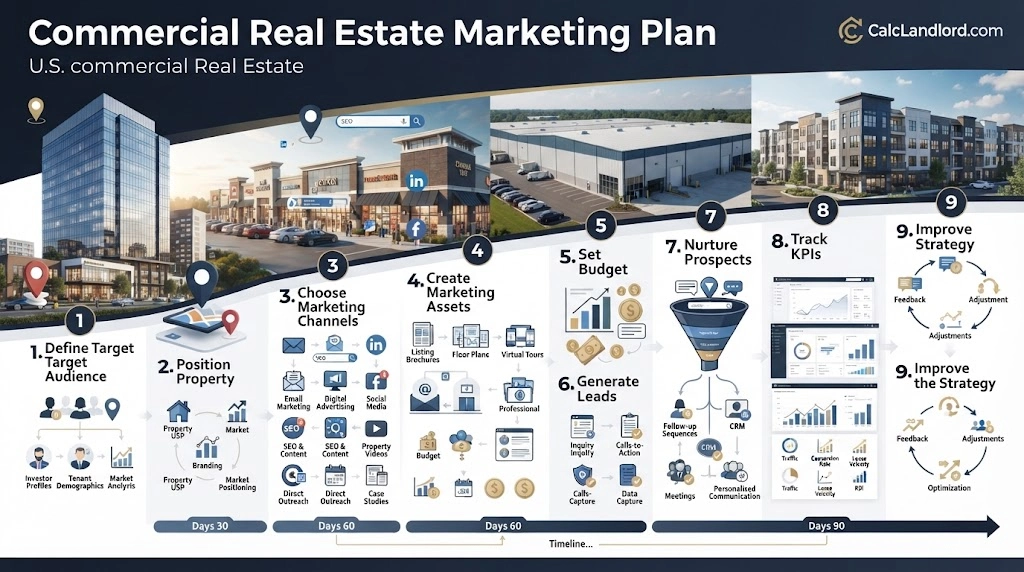
Which Marketing Channels Work for Commercial Real Estate?
There is no universal best channel for every CRE campaign.
The appropriate mix depends on the property, audience, market, budget, and transaction objective.
Commercial property listing platforms
Listing services can place properties in front of people already searching for commercial space or investment opportunities.
A strong listing should contain:
- Accurate specifications
- Current availability
- Professional images
- Clear description
- Floor plans
- Maps
- Contact details
- Relevant property information
Commercial real estate SEO
SEO can capture people researching properties, markets, brokers, and commercial real estate opportunities.
Potential content includes:
- Office space for lease in [market]
- Industrial property for sale in [market]
- Retail space for lease in [market]
- Warehouse space in [market]
- Commercial property investment in [market]
- Local commercial market reports
- Neighborhood development guides
- Commercial property investment guides
SEO should support both transactional pages and useful educational content.
Property websites
A dedicated property page can act as the campaign’s central information hub.
It may include:
- Property overview
- Images
- Video
- Floor plans
- Site plans
- Maps
- Specifications
- Downloadable documents
- Inquiry form
- Tour request
- Contact details
Email marketing
Segment email audiences instead of sending every property to everyone.
For example, an industrial property should primarily reach contacts with industrial requirements.
LinkedIn can support:
- Property announcements
- Market insights
- Development updates
- Deal announcements
- Property videos
- Leasing milestones
- Local market reports
Google Ads
Paid search can capture high-intent searches such as:
- Commercial space for lease
- Warehouse for lease
- Office space for lease
- Retail space for lease
- Commercial property for sale
The landing page should closely match the searcher’s intent.
Social media
Useful formats include:
- Property photography
- Short videos
- Market updates
- Development progress
- Neighborhood content
- Broker insights
- New listings
Video and virtual tours
Video can show:
- Layout
- Building condition
- Access
- Amenities
- Surrounding area
- Development progress
Virtual tours can be particularly useful for large properties or prospects located outside the immediate market.
Direct outreach and networking
Commercial real estate remains relationship-driven.
Possible activities include:
- Broker outreach
- Industry events
- Local business groups
- Investor events
- Property tours
- Direct calls
- Targeted mail
- Referral relationships
The strongest campaign often combines digital discovery with professional relationships.
How to Market Different Types of Commercial Properties
A commercial real estate marketing plan should change according to the asset.
| Property Type | Key Marketing Focus |
| Office | Location, accessibility, amenities, employee experience |
| Retail | Visibility, traffic, parking, demographics, tenant mix |
| Industrial | Loading, clear height, access, yard, logistics |
| Multifamily | Occupancy, unit mix, rents, condition, investment data |
| Land | Zoning, acreage, utilities, access, development potential |
| Medical Office | Accessibility, parking, patient convenience, infrastructure |
| Mixed-Use | Tenant mix, location, uses, amenities, development context |
Office marketing
The central question is:
Why would this space work for this organization?
Don’t focus only on beautiful photography.
Explain the practical business advantages.
Retail marketing
Retail prospects often need to understand the commercial environment around the property, not just the building itself.
Include relevant information about:
- Visibility
- Access
- Parking
- Nearby businesses
- Trade area
- Signage
- Tenant mix
Industrial marketing
Technical specifications often matter more than lifestyle-oriented imagery.
Clearly present:
- Square footage
- Clear height
- Loading
- Dock configuration
- Yard
- Power
- Parking
- Zoning
- Transportation access
Multifamily marketing
Investor-facing campaigns should combine property presentation with appropriate operating and financial information.
Commercial land marketing
Land buyers need answers to questions such as:
- How large is the site?
- What is the zoning?
- What uses are permitted?
- Are utilities available?
- How is the site accessed?
- What development may be possible?
- What studies or plans are available?
How to Build a Commercial Real Estate Marketing Package
A marketing package should make the property understandable before a prospect needs to contact the broker.
PropertyMetrics also emphasizes creating a distinctive, property-specific marketing package rather than relying on generic materials.
Core marketing package
Consider including:
- Cover page
- Property overview
- Key property facts
- High-quality photography
- Location information
- Maps
- Site plan
- Floor plans
- Market information
- Financial information when relevant
- Investment highlights
- Contact information
The property story
A strong package should answer:
What is the property?
Who is it for?
Why does it matter?
What evidence supports the positioning?
What should the prospect do next?
Avoid turning the package into a collection of generic adjectives.
Specific information usually provides more decision value.
How to Create a Commercial Real Estate Marketing Budget
There is no universal CRE marketing budget that applies to every property.
Costs can depend on:
- Property type
- Property size
- Market
- Transaction value
- Campaign duration
- Existing assets
- Photography requirements
- Video requirements
- Paid advertising
- Listing costs
- Agency resources
Instead of selecting an arbitrary percentage, build the budget by activity.
| Budget Category | Example Expense |
| Photography | Property photography |
| Video | Walkthrough or promotional video |
| Design | Flyer, brochure, OM |
| Website | Property landing page |
| Listings | Listing platform costs |
| Advertising | Search, social, display |
| Production/software | |
| Brochures, signage, direct mail | |
| Events | Tours and networking |
| Analytics | Tracking/reporting |
| Testing | Experimental campaigns |
| Contingency | Unexpected requirements |
How to prioritize the budget
Start with the objective.
If the property requires high-quality presentation, allocate enough resources to photography, plans, website presentation, and core materials.
When the audience is highly searchable, paid search and SEO may deserve greater attention.
If broker relationships are particularly important, allocate time and resources to broker outreach and events.
The budget should follow the commercial strategy, not the other way around.
Commercial Real Estate Marketing Plan for Leasing
A leasing campaign should move prospects through a defined funnel:
Awareness → Inquiry → Qualification → Tour → Proposal → Negotiation → Lease
Before launch, establish:
- Available space
- Asking rent
- Lease structure
- Availability date
- Tenant requirements
- Improvements
- Concessions, where applicable
- Target tenant profile
Leasing marketing assets
Consider:
- Property landing page
- Floor plan
- Site plan
- Photos
- Video
- Property brochure
- Listing
- Email campaign
- Broker outreach
- Signage
Leasing KPIs
Track:
- Listing views
- Website visits
- Inquiries
- Calls
- Qualified leads
- Tour requests
- Completed tours
- Proposals
- Negotiations
- Signed leases
- Cost per qualified lead
The key is to identify where prospects are dropping out.
For example:
High views + low inquiries:
Review the listing, positioning, CTA, price presentation, or property fit.
High inquiries + low tours:
Review lead qualification and follow-up.
Over tours + low proposals:
Investigate pricing, property condition, tenant requirements, or qualification.
Commercial Real Estate Marketing Plan for Selling and Investment
A sales campaign should give buyers enough information to determine whether the opportunity deserves deeper evaluation.
A commercial investment marketing package may include:
- Executive summary
- Property overview
- Location analysis
- Financial information
- Tenant information where appropriate
- Property photographs
- Site plan
- Floor plans
- Market information
- Investment highlights
- Offering memorandum
- Contact information
Investor audiences may evaluate:
- NOI
- Cap rate
- Occupancy
- Lease terms
- Tenant concentration
- Operating expenses
- Capital expenditures
- Rent growth
- Comparable properties
- Market conditions
- Exit considerations
Separate facts from projections
This is particularly important in investment marketing.
Clearly distinguish between:
Verified information
and
Assumptions, projections, estimates, or scenarios.
A marketing document should not present uncertain future outcomes as guaranteed results.
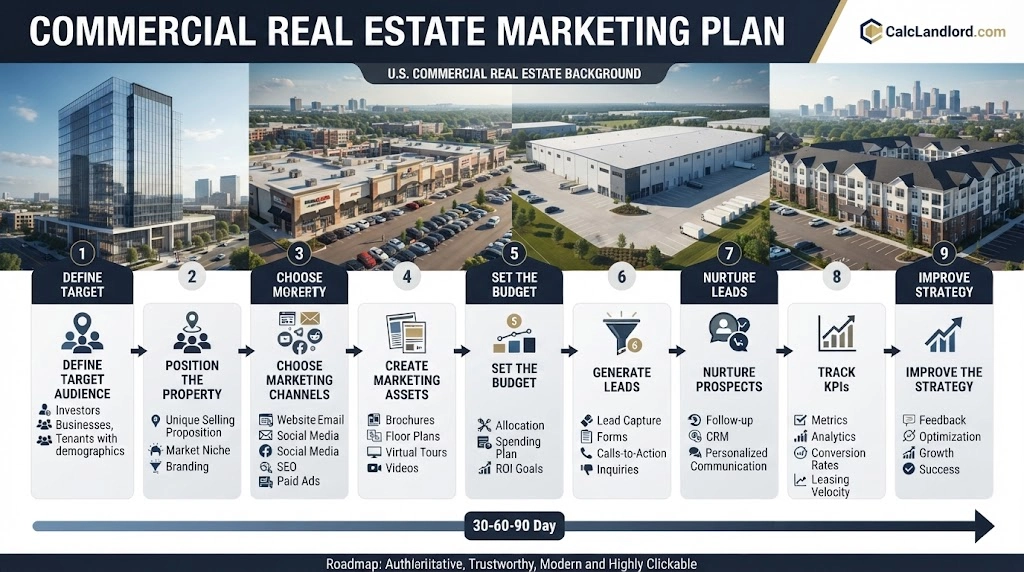
30-60-90 Day Commercial Real Estate Marketing Plan
A 90-day framework turns the strategy into an execution schedule.
Days 1-30: Research, preparation and launch
Week 1
- Define the objective
- Research competitors
- Define target audiences
- Collect property information
- Confirm facts
- Develop positioning
- Establish KPIs
Week 2
Create:
- Photography
- Property description
- Floor plans
- Site plan
- Brochure
- Offering memorandum
- Landing page
- Email creative
- Social creative
- Video
Week 3
Launch:
- Property page
- Listing distribution
- Targeted email
- Broker outreach
- Selected paid campaigns
- Social content
- Lead tracking
Week 4
Review:
- Traffic
- Inquiries
- Lead quality
- Calls
- Tours
- Advertising performance
- Email engagement
- Broker activity
Then fix the weakest part of the funnel.
Days 31-60: Optimize
During the second month:
- Refresh weak creative
- Expand successful audience segments
- Test new messaging
- Publish supporting content
- Increase broker outreach where appropriate
- Test additional advertising
- Publish additional video
- Review inquiry quality
- Update property information
The objective is to discover which activities are producing qualified opportunities.
Days 61-90: Scale and document
Review:
- Lead sources
- Channel performance
- Tour-to-proposal conversion
- Proposal-to-transaction progression
- Cost per qualified lead
- Campaign budget allocation
- Stale listing content
Then document the lessons.
The result should be a repeatable CRE marketing playbook, not simply a one-time campaign report.
Commercial Real Estate Marketing KPIs and Measurement
A useful KPI system should measure the entire funnel.
Awareness KPIs
- Impressions
- Reach
- Website traffic
- Listing views
- Video views
Engagement KPIs
- Time on page
- Email Clicks
- Content engagement
- Document downloads
- Video engagement
Lead KPIs
- Inquiries
- Calls
- Form submissions
- Qualified leads
- Cost per lead
Transaction KPIs
- Tours
- Proposals
- Negotiations
- Signed leases
- Closed sales
- Pipeline value
Efficiency KPIs
- Cost per qualified lead
- Cost per tour
- Cost per opportunity
- Channel conversion rate
- Marketing contribution
Don’t optimize only for impressions
Suppose Campaign A generates:
10,000 impressions → 20 inquiries → 2 qualified leads
Campaign B generates:
2,500 impressions → 10 inquiries → 5 qualified leads
The second campaign generates fewer impressions but more qualified opportunities.
That is why commercial real estate marketing should connect visibility metrics to actual pipeline progression.
Common Commercial Real Estate Marketing Mistakes
1. Marketing to everyone
A generic audience usually produces generic messaging.
2. Using vague descriptions
“Prime location” isn’t enough.
Explain what makes the location valuable.
3. Choosing channels before defining the audience
Start with the prospect, not the platform.
4. Depending on one listing platform
Listing services can be valuable, but they should normally be part of a broader campaign.
5. Ignoring owned channels
A dedicated property page gives the campaign a destination that the brokerage controls.
6. Using weak photography
Poor presentation can undermine confidence before prospects read the description.
7. Ignoring mobile users
Property pages, documents, forms and contact options should be usable on mobile devices.
8. Measuring vanity metrics only
Traffic is useful, but qualified leads and transaction progression provide stronger commercial signals.
9. Slow lead follow-up
Demand can be lost after the marketing has already generated it.
10. Failing to update information
Availability, pricing, specifications and property conditions can change.
Outdated marketing creates confusion and can damage credibility.
11. Creating too many disconnected tools
SharpLaunch specifically highlights the problem of disconnected CRE technology and data silos.
Your technology stack should support a coherent workflow rather than create additional administrative work.
Commercial Real Estate Marketing Plan Template and FAQs
Copy-and-use CRE marketing plan template
PROPERTY:
[Property name/address]
OBJECTIVE:
[Lease / Sale / Investment / Lead Generation]
PROPERTY TYPE:
[Office / Retail / Industrial / Multifamily / Land / Other]
MARKET:
[City / Submarket]
TARGET AUDIENCE:
[Primary prospect group]
POSITIONING:
[Why should this audience consider the property?]
KEY PROOF POINTS:
- [Proof point]
- [Proof point]
- [Proof point]
PRIMARY CHANNELS:
[Channels]
SECONDARY CHANNELS:
[Channels]
MARKETING ASSETS:
- Photography
- Property page
- Brochure
- Offering memorandum
- Floor plan
- Site plan
- Video
- Social content
- Signage
BUDGET:
[Amount]
LAUNCH DATE:
[Date]
30-DAY GOAL:
[Goal]
60-DAY GOAL:
[Goal]
90-DAY GOAL:
[Goal]
PRIMARY KPIs:
- Qualified leads
- Tours
- Proposals
- Negotiations
- Leases
- Sales
REPORTING FREQUENCY:
[Weekly / Biweekly / Monthly]
People Also Ask
A: The most important foundation is alignment between the business objective, target audience, property positioning, distribution channels, and measurement system.
A beautiful marketing campaign is not necessarily effective if it reaches the wrong audience.
A: Start by defining the transaction objective and target audience. Then develop property positioning, create the required assets, distribute the listing through relevant digital and offline channels, follow up with prospects, and measure progression toward tours, proposals, leases, or sales.
A: There is no universal channel mix. Common options include commercial listing platforms, SEO, property websites, email, LinkedIn, paid search, social media, video, direct outreach, broker networks, events and signage.
The appropriate combination depends on the property and audience.
A: There is no single universal amount. Costs depend on the property, market, transaction objective, campaign length, required creative assets, listing costs, advertising and available internal resources.
Build the budget around specific activities and objectives rather than assuming one percentage applies to every campaign.
A: The appropriate duration depends on the property, market and transaction. A 30-60-90 day framework is useful for organizing execution and optimization, but it should not be treated as a guarantee that every commercial property will transact within 90 days.
Final Takeaways
A strong Commercial Real Estate Marketing Plan is more than a list of advertising channels.
It is an operating system for turning a property and its value proposition into qualified commercial opportunities.
The process can be summarized as:
1. Define the objective.
Know what transaction or business outcome you’re pursuing.
2. Research the market.
Understand competing properties, pricing, supply, demand and local conditions.
3. Define the audience.
Identify the businesses, investors or decision-makers who actually matter.
4. Position the property.
Lead with specific, verifiable differentiators.
5. Build the assets.
Prepare photography, plans, property pages, brochures and other necessary information.
6. Choose channels deliberately.
Match distribution to the audience instead of automatically using every platform.
7. Build the follow-up process.
Move inquiries into qualification, tours, proposals and negotiations.
8. Measure the funnel.
Connect marketing activity to meaningful commercial outcomes.
9. Optimize continuously.
Improve the stage where prospects are being lost.
10. Document the playbook.
Turn successful processes into a repeatable system for future properties.
For CalcLandlord, this topic can also become part of a broader real-estate content cluster covering property analysis, rental-property finance, investment returns, cash flow, and landlord decision-making. Because no verified CalcLandlord internal URLs were surfaced in the research, specific internal links should be added only after confirming the actual site pages.
