
Ground Lease Guide: Terms, Costs, Risks & Investor Insights
A Ground Lease is a long-term real estate agreement in which a tenant leases land from a landowner and typically develops, operates, or improves the property during the lease term. The landowner retains ownership of the land, while the tenant receives a leasehold interest and may own or control the improvements for the period specified in the agreement.
For real estate investors, developers, landlords, and property owners, a ground lease can create an opportunity to control a valuable site without purchasing the underlying land. However, it also introduces important questions about ground rent, financing, lease expiration, property improvements, operating expenses, and long-term investment value.
Current commercial real-estate sources commonly describe ground leases as long-term arrangements in which tenants develop or operate improvements on land they do not own.
This guide explains how a ground lease works, who owns the land and building, how ground rent affects the numbers, how financing works, what happens at expiration, and how investors can evaluate the risks before committing capital.
What Is a Ground Lease and How Does It Work?
A ground lease separates ownership of the land from the right to use and develop that land.
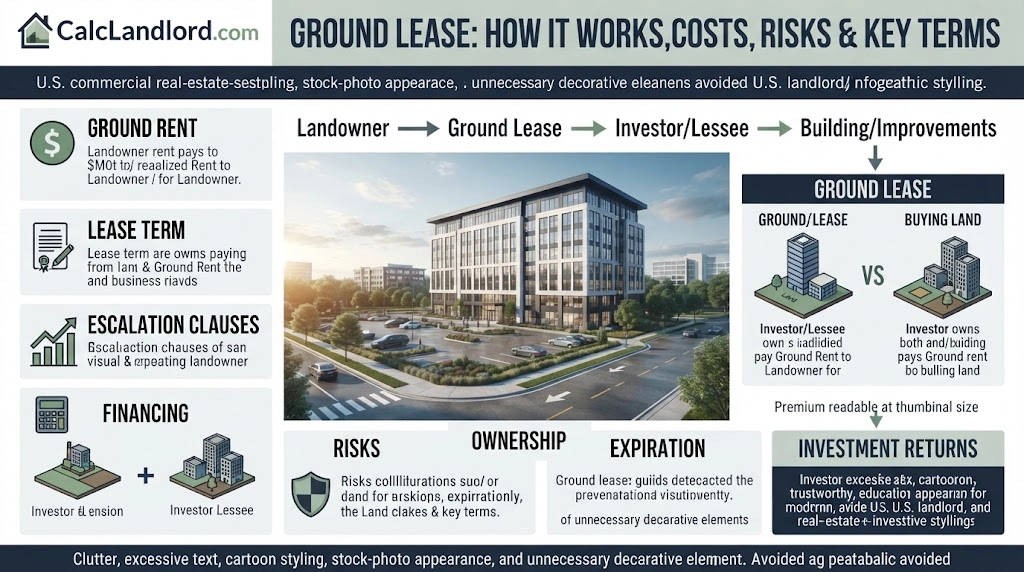
The basic structure is:
Landowner → owns the land
Tenant → leases the land
Tenant → may develop or operate improvements
Lease → controls rights and obligations
Expiration → contract determines what happens next
Unlike a typical commercial lease where a tenant rents an existing building, a ground lease primarily concerns the underlying land. The tenant may construct a building or other improvements and operate the property during the lease term.
The tenant therefore holds a leasehold interest, rather than fee-simple ownership of the land.
For example, imagine a developer wants to build a $4 million retail property on a parcel worth $2 million. Instead of spending $2 million to buy the land, the developer could negotiate a long-term ground lease and use its available capital for construction and other project costs.
The arrangement may provide the developer with access to the location while allowing the landowner to retain ownership and receive ground rent.
However, the exact rights are determined by the lease. A ground lease should never be evaluated from the label alone.
Important provisions include:
- Lease duration
- Ground rent
- Rent escalation
- Permitted use
- Construction rights
- Maintenance
- Property taxes
- Insurance
- Assignment
- Subleasing
- Financing
- Default
- Renewal
- Expiration
- Improvement ownership
- Reversion
Who Owns the Land and Building in a Ground Lease?
The landowner generally retains ownership of the underlying land.
The tenant may own, control, or be responsible for the building and other improvements during the lease term, depending on the agreement.
That distinction is fundamental.
Consider a hypothetical property:
- Land value: $1,500,000
- Building value: $3,500,000
- Ground lease term: 60 years
- Tenant: Developer
- Landowner: Fee owner
The developer does not own the $1.5 million parcel simply because it constructed the $3.5 million building.
Instead, it holds a contractual leasehold interest in the land and rights concerning the improvements.
At expiration, the treatment of the building depends on the lease. Improvements may transfer to the landowner, be removed, or be subject to renewal, purchase, or another contractual arrangement.
This makes the end-of-term provisions especially important.
Fee Simple vs. Leasehold
Fee simple ownership generally means the owner owns the property interest without a fixed lease expiration.
Leasehold ownership means the tenant’s rights exist for the period established by the lease.
That difference affects:
- resale value;
- financing;
- control;
- long-term planning;
- inheritance;
- redevelopment;
- exit strategy.
An investor should therefore determine exactly what interest is being purchased before analyzing the property’s financial returns.
How Long Does a Ground Lease Usually Last?
Ground leases are typically long-term arrangements because tenants may need decades to recover development costs and generate a return on improvements.
NAR describes ground leases as arrangements that can extend for many decades, including terms of up to 99 years.
However, there is no universal ground-lease term.
A lease could be structured for:
- 20 years;
- 30 years;
- 50 years;
- 60 years;
- 75 years;
- 99 years;
- another negotiated period.
The remaining term is often more important to an investor than the original term.
A property with 70 years remaining is economically different from a similar property with 12 years remaining.
Why?
Because the tenant’s rights have a limited life.
As the expiration date approaches, investors and lenders may become increasingly concerned about:
- refinancing;
- resale;
- renewal;
- improvement value;
- lender collateral;
- future rent;
- exit value.
For example, Freddie Mac’s 2026 multifamily ground-lease guidance includes specific remaining-term requirements relative to mortgage maturity, demonstrating that lenders can place substantial importance on the relationship between lease duration and loan duration.
Never assume that a long original lease automatically means a property is financeable today.
Always calculate the remaining term.
What Is Ground Rent and How Is It Calculated?
Ground Rent is the rent a tenant pays the landowner for the right to use the leased land.
A simple annual ground-rent calculation is:
Annual Ground Rent = Monthly Ground Rent × 12
For example, if the tenant pays $8,000 per month:
$8,000 × 12 = $96,000 annual ground rent
But the initial amount is only part of the analysis.
Ground leases can include rent escalation provisions that increase payments over time. These may use fixed increases, an index such as the Consumer Price Index, or negotiated market-based adjustments depending on the agreement.
Example of Fixed Rent Escalation
Suppose:
- Starting annual ground rent = $100,000
- Annual increase = 2%
- Initial term = 10 years
The rent in later years will be materially higher than the starting amount.
The investor should therefore model total ground rent, not just year-one rent.
A simplified future-rent formula is:
Future Rent = Initial Rent × (1 + Escalation Rate)^n
where:
- Initial Rent = starting annual rent
- Escalation Rate = annual increase
- n = number of years
This is only a simplified model. Actual leases can contain different escalation mechanisms, reset dates, floors, caps, or appraisal provisions.
Why Ground Rent Matters to Investors
Ground rent is effectively a long-term operating obligation.
Higher ground rent can reduce:
- net operating income;
- cash flow;
- debt-service coverage;
- property value;
- investor returns.
When comparing two properties, don’t compare purchase prices alone.
Compare the complete economic structure.
What Are the Main Types of Ground Leases?
Ground leases can be structured in different ways, but two important categories concern the relationship between the landowner’s interest and the tenant’s lender.
Subordinated Ground Lease
In a subordinated ground lease, the landowner may agree to subordinate its fee interest to the tenant’s lender.
That can give the lender stronger collateral rights and potentially make financing easier for the tenant.
However, it increases the landowner’s risk.
If the tenant defaults, the lender may have rights that affect the underlying land depending on the mortgage and lease documents.
Unsubordinated Ground Lease
In an unsubordinated ground lease, the landowner generally retains priority over the tenant’s financing with respect to the fee interest.
This can provide greater protection to the landowner.
However, the tenant may face more complicated financing because the lender’s collateral is primarily the tenant’s leasehold interest and improvements.
Current commercial sources identify this financing-versus-landowner-protection trade-off as a central distinction between the two structures.
Other characteristics can also distinguish ground leases, including:
- fixed vs. variable rent;
- short vs. long remaining term;
- renewal vs. no renewal;
- development vs. existing improvements;
- purchase options;
- different reversion provisions.
The actual contract controls.
Subordinated vs. Unsubordinated Ground Lease: What’s the Difference?
The simplest way to understand the distinction is to ask:
What happens to the landowner’s position if the tenant’s lender has to enforce its loan?
| Feature | Subordinated | Unsubordinated |
| Landowner’s fee interest | May be subordinate to lender | Generally retains priority |
| Lender collateral | Potentially includes land | Primarily leasehold/improvements |
| Tenant financing | May be easier | Can be more difficult |
| Landowner risk | Higher | Generally lower |
| Negotiation complexity | High | High |
| Importance of lender protections | Very high | Very high |
This is not a universal outcome for every transaction. The actual lease, mortgage, lender requirements, title documents, and applicable law determine the parties’ rights.
For example, Freddie Mac’s current multifamily guidance expressly distinguishes requirements based on whether the ground lessor joins in the mortgage and whether the ground lease is subordinated.
What Should a Landlord Ask?
A landowner should understand:
- Is the fee interest being pledged?
- What happens after tenant default?
- What lender cure rights exist?
- Can the lender replace the tenant?
- Can the lender obtain a new lease?
- What happens in bankruptcy?
- What happens after foreclosure?
What Should a Tenant Ask?
A tenant should understand:
- Will lenders accept the lease?
- Can the leasehold be mortgaged?
- Does the lender receive notice of default?
- Does the lender receive cure rights?
- What happens if the landlord terminates the lease?
- Is there a non-disturbance arrangement?
- Does the remaining lease term satisfy lender requirements?
These questions should be reviewed with qualified real-estate counsel and the proposed lender before signing.
What Are the Costs and Financial Considerations of a Ground Lease?
The financial analysis should go beyond ground rent.
A tenant or investor may need to consider:
- Ground rent
- Rent escalations
- Property taxes
- Insurance
- Maintenance
- Repairs
- Utilities
- Construction
- Financing
- Legal costs
- Property management
- Leasing costs
- Capital expenditures
- Renewal costs
- Exit costs
The lease should clearly identify which party is responsible for each expense.
A Simple Annual Cost Example
Suppose a commercial tenant has:
| Cost | Annual Amount |
| Ground rent | $90,000 |
| Property taxes | $35,000 |
| Insurance | $12,000 |
| Maintenance | $18,000 |
| Management | $15,000 |
| Other operating costs | $10,000 |
| Total | $180,000 |
The tenant’s economic obligation isn’t $90,000.
It is potentially much closer to $180,000 per year before debt service and other project-specific costs.
That is why comparing ground rent alone can produce a misleading investment analysis.
Present Value Matters
If future ground rent increases over time, an investor can estimate its present value using:
PV = Future Cash Flow ÷ (1 + Discount Rate)^n
A professional investment model would typically incorporate:
- expected rent;
- escalation;
- discount rate;
- lease term;
- renewal assumptions;
- operating expenses;
- financing;
- terminal value.
The objective is to understand the economic burden of the lease today rather than simply adding up nominal future payments.
How Does Ground Lease Financing Work?
Ground lease financing can be more complicated than financing fee-simple property because the borrower does not own the underlying land.
Instead, the lender may be financing a leasehold interest and the improvements associated with it.
The lender may review:
- remaining lease term;
- loan maturity;
- renewal rights;
- assignment provisions;
- mortgage rights;
- lender notice rights;
- cure rights;
- default provisions;
- casualty provisions;
- condemnation provisions;
- improvement ownership;
- rent escalation;
- landlord consent requirements.
The lender’s concern is straightforward:
What happens to the collateral if the ground lease ends or is terminated?
If the lease expires before the loan is repaid, the lender may face a serious collateral problem.
That is why lenders can require significant remaining lease term beyond loan maturity.
Freddie Mac’s current multifamily guide provides a concrete example: depending on the mortgage and whether the ground lessor joins in the mortgage, its requirements can call for the ground lease to extend beyond mortgage maturity by specified periods.
Leasehold Mortgage
A leasehold mortgage generally uses the tenant’s leasehold interest as collateral rather than treating the tenant as the fee owner of the land.
The precise structure depends on the transaction and lender.
Before assuming financing is available, investors should obtain lender feedback on the actual ground lease.
Do not purchase a ground-leased property first and investigate financing afterward.
For an acquisition that depends on debt financing, financing feasibility should be part of due diligence from the beginning.
What Happens to the Property When a Ground Lease Expires?
Expiration is one of the most important ground-lease issues.
Possible outcomes include:
- Renewal of the ground lease
- Transfer of improvements to the landowner
- Removal of improvements
- Purchase of the land
- New lease negotiations
- Another contractual arrangement
The exact outcome depends on the lease.
A tenant that spends millions constructing a building should know precisely what happens to that building at expiration.
Reversion
A reversion occurs when the improvements ultimately return to the landowner according to the lease arrangement.
This can create a major economic issue.
Imagine a tenant invests $5 million in improvements.
If the lease expires without renewal and the improvements revert to the landowner, the tenant cannot simply assume that its original construction investment will be recovered.
The investment case therefore needs to account for the remaining economic life of the leasehold.
Renewal Options
Renewal rights can materially change the analysis.
But an option is not automatically equivalent to guaranteed renewal.
Review:
- Who controls the option?
- How long is each extension?
- How is rent determined?
- Is rent fixed or market-based?
- Are there conditions?
- Must the tenant be in good standing?
- Can the landlord challenge the renewal?
These details matter when valuing the leasehold.
What Are the Benefits and Risks of a Ground Lease?
A ground lease can solve a genuine capital problem, but it also creates long-term contractual risk.
Potential Benefits
For tenants and developers:
- Lower upfront land acquisition requirement
- Access to valuable locations
- Capital available for construction
- Long-term site control
- Potential development opportunities
For landowners:
- Retain ownership of land
- Generate rental income
- Potential long-term appreciation
- Potential reversion of improvements
- Avoid selling the underlying parcel
NAR similarly identifies the ability to use/develop land without purchasing it as one of the central attractions of ground leases.
Potential Risks
For tenants:
- Long-term rent obligations
- Rent escalation
- Financing restrictions
- Lease expiration
- Loss or transfer of improvements
- Restrictions on redevelopment
- Assignment limitations
- Refinancing risk
For landowners:
- Tenant default
- Long-term commitment
- Financing/subordination risk
- Restrictions on land use
- Tenant credit risk
- Potential disputes over improvements
The important question isn’t whether a ground lease has risks.
Every real-estate structure does.
The important question is whether the financial benefits compensate for the specific risks created by the lease.
Ground Lease vs. Buying Land: Which Costs Should Investors Compare?
The right comparison is not simply:
Ground lease = rent
versus
Land purchase = mortgage
Instead, compare the entire economic structure.
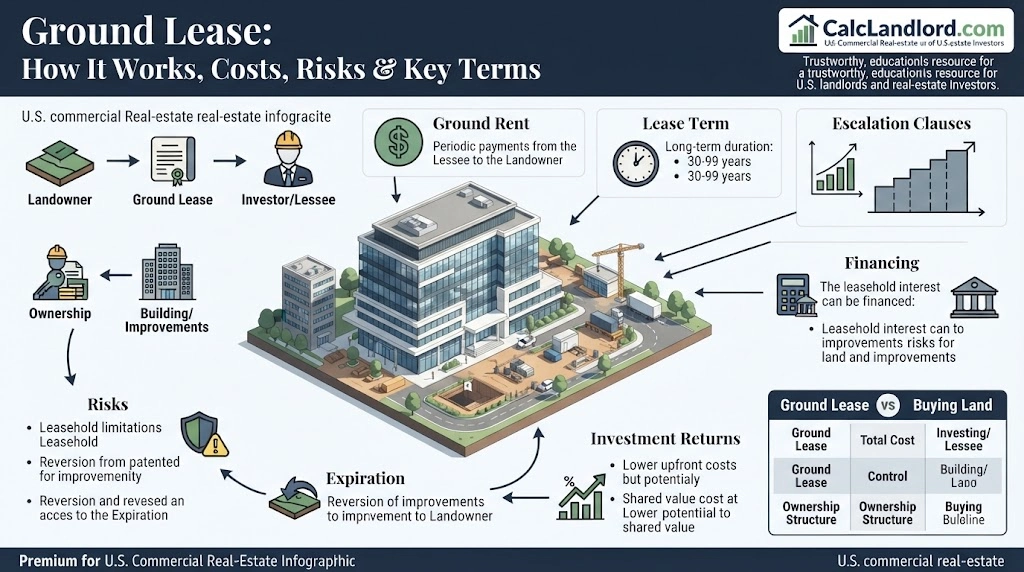
| Ground Lease | Buying Land |
| Ground rent | Land purchase price |
| Rent escalation | Financing cost |
| Leasehold financing | Land mortgage |
| Lease restrictions | Ownership flexibility |
| Expiration risk | No lease expiration |
| Potential reversion | Owner retains improvements |
| Lower initial land acquisition | Higher upfront capital |
| Leasehold resale considerations | Fee-simple resale |
Ground Lease Example
Suppose:
Option A — Ground Lease
- Ground rent: $100,000/year
- Initial building investment: $3 million
- Annual rent escalation: 2%
- Lease: 60 years
Option B — Buy Land
- Land price: $1.5 million
- Building investment: $3 million
The ground lease requires less initial capital for land.
But the investor needs to model decades of rent.
The land purchase requires more capital but creates fee ownership of the site.
What Should an Investor Compare?
Compare:
- Initial capital requirement
- Annual operating cost
- Ground rent
- Rent escalation
- Financing cost
- Expected rental income
- NOI
- Cash flow
- Exit value
- Remaining lease term
- Renewal probability/terms
- Improvement value
- Tax implications
- Risk
- Opportunity cost of capital
A proper model may show that the lower upfront-cost option is not necessarily the lower-cost option over the full investment period.
What Ground Lease Terms and Clauses Should You Review?
Never evaluate a ground lease only by looking at the monthly or annual rent.
Review the entire document.
1. Lease Term
How long does the tenant have the site?
2. Renewal Options
Can the tenant extend the lease?
3. Ground Rent
How much is due initially?
4. Escalation
How and when does rent increase?
5. Permitted Use
What can the tenant legally and contractually do?
6. Development Rights
Can the tenant construct, expand, renovate, or redevelop?
7. Taxes
Who pays property taxes and assessments?
8. Insurance
Who carries insurance and what coverage is required?
9. Maintenance
Who maintains the land, building, parking areas, utilities, and other improvements?
10. Assignment
Can the tenant sell or transfer its leasehold interest?
11. Subleasing
Can the tenant lease space to another party?
12. Financing
Can the tenant mortgage its leasehold?
13. Lender Protections
Does the lender receive notice and cure rights?
14. Default
What happens after a tenant or landlord breach?
15. Casualty
What happens after fire, storm, or another damaging event?
16. Condemnation
How are proceeds distributed if a government takes the property?
17. Improvements
Who owns improvements during and after the lease?
18. Expiration
What happens at the end of the lease?
19. Environmental Responsibilities
Who handles contamination and environmental compliance?
20. Purchase Rights
Does either party have an option to buy the land or improvements?
These clauses can materially change the economics of the transaction.
Ground Lease Due Diligence Checklist for Investors and Landlords
A ground lease should be analyzed like a major long-term investment contract, not simply like another rental agreement.
Ownership Due Diligence
- Verify the landowner.
- Review title.
- Confirm legal description.
- Check easements.
- Check access.
- Review restrictions.
- Confirm zoning.
- Verify permitted use.
Financial Due Diligence
- Determine current ground rent.
- Build the future rent schedule.
- Model escalation.
- Estimate taxes.
- Estimate insurance.
- Estimate maintenance.
- Estimate capital expenditures.
- Calculate projected NOI.
- Model debt service.
- Calculate expected cash flow.
Lease Due Diligence
- Confirm the remaining term.
- Review renewal options.
- Examine assignment provisions.
- Review sublease provisions.
- Examine default provisions.
- Review termination provisions.
- Check improvement ownership.
- Check expiration provisions.
Financing Due Diligence
Ask the proposed lender:
- Will you finance this leasehold?
- What minimum remaining term is required?
- Are lender cure rights required?
- Is subordination required?
- Is a non-disturbance agreement required?
- What lease provisions must be amended?
- How will the lender value the collateral?
Physical Due Diligence
Review:
- Building Condition
- Roof
- HVAC
- Electrical
- Plumbing
- Parking
- Site drainage
- Environmental conditions
- Accessibility
- Deferred maintenance
Professional Review
For a significant transaction, consider having qualified professionals review:
- lease documents;
- title;
- taxes;
- environmental matters;
- financing;
- insurance;
- accounting;
- valuation.
A ground lease can involve legal and financial issues that cannot be resolved from a generic online checklist.
How Should Investors Analyze a Ground Lease Property?
The best approach is to treat the ground lease as part of the investment’s economics rather than as a footnote.
Start with NOI.
NOI = Effective Rental Income − Operating Expenses
Then evaluate:
Cap Rate = NOI ÷ Property Value
For cash-on-cash analysis:
Cash-on-Cash Return = Annual Pre-Tax Cash Flow ÷ Initial Cash Invested
For a ground-leased property, however, the investor must determine exactly how ground rent is treated in the financial model.
If ground rent is an operating expense under the property’s structure, it can reduce NOI.
If the investment is structured differently, the treatment may differ.
Do not blindly copy a formula from another property type.
Hypothetical Investment Example
Suppose:
- Annual rental income = $600,000
- Other operating expenses = $180,000
- Ground rent = $100,000
Then:
NOI before ground rent = $600,000 − $180,000 = $420,000
After ground rent:
Adjusted operating income = $420,000 − $100,000 = $320,000
Now imagine the ground rent increases to $125,000.
The same property would have:
$420,000 − $125,000 = $295,000
The $25,000 increase in annual ground rent reduces the property’s available operating income by $25,000, assuming all other assumptions remain unchanged.
This illustrates why escalation provisions deserve serious attention.
Scenario Analysis
A useful investor model should include at least three scenarios:
Base case
- Expected rent
- Expected occupancy
- Contractual ground-rent increases
Downside case
- Lower rental income
- Higher vacancy
- Higher maintenance
- Higher financing cost
- Same or higher contractual ground rent
Upside case
- Stronger rental income
- Higher occupancy
- Favorable operating performance
The goal is not to predict the future perfectly.
The goal is to understand which assumptions can break the investment thesis.
What Should Investors Pay Particular Attention To?
Focus on:
Remaining lease term
A shorter term can affect financing and exit value.
Ground-rent escalation
Large future increases can reduce cash flow.
Renewal provisions
A renewal option may materially change the property’s long-term economics.
Financing
A lease that cannot satisfy lender requirements may limit exit opportunities.
Reversion
Understand what happens to improvements.
Exit market
Determine whether future buyers are likely to accept the same lease structure.
A ground-lease investment should be evaluated based on its actual contractual economics rather than on the headline property price.
People Also Ask
A: A ground lease is a long-term agreement in which a tenant leases land from a landowner, pays ground rent, and generally receives rights to use or develop the site during the lease term.
A: The landowner generally retains ownership of the underlying land while the tenant holds a leasehold interest.
A: The tenant may own or control the improvements during the lease term, but the lease determines what happens to them at expiration. Improvements can potentially revert to the landowner or be subject to other contractual arrangements.
A: The terms can overlap and are sometimes used interchangeably. The actual agreement is more important than the label.
A: Ground leases are generally long-term arrangements, and terms can extend for several decades. Some are structured for periods approaching 99 years.
Conclusion
A Ground Lease can give landlords, developers, and real estate investors access to valuable land without purchasing the underlying property, but the long-term financial and legal obligations require careful evaluation. Ground rent, escalation clauses, remaining lease term, financing requirements, renewal options, improvement ownership, and expiration provisions can all significantly affect the investment.
Before entering a ground lease, compare the total cost of leasing the land with the cost of purchasing it. Model rental income, operating expenses, ground-rent increases, financing costs, cash flow, and potential exit value rather than focusing only on the initial rent.
For investors, the most important step is to understand how the lease affects the property’s NOI, cash flow, financing, resale value, and long-term investment returns. Reviewing the complete agreement with qualified real-estate, legal, tax, and financial professionals can help identify risks before they become expensive problems.
Ultimately, a ground lease should be evaluated based on its specific terms and economics—not simply because it requires less upfront capital. Use the appropriate CalcLandlord calculators to model the property’s cash flow, ROI, cap rate, and other key metrics before making an investment decision.

nice
Pingback: 7 Numbers to Check Before Buying a Rental Property
Pingback: Long Term Rental: The Smart 12-Month Guide to Steady Income