
1. What Happens Immediately When a Commercial Tenant Files Bankruptcy?
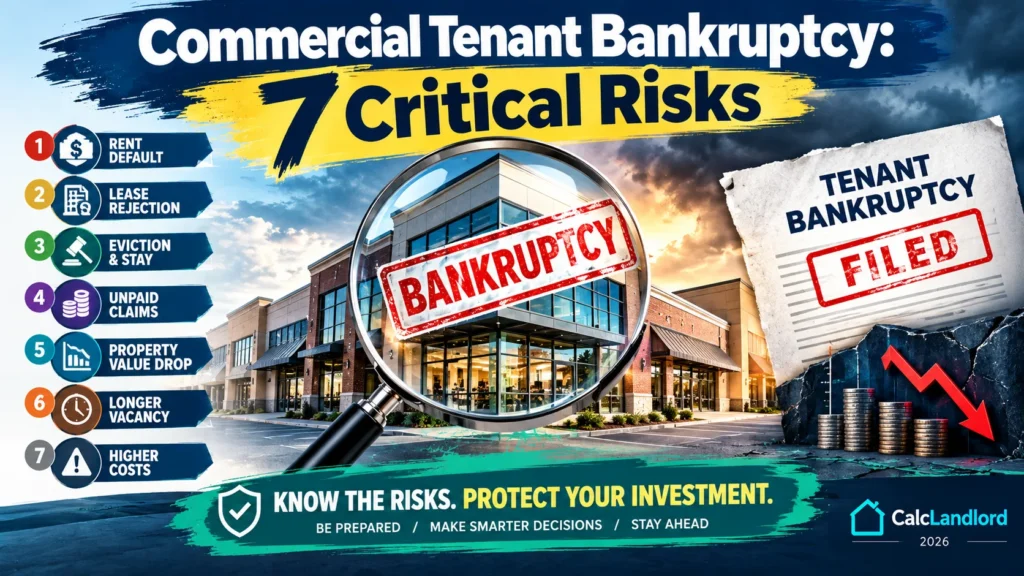
A tenant files bankruptcy, and suddenly the rules change. Can you still collect rent? Can you evict? Does the lease disappear? What happens to unpaid rent, security deposits, guaranties, and the income you expected from the property? These questions matter because a bankruptcy filing can trigger the automatic stay and change how a landlord enforces the lease. The good news: bankruptcy does not automatically erase the lease or every landlord right. This guide explains what happens first, how prepetition and postpetition rent differ, what lease options exist, which deadlines matter, and what landlords should do to avoid an expensive mistake.
The first few hours matter because federal bankruptcy law may suddenly apply to a landlord’s normal lease remedies.
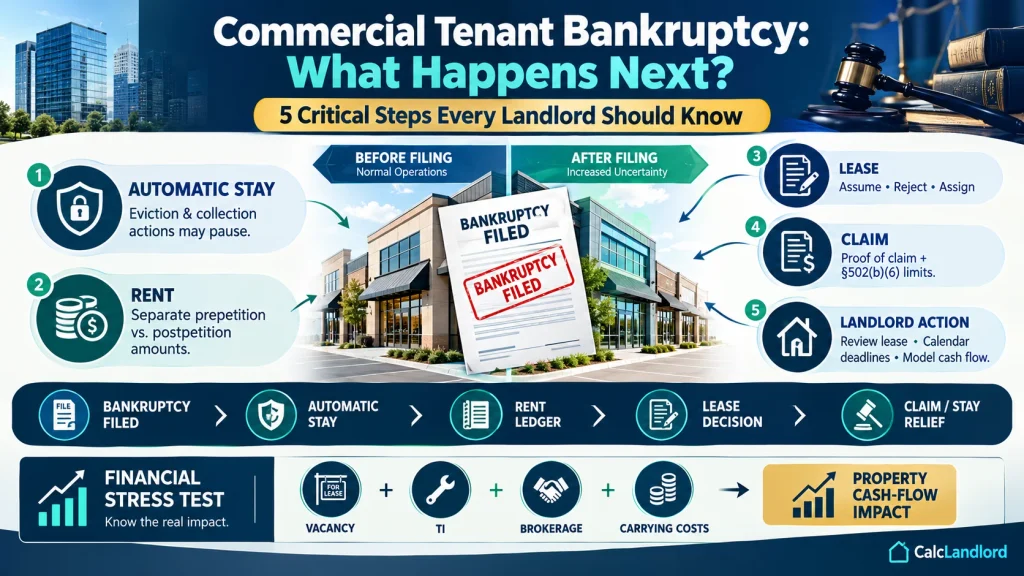
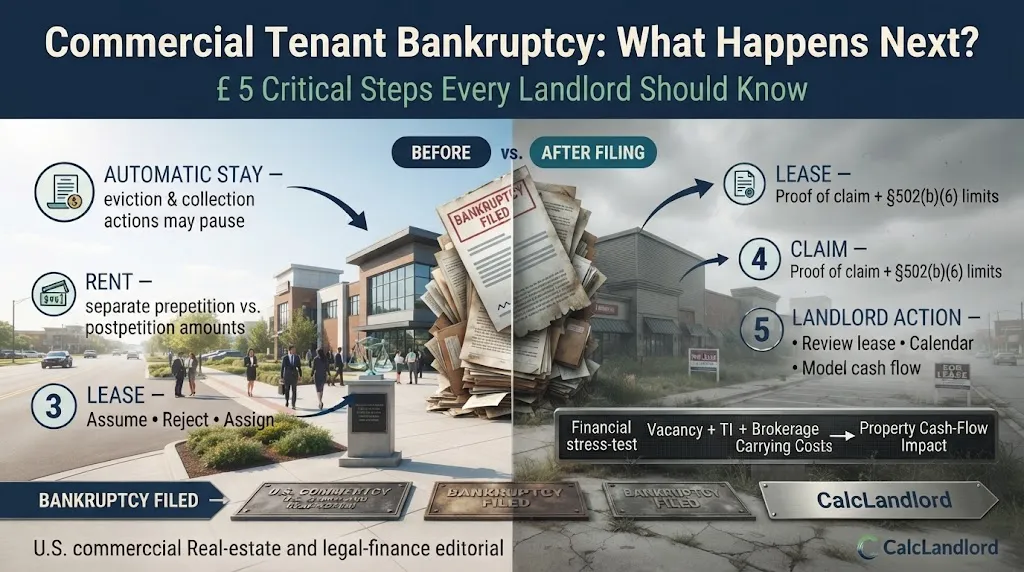
The bankruptcy petition generally triggers an automatic stay. The stay is designed to halt many collection and enforcement activities while the bankruptcy case proceeds.
For a commercial landlord, that can affect:
- Eviction or possession proceedings
- Collection of prepetition rent
- Lawsuits seeking payment of prepetition debts
- Lockouts or other attempts to take possession
- Setoffs involving prepetition debts
- Attempts to seize property belonging to the bankruptcy estate
- Lease enforcement actions that violate the stay
The key distinction is what arose before the bankruptcy filing and what arose afterward.
Suppose a tenant owes $30,000 in rent when it files. That $30,000 is generally not something the landlord should simply demand through an ordinary collection letter after the filing. Instead, the landlord usually needs to address the amount through the bankruptcy case.
Now suppose the tenant remains in possession and another $15,000 of rent and lease charges accrue after the filing. Those postpetition obligations are treated differently, and the Bankruptcy Code contains specific rules governing ongoing performance under an unexpired nonresidential lease.
The practical rule for Day 1 is simple:
Do not act as though the bankruptcy never happened.
Pause enforcement activity, confirm the case information, preserve records, separate pre-petition and post-petition amounts, and get legal guidance before changing locks, applying a deposit, sending a demand, or continuing an eviction.
2. How Does the Automatic Stay Affect a Commercial Landlord?
The automatic stay is one of the most important concepts in a commercial tenant bankruptcy.
Under 11 U.S.C. §362, it generally takes effect when the bankruptcy petition is filed and prevents many actions designed to collect prepetition debts or obtain possession or control of estate property.
For landlords, the stay can mean:
| Landlord action | General bankruptcy effect |
| Demand for prepetition rent | Generally stayed |
| New eviction action based on prepetition default | Generally stayed |
| Continuing a pending eviction | Generally stayed unless an exception or court order applies |
| Locking out the debtor-tenant | Potentially stayed |
| Suing for prepetition rent | Generally stayed |
| Applying a security deposit to a prepetition debt | Requires careful analysis |
| Requesting relief from stay | Permitted bankruptcy-court process |
A landlord should also understand that a lease clause saying “bankruptcy constitutes an event of default” does not necessarily override federal bankruptcy law. Section 365 generally restricts termination or modification based solely on insolvency or commencement of a bankruptcy case. These provisions are often called ipso facto clauses.
That does not mean every lease remedy disappears. It means the landlord has to determine which remedy remains available and whether bankruptcy-court approval is required.
The stay is also not permanent. A creditor can seek relief from the automatic stay, and statutory exceptions exist. For example, §362 contains an exception related to obtaining possession of nonresidential real property when the lease term expired before the bankruptcy case began.
This is why a landlord should avoid the two opposite mistakes:
Mistake one: “Bankruptcy means I can do nothing.”
Mistake two: “My lease says I can evict, so I can continue as normal.”
Neither is a safe assumption.
3. Can a Landlord Evict a Commercial Tenant After Bankruptcy?
Usually, not immediately.
A bankruptcy filing can stop or pause an eviction even when the tenant was already in default. A landlord generally needs to determine whether the automatic stay applies and, where necessary, seek bankruptcy-court relief before continuing possession proceedings.
That does not mean the tenant has unlimited protection.
A landlord may have grounds to request relief from the stay or other court relief when, for example:
- Postpetition rent is not being paid.
- The premises have been abandoned.
- The property is being damaged.
- Insurance requirements are not being maintained.
- The tenant cannot perform its ongoing obligations.
- The lease was validly terminated before bankruptcy.
- Other facts provide sufficient cause under the applicable bankruptcy procedure.
The exact remedy depends on the case.
What if the lease expired before the filing?
This is an important edge case.
Federal law contains a specific stay exception for certain actions by a lessor to obtain possession when the stated term of a nonresidential lease expired before the bankruptcy case began.
But expiration is not the same thing as every possible form of termination.
For example, questions can arise about whether a lease was properly terminated under state law, whether the termination was effective before the petition date, whether an appeal or cure right remained, and whether the tenant still possessed a legally meaningful leasehold interest.
That is why “the lease was terminated before bankruptcy” should be treated as a legal issue to verify—not a box a landlord simply checks.
A landlord should compare:
Lease language → state law → termination date → bankruptcy petition date → bankruptcy-court procedure.
That timeline can materially affect possession rights.
4. Does a Commercial Tenant Still Have to Pay Rent After Filing?
Generally, yes.
Bankruptcy does not turn an occupied commercial property into rent-free space.
Under §365(d)(3), obligations under an unexpired nonresidential real-property lease that arise from and after the order for relief generally must be timely performed until the lease is assumed or rejected, subject to the statute’s qualifications.
Depending on the lease, ongoing obligations can include:
- Base rent
- Additional rent
- CAM charges
- Operating expenses
- Utilities
- Insurance obligations
- Certain taxes and pass-through expenses
- Maintenance responsibilities
- Other contractual obligations
The crucial accounting distinction is:
Prepetition obligations
These arise before the bankruptcy filing.
Example:
A tenant files on September 15 and owes $40,000 in unpaid rent from June through August.
That amount generally becomes part of the landlord’s bankruptcy claim rather than an ordinary post-filing collection demand.
Postpetition obligations
These arise after the filing.
If the tenant remains in possession and another month’s contractual obligations arise after filing, those amounts are treated differently under the Bankruptcy Code.
What is “stub rent”?
Stub rent refers to rent attributable to the portion of a month after the bankruptcy petition is filed.
For example:
- Monthly rent: $30,000
- Bankruptcy filed September 10
- Lease continues
- Rent attributable to the remainder of September may be called stub rent
Courts do not always treat stub rent identically, so the precise treatment can depend on jurisdiction and the facts of the case. Recent commercial-landlord commentary specifically identifies stub rent as an issue that can vary among courts.
For landlords, the safest approach is to keep a daily or monthly ledger that clearly shows when each charge accrued, not merely when an invoice was sent.
5. What Happens to Unpaid Rent Owed Before Bankruptcy?
Prepetition rent generally becomes a claim in the bankruptcy case.
That means the landlord may need to submit a proof of claim identifying the amount owed and supporting it with appropriate documentation. The bankruptcy court will establish the applicable claims deadline, commonly called a bar date.
The landlord’s claim might include qualifying amounts such as:
- Unpaid base rent
- Additional rent
- CAM or operating charges
- Certain repair obligations
- Enforceable late charges
- Contractually recoverable attorneys’ fees
- Other prepetition amounts
- Rejection damages when the lease is later rejected
However, a proof of claim is not a guarantee of payment.
Recovery depends on the bankruptcy estate, claim classification, available assets, secured claims, administrative expenses, the Chapter 11 plan where applicable, and other case-specific factors.
Build the claim from the lease, not memory
A landlord should gather:
- The original lease
- All amendments and side letters
- Rent schedules
- Payment history
- CAM reconciliations
- Tax and insurance reconciliations
- Repair invoices
- Default notices already issued
- Guaranties
- Security documentation
- A current tenant ledger
Official Bankruptcy Form B410 is the federal Proof of Claim form. The U.S. Courts currently identify B410 as an official bankruptcy form.
Do not wait until the claims deadline to reconstruct five years of tenant history.
A clean accounting file can be one of the landlord’s most valuable assets in the case.
6. What Happens to the Commercial Lease in Bankruptcy?
Bankruptcy does not automatically cancel an unexpired commercial lease.
Section 365 gives the trustee, subject to court approval and statutory restrictions, the ability to assume or reject an executory contract or unexpired lease. A lease may also be assumed and assigned to another party when the statutory requirements for assignment are satisfied.
For a landlord, the lease can therefore move into one of three basic paths:
| Lease path | What it generally means |
| Assume | Tenant keeps the lease and addresses required defaults |
| Reject | Lease is treated as breached under bankruptcy law |
| Assume + assign | Tenant preserves the lease and transfers it to a qualified replacement party |
The economics matter.
Imagine a commercial space renting for $22 per square foot when comparable new deals in the same submarket are closer to $26.
That lease might be below market and potentially valuable.
Now reverse the situation. The tenant is paying $32 when comparable space rents for $26.
The lease may be economically burdensome.
That difference can influence the tenant’s bankruptcy strategy, an assignee’s interest, and the landlord’s negotiating position.
A landlord should therefore calculate:
Contract rent vs. market rent → remaining lease term → renewal options → concessions → tenant obligations → re-leasing cost.
The legal question is important, but so is the property-level economic question:
What is this lease actually worth today?
7. Can the Tenant Assume, Reject, or Assign the Lease?
Yes. These are the three central lease paths.
Assume
The tenant elects to keep the lease.
Generally, the tenant must address qualifying defaults, compensate the landlord for qualifying actual pecuniary losses, and provide adequate assurance of future performance.
Reject
The tenant chooses not to continue under the lease.
Rejection generally constitutes a breach of the lease for bankruptcy-claim purposes. It does not mean the landlord automatically receives every dollar of future rent that the original lease would have produced.
Assume and assign
The tenant can sometimes preserve a valuable lease and assign it to a replacement business.
Section 365(f) generally allows assignment despite many anti-assignment restrictions when statutory requirements are met, including assumption and adequate assurance of future performance. Important exceptions apply.
For shopping-center leases, the landlord receives additional statutory protections concerning items such as:
- Source of rent
- Proposed assignee’s financial condition
- Percentage rent
- Use restrictions
- Exclusivity
- Radius provisions
- Tenant mix
- Operating requirements
Those special adequate-assurance rules are expressly addressed in §365(b)(3).
The U.S. Supreme Court has also addressed the importance of adequate assurance in the assignment of shopping-center leases.
For the landlord, the important question is not merely “Can this lease be assigned?”
It is:
Who is the proposed assignee, what will they operate, can they perform, and what does the assignment do to the property’s economics and tenant mix?
8. How Long Does a Tenant Have to Decide on the Lease?
This is one of the most important deadlines for commercial landlords—and one that can be misstated online.
For an unexpired lease of nonresidential real property, §365(d)(4) currently provides that the lease is deemed rejected if it is not assumed or rejected by the earlier of:
- 120 days after the order for relief, or
- The date the court enters an order confirming a plan.
The court may extend the 120 days by up to 90 days for cause before the initial period expires. A later extension generally requires the landlord’s prior written consent.
Important Chapter 7 clarification
Some practitioner articles summarize Chapter 7 as having a general 60-day lease deadline. That statement can be misleading when applied to a commercial real-property lease.
The current statutory structure distinguishes between §365(d)(1), which addresses certain Chapter 7 executory contracts and residential/personal-property leases, and §365(d)(4), which specifically governs nonresidential real property. For the commercial lease covered by this article, the federal commercial-lease deadline is the 120-day rule in §365(d)(4), subject to permitted extensions.
What should a landlord calendar?
At minimum:
| Deadline/event | Why it matters |
| Petition/order-for-relief date | Starts key timelines |
| Claims bar date | Controls proof-of-claim timing |
| Lease assumption/rejection deadline | Determines lease status |
| Motions for relief from stay | May affect possession rights |
| Proposed cure deadline | May affect assumption |
| Plan confirmation date | Can affect lease treatment |
| Objection deadlines | Preserve procedural rights |
Do not rely on a generic online timeline.
Calendar the dates from the actual bankruptcy case notice and docket.
9. What Happens When the Tenant Assumes the Commercial Lease?
When a tenant assumes the lease, it is essentially saying:
“We want to keep this lease and continue performing it.”
That comes with obligations.
Under §365, a defaulted lease generally cannot be assumed unless qualifying defaults are cured or arrangements provide for prompt cure, actual pecuniary loss caused by the default is compensated or addressed, and adequate assurance of future performance is provided.
What is adequate assurance?
Adequate assurance is not necessarily a promise that the tenant will never experience another problem.
It is evidence supporting the tenant’s ability to perform going forward.
Possible evidence can include:
- Recent financial statements
- Cash-flow forecasts
- Financing commitments
- Capital injections
- Postpetition payment history
- A stronger guarantor
- Additional security
- Insurance evidence
- A credible operating plan
For a shopping-center lease, the analysis can become more detailed because tenant mix, use, percentage rent, exclusivity, and related provisions can matter.
Example
Suppose a restaurant tenant has:
- $60,000 in qualifying lease defaults
- $20,000 in documented landlord losses
- Monthly rent of $25,000
- Weak cash reserves
- A new investor willing to inject $300,000
The landlord should not assess the proposal based only on “they will pay.”
Instead, the review should examine:
Cure amount + operating economics + security + guaranty + future rent capacity + business viability.
This is where legal and financial analysis meet.
For a property owner, the question is whether keeping the tenant produces a stronger expected result than rejection, turnover, re-leasing, and the associated vacancy and tenant-improvement costs.
10. What Happens When the Tenant Rejects the Commercial Lease?
When a tenant rejects an unexpired lease, rejection generally constitutes a breach under the Bankruptcy Code. The landlord may then have a claim arising from that breach, subject to the Bankruptcy Code’s limitations.
Rejection can lead to a familiar landlord problem:
The landlord gets the space back, but loses the certainty of the original rent stream.
The landlord may need to:
- Recover possession through the appropriate process
- Secure the property
- Inspect the premises
- Document damage
- Remove or address abandoned property where legally permitted
- Re-market the space
- Negotiate new lease terms
- Calculate the bankruptcy claim
- Track re-leasing costs
The financial exposure can be substantial.
Why rejection does not equal full future-rent recovery
Section 502(b)(6) limits a lessor’s claim for damages resulting from termination of a real-property lease.
The statutory framework generally includes:
Unpaid rent due by the earlier of filing or repossession/surrender
PLUS
Future-rent damages capped at the greater of one year’s rent or 15% of the remaining lease term, not exceeding three years.
Hypothetical example
Assume:
- Monthly rent: $12,000
- Remaining term: 30 months
- Remaining contractual rent: $360,000
- One year’s rent: $144,000
- 15% of remaining rent: $54,000
The greater amount is $144,000, subject to the statute and the specific claim calculation.
If instead 96 months remained:
- Remaining rent: $1,152,000
- 15%: $172,800
- One year’s rent: $144,000
The relevant capped future-rent component would be $172,800, assuming the statutory calculation otherwise applies.
These are illustrations, not legal claim calculations. Escalations, percentage rent, concessions, mitigation, surrender dates, lease language, and other factors can materially change the result.
That is why landlords should calculate the claim from the actual lease rather than multiply monthly rent by remaining months.
11. What Can a Landlord Claim After Lease Rejection?
A landlord’s recovery can involve more than simple unpaid base rent.
Depending on the lease, applicable law, and bankruptcy treatment, potential components may include:
- Prepetition unpaid rent
- Qualifying postpetition rent
- Additional rent
- CAM or operating charges
- Certain repair costs
- Restoration obligations
- Contractual attorneys’ fees where recoverable
- Rejection damages
- Other amounts allowed by the lease and applicable law
The claims must still fit within the Bankruptcy Code and applicable procedural rules.
The §502(b)(6) cap
The most important federal limitation for a commercial landlord is the rejection-damage cap under §502(b)(6). The statute addresses claims for damages resulting from termination of a real-property lease and places a limit on the future-rent component.
That distinction is important because a landlord may have a large contractual claim but a smaller allowed bankruptcy claim.
Re-leasing costs matter too.
A landlord should separately document:
- Brokerage commissions
- Tenant improvements
- Legal leasing costs
- Cleanup
- Repairs
- Restoration
- Security
- Marketing
- Vacancy period
Whether and how each item enters the bankruptcy claim can depend on the lease, applicable law, and the nature of the loss.
Mitigation
Rejection damages should not be treated as a blank check.
State law may impose mitigation requirements, and the actual legal calculation can be more complicated than the face amount of the remaining rent.
The ABA’s discussion of commercial lease rejection likewise describes rejection damages as a prepetition general unsecured claim and emphasizes the federal limitation under §502(b)(6).
For investors, the better question is:
What is the expected economic loss after vacancy, re-leasing cost, mitigation, claim limitations, and likely bankruptcy recovery?
That number can be very different from “remaining rent.”
12. What Happens to Security Deposits, Letters of Credit, and Guarantees?
Security instruments can become especially important when a commercial tenant files bankruptcy.
Security deposits
Do not automatically apply a cash security deposit to old rent after the bankruptcy filing.
Setoff and collection rules can be implicated by the automatic stay, and the legal treatment can depend on how the deposit is structured and what the lease and state law provide. Section 362 expressly addresses certain setoffs of prepetition debts.
Before applying the deposit, determine:
- Who legally owns the funds?
- Where are they held?
- What does the lease say?
- Has the landlord already exercised a contractual right?
- Did the right arise before or after filing?
- Does the proposed application constitute a prohibited setoff?
- Is bankruptcy-court relief required?
Letters of credit
A letter of credit can be structured differently from an ordinary cash deposit because a third-party issuer may have an independent obligation.
But landlords should not assume that every letter of credit can be drawn immediately.
Review:
- Expiration date
- Draw conditions
- Required documentation
- Evergreen provisions
- Issuing bank
- Standby vs. other structure
- Lease language
- Bankruptcy implications
Guaranties
A separate guarantor that did not file bankruptcy is generally not automatically protected by the tenant’s bankruptcy stay. AGG’s commercial-landlord analysis specifically notes this distinction.
That can make the guaranty financially important.
A landlord should determine:
- Whether the guarantor is also a bankruptcy debtor
- Whether the guaranty is enforceable
- What obligations it covers
- Whether it covers future rent
- Whether it covers rejection damages
- Whether attorneys’ fees are covered
- Whether pursuing the guarantor risks double recovery concerns
- Whether another court order affects enforcement
The existence of a guaranty can therefore change the landlord’s overall recovery analysis.
13. Chapter 7 vs. Chapter 11: What Changes for the Landlord?
The bankruptcy chapter affects the broader business process, even though commercial lease treatment is still governed by the Bankruptcy Code.
| Issue | Chapter 7 | Chapter 11 |
| General purpose | Liquidation | Reorganization or structured sale/wind-down |
| Business control | Trustee generally administers estate | Debtor commonly remains in possession |
| Commercial lease | May be rejected or otherwise administered | May be assumed, rejected, or assigned |
| Commercial real-property lease deadline | Generally governed by §365(d)(4)’s 120-day rule | Generally governed by §365(d)(4)’s 120-day rule |
| Landlord focus | Possession, claim, property condition | Ongoing rent, cure, assurance, plan and lease economics |
Chapter 7 is generally a liquidation process in which a trustee administers the debtor’s estate. Chapter 11 is generally a reorganization process in which the debtor commonly remains in possession and operates while pursuing a restructuring or sale strategy.
Why Chapter 11 can be more operationally complex
A Chapter 11 commercial tenant may be trying to preserve valuable locations while shedding unprofitable ones.
That can produce negotiations around:
- Rent
- Cure amounts
- Security
- Lease modifications
- Assignment
- Tenant improvements
- Guaranties
- Use restrictions
- Store closures
- Co-tenancy
- Plan treatment
A strong tenant with a strong location may attempt to keep a below-market lease.
A weak location with above-market rent may be a candidate for rejection.
From the landlord’s perspective, the bankruptcy chapter is therefore only the starting point.
The more useful analysis is:
What is the tenant’s business situation + what is the property’s market value + what does the lease actually provide?
14. What Should a Commercial Landlord Do in the First 24 Hours?
The best first-day response is organized, not aggressive.
Step 1: Confirm the bankruptcy case
Record:
- Debtor’s legal name
- Bankruptcy chapter
- Case number
- Bankruptcy court
- Petition date
- Counsel information
- Trustee, if applicable
- Claims deadline
- Major hearing dates
Do not rely only on a tenant email.
Step 2: Pause potentially prohibited actions
Temporarily stop or review:
- Eviction activity
- Collection letters for old rent
- Lock changes
- Possession actions
- Lawsuits against the debtor
- Setoff of deposits
- Seizure of debtor property
The automatic stay is effective by operation of law when the petition is filed.
Step 3: Build a clean rent ledger
Split the ledger into:
A. Prepetition
Amounts accrued before filing.
B. Postpetition
Amounts accruing after filing.
C. Disputed/uncertain
Items requiring legal or accounting analysis.
Include base rent, additional rent, CAM, taxes, insurance, utilities, deposits, credits, repairs, and payments.
Step 4: Review the lease
Pull out:
- Default provisions
- Notice requirements
- Cure periods
- Termination rights
- Assignment provisions
- Use restrictions
- Renewal options
- Security deposit terms
- Letter of credit
- Guaranty
- Insurance
- Restoration
- Attorneys’ fees
- Exclusivity/co-tenancy provisions
Step 5: Review the property economics
Do not look at the bankruptcy only as a legal problem.
Estimate:
Expected vacancy + re-leasing costs + concessions + tenant improvements + brokerage + legal expenses + carrying costs.
Then compare that with:
Keeping tenant + cure + ongoing rent + additional security + expected performance.
Step 6: Calendar the critical deadlines
Use the actual bankruptcy notice and docket.
For claim deadlines, bankruptcy courts provide case-specific deadlines. The U.S. Bankruptcy Courts explain that Chapter 7 asset cases and Chapter 11 cases can have different procedures for establishing claim deadlines.
Step 7: Get case-specific legal advice
Before taking possession, applying a deposit, continuing eviction, or pursuing a guarantor, have bankruptcy counsel review the facts.
24-hour landlord checklist
| Priority | Action |
| Immediate | Confirm case details |
| Immediate | Stop questionable collection/possession activity |
| Immediate | Separate prepetition/postpetition charges |
| Same day | Review lease and guaranties |
| Same day | Confirm postpetition rent status |
| Same day | Preserve records and property-condition evidence |
| Calendar | Claim bar date |
| Calendar | §365 lease deadline |
| Legal | Evaluate relief from stay |
| Financial | Stress-test vacancy/re-leasing economics |
15. What Common Mistakes Should Landlords Avoid During Tenant Bankruptcy?
The biggest mistakes usually come from treating a bankruptcy filing like an ordinary lease default.
Mistake 1: Changing the locks
A landlord may believe the tenant is obviously in default and therefore can simply take possession.
The automatic stay can prevent that.
Mistake 2: Sending a demand for old rent
A demand for pre-petition rent can create stay-related problems.
Separate old debt from postpetition obligations before communicating payment demands.
Mistake 3: Assuming bankruptcy cancels the lease
The bankruptcy filing itself does not automatically terminate an unexpired commercial lease. Section 365 provides the framework for assumption, rejection, and assignment.
Mistake 4: Using the wrong deadline
Do not automatically copy a 60-day Chapter 7 deadline from a generic bankruptcy article onto a commercial real-property lease.
For the nonresidential real-property lease addressed here, check §365(d)(4) and the actual case documents.
Mistake 5: Mixing pre-petition and post-petition rent
This can create accounting and claim problems.
Your ledger should make the cutoff date obvious.
Mistake 6: Ignoring ongoing rent
The filing does not necessarily eliminate the tenant’s obligation to perform postpetition lease obligations while the lease remains in effect.
Mistake 7: Treating rejection as guaranteed recovery
Rejection creates a breach and a claim, but federal law limits the lessor’s rejection-damage claim.
Mistake 8: Applying a security deposit without analysis
The landlord should confirm the legal basis for applying a deposit rather than assuming it is simply available.
Mistake 9: Forgetting the guarantor
A nonbankrupt guarantor may remain separately exposed, subject to the guaranty’s language and applicable law.
Mistake 10: Failing to model the property-level financial impact
This is the mistake real-estate investors often overlook.
A $100,000 bankruptcy claim does not necessarily tell you whether the property is financially better or worse than keeping the tenant.
Run scenarios.
For example:
| Scenario | Vacancy | Re-leasing cost | Ongoing rent | Main uncertainty |
| Tenant cures and assumes | Low | Low | Continues | Future performance |
| Tenant rejects | Higher | Higher | Stops | Re-leasing speed |
| Assignment | Moderate | Potentially moderate | Continues | Assignee quality |
There is no universal “best” outcome. The economically relevant answer depends on the tenant, lease, property, market, security package, and realistic re-leasing assumptions.
More to Explore:People Also Ask
No. An unexpired commercial lease does not automatically disappear merely because the tenant files bankruptcy. Section 365 provides for assumption, rejection, and assignment subject to statutory requirements.
Generally, ordinary collection activity for a pre-petition debt is stayed. The landlord will generally need to pursue its claim through the bankruptcy process or obtain appropriate court relief.
Generally, yes, for postpetition obligations arising under an unexpired nonresidential lease while the lease remains in effect, subject to the Bankruptcy Code and case-specific issues.
Usually not without considering the automatic stay and, when necessary, obtaining bankruptcy-court relief. Statutory exceptions and pre-filing lease termination issues can change the analysis.
For an unexpired lease of nonresidential real property, the general federal deadline is the earlier of 120 days after the order for relief or plan confirmation, subject to a possible 90-day extension for cause and further extension generally requiring the lessor’s prior written consent.
Often, yes, provided the Bankruptcy Code’s assumption and assignment requirements are satisfied, and no statutory exception prevents the assignment. Adequate assurance of future performance is important.
Generally, the tenant’s bankruptcy stay does not automatically extend to a separate nonbankrupt guarantor, but the guaranty, applicable law, and other court orders must be reviewed.
The landlord can generally assert a rejection-damage claim, but §502(b)(6) limits the amount of damages resulting from termination of a real-property lease. The calculation can be fact-intensive.
Final Takeaway
When a commercial tenant files bankruptcy, the landlord’s position changes immediately—but it does not automatically become helpless.
The automatic stay can restrict eviction and collection activity. Prepetition rent generally moves into the bankruptcy claims process. Postpetition lease obligations remain important. The commercial lease may be assumed, rejected, or assigned. Guaranties and security instruments can create additional recovery paths, while rejection damages are subject to federal limits.
For a landlord, the most useful sequence is:
Confirm the case → stop questionable enforcement → separate pre/postpetition amounts → review the lease → monitor postpetition performance → calendar deadlines → preserve the claim → evaluate stay relief → model the property’s financial outcome.
For the investment side, the impact should be measured in property-level numbers—not just legal claims. Vacancy, concessions, tenant improvements, brokerage, carrying costs, and expected replacement rent can materially change the economics.
A CalcLandlord Cash Flow Calculator can be used to stress-test those property-level scenarios, such as several months of vacancy versus continued occupancy under a restructured lease. It should be used as a financial modeling aid, not as a substitute for bankruptcy counsel.
