
Foreclosure Process for Landlords: Steps, Risks & Timeline
A Foreclosure Process can turn a profitable rental property into a serious financial problem when mortgage payments fall behind. For landlords and real estate investors, the consequences can extend beyond losing the property: foreclosure may affect rental income, tenants, debt obligations, credit, taxes, operating cash flow, and the investor’s ability to finance future properties.
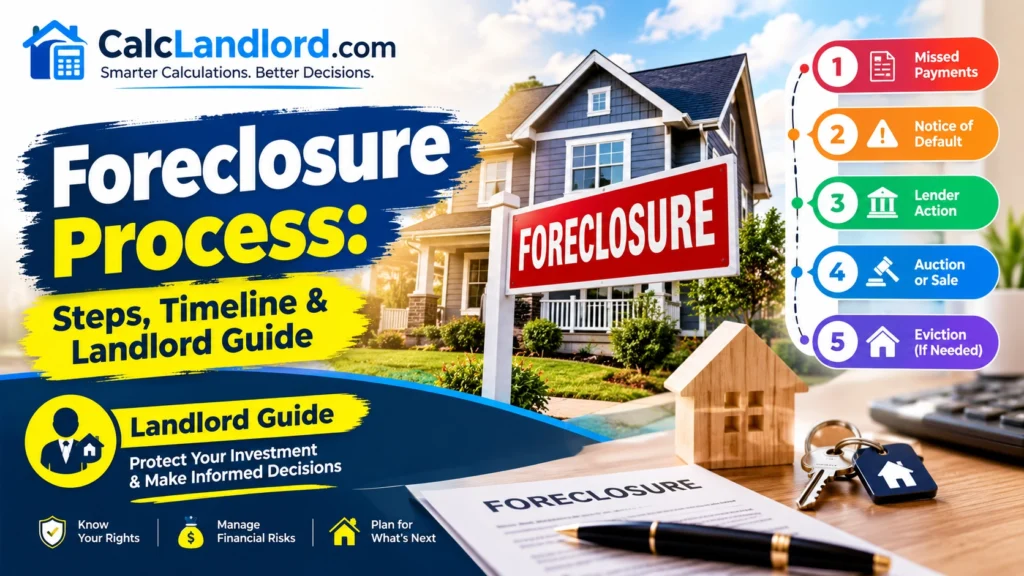
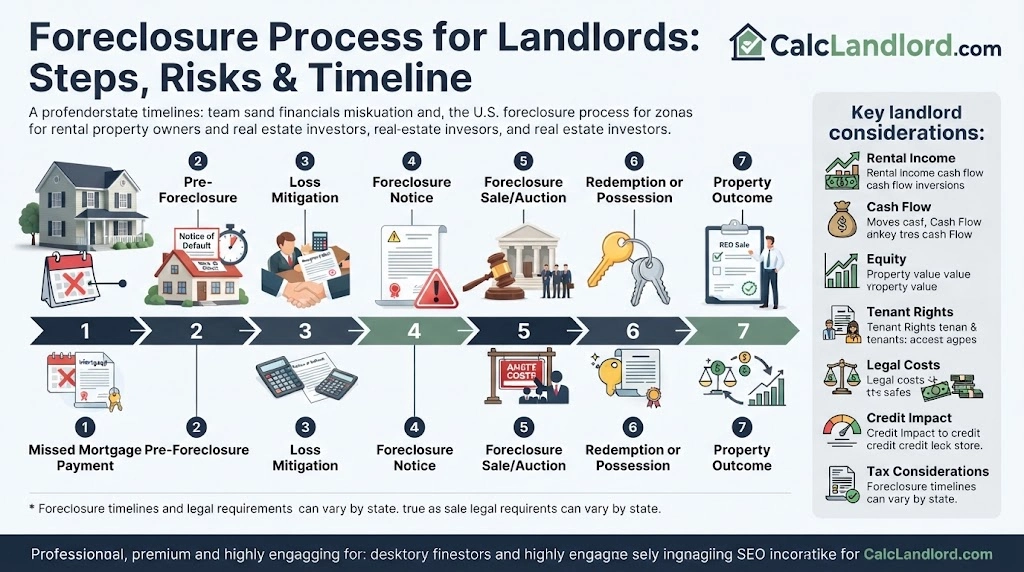
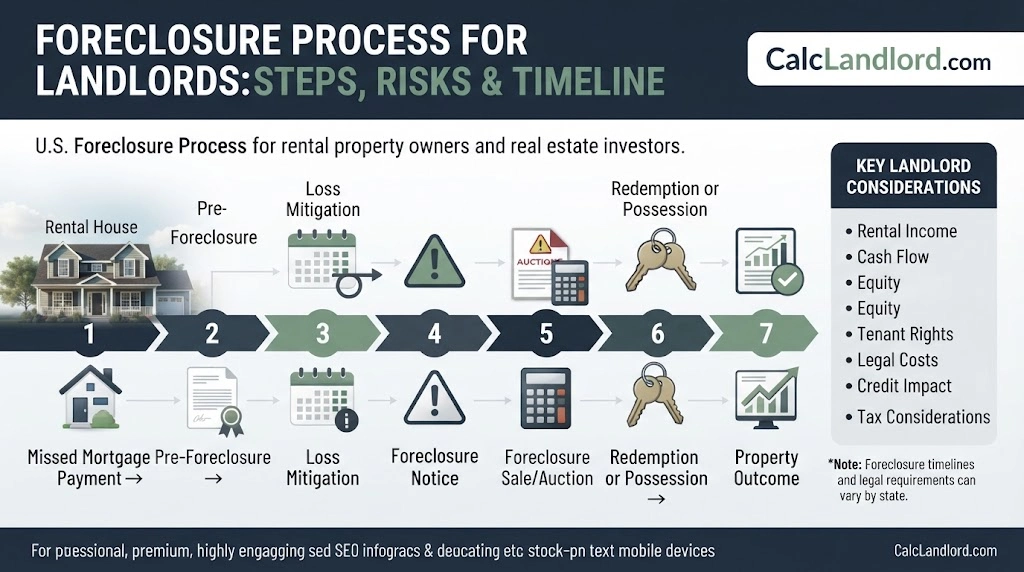
The basic foreclosure journey often moves from missed payments → delinquency → loss mitigation or workout discussions → formal foreclosure → foreclosure sale → post-sale consequences. However, there is no single nationwide procedure. State law controls many important details, including whether foreclosure is judicial or nonjudicial, required notices, reinstatement rights, redemption periods, deficiency judgments, and sale procedures.
For landlords, there is another critical distinction: a mortgage secured by an investment property may be subject to different federal servicing rules depending on the purpose and structure of the loan. Regulation X excludes loans made primarily for business, commercial, or agricultural purposes from its coverage.
This guide explains the foreclosure process from a rental-property and investment perspective, including what happens to tenants, how foreclosure affects property economics, what investors should calculate, and what to investigate before buying a foreclosed rental property.
What Is the Foreclosure Process and Why Does It Matter to Landlords?
Foreclosure is the legal process through which a lender or other authorized party enforces its security interest in a property after a borrower defaults on the loan.
For a landlord, foreclosure is not simply a homeownership issue. The property may be an income-producing asset with:
- Monthly rental income
- Mortgage payments
- Property taxes
- Insurance
- Repairs and maintenance
- Property-management costs
- Utilities
- Vacancy costs
- Existing tenant leases
- Equity or negative equity
- Tax consequences
- Other liens or obligations
That makes the financial analysis different from a typical owner-occupied property.
A simple landlord example
Suppose a rental property produces:
- Gross rent: $3,000/month
- Mortgage payment: $1,900/month
- Taxes and insurance: $450/month
- Maintenance reserve: $200/month
- Property management: $240/month
Estimated monthly cash flow before other expenses:
$3,000 − $1,900 − $450 − $200 − $240 = $210
If the mortgage falls into default, the issue is no longer simply whether the property is “profitable.”
The landlord must ask:
- How much cash is required to cure the default?
- Is the property still economically viable?
- What is the property’s current market value?
- How much equity exists?
- What happens to the tenants?
- Are there other liens?
- What are the foreclosure costs?
- Could selling before foreclosure preserve more equity?
- What are the tax consequences?
- Would restructuring the debt produce a better outcome?
That broader analysis is where a landlord-focused foreclosure guide can provide more value than a general homeowner article.
How Does the Foreclosure Process Work Step by Step?
Although the exact procedure depends on the state, loan, property, and foreclosure method, the general journey can be understood as a sequence of stages.
1. Mortgage payment becomes delinquent
The borrower fails to make a required payment.
2. Delinquency continues
The unpaid amount grows and the servicer or lender may contact the borrower about the default.
3. Workout or loss-mitigation options may be considered
Depending on the loan and applicable rules, options can include modification, forbearance, repayment arrangements, short sale, or deed in lieu.
4. Formal foreclosure begins
The applicable state procedure is initiated through court proceedings or an out-of-court process.
5. Required notices are issued
The borrower receives legally required notices, although the type and timing vary by state.
6. Foreclosure sale occurs
The property is generally offered through a public sale or auction.
7. Ownership changes
The successful bidder receives ownership according to the state’s foreclosure procedure.
8. Post-sale issues are resolved
Potential issues include possession, eviction, redemption, deficiency liability, remaining liens, and tax reporting.
A major federal rule to understand is that, for covered mortgage loans, Regulation X generally prohibits the servicer from making the first notice or filing required to initiate foreclosure until the mortgage obligation is more than 120 days delinquent, subject to exceptions.
However, do not automatically apply this 120-day rule to every rental-property loan. Regulation X excludes credit primarily for business, commercial, or agricultural purposes, which can include certain investment-property financing. The loan’s actual purpose and structure must be examined.
The landlord version of the process
For an investment property, think about the process in four parallel tracks:
| Track | What the landlord needs to monitor |
| Loan | Default, arrears, notices, lender communications |
| Property | Value, equity, condition, liens |
| Rental | Rent, lease terms, tenant rights, vacancy |
| Investment | Cash flow, ROI, taxes, exit options |
This four-track approach prevents a landlord from looking only at the mortgage balance while ignoring the property’s actual investment economics.
What Happens After a Rental Property Mortgage Payment Is Missed?
A missed mortgage payment does not automatically mean the property will immediately be sold through foreclosure.
The first question is why the payment was missed and whether the problem is temporary or structural.
Temporary cash-flow problem
For example, a landlord may have experienced:
- A large unexpected repair
- Temporary vacancy
- Insurance increase
- Property-tax increase
- Delayed rent collection
- Tenant turnover
- A short-term personal liquidity problem
In that situation, the investor may have a viable property but insufficient short-term cash.
Structural cash-flow problem
A more serious situation occurs when the property’s economics no longer support the debt.
For example:
Monthly rent: $2,400
Mortgage: $1,850
Taxes/insurance: $400
Maintenance reserve: $200
The property is already approximately:
$2,400 − $1,850 − $400 − $200 = −$50/month
And that calculation does not include every possible expense.
If vacancy, capital expenditures, management, or other costs are added, the negative cash flow could become substantially larger.
What landlords should calculate immediately
Before making a major decision, estimate:
Monthly cash flow = Rental income − Operating expenses − Debt service
Then calculate:
Equity = Estimated market value − Outstanding mortgage debt − Other liens
And:
Equity percentage = Equity ÷ Estimated market value × 100
These numbers help determine whether the property is:
- A temporary liquidity problem
- A negative-cash-flow problem
- An equity problem
- A debt-structure problem
- Or some combination of these
How Long Does the Foreclosure Process Take in the U.S.?
There is no universal foreclosure timeline for every U.S. rental property.
The timeline depends on state law, the foreclosure method, the loan, notices, court activity, loss-mitigation activity, bankruptcy, litigation, and other circumstances.
Judicial foreclosure generally involves a lawsuit and can take months or, in some cases, years. Nonjudicial foreclosure generally follows a state-prescribed out-of-court process and can move more quickly.
General timeline framework
| Stage | What may happen |
| Payment missed | Loan becomes delinquent |
| Early delinquency | Servicer/lender communications |
| Continuing Default | Arrears and fees may increase |
| Workout period | Borrower may explore available solutions |
| Formal foreclosure | Judicial or nonjudicial procedure begins |
| Notice period | Required legal notices are delivered |
| Sale | Property is auctioned or otherwise sold |
| Post-sale | Title, possession, redemption, deficiency and other issues arise |
For covered consumer mortgage loans, CFPB rules generally establish a more-than-120-day delinquency threshold before the first foreclosure notice or filing.
But for a landlord, loan classification matters. A business-purpose investment loan can fall outside Regulation X’s coverage.
Why landlords should not rely on a generic “X-month” timeline
A statement such as “foreclosure always takes six months” can be misleading.
For example, Nolo’s current state chart shows major differences among states concerning judicial versus nonjudicial foreclosure, reinstatement, redemption, and deficiency judgments.
The correct approach is:
National framework + property state + loan documents + current legal requirements.
Judicial vs. Nonjudicial Foreclosure: What Investors Need to Know
The two primary foreclosure pathways are judicial foreclosure and nonjudicial foreclosure.
Judicial foreclosure
A judicial foreclosure uses the court system.
A simplified process may involve:
- Default
- Required notices
- Foreclosure complaint
- Service on the borrower
- Borrower’s response
- Court proceedings
- Judgment
- Sale notice
- Foreclosure sale
- Possible confirmation or redemption period
Because court proceedings are involved, the process can take substantially longer in some jurisdictions.
Nonjudicial foreclosure
A nonjudicial foreclosure generally uses a state-authorized out-of-court process.
It may involve:
- Default
- Required notice
- Notice of default or comparable filing
- Cure/reinstatement period where applicable
- Notice of sale
- Public auction
- Trustee’s deed or other transfer document
- Possession proceedings where necessary
The exact process varies by state.
Investor comparison
| Factor | Judicial | Nonjudicial |
| Court involvement | Required | Usually not required for the foreclosure itself |
| Typical process | Lawsuit and judgment | Statutory/trustee procedure |
| Timing | Can take months or longer | Often faster |
| Notices | State-specific | State-specific |
| Reinstatement | State-specific | State-specific |
| Redemption | State-specific | State-specific |
| Deficiency | State-specific | State-specific |
For an investor evaluating a distressed property, knowing the state’s foreclosure mechanism can help estimate the likely timeline and research the legal status of the property.
What Happens During Pre-Foreclosure and Loss Mitigation?
Pre-foreclosure is commonly used to describe the period after default but before the foreclosure sale. It is not a uniform legal status in every state.
For landlords, this period can be particularly important because it may provide time to compare multiple exit strategies.
Possible options
Depending on the loan and circumstances, an owner might consider:
- Bringing the loan current
- Repayment arrangements
- Loan modification
- Forbearance
- Short sale
- Deed in lieu of foreclosure
- Selling the property
- Refinancing, if realistically available
- Injecting additional capital
- Negotiating with the lender
Federal loss-mitigation rules can provide important protections for covered loans. For example, when a covered servicer receives a complete loss-mitigation application more than 37 days before a scheduled foreclosure sale, Regulation X generally imposes specific evaluation and foreclosure-procedure requirements.
Important investor caveat
A landlord should not assume that every investment-property mortgage receives these same protections.
Regulation X excludes extensions of credit primarily for business, commercial, or agricultural purposes.
Therefore, before relying on a federal mortgage-servicing deadline, verify:
- The loan’s purpose
- Borrower type
- Property type
- Loan documents
- Applicable servicing rules
- State law
A practical decision matrix
| Situation | Question to investigate |
| Temporary cash shortage | Can the property return to positive cash flow? |
| Strong equity | Would selling preserve equity? |
| Negative equity | Is a workout or negotiated exit possible? |
| Strong rent but expensive debt | Can financing realistically be changed? |
| Weak rent and weak value | Is continuing ownership economically justified? |
| Tenant occupied | What rights and lease obligations apply? |
The goal is not simply to “avoid foreclosure.” The goal is to determine which available outcome creates the most defensible financial and legal result for the investor.
What Happens at a Foreclosure Sale or Auction?
If the default is not resolved and the foreclosure reaches completion, the property is generally sold according to the applicable state procedure.
A foreclosure auction may involve:
- Public notice
- Qualified bidders
- Opening bids
- Competitive bidding
- A winning bidder
- Transfer of ownership
- Recording of the appropriate documents
The lender may bid at the sale. If the lender becomes the successful bidder, the property can become lender-owned real estate, commonly referred to as REO.
Example
Imagine:
- Mortgage debt: $310,000
- Foreclosure costs and other amounts: $20,000
- Total relevant debt/costs: $330,000
- Foreclosure sale price: $280,000
The apparent shortfall is:
$330,000 − $280,000 = $50,000
But this does not automatically mean the borrower owes $50,000.
Whether a deficiency judgment is available depends on state law, the loan, the foreclosure method, and other circumstances. State rules differ substantially.
Investors buying at foreclosure
A buyer should not treat the auction price as the property’s total acquisition cost.
Potential considerations include:
- Existing liens
- Property condition
- Unpaid taxes
- Insurance
- Legal/title issues
- Occupancy
- Tenant rights
- Repair costs
- Holding costs
- Financing
- Closing expenses
- Local foreclosure procedures
A $200,000 auction purchase can become a $250,000 project surprisingly quickly if substantial repairs and other costs are discovered.

What Happens to Tenants When a Rental Property Goes Into Foreclosure?
This is one of the most important differences between homeowner foreclosure content and landlord foreclosure content.
A rental property can have tenants whose rights continue even when ownership changes.
Federal law includes protections for certain bona fide tenants following foreclosure. Under the Protecting Tenants at Foreclosure Act, a successor generally must provide a bona fide tenant at least 90 days’ notice to vacate, while qualifying bona fide leases may generally continue through the remaining lease term, subject to specified exceptions, including a purchaser who will occupy the property as a primary residence. State or local law may provide additional protections.
What is a bona fide tenancy?
The federal statute generally requires, among other things, that:
- The tenant is not the borrower or certain family members of the borrower.
- The tenancy resulted from an arms-length transaction.
- Rent is not substantially below fair market rent, unless a subsidy applies.
Landlord checklist
If a rental property is facing foreclosure, review:
- Current leases
- Lease expiration dates
- Security deposits
- Rent-payment records
- Tenant notices
- Local landlord-tenant laws
- Federal tenant protections
- State-specific foreclosure protections
- Property-management agreements
- Insurance coverage
Do not assume that foreclosure automatically terminates every lease.
For a buyer, tenant occupancy can also affect the investment analysis because the buyer may inherit an occupied property rather than an empty property ready for immediate renovation.
How Does Foreclosure Affect Rental Property Cash Flow and ROI?
Foreclosure can disrupt almost every component of a rental property’s investment model.
Normal rental-property model
A simplified cash-flow formula is:
Cash Flow = Effective Rental Income − Operating Expenses − Debt Service
Suppose:
- Monthly rent = $3,500
- Vacancy allowance = $175
- Operating expenses = $1,100
- Mortgage payment = $1,700
Then:
$3,500 − $175 − $1,100 − $1,700 = $525/month
Annualized:
$525 × 12 = $6,300
Now suppose the mortgage enters default and the owner faces:
- Late fees
- Legal expenses
- Additional servicing charges
- Reduced access to financing
- Potential vacancy
- Property-management complications
The investment’s actual return can deteriorate even if the headline rent remains unchanged.
Cash-on-cash return
A simplified cash-on-cash calculation is:
Cash-on-Cash Return = Annual Pre-Tax Cash Flow ÷ Cash Invested × 100
Suppose the investor has $100,000 invested and generates $6,300 annual cash flow:
$6,300 ÷ $100,000 × 100 = 6.3%
If foreclosure-related financial problems reduce annual cash flow to $1,000:
$1,000 ÷ $100,000 × 100 = 1%
The property has not necessarily changed physically, but the investment economics have changed dramatically.
What landlords should monitor
Use a rental-property model that tracks:
- Gross rent
- Effective rent
- Vacancy
- Repairs
- Maintenance
- Taxes
- Insurance
- Management
- Utilities
- Capital expenditures
- Debt service
- Loan balance
- Property value
- Equity
- Cash invested
For CalcLandlord, this is where a Cash Flow Calculator or ROI Calculator can be genuinely useful: the investor can model whether the rental remains viable under different debt, vacancy, and expense assumptions.
What Financial Costs and Risks Should Landlords Expect?
Foreclosure risk is broader than the missed mortgage payments.
Potential financial exposures may include:
1. Delinquent mortgage payments
The unpaid principal, interest, escrow, fees, and other amounts depend on the loan and servicing agreement.
2. Legal and foreclosure costs
State procedures can create costs associated with attorneys, trustees, court proceedings, notices, and sale administration.
3. Property deterioration
A distressed property can experience deferred maintenance or damage.
4. Vacancy
Tenants may leave because of uncertainty surrounding ownership or property management.
5. Lost rental income
If occupancy changes, the property’s income-producing ability may fall.
6. Credit consequences
Foreclosure can negatively affect the borrower’s credit history and future financing opportunities.
7. Deficiency exposure
Some states permit deficiency judgments under certain circumstances; others restrict them.
8. Tax consequences
Foreclosure can have federal tax consequences.
The IRS generally treats foreclosure or repossession as a disposition of the property, potentially creating gain or loss. Cancellation of debt can also create taxable income depending on whether the debt is recourse or nonrecourse and whether an exclusion applies. For rental property, these issues can interact with depreciation, adjusted basis, and business/rental reporting.
This is an area where landlords should obtain advice from a qualified tax professional rather than relying on a generic online calculation.
A better risk framework
Think about foreclosure exposure as:
Total foreclosure risk = Debt risk + Property risk + Rental risk + Legal risk + Tax risk + Liquidity risk
A property can have strong appreciation potential and still have unacceptable short-term liquidity risk.
Can a Landlord Stop or Avoid Foreclosure on an Investment Property?
Potentially, but the available options depend heavily on the loan, state, lender, property economics, and stage of foreclosure.
The first step is to identify whether the problem is temporary or permanent.
Option 1: Bring the loan current
If the investor has sufficient liquidity and the property remains viable, curing the default may be possible.
Option 2: Negotiate a workout
Depending on the lender and loan structure, possible arrangements may include:
- Repayment plan
- Modification
- Forbearance
- Other restructuring
Option 3: Sell the property
If the property has sufficient equity, selling before foreclosure may preserve some or all of that equity.
Option 4: Short sale
If the property is worth less than the amount required to satisfy the debt and the lender approves, a short sale may be considered.
Option 5: Deed in lieu
A deed in lieu can involve voluntarily transferring the property to the lender, subject to lender approval and the agreement’s terms.
Option 6: Professional legal review
If the investor believes the foreclosure is defective, disputes the debt, receives court papers, or needs state-specific advice, an attorney can review the situation.
A landlord decision framework
Ask these five questions:
1. What is the property worth today?
Use realistic market evidence, not the purchase price.
2. What is the total debt?
Include the mortgage and relevant liens.
3. What is the property’s normalized cash flow?
Do not calculate using an unusually low repair or vacancy assumption.
4. How much cash is required to stabilize the property?
Include arrears, repairs, reserves, and transaction costs.
5. What is the best realistic exit?
Compare:
- Keep
- Restructure
- Sell
- Short sale
- Other negotiated options
The objective is to compare outcomes using actual numbers rather than reacting emotionally to the foreclosure notice.
How Does Foreclosure Affect the Property Owner, Mortgage Debt, and Credit?
Foreclosure can affect several parts of an investor’s financial position.
Property ownership
After a completed sale, ownership generally transfers according to the applicable state process.
Mortgage debt
The foreclosure may satisfy some or all of the secured obligation, but a deficiency may remain depending on state law and loan circumstances.
Credit
A foreclosure can appear in credit history and affect future borrowing decisions.
Future investment financing
For a real estate investor, financing consequences can be especially important.
A foreclosure may make it more difficult to qualify for certain loans or may affect underwriting, pricing, reserves, or lender requirements.
The exact effect depends on the investor’s complete financial profile and the lender’s underwriting rules.
Tax treatment
The tax analysis can be complicated for rental properties.
The IRS states that foreclosure can be treated as a sale or exchange and that canceled debt may have separate tax consequences. For business or rental activity, canceled debt may be reported as business or rental income depending on the circumstances.
Example
Suppose an investor has:
- Adjusted basis: $190,000
- Mortgage debt: $240,000
- Property FMV: $210,000
A foreclosure does not simply mean:
$240,000 − $210,000 = $30,000 tax loss
The actual tax result depends on factors such as:
- Recourse vs. nonrecourse debt
- Amount realized
- Adjusted basis
- Debt cancellation
- Depreciation
- Applicable exclusions
- Other tax rules
That is why foreclosure tax planning should be reviewed with a qualified tax professional.
What Should Real Estate Investors Check Before Buying a Foreclosed Rental Property?
Foreclosure can create buying opportunities, but an auction price alone does not tell you whether a property is a good investment.
1. Determine the property’s true market value
Do not use the auction opening bid as market value.
Research comparable properties and consider:
- Location
- Size
- Condition
- Unit count
- Rent potential
- Recent sales
- Required renovations
2. Estimate realistic rent
Use market rents supported by comparable properties.
Do not assume that asking rent equals achievable rent.
3. Estimate all operating expenses
Include:
- Property taxes
- Insurance
- Maintenance
- Repairs
- Management
- Vacancy
- Utilities where applicable
- Capital expenditures
- Licensing or local fees
4. Investigate title and liens
A foreclosure may not eliminate every possible claim or obligation in every situation.
Professional title research is essential.
5. Check occupancy
Determine whether the property is:
- Vacant
- Owner occupied
- Tenant occupied
- Abandoned
- Subject to an unknown occupant
6. Review tenant rights
Existing tenants may have federal, state, or local protections.
7. Estimate renovation costs
Distressed properties frequently require more work than visible inspection suggests.
8. Model the investment
Calculate:
Cap Rate = NOI ÷ Property Value × 100
For example:
- Annual NOI = $24,000
- Purchase price = $300,000
Cap Rate = $24,000 ÷ $300,000 × 100 = 8%
But an investor should also calculate cash-on-cash return and projected cash flow after financing.
9. Build a contingency
A property purchased at a discount can still become a poor investment if renovation costs exceed the discount.
10. Calculate the all-in basis
A better investment calculation is:
All-In Cost = Purchase Price + Closing Costs + Repairs + Immediate Capital Improvements + Other Acquisition Costs
This number is more useful than the auction price alone.
A CalcLandlord ROI Calculator, Cap Rate Calculator, or Cash Flow Calculator can help investors compare the property under different assumptions before committing capital.
How Does the Foreclosure Process Vary by State?
This is one of the most important sections for anyone publishing a national foreclosure guide.
There is no single U.S. foreclosure procedure.
State law can affect:
- Judicial vs. nonjudicial foreclosure
- Notice requirements
- Cure rights
- Reinstatement
- Mediation
- Foreclosure-sale procedures
- Redemption periods
- Deficiency judgments
- Eviction
- Court involvement
Current state-law resources show substantial differences across the country.
Examples of why state research matters
California commonly uses nonjudicial foreclosure, while states such as Florida, New York, Pennsylvania, and Ohio commonly use judicial procedures. Some states allow multiple methods or have special circumstances that change the process.
The rights following a sale also differ.
For example, some states provide post-sale redemption rights while others generally do not under their common foreclosure procedure. Deficiency rules also vary.
Investor research checklist by state
Before purchasing or managing a distressed rental property, investigate:
- Foreclosure method
- Required notices
- Reinstatement deadline
- Redemption rights
- Deficiency rules
- Tenant protections
- Eviction procedure
- Property-tax status
- HOA obligations
- Recording and title requirements
A national article should provide the framework. The property’s state should determine the detailed legal research.
People Also Ask
A: No. The 120-day federal rule is not a universal statement that every foreclosure takes 120 days. For covered loans subject to Regulation X, a servicer generally cannot make the first notice or filing to initiate foreclosure until the mortgage obligation is more than 120 days delinquent, subject to exceptions. State procedures then determine much of the subsequent timeline.
Investment-property loans made primarily for business purposes may be outside Regulation X’s coverage.
A: Yes. A rental property can proceed through foreclosure while occupied, but tenants may have legal protections. Federal law provides certain protections to bona fide tenants following foreclosure, including a generally required 90-day notice to vacate and, in qualifying circumstances, continuation of a bona fide lease through its remaining term. State and local laws may provide additional protections.
A: Rent does not automatically disappear simply because a property is in foreclosure. However, ownership, property management, collection rights, tenant notices, and the eventual recipient of rent can become complicated. Landlords should review the lease, applicable law, lender documents, and any post-sale instructions rather than assuming that rent should continue being paid to the original owner indefinitely.
Conclusion
The Foreclosure Process can have major financial and operational consequences for landlords and real estate investors. It may affect rental income, cash flow, property equity, tenants, credit, financing, and potential tax obligations. Because foreclosure laws and timelines vary by state, investors should never rely on a one-size-fits-all timeline or assume that federal mortgage protections apply to every investment-property loan.
If a rental property is approaching foreclosure, start by understanding the outstanding debt, current property value, rental income, operating expenses, equity, and available alternatives. Compare the numbers carefully before deciding whether to keep, restructure, sell, or pursue another available solution.
For investors considering a foreclosed property, look beyond the auction price. Calculate the all-in acquisition cost, expected rental income, operating expenses, repairs, vacancy, cash flow, cap rate, and cash-on-cash return before committing capital.
Use CalcLandlord’s relevant calculators to model the property’s financial performance, and consult qualified legal or tax professionals when state-specific foreclosure, tenant, or tax issues could materially affect your decision.
