

How to Analyze a Rental Property Before Buying: Run the Numbers First
Buying a rental property is easy. Buying one that still makes sense after vacancy, repairs, insurance, taxes, financing, and unexpected surprises is harder. A seller can show you rent projections, but the real question is what the property produces after every cost. Before you make an offer, you need to know the market rent, effective income, operating expenses, NOI, cash flow, and return metrics. Then stress-test the deal to see what happens when assumptions go against you. This step-by-step framework shows you how to analyze a rental property before buying—and spot weak deals before your money is at risk today.
To analyze a rental property before buying, estimate realistic market rent, calculate effective rental income, identify every operating expense, model financing and debt service, calculate NOI and investment returns, stress-test the deal, determine a maximum offer price, and complete physical, financial, legal, and tenant due diligence before closing.
A rental property should be analyzed as an investment, not simply as a house with rent attached to it.
Before making an offer, you should be able to answer six questions:
- What rent can the property realistically achieve?
- How much income will remain after vacancy, concessions, and collection losses?
- What will it really cost to operate the property?
- How much cash will you need for the purchase, financing, repairs, and reserves?
- What returns remain after operating expenses and debt service?
- Does the deal still work if your assumptions turn out to be wrong?
A disciplined process connects the listing, neighborhood, rental comps, seller records, operating expenses, financing, stress testing, offer price, and due diligence into one decision framework.
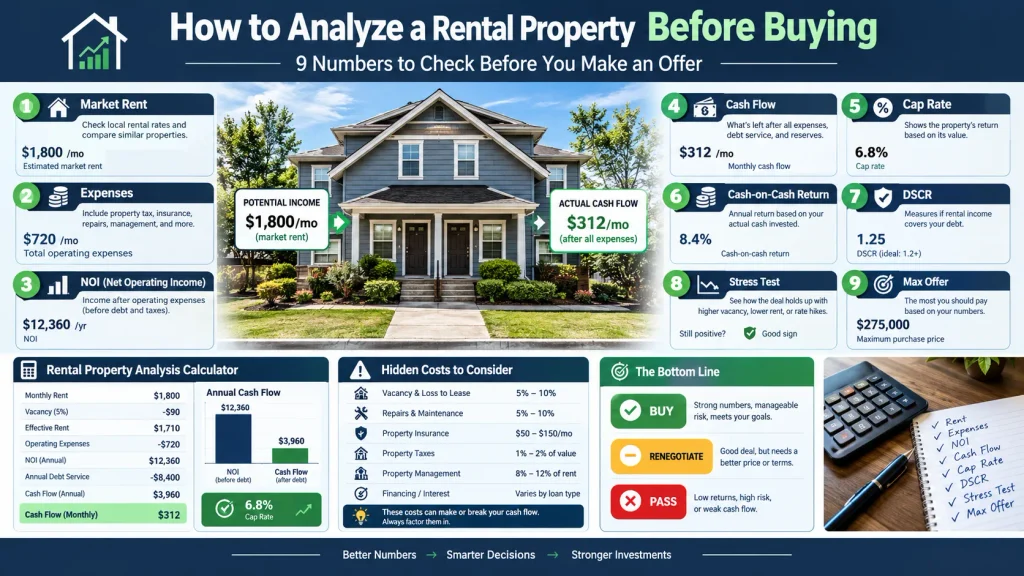
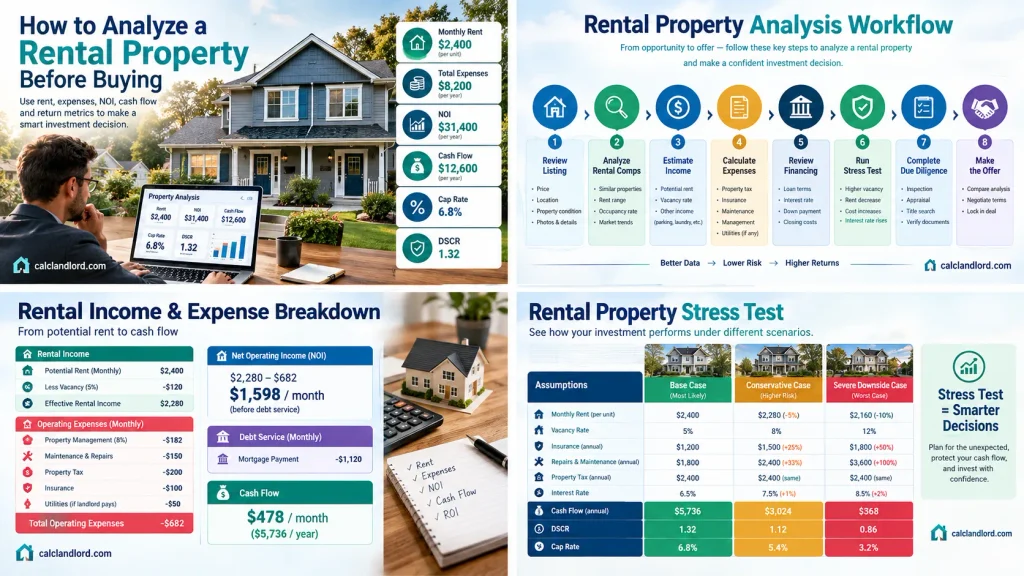
The 12-step rental property analysis workflow
| Step | What to analyze |
| 1 | Define your investment strategy |
| 2 | Analyze the market and neighborhood |
| 3 | Estimate realistic market rent |
| 4 | Build the income model |
| 5 | Forecast operating expenses |
| 6 | Calculate NOI and cash flow |
| 7 | Calculate return and valuation metrics |
| 8 | Stress-test the assumptions |
| 9 | Calculate your maximum offer price |
| 10 | Complete physical and financial due diligence |
| 11 | Reconcile seller information with independent records |
| 12 | Decide whether to buy, renegotiate, or pass |
What Information Do You Need Before Buying?
Do not begin with a return percentage. Begin by collecting the inputs that determine that return.
At minimum, gather:
- Asking price and expected purchase price
- Estimated closing costs
- Current rent roll
- Existing leases
- Recent rental comps
- Property taxes
- Insurance quote
- HOA or condominium fees, if applicable
- Seller’s trailing-12-month operating statement
- Utility bills
- Repair and maintenance history
- Property management costs
- Leasing and turnover costs
- Financing terms
- Expected down payment
- Interest rate
- Loan term
- Planned initial repairs
- Capital expenditure reserves
- Required cash reserves
- Property condition information
- Zoning and rental-license information
- Relevant local landlord requirements
The more of these items that are estimates rather than verified numbers, the more uncertainty exists in your analysis.
Step 1: Define Your Investment Strategy
There is no single definition of a “good” rental property.
A property that produces modest current cash flow could fit a long-term appreciation strategy. The same property might not work for an investor whose primary objective is immediate income.
Start by defining what you are trying to accomplish.
Cash flow versus appreciation
A cash-flow investor generally focuses heavily on the relationship between rent, operating expenses, debt service, and the cash left over each month.
An appreciation-focused investor may tolerate lower current cash flow because the strategy includes long-term value growth.
Neither approach changes the need for accurate underwriting.
You still need to know:
- What the property earns today
- What it costs today
- What the financing costs
- What assumptions drive future returns
- What happens if the assumptions fail
Buy-and-hold
For a long-term rental, analyze:
- Stabilized rent
- Vacancy and collection loss
- Operating expenses
- Property condition
- Financing
- Long-term capital expenditures
- Insurance risk
- Property taxes
- Local rental demand
- Potential rent growth
Value-add and BRRRR
A value-add property requires another layer of analysis.
You need to estimate:
- Acquisition cost
- Renovation budget
- Financing costs
- Holding costs
- Stabilized rent
- After-repair value
- Refinance assumptions
- Cash remaining after refinance
- Required reserves
Do not assume that a renovation automatically creates enough value to justify the purchase price.
House hacking
For a house hack, separate the economics of the owner-occupied portion from the units or rooms generating rental income.
Your analysis should answer:
How much of my housing cost is actually being offset by rental income, and what happens after vacancy, repairs, and unexpected costs?
Set your minimum requirements
Before comparing properties, establish your own requirements for:
- Minimum cash reserves
- Maximum monthly investment
- Maximum acceptable negative cash flow
- Minimum debt-service coverage
- Maximum renovation exposure
- Acceptable management workload
- Acceptable geographic and property risk
This prevents a particularly attractive listing from changing your criteria halfway through the analysis.
Step 2: Analyze the Market and Neighborhood
A spreadsheet can tell you what happens if the rent is $2,000.
It cannot tell you whether tenants will actually pay $2,000.
Market analysis helps determine whether your income assumptions have a reasonable foundation.
Measure rental demand
Look at:
- Comparable rentals
- Occupancy patterns
- Days on market
- Tenant turnover
- New rental supply
- Competing properties
- Unit type
- Bedroom and bathroom configuration
- Parking
- Amenities
- Property condition
A property with strong projected rent but weak tenant demand deserves additional scrutiny.
Study employment, population, and income trends
Consider the economic drivers supporting rental demand.
For example:
- Major employers
- Employment concentration
- Population changes
- Household income
- New businesses
- Planned infrastructure
- University or hospital presence
- Transportation access
The objective is not to predict the future perfectly. It is to understand what currently supports tenant demand and what could weaken it.
Evaluate tenant appeal
Two properties with identical rents can have very different tenant demand.
Consider:
- School district
- Public transportation
- Shopping
- Restaurants
- Parks
- Healthcare
- Major roads
- Walkability
- Parking
- Outdoor space
- Laundry
- Storage
- Security features
- Neighborhood condition
Visit the area at different times of day when practical. A neighborhood can look very different at 8 a.m., 6 p.m., and late at night.
Check vacancy and turnover
A property’s advertised rent does not tell you how frequently units sit vacant.
Ask:
- How long do comparable properties remain available?
- How often do tenants move?
- Are there seasonal leasing patterns?
- Are landlords offering concessions?
- Is new supply entering the submarket?
- Are competing properties lowering rents?
A higher nominal rent can be less attractive if it requires frequent turnover or extended lease-up periods.
Investigate future development
Look for:
- New apartment developments
- Commercial projects
- Road expansions
- Transit projects
- Zoning changes
- Planned infrastructure
- Major employer moves
- Large redevelopment projects
Future development can create opportunity, but it can also increase rental competition.
Check local landlord rules
Rental-property analysis is not purely financial.
Verify applicable rules regarding:
- Rental licensing
- Registration
- Inspections
- Occupancy limits
- Security deposits
- Notice requirements
- Rent restrictions
- Local property taxes
- Short-term rentals
- Housing standards
- Lead or safety requirements where applicable
Rules vary by state and municipality, so use the relevant government sources and qualified local professionals when necessary.
Step 3: Estimate Market Rent Correctly
Rent is often the most important assumption in a rental property analysis.
It is also one of the easiest numbers to overestimate.
How to find reliable rental comps
A good comparable rental should be similar in:
- Neighborhood or submarket
- Property type
- Bedrooms
- Bathrooms
- Square footage
- Age
- Condition
- Parking
- Outdoor space
- Appliances
- Utilities included
- Amenities
Do not automatically choose the three highest advertised rents and call them your comps.
Asking rent versus achieved rent
An advertised rental price shows what a landlord wants.
It does not necessarily show what tenants actually agreed to pay.
Where available, investigate:
- Recently leased properties
- Lease dates
- Actual lease terms
- Days on market
- Concessions
- Free-rent incentives
- Included utilities
- Furnished versus unfurnished status
Adjust for differences
Suppose your property has:
- Older appliances
- No garage
- Smaller bedrooms
- No laundry
- Less outdoor space
A nearby renovated property renting for $2,300 may not be a valid basis for assigning your property a $2,300 rent.
Adjust your estimate for actual differences.
Account for seasonality
Rental demand can change throughout the year.
Depending on the market, leasing may be easier during certain months and slower during others.
Your underwriting should not assume immediate lease-up at the highest observed rent.
Verify the estimate
A useful additional check is asking a local property manager or leasing professional:
“What rent would you realistically list this property for today, and what rent would you expect it to actually lease for?”
Compare that answer with your comp set rather than accepting it blindly.
Use a conservative rent assumption
When several reasonable numbers exist, do not make the deal dependent on the most optimistic one.
For example:
| Rent Scenario | Monthly Rent | Annual Rent |
| Conservative | $1,850 | $22,200 |
| Base | $1,950 | $23,400 |
| Optimistic | $2,050 | $24,600 |
The difference between $1,850 and $2,050 is only $200 per month, but over a year it represents $2,400 of gross rent per unit.
On a leveraged property, that difference can materially affect cash flow.
Step 4: Build the Income Model
Do not stop at monthly rent.
A useful rental income model moves from potential income to effective income.
Potential gross rental income
If a property has two units renting for $1,900 per month:
$1,900×2×12=$45,600\$1,900 \times 2 \times 12 = \$45,600
That is potential gross rental income before vacancy, collection losses, and other adjustments.
Add recurring other income
Depending on the property, other income could include:
- Parking
- Storage
- Laundry
- Pet rent
- Utility reimbursements
- Certain other tenant charges where legally permitted
Only include income that is realistically recurring.
Do not capitalize a one-time fee as though it were permanent annual income.
Subtract vacancy and collection loss
Suppose potential gross income is $45,600 and you use a 5% vacancy and collection-loss assumption:
$45,600×5%=$2,280\$45,600 \times 5\% = \$2,280
That leaves:
$45,600−$2,280=$43,320\$45,600-\$2,280=\$43,320
Account for concessions and bad debt
Potential rent is not the same as collected rent.
Depending on the property and market, you may need to account for:
- Free-rent promotions
- Move-in concessions
- Uncollected rent
- Delinquencies
- Lease-up losses
- Owner-paid utilities
Effective Gross Income
A practical model is:
Effective Gross Income=Potential Gross Income+Other Income−Vacancy−Collection Loss−Concessions\text{Effective Gross Income} = \text{Potential Gross Income} + \text{Other Income} – \text{Vacancy} – \text{Collection Loss} – \text{Concessions}
This approach helps prevent an inflated revenue estimate.
Rental-income example
Suppose a duplex has the following assumptions:
| Income Item | Annual Amount |
| Unit 1 rent | $22,800 |
| Unit 2 rent | $22,800 |
| Parking/storage/other income | $1,200 |
| Potential gross income | $46,800 |
| Vacancy & collection loss (5%) | -$2,340 |
| Effective gross income | $44,460 |
Your analysis should now use $44,460, not $46,800, as the operating income basis.
Step 5: Forecast Every Operating Expense
Underestimating expenses is one of the easiest ways to make a bad property look profitable.
A complete rental-property expense model should include both recurring operating expenses and realistic reserves for future capital needs.
Fixed expenses
Typical fixed or relatively predictable expenses may include:
| Expense | Example Annual Cost |
| Property taxes | $5,400 |
| Landlord insurance | $2,400 |
| HOA/condo fees | $0–variable |
| Licenses/recurring permits | $300 |
| Subtotal | $8,100+ |
These are examples, not universal benchmarks.
Property taxes, insurance, and local fees can vary substantially by location and property type.
Variable expenses
Consider:
- Property management
- Leasing fees
- Repairs
- Routine maintenance
- Utilities
- Landscaping
- Pest control
- Snow removal
- Advertising
- Turnover
- Make-ready costs
- Accounting
- Legal costs
- Software
- Banking fees
A property that appears inexpensive to operate because the seller self-manages it should still be modeled as though professional management is required, particularly when comparing it with other investments.
Capital expenditures and reserves
Capital expenditures are not the same as routine maintenance.
Examples include:
- Roof replacement
- HVAC replacement
- Major plumbing work
- Electrical upgrades
- Exterior work
- Appliances
- Windows
- Parking surfaces
- Large flooring replacements
An investor may have little or no major capital spending in a particular year. That does not mean those costs disappear.
Build an appropriate reserve based on the property’s condition, age, systems, and expected replacement cycle.
Expenses sellers commonly understate
Be cautious when you see:
- Zero maintenance
- Zero vacancy
- Extremely low insurance
- No management expense
- No turnover costs
- Outdated property tax figures
- Missing utilities
- No capital reserve
- No leasing expense
- Unrealistically low repair assumptions
The absence of an expense in the seller’s spreadsheet does not prove that the expense does not exist.
Verify the numbers
Where possible, compare expense assumptions with:
- Tax records
- Insurance quotes
- Seller statements
- Utility bills
- Vendor invoices
- Service contracts
- HOA documents
- Local market data
- Property-management estimates
A trailing-12-month operating statement is particularly useful, but it should still be reconciled with other records.
Step 6: Calculate NOI and Cash Flow
Once income and operating expenses are modeled, calculate the property’s operating performance.
Net Operating Income
The basic formula is:
NOI=Effective Gross Income−Operating Expenses\text{NOI} = \text{Effective Gross Income} – \text{Operating Expenses}
NOI measures property performance before financing costs and income taxes.
Using the example above:
- Effective gross income: $44,460
- Operating expenses: $19,657
Therefore:
$44,460−$19,657=$24,803\$44,460-\$19,657=\$24,803
NOI = $24,803
What is included in operating expenses?
Operating expenses generally relate to running the property.
They may include:
- Taxes
- Insurance
- Management
- Maintenance
- Utilities paid by the owner
- Landscaping
- Pest control
- Leasing
- Turnover
- Licenses
- HOA expenses
Debt principal and interest are not operating expenses used to calculate traditional NOI.
Debt service
After NOI, analyze financing.
Debt service may include the periodic principal and interest required under the loan. Depending on the financing structure, there may also be mortgage insurance or other financing-related costs that should be modeled separately.
For example, assume:
- Purchase price: $425,000
- Down payment: 25%
- Loan: $318,750
- Interest rate: 7%
- Term: 30 years
The annual principal-and-interest debt service is approximately $25,448 under those assumptions.
Cash flow
A basic pre-tax cash-flow formula is:
Cash Flow=NOI−Annual Debt Service\text{Cash Flow} = \text{NOI} – \text{Annual Debt Service}
Using the example:
$24,803−$25,448≈−$645\$24,803-\$25,448\approx-\$645
That means the modeled property produces approximately -$645 per year, or about -$54 per month, before considering income taxes and any additional owner-specific cash items.
This illustrates an important point:
A property can have positive NOI and still have negative cash flow after financing.
Capital reserves may not be included in formal NOI, but they should still be included in your practical cash planning.
Break-even occupancy
Break-even occupancy estimates how much occupancy is required for the property’s income to cover its relevant fixed costs.
A simplified version is:
Break-even Occupancy=Fixed CostsPotential Gross Income\text{Break-even Occupancy} = \frac{\text{Fixed Costs}}{\text{Potential Gross Income}}
The exact treatment depends on how you classify expenses and debt service.
This metric is especially useful for understanding how vulnerable a property is to vacancy.
Step 7: Calculate the Key Investment Metrics
One return metric rarely tells the whole story.
Use several metrics together.
| Metric | Formula | What It Tells You | Main Limitation |
| NOI | EGI − operating expenses | Property performance before financing | Ignores debt |
| Cap rate | NOI ÷ property price | Unleveraged yield | Ignores financing and future changes |
| Cash flow | NOI − debt service | Cash left after financing | Can change with loan terms |
| Cash-on-cash return | Annual pre-tax cash flow ÷ cash invested | Return on actual cash invested | Ignores some long-term value changes |
| DSCR | NOI ÷ annual debt service | Ability of property income to cover debt | Lenders may use different conventions |
| GRM | Purchase price ÷ gross annual rent | Quick valuation screen | Ignores expenses |
| ROI | Return ÷ investment | Broad return measure | Definition can vary |
| IRR | Discount rate producing zero NPV | Time-weighted investment return | Highly assumption-sensitive |
Cap rate
The basic formula is:
Cap Rate=NOIPurchase Price\text{Cap Rate} = \frac{\text{NOI}}{\text{Purchase Price}}
Using the example:
$24,803$425,000≈5.84%\frac{\$24,803}{\$425,000} \approx5.84\%
A cap rate should generally be compared with similar properties in the same market and time period.
A higher cap rate is not automatically better. It may reflect higher property, tenant, neighborhood, physical, or income risk.
Cash-on-cash return
The common formula is:
Cash-on-Cash Return=Annual Pre-Tax Cash FlowTotal Cash Invested\text{Cash-on-Cash Return} = \frac{\text{Annual Pre-Tax Cash Flow}} {\text{Total Cash Invested}}
Total cash invested can include:
- Down payment
- Closing costs
- Initial repairs
- Immediate improvements
- Other acquisition cash requirements
Be consistent about what you include.
DSCR
The basic formula is:
DSCR=NOIAnnual Debt Service\text{DSCR} = \frac{\text{NOI}} {\text{Annual Debt Service}}
For the example:
$24,803$25,448≈0.97\frac{\$24,803}{\$25,448} \approx0.97
A ratio below 1.00 means NOI does not fully cover the modeled debt service.
Lenders may calculate DSCR differently depending on the loan and underwriting policy, so always check the lender’s definition.
Gross Rent Multiplier
The formula is:
GRM=Purchase PriceGross Annual Rent\text{GRM} = \frac{\text{Purchase Price}} {\text{Gross Annual Rent}}
GRM is useful as a quick screen, but it ignores expenses.
A property can have an attractive GRM and poor actual cash flow.
ROI
ROI is often calculated as:
ROI=ReturnInvestment\text{ROI} = \frac{\text{Return}} {\text{Investment}}
However, investors use different definitions of “return” and “investment.”
Always state exactly what you are measuring.
IRR and total return
IRR can incorporate multiple cash flows over time, including:
- Initial investment
- Annual cash flow
- Principal paydown
- Sale proceeds
- Selling costs
IRR can be useful for comparing different holding periods, but it is highly sensitive to assumptions about rent growth, appreciation, refinancing, sale price, and timing.
Do not let a projected IRR obscure weak current operations.
Equity buildup and principal paydown
Part of each mortgage payment may reduce loan principal.
That creates equity over time, even when the property’s market value remains unchanged.
For a long-term investor, total wealth creation may come from a combination of:
- Cash flow
- Principal paydown
- Appreciation
- Tax effects
- Other income
These should be analyzed separately rather than lumped into one optimistic return assumption.
Step 8: Stress-Test the Deal
A rental property should not be tested only under perfect conditions.
Build at least three scenarios.
Base case
Use realistic assumptions for:
- Rent
- Vacancy
- Expenses
- Financing
- Repairs
- Capital reserves
Conservative case
For example:
- Rent 5% below your estimate
- Higher vacancy
- Higher maintenance
- Higher insurance
- Higher property taxes
- Additional turnover costs
Severe downside case
Model a combination of problems such as:
- Two months of vacancy
- Major HVAC replacement
- Roof repair
- Higher insurance
- Higher property taxes
- Lower achieved rent
- Large tenant turnover expense
- Higher financing costs at refinance
The point is not to predict exactly what will happen.
The point is to determine whether the investment has enough margin for error.
Example sensitivity analysis
Suppose your base annual cash flow is approximately -$645.
Now change one assumption at a time:
| Stress Test | Possible Effect |
| Rent 5% below estimate | Lower effective income |
| Vacancy increases from 5% to 10% | Lower collected rent |
| Repairs increase 25% | Higher operating expenses |
| Insurance increases 20% | Higher fixed expenses |
| Property taxes reassessed upward | Higher fixed expenses |
| Major HVAC replacement | Large one-time cash requirement |
| Two-month vacancy | Temporary revenue loss |
| New-tenant concession | Reduced effective rent |
| Refinance at a higher rate | Higher debt service |
If a deal works only when every assumption is favorable, its margin of safety is thin.
Step 9: Calculate the Maximum Offer Price
Do not ask only:
“Is this property a good investment at the asking price?”
Ask:
“What is the highest price at which this property meets my investment requirements?”
That is a much more useful underwriting question.
Maximum price based on target cap rate
The basic formula is:
Maximum Price=Stabilized NOITarget Cap Rate\text{Maximum Price} = \frac{\text{Stabilized NOI}} {\text{Target Cap Rate}}
For example, if stabilized NOI is $24,803, and your target cap rate is 7%:
$24,8030.07≈$354,329\frac{\$24,803}{0.07} \approx \$354,329
That does not automatically mean you should offer $354,329.
You still need to account for:
- Immediate repairs
- Closing costs
- Financing
- Required reserves
- Property condition
- Market value
- Competition
- Due-diligence findings
Maximum price based on cash flow
A cash-flow-based offer asks:
At what purchase price does the property’s projected cash flow meet my required minimum?
The answer depends on:
- Purchase price
- Loan-to-value
- Interest rate
- Loan term
- Closing costs
- Operating expenses
- Rent
- Vacancy
- Reserves
A calculator or spreadsheet is particularly useful here because changing the purchase price also changes the financing amount and debt service.
Maximum price based on cash-on-cash return
The same principle applies to cash-on-cash return.
You can solve for the purchase price that allows the investment to reach your required return based on the amount of cash invested and the financing structure.
Subtract repairs and account for reserves
Suppose a property meets your target at one price before repairs.
If it requires $25,000 of immediate work, the practical acquisition economics have changed.
Your underwriting should reflect the all-in project cost, not just the seller’s asking price.
Build an offer range
Real estate rarely rewards false precision.
Instead of treating one spreadsheet output as the exact “right” price, consider an offer range based on:
- Base-case valuation
- Conservative valuation
- Repair exposure
- Financing
- Market evidence
- Required return
- Required reserves
Step 10: Complete Physical and Financial Due Diligence
A spreadsheet cannot uncover every property problem.
Complete contractual due diligence before your deadlines expire.
Physical inspection
Use an appropriately qualified inspector and investigate, as relevant:
- Roof
- HVAC
- Plumbing
- Electrical
- Foundation
- Drainage
- Exterior
- Windows
- Appliances
- Moisture
- Mold
- Pests
- Sewer
The property’s age and condition should influence your reserve assumptions.
Permits, zoning, and code compliance
Verify:
- Permitted use
- Number of legal units
- Building permits
- Rental license
- Certificate of occupancy where applicable
- Code violations
- Zoning restrictions
- Unpermitted additions
An “extra bedroom” or “finished basement” in a listing does not necessarily mean it is legally recognized as living space.
Title and ownership
Review, as applicable:
- Title
- Liens
- Easements
- Survey
- Property boundaries
- Ownership records
- Restrictions
For material legal questions, use the appropriate local professional rather than relying solely on an online article.
Leases and tenants
For an occupied rental, review:
- Lease agreements
- Rent roll
- Security deposits
- Payment history
- Delinquencies
- Notices
- Tenant disputes
- Move-in records
- Lease expiration dates
- Tenant concessions
The rent on a spreadsheet matters less than the rent supported by actual lease and payment records.
Reconcile seller data
Compare the seller’s information across multiple records:
| Record | What to Compare |
| Listing | Price, rent, unit count |
| Rent roll | Current tenants and rents |
| Leases | Contracted rent and terms |
| Bank deposits | Actual collections |
| T-12 statement | Historical operating income and expenses |
| Tax records | Property tax liability |
| Utility bills | Owner-paid utility costs |
| Vendor invoices | Repairs and maintenance |
| Insurance declarations | Coverage and premium |
| HOA documents | Fees and assessments |
A seller’s pro forma is an assumption set, not independently verified performance.
Insurance and environmental risk
Get an insurance quote before your due diligence period expires.
Check for:
- Flood exposure
- Wind exposure
- Fire risk
- Earthquake risk where relevant
- Coverage exclusions
- Deductibles
- Property-specific hazards
Insurance costs can materially affect rental economics, especially when the property’s historical premium is no longer representative of current coverage requirements.
HOA or condominium documents
For applicable properties, review:
- Current dues
- Special assessments
- Rental restrictions
- Pet restrictions
- Litigation
- Financial health
- Pending projects
- Rules affecting leasing
Rental Property Red Flags
1. The seller’s rent is above market
If the seller’s claimed rent is materially higher than comparable properties, verify it before using it in your underwriting.
2. Expenses appear unusually low
Zero maintenance, zero vacancy, and unusually low insurance should trigger questions.
3. Cosmetic renovations hide deferred maintenance
New flooring and fresh paint do not prove that the roof, HVAC, plumbing, electrical systems, or foundation are in good condition.
4. Occupancy is high, but collections are weak
A property can show 100% occupancy while producing less cash than expected because of:
- Delinquencies
- Discounts
- Concessions
- Nonpayment
- Write-offs
5. Taxes or insurance are about to change
Do not automatically carry the seller’s current cost into your future budget.
Check the expected cost under the new ownership and policy circumstances.
6. Appreciation is doing all the work
Be cautious when a property is difficult to justify using current income and expenses, but the projected return becomes attractive only after assuming significant appreciation.
7. Unpermitted units or additions
Legal unit count matters.
An unpermitted basement apartment may appear extremely profitable until the local authority requires changes or prohibits the use.
8. Short-term rental income is uncertain
If the deal depends on short-term rental revenue, verify local rules, licensing, building restrictions, HOA rules, and other applicable requirements.
9. Vague growth assumptions justify negative cash flow
“Rent will probably rise” is not an underwriting model.
Document the assumptions and stress-test them.
Full Worked Example: Analyzing a Duplex Before Buying
Consider this fictional property:
Property and financing assumptions
| Item | Assumption |
| Property type | Duplex |
| Purchase price | $425,000 |
| Down payment | 25% |
| Loan amount | $318,750 |
| Interest rate | 7% |
| Loan term | 30 years |
| Unit 1 rent | $1,900/month |
| Unit 2 rent | $1,900/month |
| Other recurring income | $100/month |
| Vacancy & collection loss | 5% |
Income
Annual base rent:
$1,900×2×12=$45,600\$1,900\times2\times12=\$45,600
Other annual income:
$100×12=$1,200\$100\times12=\$1,200
Potential gross income:
$45,600+$1,200=$46,800\$45,600+\$1,200=\$46,800
Vacancy and collection loss:
$46,800×5%=$2,340\$46,800\times5\%=\$2,340
Effective gross income:
$46,800−$2,340=$44,460\$46,800-\$2,340=\$44,460
Operating expenses
| Expense | Annual Amount |
| Property taxes | $5,400 |
| Insurance | $2,400 |
| Property management | $3,557 |
| Repairs and maintenance | $2,500 |
| Capital reserve | $2,500 |
| Utilities | $1,200 |
| Landscaping/pest control | $1,000 |
| Turnover/leasing | $800 |
| Licenses | $300 |
| Total | $19,657 |
NOI
$44,460−$19,657=$24,803\$44,460-\$19,657=\$24,803
NOI = $24,803
Cap rate
$24,803$425,000≈5.84%\frac{\$24,803}{\$425,000} \approx5.84\%
Debt service
Annual principal and interest is approximately:
$25,448\$25,448
Cash flow
$24,803−$25,448=−$645\$24,803-\$25,448=-\$645
The property therefore has approximately -$645 in annual pre-tax cash flow under this particular financing and operating model.
DSCR
$24,803$25,448≈0.97\frac{\$24,803}{\$25,448} \approx0.97
What changes if the purchase price changes?
Holding the other assumptions constant, a lower purchase price reduces the loan amount and debt service.
| Purchase Price | 25% Down | Approx. Annual P&I at 7% | Approx. Cash Flow* |
| $425,000 | $106,250 | $25,448 | -$645 |
| $400,000 | $100,000 | $23,951 | $852 |
| $390,000 | $97,500 | $23,352 | $1,451 |
*Illustrative calculation using the same example NOI for comparison. In a real underwriting model, property taxes, insurance, closing costs, repairs, and other price-dependent assumptions should be adjusted where appropriate.
This is why purchase price is not just a negotiation issue. It can fundamentally change the investment’s economics.
Rental Property Analysis Spreadsheet
A spreadsheet does not need to be complicated.
It needs to be complete and transparent.
Suggested spreadsheet sections
Property information
- Address
- Property type
- Units
- Square footage
- Year built
- Asking price
- Offer price
- Expected closing date
Acquisition
- Purchase price
- Closing costs
- Initial repairs
- Renovation budget
- Financing fees
- Initial reserve
- Total acquisition cash
Income
- Unit 1 rent
- Unit 2 rent
- Additional units
- Parking
- Storage
- Laundry
- Pet rent
- Utility reimbursements
- Vacancy
- Collection loss
- Concessions
- Effective gross income
Operating expenses
- Property taxes
- Insurance
- HOA
- Management
- Leasing
- Repairs
- Maintenance
- Utilities
- Landscaping
- Pest control
- Turnover
- Licenses
- Legal
- Accounting
- Advertising
- Capital reserves
Financing
- Loan amount
- Down payment
- Interest rate
- Loan term
- Monthly principal and interest
- Annual debt service
- Mortgage-related fees
- Refinance assumptions
Return metrics
- NOI
- Cap rate
- Cash flow
- Cash-on-cash return
- DSCR
- GRM
- ROI
- IRR
- Equity buildup
Stress tests
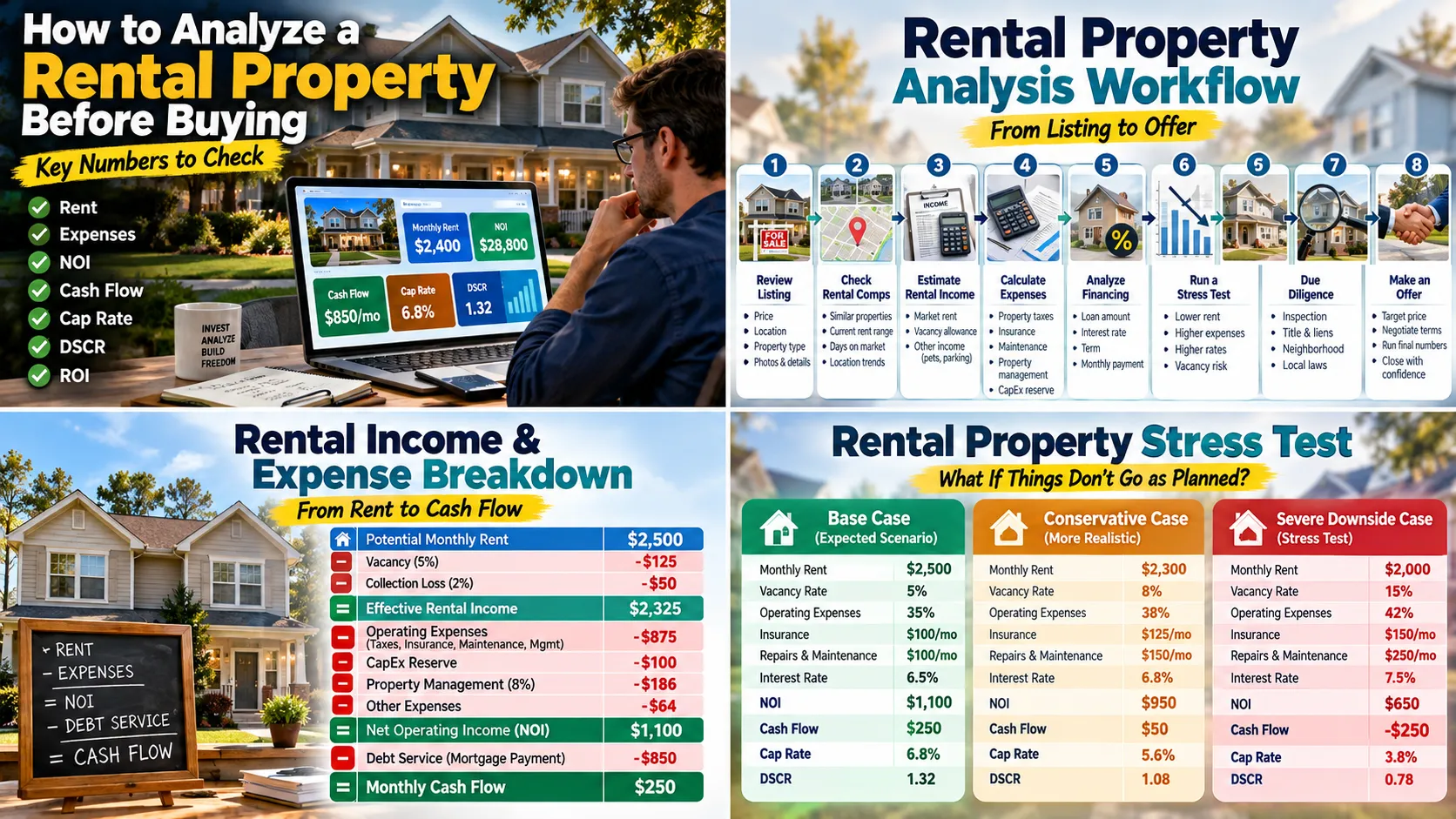
Create separate columns for:
- Base
- Conservative
- Severe downside
This makes it easier to see which assumptions are responsible for the investment’s performance.
Avoid double-counting expenses
A common spreadsheet mistake is counting the same cost twice.
For example, if your management fee already includes leasing, do not add a separate leasing fee unless the manager actually charges it separately.
Likewise, make sure your treatment of:
- Taxes
- Insurance
- Mortgage escrow
- Maintenance
- Capital reserves
- Utilities
is consistent throughout the model.
How to Use a Rental Property Calculator
Once you have verified your assumptions, a rental property calculator can speed up the repetitive math.
A useful calculator should help you evaluate:
- Purchase price
- Down payment
- Financing
- Rental income
- Vacancy
- Operating expenses
- NOI
- Debt service
- Cash flow
- Cap rate
- Cash-on-cash return
- DSCR
- Other key deal metrics
The calculator is most valuable when it is fed with realistic numbers.
A calculator can calculate a bad assumption perfectly.
Before relying on the output, validate the rent, taxes, insurance, repairs, vacancy, financing, and property condition.
Use the Calclandlord rental property calculator to turn your verified assumptions into a consistent deal analysis rather than calculating every scenario manually.
The 1% Rule and 2% Rule: Should You Use Them?
The 1% and 2% rules are rough screening heuristics sometimes used by investors.
For example, the 1% rule broadly compares monthly rent with purchase price.
A $300,000 property producing $3,000 in monthly rent would equal 1%.
But passing the 1% rule does not prove that a property is profitable.
Consider:
- Property taxes
- Insurance
- Management
- Maintenance
- Vacancy
- Utilities
- Debt service
- Capital expenditures
- Financing terms
A property can pass a rent-to-price screen and still lose money.
The same logic applies to the 2% rule. These shortcuts should be treated as initial filters, not complete investment analysis
How to Decide: Buy, Renegotiate, or Pass
The analysis should end with a decision framework, not just a return percentage.
Buy
A property may fit your strategy when:
- Income assumptions are supported
- Expenses are reasonably verified
- Financing works
- Reserves are adequate
- The property survives your downside scenarios
- Due diligence does not reveal unacceptable problems
- The price fits your underwriting
Renegotiate
A property may require a different price or terms when:
- Repairs are higher than expected
- Rent is lower than the seller’s projection
- Insurance costs more
- Property taxes are higher
- A major system is near replacement
- The seller’s records do not support the pro forma
- The deal works only below the asking price
Pass
Consider walking away when:
- Income cannot be verified
- The property fails your downside tests
- Required reserves are inadequate
- Major legal or zoning problems remain unresolved
- Physical defects exceed your risk tolerance
- The investment depends almost entirely on speculative appreciation
- The numbers fail to meet your own requirements
A “pass” is not necessarily a bad outcome. A property you do not buy does not create an unexpected vacancy, repair bill, financing problem, or tenant issue.
Common Rental Property Analysis Mistakes
Using the seller’s pro forma as fact
A pro forma is a projection.
Verify it against actual records.
Using the highest rent comp
The highest advertised rent is not automatically the achievable rent.
Ignoring vacancy
Even a well-performing rental can experience turnover and lease-up periods.
Forgetting capital expenditures
A roof does not care whether you included it in your spreadsheet.
Treating NOI as cash flow
NOI occurs before debt service.
Cash flow after financing is a different measurement.
Using the 1% rule as a profitability test
A rent-to-price shortcut ignores too many variables to replace underwriting.
Assuming current taxes will remain unchanged
Property-tax treatment and amounts can vary by jurisdiction and ownership circumstances.
Verify the applicable tax information.
Ignoring insurance
Get an actual insurance quote whenever possible.
Not modeling management
Self-management has a cost even if the cost is your time.
Overestimating appreciation
Appreciation can contribute to long-term return, but it should not be used to hide weak current economics.
Failing to stress-test
A base case is not enough.
You need to know how the investment behaves when assumptions deteriorate.
Rental Property Due-Diligence Checklist
Before closing, verify the items relevant to your property:
Property
- Professional inspection
- Roof condition
- HVAC condition
- Plumbing
- Electrical
- Foundation
- Drainage
- Sewer where appropriate
- Appliances
- Pest issues
- Moisture or mold concerns
Legal and regulatory
- Title search
- Liens
- Survey
- Zoning
- Permits
- Code violations
- Rental license
- Certificate of occupancy where applicable
- Local rental restrictions
Financial
- Rent roll
- Lease agreements
- Trailing-12-month statement
- Tax records
- Insurance quote
- Utility bills
- Repair invoices
- Service contracts
- HOA documents
- Pending assessments
Tenant-related
- Security deposits
- Payment history
- Delinquencies
- Notices
- Disputes
- Lease expiration dates
- Tenant concession
Risk
- Flood exposure
- Environmental concerns
- Disaster risk
- Insurance exclusions
- Major upcoming repairs
- Local market supply
- Future development
More Explore https://calclandlord.com/how-green-bonds-work-in-real-estate/
People Also Ask
How much cash flow should a rental property produce?
There is no universal monthly cash-flow target that makes a property automatically good.
The appropriate amount depends on:
- Purchase price
- Financing
- Market
- Property condition
- Risk
- Reserves
- Investment strategy
- Opportunity cost
Focus on whether the property meets your underwriting requirements and remains viable under reasonable downside assumptions.
What is a good cap rate?
There is no single cap rate that is universally “good.”
Cap rates should be compared with similar properties in the same market, asset type, and time period.
A higher cap rate can also reflect greater risk.
Is the 1% rule still useful?
Yes, as a quick screening heuristic.
No, as a complete investment test.
It does not account adequately for expenses, financing, vacancy, repairs, taxes, insurance, or capital expenditures.
Should I use gross rent or NOI?
Use gross rent when assessing the property’s revenue potential.
Use NOI when evaluating operating performance before financing.
They answer different questions.
What expenses should I include in rental-property analysis?
At minimum, consider:
- Property taxes
- Insurance
- Vacancy
- Management
- Repairs
- Maintenance
- Utilities
- HOA
- Leasing
- Turnover
- Licensing
- Capital reserves
- Other recurring property-specific expenses
The exact list depends on the property.
How much vacancy should I assume?
Use evidence from the local market and the property’s actual characteristics.
Consider:
- Local occupancy
- Similar properties
- Tenant demand
- Seasonality
- Unit type
- Condition
- Historical performance
Do not use an arbitrary vacancy percentage simply because it looks standard.
Should I include property appreciation?
Yes, when evaluating a long-term investment scenario.
But appreciation should be modeled as an assumption, not a certainty.
A property should not require aggressive appreciation projections just to justify the purchase.
How many properties should I analyze before buying?
Analyze enough comparable deals to understand the local relationship between price, rent, expenses, financing, and expected returns.
The objective is to recognize what normal looks like in the market rather than becoming attached to the first property that appears attractive.
When should I walk away from a rental property?
Walk away when the property fails requirements that matter to your strategy, such as:
- Unverified income
- Unacceptable physical problems
- Unresolved legal issues
- Insufficient reserves
- Poor downside performance
- Unsustainable financing
- Economics that do not work at a reasonable price
People Also Ask
Evaluate market rent, effective income, operating expenses, financing, NOI, cash flow, cap rate, cash-on-cash return, DSCR, property condition, risks, and downside scenarios. Then compare the result with your investment requirements.
At minimum, calculate effective gross income, operating expenses, NOI, annual debt service, cash flow, cap rate, cash-on-cash return, DSCR, total cash required, and several downside scenarios.
ROI depends on how you define the return and investment base. A simple approach is return divided by investment, but rental investors should specify whether the calculation includes cash flow, appreciation, principal paydown, sale proceeds, taxes, or other components.
There is no single number that answers every investment question. NOI measures property operations, cash flow measures cash remaining after financing, cap rate measures unleveraged yield, and cash-on-cash return measures return on invested cash.
A basic formula is:
Cash Flow=NOI−Annual Debt Service\text{Cash Flow} = \text{NOI} – \text{Annual Debt Service}
Your practical cash planning may also need to account for reserves, capital expenditures, and other owner-specific cash requirements.
NOI measures operating income after operating expenses but before financing.
Cash flow generally measures what remains after debt service.
One approach is:
Maximum Price=Stabilized NOITarget Cap Rate\text{Maximum Price} = \frac{\text{Stabilized NOI}} {\text{Target Cap Rate}}
You should then evaluate repairs, closing costs, financing, reserves, market evidence, and other acquisition costs before determining an offer.
Final Rental Property Analysis Checklist
Before making an offer, ask:
Market
- Do I understand local rental demand?
- Are my comps genuinely comparable?
- Is the property exposed to unusual supply or neighborhood risks?
Income
- Is my rent estimate conservative?
- Have I accounted for vacancy and collection loss?
- Are other income sources realistic and recurring?
Expenses
- Did I include taxes?
- Did I get an insurance quote?
- Did I include management?
- Did I budget repairs and turnover?
- Did I account for capital expenditures and reserves?
Financing
- What is the actual loan amount?
- What is the annual debt service?
- What happens if financing terms change?
Returns
- What is the NOI?
- What is the cap rate?
- What is the cash flow?
- What is the cash-on-cash return?
- What is the DSCR?
- What assumptions drive the result?
Stress test
- What happens if rent is lower?
- What happens if vacancy doubles?
- What happens if insurance rises?
- What happens if taxes increase?
- What happens when a major system fails?
Due diligence
- Does the physical property match the listing?
- Do leases support the rent roll?
- Do bank deposits support collections?
- Do expenses match the seller’s statements?
- Are the units legal?
- Are title, zoning, permits, insurance, and tenant issues resolved?
Offer
- What price meets my required return?
- What repairs should be reflected in the offer?
- How much cash must remain after closing?
- Does the deal still work without optimistic appreciation?
Conclusion
The best way to analyze a rental property before buying is to treat the purchase like an underwriting exercise rather than a search for a single attractive number.
Start with the market and realistic rent. Build effective income. Itemize every operating expense. Calculate NOI and debt service. Measure cash flow, cap rate, cash-on-cash return, and DSCR. Then stress-test the assumptions, determine the price that works for your strategy, and complete thorough physical, financial, legal, and tenant due diligence.
Most importantly, separate verified information from assumptions.
A listing can tell you what the seller wants.
A rent comp can tell you what similar properties are asking.
A spreadsheet can tell you what happens under your assumptions.
Only careful verification can tell you how much confidence you should place in those assumptions.
Use a rental property calculator to compare scenarios quickly, but never let a calculated result replace inspection, document review, local market research, or professional tax and legal advice.
