
Commercial Construction Loans: Rates, Requirements & How They Work
Commercial Construction Loans provide financing for building, expanding, or substantially renovating commercial real estate. Unlike a traditional commercial mortgage, construction financing is usually released in stages as work progresses rather than funded entirely at closing.
For lenders, the property is still being built, so underwriting goes beyond the real estate itself. The lender may evaluate the borrower’s financial strength, developer experience, general contractor, construction budget, project timeline, market conditions, projected completed value, loan-to-cost ratio (LTC), loan-to-value ratio (LTV), debt service coverage ratio (DSCR), and repayment strategy.
Whether you are developing a warehouse, office building, retail property, hotel, multifamily project, mixed-use property, or owner-occupied commercial building, understanding how commercial construction loans work can help you prepare a stronger financing package and manage project risk.
Quick answer: A commercial construction loan is generally short-term financing used to fund eligible construction or major renovation costs. The lender typically advances money through construction draws as specified work is completed and verified. When construction ends, the balance may be repaid through a sale, refinanced with permanent financing, or converted under a construction-to-permanent structure.
What Are Commercial Construction Loans?
A commercial construction loan is financing designed to help fund the development, construction, expansion, or substantial renovation of commercial real estate.
Instead of borrowing against an already completed and stabilized property, the borrower is financing a project that is still being developed.
Depending on the lender and loan structure, eligible costs may include:
- Land acquisition
- Site preparation
- Building materials
- Contractor labor
- Subcontractor expenses
- Architectural fees
- Engineering costs
- Permits
- Professional services
- Certain financing costs
- Construction-related interest
- Contingency reserves
- Other approved project expenses
The exact eligible uses vary by lender.
How construction financing differs from a commercial mortgage
A conventional commercial mortgage is generally designed to finance an existing property. A construction loan is designed around the process of creating or substantially improving the property.
The lender therefore has to consider two different questions:
- Can the project be completed as planned?
- Will the completed property provide sufficient value or cash flow to support repayment?
That makes construction financing highly dependent on project feasibility.
Construction lending is also a significant category within commercial real estate finance. Federal Reserve financial-account data separately tracks construction and land-development loans alongside other commercial real estate loans.
How Do Commercial Construction Loans Work?
Commercial construction loans usually follow a staged funding process.
The borrower does not normally receive the entire approved loan amount immediately. Instead, the loan commitment becomes available through construction draws.
A simplified process looks like this:
Application → Underwriting → Approval → Closing → Construction → Draw Requests → Inspections → Fund Releases → Completion → Repayment or Permanent Financing
Step 1: Project planning
The borrower establishes:
- Property type
- Location
- Land cost
- Construction scope
- Estimated project cost
- Construction schedule
- Expected completed value
- Expected revenue or sale proceeds
- Financing requirement
Step 2: Underwriting
The lender reviews both the borrower and the project.
This can include:
- Credit history
- Liquidity
- Net worth
- Financial statements
- Tax returns
- Developer experience
- Contractor qualifications
- Construction budget
- Plans and specifications
- Appraisal
- Market analysis
- Projected cash flow
- Exit strategy
Step 3: Loan closing
Once approved, the borrower closes the loan and contributes the required equity or other approved sources of funds.
Step 4: Construction draws
As eligible work is completed, the borrower submits draw requests.
The lender may review invoices, payment applications, inspections, lien waivers, updated budgets, and other documentation before releasing funds.
Step 5: Completion
Once construction is complete, the borrower may:
- Refinance
- Sell the property
- Stabilize and obtain permanent financing
- Convert the loan if structured as construction-to-permanent
- Repay the loan from another approved source
This staged structure is one of the defining characteristics of commercial construction financing.
What Can Commercial Construction Loans Pay For?
Eligible expenses depend on the lender, project, and loan agreement. A construction loan may cover several categories of project costs.
Land acquisition
Some Construction Loans can include the purchase of the development site.
Other lenders may require the borrower to already own the land or contribute it as equity.
Hard costs
Hard costs are expenses directly associated with physically constructing the property.
Examples include:
- Concrete
- Steel
- Lumber
- Electrical work
- Plumbing
- HVAC
- Roofing
- Site work
- Interior construction
- Contractor labor
- Construction materials
Soft costs
Soft costs are project expenses that are not directly related to physically building the structure.
They can include:
- Architecture
- Engineering
- Legal services
- Permits
- Consulting
- Project management
- Certain professional fees
- Approved financing expenses
Contingency
A construction budget may also include a contingency reserve for unexpected costs.
The appropriate amount depends on the project, construction stage, complexity, cost certainty, and lender requirements.
Costs that may not qualify
Not every project expense is automatically eligible.
For example, lenders may restrict:
- Nonessential furnishings
- Decorative expenses
- Certain operating expenses
- Unapproved change orders
- Costs outside the approved budget
Always confirm eligible uses before assuming an expense can be financed.
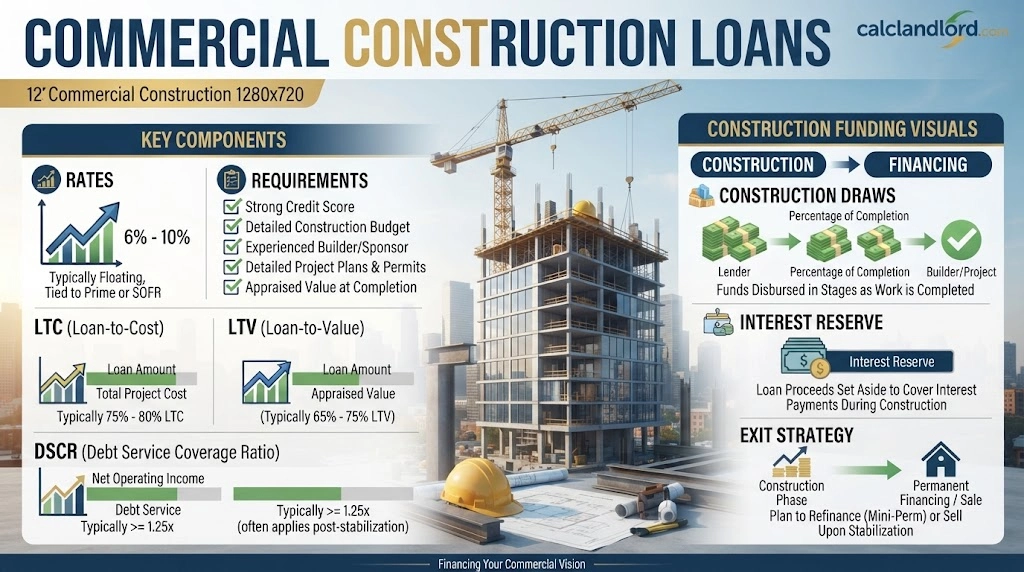
What Types of Commercial Construction Loans Are Available?
Different projects require different financing structures.
Standalone construction loan
A standalone construction loan covers the construction period and generally must be repaid or refinanced when the construction term ends.
This structure can provide flexibility, but the borrower needs a credible exit strategy before taking the loan.
Construction-to-permanent loan
A construction-to-permanent loan combines construction financing with longer-term financing.
After construction is completed and the applicable conditions are satisfied, the loan may convert into permanent financing.
The major advantage is that the borrower may avoid arranging a completely separate takeout loan.
Acquisition, development and construction financing
Some projects require financing for:
- Land acquisition
- Site development
- Construction
An acquisition, development and construction structure can combine these requirements into one broader project financing package.
SBA-backed financing
Eligible small businesses may also consider SBA financing for qualifying real-estate-related purposes.
SBA 7(a) loans can be used for acquiring, refinancing, or improving real estate and buildings, with a maximum loan amount of $5 million. SBA 504 financing is designed for major fixed assets and has a maximum SBA loan amount of $5.5 million, subject to program rules and eligibility.
The important point is that SBA financing is not automatically suitable for every commercial development. Property use, occupancy, borrower eligibility, project structure, and other SBA requirements matter.
How Much Can You Borrow for a Commercial Construction Project?
There is no universal commercial construction loan amount.
The maximum financing depends on factors such as:
- Total project cost
- Property value
- LTC
- LTV
- Borrower equity
- Borrower liquidity
- Developer experience
- Contractor strength
- Project feasibility
- Property type
- Market conditions
- Lender risk tolerance
- Exit strategy
A lender may evaluate both the cost of creating the property and the value of the completed asset.
Loan-to-cost example
Suppose:
- Total project cost = $10,000,000
- Construction loan = $7,000,000
The LTC is:
$7,000,000 ÷ $10,000,000 = 70% LTC
The remaining $3 million would need to come from qualifying equity or another permitted source.
Published lending guides commonly describe construction financing as covering a portion rather than 100% of total project costs, although the actual percentage is lender- and project-specific.
How Do LTC, LTV and DSCR Affect Construction Financing?
Three important concepts appear repeatedly in commercial construction underwriting:
- LTC
- LTV
- DSCR
Understanding the difference between them can make construction financing much easier to evaluate.
Loan-to-cost ratio (LTC)
LTC measures the loan against the total project cost.
LTC = Loan Amount ÷ Total Project Cost × 100
Example:
- Project cost = $12 million
- Loan = $8.4 million
LTC = 70%
LTC answers:
“How much of the project cost is the lender financing?”
Loan-to-value ratio (LTV)
LTV compares the loan amount with the relevant property value.
LTV = Loan Amount ÷ Property Value × 100
Suppose:
- Loan = $8.4 million
- Completed value = $14 million
LTV = 60%
LTV answers:
“How large is the loan compared with the property’s value?”
Federal banking guidance includes an 80% supervisory LTV limit for commercial, multifamily, and other nonresidential construction loans. That is a supervisory guideline, not a guarantee that a borrower can obtain an 80% LTV loan from an individual lender.
Debt service coverage ratio (DSCR)
DSCR measures the relationship between property income and debt service.
DSCR = Net Operating Income ÷ Annual Debt Service
For example:
- NOI = $1,200,000
- Annual debt service = $900,000
DSCR = 1.33x
During construction, the property may not yet generate stabilized operating income. Therefore, lenders may place significant emphasis on projected stabilized performance and the eventual repayment source.
Why all three matter
Consider a project with:
- $10 million cost
- $7 million loan
- $11 million completed value
The project has:
- 70% LTC
- 63.6% LTV
The lender can therefore analyze both construction cost and expected completed value rather than relying on one ratio.
What Are the Rates, Terms and Fees for Commercial Construction Loans?
There is no single commercial construction loan rate that applies to every borrower.
Pricing can vary according to:
- Credit quality
- Project risk
- Loan size
- LTC
- LTV
- Developer experience
- Contractor strength
- Property type
- Location
- Construction timeline
- Interest-rate environment
- Recourse structure
- Exit strategy
- Lender type
Current published guides give broad market examples rather than one universal rate. NerdWallet, for example, currently describes commercial construction rates as commonly ranging from about 5% to 13% or more, depending on borrower and project characteristics. These are market examples, not guaranteed quotes.
Construction loan terms
Construction financing is usually shorter-term than permanent commercial real estate financing.
Published guides commonly cite approximately six to 36 months, although the actual term depends on the construction schedule, project complexity, lender, and extension provisions.
Common fees
Potential costs include:
- Origination fees
- Underwriting fees
- Appraisal fees
- Inspection fees
- Legal fees
- Closing costs
- Extension fees
- Guarantee fees where applicable
- Construction administration fees
Do not compare offers solely by the interest rate.
A loan with a lower rate could still have a higher total financing cost if it includes substantial fees, restrictive draw conditions, or expensive extension provisions.
- Explore More: https://calclandlord.com/credit-approval-process/
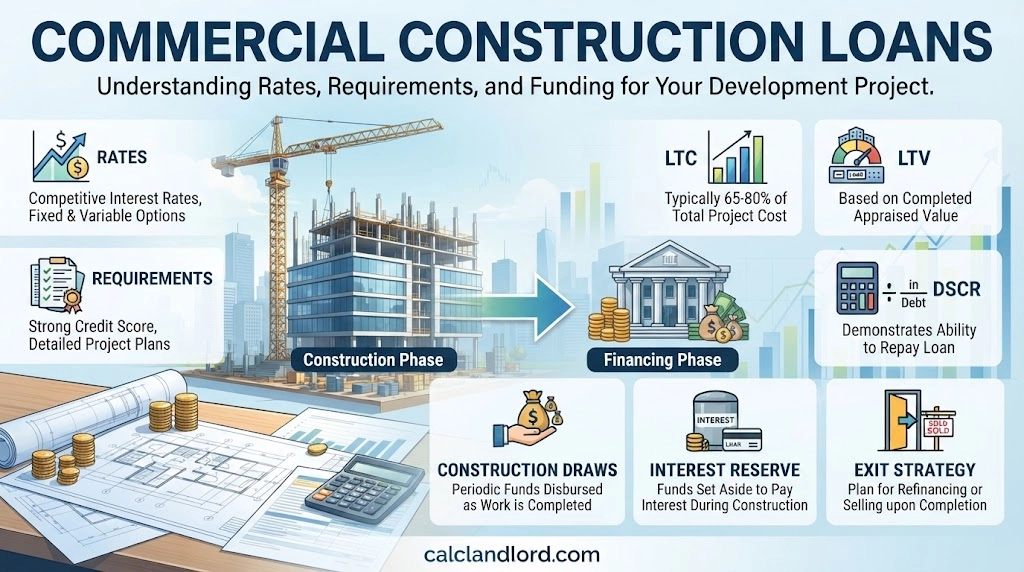
What Are the Requirements for a Commercial Construction Loan?
Requirements vary considerably among lenders.
However, construction lenders commonly examine five major areas.
1. Borrower financial strength
The lender may review:
- Credit history
- Personal financial statements
- Business financial statements
- Tax returns
- Liquidity
- Existing debt
- Net worth
- Guarantees
2. Developer experience
Development experience can be particularly important because construction involves execution risk.
A lender may ask:
- Have you completed comparable projects?
- Were previous developments completed on time?
- Did previous projects stay within budget?
- Have you managed similar loan sizes?
- Do you have an established lender history?
A first-time developer may strengthen an application by working with an experienced development partner, contractor, architect, or project management team.
3. General contractor
The lender may evaluate the contractor’s:
- Experience
- Licensing
- Financial strength
- Insurance
- Bonding
- References
- Previous projects
- Contract structure
4. Project feasibility
The lender needs evidence that the project makes economic sense.
That can include:
- Market analysis
- Appraisal
- Construction budget
- Timeline
- Leasing assumptions
- Sales assumptions
- Operating projections
- Permits
- Zoning
- Environmental information
5. Exit strategy
The lender will want to understand how the construction loan will be repaid.
Possible exits include:
- Permanent refinancing
- Construction-to-permanent conversion
- Sale of the completed property
- Stabilization followed by permanent financing
- Another approved repayment source
A strong construction loan application therefore needs both a construction plan and a repayment plan.
What Documents Do Lenders Need for Construction Financing?
A lender-ready application package should make it easy to understand both the borrower and the project.
Borrower documents
Common documents can include:
- Personal financial statement
- Business financial statements
- Tax returns
- Bank statements
- Organizational documents
- Existing debt schedule
- Asset and liability information
- Ownership information
Project documents
You may also need:
- Architectural plans
- Construction specifications
- Detailed project budget
- Construction schedule
- Contractor agreement
- Contractor qualifications
- Engineering information
- Permits
- Zoning documentation
- Property information
- Appraisal
- Environmental reports
- Market study
- Pro forma
- Sources-and-uses statement
Why consistency matters
Your documents should tell the same financial story.
For example, if the construction contract shows one amount but the project budget shows another, the lender may need additional explanation.
Likewise, your:
Budget + Sources & Uses + Construction Contract + Pro Forma + Loan Request
should be internally consistent.
A well-organized package can make underwriting easier and help identify problems before they become closing delays.
How Do Construction Loan Draws and Inspections Work?
Construction draws are one of the most important practical differences between construction financing and a conventional commercial mortgage.
Instead of receiving the full loan amount at closing, the borrower requests funds as eligible work progresses.
A simplified draw cycle is:
Construction Work → Draw Request → Documentation → Inspection/Review → Approval → Funds Released
What may be included in a draw request?
Depending on the lender, documentation can include:
- Contractor invoices
- Payment applications
- Updated budget
- Updated construction schedule
- Lien waivers
- Inspection reports
- Evidence of completed work
- Change-order documentation
Example draw
Suppose a $10 million project has a $7 million construction loan.
The borrower does not necessarily receive the full $7 million on day one.
Instead, the lender may release approved portions as construction milestones are completed.
For example:
| Construction Stage | Example Funding |
| Site work | $700,000 |
| Foundation | $900,000 |
| Structure | $1,500,000 |
| Mechanical/electrical | $1,200,000 |
| Interior work | $1,300,000 |
| Final work | $1,400,000 |
These figures are only an illustration; actual draw schedules vary.
Why draw administration matters
A construction project can experience cash-flow problems if a draw is delayed.
Borrowers should therefore understand:
- Required documents
- Inspection timing
- Approval procedures
- Lien-waiver requirements
- Draw fees
- Minimum draw amounts
- Retainage policies
- Change-order procedures
The lender’s exact draw process should be understood before closing.
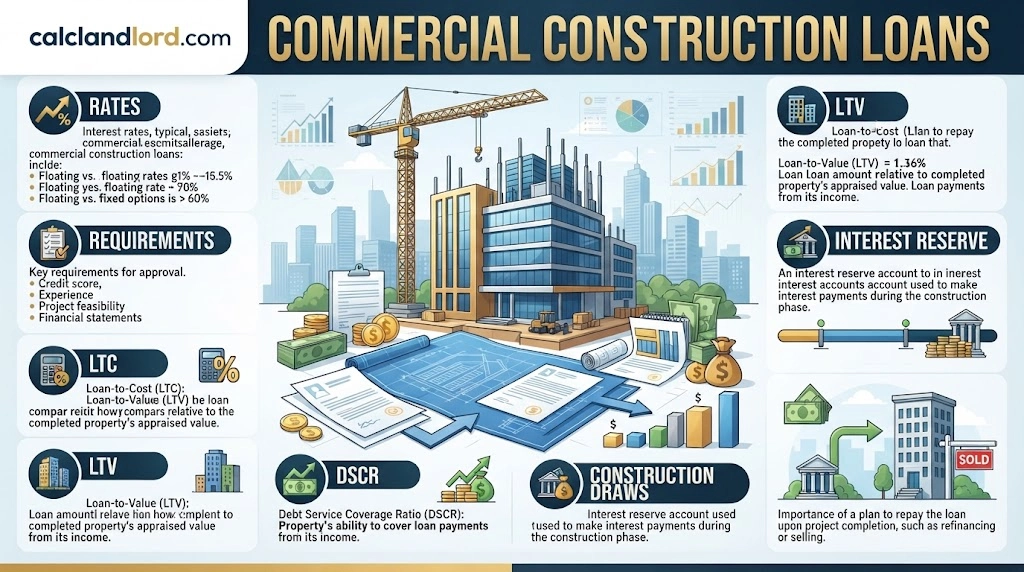
What Is a Construction Loan Interest Reserve?
An interest reserve is money included in the financing structure to cover eligible interest payments during the construction period.
This can be useful when the property is not yet generating sufficient operating income.
For example, a newly constructed building may have:
- No tenants
- No rental income
- No stabilized NOI
Yet the construction loan may still generate interest expense.
An interest reserve can be structured to address some or all of that eligible interest during construction, depending on the lender and loan agreement.
Important consideration
An interest reserve is not free financing.
If interest is funded or capitalized into the loan structure, it can increase the amount outstanding or affect total project financing costs.
Therefore, borrowers should understand:
- How much reserve is included
- How the reserve is calculated
- When it can be used
- Whether it is included in the maximum loan amount
- What happens if the reserve runs out
- Whether additional borrower equity is required
How Should You Handle Construction Cost Overruns and Delays?
Cost overruns are among the most important risks in commercial construction financing.
Potential causes include:
- Material price increases
- Labor shortages
- Design changes
- Change orders
- Contractor problems
- Permit delays
- Unexpected site conditions
- Weather
- Structural problems
- Construction delays
Federal Reserve commercial-bank examination guidance identifies cost overruns, contractor or subcontractor failures, increased labor or material costs, and delays as risks that lenders consider in construction lending.
Build a realistic contingency
A contingency reserve can provide protection against unexpected costs.
However, the important question is not simply:
“Do we have a contingency?”
It is:
“Is the remaining contingency sufficient for the remaining work?”
Monitor committed versus remaining costs
A useful project-management approach is to track:
Original Budget
minus
Costs Incurred
minus
Committed Future Costs
equals
Remaining Uncommitted Budget
Then compare the remaining budget with the remaining construction scope.
What if the budget increases?
If construction costs exceed the approved budget, possible solutions may include:
- Borrower equity
- Remaining contingency
- Approved loan increase
- Contractor concessions
- Scope reductions
- Change-order management
- Additional financing
None of these should be assumed in advance. The loan documents and lender approval determine what is permitted.
Delays create multiple risks
A delay can affect:
- Interest expense
- Contractor costs
- Leasing
- Sales
- Permanent financing
- Loan maturity
- Extension fees
- Project profitability
That is why the construction schedule should be treated as a financial document—not merely a project-management document.
Construction-to-Permanent vs. Standalone Construction Loans: What’s the Difference?
The two structures serve different financing strategies.
| Feature | Construction-to-Permanent | Standalone Construction |
| Construction financing | Yes | Yes |
| Permanent financing | Included/structured | Separate |
| Separate takeout needed | Usually not | Usually |
| Construction period | Yes | Yes |
| Long-term financing | Built into structure | Arranged separately |
| Main consideration | Less need for separate refinance | Greater flexibility in choosing takeout lender |
Construction-to-permanent
This structure can simplify the transition from construction to long-term financing.
The borrower may have a predetermined path from construction financing to permanent financing, subject to the loan agreement and completion conditions.
Standalone construction financing
A standalone loan gives the borrower greater flexibility to arrange permanent financing separately.
However, this creates an important responsibility:
The borrower must have a credible exit strategy.
Which structure should you examine?
Consider:
- Expected construction timeline
- Expected stabilization period
- Permanent loan availability
- Interest-rate risk
- Fees
- Conversion conditions
- Prepayment provisions
- Extension provisions
- Long-term financing goals
The best structure depends on the specific project and financing strategy rather than one universal rule.
How Do You Apply for and Compare Commercial Construction Loans?
A successful application starts well before submitting the loan request.
Step 1: Define the project
Know:
- What you are building
- Where you are building
- Why the property is needed
- Who will use it
- Expected cost
- Expected completion date
Step 2: Build the complete budget
Separate:
- Land
- Hard costs
- Soft costs
- Financing costs
- Contingency
- Other project expenses
Step 3: Determine your equity
Calculate the amount of capital you can contribute and the financing requirement.
Step 4: Prepare the lender package
Organize:
- Financial statements
- Tax returns
- Plans
- Budget
- Contractor information
- Appraisal
- Market information
- Pro forma
- Sources and uses
- Exit strategy
Step 5: Identify suitable lenders
Potential sources include:
- Banks
- Credit unions
- SBA-related lenders
- Commercial finance companies
- Private lenders
- Specialty construction lenders
Step 6: Compare complete loan structures
Do not compare only rates.
Review:
- Interest rate
- Maximum LTC
- Maximum LTV
- Fees
- Draw process
- Inspection requirements
- Interest reserve
- Recourse
- Guarantees
- Extension provisions
- Prepayment terms
- Closing timeline
- Permanent financing options
Step 7: Submit for underwriting
The lender evaluates the borrower, project, collateral, construction plan, economics, and repayment strategy.
Step 8: Close and fund
Once approved, the loan closes according to the negotiated documents.
Step 9: Manage construction draws
Keep invoices, schedules, lien waivers, budgets, and project documentation current.
Step 10: Complete and repay or convert
At completion, execute the planned exit:
Sale + Refinance + Permanent Financing + Conversion + Other Approved Repayment Source
How Should You Evaluate a Commercial Construction Loan Before Signing?
A Commercial Construction Loan should be evaluated as a complete financing package rather than as a single interest rate.
Before signing, ask the lender the following questions.
Loan structure
- What is the maximum loan amount?
- What is the maximum LTC?
- How is LTV calculated?
- What property value will be used?
- Is the loan construction-only or construction-to-permanent?
Pricing
- Is the interest rate fixed or floating?
- What index and margin apply if the rate is floating?
- Are there rate floors or caps?
- What fees apply?
- Are there extension fees?
Draws
- How does the draw process work?
- How frequently are inspections performed?
- Who pays inspection costs?
- What documentation is required?
- Are there minimum draw amounts?
- How are change orders handled?
Risk and guarantees
- Is the loan recourse or non-recourse?
- Is a personal guarantee required?
- Is a completion guarantee required?
- What happens if construction is delayed?
- What happens if the project goes over budget?
Exit
- What is the required repayment strategy?
- Is permanent financing available?
- What are the conversion requirements?
- What happens if the property is not completed by maturity?
Final comparison
Before choosing between offers, calculate the broader financing cost.
Consider:
Interest + Origination Fees + Closing Costs + Inspection Costs + Extension Costs + Other Financing Charges
Then compare those costs against:
- Loan flexibility
- Maximum leverage
- Draw administration
- Recourse
- Exit requirements
- Maturity
- Permanent financing options
A lower advertised rate does not automatically mean a lower total financing cost.
Commercial Construction Loan Example
Consider a $12 million commercial development.
Project costs
| Cost Category | Amount |
| Land | $2,000,000 |
| Hard construction costs | $7,000,000 |
| Soft costs | $1,500,000 |
| Financing and other costs | $500,000 |
| Contingency | $1,000,000 |
| Total Project Cost | $12,000,000 |
Suppose the lender provides an $8.4 million construction facility.
LTC
$8.4 million ÷ $12 million = 70% LTC
The remaining $3.6 million would need to come from qualifying equity or other permitted sources.
Now assume the completed property is projected to be worth $14 million.
LTV
$8.4 million ÷ $14 million = 60% LTV
This example demonstrates why lenders can consider both project cost and completed value.
The project may have one leverage profile based on cost and another based on value.
Actual lender requirements, valuation methods, eligible equity, and underwriting standards vary.
Commercial Construction Loan Checklist
Before submitting an application, use this checklist:
Borrower
- Credit information
- Personal financial statement
- Business financial statements
- Tax returns
- Bank statements
- Net-worth information
- Liquidity information
- Existing debt schedule
Project
- Property information
- Site information
- Architectural plans
- Engineering information
- Construction specifications
- Detailed construction budget
- Construction schedule
- Contractor agreement
- Contractor qualifications
- Permits
- Zoning documentation
- Appraisal
- Environmental reports where applicable
- Market study where applicable
- Pro forma
Financing
- Loan amount
- LTC calculation
- LTV calculation
- DSCR analysis
- Equity contribution
- Sources and uses
- Interest reserve
- Contingency
- Draw schedule
- Exit strategy
Lender comparison
- Interest rate
- Fees
- Maximum LTC
- Maximum LTV
- Recourse
- Guarantees
- Inspection requirements
- Extension terms
- Prepayment terms
- Permanent financing options
People Also Ask
A: Commercial construction loans are generally used to finance ground-up construction, development, expansion, or substantial renovation of commercial real estate, subject to the lender’s eligible-use rules.
A: There is no universal down-payment requirement. Published lending guides commonly describe borrower equity requirements around 10% to 30% or more, depending on the borrower, project, lender, and financing structure.
A: There is no single universal credit-score minimum. Lenders may consider credit history alongside liquidity, net worth, experience, project feasibility, collateral, guarantees, and repayment capacity.
A: Construction loans are generally short-term facilities. Current published guides commonly cite approximately six to 36 months, although the actual term depends on the project and lender.
A: Usually not. Commercial construction financing commonly uses staged draws tied to construction progress and lender verification.
Final Takeaway
Commercial Construction Loans are not simply loans for buying building materials and paying contractors. They are financing structures built around an entire project.
The lender may evaluate:
Borrower + Developer + Contractor + Budget + Timeline + Market + Collateral + LTC + LTV + DSCR + Draws + Contingency + Exit Strategy
That is why preparation matters.
Before applying, build a detailed and realistic project budget, determine your required equity, document your development team’s experience, understand your LTC and LTV, evaluate projected cash flow, establish an appropriate contingency, organize the draw process, and prepare a credible repayment strategy.
Most importantly, compare the complete financing structure rather than focusing only on the advertised interest rate.
A commercial construction loan should make sense not only when the project starts, but also when construction is completed and the loan reaches its exit.
