

Introduction
A Full-Service Lease is a commercial real estate agreement in which a tenant pays an agreed rental amount that generally includes major building operating expenses, such as property taxes, insurance, maintenance, and certain utilities.
This type of lease is commonly used in office buildings because it makes occupancy costs easier to understand and manage. Instead of paying separate bills for every building service, tenants usually pay rent to the landlord, who manages the property and pays the covered expenses.
However, a full-service lease does not always mean that every expense is included or that rent will remain unchanged throughout the lease term. Many agreements contain base-year provisions, expense stops, operating expense escalations, and charges for additional services.
Understanding these terms is essential before signing a commercial lease.
In this guide, you will learn what a full-service lease means, what it covers, how to calculate its actual cost, how it compares with other commercial lease types, and what landlords and tenants should review before entering an agreement.
Quick answer: A full-service lease is a commercial lease in which the landlord typically includes specified property operating expenses in the rent. The tenant may still pay for expense increases, additional services, and other items excluded by the lease.
What Is a Full-Service Lease in Commercial Real Estate?
A full-service lease is a commercial property rental agreement in which the landlord includes specified operating expenses in the tenant’s rental rate.
The landlord typically manages the building, arranges maintenance, pays covered property expenses, and provides agreed services. The tenant pays the contract rent and any additional charges required by the lease.
Full-service arrangements can include different expense structures. Some agreements require the landlord to cover operating expenses throughout the term, while others allow the landlord to recover increases above a base year or expense stop.
This distinction is important because the term “full-service lease” does not have one universal meaning in every commercial property market.
Simple example of a full-service lease
Suppose a company rents 3,000 square feet of office space at an annual full-service rental rate of $30 per square foot.
The annual base rent is:
3,000×$30=$90,0003,000 \times \$30 = \$90,0003,000×$30=$90,000
The monthly base rent is:
$90,000÷12=$7,500\$90,000 \div 12 = \$7,500$90,000÷12=$7,500
The landlord might use this rental income to pay for:
- Building property taxes and insurance.
- Common-area cleaning and maintenance.
- Standard building electricity and HVAC.
- Landscaping and shared facilities.
- Building management and routine maintenance.
If the lease includes these expenses, the tenant generally does not receive separate monthly invoices for each covered service.
However, the tenant might still pay for after-hours air conditioning, excess electricity, parking, or increases in operating expenses, depending on the agreement.
Where are full-service leases commonly used?
Full-service leases are particularly common in multi-tenant office buildings, where multiple businesses share building services and common areas.
They may also be used in medical office buildings, professional office suites, and certain flexible office arrangements.
The structure is useful when tenants want a single rental payment and landlords want to manage building operations centrally.
How Does a Full-Service Lease Work?
A full-service lease works by combining base rent and specified property operating expenses into a single rental arrangement.
The landlord collects rent, manages the property, and pays the expenses covered by the lease. The tenant pays the agreed rent and any additional charges permitted by the contract.
The process generally follows these steps.
Step 1: Agree on the rental rate
The landlord and tenant negotiate the rent per square foot, lease term, rent increases, and services included in the agreement.
Step 2: Sign the lease
The agreement defines which expenses the landlord covers and which costs remain the tenant’s responsibility.
Step 3: The landlord operates the property
The landlord arranges building maintenance, cleaning, insurance, tax payments, and other covered services.
Step 4: The tenant pays rent and applicable extras
The tenant pays the contracted rent. If the lease includes expense reconciliations, the landlord may also bill the tenant for its share of eligible increases.
What happens when operating expenses increase?
The answer depends on the lease’s expense provisions.
In a genuinely fixed gross arrangement, the landlord may bear covered expense increases for the agreed term, subject to the contract.
In a full-service gross lease with a base year, the landlord generally covers operating expenses up to the agreed baseline. The tenant then pays its proportionate share of eligible increases above that amount.
For example, if annual building expenses increase because of higher insurance premiums or property taxes, a tenant may receive an additional expense bill even though the stated base rent has not changed.
The American Bar Association explains that base-year provisions are designed to establish an initial operating expense benchmark and allocate later increases according to the lease.
Important: Always review the expense-recovery clause rather than assuming that the lease label guarantees a fixed total cost.
What Is Included in a Full-Service Lease?
A full-service lease commonly includes major expenses associated with operating and maintaining the commercial building.
The exact list depends on the property, market, lease negotiations, and wording of the agreement.
The following table shows expenses that may be included in a typical full-service office lease.
| Expense | What it generally covers |
| Property taxes | Real estate taxes assessed on the building and land |
| Building insurance | Property and specified liability insurance maintained by the landlord |
| Common-area maintenance | Cleaning, maintenance, and repairs in shared spaces |
| Utilities | Standard building electricity, water, and HVAC services |
| Janitorial services | Agreed cleaning services for offices and common areas |
| Property management | Day-to-day building management and administration |
| Landscaping | Maintenance of grounds and outdoor common areas |
| Routine repairs | Specified maintenance of building systems and facilities |
Property taxes
Property taxes are a significant component of commercial property operating expenses.
In many full-service leases, the landlord pays the property tax bills and incorporates the expected expense into the rental rate.
However, the lease may allow the landlord to recover some or all increases above the base-year tax expense or agreed expense stop.
Tenants should also check whether special assessments, tax appeals, tax refunds, and reassessments are addressed separately.
Building insurance
The landlord generally maintains insurance covering the building and specified property-related risks.
The cost of this insurance may be included in the rental rate, but the tenant typically remains responsible for its own business insurance, contents coverage, and other policies required by the lease.
The contract should clearly distinguish the landlord’s insurance obligations from the tenant’s insurance obligations.
Common-area maintenance (CAM)
Common-area maintenance covers the upkeep of spaces shared by building occupants.
Examples include:
- Lobbies and corridors.
- Shared restrooms and elevators.
- Parking areas and walkways.
- Landscaping and outdoor spaces.
- Shared building facilities.
In a full-service arrangement, CAM expenses are often included in rent or handled through the lease’s operating expense provisions.
The lease should identify which expenses qualify as CAM and whether the landlord can recover management fees, capital expenses, or other administrative costs.
Utilities and HVAC
Standard electricity, water, and heating, ventilation, and air conditioning (HVAC) may be included in the rental rate.
Some landlords provide utilities only during normal business hours. Others include a specified level of consumption and separately bill tenants for excess usage.
Businesses that operate outside standard hours should check the lease’s overtime HVAC and utility provisions.
Janitorial and cleaning services
Full-service office leases may include regular cleaning of the tenant’s premises and shared spaces.
The agreement should identify the cleaning schedule, covered areas, and services included.
Specialized cleaning, hazardous waste removal, unusually frequent cleaning, or services beyond the agreed standard may be charged separately.
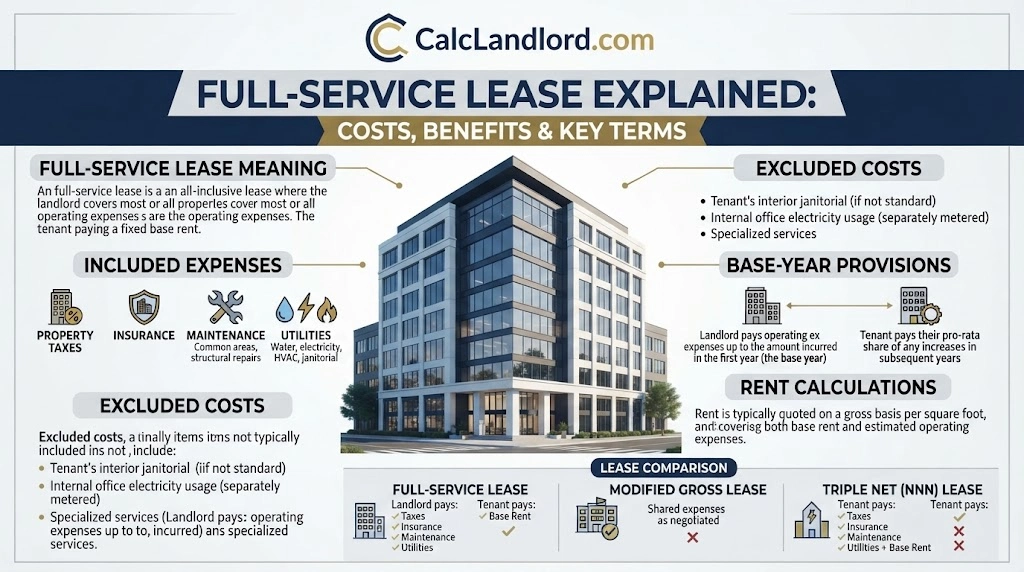
What Is Not Included in a Full-Service Lease?
A full-service lease does not automatically cover every cost associated with occupying a commercial property.
Tenants may remain responsible for business-specific expenses, additional services, and charges expressly excluded from the rental rate.
| Expense | Why it may be excluded |
| Internet and telephone | Usually purchased directly by the tenant |
| Business insurance | Covers the tenant’s business, equipment, or liability |
| After-hours HVAC | Requires additional building services outside normal operating hours |
| Excess utilities | Results from unusually high or separately metered consumption |
| Parking | May be separately leased or charged per parking space |
| Extra cleaning | Goes beyond the services specified in the lease |
| Tenant improvements | Depends on negotiated allowances and construction responsibilities |
| Operating expense increases | May be passed through under a base-year or expense-stop clause |
Tenant-specific operating expenses
A business that uses specialized equipment may consume more electricity, water, or cooling than a typical office tenant.
For example, a technology company operating a server room may require additional cooling. The landlord might separately meter this usage or charge an agreed supplemental utility fee.
Similarly, a medical office may need specialized waste handling or cleaning services that are not included in standard building operations.
After-hours building services
Some office buildings provide HVAC during standard operating hours but charge tenants for evening, weekend, or holiday use.
Before signing, tenants should determine:
- The building’s standard operating hours.
- Whether overtime HVAC is available.
- The hourly or per-zone service rate.
- Whether advance booking is required.
- Whether the charge can increase during the lease term.
Capital improvements and major repairs
Capital improvements can include substantial building upgrades, replacements, or improvements that provide benefits over multiple years.
A landlord’s ability to pass these costs to tenants depends on the lease language and applicable law. Some agreements exclude capital expenditures, while others permit recovery of certain qualifying costs over a defined period.
Tenants should distinguish routine repairs from capital expenditures and confirm whether any permitted recovery is limited to improvements that reduce operating costs or are required by law.
How to Calculate Full-Service Lease Rent: Formula and Example
Calculating full-service lease rent begins with the agreed rental rate and the amount of rentable square footage.
However, the total occupancy cost may also include expense escalations, additional services, parking, and other contractual charges.
Full-service lease rent formula
The basic annual rent formula is:
Annual Base Rent=Rentable Square Feet×Annual Rate per Square Foot\text{Annual Base Rent} = \text{Rentable Square Feet} \times \text{Annual Rate per Square Foot}Annual Base Rent=Rentable Square Feet×Annual Rate per Square Foot
The monthly base rent is:
Monthly Base Rent=Annual Base Rent12\text{Monthly Base Rent} = \frac{\text{Annual Base Rent}}{12}Monthly Base Rent=12Annual Base Rent
To estimate the total occupancy cost:
Total Occupancy Cost=Base Rent+Expense Recoveries+Additional Charges\begin{aligned} \text{Total Occupancy Cost} ={}& \text{Base Rent}\\ &+\text{Expense Recoveries}\\ &+\text{Additional Charges} \end{aligned}Total Occupancy Cost=Base Rent+Expense Recoveries+Additional Charges
This is a budgeting formula. The actual amount due must be calculated according to the lease’s definitions and billing provisions.
Example: Calculate monthly full-service rent
Suppose a tenant leases 4,000 rentable square feet in a commercial office building.
Illustrative example
Full-service rent calculation
Rentable area
4,000 sq. ft.
Annual rental rate
$32 per sq. ft.
Annual base rent
$128,000
Monthly base rent
$10,666.67
Assumes the quoted rate is annual rent per rentable square foot and does not include additional charges.
The annual rent is:
4,000×$32=$128,0004,000 \times \$32 = \$128,0004,000×$32=$128,000
The monthly rent is:
$128,000÷12=$10,666.67\$128,000 \div 12 = \$10,666.67$128,000÷12=$10,666.67
If the quoted rate includes the specified operating expenses, those covered expenses do not need to be added a second time when calculating the base rent.
How to calculate operating expense increases
Suppose the lease contains a base-year provision with the following terms:
| Item | Amount |
| Tenant’s rentable area | 4,000 sq. ft. |
| Base-year operating expenses | $12.00 per sq. ft. |
| Current-year operating expenses | $13.50 per sq. ft. |
| Increase | $1.50 per sq. ft. |
The tenant’s annual expense recovery, assuming the entire increase is eligible and the tenant is responsible for its full proportionate share, is:
4,000×($13.50−$12.00)=$6,0004,000 \times (\$13.50-\$12.00) =\$6,0004,000×($13.50−$12.00)=$6,000
The monthly equivalent is:
$6,000÷12=$500\$6,000 \div 12 = \$500$6,000÷12=$500
The tenant’s annual occupancy cost would then be:
$128,000+$6,000=$134,000\$128,000+\$6,000=\$134,000$128,000+$6,000=$134,000
The monthly equivalent would be approximately $11,166.67.
This example excludes other charges and assumes the lease permits the full expense recovery. Actual calculations may differ based on occupancy adjustments, exclusions, caps, rentable-area definitions, and the tenant’s share of the building.
Calculate your own full-service rent
Use the following calculator to estimate your base rent and potential expense increases.
Full-Service Lease Cost Calculator
Enter your lease figures to estimate annual and monthly rent, plus potential operating expense recoveries.
Rentable square feet
Annual rent per square foot ($)
Base-year expenses per square foot ($)
Current-year expenses per square foot ($)
Tenant’s share of eligible increase (%)
Estimated annual base rent
$128,000.00
Monthly base rent
$10,666.67
Annual expense recovery
$6,000.00
Monthly expense recovery
$500.00
Estimated total annual occupancy cost
$134,000.00
Estimated monthly total: $11,166.67
For planning purposes only. This calculator assumes a simple annual per-square-foot expense comparison and does not account for lease-specific exclusions, expense caps, gross-up adjustments, or billing timing.
Rentable square feet vs. usable square feet
Commercial office rent is often calculated using rentable square footage rather than only the usable area inside the tenant’s suite.
Usable square footage generally refers to the space the tenant can occupy and use. Rentable square footage may also include an allocated share of common areas, depending on the building’s measurement method and lease.
For example, a tenant may occupy 3,600 usable square feet but be charged rent on 4,000 rentable square feet.
This difference affects the rent calculation and may also affect the tenant’s proportionate share of operating expenses.
Tenants should verify the measured area, applicable measurement standard, and any load factor used in the lease.
What Is a Base Year in a Full-Service Lease?
A base year is the agreed reference year used to determine how much operating expense increases a tenant must pay under a commercial lease.
In a typical full-service gross office lease, the landlord covers operating expenses up to the base-year amount. If eligible expenses rise in a later year, the tenant pays its proportionate share of the increase, as defined in the lease.
The base year is particularly important because it can determine the tenant’s additional costs for the remainder of a multiyear lease.
How a base-year provision works
Consider this example:
Base-year expense comparison
| Lease year | Expenses per sq. ft. |
| Year 1 — Base year | $12.00 |
| Year 2 | $12.75 |
| Year 3 | $13.50 |
Illustrative figures assuming the tenant’s full expense increase is eligible for recovery.
If the tenant leases 5,000 rentable square feet, the Year 3 increase is:
5,000×($13.50−$12.00)=$7,5005,000\times(\$13.50-\$12.00)=\$7,5005,000×($13.50−$12.00)=$7,500
The tenant would pay $7,500 in additional annual expenses, or $625 per month on an equivalent basis, in addition to base rent.
The tenant is not normally charged the entire $13.50 per square foot under this type of arrangement. It is charged the eligible increase above the $12.00 base-year level, subject to the contract.
Calendar-year vs. lease-year base year
The lease should identify precisely which period establishes the base year.
A calendar-year base year uses a specified calendar year, while a lease-year base year uses a period defined by the lease’s commencement date or anniversary.
For example, if a lease begins on July 1, the parties should specify whether the base year is the calendar year in which the lease begins, the first full calendar year, or another agreed period.
A partial-year baseline can create complications because it may not represent normal annual operating expenses.
Tenants should also confirm how partial-year expenses, free-rent periods, concessions, and changes in building occupancy affect the baseline.
What is an expense stop?
An expense stop is a specified operating expense amount above which the tenant becomes responsible for eligible costs.
For example, a lease might set an expense stop at $11.50 per rentable square foot per year.
If eligible operating expenses rise to $13.00 per square foot, the potential excess is $1.50 per square foot, before applying the tenant’s proportionate share and any exclusions or limitations.
A base year and an expense stop are related but not identical. A base year establishes a reference year’s expenses; an expense stop establishes a specified financial threshold.
Both mechanisms should be read alongside the lease’s operating expense definition, billing rules, and exclusions.
How Do Expense Stops, Escalations, and Gross-Up Clauses Work?
Expense stops, escalations, and gross-up provisions determine how certain property operating expenses are allocated between landlords and tenants.
These clauses can have a significant effect on total occupancy costs, especially in long-term commercial office leases.
Expense escalations
An expense escalation provision allows rent or eligible operating expense charges to increase according to the lease.
There are two common types of increases.
| Type | How it works |
| Fixed rent escalation | Base rent increases by a stated amount or percentage according to a schedule |
| Operating expense escalation | Tenant pays eligible operating expense increases above a base year or expense stop |
A lease could include both provisions.
For example, a tenant’s base rent might increase by 3% annually while the tenant also pays its share of eligible operating expense increases above the base year.
The 3% increase and the expense reconciliation are separate calculations. A tenant should not assume that one replaces the other unless the lease explicitly says so.
What is a gross-up clause?
A gross-up clause allows specified variable operating expenses to be adjusted as though a building were operating at an agreed occupancy level.
It is used because certain expenses, such as janitorial services and some utility costs, change as the number of occupants changes.
A partially occupied building may have lower variable operating expenses than a fully occupied building. A gross-up provision can normalize eligible variable costs to a stated occupancy level, often 95% or another contractually specified percentage.
For example, assume a building is only 60% occupied during the base year. If the lease compares later expenses at a stabilized occupancy level but leaves the base year unadjusted, the tenant could pay for increases caused by the building filling up rather than genuine cost increases.
For a tenant negotiating a base-year lease, it is important to determine whether the gross-up applies to both the base year and comparison years, which expenses are eligible, and how the calculation is performed.
Which expenses can be grossed up?
Gross-up provisions generally focus on expenses that vary with occupancy.
Examples may include:
- Janitorial services.
- Certain building utilities.
- Trash removal.
- Some occupancy-related maintenance services.
Fixed expenses, such as certain property taxes and insurance premiums, do not ordinarily increase simply because more tenants occupy the building.
The lease must define the eligible expenses and the calculation method. A gross-up clause should not be assumed to permit every operating expense to be increased automatically.
Why tenants should review expense caps
An expense cap limits the amount by which certain operating expenses may increase or the amount that can be passed through to a tenant.
The cap might apply to specified controllable expenses, while excluding items such as taxes, insurance, utilities, or other negotiated categories.
Before signing, a tenant should verify:
- Whether the cap is annual or cumulative.
- Whether it compounds from year to year.
- Which expense categories are covered.
- Whether increases can be carried forward.
- Whether the cap applies to the tenant’s share or the building’s total expense pool.
The financial effect depends on the exact language, not merely on whether the lease mentions a cap.
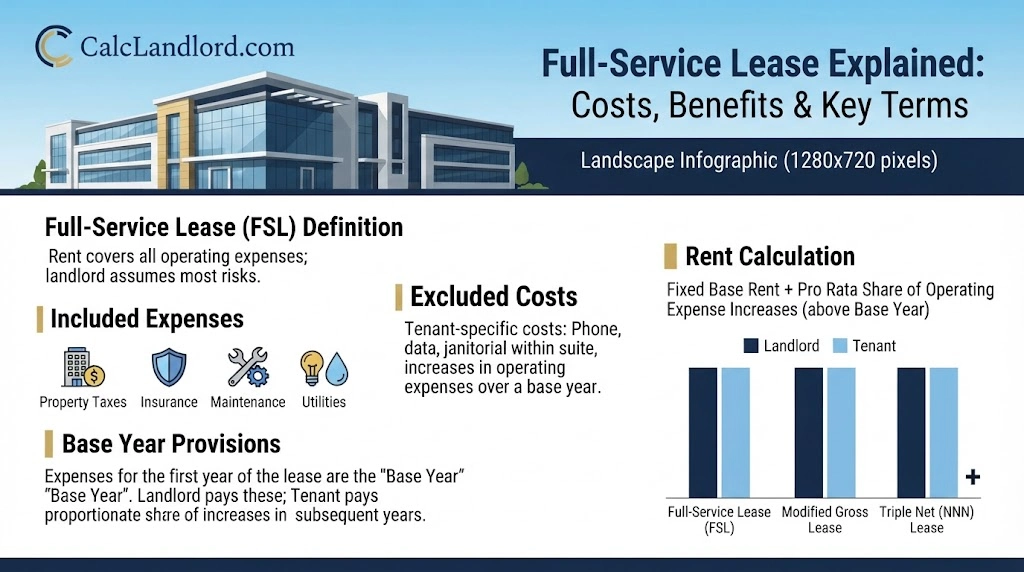
Full-Service Lease vs. Gross Lease: What Is the Difference?
A full-service lease is generally a form of gross lease, but the terms are not always used consistently.
A gross lease typically includes property operating expenses in the rent. A full-service gross lease commonly includes a broader package of services, potentially including utilities and janitorial services for the tenant’s premises.
However, a gross lease can still contain exclusions, expense stops, and base-year provisions.
Comparison of full-service and gross leases
| Feature | Full-service gross lease | Gross lease |
| Base rent | Usually includes specified operating expenses | Includes operating expenses defined in the lease |
| Property taxes | Commonly included | Commonly included |
| Building insurance | Commonly included | Commonly included |
| Utilities | May include standard tenant-space utilities | Depends on the contract |
| Janitorial | Often included in full-service arrangements | May be included or excluded |
| Expense increases | May be passed through above a base year | Depends on the contract |
| Tenant billing | Rent plus any agreed additional charges | Rent plus any agreed additional charges |
The most important distinction is the scope of services and expenses included in the rental rate.
Is a full-service lease always more expensive?
Not necessarily.
A full-service rental rate may appear higher than a net rental rate because it incorporates certain property expenses.
But comparing only the quoted base rents can be misleading.
For example, a full-service lease at $32 per square foot may include expenses that a net lease tenant must pay separately. A net lease with a lower base rent could produce a higher total occupancy cost after taxes, insurance, maintenance, utilities, and other charges are added.
To compare the two accurately, use the same rentable area, lease period, expense assumptions, and service requirements.
Full-Service Lease vs. Modified Gross Lease
A modified gross lease is a commercial lease in which the landlord and tenant share operating expenses according to negotiated terms.
Unlike a more inclusive full-service arrangement, a modified gross lease may require the tenant to pay certain utilities, maintenance costs, or other expenses directly.
The exact allocation varies by contract.
Main differences
| Feature | Full-service gross | Modified gross |
| Expense coverage | Typically includes a broader package of building services | Includes selected expenses |
| Utilities | Standard utilities may be included | Some or all utilities may be separately billed |
| Maintenance | Landlord usually manages covered building maintenance | Responsibilities may be divided |
| Operating expense increases | May be passed through above a base year | May be passed through under negotiated provisions |
| Cost predictability | Depends on exclusions and escalation clauses | Depends on the specific expense allocation |
Both lease structures can use base-year or expense-stop provisions.
In practice, the label alone does not tell a tenant which arrangement has the lower total cost. A modified gross lease with fewer included services may have a lower quoted rent but more separately billed expenses.
Example of a modified gross lease
Suppose a landlord offers office space with base rent of $24 per square foot per year.
The landlord includes property taxes and building insurance, while the tenant pays separately for electricity and its own janitorial service.
The tenant’s effective occupancy cost must include the base rent plus these additional expenses.
By contrast, a full-service arrangement for comparable space might include those services in a higher quoted rental rate.
For an accurate comparison, tenants should obtain a written list of included and excluded expenses for each property.
Full-Service Lease vs. Triple Net (NNN) Lease
A triple net lease, commonly called an NNN lease, generally requires the tenant to pay base rent plus its allocated share of property taxes, building insurance, and maintenance or operating expenses.
A full-service lease usually incorporates specified operating expenses into the rental rate instead.
The difference is primarily how expenses are allocated and billed.
Full-service vs. NNN lease comparison
| Feature | Full-service lease | Triple net lease |
| Base rent | Generally higher because specified expenses are included | Often quoted separately from operating expenses |
| Property taxes | Typically included initially, subject to contract | Generally paid or reimbursed by tenant |
| Insurance | Building insurance commonly included in the rental structure | Tenant generally pays its allocated insurance expense |
| Maintenance | Landlord manages specified services | Tenant pays allocated maintenance costs under the agreement |
| Utilities | May include standard utilities | Often paid directly or separately |
| Expense administration | Landlord usually handles covered expenses | Tenant may receive separate operating expense statements |
The allocation of responsibility is not absolute. Some full-service leases pass through increases, while NNN leases can include exclusions, expense caps, or landlord responsibilities.
Example: Comparing a full-service quote with an NNN quote
Suppose a tenant is comparing two properties with the same rentable area.
Illustrative annual cost comparison
Option A
Full-service lease
Base rent: 4,000 sq. ft. × $32
$128,000
Separately billed expenses
$0
Illustrative annual total
$128,000
Option B
Triple net lease
Base rent: 4,000 sq. ft. × $24
$96,000
Estimated NNN expenses: 4,000 × $8
$32,000
Illustrative annual total
$128,000
These figures are hypothetical and exclude other charges, expense changes, and differences in service levels. They illustrate why quoted base rent alone is not a reliable comparison.
In this example, both arrangements have the same initial estimated annual cost.
The NNN tenant may have more direct responsibility for expenses and greater exposure to changes in those expenses. The full-service tenant may have a simpler billing arrangement, but could still be responsible for expense increases under its lease.
Which expenses should tenants compare?
Before selecting a commercial space, compare:
- Base rent per rentable square foot.
- Taxes, insurance, and maintenance expenses.
- Utility and janitorial arrangements.
- Expense stops, base years, and escalations.
- Parking, after-hours HVAC, and other additional charges.
- Tenant improvement costs and lease concessions.
A consistent comparison should cover the full lease term, not just the first month’s payment.
What Are the Advantages of a Full-Service Lease?
A full-service lease can offer benefits to both tenants and landlords, especially when the parties value centralized building management and predictable expense arrangements.
The actual benefits depend on the lease terms, the property’s operating efficiency, and the services included.
1. Easier budgeting for tenants
A full-service lease gives tenants a clearer starting point for estimating occupancy costs.
When major expenses are included in rent, businesses do not need to budget separately for every covered property expense from the beginning.
This can make it easier for small businesses, professional offices, and companies establishing a new location to plan their monthly operating budgets.
However, tenants should still account for expense escalations, utilities excluded from rent, and additional services.
2. Fewer separate property bills
Under a full-service arrangement, the landlord typically manages the payment of covered expenses.
The tenant may not need to coordinate directly with the property tax authority, insurance provider, cleaning contractor, or maintenance company for those services.
This can reduce administrative work for businesses that do not have an internal facilities management team.
3. Centralized maintenance and building operations
The landlord generally coordinates the maintenance and management of shared building systems.
This may include elevators, common-area cleaning, HVAC systems, landscaping, and other shared facilities.
Centralized management can also help maintain consistent service standards throughout a multi-tenant building.
4. Access to shared building services
Tenants may receive services and facilities that would be expensive or impractical to arrange independently.
Examples include staffed reception areas, shared meeting spaces, security systems, common-area cleaning, and building maintenance.
The availability of these services depends on the property and the lease.
5. Potentially simpler lease administration
A lease with clearly defined services and expenses can make monthly payment administration easier.
The tenant has a single base rental obligation, supplemented by any clearly defined additional charges.
The landlord can also manage vendors and building operations centrally, potentially benefiting from coordinated service contracts.
6. Advantages for landlords
Full-service leases may help landlords market office space to businesses that value a bundled rental arrangement.
Landlords can retain control over maintenance standards, building systems, vendors, and shared services.
They can also incorporate anticipated operating expenses into the rental rate when negotiating a lease.
Nevertheless, landlords must consider the risk of expenses increasing faster than anticipated, particularly when the contract does not allow recovery of those increases.
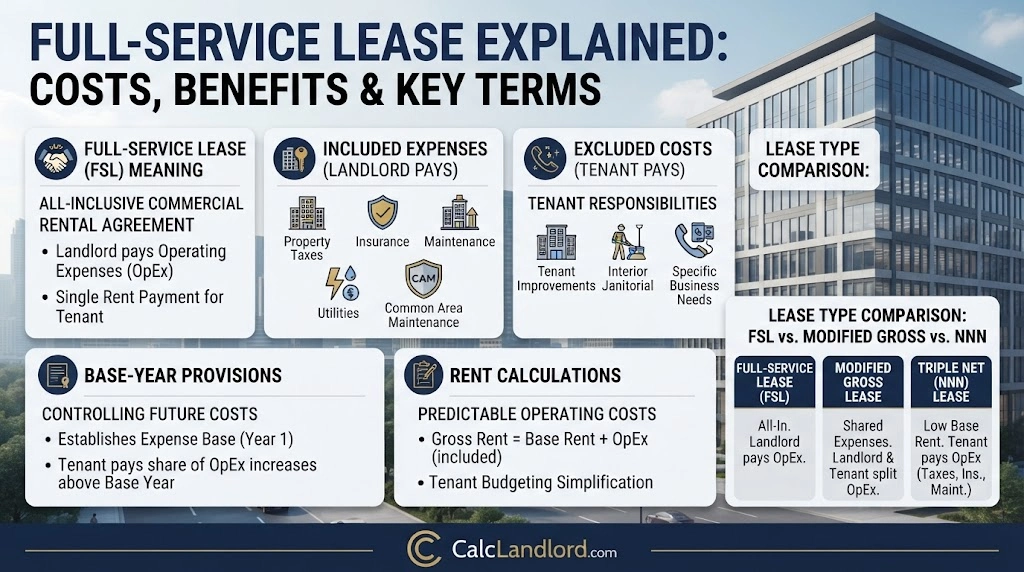
What Are the Disadvantages and Risks of a Full-Service Lease?
A full-service lease can simplify occupancy, but it also creates financial and contractual risks for both parties.
Tenants should not assume that an all-inclusive rental rate guarantees a fixed total cost. Landlords should not assume that the rent collected will always cover operating expenses.
Disadvantages for tenants
| Risk | Potential effect |
| Higher quoted base rent | Rent may appear more expensive than a net lease |
| Expense escalations | Additional payments may increase total occupancy costs |
| Limited control over vendors | Tenant may have little say in building service providers |
| Service restrictions | Utilities or HVAC may only be available during specified hours |
| Unclear expense definitions | Disputes may arise over reimbursable expenses |
| Building-wide cost exposure | Eligible expense increases can affect multiple tenants |
Unpredictable additional charges
A tenant may budget for the stated rent but later receive expense reconciliation bills.
These charges may result from increases in taxes, insurance, utilities, maintenance, or other eligible operating expenses.
To reduce uncertainty, tenants should request historical operating expense statements and review how the lease defines recoverable costs.
Paying for services the tenant does not need
A bundled rental arrangement may include building services that a particular tenant uses very little.
For example, a business that operates mainly during daytime hours may not benefit from extensive evening building services.
The tenant should consider whether the services included in the rental rate align with its actual operating requirements.
Limited control over property management
Because the landlord manages the building, tenants may have limited control over vendor selection, maintenance schedules, or operating decisions.
The lease should identify the landlord’s obligations for maintaining building systems and responding to service requests.
Tenants should also check whether service failures give rise to any contractual remedies.
Disadvantages for landlords
Landlords face a different set of risks.
Operating expense inflation: If taxes, insurance, labor, utilities, or maintenance costs rise faster than anticipated, the landlord’s operating margin may decline when increases cannot be passed through.
Vendor and maintenance obligations: The landlord remains responsible for coordinating covered services and meeting contractual maintenance obligations.
Vacancy and occupancy changes: A partially occupied building can create uneven operating costs and complicate expense allocation.
Tenant disputes: Unclear expense provisions may lead to disagreements over management fees, capital expenses, utility charges, and expense reconciliations.
Budgeting uncertainty: Landlords must estimate future operating costs when negotiating rental rates, especially in leases with fixed rent and limited escalation rights.
How to reduce these risks
Both parties should carefully review the expense definitions, maintenance obligations, rent escalation schedule, insurance provisions, and operating expense reconciliation process.
A written lease should specify what is included, what is excluded, how expenses are allocated, and what supporting records are available.
For substantial commercial transactions, a qualified commercial real estate attorney and an experienced property accountant can help review the contract and its financial implications.
How to Negotiate and Review a Full-Service Lease Before Signing
Negotiating a full-service lease involves more than agreeing on a rental rate.
Tenants should review the services, expense allocation, building condition, lease duration, renewal rights, and additional charges before committing to the space.
Landlords should also make sure the lease accurately defines the services they must provide and the expenses they may recover.
Step 1: Request a detailed list of included expenses
Ask the landlord to identify each expense included in the rental rate.
Do not rely solely on statements such as “all operating expenses included.”
The lease should clearly address:
- Property taxes and assessments.
- Building insurance.
- Common-area maintenance.
- Utilities and HVAC.
- Janitorial services.
- Management fees.
- Routine repairs and capital expenditures.
The more precise the definitions, the easier it is to determine whether an additional charge is permitted.
Step 2: Review the base year and expense stop
If the lease uses a base-year provision, confirm the exact year and how the baseline is calculated.
Ask whether the base year reflects a full operating year and whether adjustments apply for unusual conditions or low occupancy.
For an expense stop, verify the dollar amount, covered expense categories, and whether the stop changes during the term.
The American Bar Association highlights the importance of ensuring that the base year reflects a representative level of services and expenses.
Step 3: Negotiate expense exclusions and caps
Tenants may seek to exclude certain costs from operating expense recoveries.
Depending on the transaction, these may include:
- Costs caused by another tenant’s specific activities.
- Landlord Financing Costs.
- Leasing commissions and tenant improvement allowances.
- Costs reimbursed by insurance or third parties.
- Certain capital expenditures or structural costs.
- Penalties resulting from the landlord’s failure to comply with its obligations.
The parties should also define whether management fees and administrative charges are recoverable and whether expense caps apply.
These are negotiation points, not universal exclusions. Their treatment depends on the contract and applicable law.
Step 4: Review the building’s historical expenses
Request available historical operating expense statements, preferably covering several years.
Review changes in property taxes, insurance, utilities, maintenance, and other major categories.
Where possible, compare the historical expenses with the landlord’s estimated budget for the coming year.
Historical expenses do not guarantee future costs, but they can help identify trends and improve budgeting.
Step 5: Confirm the rentable square footage
Verify the rentable area used to calculate rent and the tenant’s share of building expenses.
Ask how the landlord measured the premises and whether common areas or a load factor are included.
This is particularly important when comparing multiple properties because different measurement assumptions can affect the effective rental rate.
Step 6: Review additional charges and service hours
Confirm the costs and availability of services outside the standard package.
These may include overtime HVAC, additional cleaning, parking, security, signage, and supplemental utility usage.
Tenants with evening or weekend operations should obtain the applicable service rates in writing.
Step 7: Check renewal, termination, and assignment rights
The lease should specify:
- The initial lease term.
- Renewal options and notice deadlines.
- Rent adjustments during renewal periods.
- Early termination rights, if any.
- Assignment and subleasing requirements.
- Security deposit and default provisions.
A renewal option may have significant financial consequences if it resets the base year, changes the rent structure, or modifies expense recovery obligations.
Step 8: Review the lease with qualified professionals
Commercial lease agreements can contain detailed legal and financial provisions.
A commercial real estate attorney can help review contractual rights and obligations, while a qualified accountant or property professional can help evaluate expense allocations and financial calculations.
The review should focus on the actual lease document, applicable local law, and the property’s operating records.
Practical tip: Request a written lease summary or expense schedule that identifies the base rent, included services, excluded expenses, escalation clauses, and additional charges. Keep it with the signed lease for future reference.
What Should Landlords Know About Full-Service Lease Expenses and NOI?
For landlords, a full-service lease affects operating budgets, rental income, expense recoveries, and net operating income (NOI).
Understanding these relationships helps property owners evaluate leasing proposals, estimate cash flow, and monitor building performance.
What is net operating income?
Net operating income is a measure of a property’s income after operating expenses but before debt service and certain other items.
A simplified formula is:
NOI=Effective Operating Income−Operating Expenses\text{NOI}=\text{Effective Operating Income}-\text{Operating Expenses}NOI=Effective Operating Income−Operating Expenses
Effective operating income generally starts with rental and other operating income, adjusted for items such as vacancy and collection losses.
The precise accounting and underwriting treatment depends on the property, reporting method, and transaction.
How full-service rent affects NOI
Consider a simplified commercial office building with the following annual figures.
| Item | Annual amount |
| Rental and other operating income | $600,000 |
| Operating expenses | $220,000 |
| Net operating income | $380,000 |
The NOI is:
$600,000−$220,000=$380,000\$600,000-\$220,000=\$380,000$600,000−$220,000=$380,000
This example assumes that the stated income and expense figures are measured consistently and that all listed expenses are operating expenses.
Why expense recovery matters
Under a full-service lease with a base-year provision, the landlord may recover eligible operating expense increases from tenants.
Those recoveries affect the property’s operating income and help offset higher operating expenses.
However, the landlord should not treat every reimbursement as additional profit. The recovery may simply offset the corresponding expense.
For example, if operating expenses rise by $20,000 and the landlord recovers $15,000 from tenants, the landlord’s net exposure to that increase is $5,000, assuming the recovery and expense amounts are recognized in the same period.
Budgeting and expense management
Landlords should maintain clear operating budgets and track actual expenses against the budget.
Useful practices include:
- Reviewing property taxes and insurance renewals.
- Monitoring utility consumption.
- Maintaining vendor contracts and service records.
- Tracking repairs and capital expenditures separately.
- Maintaining accurate tenant rentable-area and expense-share records.
- Issuing reconciliations with supporting calculations.
Accounting considerations for commercial landlords and tenants
Commercial leases may also have accounting implications.
For U.S. entities applying U.S. GAAP, lease accounting is addressed by FASB Accounting Standards Codification Topic 842, Leases. The accounting treatment depends on the facts, contract terms, and applicable accounting requirements.
Landlords and tenants should distinguish lease payments from service components and other charges when determining the appropriate accounting treatment.
The fact that operating expenses are bundled into a single commercial rent payment does not, by itself, determine how the entire arrangement must be classified or reported.
For accounting or tax reporting, consult the applicable accounting standards and a qualified professional rather than relying solely on the commercial lease label.
People Also Ask
Here are answers to common questions about full-service leases, including costs, operating expenses, and landlord and tenant responsibilities.
A: A full-service lease is a commercial rental agreement in which the landlord includes specified property operating expenses in the rent. The tenant typically makes one base rent payment, while the landlord manages covered expenses and building services.
The tenant may still pay for expense increases or services excluded from the agreement.
A: A full-service lease is generally a type of gross lease. A full-service gross lease often includes a broader package of services, such as standard utilities and janitorial services.
However, the terms are sometimes used interchangeably. The actual expenses included depend on the lease contract.
A: The landlord generally pays the property taxes and incorporates the expected cost into the rental rate.
However, the tenant may be responsible for its proportionate share of eligible tax increases under a base-year, expense-stop, or other expense-recovery provision.
A: Standard building utilities, such as electricity, water, and HVAC during specified operating hours, may be included.
After-hours HVAC, unusually high consumption, and separately metered utilities may be billed separately. The lease should identify the services covered and any additional utility charges.
A: Yes. Rent can increase through scheduled rent escalations, operating expense recoveries, or other charges permitted by the lease.
A full-service lease does not automatically guarantee a fixed total occupancy cost throughout the lease term.
Conclusion
A Full-Service Lease is a commercial real estate arrangement that combines rent with specified property operating expenses, making it easier for tenants to understand their initial occupancy costs while allowing landlords to manage building operations centrally.
However, the phrase “full service” does not necessarily mean that every expense is included or that the tenant’s total cost will remain fixed.
The most important terms to understand are the base rent, included services, base year, expense stop, operating expense escalations, and additional charges. These provisions determine how costs are shared between landlords and tenants throughout the lease term.
For tenants, the key is to compare total occupancy costs and review the contract carefully. For landlords, clear expense definitions, accurate operating budgets, and transparent expense reconciliations help support effective property management.
Before signing any full-service lease, review the actual agreement and confirm exactly who pays each expense, when additional charges apply, and how future increases will be calculated.

Pingback: 4 Rental Property Metrics Every Investor Should Know