
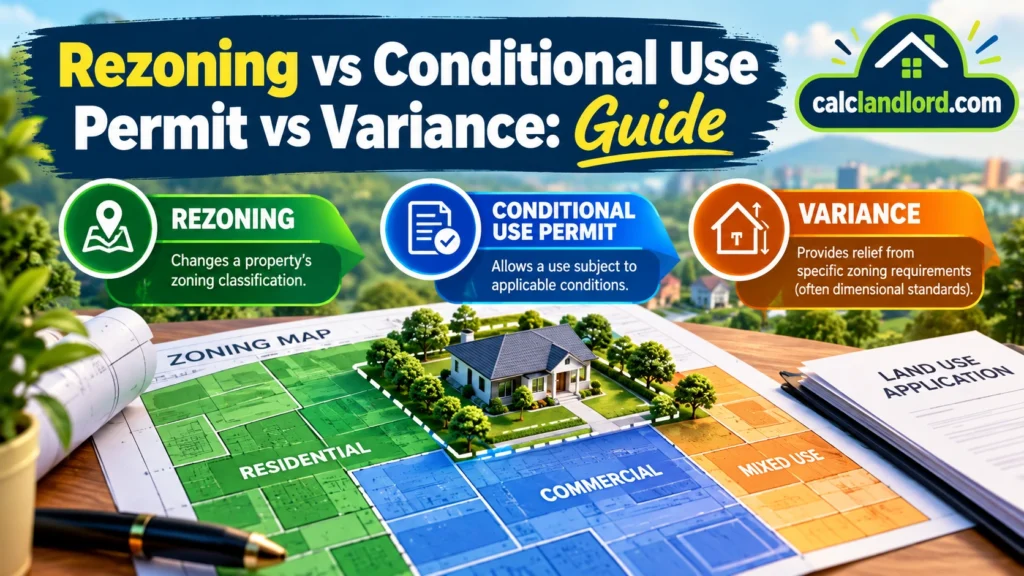
Rezoning vs Conditional Use Permit vs Variance: Which Do You Need?
If you’re buying, developing, converting, or operating a rental property, zoning can determine whether your investment plan is actually possible.
A Property may look attractive because of its price, location, rental demand, or projected cash flow—but if the proposed use does not fit the property’s zoning, your investment assumptions may change dramatically.
The three terms most commonly confused are rezoning, conditional use permits (CUPs), and zoning variances.
The simplest distinction is:
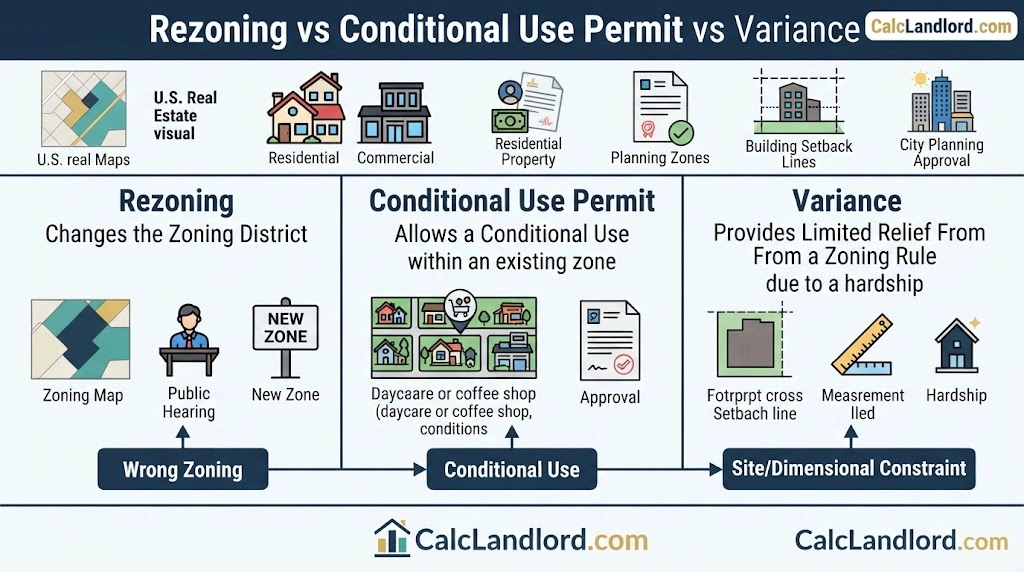
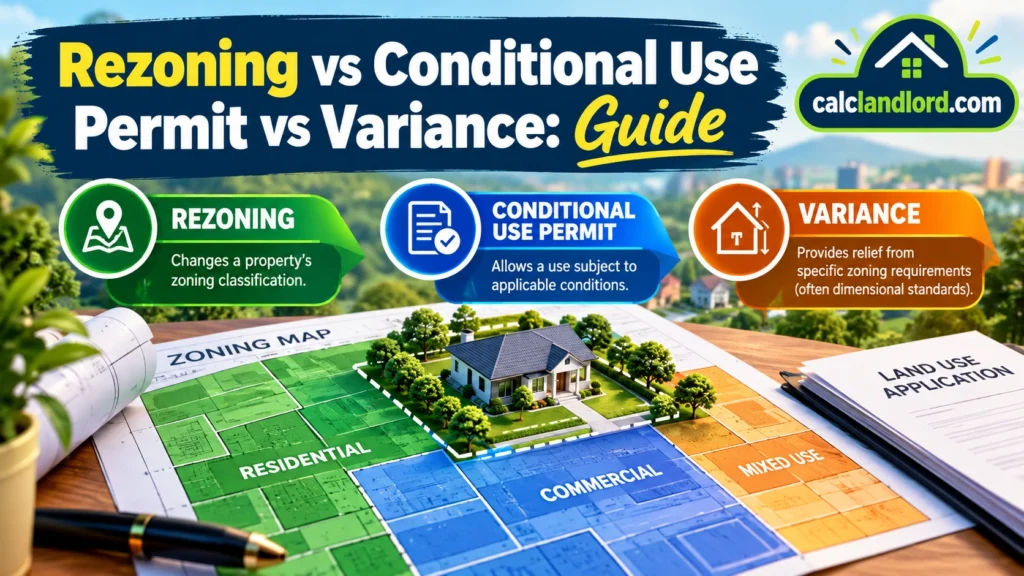
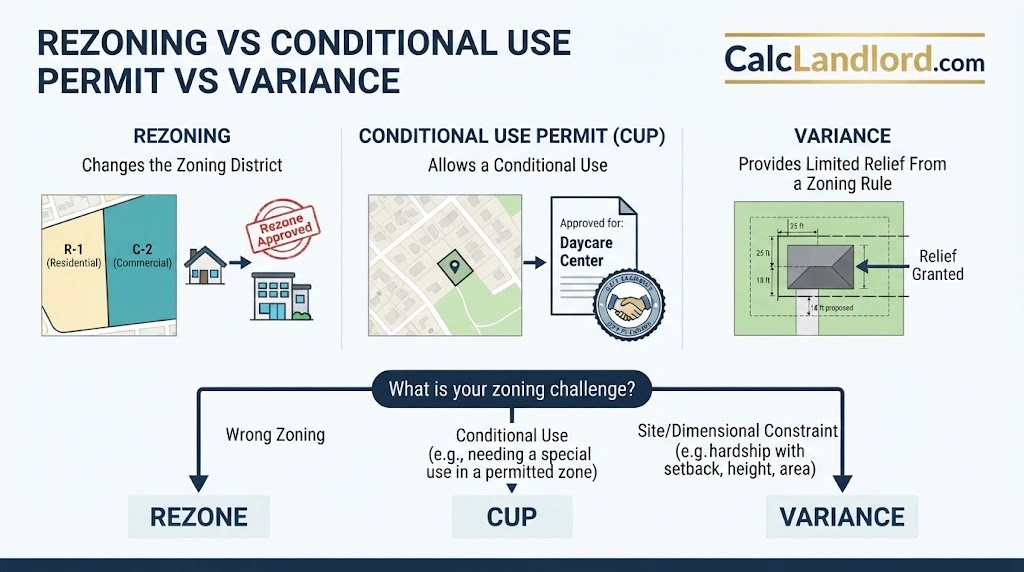
Rezoning changes the property’s zoning classification. A conditional use permit allows a use that the local code already recognizes as conditionally appropriate. A variance provides limited relief from a specific zoning requirement.
The exact rules are local. Cities and counties can use different terminology, approval standards, hearing procedures, and decision-making bodies. Some jurisdictions also use terms such as special use permit, special exception, or use variance.
For landlords and real estate investors, the important question is not simply what each term means.
It is:
Which zoning approval, if any, does your rental-property strategy actually require—and what could that approval mean for your investment?
Rezoning vs. Conditional Use Permit vs. Variance: What’s the Difference?
Before spending money on plans, consultants, or an application, identify the exact zoning problem.
| Situation | Potential zoning solution | What it generally does |
| The property’s zoning district does not support the intended use | Rezoning | Changes the zoning classification |
| The use is listed as conditionally allowed | Conditional Use Permit | Allows the specified use subject to review and conditions |
| The use is allowed but the property cannot satisfy a specific standard | Variance | Provides limited relief from a zoning requirement |
| The use is permitted by right and the site complies with development standards | None of these may be needed | The project may proceed through ordinary permitting |
For example, imagine you’re considering a property for a small multifamily rental.
If multifamily housing is prohibited in the current zoning district, a setback variance generally does not solve the fundamental problem.
When multifamily housing is conditionally allowed, a CUP may be the relevant approval.
If multifamily housing is allowed but an unusual lot configuration prevents compliance with a required setback, a variance may potentially address that specific issue.
This use-versus-standard-versus-zoning-district framework is the most important concept to understand.
Local law controls the actual answer.
What Is Rezoning and When Is It Required?
Rezoning is a change to a property’s official zoning classification.
A zoning ordinance typically divides land into districts and establishes the uses and development standards associated with those districts. A rezoning request asks the local government to change the district that applies to the property. Fairfax County, for example, describes rezoning as a request to change the existing zoning designation of a parcel.
For a rental-property investor, rezoning can become relevant when the property’s current zoning does not support the intended investment strategy.
Examples might include wanting to:
- Convert a property to a different residential use
- Develop multifamily housing
- Add a commercial component to a mixed-use project
- Develop a use that is prohibited in the existing district
- Increase development intensity where local law requires a different district
- Align the property’s zoning with a different planned land use
Example
Suppose you find a vacant parcel for $300,000.
Your investment plan assumes you can develop eight rental units.
After checking the zoning ordinance, you discover that the current district permits only single-family development.
Your projected rental income and ROI were based on eight units.
That means the zoning issue is not merely a setback problem.
The fundamental question is whether the property can legally support the intended use and density.
A rezoning request may therefore need to be investigated.
Why Rezoning Matters to Landlords
Rezoning can create both opportunity and risk.
If approved, a zoning change may increase the property’s development potential.
But approval is not guaranteed.
The process may involve planning staff, public notice, a planning commission or similar body, and a local governing body depending on the jurisdiction. Local comprehensive-plan policies can also matter.
That creates an important investment principle:
Do not value a property solely on the assumption that rezoning will be approved.
Treat the potential zoning change as an entitlement risk until it is actually secured.
What Is a Conditional Use Permit (CUP)?
A Conditional Use Permit, often called a CUP, generally allows a specific use that the zoning code recognizes as potentially appropriate in a particular district but requires additional review.
The American Planning Association explains that conditional uses provide flexibility within zoning districts while allowing local governments to apply additional standards to potentially compatible uses. Some jurisdictions use terms such as special use permit or special exception for similar concepts.
A CUP normally does not change the underlying zoning classification.
Instead, it authorizes a particular use subject to applicable standards and potentially conditions.
Conditions can address issues such as:
- Operating hours
- Parking
- Traffic
- Noise
- Landscaping
- Lighting
- Access
- Screening
- Site design
- Occupancy
- Other neighborhood or public-impact concerns
Rental-Property Example
Suppose a zoning district allows a particular housing-related or community-serving use only through conditional approval.
The investor does not necessarily need to rezone the entire parcel.
Instead, the relevant question may be whether the proposed use satisfies the jurisdiction’s CUP criteria.
This can be a much more targeted approval than changing the property’s zoning classification.
However, a CUP is not automatic merely because the use appears in a conditional-use table.
The applicant generally still has to satisfy the applicable criteria and conditions.
For example, Henrico County explains that zoning districts can identify uses allowed by right and other uses that may be allowed under a conditional-use permit, with the reviewing body considering factors such as compatibility with adopted plans and public welfare.
What Is a Zoning Variance and What Can It Change?
A zoning variance generally provides limited relief from a particular zoning requirement.
Variances are commonly associated with physical or dimensional standards such as:
- Setbacks
- Building height
- Lot coverage
- Lot dimensions
- Certain site-development requirements
The American Planning Association describes variances as limited relief from the strict application of zoning standards.
The critical point for investors is that a variance generally does not rezone the property.
It also is not normally a general permission slip to ignore zoning regulations.
Example
Suppose your rental property is zoned for the intended residential use.
The zoning code requires a 20-foot rear setback.
Because of an unusual lot configuration, complying with the setback could make the planned addition impractical.
Depending on local law, a variance may be worth investigating.
But the applicant usually has to satisfy specific legal standards.
For example, Henrico County states that a variance cannot change the zoning or permitted uses and requires circumstances such as qualifying hardship that are not simply the result of inconvenience or self-imposed conditions.
Important Investor Warning
Do not assume:
“The project doesn’t work financially, so I should ask for a variance.”
Financial inconvenience by itself may not satisfy a jurisdiction’s variance standard.
The legal test is jurisdiction-specific.
Some jurisdictions also regulate use variances differently from dimensional variances. The American Planning Association notes that use variances can effectively operate like de facto rezoning and have therefore received different treatment in some communities.
Rezoning vs. Conditional Use Permit: Which One Do You Need?
The central difference is whether you need to change the zoning district or obtain approval for a particular use within the existing district.
Rezoning
You are essentially asking:
“Can this property be placed into a different zoning district?”
CUP
You are asking:
“Does the existing zoning allow this particular use after additional review and conditions?”
A rezoning can change the broader framework of permitted uses.
A CUP normally addresses a particular proposed use without changing the underlying district. Current planning guidance and municipal procedures consistently reflect this distinction, although the exact terminology and process vary by jurisdiction.
Rental Investment Example
Imagine you want to buy a property and operate it as a particular rental-oriented use.
You discover three possibilities:
Option A — Permitted use
The zoning code already permits the use.
You may not need either rezoning or a CUP for that use.
Option B — Conditional use
The zoning code lists the use as conditionally allowed.
A CUP may be the appropriate path.
Option C — Prohibited use
The zoning code does not allow the intended use in that district.
A rezoning request may need to be evaluated, assuming the local law permits such a request.
This is why investors should read the actual zoning use table instead of relying on a property listing description.
Rezoning vs. Variance: How Are They Different?
The Rezoning and a variance solve different problems.
Rezoning changes the property’s zoning classification.
A variance generally provides limited relief from a specific zoning requirement.
Consider a rental property where apartments are already permitted.
If the problem is that the proposed building cannot meet a required setback because of a property-specific constraint, a variance may potentially be relevant.
But if apartments are prohibited altogether, reducing the setback does not make apartments a permitted use.
That is a zoning-classification or use problem.
Quick Comparison
| Factor | Rezoning | Variance |
| Changes zoning district | Yes | No |
| Changes broader land-use framework | Potentially | No |
| Typical scope | Broad | Narrow |
| Common issue | Wrong zoning classification | Specific zoning standard |
| Setback relief | Usually not the main purpose | Common example |
| Height relief | Usually not the main purpose | May be relevant |
| Permitted use | Can change what district applies | Generally does not create a prohibited use |
| Investor risk | Entitlement/policy risk | Property-specific qualification risk |
A recent 2026 real-estate comparison similarly describes rezoning as a broader classification change and a variance as narrower relief from a specific requirement.
Conditional Use Permit vs. Variance: Which Approval Fits?
This is where many property owners become confused because both processes can involve discretionary review.
The simplest distinction is:
CUP = “Can this use operate here under the required conditions?”
Variance = “Can this property receive limited relief from this particular zoning requirement?”
CUP Example
A use is listed as conditionally permitted.
The investor wants to operate that use.
The application focuses on whether the proposed operation satisfies the jurisdiction’s CUP standards.
Variance Example
The use is already allowed.
The problem is a dimensional requirement, such as a setback or height limitation.
The investor asks whether the property qualifies for limited relief.
Why Choosing the Correct Path Matters
Submitting the wrong application can waste:
- Application fees
- Consultant fees
- Engineering costs
- Attorney fees
- Design costs
- Financing time
- Due-diligence time
- Potential acquisition opportunities
Some local governments explicitly state that a variance cannot replace a conditional-use approval or authorize a prohibited use.
That is why the first step should always be identifying the exact zoning rule that prevents your intended project.
Can a Rental Property Need More Than One Zoning Approval?
Yes.
A property can sometimes require multiple approvals.
For example, an investor might need:
- Rezoning to change the zoning district.
- CUP approval for a specific use.
- Variance for a qualifying dimensional issue.
- Site-plan or development-plan approval.
- Subdivision or lot-line approval.
- Building permits.
- Fire or life-safety approvals.
- Environmental or infrastructure approvals.
The exact combination depends on the jurisdiction and project.
A real-world 2026 Suffolk, Virginia staff report illustrates how rezoning and a CUP can sometimes be processed together: the applicant sought a rezoning and also submitted a concurrent CUP because the proposed use required conditional approval in the requested district.
Why This Matters for Investors
Suppose your investment model assumes:
- $500,000 acquisition
- $150,000 improvements
- $50,000 closing and project costs
- $700,000 total basis
- $4,500 monthly rent after completion
If an additional entitlement is required, your actual:
- Timeline
- Professional fees
- Carrying costs
- Financing costs
- Construction start date
- Stabilization date
may all change.
Therefore, zoning due diligence should occur before you finalize the investment model.
- Explore More: https://calclandlord.com/break-even-occupancy-rate/
How to Determine Which Zoning Approval Your Property Needs
Use this process before buying a property or committing substantial project capital.
Step 1: Confirm the Official Zoning
Find the property’s official zoning designation through the relevant city or county.
Do not rely solely on:
- MLS descriptions
- Seller statements
- Broker assumptions
- Previous owner claims
- Online property databases
Verify the official zoning map and applicable ordinance.
Step 2: Define Your Intended Use
Be specific.
Instead of:
“I want to develop rentals.”
Write:
“I want to develop a six-unit multifamily rental property.”
The difference matters because zoning codes can distinguish among use categories.
Step 3: Check the Use Table
Determine whether your intended use is:
- Permitted by right
- Conditional
- Specially permitted
- Prohibited
- Subject to additional standards
Step 4: Check Development Standards
Review:
- Minimum lot size
- Setbacks
- Height
- Density
- Lot coverage
- Parking
- Access
- Landscaping
- Open space
- Floor-area requirements
- Overlay districts
Step 5: Identify the Actual Problem
Ask:
Is the problem the zoning district?
If yes, investigate rezoning.
Is the proposed use conditionally allowed?
If yes, investigate a CUP or locally equivalent approval.
Is the use allowed but a specific standard cannot be met?
If yes, investigate a variance or other applicable relief mechanism.
Step 6: Check the Comprehensive Plan
A rezoning request can involve broader land-use policy.
Check whether your proposal is consistent with the applicable comprehensive or general plan.
Step 7: Ask the Planning Department
Many jurisdictions offer pre-application consultation.
For example, Fairfax County provides a pre-application consultation process for applicants who know they need a zoning application.
This can help you identify the likely application path before paying for a complete submission.
Step 8: Model the Financial Impact
Once you know the likely approval path, update your investment analysis.
Include:
Purchase Price + Closing Costs + Entitlement Costs + Professional Fees + Carrying Costs + Construction/Improvement Costs
Then compare that total investment with:
- Expected rental income
- Operating expenses
- Stabilized NOI
- Financing costs
- Expected value
- Exit assumptions
For rental-property analysis, CalcLandlord’s available tools include ROI, cash flow, cap rate, cash-on-cash return, mortgage, BRRRR, appreciation, and other investment calculators.
How the Rezoning, CUP, and Variance Process Works
There is no single nationwide zoning process.
However, a typical project may follow a sequence like this:
1. Preliminary zoning research
Confirm the current zoning, permitted uses, standards, overlays, and applicable policies.
2. Pre-application discussion
Speak with planning staff where the jurisdiction provides that opportunity.
3. Application preparation
Prepare the required:
- Application forms
- Site plans
- Narratives
- Surveys
- Ownership documents
- Supporting studies
- Fees
- Other required materials
4. Staff review
Planning staff evaluate the application under the applicable regulations.
5. Public notice
Depending on the jurisdiction and approval type, notice may be provided to neighboring owners or the broader public.
6. Public meeting or hearing
A planning commission, zoning board, board of adjustment, hearing examiner, city council, county commission, or another authorized body may become involved.
7. Decision
The request may be:
- Approved
- Approved with conditions
- Denied
- Continued for additional information
8. Appeals or subsequent approvals
Some decisions can be appealed.
And an approved zoning entitlement does not necessarily mean that the property is immediately ready for construction or occupancy.
For example, Urbana’s current zoning information distinguishes conditional-use approval and variance processes and notes that conditions can affect the validity and implementation of a conditional use.
Important Investor Lesson
Zoning approval is not the same thing as a finished rental property.
You still need to understand the complete entitlement and construction pathway.
What Does a Zoning Approval Cost and How Long Does It Take?
There is no reliable nationwide price or timeline for rezoning, CUPs, or variances.
Local application fees can differ substantially.
For example, Wichita Falls’ 2026 fee schedule lists different fees for rezoning, conditional-use applications, and variances, demonstrating why investors should obtain the actual fee schedule for the jurisdiction involved rather than relying on a national average.
Direct Costs
Potential costs include:
- Application fees
- Surveying
- Planning consultants
- Land-use attorneys
- Civil engineering
- Traffic studies
- Environmental studies
- Architectural plans
- Public-notice expenses
Indirect Costs
These can be even more important for a landlord.
Consider:
- Loan interest
- Property taxes
- Insurance
- Utilities
- Security
- Opportunity cost
- Lost rental income
- Delayed construction
- Extended closing periods
- Additional redesign costs
A Simple Carrying-Cost Example
Suppose a property costs you $4,000 per month in financing, taxes, insurance, and other carrying costs.
If an entitlement delay adds four months:
$4,000 × 4 = $16,000
That $16,000 may not appear on the zoning application fee schedule.
But it is still a real investment cost.
Therefore, an investor should evaluate total entitlement cost, not merely the application fee.
What Evidence Strengthens a Rezoning, CUP, or Variance Application?
The evidence should match the type of approval.
Rezoning Evidence
A rezoning application may benefit from documentation addressing:
- Proposed land use
- Comprehensive-plan consistency
- Surrounding land uses
- Infrastructure
- Transportation
- Site characteristics
- Compatibility
- Development impacts
- Public benefits
- Proposed mitigation
The exact findings required are determined by local law.
CUP Evidence
A CUP application should focus on the proposed operation and potential impacts.
Depending on the jurisdiction, useful materials may include:
- Site plan
- Parking analysis
- Traffic information
- Operating hours
- Noise controls
- Landscaping
- Lighting
- Access plan
- Screening
- Security measures
- Waste management
Variance Evidence
A variance application typically needs stronger property-specific evidence.
Potential materials include:
- Survey
- Site dimensions
- Topography
- Property configuration
- Existing structures
- Physical constraints
- Alternative site layouts
- Demonstration of the specific zoning requirement
- Explanation of why the applicable variance standard is satisfied
The goal is not simply to say:
“This project would be more profitable if the rule were waived.”
The relevant legal question may be whether the property’s particular circumstances satisfy the jurisdiction’s variance criteria.
How Zoning Approvals Affect Rental Property Investment Returns
For CalcLandlord readers, this is the section that turns zoning knowledge into investment analysis.
A zoning issue can affect nearly every part of a rental-property model.
Acquisition Price
A property with uncertain development potential may deserve a different price than an equivalent property with confirmed zoning.
Carrying Costs
If approval takes longer than expected, you may pay expenses before generating the projected rental income.
Construction Timing
A delayed entitlement can push back construction.
Rental Income
If the number of units or permitted use changes, projected gross rental income can change.
Operating Expenses
Different property types can have different:
- Maintenance costs
- Insurance
- Utilities
- Management costs
- Common-area expenses
Property Value
A change in permitted use or development potential can materially affect the property’s investment value.
ROI Example
Suppose your original investment model assumes:
- Total Investment: $750,000
- Annual cash flow: $45,000
- Annual appreciation: $20,000
- Annual principal paydown: $10,000
A simplified total-return calculation would be:
ROI = ($45,000 + $20,000 + $10,000) ÷ $750,000 × 100
ROI = 10%
Now suppose a zoning delay adds $30,000 in carrying and professional costs.
Your effective investment becomes:
$750,000 + $30,000 = $780,000
If the other assumptions remain unchanged:
ROI = $75,000 ÷ $780,000 × 100 ≈ 9.62%
This is only a hypothetical illustration—not a prediction.
The point is that entitlement costs can affect investment returns even when the final property performs exactly as expected.
CalcLandlord’s ROI calculator can help investors examine cash flow, appreciation, and principal paydown together when evaluating a rental property.
Don’t Stop at ROI
A stronger analysis should also consider:
- Cash flow
- Cap rate
- Cash-on-cash return
- DSCR
- Total basis
- Financing costs
- Exit value
- Timeline
- Approval probability
- Downside scenarios
A zoning opportunity can look excellent on paper while still carrying too much entitlement risk for a particular investor.
Common Zoning Mistakes Landlords and Investors Should Avoid
Mistake 1: Assuming the MLS Description Is the Zoning
Always verify the official zoning designation.
Mistake 2: Confusing a CUP With Rezoning
A CUP generally approves a specific conditional use without changing the underlying zoning classification.
Mistake 3: Treating a Variance as a General Exception
A variance is generally limited relief from specified zoning requirements.
It is not a universal way around zoning restrictions.
Mistake 4: Assuming Financial Hardship Automatically Supports a Variance
Many jurisdictions use property-specific standards that go beyond simple financial inconvenience.
Mistake 5: Buying Before Checking the Zoning
If your investment thesis depends on discretionary approval, consider appropriate purchase-contract contingencies and conduct zoning due diligence before becoming irreversibly committed.
Mistake 6: Ignoring the Comprehensive Plan
A rezoning proposal may need to be evaluated against broader land-use policies.
Mistake 7: Modeling Rental Income Before Confirming the Use
Don’t calculate projected rent from a property configuration that the zoning code may not permit.
Mistake 8: Ignoring Carrying Costs
Every month of delay can cost money.
Mistake 9: Assuming Approval Guarantees Construction
Zoning approval may be only one step in a longer development and permitting process.
Mistake 10: Using a Competitor’s Local Rules as Your Rules
A rule from California, Texas, Virginia, or another jurisdiction should not automatically be treated as applicable to your property.
Zoning is fundamentally local.
People Also Ask
A: No. Rezoning changes the property’s zoning classification. A variance generally provides limited relief from a particular zoning requirement while leaving the underlying zoning classification unchanged.
A: No. A CUP generally allows a specified use under the existing zoning framework, subject to applicable conditions. Rezoning changes the zoning classification itself.
A: A standard variance generally is not intended to authorize a prohibited use. However, some jurisdictions have separate rules concerning use variances, so the local ordinance must be checked.
A: Generally, no. A CUP normally operates within the existing zoning classification and authorizes a particular use subject to conditions.
A: Yes. A project may require rezoning into an appropriate district and then a conditional-use approval if the proposed use is conditional in that district. A 2026 Suffolk, Virginia case illustrates this type of concurrent rezoning and CUP request.
Conclusion
Rezoning, a Conditional Use Permit (CUP), and a zoning variance are three different tools for solving different property-use and development problems. Rezoning changes the zoning district, a CUP allows a conditionally permitted use, while a variance provides limited relief from a specific zoning requirement.
For landlords and real estate investors, choosing the correct approval is essential before purchasing, renovating, converting, or developing a property. Start by checking the property’s current zoning district, permitted uses, dimensional requirements, and local approval process. If the proposed use is not allowed at all, rezoning may be necessary. If the use is conditionally allowed, a CUP may be the appropriate path. When the use is allowed but a specific requirement creates a hardship, a variance may be considered.
Because zoning rules, approval standards, costs, and timelines vary by municipality, always confirm requirements with the local planning or zoning department before making an investment decision. Understanding the difference between these approvals can help you avoid costly delays, reduce zoning risk, and make smarter real estate investment decisions.
