
Landlord Blogging Guide: How to Build a Successful Rental Property Blog
A Landlord Blog is more than a place to publish articles. It can become a long-term resource for rental property owners, real estate investors, and property managers who want to learn, solve problems, and make better decisions.
A well-planned rental property blog can answer common landlord questions, explain complicated real estate concepts, attract qualified visitors, demonstrate expertise, and support a broader property-investment business.
Whether you are an experienced landlord or just getting started with rental properties, blogging can help you build an online presence around topics such as rental property financing, tenant management, cash flow, property analysis, maintenance, investing, and landlord responsibilities.
This guide explains what a blog is, how landlord blogging works, what to write about, how to build a content strategy, how SEO can increase visibility, and how real estate bloggers can monetize their content.
What Is a Blog and How Does It Work?
A blog is a website or section of a website where articles and other content are published regularly around specific topics.
Unlike a traditional static webpage, a blog usually contains multiple individual posts that answer questions, explain subjects, provide advice, or share useful information.
For landlords, a blog can become an educational library covering the entire rental-property journey.
For example, a landlord blog might publish articles about:
- Rental property investing
- Tenant screening
- Lease agreements
- Security deposits
- Property maintenance
- Rental income
- Operating expenses
- Cash flow
- Cap rate
- NOI
- DSCR
- Property management
- Real estate financing
- Landlord insurance
- Rental property taxes
- Buying and selling investment properties
A typical blog works through a simple process:
Choose a topic → research the search intent → create useful content → optimize the article → publish it → promote it → update it over time.
The strongest blogs do not publish content simply to increase page count. They create resources that genuinely help a specific audience.
For a landlord website, that audience should primarily include rental property owners, aspiring investors, landlords, and property managers.
What Does Blogging Mean for Landlords and Real Estate Investors?
For landlords and real estate investors, blogging means creating useful educational content around rental properties and real estate ownership.
Instead of only promoting a service or product, a landlord blog answers the questions people ask before, during, and after owning an investment property.
For example, someone considering an apartment investment may search for:
- Is apartment investing profitable?
- How do I calculate rental property cash flow?
- What is a good cap rate?
- How much should I budget for maintenance?
- What is NOI in real estate?
- How does DSCR work?
- Should I manage my rental property myself?
- What expenses do landlords pay?
- How do I calculate rental property ROI?
Each question can represent an opportunity for a useful article.
Blogging can also help investors understand the numbers behind a property. Articles can explain calculations and link readers to relevant rental-property calculators and educational resources.
The goal is to turn your website into a trusted knowledge hub for rental property decisions.
Why Should a Landlord Have a Blog?
A landlord blog can provide several long-term benefits.
Build Search Visibility
Useful articles can target informational searches related to rental properties, real estate investing, and landlord management.
Instead of relying only on a homepage or service page, your website can rank for hundreds of relevant questions.
Establish Authority
Publishing accurate and helpful content demonstrates knowledge of the rental-property industry.
For a real estate website, authority is especially important because readers may use the information to make significant financial decisions.
Answer Tenant and Landlord Questions
A blog can address recurring questions before someone contacts you.
For example, you can explain:
- How security deposits work
- What landlords typically pay
- How rental income is calculated
- How to evaluate a property
- What operating expenses mean
- How to estimate cash flow
Support Other Pages
Blog articles can naturally link to related calculators, guides, definitions, and tools.
This creates a stronger internal-linking structure and helps visitors move from basic education to more advanced resources.
Generate Business Opportunities
A blog can attract people who may eventually become customers, investors, clients, subscribers, or users of your tools.
However, the primary objective should be helpfulness first and promotion second.
What Types of Real Estate and Landlord Blogs Are There?
Not every real estate blog has the same purpose.
A landlord website can combine several content types to serve different search intents.
Landlord Education Blog
This type focuses on practical ownership topics such as tenant screening, leases, maintenance, rent collection, and property management.
Real Estate Investing Blog
Investment-focused content can cover:
- Rental property investing
- Apartment investing
- Commercial real estate
- Financing
- ROI
- Cash flow
- Property valuation
- Investment strategies
Rental Property Finance Blog
This category focuses on the financial side of ownership.
Topics may include:
- Mortgage payments
- Cash-on-cash return
- Cap rate
- NOI
- DSCR
- Operating expenses
- Debt service
- Rental property ROI
Property Management Blog
This content focuses on running properties efficiently.
Common topics include:
- Tenant communication
- Maintenance
- Rent collection
- Vacancy management
- Inspections
- Lease administration
Real Estate Definitions Blog
Definition-based articles explain important terminology in simple language.
Examples include:
- What is a ground lease?
- What is a full-service lease?
- What is NOI?
- What is a cap rate?
- What is a DSCR?
- What is a base year?
A strong landlord website can combine all of these content formats into one interconnected topical ecosystem.
What Should You Blog About as a Landlord?
The best landlord blog topics come directly from the problems, questions, and decisions your audience faces.
Start by identifying the major stages of property ownership.
Before Buying
Write about:
- How to evaluate rental properties
- Rental property investment strategies
- Location analysis
- Property valuation
- Financing options
- Due diligence
During the Investment
Cover:
- Purchase costs
- Mortgage calculations
- Closing costs
- Renovation budgets
- Cash flow projections
- Cap rate
- NOI
- DSCR
During Ownership
Create content about:
- Rent collection
- Tenant screening
- Maintenance
- Property expenses
- Vacancy
- Insurance
- Property management
During the Exit
Discuss:
- Selling an investment property
- Calculating investment returns
- Refinancing
- Portfolio strategies
- Evaluating when to sell
A good content plan follows the real-world journey of the landlord, not just a random list of keywords.
How to Choose a Rental Property Blog Niche
Choosing a focused niche makes it easier to build topical authority.
Instead of creating a website about every possible real estate subject, define your primary audience and content boundaries.
For a landlord-focused website, a strong niche could be:
Rental property ownership + landlord management + real estate investment education.
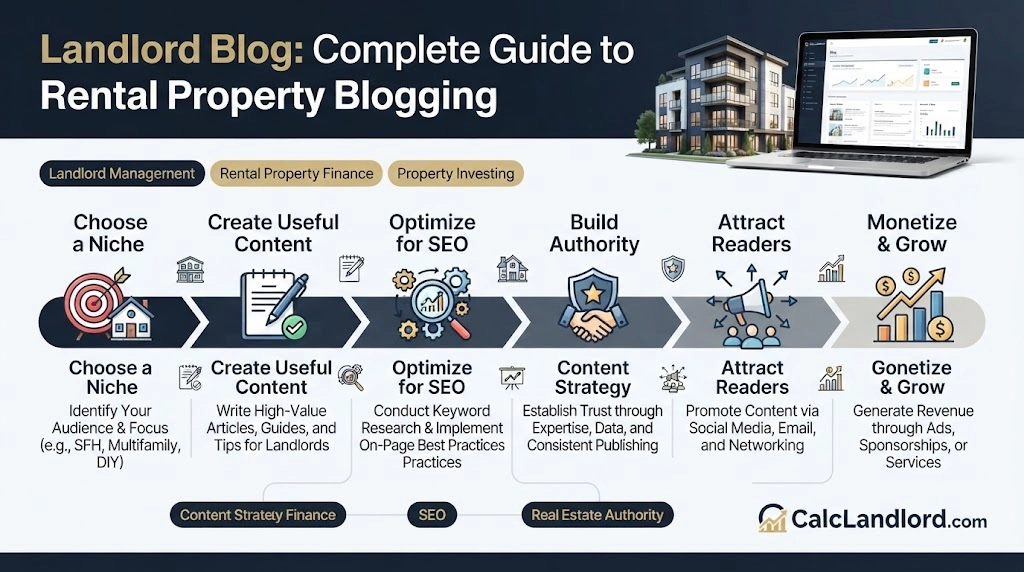
You can then divide your content into clear categories.
Property Investment & Returns
Topics include:
- Apartment investing
- Rental property ROI
- Cap rate
- Cash-on-cash return
- Property valuation
- Investment analysis
Rental Property Finance
Topics include:
- Mortgage calculations
- DSCR
- NOI
- Financing
- Debt service
- Operating expenses
Landlord Management
Topics include:
- Tenant management
- Rent collection
- Maintenance
- Lease management
- Vacancy
- Landlord responsibilities
This structure helps both users and search engines understand what your website is about.
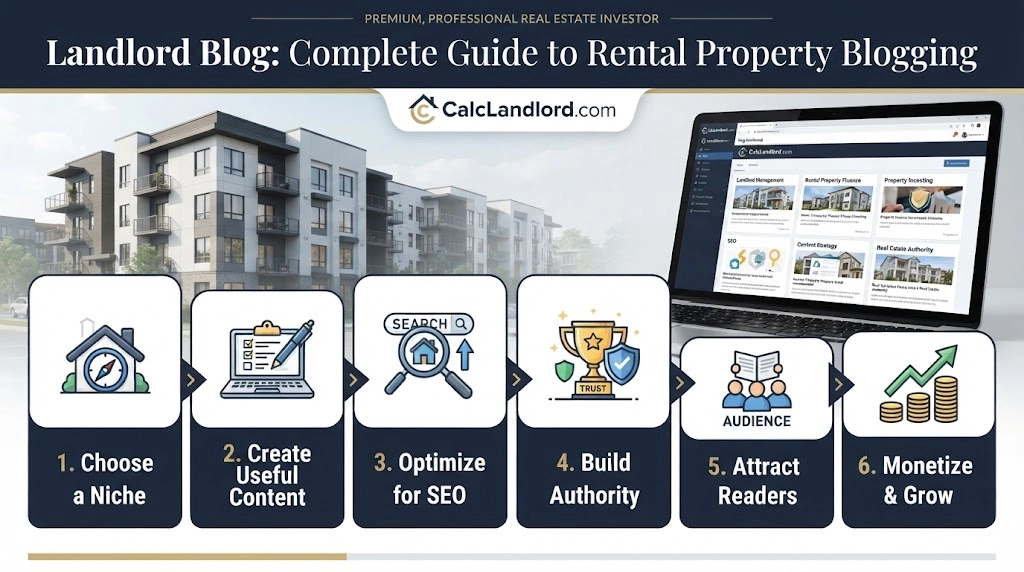
How to Start a Landlord Blog Step by Step
Starting a landlord blog does not require publishing hundreds of articles immediately.
Follow a structured process.
Step 1: Define Your Audience
Decide whether you primarily serve:
- Beginner landlords
- Experienced landlords
- Real estate investors
- Property managers
- Commercial property owners
- Rental property owners
You can serve multiple groups, but establish a clear primary audience.
Step 2: Build Your Topic Clusters
Create broad categories such as:
Rental Property Investing
Landlord Management
Rental Property Finance
Then develop supporting articles beneath each category.
Step 3: Research Search Intent
Determine what the searcher actually wants.
For example:
“What is NOI?” has informational intent.
“Rental property calculator” has tool-oriented intent.
“How to calculate cap rate” has educational and calculation intent.
Your article should satisfy the specific intent behind the query.
Step 4: Create Helpful Content
Give readers a direct answer first, then provide supporting details, examples, calculations, tables, FAQs, and practical guidance.
Step 5: Optimize the Article
Use a descriptive title, logical headings, concise paragraphs, relevant internal links, useful examples, and natural keyword placement.
Step 6: Publish and Update
Real estate information can change over time. Review important articles regularly and update outdated information.
How to Create High-Quality Rental Property Blog Posts
A high-quality landlord article should solve a specific problem rather than simply contain keywords.
Start with a clear answer.
If the article asks “What is a cap rate?”, define it immediately.
Then explain:
- How the formula works
- What numbers are required
- How investors interpret it
- What can influence cap rates
- Common mistakes
- A practical example
For financial topics, formulas and examples can make complicated concepts much easier to understand.
For example:
Cap Rate = Net Operating Income ÷ Property Value × 100
If a property produces $30,000 in annual NOI and is worth $500,000:
$30,000 ÷ $500,000 × 100 = 6% cap rate
Examples like this make an article more useful than a generic definition.
Use Clear Formatting
Break long sections into:
- Short paragraphs
- Bullet points
- Tables
- Step-by-step instructions
- Examples
- FAQs
The reader should be able to scan the page quickly and still understand the main answer.
How to Build a Content Strategy for a Real Estate Blog
A successful landlord blog needs a content system, not random publishing.
One effective approach is the pillar-and-cluster model.
Pillar Content
A pillar article provides a comprehensive overview of a major subject.
Examples:
- Rental Property Investing
- Landlord Management
- Rental Property Finance
- Apartment Investing
Cluster Content
Cluster articles answer narrower questions related to the pillar.
For example, a rental-property-investing cluster could include:
- How to calculate rental property ROI
- What is the cap rate?
- What is a cash-on-cash return?
- How to calculate NOI
- How to evaluate rental property cash flow
- Apartment investing guide
Then connect related articles using contextual internal links.
This structure creates a logical topical network.
Cover Different Search Intents
Your content calendar should include:
Informational: What is NOI?
How-to: How to calculate rental property ROI
Commercial investigation: Best rental property analysis methods
Tool-oriented: Rental property calculator
This gives your website opportunities across multiple stages of the user’s journey.
How Does SEO Help a Landlord Blog Get Traffic?
SEO helps search engines understand your content and helps users discover it when they search for relevant information.
For a landlord blog, SEO should go beyond inserting keywords into an article.
Search Intent
Understand why the person searched for the phrase.
Semantic Coverage
Use closely related concepts naturally.
For a cap-rate article, relevant concepts may include:
- NOI
- Property value
- Investment return
- Operating income
- Rental property
- Commercial real estate
- Valuation
Internal Linking
Link related articles and tools together.
For example, an article about rental property cash flow could link to relevant pages about NOI, operating expenses, cap rate, and rental property calculations.
Helpful Content
Give readers information they can actually use.
Clear Structure
Use descriptive H2 and H3 headings so readers and search engines can understand the page.
Trust Signals
For financial and real estate content, demonstrate expertise through accurate explanations, transparent calculations, credible references, and clear authorship where appropriate.
SEO should support the user experience rather than replace it.
How to Attract Readers and Grow a Rental Property Blog
Search traffic can become an important acquisition channel, but it should not be the only one.
Optimize for Search
Target questions that your audience actually asks.
Promote Useful Articles
Share valuable guides through relevant social channels, newsletters, communities, and professional networks where appropriate.
Build Email Subscribers
A useful landlord guide can encourage interested readers to subscribe for future educational content.
Create Evergreen Resources
Evergreen topics such as rental property calculations, landlord terminology, and investment fundamentals can continue attracting visitors over time.
Update Existing Articles
Updating an existing article can be more valuable than continually creating new content.
Review:
- Outdated information
- Broken links
- Old Examples
- Missing questions
- New related topics
- Changes in laws or regulations
For legal and regulatory topics, always verify current rules for the relevant jurisdiction rather than presenting general information as universal legal advice.
How Can Landlords Use a Blog to Build Trust and Authority?
Trust is particularly important in real estate because readers may make financial decisions based on what they read.
A strong landlord blog should demonstrate that its content is created to help readers, not simply manipulate search rankings.
Be Accurate
Check calculations, terminology, and factual claims.
Explain Complex Topics Clearly
Avoid unnecessary jargon or explain it when it is unavoidable.
Use Realistic Examples
Examples can show readers how a concept works in practice.
Be Transparent
If a calculation has assumptions, state them.
If a strategy has risks, explain those risks.
Show Expertise
Where appropriate, include author credentials, relevant experience, editorial standards, sources, and updated dates.
Avoid Overpromising
Real estate returns are not guaranteed.
Avoid statements suggesting that every investment strategy will produce a particular return.
A trustworthy landlord blog should help readers understand both opportunities and risks.
How Do Real Estate Bloggers Make Money?
A real estate blog can generate revenue through several models.
Advertising
A website with significant traffic may generate revenue from display advertising.
Affiliate Marketing
Relevant affiliate partnerships can generate commissions when readers purchase qualifying products or services.
The recommendations should remain genuinely useful and clearly disclosed where required.
Lead Generation
A blog can introduce readers to relevant services, professionals, tools, or investment resources.
Digital Products
Experienced creators may develop:
- Guides
- Templates
- Spreadsheets
- Courses
- Educational resources
Software and Tools
A landlord-focused website can connect educational content with useful calculators and property-analysis tools.
For example, an article explaining rental property cash flow could direct readers toward a related calculator that helps them perform the calculation themselves.
The strongest monetization strategy is usually built around helpful content + relevant products or tools, rather than aggressive advertising.
Common Landlord Blogging Mistakes to Avoid
Even a well-designed blog can struggle if its content strategy is weak.
Publishing Random Topics
Writing about unrelated subjects makes it harder to build a clear topical identity.
Keyword Stuffing
Repeating the same keyword unnaturally can make content difficult to read.
Writing Only for Search Engines
A page should satisfy the person behind the search query.
Ignoring Search Intent
A detailed article can still fail if it does not answer what the searcher actually wants.
Publishing Thin Content
Short content is not automatically bad, but an article should contain enough information to solve its intended problem.
Using Unsupported Claims
Avoid presenting uncertain statistics, legal claims, or financial promises as facts.
Forgetting Internal Links
Related articles should connect naturally so readers can explore the topic further.
Never Updating Old Articles
Outdated financial, legal, market, or regulatory information can reduce usefulness and trust.
Overpromoting Products
Readers should receive genuine value before being pushed toward a conversion.
People Also Ask
A: A landlord blog is a website or website section that publishes educational and practical content about rental properties, property management, real estate in vesting, landlord responsibilities, and related financial topics.
A: A landlord blog can cover rental property investing, tenant management, property maintenance, financing, cash flow, ROI, NOI, cap rates, leases, property management, taxes, insurance, and other relevant ownership topics.
A: Yes. A well-planned blog can help real estate investors educate their audience, build authority, attract organic search traffic, explain investment concepts, and support related tools or services.
A: There is no universal ideal publishing frequency. Consistently publishing genuinely useful content is generally more valuable than producing large quantities of low-quality articles.
A: Yes. Depending on the website and audience, possible revenue models include advertising, affiliate marketing, lead generation, digital products, subscriptions, and relevant software or services.
Conclusion
A Landlord Blog can become one of the most valuable content assets for a rental-property website. Instead of publishing random articles, build a structured resource that follows the real questions landlords and investors face.
Start with major topics such as property investment, rental property finance, and landlord management. Build pillar pages around those subjects, create supporting cluster articles, connect them with relevant internal links, and keep the information accurate and useful.
The ultimate goal is not simply to publish more blog posts. It is to create a trusted rental-property knowledge hub that helps readers understand investments, evaluate properties, manage rentals, and make more informed decisions.
When useful content is combined with strong SEO, clear organization, practical examples, calculators, and trustworthy information, a landlord blog can support both users and the long-term growth of a real estate website.

Pingback: Tenant Filed Bankruptcy? 5 Steps Landlords Should Take