

What Happens When a Commercial Tenant Files Bankruptcy? A Landlord and Tenant Guide
A commercial tenant has filed for bankruptcy. Rent may already be overdue, an eviction may already be underway, and you may be unsure whether you can take back the property. The first mistake is assuming the lease automatically ends—or that you can keep collecting and proceed as usual. In the United States, bankruptcy generally triggers an automatic stay that restricts many collection and eviction actions, while the lease may remain in place until it is assumed, rejected, or assigned. This guide explains the key deadlines, post-filing rent rules, damages limits, and practical steps for landlords and tenants before they act.
When a commercial tenant files for bankruptcy, the landlord may suddenly face unpaid rent, uncertainty over the lease, and restrictions on enforcing ordinary landlord remedies. However, a commercial tenant’s bankruptcy filing does not automatically cancel the lease or eliminate every rent obligation. It triggers a federal legal process that determines how the lease and the landlord’s claims will be handled.
1. The Short Answer: What Happens When a Commercial Tenant Files Bankruptcy?
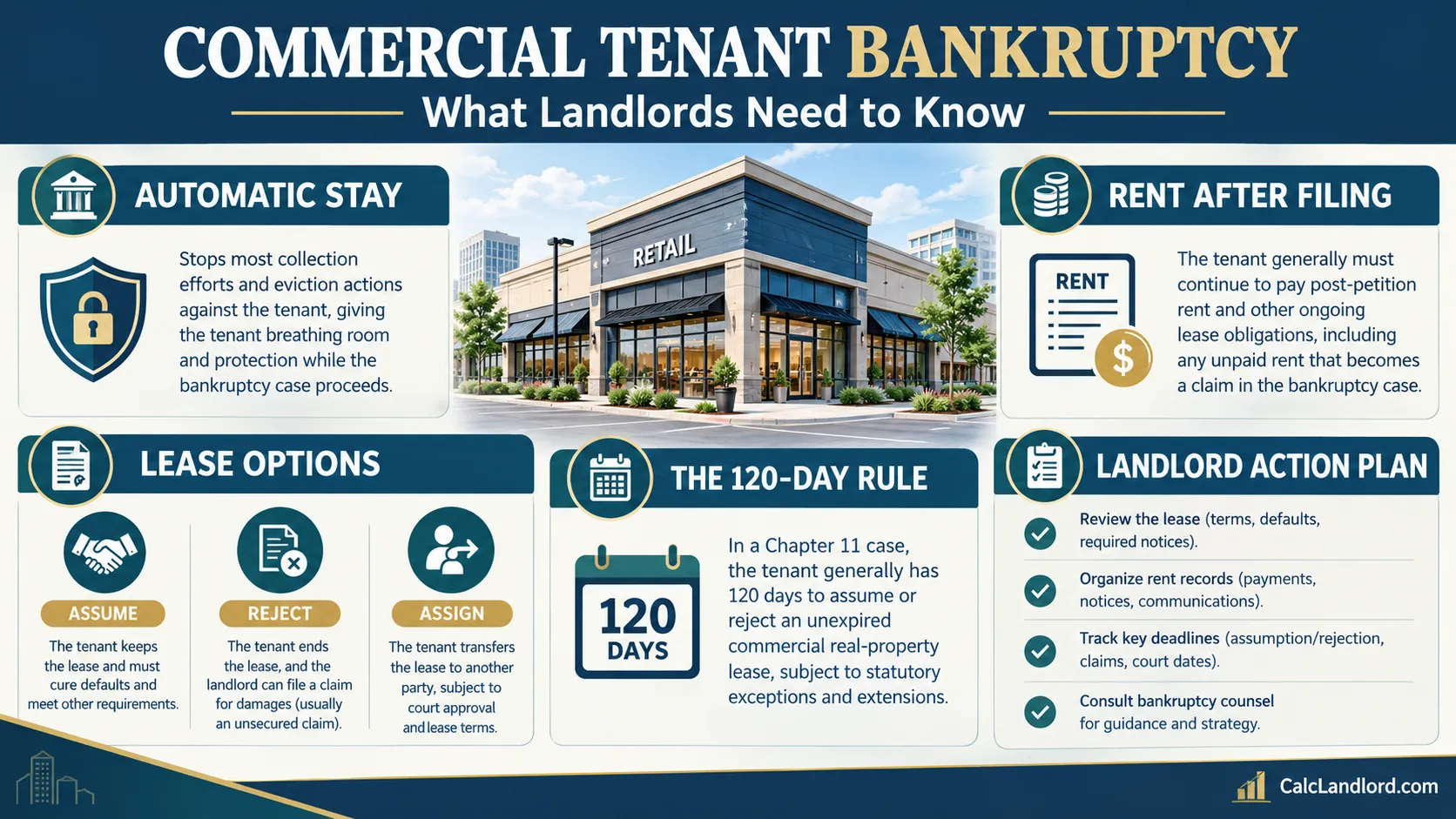
When a commercial tenant files bankruptcy, the automatic stay generally restricts the landlord from continuing covered collection or eviction actions against the tenant. The commercial lease does not automatically disappear, and the bankruptcy case determines how the lease and related claims will be treated.
The principal rules are:
- The automatic stay: Many actions to collect pre-bankruptcy debts or obtain possession of the premises must stop unless a legal exception or court order permits the action.
- Ongoing lease obligations: Obligations arising after the filing generally remain subject to the performance requirements in Section 365(d)(3) while an unexpired nonresidential lease remains unresolved.
- Lease options: The debtor or trustee may seek to assume the lease, reject it, or assume and assign it, subject to statutory requirements.
- A statutory deadline: Section 365(d)(4) generally provides a 120-day period for an unexpired nonresidential real-property lease, subject to the earlier plan-confirmation date and permitted extensions.
- Past-due rent and damages: Pre-filing claims and rejection damages are handled through bankruptcy procedures, with the rejection-damages claim subject to the rules in Section 502(b)(6).
These rules come primarily from 11 U.S.C. § 362, which governs the automatic stay, and 11 U.S.C. § 365, which governs executory contracts and unexpired leases.
The practical result depends on whether the tenant is restructuring its business, closing a location, or attempting to transfer a valuable lease. The lease’s status at the filing date is especially important.
2. What Happens Immediately? The Automatic Stay and Landlord Restrictions
The first major change occurs when the bankruptcy petition is filed. The automatic stay generally operates immediately, without the landlord needing to receive a separate warning or wait for a court hearing.
Under Section 362(a), the stay restricts many actions to collect pre-petition debts, continue covered lawsuits, enforce judgments, or exercise control over property of the bankruptcy estate.
For a commercial landlord, potentially restricted actions include:
- Continuing an eviction or possession action against the debtor.
- Pursuing a lawsuit to collect rent owed before the filing.
- Attempting to collect a pre-bankruptcy debt outside the bankruptcy process.
- Taking possession of the premises or tenant property through actions prohibited by the stay.
The precise scope depends on the facts and the statutory exceptions. A landlord should not assume every action involving a tenant or a leased property is automatically prohibited or automatically permitted.
A bankruptcy filing also does not normally make a contractual clause enforceable simply because it says the lease ends upon bankruptcy. Section 365(e) generally restricts termination or modification solely because the bankruptcy case began, subject to statutory exceptions.
Example: A retail tenant owes three months of rent and files Chapter 11 while still operating its store. The landlord should not change the locks or continue a covered eviction action without determining whether the stay applies and whether court authorization is required.
The landlord should immediately confirm the filing, preserve records, and obtain legal advice about the next appropriate court procedure. Violating an applicable automatic stay can expose a creditor to legal consequences.
For further guidance, the U.S. Bankruptcy Court’s tenant-bankruptcy FAQ explains the general stay and the procedure for requesting relief.
3. Can a Landlord Evict a Commercial Tenant After a Bankruptcy Filing?
Generally, a landlord must pause covered eviction and possession actions against a commercial tenant while the automatic stay applies. The landlord may be able to obtain permission from the bankruptcy court to proceed, but should not assume that ordinary state eviction procedures can continue unchanged.
The landlord’s options depend on the lease, the stage of any existing eviction proceeding, the tenant’s status, and the court’s orders. If the landlord wants possession, a common route is to file a motion for relief from the automatic stay.
A bankruptcy judge may grant, deny, modify, or condition the requested relief. Obtaining relief from the stay does not mean every subsequent step is complete; the landlord may still need to follow applicable state law and required court procedures.
There is also an important distinction between a lease that remains legally in effect and a lease that was already terminated before bankruptcy. Under Section 365(c)(3), a nonresidential lease that was terminated under applicable nonbankruptcy law before the order for relief generally cannot be assumed. Section 362 also contains specific exceptions whose application depends on the lease and the circumstances.
A commercial landlord should therefore verify:
- Whether the lease was legally in effect on the bankruptcy filing date.
- Whether an eviction judgment or other order existed before filing.
- Whether the automatic stay applies to the proposed action.
- Whether relief from stay is needed.
- Which state-law procedures remain necessary after any relief is granted.
Do not treat a missed rent payment or the bankruptcy filing itself as permission to change locks, remove merchandise, dispose of tenant property, or take possession. Have counsel confirm the legally permitted next step.
4. Does a Commercial Tenant Have to Pay Rent After Filing?
Filing bankruptcy does not automatically give a commercial tenant free occupancy. Section 365(d)(3) generally requires timely performance of the debtor’s obligations arising after the order for relief under an unexpired lease of nonresidential real property until the lease is assumed or rejected, subject to the statutory exceptions and applicable court orders.
This distinction matters because a landlord may be dealing with two different categories of rent.
| Rent category | General treatment |
| Pre-petition rent | Generally handled as a bankruptcy claim, subject to the claims process and applicable rules. |
| Post-petition lease obligations | Generally subject to Section 365(d)(3)’s performance requirements until assumption or rejection. |
| Rent for the remainder of the filing month | May raise a “stub rent” dispute depending on when charges accrue, become payable, and how the relevant court treats the obligation. |
The distinction is not always as simple as checking an invoice date. For example, a common-area maintenance reconciliation issued after filing may relate partly or entirely to costs incurred before filing. The lease language, applicable law, and bankruptcy-court analysis may determine how the charge is classified.
Stub rent—the amount associated with the portion of a month after the filing—can also be disputed. Landlords and tenants should not assume that every court uses the same method to determine the amount due or its payment priority.
If post-petition rent or other lease obligations go unpaid, the landlord should document the amount, identify the specific obligations involved, and seek advice about raising the issue with the bankruptcy court. It should not treat nonpayment as permission to bypass the automatic stay.
For tenants, the financial lesson is equally important: a restructuring budget should account for ongoing occupancy costs, including additional rent, insurance, taxes, maintenance obligations, and other lease charges where applicable.
5. What Happens if the Tenant Assumes the Lease?
Assumption means the debtor or trustee elects to keep the lease, subject to the Bankruptcy Code and any required court approval. It may be appropriate when the premises are essential to the business, the location is profitable, or the existing lease is economically favorable.
When there has been a default, Section 365(b) generally requires the debtor to cure the default or provide adequate assurance of prompt cure, compensate the landlord for certain actual pecuniary losses resulting from the default, and provide adequate assurance of future performance.
Statutory exceptions apply to certain defaults, including some defaults based solely on insolvency or the commencement of the bankruptcy case.
Assumption does not simply erase the landlord’s rights or permanently excuse rent obligations. The tenant must be capable of performing the lease as required going forward.
Example: A retailer operates from a busy shopping district and has a below-market lease. Its sales have temporarily declined, but its restructuring plan shows that the location remains viable. Assuming the lease could be preserved, provided the tenant can satisfy the relevant statutory requirements and maintain future performance.
From the landlord’s perspective, a cure can preserve the tenancy and future rental income. However, the landlord should closely review proposed cure amounts, unresolved additional-rent charges, property condition, insurance requirements, and evidence of the tenant’s ability to perform.
From the tenant’s perspective, assumption should be a financial decision as well as a legal decision. Keeping a location that produces persistent losses may worsen the restructuring, even if the lease has attractive terms.
6. What Happens if the Tenant Rejects the Lease?
Rejection means the debtor or trustee elects not to continue performing under the lease, subject to bankruptcy law and court procedures. Under Section 365(g), rejection generally constitutes a breach of the lease for bankruptcy-claim purposes. For a lease that has not previously been assumed, the statute generally treats that breach as occurring immediately before the bankruptcy filing.
Rejection does not mean the landlord automatically receives every dollar of rent that would have become due through the original expiration date. Instead, the landlord may have a claim for damages, subject to the Bankruptcy Code, the lease, and applicable law.
The landlord may also seek to recover the premises through the legally appropriate process. Rejection should not be confused with permission to bypass the automatic stay or ignore court orders.
Rejection can make sense for a tenant when a location is persistently unprofitable, rent is substantially above market, or the business needs to close or consolidate operations. For a landlord, rejection can mean a loss of rent, a vacancy, repair costs, re-leasing expenses, and a claim that may not be paid in full.
A landlord should begin preparing for those possibilities without assuming the final financial recovery is already known.
Relevant considerations include:
- The lease’s remaining term and rent structure.
- The amount of past-due rent.
- Whether the tenant has surrendered the premises or the landlord has repossessed them.
- The statutory limit on certain lease-termination damages.
- The time and expense required to find a new tenant.
- Whether a guarantor or another legally available source of recovery exists.
The landlord’s claim and the process for regaining possession are separate issues. Both should be evaluated with bankruptcy counsel.
7. Can the Tenant Assign the Commercial Lease to Another Business?
A commercial tenant in bankruptcy may be able to assume the lease and assign it to another business. This can be valuable when the lease is favorable, and another operator wants the location, but the assignment must satisfy the Bankruptcy Code.
Under Section 365(f), many restrictions on assignment may be overridden, subject to exceptions in the statute. In general, the lease must first be assumed, and the proposed assignee must provide adequate assurance of future performance.
The law does not make every lease freely transferable in every circumstance. For example, Section 365(c) can restrict assumption or assignment where applicable law excuses the other party from accepting performance from a different entity and that party does not consent. A nonresidential lease already terminated under applicable nonbankruptcy law before the order for relief generally cannot be assumed.
A landlord evaluating a proposed assignee should review the proposed operator’s finances, relevant business experience, ability to meet insurance and maintenance requirements, use of the premises, and expected compliance with the lease.
Example: A restaurant chain closes an underperforming location during Chapter 11 but finds an independent operator interested in taking over a favorable lease. An assignment may preserve occupancy and rental income, provided the statutory requirements are satisfied, and the proposed operator can provide the required assurance of future performance.
Shopping-center leases receive additional statutory treatment, including considerations relating to use, exclusivity provisions, percentage rent, and tenant mix. Section 365(b)(3) addresses adequate assurance in that setting.
Tenants should compare the value of an assignment against the costs of curing defaults, negotiating the transfer, and meeting future obligations. Landlords should evaluate the proposed operator rather than relying solely on the outgoing tenant’s promise.
8. How Long Does the Tenant Have to Decide? The 120-Day Deadline
The deadline for deciding what to do with a commercial real-property lease is one of the most important dates in the bankruptcy case.
Under the current text of Section 365(d)(4), an unexpired lease of nonresidential real property under which the debtor is the lessee is generally deemed rejected if it is not assumed or rejected by the earlier of:
- 120 days after the order for relief, or
- The date the court enters an order confirming a plan.
Before the 120-day period expires, the court may extend the period by 90 days for cause on the motion of the trustee or lessor. A subsequent extension requires the lessor’s prior written consent in each instance.
The exact deadline should be calculated from the relevant court record and applicable orders, not an informal estimate.
Important statutory clarification: Some older summaries quote a 60-day deadline for nonresidential commercial leases. The historical text of the statute used 60 days before Congress amended the rule. The current § 365(d)(4) contains the 120-day rule. The 60-day period in current § 365(d)(1) concerns residential real-property leases and personal-property leases, not the general deadline for an unexpired nonresidential commercial real-property lease. See the current U.S. Code text of Section 365.
For landlords, the deadline affects how long lease status may remain unresolved and when it may be appropriate to seek legal or court relief. For tenants, it determines how much time is available to assess the location, prepare a restructuring strategy, cure defaults, and arrange an assignment.
Do not wait until the last few days to investigate the deadline. A plan-confirmation order, court motion, or other procedural development may change the relevant timeline.
9. What Happens to Past-Due Rent and a Landlord’s Proof of Claim?
Rent owed before the bankruptcy filing is generally treated differently from obligations arising afterward. The landlord ordinarily must use the bankruptcy claims process rather than continue ordinary collection activity against the debtor while the stay applies.
A landlord should review the case notice and determine whether a proof of claim is required, which form and supporting documents are appropriate, and what deadline applies. The relevant filing deadline is not necessarily the same in every bankruptcy case.
Supporting records may include:
- The complete signed lease and relevant amendments.
- A rent ledger showing charges, credits, and payments.
- Invoices for additional rent, taxes, insurance, and common-area charges.
- Notices of default and other relevant correspondence.
- Records of payments and the allocation of any security deposit, where legally appropriate.
- Documentation supporting damages or other claimed amounts.
It is essential to separate the numbers rather than combine every amount into one undifferentiated total.
For example, a landlord could have unpaid rent from before the filing, post-filing rent obligations, and a potential claim for damages after rejection. The legal classification, supporting evidence, and applicable treatment can differ for each category.
A proof of claim also does not guarantee full payment. The result may depend on the available bankruptcy estate, claim priority, objections, applicable law, and the final allowance of the claim.
The landlord should calendar the bar date stated in the applicable case notices and consult counsel on whether the claim requires special calculations or documentation.
10. How Are Commercial Lease Rejection Damages Calculated?
Section 502(b)(6) of the Bankruptcy Code limits the amount of certain claims by a lessor for damages resulting from termination of a real-property lease.
In general, the cap consists of:
- The rent reserved by the lease, without acceleration, for the greater of one year or 15% of the remaining lease term, with the 15% period capped at three years; plus
- Qualifying unpaid rent due under the lease, without acceleration, on the earlier of the bankruptcy filing date or the date the landlord repossessed the property or the tenant surrendered it.
Read the statutory language of Section 502 before relying on a simplified summary. How specific charges, additional rent, and other lease provisions fit into the calculation can raise legal questions.
Worked example: A commercial lease with 10 years remaining
Assume the following hypothetical facts:
- Remaining lease term: 10 years.
- Fixed monthly rent: $10,000.
- Remaining term expressed in months: 120.
- No rent increases are assumed for this simplified illustration.
Step 1: Calculate 15% of the remaining term.
120 months × 15% = 18 months.
Step 2: Compare the result with one year.
One year is 12 months. Because 18 months is greater than 12 months, the rent-period component uses 18 months in this example. That period is also below the three-year maximum.
Step 3: Calculate the illustrative rent component.
18 months × $10,000 = $180,000.
Step 4: Consider qualifying unpaid rent separately.
The applicable statutory calculation may also include qualifying unpaid rent due on the earlier of the bankruptcy filing date or repossession/surrender date, without acceleration.
The $180,000 figure is only an illustration of the rent-period component under the stated assumptions. It is not a determination of the landlord’s final allowed claim, an estimate of the amount that will be collected, or a substitute for analyzing the actual lease.
The calculation may be more complicated when the lease contains scheduled rent increases, percentage rent, common-area maintenance charges, tax reimbursements, or other disputed amounts. The statute limits the allowed claim; it does not guarantee that the landlord will recover the amount of the cap.
A landlord should have bankruptcy counsel determine how the formula applies to the actual lease and the legally relevant dates.
11. What Should a Landlord Do When a Commercial Tenant Files Bankruptcy?
A commercial landlord should respond promptly, but it should not confuse fast action with unrestricted enforcement rights. The safest approach is to preserve the evidence, understand the court’s deadlines, and identify the remedies legally available in the case.
Practical landlord checklist
1. Verify the bankruptcy filing. Confirm the filing date, court, case number, debtor’s legal name, and bankruptcy chapter. Retain the formal notice and check the case docket.
2. Pause potentially prohibited enforcement activity. Have counsel determine which communications, collection steps, lawsuits, eviction proceedings, and possession actions must stop under the automatic stay.
3. Review the lease and amendments. Identify rent terms, additional-rent provisions, default clauses, assignment terms, deposits, guarantees, renewal options, and other relevant rights.
4. Reconcile the rent ledger. Separate pre-petition arrears from post-petition obligations and identify disputed amounts. Preserve invoices, payment records, and supporting calculations.
5. Monitor ongoing performance. Track applicable rent, taxes, insurance, maintenance, and other lease requirements while the lease remains unresolved.
12. What Should a Commercial Tenant Do After Filing Bankruptcy?
A business tenant should treat the lease as an important restructuring decision. The question is not simply whether rent is overdue, but whether the location is essential to the business and whether the company can realistically meet its obligations.
Practical tenant checklist
1. Identify every property agreement. Prepare a complete list of leases, subleases, guarantees, amendments, and related property agreements. Include each location’s rent, expiration date, outstanding defaults, and renewal options.
2. Evaluate each location economically. Identify profitable locations, loss-making stores, below-market leases, and sites with significant closure or relocation costs.
3. Confirm the controlling deadline. Work with bankruptcy counsel to calculate the applicable assumption/rejection deadline and identify any motions, hearings, or plan-related dates.
4. Prepare a realistic occupancy budget. Include rent and additional lease charges, utilities, maintenance, insurance, relocation costs, and other ongoing obligations.
5. Calculate the cost of assumption. Determine the potential cure amount, compensation for qualifying losses, and the financial requirements of future performance.
6. Evaluate assignment opportunities. Where permitted, assess whether another qualified operator may be interested in the location or lease.
7. Obtain advice before stopping performance. Do not assume that bankruptcy automatically cancels the lease or removes every obligation. Ask counsel what the applicable statute, lease, and court orders require.
A useful decision framework is to compare the estimated financial outcome of keeping a location, transferring the lease, or rejecting it. Consider the lease’s commercial value, the cost of cure, future rent, business revenue, relocation costs, and the effect on the wider restructuring.
The tenant should also avoid relying only on the amount of rent currently overdue. A location with overdue rent may still be valuable, while a location with no existing arrears may nevertheless be too costly to retain.
13. What Happens to Personal Guarantees and Security Deposits?
Personal guarantees and security deposits can materially affect a commercial landlord’s potential recovery, but neither should be treated as a simple extension of the tenant’s rent ledger.
Personal guarantees
A guarantee may make an individual or another entity liable for specified lease obligations. The bankruptcy filing of the tenant company does not ordinarily mean that every guarantor has also filed bankruptcy or receives identical stay protection.
However, the wording of the guarantee, applicable law, the guarantor’s own circumstances, and any separate bankruptcy proceeding can change the analysis.
A landlord should identify each guarantor and review the guarantee’s scope before deciding whether a claim or enforcement action is available. A tenant should determine which obligations may survive at the guarantor level and discuss the implications with counsel.
Do not assume that a claim against a guarantor is always permitted immediately. The applicable stay, other court orders, or other legal restrictions may affect the action.
Security deposits
A cash security deposit can raise questions about ownership, the landlord’s right to apply it, setoff, and the tenant’s rights in bankruptcy.
A landlord should not automatically assume that it can use the deposit to offset pre-petition arrears after the filing. Counsel should review the lease, the deposit’s status, applicable law, and the automatic stay before the funds are applied or transferred.
A tenant should retain the original deposit documentation and reconcile the amount paid, any deductions already made, and the balance held by the landlord.
Why the distinction matters
Suppose a tenant owes $60,000 in pre-petition rent and has a $25,000 security deposit. The existence of the deposit does not, by itself, establish that the landlord can immediately apply it or that the remaining $35,000 will be recovered.
Those questions depend on the relevant legal rules and claim analysis. The same caution applies to guarantees: potential liability is not the same as immediate, guaranteed collection.
14. What Special Rules Apply to Shopping-Center Leases and Previously Terminated Leases?
Two situations deserve particular attention: leases in shopping centers and leases that may have terminated before the bankruptcy filing.
Shopping-center leases
Section 365(b)(3) addresses adequate assurance of future performance for shopping-center leases. The statute includes considerations involving the source of rent, percentage rent, restrictions relating to radius, location, use and exclusivity, and the effect of the proposed arrangement on the shopping center’s tenant mix or balance.
These provisions can matter when a debtor seeks to assume and assign a retail lease to a different business.
For example, a replacement operator may be financially capable of paying the rent but propose a use that conflicts with an enforceable lease restriction. The financial ability to pay is important, but it may not resolve every shopping-center lease issue.
Landlords and tenants should therefore review the whole lease, other relevant shopping-center agreements, and the proposed assignee’s operations.
Leases terminated before the filing.
The status of the lease immediately before bankruptcy can be decisive. Under Section 365(c)(3), a nonresidential lease that was terminated under applicable nonbankruptcy law before the order for relief generally cannot be assumed.
Whether a particular lease was legally terminated depends on the lease, the governing state law, the relevant notices and proceedings, and the timing of events.
A landlord should not assume that sending a termination notice necessarily completed a valid termination. A tenant should not assume that filing bankruptcy automatically revives a lease that had already terminated.
Both sides should have counsel review the relevant records and determine whether the lease remained unexpired and eligible for assumption.
15. People Also Ask About Commercial Tenant Bankruptcy
No. The filing itself does not ordinarily cancel an unexpired commercial lease. The lease may be assumed, rejected, or assumed and assigned under Section 365, subject to statutory requirements, deadlines, and court oversight.
A landlord should not change the locks or attempt to take possession without confirming that the action is permitted. The automatic stay generally restricts covered eviction and possession actions, and the landlord may need relief from the bankruptcy court.
Generally, Section 365(d)(3) requires timely performance of obligations arising after the order for relief under an unexpired nonresidential real-property lease until assumption or rejection, subject to the statutory exceptions and applicable orders. Disputed charges, including some stub-rent issues, require careful analysis.
Under the current Section 365(d)(4), the lease is generally deemed rejected if it is not assumed or rejected by the earlier of 120 days after the order for relief or entry of an order confirming a plan. The court may extend the deadline by 90 days for cause before the original period expires. A further extension requires the lessor’s prior written consent in each instance.
Pre-petition arrears are generally addressed through the bankruptcy claims process. The landlord should review the case notice, preserve supporting records, and determine the applicable proof-of-claim deadline. The amount ultimately allowed or recovered depends on the claim, applicable law, priority rules, and the facts of the case.
Conclusion: What Landlords and Tenants Should Do Next
When a commercial tenant files bankruptcy, the lease does not automatically end, and the landlord cannot necessarily continue collection or eviction actions as usual. The automatic stay, ongoing rent obligations, lease deadlines, and potential damages claims all influence what happens next.
For landlords, the priority is to verify the bankruptcy filing, review the lease, organize rent records, track court deadlines, and consult a qualified bankruptcy attorney before taking enforcement action. For tenants, the key decision is whether to assume, reject, or potentially assign the lease while meeting applicable legal requirements.
Remember these three important points:
- The automatic stay matters: Determine which collection and eviction actions must stop.
- The lease deadline matters: The general Chapter 11 deadline for an unexpired commercial real-property lease is 120 days, subject to plan-confirmation rules and permitted extensions.
- Damages are not guaranteed: The Bankruptcy Code limits certain commercial lease termination claims, and the final recoverable amount depends on the facts and applicable law.

Pingback: Effective Annual Rate: Formula + 3 Clear Examples - CalcLandLord
Pingback: Sign With RowCal? 12 Questions to Protect Your Money