

Ramsey Invest Calc: Project Your Investment Growth the Honest Way
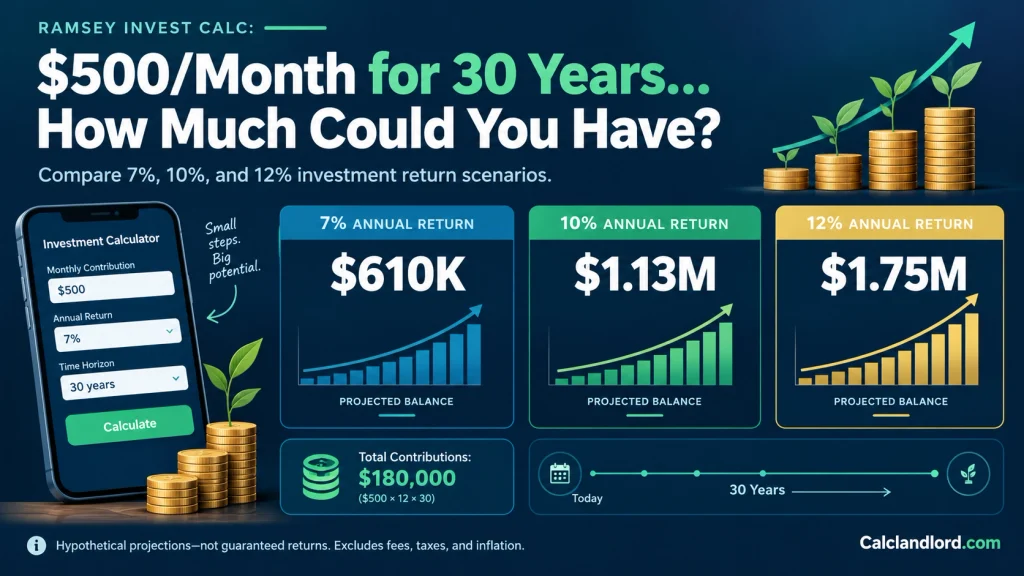
How much could your investments be worth if you put money away every month for 30 years? A Ramsey investment calculator can help you estimate the answer—but the result depends heavily on the return you assume. For example, investing $500 monthly for 30 years could grow to roughly $610,000 at 7%, $1.13 million at 10%, or $1.75 million at 12%, before fees, taxes, and inflation. Those are illustrations, not promises. In this guide, compare the scenarios, learn how compounding works, and see how contributions, employer matches, and inflation affect your retirement estimate. Run the numbers before setting your goal.
A Ramsey invest calc helps you estimate how much your investments could grow over time through regular contributions and compound growth. It is commonly associated with Dave Ramsey’s investment approach, including the idea of investing consistently over several decades and targeting 15% of gross household income for retirement.
The biggest question is not simply how much money you could accumulate. It is whether the assumptions behind your projection are realistic enough to help you plan.
For example, investing $500 per month for 30 years could produce approximately $610,000 at a hypothetical 7% annual return, $1.13 million at 10%, or $1.75 million at 12%. These figures assume monthly compounding, no starting balance, and contributions at the end of each month. They exclude fees, taxes, and inflation.
That difference shows why you should compare several return scenarios instead of relying on one attractive number.
In this guide, you will learn how the Ramsey investment calculator works, how to calculate compound growth, how its 12% assumption should be interpreted, and how to use your results to make better long-term financial decisions.
Quick Answer: What Is the Ramsey Invest Calc?
The Ramsey invest calc is a compound-growth calculator that estimates the future value of an initial investment plus recurring contributions. You typically enter your starting balance, monthly investment, expected annual return, and investment period to estimate how much your portfolio could be worth.
Ramsey-style projections often use a 12% annual return assumption. However, 12% is not guaranteed, and actual investment results depend on market performance, fees, taxes, contribution timing, and other factors.
For a more balanced estimate, compare multiple scenarios, such as 7%, 10%, and 12%, before deciding how much you need to invest.
What Is the Dave Ramsey Investment Calculator?
The Dave Ramsey investment calculator is designed to show how regular investing and compound growth can build wealth over time.
The calculation considers two sources of potential growth:
- Your contributions: The money you deposit into an investment account.
- Investment growth: The returns earned on your initial investment and previous returns that remain invested.
For example, suppose you invest $500 every month for 30 years. You contribute $180,000 from your own income over that period. Depending on investment performance, your final account balance could be significantly higher.
The calculator helps estimate that potential difference.
Where Can You Find the Official Ramsey Investment Calculator?
Ramsey Solutions provides an investment calculator through its official website.
You can access it here: Ramsey Investment Calculator.
You can also use the U.S. Securities and Exchange Commission’s Investor.gov Compound Interest Calculator to model an initial investment, recurring contributions, an estimated return, and a selected time period.
These tools provide mathematical projections, not promises of future returns.
How to Use the Ramsey Invest Calc
To make the calculation useful, enter realistic figures that reflect your current financial situation and long-term goals.
1. Enter your starting investment
Include your current investment balance if the calculator supports it. This might be money held in a 401(k), Roth IRA, traditional IRA, or taxable brokerage account. Enter $0 if you are starting from scratch.
2. Enter your monthly contribution
Choose an amount you can realistically invest every month. For example, start with $250, $500, or $1,000, depending on your budget.
3. Select an annual return assumption
Compare 7%, 10%, and 12% rather than relying on a single projection. Make sure you understand whether the calculator assumes a nominal annual return or another return convention.
4. Choose your investment period
Enter the number of years you expect to keep investing. Someone with 30 years until retirement has more time for compounding than someone with only 10 years remaining.
5. Review your projected balance
Compare the results under different assumptions. Check whether the calculator includes employer contributions, fees, taxes, and inflation before treating its output as a retirement target.
The most useful result is not necessarily the highest projected balance. It is the range of outcomes that helps you decide whether your savings rate and investment timeline are adequate.
Ramsey Invest Calc Formula
A compound-growth calculator estimates the future value of your existing balance and the future value of your recurring contributions.
A commonly used formula for monthly compounding and end-of-month contributions is:
\[ FV=P(1+i)^n+PMT\left(\frac{(1+i)^n-1}{i}\right) \]
Where:
| Variable | Meaning |
|---|---|
| \(FV\) | Future investment value |
| \(P\) | Initial investment balance |
| \(PMT\) | Monthly contribution |
| \(i\) | Monthly assumed return, calculated as the annual nominal rate divided by 12 |
| \(n\) | Total number of monthly periods |
| \(t\) | Number of investment years, where \(n=12t\) |
For a monthly return assumption of 10% annually:
\[ i=\frac{0.10}{12} \]
For a 30-year investment period:
\[ n=30\times12=360 \]
The calculator applies the assumed monthly growth rate across 360 periods while accounting for each recurring contribution.
This is a simplified projection. Actual investment returns fluctuate, and some calculators use different compounding or contribution-timing conventions.
How Much Will $500 a Month Be Worth in 30 Years?
Investing $500 every month for 30 years means contributing $180,000 of your own money.
The final balance depends heavily on the assumed rate of return.
| Annual return assumption | Total contributions | Projected final balance | Growth above contributions |
|---|---|---|---|
| 7% | $180,000 | $609,985 | $429,985 |
| 10% | $180,000 | $1,130,244 | $950,244 |
| 12% | $180,000 | $1,747,482 | $1,567,482 |
Illustrative estimates using monthly compounding and end-of-month contributions, with a $0 starting balance. Figures exclude investment fees, taxes, and inflation and are not forecasts.
At 7%, your projected balance is about $610,000. At 12%, it approaches $1.75 million.
Both examples use the same monthly contribution and investment period. Only the assumed return changes.
That is why a compound-growth calculator should be used to explore a range of potential outcomes rather than to predict a precise retirement balance.
Compare Different Monthly Investment Amounts
The following table shows how changing your monthly contribution affects projected growth over 30 years.
| Monthly investment | At 7% | At 10% | At 12% |
|---|---|---|---|
| $250 | $305,000 | $565,000 | $874,000 |
| $500 | $610,000 | $1,130,000 | $1,747,000 |
| $1,000 | $1,220,000 | $2,260,000 | $3,495,000 |
| $1,500 | $1,830,000 | $3,391,000 | $5,242,000 |
These are hypothetical balances before fees, taxes, and inflation, rounded to the nearest thousand dollars.
Increasing your contribution can make a substantial difference. However, the best monthly amount is one you can sustain without neglecting necessary expenses, emergency savings, or other financial obligations.
Is Dave Ramsey’s 12% Return Assumption Realistic?
The 12% assumption is an important part of discussions about the Ramsey investment calculator.
In its article Can You Really Get a 12% Return on Your Investments?, Ramsey Solutions reports a historical average annual S&P 500 return of 11.86% for 1928–2025.
That historical figure helps explain where the 12% assumption comes from. However, a historical average is not a guaranteed annual return or a promise that your portfolio will compound at 12% every year.
There are three important distinctions to understand.
1. Average returns and compound returns are different
Imagine an investment worth $100 that loses 50% in the first year.
Your balance falls to $50.
If the investment then gains 100%, your balance returns to $100.
The two annual returns average 25% arithmetically:
\[ \frac{-50\%+100\%}{2}=25\% \]
Yet your investment has not grown at all over the two years.
This illustrates why an average of annual returns is not the same as the actual compounded return experienced by an investor.
2. Market returns are unpredictable
Stock markets can rise substantially during some years and fall during others. The timing and size of these changes affect your final balance.
A fixed-rate calculator smooths these changes into one assumed percentage. Actual investment accounts do not grow so predictably.
The SEC’s Introduction to Investing explains that investing involves risk and that market fluctuations should be expected.
3. Fees and taxes reduce what you keep
A calculator may show growth before investment expenses, account fees, or taxes.
The SEC explains in its Investor Bulletin on investment fees and expenses that even relatively small fees can reduce long-term portfolio values.
Your actual results depend on the investments you choose, their costs, your account type, your tax situation, and the returns you receive.
Which return should you use?
Use several assumptions to test your plan. For example:
| Scenario | Assumed annual return | How to interpret it |
|---|---|---|
| Conservative illustration | 7% | A lower-return scenario for testing your plan |
| Middle illustration | 10% | A higher-growth scenario for comparison |
| Ramsey-style illustration | 12% | An optimistic scenario associated with Ramsey’s approach |
These are illustrative inputs, not predictions or recommended returns for every investor. The SEC’s investor education material discusses 7%–10% as a useful historical reference range for long-term diversified U.S. stock investments, but future returns may fall outside that range.
For retirement planning, also consider inflation, expenses, and the possibility of poor returns near the time you need your money.
What Is Dave Ramsey’s 15% Investment Rule?
Dave Ramsey’s Baby Step 4 recommends investing 15% of gross household income toward retirement after paying off non-mortgage debt and establishing an emergency fund covering three to six months of expenses.
This is Ramsey’s personal-finance framework, not a universal rule that automatically suits every household.
Ramsey Solutions explains the approach in its official Baby Step 4 guide.
To calculate the target, multiply your annual gross household income by 15%, then divide by 12.
| Annual gross household income | Annual 15% target | Monthly contribution target |
|---|---|---|
| $50,000 | $7,500 | $625 |
| $60,000 | $9,000 | $750 |
| $80,000 | $12,000 | $1,000 |
| $100,000 | $15,000 | $1,250 |
| $120,000 | $18,000 | $1,500 |
For example, someone earning $80,000 annually would target $12,000 in personal retirement contributions per year, or $1,000 per month, under this guideline.
You can enter that monthly target into an investment calculator to estimate how much your contributions might grow over 20, 30, or 40 years.
Remember that the 15% target and the calculator’s return assumption answer different questions. The first determines how much you save; the second estimates how that money might grow.
Should You Include Your Employer’s 401(k) Match?
Yes, when estimating your total retirement account balance, account for employer contributions if your calculator allows it.
An employer match can substantially increase the amount invested. However, Ramsey’s 15% rule does not count the employer match toward your personal 15% contribution target.
Suppose you earn $80,000 annually and contribute 6% of your salary to a workplace retirement plan.
Your personal contribution is:
\[ \$80,000\times6\%=\$4,800\text{ per year} \]
That equals $400 per month.
If your employer matches 50% of those eligible contributions, the employer would add $2,400 annually, or $200 per month, assuming the full contribution qualifies under the plan’s terms.
Your combined monthly investment would be $600.
For the projected account balance, you can model the combined contributions. For Ramsey’s 15% guideline, however, you would still calculate your target using your own contributions.
Check the employer’s matching formula, eligibility requirements, and vesting schedule before assuming the full match will be available to you.
How Does Inflation Affect Your Ramsey Invest Calc Result?
Inflation reduces the purchasing power of money over time.
A calculator might show that you could accumulate $1.75 million over 30 years. That figure is expressed in future dollars, not in the purchasing power of today’s dollars.
For illustration, suppose inflation averages 3% annually for those 30 years.
You can estimate today’s equivalent purchasing power with:
\[ \text{Today’s value}= \frac{\text{Future balance}}{(1+\text{inflation rate})^{\text{years}}} \]
Using the $1.75 million example:
\[ \frac{\$1,747,482}{(1.03)^{30}} \approx \$720,000 \]
Under that hypothetical inflation rate, the future balance would have purchasing power comparable to approximately $720,000 today.
This is an illustration, not an inflation forecast. Actual inflation can be higher or lower, and future investment returns will not necessarily match the calculator’s fixed rate.
For a more complete retirement plan, estimate your future spending needs in today’s dollars and account for taxes, investment costs, and inflation.
How Much Should You Invest to Reach $1 Million?
The amount required to reach a $1 million target depends on your starting balance, monthly contribution, investment period, and assumed return.
The table below estimates the monthly contribution needed to reach $1 million in 30 years, starting from zero.
| Assumed annual return | Approximate monthly contribution |
|---|---|
| 7% | $820 |
| 8% | $671 |
| 10% | $442 |
| 12% | $286 |
Estimates use monthly compounding, end-of-month contributions, and a fixed return assumption. They exclude fees, taxes, and inflation.
At the assumed 7% return, the calculation requires about $820 per month. At the assumed 12% return, it requires approximately $286 per month.
The lower monthly figure may look attractive, but it depends on the more optimistic assumption being achieved over the full period. If returns are lower, contributions may need to increase or the target date may need to change.
The most reliable way to use this table is as a planning comparison, not a promise that any particular contribution will produce a million-dollar portfolio.
Common Ramsey Invest Calc Mistakes to Avoid
A compound-growth calculator is useful only when you understand its assumptions. These common mistakes can make a projection misleading.
Relying entirely on a 12% return
A 12% illustration may show an impressive balance, but actual investment returns can differ materially. Compare lower-return scenarios before making decisions based on the result.
Ignoring inflation
A million dollars in the future will not necessarily buy what a million dollars buys today. Estimate future expenses and purchasing power when planning retirement.
Forgetting investment fees
Fund expenses, advisory fees, and account charges reduce the money available to compound. Use an appropriate net-return assumption when possible, or account for fees separately.
Entering annual contributions as monthly contributions
If you plan to invest $6,000 per year, entering $6,000 as a monthly contribution will dramatically overstate your result. Enter $500 per month if your calculator asks for monthly contributions and you spread the annual amount evenly across 12 months.
Counting an employer match incorrectly
For an account-balance projection, include employer contributions when appropriate. For Ramsey’s personal 15% target, do not count the match as part of your own contribution.
Assuming returns will be smooth
Markets do not deliver the same return every month or year. A calculator using a fixed rate cannot show every possible market path or the effect of withdrawing money after a downturn.
Forgetting taxes and withdrawal needs
Your projected balance is not necessarily the amount you can spend in retirement. Tax treatment depends on the account and your circumstances, while withdrawals and retirement timing affect how long the money may last.
How Does the Ramsey Invest Calc Fit With Rental Property Investing?
For readers who invest in rental properties as well as retirement accounts, an investment calculator can help estimate the potential growth of money kept in financial markets.
However, a stock-market projection should not be compared directly with a rental property’s gross rental income or purchase price.
Rental properties have different costs, risks, and sources of return. You need to consider rental income after vacancy, maintenance, insurance, property taxes, management costs, capital expenditures, and financing expenses.
For example, a rental property that collects $2,500 per month in rent does not necessarily generate $30,000 in annual profit. Its actual cash flow depends on the expenses and debt obligations associated with the property.
Before deciding how to allocate money between retirement investing and rental real estate, examine both sides of the decision.
Useful calculations include:
- Rental Property Investing: Understand the broader process of evaluating and owning rental properties.
- Cash-on-Cash Return: Estimate the annual pre-tax cash return on the cash invested in a property.
- Rental property cash flow: Assess income after operating costs and debt service.
- Rental property expenses: Estimate the costs that reduce a property’s actual profitability.
The goal is to compare investments using appropriate measures while accounting for liquidity, leverage, taxes, risk, and the time required to manage each investment.
People Also Ask About the Ramsey Invest Calc
Yes. Ramsey Solutions provides an investment calculator through its official calculator link. You can also compare projections using the SEC’s compound interest calculator.
With a $0 starting balance and contributions at the end of each month, $500 invested monthly for 30 years could grow to approximately $610,000 at 7%, $1.13 million at 10%, or $1.75 million at 12%. These are hypothetical balances before fees, taxes, and inflation.
Ramsey’s investing guidance is associated with a 12% historical average annual return assumption. That figure is not a guaranteed future return, and actual compound growth depends on the investment period, market performance, and costs.
Ramsey recommends investing 15% of gross household income toward retirement as Baby Step 4, after paying off non-mortgage debt and building an emergency fund covering three to six months of expenses. The employer match does not count toward his personal 15% target. See the official Baby Step 4 guidance.
Do not assume that it does. Check the calculator’s inputs and explanation. Many basic projections show future dollars without adjusting for inflation, so a projected balance may overstate its future purchasing power.
Frequently Asked Questions
Can I use the Ramsey investment calculator for a 401(k) or Roth IRA?
Yes. The compound-growth mathematics can model contributions to a 401(k), Roth IRA, traditional IRA, or taxable brokerage account. However, the tax treatment and withdrawal rules differ between accounts and can affect the amount you eventually keep.
Should I use the calculator if I am still paying off debt?
You can use it for educational projections at any time, but an estimated investment balance does not determine which financial priority is best for your circumstances.
Ramsey’s Baby Steps generally place paying off non-mortgage debt and building a fully funded emergency fund before its main retirement-investing step. Other financial planning approaches may weigh employer matching contributions, debt interest rates, and personal circumstances differently.
Can the calculator tell me when I can retire?
Not by itself. It estimates a potential account balance under selected assumptions. Retirement planning also requires estimating spending, other sources of income, taxes, inflation, healthcare costs, investment risks, and withdrawal needs.
Use a projection as one input in a broader retirement plan, not as the sole basis for deciding when to stop working.
Final Thoughts
The Ramsey invest calc can help you understand how regular contributions and compound growth may affect your long-term wealth.
Its most useful feature is not the ability to display a large future balance. It is the ability to test different contribution amounts, time horizons, and return assumptions so you can see how your plan responds to changing conditions.
Start with an affordable contribution, compare several return scenarios, and consider inflation, fees, taxes, and any eligible employer match. Review your plan periodically as your income, expenses, and goals change.
Most importantly, do not confuse a mathematical projection with a guaranteed outcome. A realistic plan should account for uncertainty and remain useful even when investment returns fall short of your expectations.
Disclaimer: This article is for educational purposes only and is not individualized investment, tax, or legal advice. Investment returns are not guaranteed. Consult an appropriately qualified professional about decisions specific to your circumstances. Calclandlord.com is not affiliated with or endorsed by Ramsey Solutions.
