
How to Use the Effective Annual Rate (EAR): Formula and Examples
Two financial products can advertise similar interest rates yet deliver different results. The reason is often compounding: how frequently interest is added to a balance and begins earning—or costing—more interest. The effective annual rate (EAR) turns a stated annual rate into a figure that reflects this effect, making it easier to compare products on equal terms. In this guide, you’ll learn how to calculate EAR step by step, understand the formula, and use practical examples for savings accounts, loans, and investments. You’ll also see what EAR leaves out, so you can make a more informed financial decision with clarity.
Knowing how to use the effective annual rate (EAR) can help you make better financial decisions, whether you are comparing savings accounts, evaluating loan offers, or deciding where to keep your rental property reserves.
Two financial products can advertise similar interest rates but produce different results because they compound interest at different frequencies. One might compound monthly, another quarterly, and a third annually. Looking only at their advertised rates can make a better offer appear less attractive than it really is.
The effective annual rate solves this problem by converting a stated annual interest rate into an annual rate that reflects compounding. It gives you a consistent starting point for comparing the effect of interest-on-interest.
However, EAR is not the complete cost of a loan or the complete return on an investment. Fees, taxes, repayment schedules, risk, and other terms still matter.
This guide explains how to calculate EAR, interpret the result, compare financial products, and apply the formula to practical personal finance and rental property decisions.
Quick Answer: How Do You Use the Effective Annual Rate?
Use the effective annual rate to compare financial products that compound interest at different frequencies.
The formula is:
EAR = (1 + r/n)^n − 1
Where:
- EAR = effective annual rate, expressed as a decimal.
- r = nominal annual interest rate, expressed as a decimal.
- n = number of compounding periods per year.
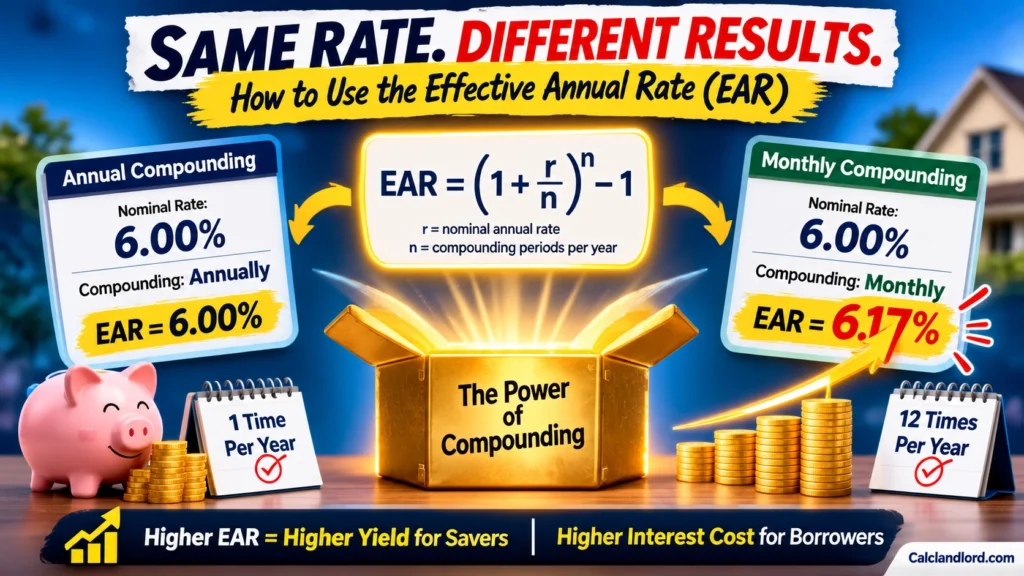
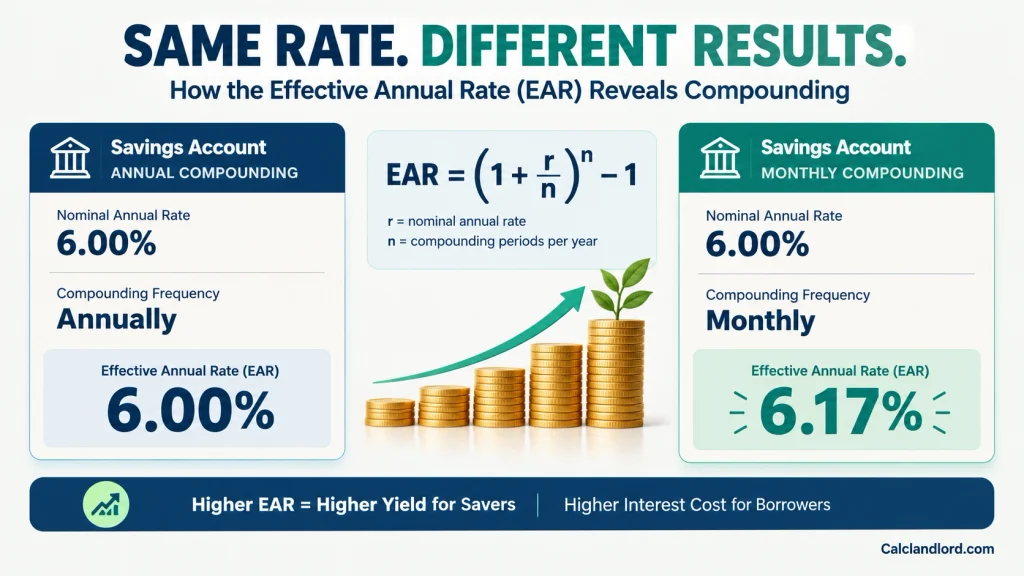
For example, a nominal annual interest rate of 6% compounded monthly produces an EAR of approximately 6.17%.
EAR = (1 + 0.06/12)^12 − 1
\[ EAR\approx0.061678=6.17\% \]
For savers, a higher effective annual rate generally means greater interest growth under otherwise comparable conditions. For borrowers, a higher rate means greater annualized interest costs under the same assumptions.
Before making a decision, compare fees, account restrictions, loan terms, and other costs as well.
What Is the Effective Annual Rate?
The effective annual rate, commonly abbreviated as EAR, measures the annual interest rate after accounting for the effect of compounding.
Compounding occurs when previously earned interest becomes part of the balance on which future interest is calculated. As the balance grows, subsequent interest calculations can produce additional earnings or interest charges.
Consider a savings account with a stated annual interest rate of 6%.
If interest is compounded annually, the effective annual rate is 6%. If the same nominal rate is compounded monthly, the effective annual rate is approximately 6.17%.
The stated rate has not changed. The difference comes from how frequently interest is added to the balance.
The effective annual rate is also known as the effective annual interest rate or effective interest rate in many finance contexts. It is useful for evaluating savings products, investment returns that compound, and borrowing arrangements with periodic interest compounding.
See the Corporate Finance Institute’s explanation of the effective annual interest rate for an additional overview of its financial applications.
Effective Annual Rate vs. Nominal Interest Rate
The nominal interest rate is the stated annual rate before adjusting for the effect of compounding. The EAR converts that rate into an effective annual figure.
| Feature | Nominal annual rate | Effective annual rate |
| Meaning | Stated annual interest rate | Annual rate after compounding |
| Accounts for compounding | No | Yes |
| Changes with compounding frequency | Not necessarily | Yes |
| Main purpose | Expressing the stated rate | Comparing annualized interest effects |
| Best application | Reviewing the quoted rate | Comparing rates with different compounding schedules |
When interest compounds annually, the nominal rate and EAR are equal. When a positive nominal rate compounds more than once a year, the EAR is higher.
Effective Annual Rate Formula Explained
The standard EAR formula is:
\[ \boxed{EAR=\left(1+\frac{r}{n}\right)^n-1} \]
This formula assumes a fixed nominal annual rate, a consistent compounding schedule, and a periodic rate equal to the nominal annual rate divided by the number of compounding periods.
What Does Each Variable Mean?
| Variable | Definition | Example |
| r | Nominal annual interest rate as a decimal | 6% = 0.06 |
| n | Number of compounding periods per year | 12 for monthly compounding |
| r/n | Interest rate for each compounding period | 0.06 ÷ 12 = 0.005 |
| EAR | Effective annual rate | Approximately 0.061678 |
The final answer is commonly converted into a percentage by multiplying the decimal result by 100.
Common Compounding Frequencies
| Compounding schedule | Periods per year |
| Annually | 1 |
| Semiannually | 2 |
| Quarterly | 4 |
| Monthly | 12 |
| Biweekly | 26 |
| Weekly | 52 |
| Daily | 365 |
Daily compounding is often modeled using 365 periods, but the exact convention can depend on the financial product and its agreement.
More frequent compounding increases EAR when the nominal rate remains positive and unchanged. However, the additional benefit becomes progressively smaller as compounding becomes more frequent.
How to Use the Effective Annual Rate Step by Step
Follow these five steps whenever you need to calculate an effective annual rate from a nominal annual interest rate.
Step 1: Identify the Nominal Annual Interest Rate
Find the stated annual interest rate in the financial product’s terms.
For example, suppose a savings account advertises a nominal interest rate of 6% per year.
Use the nominal rate for the standard EAR formula. Do not automatically substitute a fee-inclusive loan APR, because APR and the rate used in the EAR formula are not always the same thing.
Step 2: Convert the Percentage to a Decimal
Divide the stated interest rate by 100.
6 ÷ 100 = 0.06
The decimal rate is 0.06.
Step 3: Identify the Compounding Frequency
Determine how often interest is added to the balance.
If interest compounds monthly:
n=12
If it compounds quarterly:
n=4
Use the frequency specified in the product’s actual terms rather than assuming every financial product compounds monthly.
Step 4: Apply the EAR Formula
For a 6% nominal annual rate compounded monthly:
EAR = (1 + 0.06/12)^12 − 1
First, calculate the monthly rate:
0.06 ÷ 12 = 0.005
Next, calculate the growth factor:
(1.005)^12 ≈ 1.061678
Subtract 1:
1.061678-1=0.061678
Step 5: Convert the Result to a Percentage
Multiply the decimal result by 100.
\[ 0.061678\times100\approx6.17\% \]
The effective annual rate is approximately 6.17%.
That means the balance grows by about 6.17% over one year under the formula’s assumptions, provided the rate and compounding terms remain unchanged and there are no additional deposits, withdrawals, fees, or other adjustments.
Effective Annual Rate Examples
The easiest way to understand EAR is to apply it to familiar financial situations.
Example 1: A Savings Account With Monthly Compounding
Suppose you deposit $10,000 into an account offering a 6% nominal annual interest rate compounded monthly.
Given:
- Initial deposit: $10,000
- Nominal annual interest rate: 6%
- Compounding frequency: 12 times per year
The EAR is:
EAR = (1 + 0.06/12)^12 − 1
\[ EAR\approx6.17\% \]
The approximate ending balance is:
\[ \$10,000(1.061678)\approx\$10,616.78 \]
| Item | Amount |
| Initial deposit | $10,000.00 |
| Approximate interest earned | $616.78 |
| Approximate ending balance | $10,616.78 |
| Effective annual rate | 6.17% |
The EAR reveals how monthly compounding increases the return above the 6% nominal rate.
This calculation assumes the full deposit remains in the account for one year and excludes taxes and fees.
Example 2: Comparing Two Savings Accounts
Suppose you are choosing between two savings products.
- Account A: 5.00% nominal interest, compounded annually.
- Account B: 4.95% nominal interest, compounded monthly.
Account A has the higher advertised rate. However, Account B benefits from more frequent compounding.
For Account A:
\[ EAR_A=(1+0.05)^1-1=5.00\% \]
For Account B:
EAR B = (1 + 0.0495/12)^12 − 1
\[ EAR_B\approx5.06\% \]
| Account | Nominal rate | Compounding | Approximate EAR |
| A | 5.00% | Annually | 5.00% |
| B | 4.95% | Monthly | 5.06% |
Based purely on effective annual interest, Account B offers the higher yield.
On a $10,000 deposit held for one year, the estimated difference is approximately $6 before taxes and fees. That difference is modest, so account access, minimum-balance rules, and other conditions could matter more.
Important: U.S. deposit accounts commonly advertise an annual percentage yield (APY), which already reflects compounding under the applicable calculation rules. When comparing actual savings accounts, use their disclosed APYs rather than recalculating an EAR from an already-effective rate. Capital One’s guide to effective interest rates explains the relationship between APY and the effective annual rate.
Example 3: Comparing Loan Interest Rates
Assume a hypothetical loan charges a fixed nominal interest rate of 12%, with interest compounding monthly. Ignore scheduled principal repayments and fees for this example.
The calculation is:
EAR = (1 + 0.12/12)^12 − 1
EAR = (1.01)^12 − 1
\[ EAR\approx12.68\% \]
The effective annual interest rate is approximately 12.68%, even though the stated nominal rate is 12%.
This example isolates the mathematical effect of compounding. It does not represent the total cost of a typical installment loan, whose balance falls as scheduled payments repay principal.
When comparing real loan offers, review the interest rate, disclosed APR, fees, repayment schedule, and total amount payable. A higher EAR means a higher effective interest rate under comparable compounding assumptions, but EAR alone cannot determine which loan is cheapest overall.
Example 4: Comparing a Rental Property Reserve Account
Suppose a landlord holds $30,000 in an account intended for vacancies, repairs, insurance deductibles, and other unexpected rental property expenses.
The account offers a nominal annual rate of 4.25%, compounded monthly.
The EAR is:
\[ EAR\approx4.33\% \]
If the rate remains fixed for the year and no money is added or withdrawn, the approximate ending balance is:
\[ \$30,000(1.0433)\approx\$31,299 \]
The estimated interest earned is about $1,299 before taxes and fees.
For a rental property owner, this calculation can help estimate interest earned on reserves without confusing that return with the property’s operating performance.
A reserve account with a higher EAR is not necessarily the best choice if withdrawals are restricted or the account does not provide the liquidity needed for urgent repairs.
How Does Compounding Frequency Change EAR?
To compare compounding schedules, consider a nominal annual interest rate of 12%.
| Compounding schedule | Periods per year | Approximate EAR |
| Annually | 1 | 12.00% |
| Semiannually | 2 | 12.36% |
| Quarterly | 4 | 12.55% |
| Monthly | 12 | 12.68% |
| Daily | 365 | 12.75% |
The table shows that more frequent compounding increases the effective annual rate when the stated rate is fixed and positive.
However, moving from annual to monthly compounding produces a larger change than moving from monthly to daily compounding. The effect of increased frequency gradually diminishes.
For an investor, this means the advertised rate alone does not tell the complete interest story. For a borrower, it means that differences in compounding conventions may affect the annualized interest rate.
Always check the agreement to understand the actual rate and how interest is calculated.
How to Compare Financial Products Using EAR
EAR is most useful when you convert competing products into comparable annual effective rates.
Comparing Savings Accounts and Certificates of Deposit
For deposit products, examine the disclosed APY first. APY is generally the most relevant consumer-facing comparison because it reflects annualized interest including compounding.
Compare minimum deposits, withdrawal restrictions, promotional periods, and account fees before choosing a product.
Comparing Loans and Lines of Credit
For borrowing, calculate EAR only when you can identify the correct nominal rate and the applicable compounding schedule.
Then review the fee-inclusive APR and the actual repayment terms. The APR can incorporate certain borrowing costs that a standard EAR calculation does not capture. The Consumer Financial Protection Bureau explains the difference between a loan’s interest rate and APR.
Comparing Investments
EAR helps compare interest-bearing products that compound at different frequencies. It does not tell you whether an investment is safe or whether its advertised rate is guaranteed.
Before choosing an investment, consider the creditworthiness of the issuer, liquidity, taxes, fees, inflation, and whether the investment’s stated return is fixed or variable.
For a rental property investor, EAR can help compare interest earned on idle cash or understand a financing rate’s compounding effect. It cannot replace an analysis of property cash flow, operating expenses, debt service, or expected return on invested capital.
EAR vs. APR vs. APY
These three terms are related, but they serve different purposes.
| Feature | EAR | APR | APY |
| Full name | Effective annual rate | Annual percentage rate | Annual percentage yield |
| Main purpose | Measures annual interest after compounding | Discloses an annualized cost of borrowing under applicable rules | Discloses annualized yield on deposit accounts |
| Reflects compounding | Yes | Not as an effective yield in the same way as EAR | Yes |
| Includes certain required loan fees | No, not in the standard EAR formula | May include certain fees, depending on the product and rules | Not a measure of borrowing fees |
| Common use | Comparing compounded rates | Comparing credit offers | Comparing savings accounts and CDs |
Is EAR Better Than APR?
Neither measure is universally better. The appropriate measure depends on the financial product and what you are trying to compare.
EAR is useful for isolating the impact of compounding. APR is important when reviewing the disclosed cost of borrowing because it can include certain fees as required by applicable rules.
For U.S. mortgages, for example, APR reflects the interest rate plus certain other charges. The CFPB explains this distinction in its guide to mortgage interest rates and APR.
Do not treat a fee-inclusive APR as though it were always a nominal rate that can be inserted directly into the standard EAR formula.
Is EAR the Same as APY?
They are closely related measures of annualized interest after compounding.
EAR is the broader finance term. APY is commonly used for U.S. deposit products and follows applicable disclosure and calculation rules.
If a U.S. savings account or certificate of deposit already provides an APY, use that figure for the annualized yield comparison. Recalculating an EAR from a disclosed APY could count compounding twice.
How to Calculate EAR in Excel or Google Sheets
You can calculate EAR quickly in Excel or Google Sheets using the standard formula.
Suppose:
- Cell A1 contains the nominal annual rate as a decimal, such as 0.06.
- Cell A2 contains the number of compounding periods per year, such as 12.
Enter the following formula in another cell:
=(1+A1/A2)^A2-1
For a 6% nominal rate compounded monthly, the result is approximately 0.061678.
Format the output cell as a percentage and display two decimal places to show 6.17%.
If you enter the rate as 6 rather than 0.06, use the adjusted formula:
=(1+(A1/100)/A2)^A2-1
The distinction matters because spreadsheets do not automatically know whether a number represents a whole percentage or a decimal rate.
Continuous Compounding: An Advanced EAR Calculation
Some theoretical finance models assume interest compounds continuously rather than at discrete intervals.
In that case, the effective annual rate is:
EAR = e^r − 1
Where:
- e is the mathematical constant approximately equal to 2.71828.
- r is the nominal annual rate expressed as a decimal.
For a nominal annual rate of 10%:
EAR = e^0.10 − 1
\[ EAR\approx10.52\% \]
This is a mathematical model used in finance and investment analysis. Most everyday bank accounts and loan products use defined interest-calculation conventions rather than literally continuous compounding.
What EAR Does Not Tell You
The effective annual rate is useful, but it is not a complete measure of financial value.
Fees and Other Charges
A standard EAR formula accounts for compounding, not account maintenance charges, loan origination fees, transaction costs, or other expenses outside the interest calculation.
A financial product with a higher EAR may deliver a lower net return after fees.
Taxes
The formula does not calculate after-tax returns. Taxes on interest or investment income depend on the person’s circumstances and the applicable tax rules.
For a more accurate comparison, estimate the return after relevant taxes and fees.
Inflation
A nominal effective annual rate does not automatically tell you how much purchasing power your money gains.
To estimate an inflation-adjusted effective return, use:
Real Return = (1 + EAR) ÷ (1 + Inflation Rate) − 1
For example, if EAR is 6.17% and inflation is 3%, the approximate real return is:
\[ \frac{1.0617}{1.03}-1\approx3.17\% \]
This simplified calculation assumes the inflation rate applies over the same period.
Risk and Liquidity
EAR does not measure the possibility of default, loss of principal, changing interest rates, or restrictions on access to your money.
A higher advertised yield may come with greater risk or less flexibility. Compare those characteristics before deciding where to invest or save.
Repayment Structure
For installment loans, borrowers generally make payments that reduce principal over time. Consequently, the actual interest paid depends on the outstanding balance and repayment schedule.
EAR by itself does not calculate a loan’s full payment schedule or lifetime borrowing cost.
Credit cards also have specific interest-calculation methods. Some issuers calculate interest daily using the average daily balance, and the results depend on the account’s terms and payment activity. The CFPB’s explanation of credit card interest calculations provides more detail.
Common Effective Annual Rate Mistakes
Avoid these errors when calculating or applying EAR.
1. Using a percentage as though it were a decimal. A rate of 6% must be entered as 0.06 in the standard formula. Entering 6 instead of 0.06 produces a fundamentally incorrect answer.
2. Choosing the wrong compounding frequency. Monthly compounding uses 12 periods, while quarterly compounding uses four. The value of n must reflect the actual schedule.
3. Assuming EAR includes every fee. It does not. Add applicable charges to your comparison separately, and review the disclosed APR when evaluating U.S. consumer loans.
4. Recalculating a rate that already reflects compounding. When comparing U.S. savings accounts that disclose APY, use the stated APY rather than treating it as a nominal interest rate.
5. Assuming the highest EAR is always the best choice. A higher rate may be accompanied by restricted access, higher fees, greater risk, or unfavorable contract terms.
6. Treating a loan’s EAR as its total cost. The total cost also depends on fees, principal repayments, the loan term, and the outstanding balance.
7. Ignoring changes in variable rates. The standard formula assumes a constant nominal annual rate and consistent compounding. A variable-rate product may produce a different realized annual return or cost.
Practical Tips for Using EAR Effectively
Use the following approach before choosing a financial product.
First, confirm which rate you are looking at. Distinguish the nominal interest rate from a fee-inclusive APR and from an advertised deposit APY.
Second, establish the compounding schedule from the product’s terms. Do not assume that every product compounds interest monthly or that a daily rate always uses the same day-count convention.
Third, calculate EAR when you need to compare nominal rates with different compounding frequencies. Use the result to make an apples-to-apples comparison of the compounding effect.
Fourth, account for fees and restrictions separately. A small difference in EAR might not justify choosing an account with poor access or high charges.
Finally, connect the result to your actual financial goal. A saver may prioritize annualized yield and liquidity. A borrower should consider APR, payment amounts, fees, and total repayment costs. A rental property investor should also assess cash reserves, operating expenses, mortgage payments, and projected cash flow before committing capital.
Frequently Asked Questions About the Effective Annual Rate
1. What is the easiest way to calculate EAR?
Use the formula:
EAR = (1 + r/n)^n − 1
Convert the nominal annual interest rate into a decimal, divide it by the number of annual compounding periods, raise the result to that number of periods, and subtract 1.
2. How do you calculate EAR compounded monthly?
For monthly compounding, use:
EAR = (1 + r/12)^12 − 1
For example, a nominal annual rate of 6% produces an EAR of approximately 6.17%.
3. Is a higher EAR always better?
No. A higher EAR generally benefits savers when rates, risks, fees, and account terms are otherwise comparable. For borrowers, a higher effective interest rate generally means higher interest costs.
The best choice depends on the product’s complete terms and your financial needs.
4. Can I use EAR to compare loans?
Yes, when you have the appropriate nominal interest rates and compounding schedules. However, EAR does not include all borrowing costs.
Compare the disclosed APR, required fees, repayment structure, total payments, and loan term before choosing a lender.
5. Does EAR include fees and taxes?
No. The standard EAR formula calculates the effect of compounding. It does not automatically account for fees, taxes, inflation, or investment risk.
Consider these factors separately when estimating the actual financial outcome.
6. What is the difference between EAR and APY?
EAR is a general finance term for an annualized interest rate that reflects compounding. APY is commonly used for U.S. deposit accounts and reflects annualized yield under applicable calculation rules.
When comparing U.S. savings accounts or CDs, use the advertised APY where available.
7. Can I calculate EAR with a financial calculator?
Yes. You can use a scientific calculator, spreadsheet, or an effective annual rate calculator. Enter the correct nominal annual rate and compounding frequency, and make sure the output is expressed as a percentage.
8. How does EAR help rental property investors?
EAR can help landlords evaluate interest earned on cash reserves or understand the compounding effect on certain borrowing arrangements.
It should be used alongside rental property cash flow, financing costs, operating expenses, and return-on-investment analysis rather than as a standalone measure of property profitability.
People Also Ask About EAR
EAR converts a nominal rate into an annualized rate that reflects compounding. Investors and borrowers use it to compare the interest effect of different compounding schedules.
With a positive nominal rate compounded more than once annually, interest can earn additional interest during the year. This generally makes the EAR higher than the nominal rate.
The two rates are equal when interest compounds annually, assuming the nominal annual rate and effective rate cover the same period.
The calculation is:
EAR = (1 + 0.12/12)^12 − 1
The effective annual rate is approximately 12.68%.
No. EAR reflects the effect of compounding, while a real interest rate adjusts for inflation. An inflation-adjusted return can be estimated by dividing one plus EAR by one plus the inflation rate and then subtracting 1.
Conclusion
Learning how to use the effective annual rate makes it easier to understand how compounding affects savings, investments, and borrowing. By converting a nominal interest rate into an annualized effective rate, you can compare the compounding effect across products more fairly.
Remember that EAR is one part of a financial decision, not the whole decision. Compare the relevant fees, taxes, risks, liquidity, repayment structure, and contract terms before choosing a product.
For landlords and rental property investors, EAR can be useful when assessing reserve-account yields and understanding interest costs. Combine it with rental cash flow, expense planning, and investment-return analysis to make decisions that reflect the financial performance of the property as a whole.

Pingback: How Long Will My Money Last? Try This Calculator
Pingback: Sign With RowCal? 12 Questions to Protect Your Money