

RowCal HOA Management: Services, Pricing, Reviews, and Alternatives
Your HOA just sent a notice that dues are going up, and the name on the letter is RowCal. Before you decide whether that’s a problem, you need facts, not sales copy. RowCal is a U.S. HOA and community association management company, founded in 2018 and acquired by Morgan Stanley Capital Partners in 2023. It also publishes its own service commitments and exit terms. Those are useful, but they’re the company’s words. In this guide, we’ll clearly separate what RowCal promises from what you should verify, so you can judge whether it’s the right fit for your community.
If you own a condo, townhome, or single-family home inside an HOA, the company managing that community affects your returns. RowCal is one of the larger U.S. HOA and community association management companies, and you may encounter it as a board candidate, a resident, or an owner trying to understand where your monthly dues go.
This guide explains what RowCal does, how its management model works, what it typically costs boards to hire, and what to verify before signing. It also connects HOA management decisions to rental property finance, since a poorly run association can quietly eat into your cash flow.
Quick Answer: What Is RowCal?
RowCal is a full-service HOA management company that serves condominiums, townhome communities, single-family HOAs, master associations, and developing communities across the United States. The company offers financial administration, maintenance and vendor coordination, construction oversight, resident communication, and a homeowner portal and app. Morgan Stanley Capital Partners acquired the company in 2023, according to the firm’s announcement.
RowCal does not publish a single standard price list. Fees depend on community size, unit count, service scope, and project workload. Any board considering RowCal should request a written proposal that separates the base management fee from add-on charges.
Why Landlords Should Care About HOA Management
Many rental owners underestimate how much HOA management matters to their investment. Monthly association dues are an operating expense that comes straight out of your rental income, and they are not fixed forever. Boards raise dues to cover insurance premiums, reserve funding, and deferred maintenance, and the quality of management largely determines how well those increases are controlled.
Consider a condo renting for $2,400 per month with $350 in monthly HOA dues. The dues consume about 14.6% of gross rent, or $4,200 per year. If the association raises dues 8% after a poorly planned reserve study, the increase adds $28 per month, or $336 per year, with no change in your rent. Over a ten-year hold, that adds up to meaningful money.
Management also affects tenant experience. Slow work-order responses, unclear rental rules, and delinquent neighbors all create turnover and vacancy risk. If you own units in an HOA, it is worth running your numbers in our rental cash flow calculator and checking how dues fit into your target return.
What RowCal Offers
According to RowCal’s website, the company’s services fall into several categories.
HOA management. A dedicated community manager handles day-to-day operations, board support, homeowner communication, and compliance coordination.
Financial management. Services typically include budgeting, assessment collection, expense management, reserve planning, monthly reporting, and bank reconciliations. For owners, the financial side is often the most important, because it determines whether dues stay predictable.
Maintenance and vendor management. This covers routine repairs, preventive maintenance, inspections, vendor bidding, emergency coordination, and work-order tracking.
Construction and capital projects. RowCal lists project planning, contractor oversight, repairs, and capital improvements. Large projects such as roof replacements or façade work are where a poorly managed association can face special assessments, so this area deserves close questions during the sales process.
Rental support. For associations with a significant rental population, RowCal lists showings, tenant screening, payment handling, and maintenance coordination. If you own rental units in the community, confirm whether these services apply to your unit and whether they carry separate fees.
Self-management tools. Some boards want to run most operations themselves. RowCal offers software and workflows for that situation.
RowCal Elevate. The company describes this as a specialized tier for condominium, lifestyle, and urban communities with more complex operations.
How RowCal’s Management Model Works
RowCal describes a team-based model. Instead of relying on one manager, each community is assigned a dedicated manager who is backed by specialists in finance, maintenance, insurance, construction, and homeowner support.
For a board, the practical benefit is a single accountable contact supported by people with specific expertise. For owners, it can mean faster answers when a question falls outside one person’s knowledge.
The trade-off is that responsibility can spread across several people. Before signing, ask who makes decisions on escalations, who approves spending above a set threshold, who handles after-hours emergencies, and who manages vendor disputes. Clear answers to those questions matter more than any marketing description of the model.
RowCal Pricing: What Boards Should Expect
RowCal does not publish universal pricing because HOA management fees depend on the community. A 40-unit townhome association with a simple budget will pay a very different fee than a 400-unit condominium with a pool, parking structure, and active capital projects.
RowCal’s services page says its pricing is intended to be transparent, with common administrative costs included in the management fee and optional services approved in advance. Treat that as a company statement to verify, not a guarantee of final costs.
Use the table below to structure your comparison.
| Cost component | What it usually covers | Questions to ask |
| Base management fee | Core operations, manager time, board support, standard communication | What is included and excluded? |
| Financial services | Accounting, collections, reporting, reconciliations | Are monthly reports and invoice copies included? |
| Maintenance coordination | Work orders, vendor oversight, inspections | Is there a per-work-order or vendor-management charge? |
| Project management | Bidding, scheduling, capital projects | What fee applies to major projects? |
| Setup or transition fee | Records transfer, owner onboarding, software setup | Is it waived or credited? |
| Additional services | Rentals, meetings, mailings, compliance, special projects | What triggers extra billing? |
Never compare management companies on the base fee alone. Ask every bidder for a first-year cost estimate that includes transition costs, postage, meeting attendance, resale document requests, delinquency work, and project management. A low base fee paired with frequent add-on charges can cost more than a higher base fee with a clear scope.
RowCal’s Technology: Portal and Mobile App
RowCal’s homeowner portal and app are among the more concrete features the company describes publicly. The app is listed on Google Play as the RowCal Homeowner and Board App and supports payments, account access, documents, community information, and service requests. According to the listing, residents can also check request status and see community calendars.
This matters for boards in three ways:
- Routine questions about balances, documents, and work orders move out of board members’ inboxes.
- Requests and communications are documented, which helps during disputes.
- Boards get better visibility into collections, pending work, and project status.
Before relying on any portal, confirm which features are included in your contract and which require an upgrade. Also ask how residents without smartphones are supported, and whether board members get separate administrative access.
RowCal Reviews: How to Read the Feedback
RowCal’s website highlights positive feedback about responsiveness, ease of use, staff professionalism, and smooth transitions. Those testimonials are company-published, so they show what RowCal chooses to promote rather than a representative sample of client experiences.
A more useful approach is to look at several sources and weigh them carefully. Check Google Business profiles, Better Business Bureau records, and reviews on platforms where board members and owners post about HOA managers. Pay the most attention to detailed reviews that describe a specific problem and how it was handled. Vague praise or vague complaints tell you little.
Also ask prospective references direct questions. How quickly did the manager respond to urgent issues? How did the company handle a special assessment? What happened during the first 90 days after the transition?
Potential Strengths
- Team-based support rather than dependence on one manager.
- Broad service coverage across financials, maintenance, construction, and rentals.
- Digital tools for payments, documents, and work orders.
- Publicly stated service commitments, including response-time targets. Confirm whether these appear in your contract.
- A stated exit clause that RowCal describes as having no financial penalty for termination. Verify the exact notice period in writing.
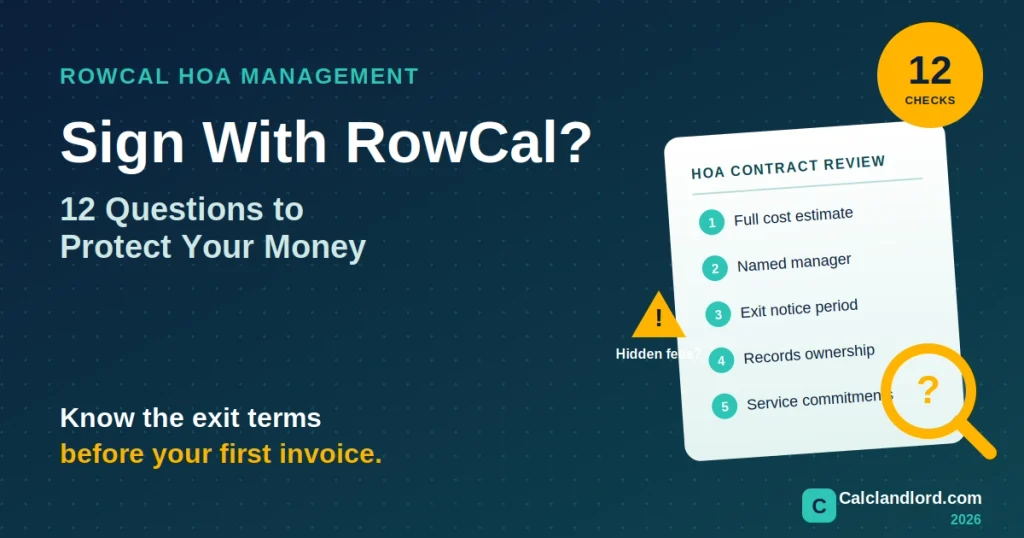
Questions to Verify Before Signing
- Are the service commitments written into the signed agreement?
- What is the actual average response time in your market?
- Who is the dedicated manager, and how many communities do they oversee?
- How are after-hours emergencies handled?
- What financial controls protect association funds?
- What happens if the assigned manager leaves?
RowCal Pros and Cons
| Pros | Cons and considerations |
| Full-service management under one provider | Pricing is customized, so boards need a formal proposal |
| Dedicated manager plus specialist support | Service quality can vary by local team and market |
| Resident-facing app and portal | Boards should confirm which portal features are included |
| Experience across several community types | Large or complex communities should review staffing depth |
| Publicly stated transparency and exit terms | Legal counsel should review termination and records terms |
Who Should Consider RowCal?
RowCal may be a good fit if your board is tired of handling vendors, financial reporting, and homeowner communication on its own. It also suits communities that want digital payments and document access, and associations of several types, including condominiums, townhomes, and master associations.
It may be a weaker match if you want published, fixed pricing before any sales conversation, if your community needs deep knowledge of a small local market, if you want a boutique firm with highly customized governance support, or if you only need occasional bookkeeping help rather than full management.
RowCal Alternatives
The right alternative depends on what your community needs. Here is how the main options compare.
| Option | Best for | Trade-off |
| Local independent manager | Hyper-local relationships and flexible service | May lack national technology and specialist depth |
| National management firm | Large portfolios that need systems and compliance support | Can feel less personal; local service quality varies |
| Boutique management firm | Luxury, high-touch, or complex communities | Often higher fees |
| Self-management software | Small, engaged boards with simple operations | The board carries the operational and legal workload |
| Hybrid model | Boards that want to keep control of major decisions | Requires clear division of responsibilities |
Get at least three proposals before choosing. Comparing identical scopes of service is the only fair way to evaluate price.
How to Choose an HOA Management Company
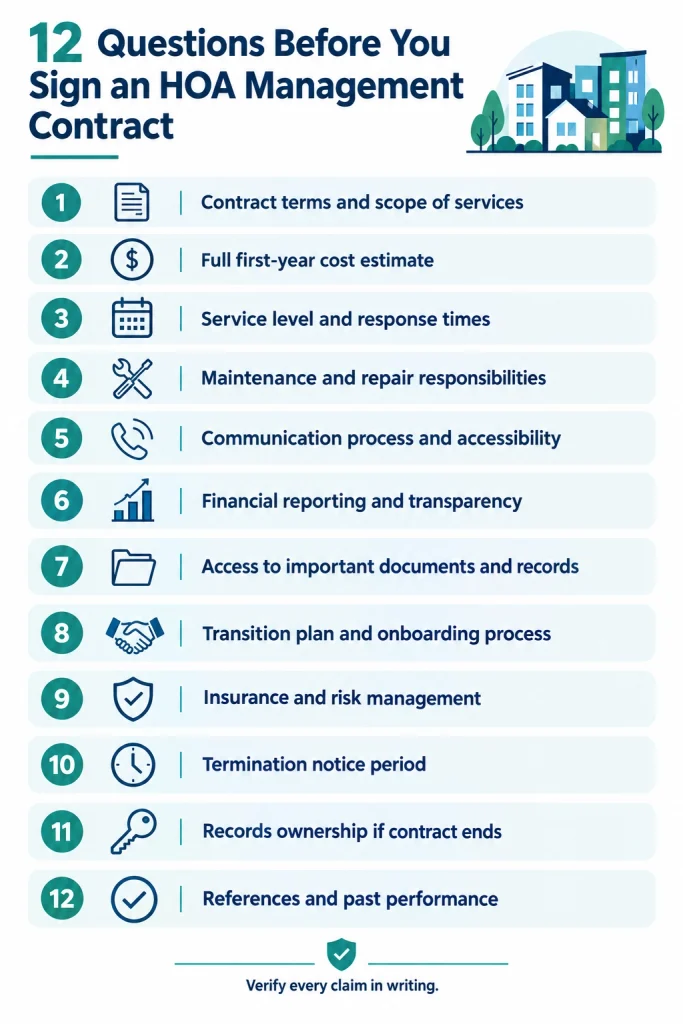
Use this checklist when reviewing any provider, RowCal included.
- Confirm the company’s state licensing and its familiarity with your state’s HOA laws.
- Request references from communities of similar size and type.
- Ask for the named manager’s portfolio size and backup coverage.
- Obtain a complete first-year cost estimate, not just the base fee.
- Review sample monthly financial reports.
- Ask how delinquencies, liens, and payment plans are handled.
- Review the vendor-selection and bidding policy, including how conflicts of interest are prevented.
- Clarify emergency response procedures and after-hours coverage.
- Confirm which portal and app features are included.
- Confirm who owns community records if the contract ends.
- Review termination notice, transition assistance, and any fees.
- Put every service commitment in the signed agreement.
RowCal Contract and Exit Terms
RowCal publicly describes its contracts as straightforward, with transparent pricing and a 90-day exit clause that carries no financial penalty. Those are useful starting points, but a board should confirm each point in the actual contract.
Pay particular attention to the following:
- The notice period and the effective termination date.
- Costs for transferring records and owner data.
- Who is responsible for open work orders and vendor contracts after termination.
- Final financial reporting and account reconciliation.
- Ownership of reserve funds, bank accounts, and outstanding invoices.
- Any non-solicitation or vendor-restriction clauses.
Have an attorney familiar with your state’s HOA statutes review the agreement. Contract and HOA rules vary by state, so the details that matter in Florida may differ from those that matter in Texas or California.
- More to Explore: https://calclandlord.com/dave-ramsey-investment-calculator/
People Also Ask
RowCal is an established HOA and community association management company. Its acquisition by Morgan Stanley Capital Partners in 2023 was publicly announced. Before hiring any firm, though, verify its licensing, references, and complaint history directly.
According to its website, RowCal offers HOA management, financial administration, maintenance coordination, construction oversight, rental support, self-management tools, and resident technology.
Pricing is customized for each community. Request a written proposal that separates base management fees from transition, project, maintenance, mailing, meeting, and optional charges.
Yes. The RowCal Homeowner and Board App is listed on Google Play and supports payments, account access, documents, community information, and service requests.
Alternatives include local independent managers, national management firms, boutique community management companies, and self-management software. The best choice depends on community size, budget, service complexity, and how much control the board wants to keep.
Dues are an operating expense that reduces net operating income and cash flow. Track them alongside taxes, insurance, maintenance, and vacancy when you calculate a rental’s return. Our cash flow calculator can help you model how a dues increase would change your numbers.
Final Thoughts
RowCal’s own materials make the case for the company, and that’s expected. What matters to you as an owner or board member is whether the management company will control costs, respond to problems, protect association funds, and let you leave cleanly if the relationship fails. Ask for proposals, check references, read the contract, and run the numbers. Whatever firm manages your association, the dues it charges become part of your investment math, so treat that decision with the same care you give your purchase.

Pingback: Rentometer Free: 5 Ways to Get Rent Data for $0
Pingback: 403b Calculator: 5 Powerful Steps to a Better Retirement