
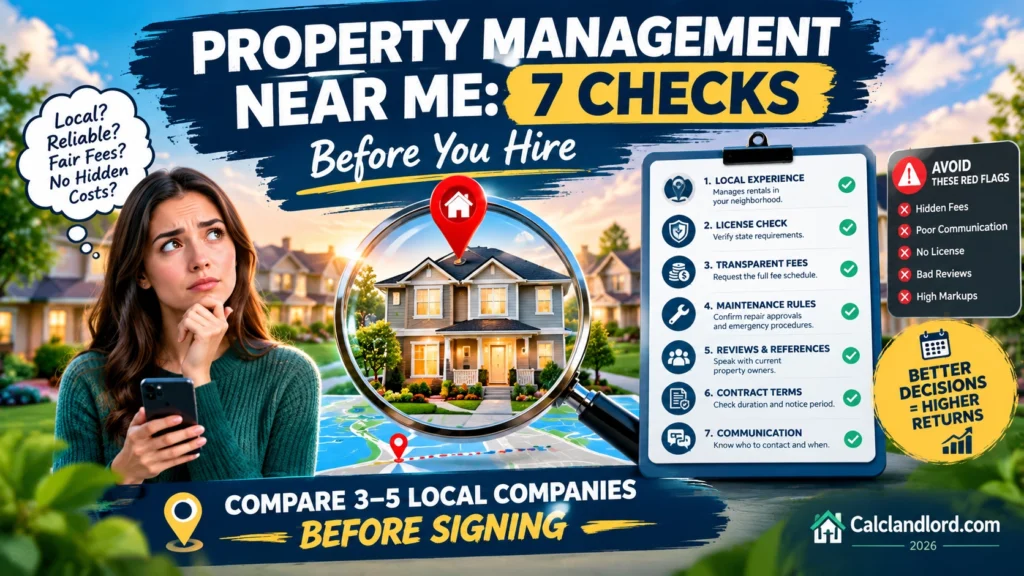
Property Management Companies Near Me USA: The Complete 2026 Guide
Searching for property management companies near you? The right team can take rent collection, tenant communication, and maintenance coordination off your plate—but the wrong choice can eat into your rental income through extra fees, slow repairs, or unclear reporting. Before you sign a contract, compare more than the monthly percentage. Check what services are included, verify any required state license, ask how tenants are screened, and understand who approves repairs. This guide shows landlords how to shortlist local managers, compare costs carefully, identify warning signs, and ask the questions that reveal whether a company fits their property and goals.
Searching for property management companies near me USA is often the first step toward making rental property ownership less time-consuming and more predictable. Whether you own a single-family rental, a duplex, a small apartment building, or several investment properties, the right property manager can handle daily operations while helping you protect your investment.
However, hiring a management company is not simply about finding one with good reviews or the lowest monthly fee. You need a company that understands your local rental market, screens tenants consistently, handles maintenance responsibly, communicates clearly, and reports your property’s financial performance accurately.
A Poor Management Agreement can cost you money through unnecessary charges, prolonged vacancies, maintenance markups, and weak tenant management.
This guide explains how to find and evaluate local property management companies across the United States, compare their fees, verify their credentials, and choose a manager who fits your property and investment goals.
Quick Answer: How Do You Find Property Management Companies Near You?
To find reliable property management companies near you, search Google Maps using your city or ZIP code, check professional property management directories, and ask local real estate investors for referrals. Shortlist three to five companies, verify applicable licenses, compare their complete fee schedules, request owner references, and review the management agreement before signing.
The best company is not necessarily the cheapest or the largest. It is the one with proven experience managing your property type in your local market, transparent pricing, reliable maintenance, and clear financial reporting.
What Do Property Management Companies Do?
A property management company operates rental properties on behalf of their owners. Depending on the agreement, it may handle everything from marketing an empty unit to collecting rent, coordinating repairs, communicating with tenants, and preparing monthly financial statements.
Most residential property management companies offer some combination of the following services.
| Service | What the company does | Why it matters |
| Rental pricing | Estimates competitive market rent | Helps attract tenants without unnecessarily sacrificing income |
| Property marketing | Creates listings, arranges photos, and schedules showings | Helps reduce vacancy |
| Tenant screening | Reviews applications using established criteria | Helps assess applicant suitability and rental risk |
| Lease administration | Prepares or coordinates leases and renewals | Supports consistent documentation |
| Rent collection | Tracks payments and follows agreed collection procedures | Improves income tracking |
| Maintenance coordination | Arranges repairs and handles vendor communication | Protects the property’s condition |
| Inspections | Documents property condition and identifies maintenance issues | Helps detect problems early |
| Financial reporting | Records income, expenses, invoices, and owner distributions | Makes investment performance easier to evaluate |
| Legal and compliance support | Helps administer applicable procedures | Supports compliance with housing and landlord-tenant requirements |
Some firms provide full-service management, while others focus on tenant placement, leasing, rent collection, or maintenance.
Before comparing companies, determine which services you actually need. Paying for a complete management package may not make sense if you only need help finding a tenant.
How to Find Property Management Companies Near Me in the USA
The most effective search combines local directories, professional referrals, independent reviews, and direct conversations with prospective managers.
1. Search Google Maps Using Your City or ZIP Code
Start with specific searches such as:
- Property management companies near me
- Rental property management companies in [city]
- Single-family property managers in [city]
- Apartment management companies near [ZIP code]
- Licensed property managers in [state]
The more specific your location and property type, the more relevant your search results are likely to be.
For example, a search for property management companies in Phoenix may produce hundreds of results. Narrowing it to single-family rental management in the neighborhood where your property is located can give you a more useful shortlist.
Review each company’s website, service area, property types, contact information, and recent customer feedback.
Important: A company advertising services throughout a metropolitan area may not actively manage properties in your particular neighborhood. Confirm that it has genuine experience in your property’s immediate market.
2. Use Professional Property Management Directories
Professional directories can help you discover firms that may not appear prominently in ordinary search results.
Two useful starting points are:
- National Association of Residential Property Managers (NARPM) — find residential property management professionals, particularly those serving single-family and smaller residential portfolios.
- ARELLO Regulatory Agency Directory — locate real estate regulatory agencies to help identify the appropriate licensing authority.
A directory listing does not guarantee that a company is the right fit or that every credential is current. Verify its qualifications, experience, and standing independently.
3. Ask Local Landlords and Real Estate Investors
Referrals from property owners can reveal details that advertisements rarely explain.
Ask other landlords about the manager’s responsiveness, maintenance costs, vacancy handling, financial reporting, and willingness to explain unexpected expenses.
Useful questions include:
- Does the manager respond quickly when something goes wrong?
- Are repair invoices documented?
- Does the company communicate before authorizing expensive work?
- Are owner statements accurate and easy to understand?
- Would the owner hire the same company again?
Whenever possible, speak with current clients who own properties similar to yours.
4. Create a Shortlist of Three to Five Companies
Avoid hiring the first company that responds to your inquiry. Gather comparable information from three to five local firms instead.
| Information to collect | What to record |
| Local experience | Properties managed in your city or neighborhood |
| Property specialization | Single-family, multifamily, condo, or commercial |
| Monthly fee | Percentage of collected rent or fixed amount |
| Leasing fee | Charge for finding and placing a tenant |
| Maintenance policy | Vendor selection, markups, and spending limits |
| Communication | Named contact and emergency procedure |
| Financial reporting | Owner statements, invoices, and online portal |
| Contract terms | Duration, renewal, and cancellation requirements |
| References | Current property owners willing to share their experience |
Comparing the same information across companies makes differences easier to identify.
Why Local Property Management Experience Matters
A management company may have an impressive brand, polished website, and strong national presence but still perform poorly in your neighborhood.
Rental property management depends heavily on local conditions. Rental demand, achievable rents, contractor availability, property maintenance requirements, and applicable landlord-tenant rules can differ considerably between cities and even between neighborhoods.
A manager who regularly works in your submarket may have a better understanding of the tenant pool, competing rentals, common maintenance issues, and local leasing practices.
Consider two investors who each own a rental property with similar layouts and monthly expenses.
One uses a manager who regularly leases homes in the neighborhood. The other hires a company that operates mainly in a different part of the metropolitan area. The second company may struggle to price the property correctly or understand the expectations of local renters.
This does not mean a local independent firm is always better than a national company. It means that demonstrated local performance matters more than brand recognition alone.
Ask prospective managers how many properties they currently oversee in your area, how they determine market rent, and what comparable rentals they would use to price your property.
How Much Do Property Management Companies Charge in the USA?
Property management fees depend on location, property type, service level, rent amount, and contract terms.
For long-term residential rentals, a commonly quoted monthly management fee is approximately 8% to 12% of collected rent. Some companies charge a fixed monthly amount instead. These are general market estimates, not guaranteed national rates; obtain current quotes for your property and location. LegalClarity discusses this range in its property management fee guide.
The monthly percentage is only one component of the total cost.
Common Property Management Fees
| Fee type | Illustrative or commonly quoted pricing | What to confirm |
| Monthly management | Often 8%–12% of collected rent | Is the fee based on rent collected, rent due, or another amount? |
| Tenant placement | Often 50%–100% of one month’s rent | Does this include marketing, showings, screening, and lease preparation? |
| Lease renewal | Varies by company | Is a renewal charge separate from monthly management? |
| Property inspection | Varies by frequency and scope | How many inspections are included? |
| Maintenance coordination | May be included or charged separately | Are vendor invoices marked up? |
| Onboarding or setup | Varies | What does the initial fee cover? |
| Eviction coordination | Varies | Are legal fees, court costs, and representation separate? |
| Early termination | Depends on the agreement | Can you cancel without substantial penalties? |
These figures are budgeting guides, not official fee schedules. Some companies bundle services, while others charge separately for almost every additional task.
Never compare management fees without comparing the services and additional charges attached to them.
Example: Calculating the Annual Cost of a Property Manager
Suppose you own a single-family rental property with the following assumptions:
| Item | Amount |
| Monthly Rent | $2,000 |
| Annual rent, assuming full collection | $24,000 |
| Monthly management fee | 10% |
| Monthly management cost | $200 |
| Annual management cost | $2,400 |
| One-time tenant placement fee | $1,000 |
| Total first-year management and placement fees | $3,400 |
The monthly management fee is:
\[ \text{Monthly Fee}=\text{Collected Rent}\times\text{Fee Rate} \]
\[ \$2,000\times10\%=\$200 \]
The annual recurring management fee is:
\[ \$200\times12=\$2,400 \]
Adding the assumed $1,000 tenant placement fee gives a first-year total of $3,400.
That equals approximately 14.2% of the $24,000 scheduled annual rent, before other expenses.
This example assumes all rent is collected for 12 months and one tenant placement fee is charged. Vacancy, repairs, insurance, taxes, renewal charges, and other applicable costs can change the actual result.
Why the Lowest Management Fee May Cost More
Imagine two companies quote different monthly percentages. Company A charges 8%, while Company B charges 10%.
Company A appears cheaper. However, if it adds substantial leasing charges, maintenance markups, and separate inspection fees, its total annual cost could exceed Company B’s.
The correct comparison is:
\[ \begin{aligned} \text{Total Management Cost}={}&\text{Recurring Fees}\\ &+\text{Leasing Fees}\\ &+\text{Other Contract Charges} \end{aligned} \]
Evaluate all charges under the same assumptions, including the expected number of tenant placements, rather than relying solely on the advertised monthly rate.
For a more complete investment assessment, include management fees in your rental property expenses and cash flow calculations. A property’s rent may look attractive while its remaining income after operating costs is less impressive.
What Services Should a Good Property Management Company Include?
A reliable manager should have documented procedures for leasing, maintenance, financial reporting, and tenant communication. Ask what is included in the quoted package and what triggers an additional fee.
Tenant Placement and Screening
Finding a tenant involves more than advertising an empty property.
Ask how the company handles:
- Rental listings and property showings.
- Written applicant qualification criteria.
- Verification of income and rental history.
- Credit and background reports where legally permitted.
- Reference checks and application documentation.
- Lease preparation and move-in records.
Screening should follow applicable fair-housing laws and use consistent, lawful procedures.
Under the federal Fair Housing Act, discrimination in housing based on protected characteristics is prohibited. Read the U.S. Department of Housing and Urban Development’s overview of the Fair Housing Act.
Property managers using consumer reports for tenant decisions must also understand their obligations under the Fair Credit Reporting Act. The Federal Trade Commission’s landlord guidance explains important requirements involving consumer reports and adverse actions.
Maintenance and Emergency Response
Maintenance can have a direct effect on tenant satisfaction, property condition, and investment returns.
Before hiring a company, establish how it handles routine repairs, emergency calls, contractor selection, and owner approvals.
Ask:
- Who responds to maintenance requests after business hours?
- What is the procedure for urgent repairs?
- What amount can the manager spend without seeking approval?
- Are multiple estimates obtained for large projects?
- Do you receive itemized invoices and completion updates?
- Are maintenance coordination fees or vendor markups disclosed?
A good manager should distinguish between a genuine emergency and a routine repair that can wait for owner approval.
The management agreement should clearly establish authority limits. You should know which costs the company can authorize independently and which require your permission, subject to applicable law and emergency obligations.
Property Inspections
Inspections help document the condition of the property and identify potential maintenance concerns.
Ask how often the company conducts inspections, whether reports include photographs, and how it records issues requiring follow-up.
Clarify the difference between a move-in inspection, a move-out inspection, periodic condition checks, and inspections related to maintenance or safety concerns.
The agreement should also explain any inspection fees, tenant notice procedures, and documentation practices required by applicable law.
Financial Reporting and Owner Communication
You should not have to chase your property manager to understand your own property’s finances.
A useful owner reporting system should make it easy to review:
- Rent received and outstanding balances.
- Management and leasing fees.
- Repair expenses and supporting invoices.
- Property-related payments.
- Owner distributions.
- Lease dates and renewals.
- Reserve balances, where applicable.
Ask to see a sample owner statement before signing. Confirm how frequently statements are issued, how quickly questions are answered, and who is responsible for resolving accounting discrepancies.
How to Check a Property Management Company’s License and Reputation
Property management licensing requirements vary by state and by the activities performed. Some activities may require a real estate license or broker supervision, while particular exemptions may apply.
Do not assume that a company is properly licensed simply because it has a professional website or an established business address.
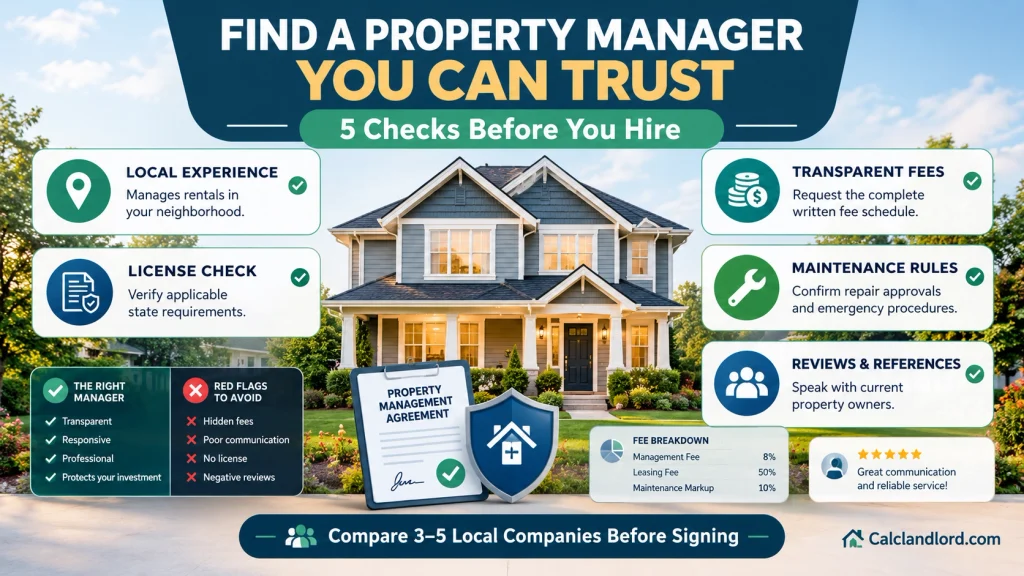
Verify Applicable Licensing Requirements
Start with the real estate commission or other relevant licensing authority in the state where the property is located.
The ARELLO Regulatory Agency Directory can help you find relevant state regulatory agencies. You should also check the agency’s own license search, rules, and disciplinary records where available.
Confirm the applicable requirements for the company and the individual responsible for your property.
Review Customer Feedback Carefully
Online reviews can reveal patterns, but they should not be treated as conclusive evidence of management quality.
Look for repeated comments about:
- Slow responses to owner questions.
- Poorly documented repair expenses.
- Delayed rent distributions.
- Inconsistent property inspections.
- Confusing contracts and unexpected charges.
- Difficulty ending the management relationship.
Pay attention to how the company responds to criticism. A thoughtful explanation of how an issue was addressed may be more informative than a collection of unexplained five-star ratings.
Request Current Owner References
Ask for references from clients with properties similar to yours.
A company managing large commercial buildings may not be the best fit for an individual landlord with one rental house. Likewise, an excellent single-family property manager may not have the systems required to manage a 30-unit apartment building.
Ask references about communication, transparency, maintenance handling, vacancies, and whether the company fulfilled the services promised in the agreement.
Local vs. National Property Management Companies
Both local independent firms and national franchises can be good choices. The important distinction is the quality of the team that will manage your specific property.
| Factor | Local independent company | National franchise or larger firm |
| Neighborhood knowledge | May have strong local relationships | Depends on the local office |
| Vendor network | Often built around local contractors | May offer centralized or regional vendor systems |
| Technology | Varies by company | May provide standardized platforms and reporting |
| Personal attention | May offer direct owner access | Depends on staffing and portfolio size |
| Service consistency | Depends on internal processes | May benefit from established procedures |
| Pricing | May be flexible | May use standardized packages or pricing |
| Best fit | Owners prioritizing local expertise and direct communication | Owners prioritizing established systems or broader operational support |
Do not assume every national company has better technology or every local company offers more personal attention. Verify the actual services, staffing, and systems of the office that would manage your property.
Choosing a Property Manager for Your Type of Rental
Your property’s size and operating model should influence your choice.
Single-Family Rental Homes
For a single-family rental, focus on tenant placement, leasing speed, maintenance coordination, property inspections, and communication.
Ask whether the company regularly manages comparable homes in the same neighborhood and understands the target tenant market.
Duplexes and Small Multifamily Properties
For duplexes, triplexes, and small apartment buildings, look for experience handling multiple leases, shared areas, recurring maintenance, tenant communication, and building-level expenses.
Ask how the company tracks expenses by unit and how it coordinates work that affects multiple tenants.
Larger Apartment Buildings
Larger properties may require more structured reporting, maintenance planning, vendor management, leasing operations, and oversight of common areas.
A firm experienced in scattered single-family rentals may not have the staffing or operating procedures required for a larger multifamily property.
Short-Term and Vacation Rentals
Short-term rentals operate differently from conventional long-term leases.
Ask about reservation management, guest communication, cleaning, turnover inspections, platform fees, furnishing costs, local short-term rental rules, and seasonal occupancy.
Do not compare short-term rental management fees directly with long-term residential management rates without accounting for the difference in services and workload.
Commercial Rental Properties
Commercial properties can involve business leases, common-area expenses, tenant improvement responsibilities, lease-specific maintenance obligations, and complex operating arrangements.
Choose a manager experienced in the relevant commercial property type rather than assuming residential management experience transfers automatically.
Red Flags to Watch for When Comparing Property Managers
Some warning signs appear before you sign the agreement. Others only become visible when you examine the company’s operating procedures.
Be cautious if a company:
- Cannot provide a complete written fee schedule.
- Pressures you to sign before reviewing the contract.
- Makes guarantees about tenant quality or rental income that it cannot substantiate.
- Gives vague answers about licensing or applicable requirements.
- Refuses reasonable requests for current owner references.
- Cannot explain how maintenance expenses are approved and documented.
- Provides no clear emergency contact procedure.
- Has no credible local experience with your property type.
- Makes it difficult to obtain owner statements or supporting invoices.
- Includes unclear termination terms or unexpected charges.
- Communicates poorly during the sales process.
A particularly important warning sign is an attractive monthly management rate paired with unclear additional costs.
The contract and the company’s actual operating procedures matter more than a sales representative’s promises.
What Should Be Included in a Property Management Agreement?
The management agreement defines the relationship between the owner and the company. Read it carefully before giving the firm authority to act on your behalf.
Although the exact terms vary, review the following provisions.
| Contract provision | What to check |
| Services | Which tasks are included and excluded? |
| Compensation | How are monthly and additional fees calculated? |
| Leasing authority | Who may advertise, show, and lease the property? |
| Maintenance authority | What spending limits and emergency exceptions apply? |
| Rent collection | How are payments tracked and transferred? |
| Financial reporting | Which reports and supporting records are provided? |
| Legal procedures | Which tasks are handled by management, and which require an attorney? |
| Insurance | What coverage does the company maintain, and what coverage must you maintain? |
| Agreement term | When does the contract begin, renew, or expire? |
| Termination | What notice, charges, and handover procedures apply? |
| Records and funds | How are property records, keys, deposits, and remaining funds handled at termination? |
Ask a qualified attorney to review unclear or high-risk provisions when appropriate, particularly if the company will manage multiple properties or has broad authority over spending and leasing decisions.
State and local requirements can affect how property managers handle security deposits, notices, evictions, trust funds, and other responsibilities. Confirm the rules that apply to your property rather than relying on a generic contract template.
Is Hiring a Property Management Company Worth It?
Hiring a manager can be worthwhile when the value of the time, expertise, and operational support exceeds the total management cost.
It is often worth considering if you live far from the property, own several rentals, have a demanding schedule, or do not want to handle tenant communication and maintenance coordination yourself.
Self-management may be appropriate if you live nearby, understand your legal obligations, have reliable contractors, and are comfortable handling leasing and tenant issues.
Neither option guarantees better financial results.
Example: Evaluating the Cost of Professional Management
Suppose a property collects $2,000 per month in rent and the company charges 10% for management.
The recurring management cost is $200 per month, or $2,400 per year when rent is collected for all 12 months.
Now consider what self-management requires: marketing vacancies, arranging showings, screening applicants, handling maintenance requests, tracking expenses, and responding to problems outside normal working hours.
If self-management saves $2,400 in fees, that saving should be weighed against your time, any additional vacancy caused by slower leasing, and the cost of coordinating repairs yourself.
However, do not automatically treat every hour of landlord work as a cash expense or assume a manager will reduce vacancy. Use realistic assumptions based on your own experience and local market.
Before deciding, compare both options using your rental property cash flow, operating expenses, expected vacancy, and maintenance budget.
How to Measure Whether Your Property Manager Is Delivering Value
Once you hire a manager, evaluate performance using measurable outcomes rather than relying solely on how busy the company appears.
Consider tracking these indicators:
| Performance measure | What it tells you |
| Vacancy duration | How long the property remains unoccupied between tenants |
| Rent collection | Whether rent is received and outstanding balances are tracked consistently |
| Tenant retention | Whether tenants renew, subject to property condition and market factors |
| Maintenance spending | Whether repair costs are reasonable and adequately documented |
| Response time | How promptly tenant and owner concerns receive attention |
| Financial reporting | Whether statements arrive on time and reconcile with supporting records |
| Budget variance | Whether actual expenses differ materially from expected costs |
| Compliance documentation | Whether leases, notices, inspections, and related records are maintained appropriately |
Do not evaluate a manager on a single metric alone. For example, a short vacancy period does not necessarily mean the company achieved the best possible rent, and unusually low maintenance spending can indicate deferred repairs rather than efficiency.
Review the full picture, including property condition, tenant experience, operating costs, and financial results.
Property Management Hiring Checklist
Use this checklist before signing a management agreement.
- The company actively manages properties in my local market.
- It has experience with my property type.
- Applicable licenses and credentials have been verified.
- I have reviewed recent customer feedback and owner references.
- The complete fee schedule is provided in writing.
- Monthly management fees and additional charges are clearly explained.
- I have reviewed a sample management agreement.
- Tenant-screening procedures and leasing responsibilities are documented.
- Maintenance approval limits and emergency procedures are clear.
- Inspection procedures and reporting arrangements are established.
- I have reviewed a sample owner statement.
- Communication responsibilities and response procedures are clear.
- The contract defines termination and handover requirements.
- I have compared the firm with at least two other suitable candidates.
- The total estimated cost fits my property’s operating budget.
If important items remain unanswered, obtain clarification before signing.
People Also Ask About Property Management Companies Near Me USA
Search Google Maps using your city or ZIP code, consult professional directories such as NARPM, and request referrals from local landlords. Compare three to five companies, verify applicable licenses, review written fee schedules, and request references from current owners.
Many residential property managers quote approximately 8% to 12% of collected monthly rent. Leasing, renewal, inspection, maintenance, and other fees may be charged separately. Actual prices vary by market, property type, service level, and agreement, so request a complete written quote.
A property manager is the person responsible for handling day-to-day operations. A property management company is the business that provides management services, which may include staff, leasing systems, maintenance coordination, financial reporting, and owner support.
Not necessarily. Local firms may have strong neighborhood knowledge, while larger companies may offer standardized systems and broader operational support. Compare the experience, staffing, responsiveness, costs, and service quality of the actual team that will manage your property.
Prioritize local experience, relevant property-type expertise, transparent pricing, reliable tenant screening, responsive maintenance, clear owner reports, appropriate licensing, good references, and reasonable contract terms.
It can be worthwhile if you live far away, have limited time, or prefer to delegate leasing and maintenance responsibilities. However, the management fee can materially reduce cash flow, so compare the total cost with the time and responsibilities involved in managing the property yourself.
Related Calclandlord Guides
To evaluate the financial impact of hiring a property manager, explore these related topics on Calclandlord.com:
- Rental Property Cash Flow: Estimate how operating costs and rental income affect monthly cash flow.
- Rental Property Expenses: Identify the recurring and unexpected costs associated with owning a rental.
- Rental Property Investing: Understand the fundamentals of evaluating and managing rental investments.
- Cap Rate Explained: Assess an income-producing property’s operating performance relative to its value.
- Cash-on-Cash Return: Measure the annual pretax cash flow generated by the cash invested.
- Tenant Screening: Understand the principles of evaluating prospective renters.
- Tenant Management: Learn about tenant communication, lease administration, and ongoing rental operations.
Use these resources together to understand how management fees and operating decisions affect the financial performance of your rental property.
Conclusion
Finding the right property management companies near me USA requires more than comparing search results or choosing the company with the lowest advertised rate.
Start with firms that actively manage properties in your neighborhood. Verify their credentials, compare total costs, evaluate tenant-screening and maintenance procedures, request owner references, and read the agreement carefully before signing.
Once you hire a manager, continue monitoring vacancies, maintenance expenses, rent collection, and financial reporting. A management company should make ownership easier while supporting the long-term condition and performance of your property.
The goal is not simply to outsource landlord responsibilities. It is to build a reliable management arrangement that protects your time, supports responsible property operations, and helps you make better-informed investment decisions.

Pingback: 7 Questions to Ask Before Hiring a Property Manager
Pingback: Rentometer Free: 5 Ways to Get Rent Data for $0