

How to Select a Property Management Company
Choosing a property management company can determine whether your rental investment runs smoothly or becomes a source of unexpected costs and tenant problems. The lowest monthly fee may look attractive, but leasing charges, maintenance markups, poor reporting, and restrictive contract terms can change the total cost. Before handing over your keys, compare more than promises. This guide explains how to evaluate experience, verify credentials, ask useful interview questions, compare proposals, and spot contract red flags. You’ll also find a simple scorecard to compare candidates, helping you choose a manager based on documented evidence—not just sales pitches or vague promises.
Selecting a property management company is about more than collecting rent. The right company should protect your rental property, communicate clearly, handle maintenance responsibly, screen tenants consistently, and provide accurate financial reports. The wrong choice can create unexpected expenses, prolonged vacancies, tenant disputes, and difficult contract disputes.
To select a property management company, define your property’s needs, interview at least three suitable candidates, verify their credentials and local experience, compare their complete fee schedules, and review their management agreements before signing. Ask each company to demonstrate how it handles real situations rather than relying on promises about higher rental income or better service.
This guide explains how to evaluate property managers for U.S. residential rentals, compare proposals using a practical scoring system, and make a decision based on evidence instead of sales language.
1. Understand What a Property Management Company Will Handle
A property management company handles some or all of the operational responsibilities involved in renting out real estate. The services included depend on the management agreement and the company’s service package.
Common responsibilities include:
- Advertising vacant properties and arranging showings.
- Processing rental applications and screening prospective tenants.
- Preparing leases and coordinating move-ins.
- Collecting rent and following up on late payments.
- Coordinating repairs, maintenance, and emergencies.
- Communicating with tenants about property-related issues.
- Managing lease renewals and documenting tenant concerns.
- Preparing financial statements and expense records.
- Arranging property inspections and coordinating vendors.
Some companies also offer eviction coordination, capital improvement oversight, or additional inspection services. These may carry separate fees.
Before comparing companies, identify which responsibilities you want to delegate.
| Management arrangement | Typically appropriate for |
| Tenant placement only | Owners who manage the property themselves but need help finding a tenant |
| Full-service management | Owners who want help with leasing, rent collection, maintenance, and ongoing operations |
| Limited-service management | Owners who want to delegate specific tasks while retaining control of others |
| Multifamily management | Owners of apartment buildings or multiple rental units requiring coordinated operations |
A company experienced in single-family homes may not be the best choice for a large apartment building. Likewise, an HOA management firm may focus on community operations rather than individual rental units.
The key question is: Does this company regularly manage properties like yours, in your location, with the level of involvement you expect?
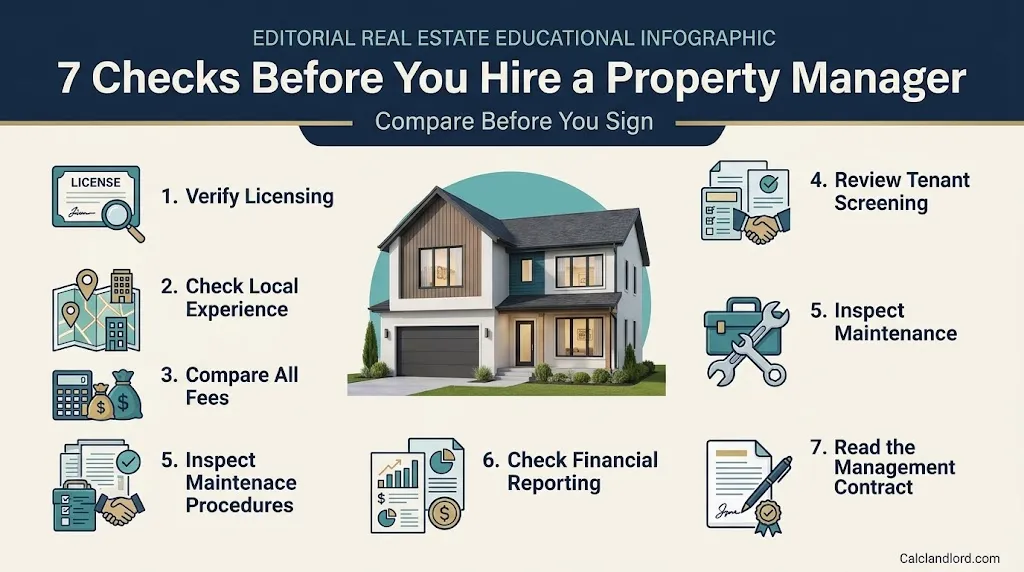
2. Define Your Property’s Needs Before You Search
Before contacting property managers, prepare a short property brief. This ensures every company receives the same information and makes its proposal easier to compare with competing offers.
Include the following details:
- Property address and type.
- Number of units.
- Current rent and occupancy status.
- Lease expiration dates, where applicable.
- Existing maintenance problems.
- Upcoming renovations or major expenses.
- Services you want the manager to handle.
- Decisions you want to approve yourself.
- Preferred communication and reporting arrangements.
Decide how much control you want to retain
Consider a situation in which you own a single-family rental worth $300,000 and collect $2,000 in monthly rent.
You may want the manager to handle tenant communication, rent collection, and routine repairs while requiring your approval for larger renovations.
Another investor with a four-unit apartment building may prefer a more comprehensive arrangement that covers leasing, maintenance coordination, financial reporting, and regular property inspections.
Neither arrangement is automatically better. The right choice depends on your time, experience, portfolio size, and willingness to remain involved.
Write down your non-negotiable requirements before interviewing anyone. A lower management fee should not persuade you to accept a service package that does not meet your needs.
3. Build a Shortlist of Local Candidates
Start with three to five property management companies serving your rental property’s market. This gives you enough options to compare without making the process unnecessarily complicated.
You can find candidates through referrals from other rental owners, real estate professionals, local investor groups, and property management directories.
Read online reviews, but treat them as a starting point rather than proof of quality. A collection of positive testimonials does not establish how a company handles maintenance emergencies, accounting discrepancies, or difficult tenant situations.
Request the same documents from every candidate
Ask each shortlisted company to provide:
- A written management proposal.
- A complete schedule of fees and additional charges.
- A sample management agreement.
- A redacted sample owner statement.
- A written explanation of its maintenance process.
- References from relevant clients, where available.
- The name and role of your proposed property manager or account contact.
Requesting the same information from every company creates a fair comparison.
It also helps reveal which managers are organized, transparent, and prepared to explain their services before you sign a contract.
4. Verify Licensing, Experience, and Financial Controls
A professional website and a polished sales presentation do not prove that a company is qualified to manage your property.
Verify its credentials, examine its relevant experience, and establish how it will handle rental income, deposits, records, and payments.
Check the applicable licensing requirements
Property management licensing requirements vary by state and by the activities performed. Some jurisdictions may require a real estate license for particular leasing or rent-collection activities, while exemptions may apply to certain arrangements.
Ask the company which license, registration, or exemption applies to the services it will provide.
Then verify the answer with the relevant state real estate commission or licensing regulator. Do not assume that a professional association membership or private certification replaces a legally required license.
Ask about relevant local experience
Use questions such as:
- How many properties do you manage in my area?
- How many are comparable to mine?
- How do you determine an appropriate asking rent?
- Which local rental properties support your pricing recommendation?
- Who handles leasing and tenant communication?
- Who covers my account manager when that person is unavailable?
- How do you stay informed about local landlord-tenant requirements?
Local experience matters because rental pricing, housing requirements, and property operations can differ substantially between jurisdictions.
Understand how the company handles money
Ask where rent payments are received, how property-related expenses are recorded, and how owner distributions are calculated.
Clarify who is responsible for handling security deposits, reconciling accounts, authorizing payments, and investigating discrepancies.
Ask whether the company can explain applicable trust-account requirements and provide the records you need to monitor your property.
For example, the California Department of Real Estate publishes guidance on trust-fund handling and recordkeeping. Its requirements should not be assumed to apply identically in every state.
A reliable manager should be able to explain its financial controls in plain English and document the procedures in place.
5. Compare the Full Cost, Not Just the Monthly Fee
Property management fees can be structured differently. One company may charge a smaller monthly percentage but add leasing, renewal, setup, or maintenance-related charges. Another may charge a higher recurring rate while including more services.
That is why the advertised management percentage should never be your only comparison point.
Ask about these charges before evaluating the total cost.
| Fee category | What to clarify |
| Monthly management | Is the fee based on rent collected, rent due, or a fixed amount? |
| Minimum fee | Does a minimum charge apply even when rent is low? |
| Tenant placement | What triggers the fee, and which leasing services are included? |
| Lease renewal | Is there a separate charge for renewing a tenant’s lease? |
| Setup or onboarding | Is an initial account or property setup fee required? |
| Maintenance coordination | Is coordinating repairs included in the regular management fee? |
| Vendor markup | Does the company add a charge to contractor invoices? |
| Inspections | How frequently are inspections performed, and what do they cost? |
| Vacancy | Are fees payable while a unit is vacant? |
| Early termination | What charges apply if you end the agreement? |
| Other charges | Who receives late fees or other tenant charges where permitted? |
Read the agreement to determine which fees are mandatory, optional, or conditional.
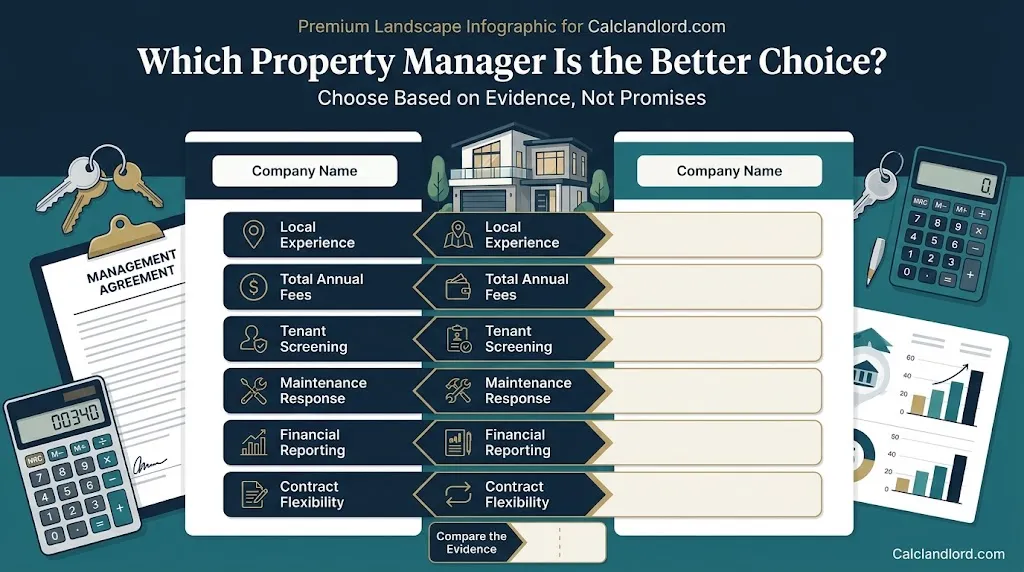
Worked example: Two property management proposals
The following example uses hypothetical figures for illustration. These are not market averages or actual company quotations.
Assume your property collects $2,000 per month in rent, or $24,000 annually. You expect one new tenant placement during the year and no lease renewal. Assume there are no additional charges for maintenance coordination.
| Cost item | Company A | Company B |
| Monthly management rate | 8% | 10% |
| Annual management fee | $1,920 | $2,400 |
| Tenant-placement fee | $2,000 | $1,000 |
| Setup fee | $200 | $0 |
| Total illustrated annual fees | $4,120 | $3,400 |
Under these assumptions, Company B costs $720 less despite charging a higher monthly management percentage.
However, the result changes if there is no tenant placement that year.
Company A’s illustrated recurring management fee would be $1,920, compared with $2,400 for Company B, before other charges.
This shows why you should compare both a typical year and a tenant-turnover year. Your actual costs will depend on the contract and the services your property requires.
Before signing, use a rental cash flow calculator to estimate how management costs affect your property’s income after operating expenses and other obligations.
6. Evaluate Tenant Placement and Screening
A property manager’s tenant-placement process affects more than how quickly a vacant property is rented. It also affects documentation, tenant relationships, payment collection, and the time you may need to spend resolving disputes.
Ask the company to explain its entire leasing process, from advertising a vacancy to documenting the tenant’s move-in.
Examine the complete leasing process
Find out how the company:
- Recommends an asking rent.
- Advertises available units.
- Arranges property showings.
- Communicates written application criteria.
- Verifies application information.
- Reviews screening reports.
- Makes and documents application decisions.
- Prepares lease documents.
- Records the property’s condition at move-in.
Avoid choosing a manager simply because it promises to find a tenant quickly. Ask how its process balances leasing speed with consistent screening and proper documentation.
Ask about fair and consistent screening
Request an explanation of the company’s written tenant-selection criteria and how they are applied to applicants.
Ask how it handles inaccurate screening reports, accommodation requests, and decisions involving third-party screening services.
The U.S. Department of Housing and Urban Development’s Fair Housing Act guidance explains federal protections against housing discrimination. Applicable state and local rules may provide additional protections.
The Federal Trade Commission also explains landlords’ obligations and applicants’ rights involving tenant background checks under the Fair Credit Reporting Act.
Your property manager should understand which requirements apply to your property and the screening activities it performs.
Put leasing performance claims into context
If a company claims to have a low vacancy rate or a short average leasing time, ask:
- What period does the figure cover?
- How many properties are included?
- Does the data cover my property type and local market?
- How is the metric calculated?
- Are vacant units counted consistently?
A performance figure is useful only when you understand what it measures.
7. Ask How Maintenance and Emergencies Are Handled
Maintenance can quickly become one of the most frustrating parts of rental ownership when responsibilities and spending authority are unclear.
A property manager should have a documented process for receiving maintenance requests, assessing urgency, assigning vendors, obtaining approvals, and recording completed work.
Test the process with a realistic scenario
Imagine a tenant reports a leaking water heater on Saturday evening.
Ask the manager:
- Who receives the emergency report?
- Who decides whether immediate action is necessary?
- Which contractor or vendor will be contacted?
- What spending authority does the manager have?
- When will you be informed?
- How will the repair and its cost be documented?
These questions reveal more than a general promise of responsive maintenance.
Clarify routine repair authority
Your agreement should specify which expenses the manager can authorize without contacting you and which require approval.
Ask whether the company obtains multiple estimates for larger jobs, uses affiliated vendors, applies maintenance markups, or charges separate coordination fees.
Also determine how completed work is verified and how you will receive invoices, photographs, and other supporting records where appropriate.
The purpose is not to demand the lowest possible price for every repair. It is to establish a clear, accountable process that protects the property and helps prevent unnecessary spending.
8. Test Communication, Accounting, and Owner Reporting
Communication problems can make even a capable property management company difficult to work with.
During the interview, establish who will manage your account after you sign and how you will receive updates about rent, maintenance, vacancies, and significant property issues.
Clarify the following:
- Your primary contact and backup contact.
- The usual communication channels.
- Expected response times for routine questions.
- Procedures for urgent or after-hours issues.
- Financial reporting frequency.
- How unresolved problems are escalated.
- When owner distributions are normally issued, subject to the agreement and available funds.
Request a sample owner statement
Ask the company to walk you through a redacted financial statement from a managed property.
Check whether you can identify:
| Statement item | What you should be able to understand |
| Rental income | What rent was received and for which period |
| Management fees | How recurring charges were calculated |
| Repairs | Which work was performed and what was paid |
| Other expenses | What additional costs were charged to the property |
| Reserves | Which funds are being held and why |
| Owner distribution | How the amount payable to the owner was determined |
| Outstanding balances | Which payments or transactions remain unresolved |
You should not have to contact the company repeatedly to discover what happened to your property’s income.
An online owner portal can make this information easier to access, but technology is useful only when the underlying records are accurate and understandable.
9. Check References and Verify Performance Claims
Before choosing a company, speak with current or former clients whose properties are similar to yours.
A manager who performs well for a small portfolio of single-family rentals may not necessarily be the best fit for a multifamily property with more complicated maintenance and tenant-management requirements.
Ask references for specific examples
Instead of asking only whether they are satisfied, ask questions such as:
- How did the company handle a difficult maintenance problem?
- Were the actual charges consistent with the agreement?
- Were financial statements accurate and understandable?
- How did the company communicate during a vacancy?
- Did you experience unexpected fees?
- How were tenant complaints handled?
- Would you hire the company again, and why?
Where possible, ask for examples involving situations your own property might encounter.
Verify important claims independently
If a manager says it has extensive local experience, ask for relevant references. If it claims to reduce maintenance costs, ask how it measures that result.
A promise about increased rental income is not a guarantee of future performance.
Give more weight to documented procedures, understandable records, credible references, and clear contractual commitments than to vague claims about maximizing returns.
10. Review the Property Management Agreement
The management agreement defines the working relationship. It should explain what the manager can do, what you must pay, what responsibilities you retain, and how either party can end the arrangement.
Read the complete document before signing.
| Contract provision | Questions to resolve |
| Services | Which tasks are included and excluded? |
| Fees | How are charges calculated, and when are they payable? |
| Authority | Which decisions may the manager make without approval? |
| Repairs | What are the routine spending limits and emergency exceptions? |
| Reserves | How much must be held, and how are funds replenished? |
| Reporting | Which records will you receive, and how often? |
| Vendors | Are affiliated businesses used, and are additional charges disclosed? |
| Contract term | How long does the agreement last, and how does renewal work? |
| Termination | What notice, fees, and continuing obligations apply? |
| Handover | Who transfers leases, records, funds, keys, and access credentials? |
| Disputes and liability | How are disagreements and responsibilities addressed? |
Pay special attention to termination provisions
A company may offer excellent service at the beginning but become less suitable as your needs change.
Determine whether the agreement has a minimum term, automatic renewal, early-termination charges, or notice requirements. Clarify the steps for transferring tenant records, handling outstanding repair requests, and reconciling funds when the relationship ends.
If a verbal promise matters to your decision, ask for it to be documented in the agreement or an appropriate written attachment.
This checklist is intended to help you identify issues, not replace legal advice. Contract enforceability and landlord-tenant requirements can vary by state and locality. Seek qualified local legal advice when a provision is unclear or could expose you to high costs.
11. Use a Weighted Scorecard to Compare Companies
After gathering proposals, score each candidate against the same criteria. A weighted scorecard helps prevent one attractive feature, such as a low monthly fee, from dominating the entire decision.
The following framework is a suggested decision-making tool, not an industry standard or a guarantee of future results.
| Evaluation category | Weight |
| Relevant local and property-type experience | 20 |
| Maintenance process and accountability | 20 |
| Accounting and financial transparency | 15 |
| Communication and staffing | 15 |
| Leasing and tenant-screening process | 15 |
| Total fees and contract clarity | 15 |
| Total | 100 |
Rate each company from 1 to 5 for every category, where 1 indicates poor evidence and 5 indicates strong evidence.
Calculate the weighted points using this formula:
WeightedPoints=Rating5CategoryWeight
For example, if a company receives a maintenance rating of 4 out of 5 and maintenance carries a weight of 20, its score is:
4520=16
It earns 16 of the available 20 maintenance points.
Repeat the calculation for every category and add the weighted points to get a total out of 100.
Example comparison
| Category | Weight | Company A rating | Company A points | Company B rating | Company B points |
| Experience | 20 | 4 | 16 | 5 | 20 |
| Maintenance | 20 | 3 | 12 | 4 | 16 |
| Accounting | 15 | 4 | 12 | 4 | 12 |
| Communication | 15 | 4 | 12 | 3 | 9 |
| Leasing and screening | 15 | 4 | 12 | 4 | 12 |
| Fees and contract | 15 | 3 | 9 | 4 | 12 |
| Total | 100 | 73 | 81 |
In this hypothetical example, Company B scores higher overall. However, Company A has a better communication score, which could matter more to an owner who wants frequent updates.
Before relying on the totals, identify any non-negotiable requirements. A high score must not compensate for a missing legally required credential, unacceptable financial controls, or a contract you are unwilling to accept.
Record the evidence behind each rating. A documented sample statement is more useful than a general impression that the company seems professional.
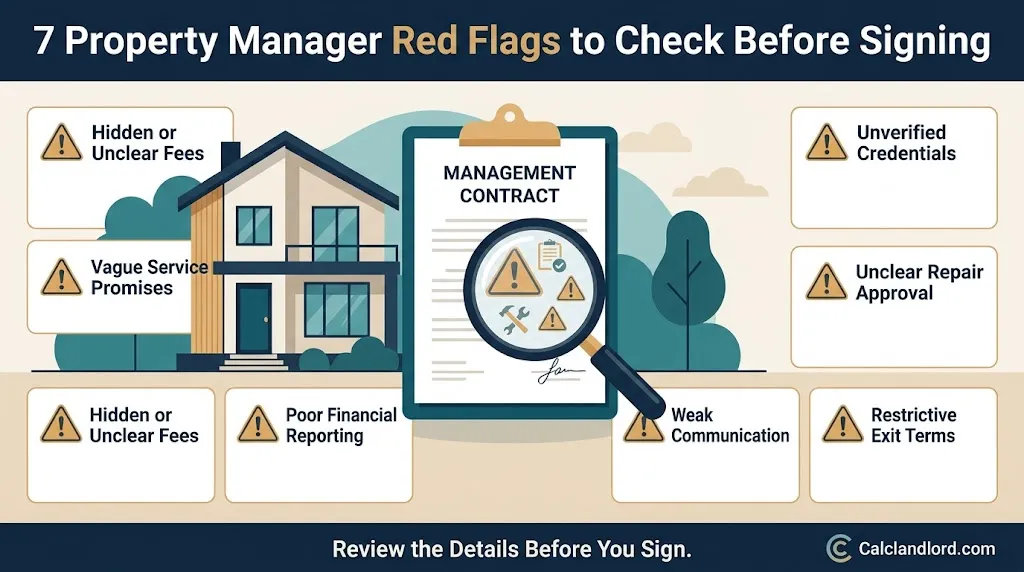
12. Recognize Red Flags Before You Sign
A single concern does not automatically prove that a company is unsuitable. However, unresolved concerns should be investigated before you commit.
Watch for these warning signs:
- The company refuses to provide a complete fee schedule.
- Important verbal promises are missing from the written agreement.
- Nobody can explain who will manage your account.
- Maintenance authorization and spending limits remain unclear.
- Vendor relationships or additional charges are not disclosed adequately.
- Performance claims have no clear timeframe or supporting evidence.
- Sample financial statements are unavailable or difficult to understand.
- Tenant-screening procedures cannot be explained.
- Required licensing or authorization cannot be verified.
- Termination and handover responsibilities remain vague.
- You are pressured to sign before having time to review the documents.
Pay particular attention when several concerns occur together.
For example, a low management fee might initially appear attractive. But if the company also refuses to disclose maintenance markups and has unclear termination terms, you cannot reasonably assess the total cost or the risk of ending the relationship.
A trustworthy candidate should be willing to answer reasonable questions and explain its responsibilities before the agreement is signed.
13. Plan the Handover and First 90 Days
Your decision is not complete when the agreement is signed. You also need a clear plan for transferring the property to the new manager and confirming that the agreed processes are working.
Prepare an onboarding checklist
Depending on your property’s circumstances, the handover may include:
- Signed management agreement.
- Current leases and amendments.
- Tenant contact details and payment records.
- Security-deposit records and required transfer arrangements.
- Keys, access devices, and entry instructions.
- Existing maintenance requests and contractor details.
- Inspection reports and condition photographs.
- Relevant warranties and property records.
- Insurance and utility information.
- Tenant communication arrangements.
- Initial reporting and owner-distribution dates.
Confirm responsibility for transferring funds and records under the existing agreement and applicable law. Do not assume the previous manager will transfer everything automatically.
Monitor performance during the first three months
Set expectations in writing and review progress against them.
| Period | What to review |
| First 30 days | Account setup, document transfer, tenant communication, and outstanding maintenance issues |
| Days 31–60 | Statement accuracy, expense documentation, communication, and service follow-through |
| Days 61–90 | Overall process consistency, unresolved problems, and compliance with agreed responsibilities |
These are suggested review periods, not guaranteed milestones. A property with an active vacancy, complicated repairs, or a manager transition may require a different schedule.
Use your findings to resolve misunderstandings early. If significant problems persist, document the issues, discuss corrective steps, and review the agreement’s dispute and termination provisions.
The goal is to establish a management relationship that remains transparent and accountable beyond the initial sales process.
14. How to Make the Final Decision
After completing your research, narrow the list to the strongest two candidates and compare their documented services, complete costs, references, and contracts.
The best company is not necessarily the largest firm or the one with the cheapest rate. It is the company that fits your property, operates transparently, and can demonstrate how it will carry out its responsibilities.
Before signing, make sure you can answer these six questions confidently:
- Has the company’s relevant experience and required licensing been verified?
- Do I understand the complete fee structure?
- Are tenant screening, maintenance, and emergency procedures clearly explained?
- Will I receive financial reports that I can understand and verify?
- Does the agreement define responsibilities, spending authority, and termination?
- Can the company provide credible evidence to support its important claims?
If any answer remains unclear, resolve the issue before committing.
For rental owners, property management should reduce operational stress without making the property’s finances harder to understand. A deliberate selection process helps you evaluate that trade-off and choose a manager whose services match your investment goals.
- More Explore :https://calclandlord.com/how-to-rent-your-house/
15. People Also Ask
Start with three to five candidates. Request the same information from each, then conduct detailed interviews with the strongest options. Comparing multiple proposals helps you understand differences in services, fees, staffing, and contract terms.
Not based on price alone. Compare total annual costs, included services, additional charges, maintenance practices, and termination terms. A lower recurring fee can still produce a higher total bill when tenant placement or other charges are added.
Look for relevant local experience, verifiable credentials, clear financial controls, consistent tenant-screening procedures, an organized maintenance process, reliable communication, transparent fees, and a well-defined written agreement.
Licensing requirements depend on the state, the activities performed, and any applicable exemptions. Verify the relevant requirements directly with the property’s state licensing regulator rather than assuming every company operates under the same rules.
Ask about properties managed locally, tenant placement, screening criteria, maintenance emergencies, repair spending limits, accounting, additional fees, staff coverage, client references, and contract termination. Request written explanations wherever possible.
At minimum, review the written service proposal, complete fee schedule, management agreement, sample owner statement, maintenance procedures, and relevant client references. Confirm that important promises are reflected in the agreement.
A property manager cannot reliably guarantee future investment returns simply by promising better service. Rental income and expenses depend on factors such as vacancy, market conditions, repair needs, financing, and tenant payment behavior. Evaluate documented performance and specific contractual commitments instead.
How long should I wait before evaluating a new property manager?
Begin reviewing the relationship during onboarding and continue throughout the first 90 days. Check reporting accuracy, communication, maintenance follow-through, and compliance with the agreement. Address problems promptly rather than waiting until the end of the review period.
Final takeaway: Select a property management company by comparing verified evidence, total costs, operational procedures, and contract terms—not just its advertised fee or sales presentation. A careful decision can help you manage your rental property with clearer expectations, better financial visibility, and fewer avoidable surprises.
