

How Long Will My Money Last? Calculator, Formula, and Ways to Make Your Money Last Longer
Your savings balance tells only part of the story. The real question is how long it can support your life—after monthly bills, changing prices, and unexpected expenses. A $500,000 nest egg could last very differently depending on how much you withdraw and whether your money earns investment returns. The How Long Will My Money Last Calculator helps you estimate your savings runway using assumptions such as your starting balance, monthly withdrawals, and expected return. Use the estimate as a planning point, compare scenarios, and spot where you may need to adjust spending. Your result is an estimate, not a guarantee.
Whether you are planning for retirement, taking time away from work, managing an inheritance, or living off rental property income, one question matters more than almost any other: How long will my money last?
A how long will my money last calculator estimates how many months or years your savings can support your spending. It considers your starting balance, monthly withdrawals, expected investment returns, and, depending on the calculator, inflation, taxes, and other income sources.
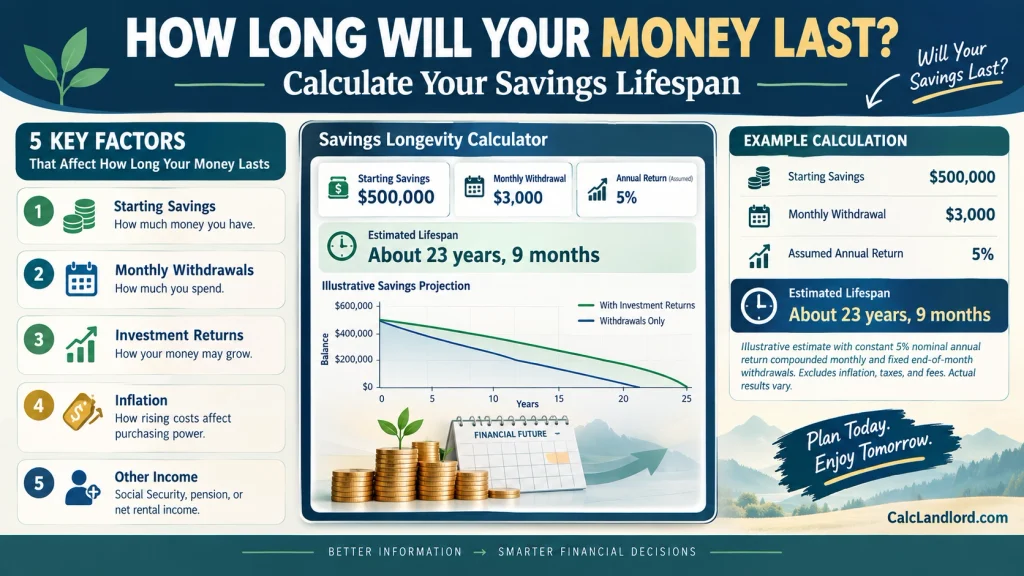
For example, $500,000 in savings could last less than 14 years if you withdraw $3,000 every month and earn nothing. Under a simplified scenario with a steady 5% annual return compounded monthly, the same balance could last approximately 23 years and 9 months with the same withdrawals. Neither estimate accounts for every real-world risk.
The difference shows why your savings balance alone does not tell the whole story. Your spending habits, investment performance, inflation, and additional income all affect how quickly your money runs out.
This guide explains how to estimate your savings lifespan, calculate a sustainable monthly withdrawal, understand the 4% rule, and make informed decisions about your financial future.
How Long Will My Money Last Calculator?
A money longevity calculator helps you estimate how long a savings balance can support regular withdrawals before it reaches zero.
It is useful for retirees, investors, homeowners, landlords, and anyone who plans to spend down savings over time.
Depending on the calculator’s features, you can use it to estimate:
- How many years your current savings may last.
- How much you can withdraw each month over a specific period.
- How investment returns affect your remaining balance.
- How inflation-adjusted spending changes your financial outlook.
- How additional income can reduce the amount withdrawn from savings.
- Whether your current spending plan needs adjustments.
Information You Need Before Calculating
Gather the following figures before using the calculator.
| Calculator input | What to enter | Why it matters |
| Current savings | Your available savings and investments intended to fund spending | Establishes your starting balance |
| Monthly withdrawal | The amount you expect to take from savings each month | Determines how quickly the balance declines |
| Expected annual return | A reasonable estimate of investment growth before applicable taxes and fees | Shows how growth may offset withdrawals |
| Inflation rate | Your estimated annual increase in living expenses | Helps measure future purchasing power |
| Other monthly income | Social Security, pension payments, or net rental income | Reduces the amount required from savings |
| Taxes and fees | Applicable withdrawal taxes, account costs, and investment fees | Provides a more realistic estimate of spendable money |
| Planning period | The number of years you want your money to last, if the calculator supports this input | Helps establish a target withdrawal amount |
Not every calculator includes all these inputs. A basic savings withdrawal calculator may consider only your balance, interest rate, and monthly withdrawal.
For a more realistic retirement projection, use a tool that allows inflation adjustments and test different return assumptions.
How to Use a How Long Will My Savings Last Calculator
Follow these steps to estimate your savings lifespan.
Step 1: Enter your available savings.
Include the funds you genuinely expect to use for spending. You might include savings accounts, cash reserves intended for long-term use, brokerage investments, and retirement accounts.
Avoid automatically counting your home equity or the full value of a rental property as available cash. You generally need to sell, refinance, or otherwise access that value before spending it.
Also consider keeping emergency savings separate if you do not intend to use those funds for regular withdrawals.
Step 2: Calculate your actual monthly spending gap.
Estimate your monthly expenses and subtract reliable income that you expect to receive.
For example:
| Monthly budget item | Amount |
| Housing and utilities | $1,800 |
| Food and transportation | $1,000 |
| Insurance and healthcare | $700 |
| Other expenses | $500 |
| Total monthly expenses | $4,000 |
| Social Security and pension income | $1,500 |
| Required monthly savings withdrawal | $2,500 |
In this example, you need $2,500 from savings each month rather than the entire $4,000.
Step 3: Choose an investment return assumption.
If your money is invested, enter a reasonable estimate of its long-term return. Do not assume that a strong recent year will continue indefinitely.
For comparison, test several possibilities, such as 2%, 4%, and 5% annual nominal returns. These are illustrative planning assumptions, not forecasts.
If your savings are held entirely in cash, use an appropriate estimate of the interest you expect to earn rather than automatically assuming stock-market returns.
Step 4: Account for inflation.
Determine whether your monthly withdrawal will remain fixed or increase as living costs rise.
A fixed $3,000 monthly withdrawal becomes less useful over time if prices rise. An inflation-adjusted withdrawal can better preserve purchasing power, but it may exhaust your savings sooner.
Step 5: Review the estimated result.
Look at the projected number of years, remaining balance, and total withdrawals if your calculator provides these outputs.
Then repeat the calculation with lower returns, higher expenses, and unexpected costs. A plan that works only under optimistic assumptions deserves closer attention.
How to Calculate How Long Your Money Will Last
There are two useful approaches: a simple calculation that ignores investment growth and a more advanced calculation that accounts for returns.
1. The simple savings lifespan formula
When you do not expect your savings to earn anything, the calculation is straightforward:
Years Money Lasts = Starting Savings ÷ Annual Withdrawals
If you withdraw monthly, calculate annual withdrawals first:
Annual Withdrawals = Monthly Withdrawal × 12
Example:
Suppose you have $240,000 in savings and withdraw $2,000 per month.
Annual withdrawals:
\[ \$2,000\times12=\$24,000 \]
Estimated lifespan:
\[ \frac{\$240,000}{\$24,000}=10 \]
Your money would last approximately 10 years if there were no investment growth, inflation adjustments, taxes, fees, or unexpected additional withdrawals.
This is a useful baseline, but it does not describe an invested portfolio whose value changes over time.
2. The formula with investment returns
When your balance earns a constant positive return and you make equal withdrawals at the end of each period, a mathematical formula can estimate how long the money lasts.
For annual withdrawals:
n=WW-rP(1+r)
Where:
- n = estimated number of years.
- P = starting savings balance.
- W = annual withdrawal.
- r = annual return expressed as a decimal.
- = natural logarithm.
This formula assumes a constant annual return, fixed annual withdrawals, and withdrawals at the end of each year. It does not account for inflation, taxes, fees, or market volatility.
It also assumes r>0 and W>rP. If these conditions do not hold, use an appropriate alternative calculation or a period-by-period model.
For monthly withdrawals, a similar formula applies using a monthly withdrawal amount and a monthly return rate.
n=WW-iP(1+i)
Here, i is the monthly return rate and n represents the number of months.
For an illustrative nominal annual return of 5% compounded monthly:
i = 0.05 ÷ 12
A spreadsheet or calculator can apply this formula repeatedly and convert the resulting months into years.
Important: These formulas are useful for understanding the math. They should not be treated as precise forecasts of real-world investment outcomes.
Example: How Long Will $500,000 Last?
Consider a person with $500,000 in savings who wants to withdraw $3,000 each month.
Assume a constant 5% nominal annual investment return compounded monthly, monthly withdrawals at the end of each month, and no taxes, fees, or inflation adjustments.
The starting figures are:
| Item | Amount |
| Starting savings | $500,000 |
| Monthly withdrawal | $3,000 |
| Initial annual withdrawal | $36,000 |
| Illustrative annual return | 5% |
| Inflation adjustment | None |
| Taxes and fees | Excluded |
Using monthly compounding and a fixed monthly withdrawal, the projected lifespan is approximately 285 months, or 23 years and 9 months.
This is a mathematical illustration, not a guarantee that your investments will earn 5% every year.
- More to Explore: https://calclandlord.com/commercial-property-investment-analysis/
Compare different withdrawal amounts
The same starting balance produces very different results when spending changes.
The following table compares the lifespan with no investment growth and no inflation, taxes, or additional withdrawals.
| Starting savings | Monthly withdrawal | Annual spending | Estimated lifespan |
| $500,000 | $2,000 | $24,000 | 20.8 years |
| $500,000 | $3,000 | $36,000 | 13.9 years |
| $500,000 | $4,000 | $48,000 | 10.4 years |
| $500,000 | $5,000 | $60,000 | 8.3 years |
| $750,000 | $3,000 | $36,000 | 20.8 years |
These are simple estimates, calculated by dividing savings by annual spending. Investment growth could extend the timeline, while inflation, taxes, fees, and unexpected costs could shorten it.
The main lesson is that a manageable withdrawal amount can be just as important as a large starting balance.
What Factors Affect How Long Your Money Lasts?
Your savings lifespan depends on several factors working together. Understanding them helps you identify which assumptions deserve the most attention.
1. Monthly spending and withdrawal rate
Every withdrawal reduces the amount remaining in your account unless investment growth offsets it.
A person who spends $2,500 per month from a $500,000 portfolio takes a smaller annual withdrawal than someone who spends $5,000 per month from that portfolio.
The withdrawal rate is the annual portfolio withdrawal divided by the starting portfolio balance.
For example:
\[ \text{Withdrawal Rate} = \frac{\$36,000}{\$500,000}\times100 =7.2\% \]
A 7.2% initial withdrawal rate may put significant pressure on a portfolio intended to support spending for several decades, especially if withdrawals increase with inflation.
2. Investment returns
Investment growth can help offset withdrawals, but actual returns fluctuate.
A portfolio may gain value in one year and lose value in another. An average return does not tell you the order in which those returns occur.
A projection based on a steady 5% annual return assumes a much smoother path than most market investments experience.
Use several return assumptions rather than relying on a single optimistic figure.
3. Sequence-of-returns risk
Sequence-of-returns risk is particularly important when you are withdrawing money from investments.
Imagine two retirees who earn the same average return over a long period. One experiences strong returns early in retirement, while the other suffers substantial losses during the first few years.
The second retiree may have to sell investments at depressed prices to cover living expenses. Those withdrawals leave fewer assets available to benefit from a later recovery.
The eventual average return can therefore be similar while the amount remaining for spending is very different.
This is why a money longevity calculator that assumes a constant return should be paired with stress testing and, where appropriate, more advanced retirement projections.
4. Inflation and purchasing power
Inflation increases the amount of money needed to maintain the same lifestyle.
Suppose you currently spend $3,000 per month. If living expenses increase by 3% annually, maintaining the same purchasing power would require approximately:
| Time from now | Equivalent monthly spending |
| Today | $3,000 |
| In 5 years | $3,478 |
| In 10 years | $4,032 |
| In 20 years | $5,418 |
These amounts are illustrations calculated with a constant 3% annual inflation rate. Actual inflation will vary.
If a calculator assumes that you will withdraw exactly $3,000 every month for 20 years, it may substantially understate your eventual spending needs.
5. Taxes and investment fees
The amount leaving your account is not always the amount available to spend.
Traditional IRA and many traditional workplace retirement plan distributions are generally taxable to the extent they represent previously untaxed money. Qualified Roth IRA distributions can receive different tax treatment when applicable requirements are met. See the IRS’s Publication 590-B on IRA distributions.
Investment advisory charges, fund expenses, and transaction costs can also reduce the amount of money available for future spending.
Your calculator should distinguish between gross withdrawals and the after-tax income you actually receive.
6. Other income sources
Reliable income can substantially reduce the withdrawal required from savings.
Potential sources include:
- Social Security retirement benefits.
- Pension payments.
- Part-time employment.
- Annuity payments.
- Net rental property income.
- Other regular income streams.
For personalized Social Security estimates, use the official Social Security Administration benefits estimator.
Do not count an expected income stream without considering its timing, reliability, and applicable taxes.
7. Unexpected expenses
A major medical expense, roof replacement, prolonged vacancy, or family emergency can disrupt a carefully planned budget.
A calculator cannot predict every future event. Consider maintaining an appropriate emergency reserve and testing whether you could absorb a large expense without permanently damaging your long-term plan.
The 4% Rule: Can It Help Your Savings Last Longer?
The 4% rule is a common retirement-planning guideline. Under its traditional form, you withdraw 4% of your starting portfolio in the first year of retirement and then adjust that dollar amount for inflation in subsequent years.
For example, a $1 million portfolio would provide an initial withdrawal of $40,000 under this approach.
| Starting portfolio | Initial 4% annual withdrawal | Monthly equivalent |
| $250,000 | $10,000 | $833 |
| $500,000 | $20,000 | $1,667 |
| $750,000 | $30,000 | $2,500 |
| $1,000,000 | $40,000 | $3,333 |
| $2,000,000 | $80,000 | $6,667 |
The monthly figures are annual withdrawals divided by 12. They do not represent guaranteed sustainable monthly income.
The traditional rule originated from historical retirement-withdrawal research and is commonly discussed in the context of a 30-year retirement. It is a benchmark, not a guarantee that your money will last for a particular number of years.
What does current retirement research say?
Morningstar’s 2026 retirement-income research identifies a 3.9% starting withdrawal rate for its base-case scenario involving a 30-year retirement, inflation-adjusted spending, and a modeled 90% probability of having funds remaining at the end of the period. Its results depend on assumptions about investment returns, inflation, asset allocation, and spending strategy.
That finding does not mean every retiree should use 3.9%, nor does it establish a guaranteed withdrawal rate for your situation.
Your planning period, investment mix, income sources, taxes, and willingness to reduce spending after poor market performance all affect the appropriate approach.
For someone retiring early and expecting to fund 35 or 40 years of expenses, a different plan may be necessary.
How Much Can You Withdraw Each Month to Make Your Money Last 25 Years?
Sometimes the better question is not how long your savings will last, but how much you can withdraw while targeting a specific number of years.
Suppose you have $500,000 and want to spread your money over 25 years.
With no investment growth, the calculation is:
\[ \frac{\$500,000}{25\times12} =\$1,666.67 \]
That means approximately $1,667 per month before considering inflation, taxes, fees, or unexpected costs.
If the balance earns a constant positive return, a level monthly withdrawal can be calculated using the present value of an annuity formula:
W = P × i ÷ (1 − (1 + i)^-n)
Where:
- W = monthly withdrawal.
- P = starting savings.
- i = monthly return rate.
- n = total number of monthly withdrawals.
For $500,000 over 25 years, using a constant nominal annual return of 5% compounded monthly, the formula produces a withdrawal of approximately $2,923 per month.
This higher result depends on the assumed growth and level withdrawals. It does not include inflation adjustments, taxes, fees, or market volatility.
Consequently, it should not be interpreted as a safe retirement income recommendation.
For a more realistic plan, calculate several scenarios and determine whether your spending must increase over time to maintain purchasing power.
How to Make Your Savings Last Longer
If your calculator produces a shorter timeline than you expected, the result can help you identify where adjustments may be useful.
Reduce recurring expenses
Review large, recurring expenses first. Housing, transportation, insurance, debt payments, and healthcare can have a meaningful effect on your monthly budget.
Reducing your required monthly withdrawals by even a modest amount can improve a savings projection.
Delay withdrawals when practical
Continuing to work part-time, delaying retirement, or using other available income can reduce the amount withdrawn from savings.
A shorter withdrawal period and additional time for investments to grow may improve your financial position, although neither outcome is guaranteed.
Review withdrawals after market losses
Avoid assuming that spending can continue unchanged after every market decline.
Flexible spending rules may allow you to reduce discretionary withdrawals following poor performance and reassess them when conditions improve.
Essential expenses require special attention because they may not be easy to reduce.
Maintain an emergency reserve
An appropriate reserve can help you manage irregular expenses without immediately selling long-term investments.
The right amount depends on your circumstances, including your income stability, housing obligations, health expenses, and access to other funds.
Review your plan annually
Update your savings balance, actual spending, expected income, inflation assumptions, investment performance, and tax estimates.
Also reassess after major life events, such as purchasing a home, selling an investment property, retiring, or experiencing a significant change in healthcare costs.
A calculator is most helpful when it supports an ongoing planning process rather than serving as a one-time answer.
How Long Will My Money Last in Retirement?
Retirement planning involves more than dividing your savings by your expected expenses.
A useful starting point is to identify your essential spending, calculate the reliable income available to cover it, and estimate the additional amount that must come from your portfolio.
For example, assume a retired couple needs $5,000 per month and expects $2,000 in combined Social Security and pension income.
Their initial monthly portfolio withdrawal requirement is:
\[ \$5,000-\$2,000=\$3,000 \]
The savings only need to cover the remaining $3,000 each month, rather than their entire budget.
However, the couple should also consider future healthcare expenses, inflation, taxes, market losses, and whether their income sources will change over time.
A robust retirement plan tests whether savings can support spending under less favorable conditions, not just average ones.
Can Rental Property Income Help Your Money Last Longer?
For real estate investors and landlords, rental income can reduce the amount that must be withdrawn from savings each month.
However, gross rent is not the same as spendable income.
Suppose a rental property collects $2,500 in monthly rent. The owner must still account for vacancy, property taxes, insurance, maintenance, capital expenditures, management, and mortgage payments where applicable.
Only the genuinely available net cash flow should be considered as a potential source of money for personal spending.
Consider this simplified example:
| Monthly rental property figure | Amount |
| Rent collected | $2,500 |
| Operating expenses and reserves | −$800 |
| Mortgage payment, including principal and interest | −$900 |
| Cash flow before personal income taxes | $800 |
If this $800 is reasonably sustainable, it may reduce a person’s required savings withdrawal from $3,000 to $2,200 per month.
Real rental cash flow can vary because of vacancies, repairs, insurance renewals, financing costs, and other property-specific factors.
Landlords should review their rental property investing assumptions and property investment returns before relying on rental income in a long-term spending plan.
It is also important not to confuse a rental property’s market value with available cash. Selling or refinancing a property involves costs, potential taxes, and other considerations.
Common Mistakes When Calculating How Long Money Will Last
Even a mathematically correct calculator can produce a misleading plan when its inputs are unrealistic.
Using an overly optimistic return. Assuming a high, constant return may make your savings appear more sustainable than they really are. Test lower-return scenarios as well.
Ignoring inflation. A fixed monthly withdrawal may not cover the same lifestyle in 10 or 20 years.
Forgetting taxes and fees. The amount withdrawn from an account may not equal the amount available to spend.
Counting gross rental income as spendable cash. Property expenses, vacancies, repairs, and debt service must be considered.
Using the entire emergency fund. Money reserved for a genuine emergency should not automatically be treated as available for routine spending.
Assuming the 4% rule guarantees success. Historical benchmarks and forward-looking research are based on specific assumptions and cannot guarantee an individual outcome.
Ignoring investment losses early in retirement. Poor early returns combined with continued withdrawals can have a lasting effect on your balance.
Failing to update the calculation. Your financial plan should change when your circumstances, expenses, income, or investment assumptions change.
People Also Ask
Without investment growth, inflation, taxes, or fees, $500,000 would last about 13.9 years with withdrawals of $3,000 per month. With a constant 5% nominal annual return compounded monthly, fixed $3,000 monthly withdrawals would last approximately 23 years and 9 months under the assumptions used in this guide. Actual results may differ substantially.
There is no single answer. Under the 4% rule, $1 million supports an initial annual withdrawal of $40,000, or about $3,333 per month, followed by inflation adjustments under the traditional method. The actual lifespan depends on investment returns, spending, inflation, taxes, other income, and the length of retirement.
A safe withdrawal rate is a starting percentage of a portfolio that is intended to support spending over a defined period while managing the risk of running out of money. There is no universally safe rate for every investor. The appropriate amount depends on the planning horizon, portfolio, spending flexibility, and assumptions used.
The 4% rule remains a widely recognized planning benchmark, but it is not a guarantee. Morningstar’s 2026 research estimates a 3.9% starting withdrawal rate in its base case for a 30-year retirement using inflation-adjusted withdrawals and a modeled 90% probability of having money remaining at the end of the period. Different strategies and circumstances can produce different results.
Some calculators do, while others use a fixed withdrawal amount. Check the tool’s inputs before relying on its estimate. If withdrawals do not increase with inflation, the result may not reflect how much money you need to maintain your current lifestyle over time.
Yes, when retirement planning is the goal. Subtract expected Social Security and other reliable income from your budget to estimate the amount your savings need to provide. Use your personalized Social Security estimate and remember that benefits may begin at a different time from your retirement date.
Conclusion
A how long will my money last calculator can help you turn a savings balance into a practical spending plan. By considering your withdrawals, investment returns, inflation, taxes, and other income, you can estimate how long your savings may support your needs.
The most useful result is not simply several years. It is an understanding of which assumptions determine whether your money can support your plans.
Start with a realistic monthly spending estimate, account for reliable income, and compare conservative, moderate, and optimistic scenarios. If the projected timeline is too short, use the results to identify changes that could improve your financial position.
Remember that every calculation depends on assumptions. Review your estimate regularly, allow for unexpected expenses, and seek professional advice when your decisions could materially affect your long-term financial security.

Pingback: Split Rent Calculator for Roommates & Couples
Pingback: Rentometer Free: 5 Ways to Get Rent Data for $0
Pingback: Rental Payment Calculator: 5 Costly Rent Surprises-