SBA 504 Loan Guide: Rates, Requirements, Costs & Real Estate Financing 2026
Buying a commercial building for your business can require substantial upfront capital—but the right financing structure may make ownership more achievable. An SBA 504 loan offers eligible U.S. small businesses long-term financing for major fixed assets, including commercial property, facility improvements, and qualifying equipment. But there is an important catch: a loan designed for an owner-occupied business property generally cannot finance a passive rental investment. Understanding this distinction before you apply can save time, money, and costly surprises. In this guide, you’ll discover how SBA 504 loans work, what down payments and fees to expect, who qualifies, and which financing alternatives to consider.
An SBA 504 loan can help an eligible U.S. small business finance major fixed assets, including commercial buildings, facilities, land, and qualifying long-term equipment. It combines financing from a private-sector lender with a loan made through an SBA-authorized Certified Development Company (CDC), plus an equity contribution from the borrower.
For business owners, the appeal is long-term financing for assets that support business operations and growth. For landlords and real estate investors, however, eligibility requires particular attention: the SBA 504 program generally cannot finance passive investment in rental real estate. An operating business purchasing a building for its own eligible use is different from an investor purchasing property primarily to collect rent.
This guide explains the loan structure, eligibility, down payments, rates, fees, property restrictions, alternatives, and application process so you can decide whether SBA 504 financing fits your project.
What Is an SBA 504 Loan?
An SBA 504 loan, also called a CDC/504 loan, is a government-backed financing program for eligible small businesses investing in major fixed assets. The SBA does not simply hand the borrower the entire project cost; financing is arranged through a participating lender and a CDC.
Typical eligible projects may include:
- Buying an existing building for an eligible operating business.
- Constructing a new business facility.
- Renovating or improving eligible commercial property.
- Purchasing eligible land and making related improvements.
- Financing qualifying long-term machinery and equipment.
- Refinancing certain debts when the applicable program conditions are satisfied.
The program is not intended to cover every expense involved in running a business. Working capital and inventory, for example, are generally outside the permitted uses of an ordinary 504 loan.
Who might benefit? A manufacturer buying a facility, a business expanding its premises, or an eligible company purchasing property for its own operations may be a candidate. A passive residential landlord seeking financing for a rental house should investigate other loan products instead.
2. SBA 504 Loan Requirements and Eligibility for Small Businesses
Qualifying requires more than having a good credit score or finding a suitable property. The business, its financial position, the proposed asset, and the intended use must all satisfy applicable program rules and underwriting standards.
The SBA’s published general eligibility criteria include the following:
- The applicant operates a for-profit business in the United States or its possessions.
- The business qualifies as small under applicable SBA size standards.
- The project uses funds for an eligible purpose.
- The business demonstrates repayment ability and has qualified management.
- The business has a feasible business plan and meets other applicable program conditions.
- The applicant satisfies relevant financial eligibility tests.
The SBA’s published guidance identifies tangible net worth below $15 million and average net income below $5 million after federal income taxes for the two years preceding the application as financial tests. Definitions, exceptions, and applicable rules should be confirmed with a CDC before relying on these figures.
Is there a minimum credit score?
There is no single credit score that guarantees approval for every SBA 504 application. Lenders assess credit history, business financial statements, debt obligations, cash flow, management experience, collateral, and project feasibility.
Ask your prospective lender about its current underwriting requirements rather than treating an online credit-score threshold as an official SBA-wide rule.
Does a project need to create jobs?
The 504 program promotes business growth and economic development. Job-creation or retention requirements and qualifying public-policy goals can be relevant to project eligibility. Your CDC should explain the specific test applicable to your transaction.
Practical tip: Before paying for extensive due diligence, ask a CDC to review your business type, intended property use, estimated project cost, and financial eligibility.
SBA 504 Loan Limits, Repayment Terms, and Financing Structure
The SBA currently publishes a general maximum 504 loan amount of $5.5 million. Eligible energy projects can have different provisions, and the amount approved for an individual borrower depends on program rules and project eligibility.
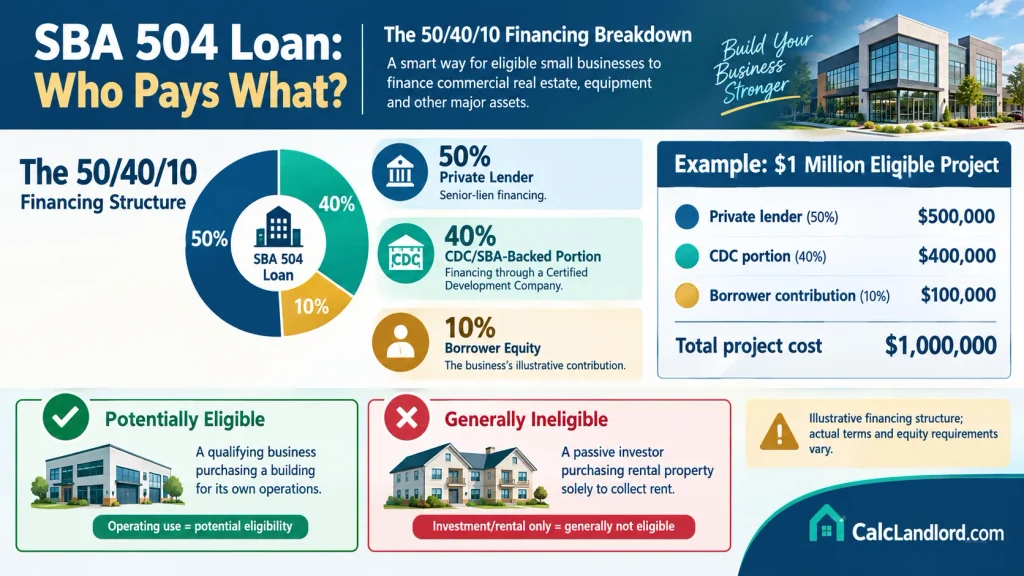
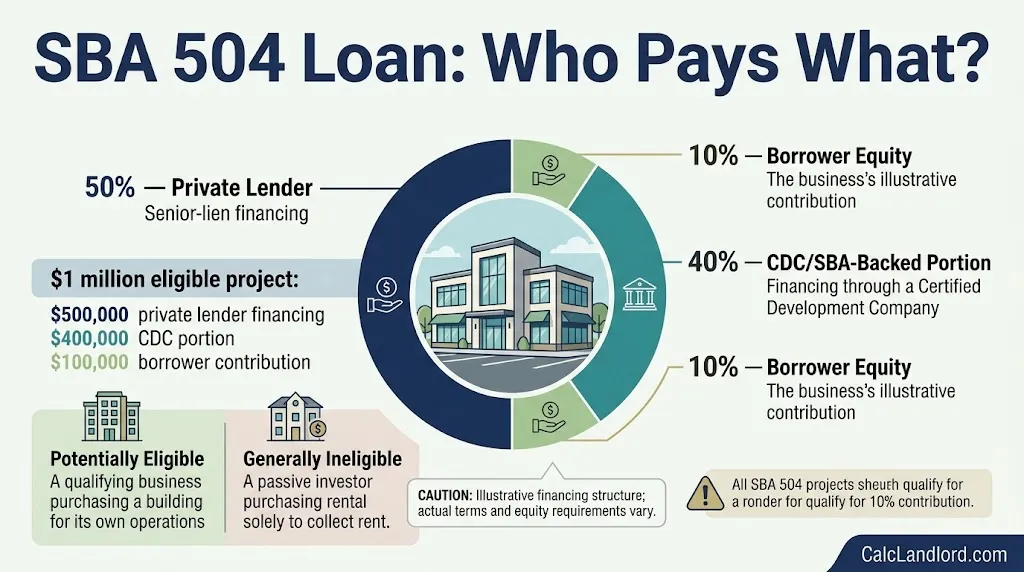
A typical 504 project uses three funding sources:
| Funding source | Illustrative share | Role |
| Private-sector lender | 50% | Senior-lien financing |
| CDC/SBA-backed portion | 40% | Junior-lien financing through a CDC debenture |
| Borrower contribution | 10% | The business’s equity in the project |
| Total | 100% | Total eligible project cost |
This is a common illustration, not a guaranteed structure. Certain projects require more borrower equity, and lender underwriting may affect the final arrangement.
Example: A $1 million project
Suppose a business purchases and improves an eligible commercial facility with a total eligible project cost of $1 million.
| Component | Illustrative amount |
| Private lender at 50% | $500,000 |
| CDC portion at 40% | $400,000 |
| Borrower contribution at 10% | $100,000 |
| Total | $1,000,000 |
The arithmetic illustrates the structure only. It does not mean a lender will approve those amounts or that $100,000 will cover every cash requirement.
The SBA lists 10-, 20-, and 25-year maturity options, depending on the financing and applicable terms. The CDC portion has fixed-rate financing, while the private lender’s portion has its own contractual terms.
How Much Down Payment Do You Need for an SBA 504 Loan?
A 10% borrower contribution is common in a standard 504 financing example, but the actual required contribution can be higher. The correct amount depends on the project, the borrower’s circumstances, and the rules applicable to the transaction.
The following table shows how different contribution percentages affect the cash contribution for various project costs.
| Eligible project cost | 10% contribution | 15% contribution | 20% contribution |
| $300,000 | $30,000 | $45,000 | $60,000 |
| $500,000 | $50,000 | $75,000 | $100,000 |
| $1,000,000 | $100,000 | $150,000 | $200,000 |
These figures are mathematical examples, not official contribution requirements for those project sizes.
Formula:
\[ \text{Equity contribution}=\text{Eligible project cost}\times\text{Contribution percentage} \]
For a $750,000 project with a hypothetical 15% contribution:
\[ \$750,000\times0.15=\$112,500 \]
The borrower may also need funds for expenses that are not included in the financed project cost, such as certain reports, professional fees, reserves, or other closing expenses.
Before committing to a purchase, ask your lender and CDC for a written estimate showing the required equity, costs payable before closing, and any additional cash reserves.
SBA 504 Loan Interest Rates: Fixed Rates and Borrowing Costs
The CDC debenture portion of an SBA 504 loan carries a fixed interest rate established under the program’s funding and pricing process. The separate private lender loan may have different pricing, repayment terms, and rate features.
This distinction matters because a project can contain two loans rather than one conventional mortgage with a single interest rate.
When requesting an SBA 504 loan quote, ask for:
- The CDC debenture interest rate and applicable maturity.
- The private lender’s rate and whether it is fixed or variable.
- The payment schedule for each portion.
- Upfront program fees and lender charges.
- Whether eligible fees are financed or paid in cash.
- Any applicable prepayment provisions.
Are SBA 504 loan rates fixed?
The CDC debenture rate is fixed under the program structure. Do not assume the bank portion is also fixed: check the actual loan agreement.
There is no single timeless interest rate that applies to every 504 borrower. Funding dates, market conditions, transaction terms, and lender pricing can change the final cost. For that reason, this article does not present an unverified figure as the current October 2026 rate.
Compare the whole financing package. A lower quoted rate on one portion does not automatically mean the lowest total cost. Evaluate payments, fees, maturity, and prepayment terms together.
SBA 504 Loan Fees, Closing Costs, and Hidden Expenses
The interest rate is only one part of the total cost of financing. An SBA 504 project may involve program-related fees, CDC charges, lender fees, legal expenses, appraisals, environmental reports, title expenses, recording charges, and other transaction costs.
The SBA publishes 504 fee information by fiscal year. Its FY 2026 fee notice is available through the official SBA document page. Because fiscal-year rules and special fee provisions can change, verify the schedule applicable to the actual approval and closing.
What costs should you budget for?
| Cost category | What to confirm |
| Program fees | Which SBA-related fees apply to the transaction? |
| CDC charges | What processing, servicing, or other charges are applicable? |
| Lender charges | Are there origination, underwriting, or other bank fees? |
| Third-party reports | Are appraisal, environmental, inspection, or valuation reports required? |
| Closing expenses | What title, legal, recording, and settlement costs apply? |
| Cash requirements | Which expenses must be paid separately rather than financed? |
Can fees be financed?
Some eligible project expenses may be included in financing when permitted by the program and accepted by the lender. Other costs may have to be paid separately. Do not assume all fees can be added to the loan balance.
Best practice: Request a written, itemized estimate. Ask the CDC and lender to distinguish the financed project cost, cash contribution, fees due before closing, and total funds needed to complete the transaction.
Can Landlords Use an SBA 504 Loan to Buy Commercial Property?
Sometimes, but the distinction is the business’s actual use of the property. SBA 504 financing supports eligible operating businesses investing in fixed assets; it is not a general financing program for passive real estate investors. The SBA expressly excludes speculation or investment in rental real estate.
Consider these examples:
Potentially eligible: Owner-occupied business facility
A qualifying manufacturing company purchases a building to operate its production business. The transaction may fit the program if the business, property, occupancy, and financing meet all applicable requirements.
Generally ineligible: Passive rental investment
An investor purchases an apartment building solely to collect rent from tenants. Ordinary passive rental-real-estate investment does not qualify for SBA 504 financing.
Requires individual review: Mixed-use commercial property
A business occupies part of a property and leases other space. The exact use, occupancy arrangements, and program requirements need to be assessed by the CDC and lender before the property is assumed eligible.
For owner-occupied commercial real estate, ask the CDC to confirm the applicable occupancy rules for an existing building, new construction, or a mixed-use project. Do not assume that owning an LLC, collecting rent, or operating a property-related business automatically makes an investment property eligible.
If your primary objective is buying residential rentals, compare conventional investment-property mortgages, portfolio loans, commercial financing, and other products designed for the actual property and borrower.
SBA 504 Loan Eligible Uses: Real Estate, Construction, and Equipment
The 504 program focuses on eligible fixed assets that support business growth and economic development. The SBA lists purchases or construction of buildings and land, qualifying long-term machinery and equipment, certain improvements, and specified debt refinancing among the potential uses.
Eligible project purposes may include:
- Buying an eligible commercial building or land.
- Constructing a new facility for an eligible operating business.
- Renovating or improving eligible business premises.
- Improving eligible site infrastructure, utilities, parking, and landscaping.
- Purchasing qualifying long-term machinery or equipment.
- Refinancing debt that meets the program’s specific requirements.
The SBA identifies qualifying machinery and equipment with a minimum remaining useful life of 10 years. Equipment eligibility should be verified for the particular asset and project.
Example: A business expansion
Suppose a company wants to expand its operations by acquiring a suitable facility and installing qualifying production equipment. It could ask a CDC whether the building, improvements, and equipment can form part of an eligible project and how each component would be treated.
Before finalizing the budget, separate the costs into:
- Potentially eligible fixed-asset expenses.
- Related costs whose eligibility needs confirmation.
- Ordinary operating expenses that require another funding source.
This prevents a common planning mistake: assuming that every expense connected to an expansion can be paid from the 504 proceeds.
What Properties and Expenses Are Ineligible for SBA 504 Financing?
Not every asset that produces income is eligible. The 504 program’s permitted uses are restricted, so a borrower should establish eligibility before signing a binding purchase agreement or paying substantial nonrefundable deposits.
According to the SBA’s program guidance, an SBA 504 loan cannot be used for working capital, inventory, or speculation or investment in rental real estate. Debt refinancing is permitted only when the applicable requirements are met.
| Intended use | General treatment |
| Eligible operating-business building | Potentially eligible |
| Qualifying long-term machinery | Potentially eligible |
| General payroll and working capital | Not an ordinary 504 use |
| Inventory purchases | Not an ordinary 504 use |
| Passive residential rental investment | Generally ineligible |
| Speculative real estate investment | Ineligible |
| Refinancing existing debt | Only under qualifying program conditions |
An important nuance: an operating business may occupy a property while renting out some space, but that does not automatically establish eligibility. The CDC must evaluate the property’s use and the relevant occupancy and program rules.
If you need funding for payroll, inventory, a business acquisition, or a broader set of operating needs, the SBA 7(a) program may be worth comparing. It permits several business-financing purposes that the 504 program does not generally cover.
SBA 504 Loan Pros and Cons for Business Owners and Property Investors
SBA 504 financing can be useful for a qualifying long-term asset investment, but it is not necessarily the right choice for every project.
| Advantages | Limitations |
| Long repayment maturities | Approval and underwriting take preparation |
| Fixed rate on the CDC portion | The bank portion may have different terms |
| Financing for eligible major fixed assets | Restrictions on how funds may be used |
| Potentially modest initial equity contribution in qualifying projects | Some projects require a larger contribution |
| A structure designed to support business investment | Detailed financial and project documentation |
| Potential financing for eligible property improvements | Not intended for passive rental-real-estate investment |
When might an SBA 504 loan make sense?
It may be worth investigating if your operating business needs a facility or qualifying equipment, has adequate repayment capacity, and can meet the program’s eligibility conditions.
It may be a poor fit if you need immediate working capital, intend to purchase an ordinary rental property, or cannot support the proposed debt payments.
What should you evaluate before deciding?
Look beyond the initial contribution. Estimate total monthly debt service, maintenance and operating costs, insurance, property taxes, and the cash your business needs to remain financially stable.
For CalcLandlord readers evaluating an income-producing commercial property, a cash flow model may help assess the economics of the property. However, that model does not replace SBA eligibility review or lender underwriting.
SBA 504 vs. SBA 7(a): Which Business Loan Is Better?
The SBA 504 and 7(a) programs both support eligible small businesses, but they are designed for different financing needs.
| Feature | SBA 504 | SBA 7(a) |
| Primary purpose | Major fixed assets | Broader eligible business financing |
| Commercial real estate | Eligible acquisitions, construction, and improvements | Eligible acquisitions and improvements |
| Equipment | Qualifying long-term equipment | Eligible equipment and other business assets |
| Working capital | Generally not permitted | Available for eligible purposes |
| Business acquisition | Not its standard purpose | Can finance eligible changes of ownership |
| Structure | Private lender plus CDC financing and borrower equity | SBA-guaranteed loan made through a participating lender |
| Published general maximum | $5.5 million for a 504 loan, subject to program rules | $5 million for a 7(a) loan, subject to program rules |
The SBA describes 504 financing as a program for major fixed assets and 7(a) as its primary business loan program, which accommodates a wider range of eligible needs.
Which should you choose?
- Consider SBA 504 if the main objective is financing an eligible fixed-asset project and the program’s structure fits your needs.
- Consider SBA 7(a) if you need a broader financing package that may include working capital or an eligible business acquisition.
- Consider conventional commercial financing if the project or borrower does not fit an SBA program, comparing the full costs and terms.
The SBA also announced a policy effective July 4, 2026, allowing eligible borrowers to combine 7(a) and 504 financing for up to $10 million in cumulative SBA-backed financing under the applicable rules. This is a combined-program provision, not an increase in the standard maximum for an individual 504 loan. Confirm eligibility and coordination requirements with your lender.
How to Apply for an SBA 504 Loan: Step-by-Step Process
SBA 504 loans are arranged through authorized CDCs working with participating lenders. The application process includes project evaluation, financial underwriting, eligibility checks, due diligence, and closing.
- Define the project. Identify the building, land, improvements, or qualifying equipment you intend to finance.
- Estimate the full project budget. Include the purchase price, eligible improvements, reports, and expected closing expenses.
- Contact a CDC. Use the SBA’s official 504 loan guide to learn about the program and find an authorized CDC.
- Speak with a participating lender. Discuss the private lender portion, repayment terms, collateral, underwriting, and cash contribution.
- Prepare the application. Submit the requested financial records, ownership information, project details, and supporting documents.
- Complete due diligence. Respond to requests for appraisals, environmental reviews, financial clarifications, and other required checks.
- Review the final terms. Confirm rates, fees, payment schedules, equity requirements, collateral, and any prepayment provisions before closing.
A useful question to ask before applying
Ask the CDC: “Based on my business, intended property use, project budget, and available equity, is this project potentially eligible for the 504 program?”
That early discussion can help identify eligibility problems before you invest heavily in reports, legal work, or transaction costs.
Documents Needed for SBA 504 Loan Approval
The exact document list varies by lender, CDC, business, and project. Preparing the core records in advance can help reduce avoidable delays.
Use this checklist to get organized.
Application preparation checklist
0 of 12
Business tax returns for the requested years
Personal tax returns, if requested
Year-to-date profit-and-loss statement and balance sheet
Business debt schedule and existing loan details
Recent bank statements and supporting financial records
Ownership details and business formation documents
Business plan or project narrative
Purchase agreement or construction budget
Equipment quotations, where applicable
Property appraisal and environmental reports, when required
Evidence of available borrower equity
Financial projections and repayment assumptions, if requested
Reset checklistCopy checklist
This is a preparation aid, not an exhaustive official SBA application form. Ask the lender and CDC for their current document requirements, including any transaction-specific or ownership-related forms.
How to Evaluate SBA 504 Financing Costs and Long-Term Affordability
A financing package can be eligible and still be too expensive for the business. Before proceeding, assess whether the projected benefits of owning the asset justify the cash contribution, ongoing debt payments, and risks of a long-term commitment.
Start with three separate questions:
- Can the project qualify? Confirm eligibility with the CDC and lender.
- Can the business afford it? Review cash flow, existing debt, reserves, and projected payments.
- Does ownership make economic sense? Compare ownership costs with alternatives, including leasing the premises where appropriate.
Example: Buying versus leasing commercial space
Suppose an operating business is considering a commercial property. The figures below are hypothetical and are not a loan quote.
| Item | Hypothetical amount |
| Eligible project cost | $1,000,000 |
| Illustrative borrower contribution | $100,000 |
| Remaining project financing | $900,000 |
| Annual property operating costs, excluding debt service | $30,000 |
| Annual business occupancy benefit or avoided rent | $100,000 |
The $900,000 financing figure is only the balance after the illustrative 10% contribution; it does not establish that a particular project will receive that loan structure. The $30,000 and $100,000 figures are assumed solely to demonstrate the analysis.
Before using this example to make a decision, obtain actual loan terms and build a model that accounts for both financing portions, taxes, insurance, maintenance, repairs, vacancy or unused space, and closing costs where relevant.
A simplified annual ownership comparison is:
Net Ownership Benefit = Avoided Rent − Operating Costs − Annual Debt Service
This simplified measure excludes taxes, appreciation, transaction costs, and other effects. It should not be treated as a complete investment return calculation.
For commercial property with rental income, a cap rate or cash flow calculator may help evaluate the property’s operating economics. For an owner-occupied business, compare the cost of ownership with the cost and flexibility of leasing. Neither approach determines SBA loan eligibility.
Common mistakes to avoid
- Assuming every commercial or residential property qualifies.
- Budgeting only for the down payment and ignoring closing expenses.
- Comparing only the CDC rate rather than the full financing package.
- Underestimating maintenance, taxes, insurance, and working capital needs.
- Signing a purchase contract before confirming financing feasibility.
- Treating projected rent savings or future appreciation as guaranteed.
The best decision is the one that remains affordable under conservative assumptions, not merely the one that produces the smallest initial cash contribution.
People Also Ask
A: There is no universal approval or closing timeline. Processing depends on application completeness, lender and CDC workloads, the complexity of the transaction, required reports, and any eligibility issues. Request a project-specific timeline from the parties handling your application.
A: There is no single score that guarantees approval for all applicants. Credit history is one factor alongside cash flow, debt obligations, management experience, financial statements, and project feasibility. Ask your lender about its current underwriting standards.
A: Generally, not if the purpose is passive investment in rental real estate. The SBA expressly lists speculation or investment in rental real estate among prohibited 504 uses. A business purchasing property for its eligible operations is a different situation and should be reviewed by a CDC.
A: The CDC debenture portion carries a fixed rate, but the private lender portion may have separate pricing and terms. Review both loan agreements before comparing financing offers.
A: The SBA’s published general maximum is $5.5 million for a 504 loan, subject to the rules and eligibility applicable to the project. Special provisions can apply to certain eligible projects.
Conclusion
An SBA 504 loan can be a valuable financing option for an eligible small business investing in commercial property, facility improvements, or qualifying long-term equipment. The key is to understand both the financing structure and the restrictions before committing to a project.
Keep these points in mind:
- Eligibility comes first: Passive rental-property investment is generally prohibited under the 504 program.
- The down payment varies: A 10% contribution is a common illustration, not a universal requirement.
- Compare both loans: Review the CDC debenture and private lender portion together.
- Budget for the complete transaction: Include fees, closing costs, ongoing property expenses, and reserves.
- Verify current requirements: Obtain a written assessment from an authorized CDC and participating lender.
For CalcLandlord readers, the next step is to evaluate the project’s affordability. Use a mortgage payment calculator, if available, to estimate payments from actual proposed loan terms, then assess the effect on business cash flow and overall property economics.
If your goal is to acquire residential rental properties, investigate financing designed for investment real estate rather than assuming SBA 504 financing will qualify.
