

Commercial Property Investment Analysis: Complete Guide
A commercial property showing an 8% cap rate might look like a great investment—but how much money will actually reach your pocket? Hidden maintenance costs, expiring leases, unexpected vacancies, and loan payments can turn an attractive deal into a financial headache. Before you commit thousands of dollars, you need to know what the numbers really mean. This guide walks you through commercial property investment analysis step by step, from calculating net operating income (NOI) and cash-on-cash return to evaluating financing, testing downside risks, and estimating resale value. Learn how to spot red flags, assess profitability, and make a more informed buying decision.
Buying a commercial property involves much more than comparing its asking price with its rental income. A property may appear profitable on paper but produce disappointing returns after vacancies, operating expenses, financing costs, tenant improvements, and major repairs.
Commercial property investment analysis evaluates a property’s income, expenses, leases, financing, market conditions, physical condition, and expected resale value to determine whether it is worth buying at a particular price.
The goal is to answer five questions:
- How much income can the property realistically generate?
- How much cash will remain after operating expenses, debt payments, and capital spending?
- Does the expected return justify the investment risk?
- How much should you pay for the property?
- Can the investment survive vacancies, unexpected expenses, or a weaker resale market?
This guide explains the process step by step, including the essential formulas, a worked commercial property example, financing analysis, exit-value calculations, and a practical due diligence checklist.
All financial examples use hypothetical U.S. properties and illustrative assumptions. They are not current market quotations or guaranteed investment outcomes.
1. What Is Commercial Property Investment Analysis?
Commercial property investment analysis is a structured evaluation of a property’s financial performance and investment risks before an investor commits capital.
It combines three areas of analysis.
Property-level analysis examines rental income, occupancy, operating expenses, leases, tenant quality, and the building’s physical condition.
Financing analysis examines the required down payment, loan terms, annual debt service, lender requirements, and the cash available to the investor after debt payments.
Investment-return analysis examines cash-on-cash return, capitalization rate, internal rate of return (IRR), equity multiple, and projected sale proceeds.
These areas are connected, but they answer different questions.
For example, a commercial property generating $240,000 in annual net operating income may appear attractive. However, if the owner spends $152,000 on annual debt service and another $20,000 on capital improvements, the cash available to the investor is substantially lower than the NOI figure suggests.
A reliable analysis therefore separates property performance from the returns earned by the investor.
Which properties require commercial investment analysis?
| Property type | Main factors to evaluate |
| Office buildings | Tenant retention, lease expirations, vacancy duration, improvement allowances |
| Retail properties | Tenant sales where relevant, traffic, anchor tenants, lease structures, competition |
| Industrial and warehouse properties | Building specifications, access, tenant concentration, functional obsolescence |
| Multifamily apartments | Occupancy, rent collections, turnover, maintenance, local rental demand |
| Medical office buildings | Specialized building requirements, tenant creditworthiness, lease terms |
| Self-storage facilities | Unit occupancy, rental rates, tenant turnover, operating costs |
| Hotels and hospitality properties | Occupancy, daily room rates, operating margins, management costs |
Multifamily properties are often analyzed within commercial real estate investing, although financing, regulatory treatment, and market conventions can differ by property type.
The appropriate analysis also depends on the investment strategy. An investor buying a stabilized office building with long-term leases faces different risks from someone acquiring a vacant retail property that requires substantial renovation and leasing.
2. Set Your Investment Strategy Before Evaluating a Deal
Before calculating returns, establish what the investment is supposed to accomplish.
Otherwise, it becomes easy to adjust assumptions until an appealing result appears, rather than determining whether the property fits your actual objectives.
Start by defining your investment criteria.
| Investment criterion | Questions to answer |
| Available capital | How much equity can you invest without exhausting reserves? |
| Income requirements | Do you need distributions immediately, or can you accept limited early cash flow? |
| Holding period | Are you planning to hold for five, ten, or more years? |
| Risk tolerance | Can you handle major vacancies, unexpected repairs, or additional capital calls? |
| Business plan | Will returns come from stable rent, renovation, lease-up, or operational improvements? |
| Financing | What debt payments, guarantees, covenants, and maturity obligations are acceptable? |
| Exit strategy | Will you sell to another investor, refinance, or continue operating the property? |
Commercial real estate strategies are commonly described as core, core-plus, value-add, or opportunistic.
A stabilized property with creditworthy tenants and long leases may suit an investor prioritizing predictable income. A vacant building requiring extensive improvements may offer more potential upside, but that upside depends on completing the work, attracting tenants, controlling costs, and achieving the projected rents.
For every major action in the business plan, document its expected cost, timing, and supporting evidence.
For example, do not assume a vacant retail unit will lease at $30 per square foot simply because that figure appears in the seller’s projections. Investigate comparable leases, current competition, tenant improvement requirements, and the expected time needed to secure a tenant.
3. Collect and Verify the Property Documents
Commercial property analysis should begin with evidence from the property’s actual operations.
A broker’s offering memorandum can help you understand the opportunity, but its projected returns are not a substitute for verifying the underlying records.
Request and review the following documents.
| Document | What to verify |
| Current rent roll | Tenant names, occupied space, contracted rent, expiration dates, outstanding balances |
| Signed leases and amendments | Contractual rent, escalations, renewal options, expense reimbursements, termination rights |
| Historical operating statements | Actual revenue, recurring expenses, unusual costs, year-to-year changes |
| Rent collection records | Delinquencies, concessions, bad debts, collection patterns |
| Property tax records | Current liabilities and potential changes following acquisition |
| Insurance information | Existing premiums, coverage requirements, exclusions, available quotations |
| Service contracts | Maintenance obligations, vendor costs, cancellation terms |
| Capital expenditure records | Roof, HVAC, plumbing, electrical, parking, and other significant projects |
| Financing documents | Loan amount, interest rate, amortization, maturity, fees, covenants |
| Property and legal records | Title, survey, zoning, permitted use, permits, known restrictions |
For a more reliable forecast, prepare three separate income views.
Historical income shows what the property actually generated.
In-place income reflects the existing leases and their current contractual terms.
Stabilized income represents what the property might generate after the business plan succeeds.
These figures should never be presented as interchangeable.
A property may have low current occupancy but strong potential if local demand, leasing costs, and tenant interest support the recovery plan. Alternatively, it may appear fully occupied while depending on temporary concessions or above-market rents that will be difficult to renew.
The difference between verified current performance and projected future performance is one of the most important parts of commercial real estate underwriting.
4. Analyze the Market and Property Type
A property can be financially attractive under optimistic assumptions yet struggle because the local market does not support those assumptions.
Market analysis helps establish whether the building can attract and retain the tenants required by the investment plan.
Investigate:
- Comparable rental rates and recent lease transactions.
- Competing vacant properties.
- Local vacancy and absorption trends.
- New construction and planned supply.
- Major employers and industry concentration.
- Transportation access and nearby amenities.
- Tenant demand for the property’s specific configuration.
- Concessions offered by competing landlords.
- Expected leasing time and tenant improvement costs.
Compare effective rental economics rather than advertised rent alone.
For example, a competing landlord may advertise rent of $28 per square foot while offering several months of free rent and a substantial improvement allowance. Your property’s headline rent of $30 per square foot may not represent a meaningful competitive advantage after those concessions are considered.
Evaluate the property’s competitive position
A useful comparison considers more than price and location.
Examine the building’s size, layout, accessibility, parking, loading facilities where relevant, energy efficiency, maintenance condition, and suitability for the intended tenants.
A warehouse that lacks the loading facilities required by local tenants may require substantial investment before it becomes competitive. An office building with outdated systems may need renovations or rent concessions to retain occupants.
The financial model should reflect those limitations.
Also investigate concentration risk. A market dependent on one major employer or industry may be vulnerable to a downturn that affects several tenants simultaneously.
Local population growth, employment growth, or a favorable headline market report cannot replace property-specific evidence.
5. Underwrite the Leases and Tenant Rollover Risk
Commercial leases determine how income is collected and which costs remain the landlord’s responsibility.
Two properties with similar rent and occupancy can produce different financial outcomes because their leases allocate expenses differently.
Common commercial lease structures include:
- Gross lease: The landlord generally pays many property operating expenses, subject to the lease’s specific terms.
- Modified gross lease: The landlord and tenant divide expenses according to negotiated provisions.
- Triple-net lease: The tenant generally pays specified property taxes, insurance, and maintenance expenses, but the exact allocation depends on the contract.
Never assume that a lease label eliminates every landlord obligation. Structural repairs, roof replacements, capital improvements, management costs, and other responsibilities must be checked against the actual agreement.
Create a lease-expiration schedule
Consider this hypothetical rent roll:
| Tenant | Share of base rent | Lease expiration | Primary concern |
| Tenant A | 45% | Year 2 | Major income concentration |
| Tenant B | 30% | Year 4 | Renewal probability and rent level |
| Tenant C | 25% | Year 5 | Portfolio income and exit valuation |
These percentages are illustrative.
The schedule shows why current occupancy alone is insufficient. If Tenant A leaves in Year 2, the owner could face lost rent, a long vacancy, leasing commissions, tenant improvements, and free-rent concessions.
All those items affect investment returns.
For each significant tenant, evaluate the following:
- Contractual rent and scheduled increases.
- Lease expiration, renewal options, and termination rights.
- Historical collection performance and available tenant financial information.
- Tenant concentration and industry exposure.
- Likely replacement rent and leasing time.
- Estimated commissions, incentives, and improvement costs.
A building with several tenants whose leases expire in the same period may face a more serious cash-flow problem than another building with identical NOI but staggered expirations.
Model lease renewals and departures explicitly rather than assuming current rent continues indefinitely.
6. Build a Commercial Property Pro Forma
A commercial property pro forma is a financial projection showing how the property’s income, operating expenses, financing, capital requirements, and eventual sale may affect investor returns.
A useful model follows a consistent sequence.
Potential rental income
Begin with the contractual or supportable rental income at full occupancy. Add contractual rent increases when they are supported by the leases.
Less vacancy and collection losses
Deduct expected lost rent from vacant space, tenant defaults, concessions, and other collection shortfalls. Avoid deducting the same loss in two different places.
Add other income
Include supportable revenue such as parking, storage, or expense reimbursements. Distinguish recurring income from unusual one-time receipts.
Calculate effective gross income
This is the income remaining after relevant vacancy, collection losses, and concessions, plus other applicable income.
Less operating expenses
Include property taxes, insurance, management, utilities, routine maintenance, and other ordinary property-level operating costs.
Calculate net operating income
NOI represents property operating performance before financing and investor-level income taxes.
Deduct financing and capital requirements
Calculate scheduled loan payments, recurring capital needs, and other applicable ownership-level cash requirements.
The resulting cash flow gives a clearer picture of the cash potentially available to equity investors.
Keep accounting assumptions consistent
A common problem in commercial property models is double-counting or overlooking expenses.
For example, if a lender’s adjusted NOI already deducts a particular reserve, do not automatically deduct the same reserve again when calculating that specific coverage measure. Conversely, if major capital requirements are excluded from NOI, they still need to be considered when evaluating investor cash flow.
Use clear labels for each line item, and document where reserves, tenant improvements, leasing commissions, and major capital spending appear in the model.
The Office of the Comptroller of the Currency’s Commercial Real Estate Lending handbook discusses property cash flow, debt-service coverage, debt yield, collateral valuation, and the importance of underwriting the relevant risks.
7. Calculate the Metrics That Drive the Decision
No single metric can establish whether a commercial property is a good investment. The figures below provide complementary information.
Net Operating Income (NOI)
NOI measures income from property operations after operating expenses.
NOI = Effective Gross Income − Operating Expenses
Suppose a property produces $380,000 in effective gross income and incurs $140,000 in annual operating expenses.
\[ \text{NOI}=\$380,000-\$140,000=\$240,000 \]
The property generates $240,000 in annual NOI.
Under the convention used in this article, mortgage principal and interest, depreciation, investor income taxes, and major capital improvements are excluded from NOI.
NOI helps compare property operating performance before financing differences. However, it is not the same as the cash available for investor distributions.
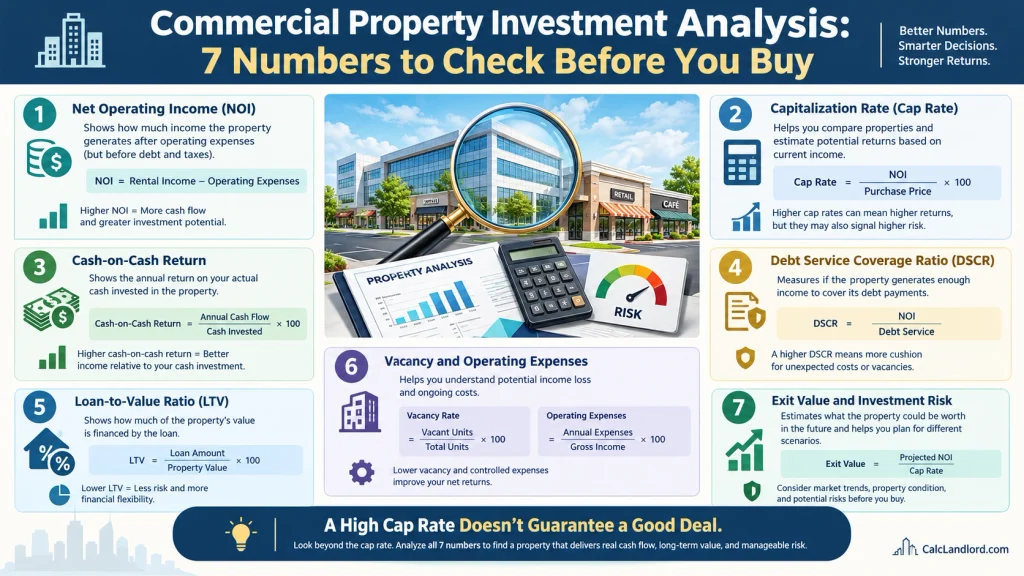
Capitalization Rate (Cap Rate)
The capitalization rate relates annual NOI to the property’s purchase price or market value.
Cap Rate = Annual NOI ÷ Property Price × 100
If annual NOI is $240,000 and the purchase price is $3,000,000:
\[ \text{Cap Rate}= \frac{\$240,000}{\$3,000,000}\times100 =8\% \]
The acquisition cap rate is 8%.
An investor can use this measure to compare income yields across properties, provided the NOI definitions, measurement periods, and assumptions are comparable.
Cap rate does not account for the buyer’s financing or capture all future capital requirements. A high cap rate may reflect weak tenants, deferred maintenance, difficult leasing conditions, or other risks rather than an unusually attractive opportunity.
Read Cap Rate Explained for a broader explanation of this valuation measure.
Cash-on-Cash Return
Cash-on-cash return measures annual pretax equity cash flow relative to the cash equity invested.
Cash-on-Cash Return = Annual Pretax Equity Cash Flow ÷ Initial Cash Equity Invested × 100
Suppose the investor contributes $1,350,000 and receives $67,336 in first-year pretax equity cash flow.
\[ \frac{\$67,336}{\$1,350,000}\times100 \approx4.99\% \]
The cash-on-cash return is approximately 4.99%.
The denominator should reflect the actual initial equity commitment, including relevant acquisition costs and funded reserves. The numerator should account for the debt payments and capital or leasing expenditures specified in the model.
This figure is particularly useful for investors who care about the cash generated from their invested capital during the holding period.
Learn more in Cash-on-Cash Return.
Debt-Service Coverage Ratio (DSCR)
DSCR measures how much NOI is available to cover annual debt service.
DSCR = NOI ÷ Annual Debt Service
If NOI is $240,000 and annual debt service is $152,664:
\[ \text{DSCR}= \frac{\$240,000}{\$152,664} \approx1.57 \]
The property generates approximately $1.57 in NOI for every $1 of scheduled annual debt service.
A ratio above 1.00 means the stated income measure exceeds the scheduled debt service. A ratio below 1.00 means it does not.
However, there is no single DSCR threshold suitable for every property and loan. Lender requirements depend on property type, lease stability, underwriting definitions, financing terms, and other risk factors.
A DSCR of 1.57 also does not mean the owner can distribute all the remaining income: capital spending and other cash requirements may reduce the actual distribution.
Debt Yield
Debt yield compares NOI with the amount borrowed.
Debt Yield = NOI ÷ Loan Amount × 100
For NOI of $240,000 and a loan of $1,800,000:
\[ \frac{\$240,000}{\$1,800,000}\times100 =13.33\% \]
Debt yield provides an additional view of property income relative to the loan amount. Unlike DSCR, it does not directly depend on the interest rate or amortization schedule.
Loan-to-Value Ratio (LTV)
LTV measures the loan balance relative to the property’s value.
LTV = Loan Amount ÷ Property Value × 100
With a $1,800,000 loan secured by a property valued at $3,000,000, the LTV is 60%.
Lenders may use an appraised value, purchase price, or another value determined under their underwriting policies. A lower LTV generally means the borrower contributes more equity relative to the property value, but it does not guarantee a profitable investment.
Internal Rate of Return (IRR)
IRR estimates the annualized rate at which the present value of an investment’s modeled cash inflows equals the present value of its cash outflows.
Unlike a first-year cash-on-cash calculation, IRR incorporates the timing of projected cash flows and the eventual sale proceeds.
It is especially useful for investments with substantial changes in cash flow over time, including renovation projects, lease-up strategies, and properties planned for resale.
IRR depends on the accuracy of every modeled cash flow. An optimistic sale price or an unrealistic lease-up schedule can make a weak investment appear attractive.
Equity Multiple
Equity multiple compares total equity distributions with total equity contributions.
Equity Multiple = Total Equity Distributions ÷ Total Equity Contributions
If an investor contributes $1 million over the life of a project and receives $1.6 million in total distributions, the equity multiple is 1.60×.
Unlike IRR, equity multiple does not account for the timing of the cash flows. Two investments can return the same multiple while delivering substantially different annualized returns.
Use these metrics together. Cap rate evaluates property-level income relative to price, DSCR and debt yield help assess financing risk, cash-on-cash return measures current equity cash flow, and IRR and equity multiple help evaluate the overall investment.
8. Commercial Property Investment Analysis: Worked Example
Consider a hypothetical investor evaluating a multi-tenant commercial property in the United States.
The seller is asking $3 million. The property appears capable of generating $240,000 in first-year NOI, but the investor needs to determine whether the income supports the price and proposed financing.
Acquisition and financing assumptions
| Item | Assumption |
| Purchase price | $3,000,000 |
| Loan amount | $1,800,000 |
| Down payment | $1,200,000 |
| Acquisition and financing costs | $90,000 |
| Initial funded reserve | $60,000 |
| Total initial investor equity | $1,350,000 |
| Illustrative annual fixed interest rate | 7.00% |
| Amortization period | 25 years |
| Planned holding period | 5 years |
Assume the loan uses monthly principal-and-interest payments. Annual debt service is approximately $152,664 under these illustrative terms.
The funded reserve is included in initial investor equity. To keep the example consistent, assume it remains unused and is returned at the sale.
First-year operating assumptions
| Item | Annual amount |
| Potential base rent | $400,000 |
| Vacancy and collection losses | −$40,000 |
| Other income | $20,000 |
| Effective gross income | $380,000 |
| Operating expenses | −$140,000 |
| Net operating income | $240,000 |
| Annual debt service | −$152,664 |
| Capital spending | −$20,000 |
| Pretax equity cash flow | $67,336 |
The arithmetic is straightforward:
\[ \$380,000-\$140,000=\$240,000 \]
\[ \$240,000-\$152,664-\$20,000=\$67,336 \]
The property produces $240,000 in NOI, but the investor has $67,336 in modeled first-year equity cash flow after debt service and capital spending.
Investment metric results
| Metric | Calculation | Result |
| Acquisition cap rate | $240,000 ÷ $3,000,000 | 8.00% |
| Cash-on-cash return | $67,336 ÷ $1,350,000 | 4.99% |
| DSCR | $240,000 ÷ $152,664 | 1.57× |
| Debt yield | $240,000 ÷ $1,800,000 | 13.33% |
| LTV | $1,800,000 ÷ $3,000,000 | 60.00% |
The difference between the 8% acquisition cap rate and the 4.99% cash-on-cash return is important.
The cap rate measures property operating income relative to price. The cash-on-cash calculation reflects the investor’s actual equity commitment, debt payments, and capital spending.
Neither result alone establishes whether the asking price is acceptable. The decision also depends on tenant stability, upcoming lease expirations, future capital needs, the cost of financing, and the expected resale value.
9. Estimate Exit Value and Total Investment Returns
Commercial real estate analysis should evaluate the expected holding period rather than stopping at the first year’s results.
For the example, assume the following:
- NOI grows by 3% annually.
- Capital spending remains $20,000 per year.
- Debt service remains approximately $152,664 per year.
- Annual positive equity cash flow is distributed at each year-end.
- The initial $60,000 reserve remains unused and is returned at sale.
- Selling costs equal 3% of the sale price.
- The property is sold at the end of Year 5.
- No additional capital contributions, partnership fees, or investor income taxes are included.
These are modeling assumptions, not predictions. A real forecast should derive annual income and expenses from the leases, market evidence, and anticipated capital requirements.
Calculate the resale price
Commercial properties are often valued using a capitalization rate applied to a relevant measure of NOI.
For this illustration, use projected Year 6 NOI to estimate the sale price at the end of Year 5.
With 3% annual NOI growth, projected Year 6 NOI is approximately $278,226.
Assume an 8% exit cap rate.
Estimated Sale Price = Projected Year 6 NOI ÷ Exit Cap Rate
\[ \text{Estimated Sale Price}= \frac{\$278,226}{0.08} \approx \$3,477,822 \]
The projected sale price is approximately $3.48 million.
This estimate is sensitive to the exit cap rate. A higher exit cap rate means buyers are paying a lower price for each dollar of NOI, assuming the income measure remains unchanged.
Calculate the investor’s sale proceeds
The investor does not receive the full sale price as equity proceeds.
The model must deduct selling costs and the outstanding loan balance, then account for the return of any unused funded reserve.
| Exit calculation | Approximate amount |
| Sale price | $3,477,822 |
| Selling costs at 3% | −$104,335 |
| Remaining loan balance | −$1,640,919 |
| Return of unused reserve | +$60,000 |
| Net equity proceeds at sale | $1,792,568 |
The loan balance is estimated after 60 scheduled monthly payments.
The investor’s cumulative holding-period returns also include any annual cash distributions received before the sale.
Compare the exit scenarios
The following table illustrates how the exit cap rate can affect the modeled outcome while holding the other assumptions constant.
| Exit cap rate | Estimated sale price | Approximate equity IRR | Approximate equity multiple |
| 7.50% | $3,709,677 | 13.50% | 1.80× |
| 8.00% | $3,477,822 | 11.21% | 1.63× |
| 9.00% | $3,091,398 | 6.89% | 1.35× |
The results are illustrative and rounded. They depend on the stated annual cash flows, loan amortization, sale costs, returned reserve, and exit assumptions.
The key lesson is that a property may perform close to its operating forecast while the investor’s total return changes substantially because the resale market values its income differently.
This is one reason to model multiple exit scenarios rather than selecting the cap rate that produces the most attractive IRR.
10. Stress-Test the Deal Before You Buy
A base-case forecast explains how a property might perform if the assumptions hold. Stress testing evaluates what happens when they do not.
At a minimum, test these scenarios:
- Rent collections decline.
- A major tenant leaves.
- Vacancy lasts longer than expected.
- Renewal rents are lower than projected.
- Operating expenses increase.
- Insurance or property taxes rise.
- Unexpected capital work becomes necessary.
- Interest rates or refinancing terms become less favorable.
- The exit cap rate increases.
- Several adverse events occur together.
The U.S. banking regulators’ guidance on commercial real estate lending risk management identifies sensitivity analysis, stress testing, collateral valuation, cash flow, and debt-service coverage among the considerations for prudent CRE lending risk management.
Investors can apply the same general discipline to their own underwriting rather than relying on a single forecast.
Example: What if rental collections fall?
Return to the worked example.
Suppose collected base rent falls to 80% of the potential $400,000, other income remains $20,000, and operating expenses rise 10%.
| Metric | Base case | Downside case |
| Collected base rent | $360,000 | $320,000 |
| Other income | $20,000 | $20,000 |
| Effective gross income | $380,000 | $340,000 |
| Operating expenses | $140,000 | $154,000 |
| NOI | $240,000 | $186,000 |
| Debt service | $152,664 | $152,664 |
| DSCR | 1.57× | 1.22× |
| Capital spending | $20,000 | $20,000 |
| Pretax equity cash flow | $67,336 | $13,336 |
The property still produces positive modeled cash flow under these assumptions, but the cushion becomes much smaller.
An additional $40,000 leasing expense in that year would turn the modeled equity cash flow negative.
This is why an apparently acceptable DSCR is not enough. The investor also needs sufficient liquidity to handle the actual timing and amount of expenses.
Estimate an adjusted cash break-even collection level
A simplified way to estimate the base-rent collection level needed to cover operating expenses, debt service, and a planned capital budget is:
Break-Even Collection Ratio = (Operating Expenses + Debt Service + Capital Budget − Other Income) ÷ Potential Base Rent × 100
Using the base-case assumptions:
\[ \frac{ \$140,000+\$152,664+\$20,000-\$20,000 }{ \$400,000 }\times100 \approx73.17\% \]
The result is approximately 73.17%.
This is a simplified, model-specific collection threshold—not a universal commercial occupancy formula. It assumes other income is collected, expenses remain fixed, and the capital budget is fully funded. If expenses vary with occupancy or tenant reimbursements change, the threshold will change as well.
A useful stress test also examines monthly cash requirements. Annual positive cash flow can hide months when a large repair or tenant improvement must be funded before rent arrives.
11. Calculate the Maximum Purchase Price
The asking price is not necessarily the right price for your investment objectives.
A property might be fairly priced relative to comparable transactions but still fail to meet your cash-flow, financing, or return requirements.
There are several ways to establish a defensible purchase price.
Method 1: Use an income-based screening price
Suppose the property’s verified NOI is $240,000 and the investor chooses an 8.5% acquisition cap rate as a screening requirement.
Screening Price = NOI ÷ Required Cap Rate
\[ \text{Screening Price}= \frac{\$240,000}{0.085} \approx \$2,823,529 \]
This produces an income-based screening price of approximately $2.82 million.
It is not proof of market value or the final maximum offer. The required cap rate is an investor-selected assumption that should reflect the property’s risk, market evidence, and available alternatives.
A proper valuation also considers comparable transactions, lease terms, capital requirements, and the quality of projected income.
Method 2: Apply a financing constraint
Suppose the investor wants a minimum DSCR of 1.40× based on the stated NOI.
Maximum Annual Debt Service = NOI ÷ Required DSCR
\[ \frac{\$240,000}{1.40} \approx \$171,429 \]
The property can support no more than approximately $171,429 in annual debt service under that specific coverage requirement.
The corresponding loan amount depends on the lender’s interest rate, amortization, fees, loan structure, and other underwriting requirements. A maximum purchase price cannot be derived from DSCR alone without those additional assumptions.
Method 3: Solve for your required equity return
For a more complete maximum-offer analysis:
- Forecast rental income, vacancies, concessions, and operating expenses.
- Model planned capital spending and tenant-related costs.
- Calculate financing payments and initial equity requirements at different purchase prices.
- Project holding-period cash distributions and sale proceeds.
- Calculate cash-on-cash return and IRR.
- Adjust the purchase price until the investment meets the investor’s required return and liquidity criteria.
- Repeat the analysis under reasonable downside scenarios.
This approach links the purchase price to the investor’s actual business plan instead of relying on a single cap-rate calculation.
Buy, renegotiate, or pass?
| Decision | Appropriate reasoning |
| Buy | The critical assumptions are verified, the business plan is achievable, financing is workable, and downside exposure is acceptable. |
| Renegotiate | Identified risks can be addressed through a lower price, revised terms, seller credits, or documented remedies. |
| Pass | Material financial information is unreliable, necessary capital is unavailable, or acceptable returns depend on unsupported assumptions. |
A disciplined investor should be able to explain not only the proposed offer but also the specific assumptions that would justify withdrawing it.
12. Complete Commercial Property Due Diligence
Financial analysis is only as reliable as the information behind it. Due diligence checks whether the assumptions used in the model correspond to the real property.
Use the following checklist before closing.
Financial and lease review
- Reconcile the rent roll with signed leases and amendments.
- Verify historical revenue against collection records.
- Review operating statements and supporting invoices.
- Investigate arrears, concessions, disputes, and unusual adjustments.
- Confirm expense reimbursements and landlord obligations.
- Identify lease expirations, renewal options, and tenant concentration.
- Review expected leasing commissions, tenant improvements, and vacancy periods.
Physical property review
- Inspect the roof, structure, HVAC, plumbing, and electrical systems.
- Review deferred maintenance and the condition of major equipment.
- Obtain specialist inspections where warranted.
- Evaluate parking, drainage, access, and other site conditions.
- Estimate the timing and cost of major capital projects.
Legal, environmental, and regulatory review
- Review title documents and applicable surveys.
- Verify permitted use, zoning, and relevant building permits.
- Investigate environmental concerns and obtain appropriate assessments.
- Check relevant accessibility, safety, and code requirements.
- Review easements, restrictions, litigation, and material contractual obligations.
Requirements vary by property, jurisdiction, and transaction. Qualified legal, environmental, engineering, tax, and real estate professionals should address matters within their respective fields.
Financing and closing review
- Obtain written financing terms.
- Confirm interest rate, amortization, maturity, fees, and covenants.
- Review guarantees and recourse obligations.
- Evaluate refinancing and maturity risk.
- Confirm insurance requirements and available coverage.
- Reconcile closing costs, reserves, and required equity contributions.
Turn due diligence findings into revised numbers
Suppose an inspection identifies a roof replacement estimated at $180,000 within two years.
Do not leave the inspection report separate from the investment model.
Revise the expected capital budget, funding requirements, investor cash flows, and acceptable purchase price. Determine whether the repair affects tenant retention, insurance, or the projected sale.
Likewise, if a major tenant’s lease contains a termination right that was not reflected in the initial forecast, model the potential vacancy and leasing costs.
The purpose of due diligence is not merely to collect reports. It is to determine whether new information changes the investment decision.
13. Common Commercial Property Analysis Mistakes
Several recurring mistakes can make a commercial real estate investment appear more profitable or less risky than it actually is.
1. Treating projected rent as existing income. Market rent estimates are not equivalent to signed leases and collected payments.
2. Comparing inconsistent cap rates. One property’s NOI may include reimbursements or exclude expenses that another property’s NOI does not.
3. Confusing NOI with equity cash flow. Financing, capital expenditure, and other ownership cash requirements can significantly reduce available cash.
4. Using the down payment as total invested capital. Acquisition costs, lender fees, initial improvements, and funded reserves may increase the equity commitment.
5. Ignoring lease rollover risk. A property’s current occupancy does not guarantee that tenants will renew or that replacement tenants will be secured quickly.
6. Underestimating tenant improvements and leasing costs. Even rent-producing space can require substantial expenditure when leases change.
7. Relying on a triple-net label. The actual contract determines expense allocation and landlord obligations.
8. Assuming the property will sell at the same cap rate. Future market pricing can reduce resale proceeds even when NOI grows.
9. Ignoring refinancing and loan maturity. A loan that works today may be difficult to refinance if rates rise, income falls, or the property value declines.
10. Using one optimistic scenario. A single forecast conceals how sensitive the investment is to rent, expenses, financing, and exit assumptions.
11. Double-counting reserves or expenses. Inconsistent treatment can distort NOI, DSCR, or cash-on-cash return.
12. Assuming a lender’s approval validates the investment. Lending requirements and an investor’s required return serve different purposes.
A sound investment decision requires consistent financial definitions, realistic assumptions, and a clear understanding of what could go wrong.
- More Explore: https://calclandlord.com/personal-guarantee/
14. People Also Ask
Commercial property investment analysis evaluates a property’s rental income, expenses, leases, financing, capital requirements, market conditions, and expected resale value to determine whether the investment meets the buyer’s objectives.
It combines financial calculations with property-specific due diligence and risk assessment.
Start by verifying the rent roll, signed leases, historical financial statements, and operating expenses. Analyze the local market and tenant rollover schedule, then build a pro forma.
Calculate NOI, cap rate, cash-on-cash return, DSCR, debt yield, and projected holding-period returns. Finally, stress-test the assumptions, calculate an acceptable purchase price, and complete professional due diligence.
There is no universally good cap rate.
An appropriate cap rate depends on the property type, location, lease quality, tenant creditworthiness, building condition, market conditions, and expected capital requirements.
A higher cap rate may indicate stronger income relative to price, but it may also reflect greater vacancy, leasing, or property-specific risk. Compare properties using consistent NOI definitions and relevant market evidence.
No.
Cap rate divides annual NOI by the property price or value. Cash-on-cash return divides annual pretax equity cash flow by the investor’s cash equity contribution.
Financing, acquisition costs, reserves, and capital spending can cause the two results to differ substantially.
NOI measures property operating income after operating expenses but before financing and major capital improvements under the convention used here.
Equity cash flow also reflects debt payments and applicable capital or leasing costs. It can therefore be materially lower than NOI.
What should a commercial property investment spreadsheet include?
A useful spreadsheet includes:
- Purchase price, acquisition costs, loan amount, and equity requirements.
- Potential rent, vacancy, concessions, reimbursements, and other income.
- Operating expenses and NOI.
- Lease expirations and tenant improvement costs.
- Debt service, reserves, and capital expenditures.
- Annual investor cash flows and exit-value assumptions.
- Selling costs and remaining loan balance.
- Cap rate, cash-on-cash return, DSCR, debt yield, IRR, and equity multiple.
- Sensitivity analysis for income, expenses, financing, and the exit cap rate.
Each assumption should be labeled, documented, and easy to change.
Is commercial property investment analysis different from residential rental analysis?
The core principles are similar: estimate income, subtract expenses, evaluate financing, and measure investment risk.
Commercial properties often require more detailed lease underwriting, tenant credit analysis, expense-reimbursement review, lease-expiration modeling, and tenant improvement budgeting. The importance of each factor depends on the property type and business plan.
What risks should investors investigate before buying commercial real estate?
Important risks include tenant concentration, lease rollover, weak local demand, unexpected capital expenditure, environmental concerns, title or zoning issues, rising operating expenses, financing constraints, and changes in resale pricing.
The relevant risks should be identified during due diligence and quantified in the financial model wherever practical.
15. Conclusion
Commercial property investment analysis is not about finding the most impressive projected return. It is about determining whether the property’s verified income, financing, capital requirements, and risks justify the proposed purchase price.
Begin with reliable documents and realistic rental assumptions. Build a transparent pro forma, calculate the main investment metrics, evaluate lease expirations, and model the expected exit. Then test what happens if income falls, expenses rise, a major repair becomes necessary, or the resale market weakens.
For Calclandlord readers, the next step is to connect these calculations with the broader principles of rental property investing and property investment returns.
Most importantly, establish your acceptable purchase price before negotiating, preserve enough liquidity to handle adverse conditions, and allow new due diligence findings to change your assumptions.
A commercial property becomes a defensible investment only when the numbers, documents, business plan, and downside risks support the same decision.

Pingback: How Long Will My Money Last? Try This Calculator