

Property Investment & Returns: How to Actually Calculate What You’re Making
If you own a rental property — or you’re about to buy one — “how’s it performing?” is the only question that matters. Not the Zestimate. Not what your agent told you at closing. The actual number.
Most articles on this topic throw around terms like ROI and cap rate without ever showing you how they connect to each other, or which one you should actually be using to judge a deal. This guide fixes that. We’ll walk through every return metric that matters for a rental property, show you the formulas with real numbers, and point you to the calculators on this site so you can run your own property through them in a couple of minutes.
Quick Answer
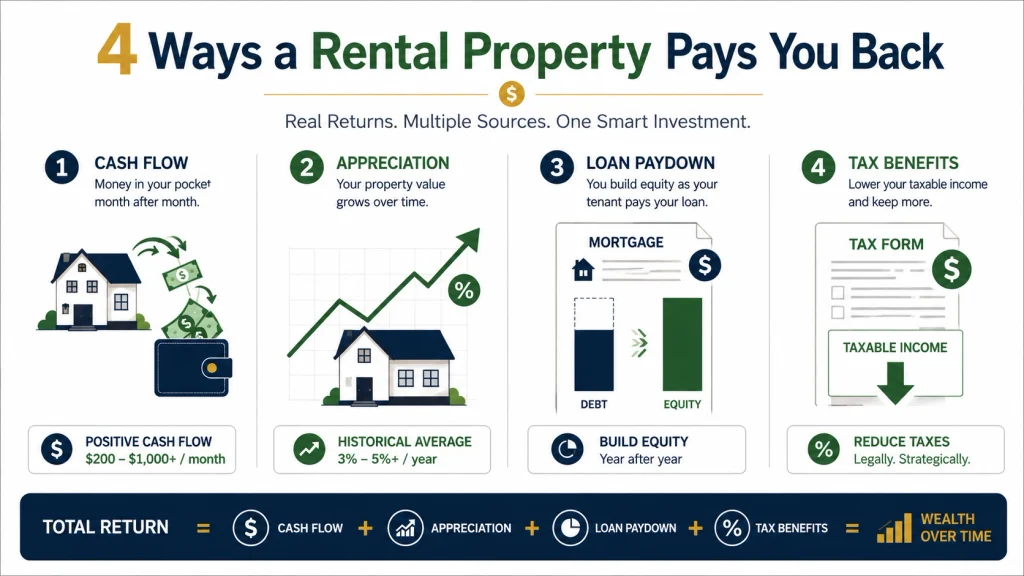
Property investment returns come from four main sources: rental cash flow, Property appreciation, loan paydown (equity you build through your mortgage payments), and tax benefits. To evaluate a property properly, you need at least two numbers: cap rate (how the property performs on its own) and cash-on-cash return (how it performs against the actual cash you put in). A cash-on-cash return of 8–12% is a commonly used benchmark for a solid buy-and-hold rental, though the right target depends on your market and strategy.
1. What “Return” Means for a Rental Property
A return is simply what you got back compared to what you put in, shown as a percentage. That’s it. But rental property returns are trickier to pin down than a stock’s return because a rental pays you in more than one way at the same time — some of it as cash in your bank account, some of it as equity you don’t see until you sell or refinance.
That’s why two landlords can look at the same property and disagree about whether it’s a good deal. One is looking only at the monthly cash flow. The other is counting appreciation and loan paydown too. Neither is wrong — they’re just measuring different things. The fix is to know which metric you’re using and why.
2. The 4 Ways a Rental Property Actually Pays You
| Return Source | What It Means | When You See It |
| Cash flow | Rent left over after mortgage, taxes, insurance, and expenses | Every month, in your account |
| Appreciation | Increase in the property’s market value | On sale or refinance |
| Loan paydown | The principal portion of your mortgage payment, building equity | On sale or refinance |
| Tax benefits | Depreciation and deductions that reduce taxable income | At tax time |
A lot of beginner content only talks about cash flow. That’s a mistake — a property with thin monthly cash flow can still be a strong performer once appreciation and loan paydown are counted, and a property with fat monthly cash flow in a declining market can quietly be a weak one.
3. Cap Rate: The First Number to Check
Cap rate is the quickest way to size up a property, because it ignores financing entirely and just tells you how the property itself performs.
Formula: Cap Rate = Net Operating Income (NOI) ÷ Property Value
NOI = Annual rental income − operating expenses (property tax, insurance, maintenance, management, vacancy allowance) — not including your mortgage payment.
Example: A duplex rents for $2,800/month ($33,600/year). Operating expenses run $9,600/year. NOI = $24,000. The property is priced at $340,000.
Cap Rate = $24,000 ÷ $340,000 = 7.06%
Use cap rate to compare properties in the same market against each other. Don’t use it to compare across very different markets or property types — a 7% cap rate in a stable suburb and a 7% cap rate in a distressed area carry very different risk.
Run this instantly with the [Cap Rate Calculator] instead of doing it by hand.
4. Cash-on-Cash Return: What You’re Really Earning
Cap rate tells you about the property. Cash-on-cash return tells you about your money — which is the number that actually matters once financing is involved.
Formula: Cash-on-Cash Return = Annual Pre-Tax Cash Flow ÷ Total Cash Invested
Total cash invested = down payment + closing costs + any upfront repair costs.
Example (same duplex): You put 25% down ($85,000) plus $6,000 in closing costs = $91,000 invested. After your mortgage payment, you’re netting $9,100/year in cash flow.
Cash-on-Cash Return = $9,100 ÷ $91,000 = 10%
This is the number most active landlords lead with, because it reflects the real return on the actual dollars they had to come up with.
The [Cash-on-Cash Return Calculator] does this automatically once you plug in your loan terms.
5. Total ROI on a Rental Property
If you want the full picture — cash flow, appreciation, and loan paydown together — you need total return, not just one metric in isolation.
Formula: Total ROI = (Annual Cash Flow + Annual Appreciation + Annual Loan Paydown) ÷ Total Cash Invested
Continuing the example: Say the property appreciates 3% this year ($10,200) and $4,200 of your mortgage payments went to principal.
Total ROI = ($9,100 + $10,200 + $4,200) ÷ $91,000 = 25.8%
This is why cash-on-cash return alone can undersell a good property — appreciation and paydown are real returns, they just don’t show up in your checking account until later.
6. Appreciation: The Return You Don’t Control
Appreciation is the increase in a property’s market value over time, driven by local supply and demand, not by anything you do to the property (renovations aside). It’s real, but it’s also the least predictable piece of your return — treat it as a bonus you estimate conservatively, not a number you bank on.
A safer way to model appreciation in your projections: use a long-run average for your specific metro (available through local MLS data or county assessor trends) rather than a national average, and run your numbers again at half that rate to see if the deal still works.
7. How Leverage Changes Your Numbers
Financing is why real estate can outperform an all-cash purchase on a percentage basis — and also why it adds risk.
All-cash purchase: $340,000 property appreciates 3% → $10,200 gain on $340,000 invested = 3% return.
Financed purchase (25% down): Same $10,200 appreciation gain, but measured against your $91,000 invested = 11.2% return on that appreciation alone.
Leverage multiplies your percentage return on appreciation and cash flow — but it multiplies your downside the same way if rents fall or the property sits vacant. Your loan-to-value ratio and interest rate aren’t just financing details; they’re a direct input into your total return.
8. Real Example: Analyzing a $300,000 Rental
| Line Item | Amount |
| Purchase price | $300,000 |
| Down payment (20%) | $60,000 |
| Closing costs | $5,000 |
| Total cash invested | $65,000 |
| Monthly rent | $2,300 |
| Annual gross rent | $27,600 |
| Operating expenses (taxes, insurance, maintenance, management, vacancy) | $8,800/year |
| NOI | $18,800 |
| Annual mortgage payment (P&I) | $14,200 |
| Annual cash flow | $4,600 |
| Cap rate | $18,800 ÷ $300,000 = 6.27% |
| Cash-on-cash return | $4,600 ÷ $65,000 = 7.1% |
At a 7.1% cash-on-cash return, this deal sits just below the typical 8–12% benchmark on cash flow alone — but before rejecting it, factor in expected appreciation and loan paydown to see the total return, which is often where a borderline cash-flow deal turns into a strong long-term hold.
9. What’s a Good Return? Benchmarks by Property Type
| Property Type | Typical Cap Rate Range | Typical Cash-on-Cash Target |
| Single-family rental | 4% – 7% | 8% – 10% |
| Small multifamily (2–4 units) | 5% – 8% | 8% – 12% |
| Larger multifamily (5+ units) | 5% – 9% | 7% – 10% |
| Short-term rental | Varies widely by market and regulation | Often 10%+ targeted due to higher management involvement |
These are reference ranges landlords commonly use to screen deals quickly, not hard rules — your market, financing rate, and risk tolerance all shift what’s “good” for your situation.
10. The BRRRR Strategy and Return Compounding
BRRRR (Buy, Rehab, Rent, Refinance, Repeat) is a strategy built specifically to boost returns by recovering your initial cash faster. The idea: buy a property below market value, put money into renovations to raise its value and rent, then refinance based on the new (higher) appraised value to pull most or all of your original cash back out — while keeping the property and its cash flow.
Done well, this can push your cash-on-cash return toward infinite (since your cash invested approaches zero after the refinance), which is why it’s popular with investors trying to scale a portfolio without needing new capital for every deal. It also carries more risk: your numbers depend on the rehab staying on budget and the refinance appraisal coming in where you expect.
11. Common Mistakes That Inflate Your Numbers
- Using gross rent instead of NOI — skipping vacancy and maintenance costs makes any property look better than it is.
- Forgetting cap-ex reserves — a roof, water heater, or HVAC replacement a few years out should be budgeted for now, not treated as a surprise later.
- Assuming 100% occupancy — always stress-test at a realistic vacancy rate for your market.
- Comparing cap rate across unrelated markets — a 7% cap rate means something different in a stable suburb than in a high-turnover area.
- Ignoring how a rate change affects cash-on-cash return — the same property can look very different at a 1-point-higher mortgage rate.
12. Tools to Run Your Own Numbers
Rather than doing this math by hand every time you look at a listing, run it through:
- [Cap Rate Calculator] — instantly compare properties on an unleveraged basis
- [Cash-on-Cash Return Calculator] — plug in your loan terms for your real, financed return
- [Rental Property ROI Calculator] — combine cash flow, appreciation, and paydown into one total return figure
- [Rental Cash Flow Calculator] — check whether a deal cash-flows before you even get to return metrics
Related reading on this site: Rental Property Cash Flow, Rental Property Depreciation, 1031 Exchange, Rental Property Expenses, Property Valuation, and Market Comparison.
13. FAQ
What is a good ROI for a rental property? Many investors target a cash-on-cash return of 8–12% and a total return (including appreciation and loan paydown) in the low-to-mid teens, though acceptable targets vary by market and strategy.
What’s the difference between cap rate and cash-on-cash return? Cap rate measures how the property performs on its own, ignoring your financing. Cash-on-cash return measures your actual return on the cash you invested, factoring in your mortgage.
Does appreciation count toward my rental property’s return? Yes. Appreciation is a real return, even though it’s unrealized until you sell or refinance — it should be included when you’re calculating total ROI, just not treated as guaranteed.
How do I calculate NOI? NOI = annual rental income minus operating expenses (property taxes, insurance, maintenance, property management, and a vacancy allowance) — before your mortgage payment.
Is a 6% cap rate good? It depends on the market and property type. In many stable single-family rental markets, 6% sits within a typical range; in higher-cash-flow markets or property types, investors may target higher.
Tax treatment of depreciation and rules around 1031 exchanges are set by the IRS and can vary based on your individual situation — check current IRS guidance or consult a tax professional for your specific case.
14. People Also Ask
This depends on your goals — cash-flow-focused investors often screen for a minimum monthly cash flow per unit alongside a cash-on-cash return target, while appreciation-focused investors may accept thinner cash flow in exchange for stronger long-term value growth.
It’s a quick screening rule some investors use, where monthly rent should be roughly 1% of the purchase price as a first-pass filter — not a substitute for running full NOI and cash-on-cash numbers.
Rental property returns include cash flow, appreciation, loan paydown, and tax benefits, and are affected directly by leverage — stock returns are typically just price appreciation and dividends, without the paydown or leverage components.
Key Takeaways
- Cap rate and cash-On-Cash return answer different questions — check both before judging a deal.
- Total return includes cash flow, appreciation, and loan paydown, not just what hits your bank account monthly.
- Leverage amplifies your percentage return on appreciation and cash flow — and your downside risk equally.
- Run your specific numbers through a calculator rather than relying on rule-of-thumb benchmarks alone.

Pingback: Rental Property Investing: 8 Proven Wealth Secrets
Pingback: Cap Rate Explained: 7 Mistakes Killing Your Returns
Pingback: Property Analysis: The 8-Step Deal-Killer Checklist
Pingback: Rental Property Cash Flow: 7 Mistakes That Silently Kill It