
Rental Property Cash Flow: How to Calculate It and Know If It’s Good Enough
Rental property cash flow is the number that decides whether a rental actually makes you money each month — not on paper, but in your bank account. It’s the single most important figure for evaluating a deal, yet it’s also the number new landlords most often calculate wrong, usually by forgetting expenses that don’t show up until months after closing.
Quick answer: Rental property cash flow is the money left over after rent covers every expense — mortgage, taxes, insurance, maintenance, vacancy, and capital reserves. The formula is:
Monthly Cash Flow = (Gross Rent × (1 − Vacancy Rate)) − Operating Expenses − Mortgage Payment (P&I)
This guide walks through the full formula, a worked example, the metrics that go with it (NOI, cap rate, DSCR, cash-on-cash return), how today’s mortgage and insurance costs are squeezing margins, and a practical framework for deciding whether a specific property is worth buying.
What Is Rental Property Cash Flow?
Cash flow is simply the money a rental property generates after every real cost of owning it — not just the mortgage.
It’s different from profit on paper and different from appreciation. A property can look great on a pro forma and still lose money every month once you account for vacancy, repairs, and management. Cash flow is the “does this actually work” test.
Landlords generally build wealth through four channels: monthly cash flow, mortgage paydown (equity), appreciation, and tax benefits like depreciation. Cash flow is the only one of the four you can measure and rely on the day you buy — the other three depend on the market cooperating over time. That’s why most experienced investors treat cash flow as the baseline requirement and treat appreciation as a bonus, not a plan.
Positive cash flow means rent covers everything with money left over. Negative cash flow means you’re subsidizing the property from your own income every month — sometimes intentionally (betting on appreciation in an expensive market), sometimes by accident (missed an expense in the underwriting).
How to Calculate Rental Property Cash Flow (Step-by-Step Formula)
Cash flow calculations go wrong for one reason more than any other: missing expense categories. Here’s the full sequence.
Step 1 — Gross Potential Rent. Verify market rent yourself using at least a few comparable active listings; don’t rely solely on a seller’s pro forma or a listing agent’s estimate, since both have an incentive to project high.
Step 2 — Effective Gross Income (EGI). Subtract a realistic vacancy allowance. EGI = Gross Rent × (1 − Vacancy Rate) A common starting assumption is 5–8% for single-family rentals and 10–15% for smaller multifamily, adjusted for your specific market’s actual turnover and time-to-lease.
Step 3 — Operating Expenses.
This is where most beginner calculations break down. A complete list includes:
| Expense | Typical Range | Notes |
| Property taxes | Varies by jurisdiction | Often reassessed at your purchase price — check the county assessor, don’t use the seller’s current bill |
| Insurance | Rising sharply nationwide | Get an actual quote before you offer, not an estimate |
| Property management | 8–10% of collected rent | Include this even if you plan to self-manage |
| Repairs & maintenance | ~1–2% of property value/year | Higher for older properties |
| Capital expenditure (CapEx) reserve | ~0.5–1% of property value/year | Separate from routine maintenance — this funds roofs, HVAC, water heaters |
| HOA / landscaping / other fixed costs | Varies | Easy to overlook when reading a listing quickly |
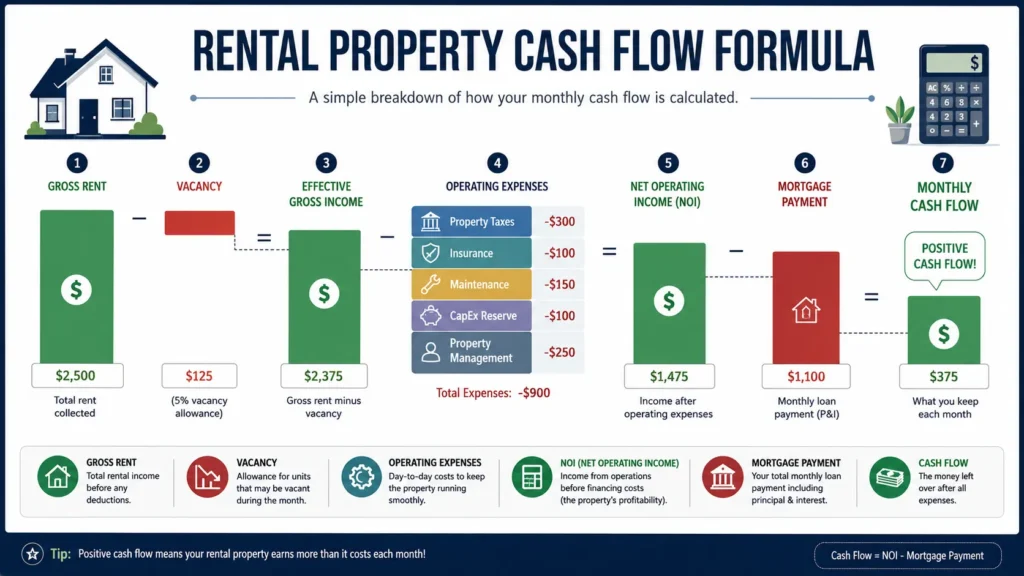
Step 4 — Net Operating Income (NOI). NOI = EGI − Operating Expenses NOI deliberately excludes mortgage payments — it measures how the property performs independent of how you financed it, which is why it’s the basis for cap rate.
Step 5 — Debt Service. Your mortgage principal and interest payment (not taxes/insurance if escrowed separately in your accounting).
Step 6 — Cash Flow. Annual Cash Flow = NOI − Annual Debt Service Monthly Cash Flow = Annual Cash Flow ÷ 12
A CalcLandlord Rental Property Cash Flow Calculator can run this full sequence automatically and let you adjust each assumption to see the effect on the bottom line.
Real-World Cash Flow Example
Here’s a hypothetical single-family rental, worked through the full formula. All figures are illustrative, not a real listing.
Assumptions: $185,000 purchase price, $1,550/month rent, 20% down ($37,000), 7% fixed 30-year mortgage.
| Line Item | Monthly | Annual |
| Gross Rent | $1,550 | $18,600 |
| Vacancy (7%) | −$109 | −$1,302 |
| Effective Gross Income | $1,441 | $17,298 |
| Property taxes | −$154 | −$1,850 |
| Insurance | −$115 | −$1,380 |
| Maintenance | −$124 | −$1,488 |
| CapEx reserve | −$78 | −$930 |
| Property management | −$140 | −$1,674 |
| Net Operating Income (NOI) | $831 | $9,976 |
| Mortgage P&I | −$985 | −$11,817 |
| Monthly Cash Flow | −$154 | −$1,841 |
The trap here: an investor who did the shortcut math ($1,550 rent − $985 mortgage = $565 “profit”) would have missed that the property is actually losing about $150/month. The gap between the naive calculation and the real one is almost entirely operating expenses that get skipped — CapEx reserves and a realistic management line, most often.
What would fix this deal: a lower purchase price, self-managing instead of paying a manager (while still budgeting the cost as a reserve), or a larger down payment to shrink the mortgage payment. Any one change alone might not be enough; combining two or three often is.
Operating Expenses That Affect Cash Flow
Operating expenses typically run 35–50% of gross rent, not counting the mortgage — and that share has been trending toward the higher end in many markets as insurance and taxes rise faster than rents.
The two categories landlords most often underbudget:
- CapEx reserves. Maintenance covers small, recurring items (a leaky faucet, a broken screen). CapEx covers the big, infrequent items — roof, HVAC, water heater, major appliances — that don’t happen every year but are certain to happen eventually. Treating CapEx as “I’ll deal with it when it happens” instead of a monthly reserve is one of the most common ways a profitable-looking deal turns into a cash crisis.
- Property management, even if self-managing. Your time has a real opportunity cost, and budgeting the fee (typically 8–10% of collected rent) ensures the deal still works if you ever hire a manager, get sick, move away, or simply want your evenings back.
Two cost categories deserve special attention for 2026 underwriting. U.S. homeowners insurance premiums rose roughly 64% nationally between 2021 and 2025 according to a 2026 analysis of servicing data by mortgage lender Newrez, with far larger jumps in some states — Arizona saw premiums roughly double over that period, and Louisiana, Florida, and Texas carry the highest average premiums in the country. Insurance costs also vary enormously by state and by property age/construction, so a quote — not a nationwide average — should drive your underwriting. Property taxes are the second frequent surprise: many jurisdictions reassess at your purchase price, so a seller’s current tax bill (based on their older assessed value) can meaningfully understate what you’ll actually owe.
Vacancy and Its Impact on Cash Flow
Vacancy has a direct, linear effect on cash flow: every percentage point of vacancy removes that same percentage of gross rent from your income, but your fixed costs (mortgage, taxes, insurance) don’t shrink at all.
That’s why vacancy is worth stress-testing rather than assuming away. A property that looks solidly positive at a 5% vacancy assumption can go negative at 10–12% if the local rental market softens or a tenant turnover takes longer than expected to fill. Multifamily properties handle vacancy better than single-family in one specific way: a vacant unit in a 4-plex still leaves 75% of the income flowing, while a vacant single-family rental drops to 0% income until it’s re-leased.
Break-even occupancy is a useful companion metric: it tells you the maximum vacancy rate the property can sustain before cash flow hits zero. Break-even occupancy = (Operating Expenses + Debt Service) ÷ Gross Potential Rent A common rule of thumb: be cautious if your break-even occupancy is within about 5 percentage points of your market’s actual average vacancy rate — that’s a thin margin for error.
Cash Flow vs. NOI vs. Cap Rate vs. Cash-on-Cash Return
These four metrics get confused constantly because they all describe “how good is this deal,” but they answer different questions.
| Metric | Formula | What It Tells You |
| NOI | EGI − Operating Expenses | Property performance before financing |
| Cap Rate | NOI ÷ Purchase Price | Return if you paid all cash — useful for comparing properties independent of your loan terms |
| Cash Flow | NOI − Debt Service | Actual monthly money left over, after your specific mortgage |
| Cash-on-Cash Return | Annual Cash Flow ÷ Total Cash Invested | Return on the actual cash you put in (down payment + closing costs + upfront repairs) |
Cap rate and cash-on-cash return often diverge, and that’s normal: a property with a modest cap rate can still deliver a strong cash-on-cash return if it’s financed favorably, because leverage amplifies the return on your actual invested cash — for better or worse.
DSCR (Debt Service Coverage Ratio) is the metric your lender will care about most on an investment property loan: DSCR = NOI ÷ Annual Debt Service. Most investment-property and DSCR-loan lenders want to see a minimum around 1.20–1.25, meaning the property generates at least $1.20–$1.25 of NOI for every $1.00 of mortgage payment. A DSCR below 1.0 means the property’s own income doesn’t cover its own debt — a red flag regardless of what the rest of the numbers say.
What Is a Good Cash Flow for a Rental Property?
There’s no single number that applies everywhere, but rough benchmarks help:
- Break-even to modest positive ($0–$150/month): thin margin, little room for surprises — proceed cautiously.
- $150–$400/month: a reasonably healthy single-family rental in most markets.
- $400+/month, or $150–250/unit on multifamily: strong performance.
Dollar amounts alone can mislead, though — $200/month sounds identical whether you invested $20,000 or $80,000 to get it, and those represent very different returns. Cash-on-cash return puts the dollar figure in context: many investors look for roughly 6–10% cash-on-cash as a minimum threshold, though acceptable targets vary by market, risk tolerance, and how much of the return you expect from appreciation versus cash flow.
The 1% Rule and 50% Rule: Quick Screening Tools
These are fast filters for deciding whether a property deserves a full analysis — not a substitute for one.
The 1% Rule: Monthly rent should be at or above roughly 1% of the purchase price ($200,000 property → $2,000/month rent). At current mortgage rates, properties well below this threshold rarely cash flow positively, making the rule a useful first-pass screen, especially in higher-priced coastal markets where it’s become harder to hit.
The 50% Rule: Assume operating expenses (excluding the mortgage) will consume roughly 50% of gross rent. Quick estimate: (Rent × 50%) − Mortgage Payment = Rough Monthly Cash Flow. It’s a blunt instrument — real expense ratios range from roughly 35% to 55%+ depending on the property’s age and market — but it’s fast enough to flag deals worth a closer look versus ones to skip immediately.
How Financing and Mortgage Rates Affect Cash Flow
Financing terms move cash flow as much as, or more than, the property itself. As of early September 2026, average 30-year fixed rates for a primary residence were running in the mid-6% range; investment property loans typically price 0.5–1.5 percentage points above that, and dedicated DSCR loans (which qualify on property income rather than personal income) often add another 1–2 points on top of standard investment-property pricing. That means investment-property borrowers were commonly seeing rates somewhere in the 7%–8%+ range depending on credit, down payment, and loan type — rates move regularly, so check current quotes from a few lenders before underwriting a specific deal.
A few financing levers that directly affect cash flow:
- Down payment size. A larger down payment shrinks the mortgage payment and improves both cash flow and DSCR, at the cost of tying up more capital (and lowering cash-on-cash return, since you invested more to get the same dollar profit).
- Loan term. A 30-year amortization produces a lower monthly payment — and generally better cash flow — than a 15-year loan on the same balance, though you’ll pay more total interest over the life of the loan.
- Rate type. Fixed-rate loans keep your biggest expense line predictable; adjustable-rate and balloon loans carry cash-flow risk if rates rise or the loan comes due before you’ve refinanced or sold.
If rates fall meaningfully after you buy, refinancing is one of the most direct ways to improve cash flow on an existing property — even a percentage point or so of rate reduction can meaningfully lower the mortgage payment on a typical rental-sized loan.
Single-Family vs. Multifamily Cash Flow Comparison
At similar price-to-rent ratios, small multifamily properties (duplex through 4-plex) often produce better cash flow metrics than single-family rentals, for a few structural reasons:
- Shared fixed costs. Property taxes, insurance, and other fixed expenses get spread across multiple rent-paying units instead of just one.
- Income diversification. A vacancy in a 4-plex still leaves most of the building’s income intact; a vacant single-family rental drops straight to zero income.
- Easier DSCR qualification, since NOI is spread across more rentable units.
The trade-off runs the other way on management complexity: multifamily properties tend to see more tenant turnover and require more hands-on management (or a higher management fee) than a single-family home, and financing for 5+ unit properties shifts into commercial lending, with different underwriting entirely. For a first rental, many landlords still choose single-family for the simpler financing and management — a legitimate trade-off, not a mistake, if it matches your bandwidth.
Stress-Testing Your Deal: Vacancy & Rate Sensitivity Analysis
A property that cash flows comfortably under your base-case assumptions can go negative quickly under a slightly worse scenario. Before making an offer, run the numbers at more than one vacancy level:
- Base case at a realistic market vacancy rate.
- Stress case at vacancy 3–5 points higher than your base case — does DSCR stay above your lender’s minimum (typically ~1.20)?
- Rate stress case, if using an adjustable or soon-to-refinance loan — what does cash flow look like at 1–2 points higher than today’s rate?
- Break-even occupancy — how much cushion exists between your break-even point and actual market vacancy?
A deal that only works at 0% vacancy and today’s exact interest rate isn’t a deal with a margin of safety — it’s a bet that nothing goes wrong.
Common Cash Flow Mistakes Landlords Make
- Using an unverified rent estimate. Sellers and listing agents have an incentive to project high; verify with your own comparables.
- Ignoring property tax reassessment. The seller’s current tax bill often reflects an old, lower assessed value — check the county assessor for what taxes will actually be after your purchase.
- Skipping CapEx reserves entirely. One major repair can erase years of accumulated cash flow if there’s no reserve built up for it.
- Assuming zero vacancy. Even strong rental markets have turnover between tenants; budgeting 0% vacancy is optimism, not analysis.
- Not budgeting management fees when self-managing. Your labor has value, and the deal should work even if your circumstances change and you need to hire help later.
- Underestimating insurance and tax growth. Both have been rising faster than rents in many markets in recent years; a single year’s snapshot can understate your real ongoing cost.
- Choosing risky loan structures. Adjustable or balloon financing can turn a cash-flowing property into a forced sale if rates move against you before you refinance.
- Buying purely for appreciation with negative cash flow. That’s a legitimate strategy in some markets, but it should be a deliberate choice with reserves to cover the monthly gap — not an oversight discovered after closing.
Strategies to Increase Rental Property Cash Flow
- Raise effective rent through targeted improvements — updated kitchens/baths or in-unit laundry can often justify a real rent premium, not just a cosmetic one.
- Add ancillary income — parking, storage, pet fees, or laundry can add meaningful monthly revenue without touching the core rent.
- Bill back utilities where the local market and lease structure support it, shifting a variable cost to the tenant.
- Refinance when rates drop — even a modest rate reduction lowers the single largest expense line on most rentals.
- Reduce controllable operating costs — energy-efficient fixtures/appliances can lower utility costs where the landlord pays them, and management fees are often negotiable at scale.
- Optimize the financing structure — a larger down payment or a longer amortization both push monthly cash flow higher, at different trade-offs (less liquidity vs. more total interest).
Cash Flow vs. Total Return: The Bigger Picture
Cash flow is one piece of total return, not the whole story. The other three pieces — equity paydown from mortgage principal, appreciation, and tax benefits like depreciation — can make a property with modest or even slightly negative monthly cash flow a strong long-term investment on a total-return basis.
The risk with that approach is liquidity, not math: negative cash flow requires a real monthly subsidy from your own income, and a job loss, a major repair, or an extended vacancy can force a sale at a bad time if you don’t have reserves to bridge the gap. Many experienced investors treat positive cash flow as a baseline requirement precisely because it’s the one return component you don’t have to wait years — or hope for market cooperation — to realize.
People Also Ask
There’s no universal number, but many landlords look for at least $150–$400/month on a single-family rental, with the more meaningful measure being cash-on-cash return (often a 6–10%+ target) rather than the raw dollar figure alone.
Start with gross rent, subtract a realistic vacancy allowance to get effective gross income, subtract all operating expenses (taxes, insurance, maintenance, CapEx, management) to get NOI, then subtract your mortgage payment. What’s left is your cash flow.
DSCR (Debt Service Coverage Ratio) equals NOI divided by annual mortgage payment. Most investment-property lenders want a minimum of roughly 1.20–1.25, and it’s a core qualifying metric for DSCR loans, which underwrite based on the property’s income rather than the borrower’s personal income.
A screening rule of thumb stating monthly rent should be at least 1% of the purchase price. It’s useful for quickly filtering deals worth deeper analysis but shouldn’t replace a full cash flow calculation.
Yes. Budgeting it (typically 8–10% of rent) accounts for the real value of your time and ensures the deal still works if you ever need or want to hire a manager.
Directly and proportionally — each percentage point of vacancy removes that percentage of gross rent, while your fixed costs stay the same. That’s why stress-testing at a higher-than-expected vacancy rate before buying is worth the extra few minutes.
Key Takeaways
- Cash flow is the Number that tells you whether a rental works today — not whether it might work eventually through appreciation.
- The most common calculation error is missing expenses, especially CapEx reserves and a management fee even if you self-manage.
- DSCR (~1.20–1.25 minimum), break-even occupancy, and cash-on-cash return round out the picture that raw dollar cash flow alone can’t tell you.
- Current investment-property mortgage rates and insurance costs are both meaningfully higher than they were a few years ago — verify actual quotes rather than underwriting off outdated assumptions.
- Stress-test every deal at a higher vacancy rate and, if applicable, a higher interest rate before you rely on the base case.
Next step: Run your own numbers through a Rental Property Cash Flow Calculator, then cross-check the result against a Cap Rate and Cash-on-Cash Return calculator to see the deal from all three angles before making an offer.
This article is for educational purposes only and isn’t legal, tax, accounting, or financial advice. Property tax rules, insurance markets, and lending requirements vary by state and lender — confirm current figures with a local professional before making a purchase decision.
Use The Calclulator