

BNBCalc Review: Pricing, Accuracy, Alternatives & Deal Analysis
A promising BNBCalc report can make a short-term rental property look like a profitable investment—but the numbers deserve a closer look. Estimated rental income is not guaranteed, and even small errors in occupancy, nightly rates, operating expenses, or financing costs can change your expected returns. Before you commit thousands of dollars to an Airbnb or vacation rental, take time to verify the assumptions behind the projection. This guide walks you through 10 essential checks, from comparable properties and seasonal demand to local regulations and unexpected costs, so you can evaluate the numbers more confidently and make a better-informed investment decision.
BNBCalc is a short-term rental investment analysis platform that helps investors estimate the potential revenue of an Airbnb or Vrbo property and model expenses, financing, and investment returns. It also offers a separate product for researching short-term rental markets.
BNBCalc
+1
But a projected revenue figure cannot tell you by itself whether a rental property is worth buying.
Before spending hundreds of thousands of dollars on a property, investors need to know whether the comparable listings are genuinely similar, whether the operating expenses are realistic, and whether the investment can withstand weaker-than-expected bookings.
This BNBCalc review examines its features, current pricing, stated limitations, alternatives, and a practical approach to testing its numbers before making a property decision.
Quick answer: BNBCalc may be useful when you want to screen short-term rental properties and combine revenue estimates with financial assumptions. Its Markets product is relevant when you also need broader market research. However, its projections are estimates based on comparable-property data, not guaranteed income or independently proven results for every property.
BNBCalc
+1
Editorial disclosure: This article is based on public product documentation, competitor research and illustrative calculations. It is not a hands-on BNBCalc accuracy test, and no forecast-versus-actual property sample was independently verified for this review. Pricing and features should be reconfirmed before subscribing.
What Is BNBCalc and Who Is It Designed For?
BNBCalc is software designed to help investors and operators analyze short-term rental opportunities. Its advertised capabilities combine revenue estimates with property-level financial modeling, comparable listings, and market research.
BNBCalc
The platform is relevant to several types of users.
Aspiring short-term rental investors can use a revenue estimate to screen potential acquisitions before paying for a full property investigation.
Existing landlords and hosts can examine possible operating income, test different assumptions, and investigate competing listings.
Property managers and real estate professionals may benefit from reports they can use to discuss proposed investments with clients.
Investors evaluating multiple markets may find the broader Markets product more relevant than a calculator designed for individual properties.
The key distinction is that screening a deal is not the same as proving it will be profitable. BNBCalc can organize information and estimate potential performance, but it cannot eliminate uncertainty about future bookings, property condition, expenses, or local restrictions.
For CalcLandlord readers, the most useful question is not simply whether the platform offers many features. It is whether its output improves the quality of your investment decision.
How Does BNBCalc Work for Short-Term Rental Analysis?
BNBCalc says its Calculator estimates Airbnb and Vrbo performance using data from comparable listings, then combines the analysis with expense, financing and investment-return assumptions. Its FAQ identifies revenue, occupancy and nightly-rate figures as estimates derived from historical comparable-listing performance.
BNBCalc
A typical evaluation involves four stages.
1. Identify the property. Enter the relevant address and confirm that the property details reflect the actual unit you intend to operate.
2. Review the comparable listings. Investigate the listings used to estimate revenue and determine whether their size, location, guest capacity and amenities resemble the subject property.
3. Enter financial assumptions. Consider acquisition costs, financing, taxes, insurance, management, utilities, maintenance, and other operating expenses.
4. Evaluate the resulting financial picture. Examine projected revenue alongside income after operating expenses, mortgage payments, and reserves—not in isolation.
This workflow can help organize early due diligence. The quality of the result still depends on the information used.
For example, an estimate based on well-equipped vacation homes with premium views may not represent a basic rental in the same town. A property may also have different booking patterns because of its location, furnishing quality, reviews, management, or seasonal restrictions.
BNBCalc’s own FAQ warns that its estimates may not account for property quality, waterfront location, and other amenities.
BNBCalc
The practical takeaway is simple: inspect the assumptions behind the number before accepting the number itself.
BNBCalc Calculator vs. Markets: What’s the Difference?
BNBCalc currently offers two main subscription products: Calculator for property-level analysis and Markets for wider short-term rental research. Markets also includes Calculator.
BNBCalc
+1
| Feature | Calculator | Markets |
| Individual-property revenue estimates | Yes | Yes, through the included Calculator |
| Expense and financing modeling | Yes | Yes, through the included Calculator |
| Investment-return projections | Yes | Yes, through the included Calculator |
| Broader market research | Not its primary purpose | Yes |
| Competitor listings and custom comparison sets | More property-focused | Wider market research and competitor analysis |
| Annual price | $199 | $399 |
The published feature descriptions support this distinction: Calculator focuses on analyzing individual properties, while Markets adds wider market comparisons, listing maps, custom comparable sets, and market-level research.
BNBCalc
+1
When Calculator may be enough: You have already chosen a location and want to screen a small group of properties for potential revenue, operating income, and returns.
When Markets may be more appropriate: You are still comparing cities or neighborhoods and want to investigate which markets and competing listings warrant further research.
Neither product removes the need to verify property-specific expenses, local rules or the feasibility of the proposed operation.
How Much Does BNBCalc Cost? Pricing, Free Trial, and Billing
The BNBCalc pricing page lists monthly subscriptions and lower annual-effective monthly costs when billed yearly. The amounts below reflect the official prices checked on October 19, 2026.
BNBCalc
+1
| Plan | Monthly billing | Annual upfront payment | Effective monthly cost on annual billing |
| Calculator | $30/month | $199/year | About $16.58 |
| Markets, including Calculator | $79/month | $399/year | $33.25 |
The annual-effective monthly cost is simply the yearly charge divided by 12. It does not mean you can buy one month at that lower rate.
For comparison, paying the monthly Calculator price for 12 months would total $360, compared with $199 upfront for the annual plan. For Markets, 12 monthly payments would total $948, compared with $399 upfront annually. These calculations assume the listed prices do not change and exclude any applicable taxes.
One detail is worth checking: BNBCalc’s annual pricing cards display plan-specific savings of 45% and 58%, while its FAQ also states a general figure of 42%. Calculating the savings directly from each listed monthly price and annual total produces approximately 44.7% for Calculator and 57.9% for Markets. Use the actual plan totals shown at checkout when comparing options.
BNBCalc
Is BNBCalc free?
BNBCalc says users without a subscription can run two property analyses. Both paid plans also offer a seven-day free trial, subject to the terms displayed when signing up.
BNBCalc
The official pricing FAQ states that users can cancel before the trial expires to avoid the subscription charge. It also states that a full refund can be requested within 14 days of a charge. Read the current terms carefully and save the cancellation or confirmation email.
BNBCalc
The free analyses may be sufficient if you only want to screen one or two properties. A subscription becomes easier to justify when repeated use, report generation, or market research solves a real problem in your workflow.
Before paying, decide what information you still need that cannot be obtained from public listing research, a spreadsheet, or a basic financial model.
Is BNBCalc Accurate? What Its Revenue Projections Can and Cannot Tell You
BNBCalc states that its revenue, occupancy and nightly-rate estimates are based on historical performance from comparable Airbnb and Vrbo listings. Its FAQ describes a dataset of more than 10 million listings with over three years of history, alongside property, mortgage, and tax information drawn from public records and third-party sources. These are the company’s descriptions of its data sources, not independently audited findings from this review.
BNBCalc
There are two separate questions to ask:
- Does the platform use relevant data to create an estimate?
- How closely will that estimate match the performance of the particular property you are considering?
The first is about data and methodology. The second requires comparison with actual outcomes.
A forecast may be useful for an initial screening exercise while still being wrong about the revenue of a particular home. Even historically strong comparable properties cannot guarantee future occupancy or nightly rates at a new listing.
BNBCalc’s terms explicitly state that projections, estimates, and benchmarks are uncertain, that actual results may differ materially, and that users assume the risk of relying on the information.
BNBCalc
What affects the usefulness of a revenue projection?
Several variables can materially change the result:
- Comparable-property fit: A similar bedroom count does not guarantee similar demand.
- Property quality: Furnishing, condition, photographs, amenities and guest experience can affect performance.
- Location: Two homes in the same city may have very different access to attractions, transport or business centers.
- Availability: Seasonal closures, owner use, repairs and local operating restrictions can reduce bookable nights.
- Operating performance: Pricing, reviews, response times and management affect actual booking outcomes.
A model that predicts $60,000 of annual revenue should therefore be treated as a working assumption to investigate, not a promise of $60,000 in future bookings.
What this review can and cannot conclude
The public product documentation explains BNBCalc’s advertised methodology and limitations. However, this review did not independently compare a sample of forecasts with actual realized property revenue.
It therefore cannot responsibly assign a universal error percentage, establish that BNBCalc is more accurate than AirDNA, or promise that a forecast will match future results.
To establish those claims, an independent test would need dated forecasts, disclosed property-selection criteria, verified actual results, consistent revenue definitions and an explanation of any exclusions.
Until such evidence is available, the most responsible approach is to evaluate the comparable properties and stress-test the financial assumptions yourself.
How to Evaluate BNBCalc’s Comparable Rental Properties
Comparable properties are central to short-term rental projections. If the examples used by a model are unlike the property being evaluated, the resulting estimate may be misleading even when the calculations themselves are performed correctly.
BNBCalc says its Calculator uses comparable Airbnb and Vrbo listings and supports reviewing the listings behind the estimate. Its own guidance emphasizes that similarity matters when estimating performance.
BNBCalc
Use the following checklist when reviewing a comparable set.
| What to check | Why it matters |
| Bedrooms and bathrooms | Capacity and layout influence which guests the property attracts |
| Maximum guest capacity | A property that accommodates larger groups may not be comparable to a smaller unit |
| Location | Nearby neighborhoods can have different demand patterns |
| Amenities | Pools, hot tubs, views and parking can affect a property’s appeal |
| Condition and quality | Renovated homes may perform differently from basic or outdated rentals |
| Operating calendar | Seasonal availability and owner use may affect annual income |
| Listing presentation | Photos, furnishings, and guest reviews can affect booking performance |
Imagine that you are evaluating a three-bedroom home. A nearby three-bedroom property with a pool, upgraded interiors, and a view may look like a reasonable comparable based on size alone. However, if those features command higher rates, using it without adjustment could overstate the subject property’s income potential.
The reverse is also possible: an inferior comparable set can make a property look less attractive than it is.
Do not treat the number of comparable listings as a substitute for judgment. Ten highly similar listings may be more informative than a larger set of properties with very different features.
Record which comparables you kept, which you excluded and why. That gives you a more transparent analysis you can revisit when new information becomes available.
How to Use BNBCalc to Analyze a Property Step by Step
A disciplined workflow makes a property-analysis tool more useful because it separates information collection from the decision to invest.
Step 1: Confirm the property details. Verify the address, bedroom count, bathrooms, guest capacity and important amenities against the actual property.
Step 2: Review the comparable listings. Investigate the closest matches and identify properties whose features could materially distort the estimate.
Step 3: Establish the revenue assumption. Record the projected amount and the date you obtained it. If available, retain the supporting report so you can examine the inputs later.
Step 4: Replace generic expense assumptions. Seek property tax records, insurance quotes, utility estimates, management proposals, and realistic maintenance allowances. Use actual figures when available rather than relying entirely on defaults.
Step 5: Enter realistic financing. Include the proposed interest rate, down payment, loan term and payment obligations. Confirm the financing structure with the prospective lender instead of treating a software estimate as an approval.
Step 6: Examine seasonality. Consider whether income arrives unevenly through the year and whether operating expenses continue during slower periods.
Enter the Property Address and Verify Details
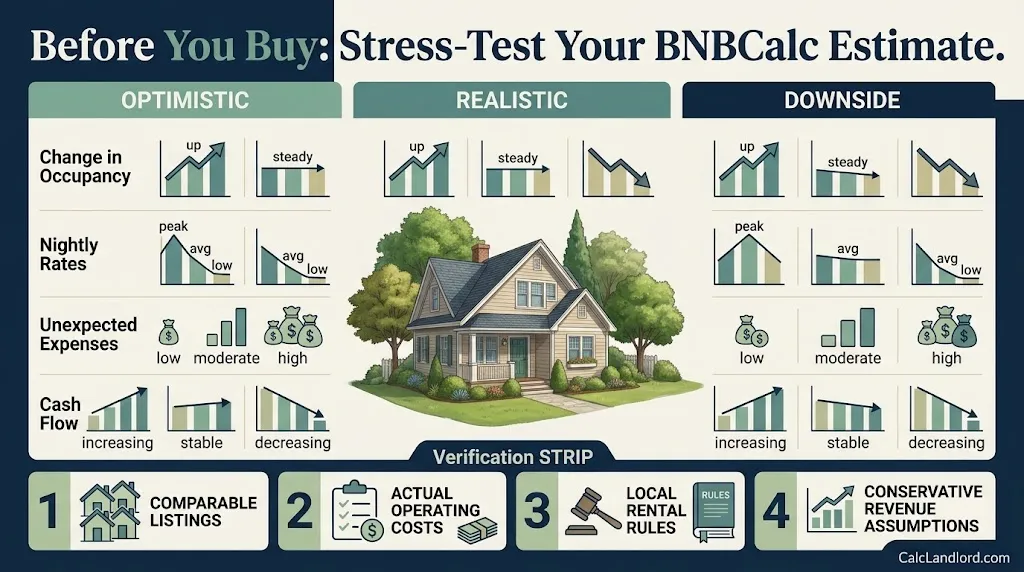
Step 7: Test alternative scenarios. Reduce revenue, increase important expenses, and account for unexpected repairs. Examine whether the investment still meets your cash-flow requirements.
Step 8: Check whether the operation is permissible. Investigate the rules applying to the specific address, including local permits, zoning or short-term rental restrictions, taxes, and any HOA or condominium requirements.
Step 9: Compare the numbers independently. Use a spreadsheet or CalcLandlord’s financial calculators to reproduce the main calculations using consistent assumptions.
Step 10: Make the purchase decision only after due diligence. An attractive projection is a reason to investigate further, not a substitute for reviewing the property’s condition, financing, insurance, and legal operating requirements.
This workflow turns BNBCalc into one part of a documented due-diligence process rather than the sole basis for a purchase decision.
BNBCalc Revenue Estimates vs. Actual Profit: A Worked Example
The following example is entirely hypothetical. It is not a BNBCalc-generated result or a claim about typical U.S. short-term rental performance. Its purpose is to show why revenue, operating income and cash flow must be evaluated separately.
Assume an investor is considering a property with these figures:
| Input | Assumed amount |
| Purchase price | $350,000 |
| Total initial cash invested | $110,000 |
| Annual accommodation revenue | $60,000 |
| Annual operating expenses | $24,000 |
| Annual mortgage debt service | $25,200 |
| Separate annual capital reserve | $3,000 |
For consistency, assume accommodation revenue excludes guest cleaning charges. The operating expenses include any cleaning costs not recovered separately, as well as the other recurring operating costs. The initial cash invested includes the down payment, closing costs, furnishing and setup costs.
Calculate net operating income
Net operating income (NOI) is rental operating income after operating expenses but before mortgage debt service.
NOI = Revenue − Operating Expenses
\[ \$60,000-\$24,000=\$36,000 \]
The property produces a modeled NOI of $36,000 per year.
Calculate the cap rate
Cap Rate = NOI ÷ Purchase Price × 100
\[ \frac{\$36,000}{\$350,000}\times100\approx10.29\% \]
The modeled cap rate is approximately 10.3%. This is the result of the stated hypothetical assumptions, not a market benchmark or a forecast validated by BNBCalc.
Calculate cash flow after financing
Cash Flow = NOI − Debt Service
\[ \$36,000-\$25,200=\$10,800 \]
The property produces $10,800 in modeled annual cash flow before the separate capital reserve.
After subtracting the $3,000 reserve, the remaining annual cash flow is $7,800.
Calculate cash-on-cash return
Using cash flow before that separate reserve:
Cash-on-Cash Return = Annual Cash Flow ÷ Total Cash Invested × 100
\[ \frac{\$10,800}{\$110,000}\times100\approx9.82\% \]
If the separate capital reserve is deducted first, the corresponding cash yield is approximately 7.09%:
\[ \frac{\$7,800}{\$110,000}\times100\approx7.09\% \]
Both figures follow from the assumptions, but they answer slightly different questions. For comparisons to be meaningful, disclose whether the calculation deducts the capital reserve before determining cash-on-cash return.
Use CalcLandlord’s Cash-on-Cash Return guide to review the metric and the Cap Rate Explained guide to understand the distinction.
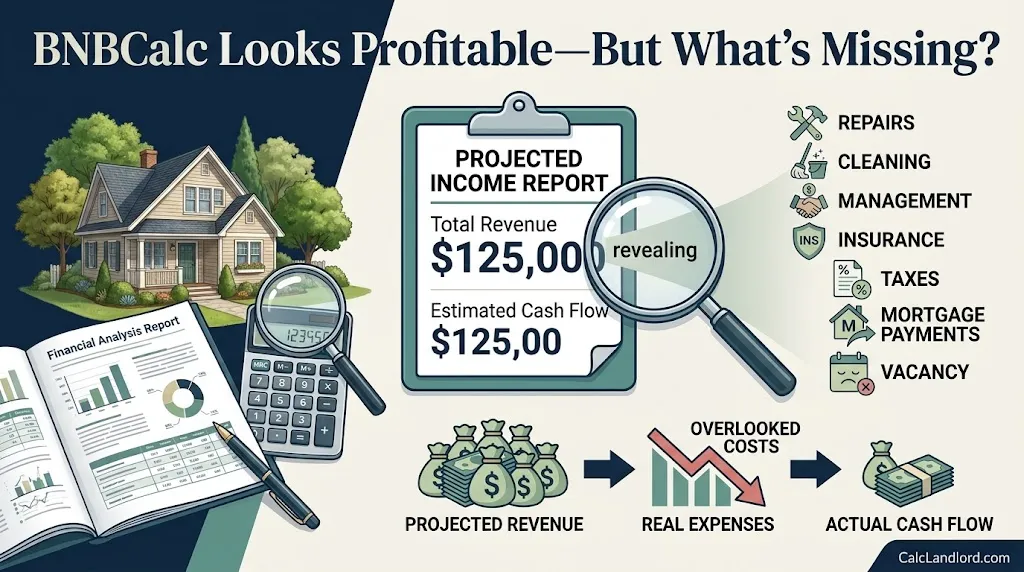
The lesson is that a headline revenue projection does not reveal whether the property delivers enough income after expenses and financing. That is the calculation the investor actually needs.
What Happens When Airbnb Revenue Falls? Stress-Testing Your Investment
A property can look profitable under a base-case forecast and still be financially fragile. Stress-testing shows how much room the investment has when bookings, rates, or expenses differ from expectations.
Use the hypothetical property from the previous section: $60,000 in annual accommodation revenue, $24,000 in operating expenses and $25,200 in annual debt service.
Suppose revenue is 15% lower than expected.
\[ \$60,000\times(1-0.15)=\$51,000 \]
For a simple conservative scenario, hold operating expenses and debt service constant. Real properties have both fixed and variable costs, so a more detailed model should adjust those expenses individually.
| Annual measure | Base case | Revenue falls 15% |
| Accommodation revenue | $60,000 | $51,000 |
| Operating expenses | $24,000 | $24,000 |
| Net operating income | $36,000 | $27,000 |
| Debt service | $25,200 | $25,200 |
| Cash flow before reserve | $10,800 | $1,800 |
| Separate capital reserve | $3,000 | $3,000 |
| Cash flow after reserve | $7,800 | −$1,200 |
The key result is that a 15% decrease in revenue reduces the modeled annual cash flow after reserves from $7,800 to a $1,200 shortfall.
The mortgage payment has not changed, and the operating expenses have not changed in this simplified scenario. That is why lower revenue can have a disproportionate impact on an investor’s available cash.
Which assumptions should you stress-test?
Test the variables that could materially affect your particular property:
- Lower average nightly rates.
- Fewer booked nights or more seasonal downtime.
- Higher property management or insurance costs.
- Unexpected repairs and replacement expenses.
- Mortgage payments that exceed the initial estimate.
- Periods when the property cannot legally or practically be operated.
Do not assume every property needs the same revenue reduction. The appropriate scenarios depend on the market, the property’s condition, the financing term and the evidence available.
A useful decision rule is to establish your minimum acceptable cash flow before evaluating the deal. If a modest downside scenario pushes the investment below that minimum, investigate further before committing capital.
BNBCalc vs. AirDNA: Which Short-Term Rental Analysis Tool Is Better?
BNBCalc and AirDNA both provide tools for estimating short-term rental revenue. So BNBCalc combines property analysis with expense and financing models and offers broader market research through Markets. AirDNA provides Rentalizer estimates, market insights and comparable-set analysis.
BNBCalc
+1
Neither platform should be declared the overall winner without comparing equivalent properties and assumptions.
| Decision factor | BNBCalc | AirDNA |
| Property-level revenue estimates | Yes | Yes, through Rentalizer |
| Comparable-property analysis | Yes | Yes |
| Broader market research | Markets product | Market Research tools |
| Expense and financial modeling | Central part of Calculator | Rentalizer includes investment-return calculations |
| Free access | Two property analyses without a plan, according to BNBCalc | Permanent free plan with limited Rentalizer and market access |
| Published annual plan price | Calculator: $199; Markets: $399 | Market Research: $400 billed annually on the pricing page checked |
| Primary decision | Screen a property or research markets within BNBCalc | Evaluate a property or investigate market and historical-performance data |
The AirDNA pricing page lists a free tier and a Market Research plan shown at $34 per month when billed annually, with $400 billed upfront for the year. These are the prices displayed during this research and may change.
Vacation Rental Data Software Subscriptions
When BNBCalc may suit your needs
Consider it when you want to combine short-term rental revenue estimates, financing, operating costs and investment-return projections within one product. Markets is also relevant if you want broader location and competitor research.
BNBCalc Markets
When AirDNA may suit your needs
Consider AirDNA when you want its particular market research, historical-performance information, comparable-set features, or Rentalizer workflow. Its official documentation describes estimates built from historical performance of similar nearby listings and allows users to customize important property details.
AirDNA Help Center
What about a spreadsheet?
A spreadsheet is useful if you want direct control over every input, formula, and downside scenario without relying on a platform’s default expense assumptions.
However, a spreadsheet still needs reliable revenue estimates and comparable-property evidence. It does not automatically solve the data-quality problem.
My recommendation: Start with the tool that fits your actual workflow. Compare the same property using consistent bedroom counts, guest capacity, revenue definitions and operating costs. Then independently calculate cash flow and returns before deciding whether either subscription is worth the money.
BNBCalc Pros and Cons for Real Estate Investors
BNBCalc has a potentially useful combination of property-level analysis and broader market research. Its value depends on how well those features fit your investment process and how carefully you inspect its output.
BNBCalc
+1
| Potential advantages | Limitations to consider |
| Combines revenue estimates with financial modeling | Estimates cannot guarantee future performance |
| Provides comparable-listing information | Comparable properties may differ in important ways |
| Offers a distinct Markets product | Market research does not replace property-specific due diligence |
| Provides reports that can support discussions | A report is not proof of profitability or lender approval |
| Offers limited free analysis and a trial | Repeated use may require a paid subscription |
| Provides broad geographic coverage through Markets | Not every financial feature is available for every country |
The strongest advantage is the ability to organize several parts of an analysis in one workflow. That may save time when screening multiple properties.
The biggest limitation is that a well-presented report can still contain assumptions that do not fit the property you are evaluating. An estimate should always be reviewed alongside actual expense records, financing quotes, comparable listings and local requirements.
BNBCalc’s terms also make clear that the service does not constitute legal, financial, tax, accounting or investment advice.
BNBCalc
The software is best regarded as an analytical aid—not a substitute for professional judgment.
Does BNBCalc Work Outside the United States?
Yes. BNBCalc advertises short-term rental analysis beyond the United States, and its Markets product covers more than 2,300 markets across 157 countries, according to its official documentation.
BNBCalc Markets
However, international coverage does not mean every feature works identically in every country.
BNBCalc states that U.S. markets include gross-yield rankings and property-value data, while its tax modeling follows U.S. rules. Investors considering a property outside the United States should not assume U.S.-specific tax or valuation features automatically apply to their location.
BNBCalc Markets
+1
Before purchasing a subscription for an international property, verify:
- Whether the exact city or market is covered.
- Whether comparable listings are sufficiently similar.
- Whether relevant property-value and financing features apply.
- Whether local rental rules permit the proposed business.
- Whether income and expense assumptions use the correct currency and local cost structure.
For U.S. properties, the same principle applies at a smaller scale: national or citywide coverage does not guarantee a reliable estimate for every neighborhood or building.
What Should You Verify Before Trusting a BNBCalc Report?
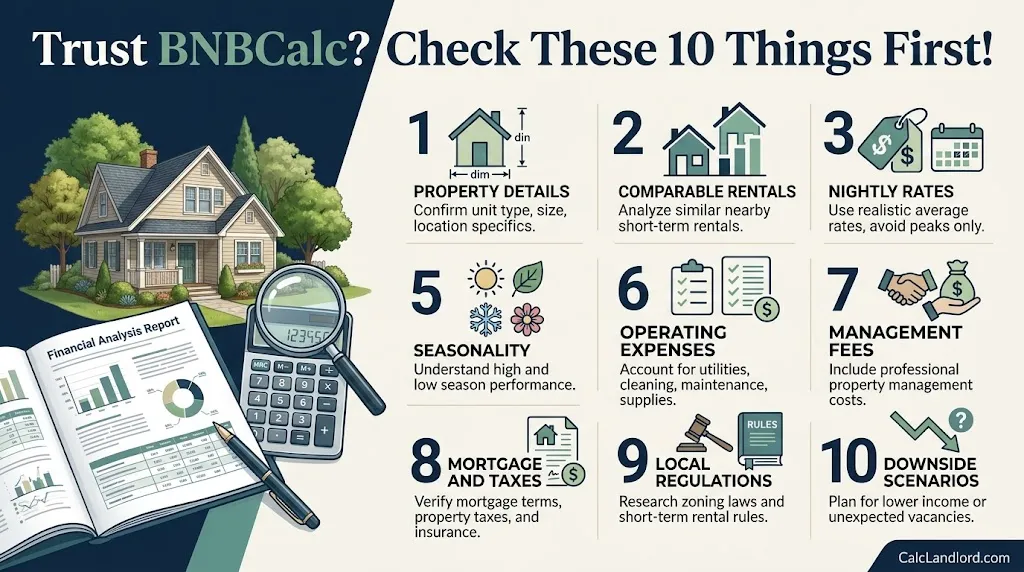
A report becomes more useful when you can trace its major assumptions back to verifiable information. Before using BNBCalc’s output to support a purchase decision, check the following.
1. Property details. Verify the address, size, bedroom count, bathroom count, guest capacity, and major amenities.
2. Comparable listings. Investigate the properties behind the projection and identify significant differences in location, condition, amenities, and operating calendar.
3. Revenue definition. Confirm exactly what projected revenue includes. If you compare reports from different providers, make sure the figures use consistent definitions, including their treatment of cleaning charges, discounts, and platform fees.
For example, AirDNA’s official methodology says its revenue calculations include nightly rates and cleaning fees, minus discounts and platform service fees, while excluding host fees and other additional fees. Do not automatically assume another platform uses the same definition.
AirDNA Help Center
4. Operating costs. Replace estimates with current quotes or records whenever possible. Consider management, insurance, utilities, maintenance, cleaning, taxes, supplies and replacement reserves.
5. Financing. Confirm actual lending terms, interest rate, down payment, loan costs, fees, and debt service with the relevant lender.
6. Local legality. Check city and county rules, zoning, required permits, lodging taxes, and any HOA, condominium, or lease restrictions. Requirements vary by location and property type.
Verify the Property Details and Listing Information
7. Downside risk. Test weaker revenue and higher costs. Ask whether the property could cover its obligations during a poor season or unexpected repair.
8. Tax treatment. Treat automated tax estimates as a starting point. Confirm property-specific deductions and reporting requirements using current IRS guidance and appropriate professional advice.
9. Evidence trail. Save the report, date, assumptions, comparable listings, and any manual adjustments. That will help you understand why the numbers change when you obtain better information.
10. Your decision criteria. Set minimum cash flow, reserve requirements and return expectations before judging the result. Otherwise, it is easy to adjust the assumptions until a property looks attractive.
This checklist addresses a critical distinction: a tool may calculate accurately from the inputs supplied and still produce an investment projection that is unsuitable for the real property.
People Also Ask About BNBCalc
BNBCalc is used to evaluate short-term rental opportunities. Its Calculator estimates property revenue and supports financial modeling, while Markets provides broader research on short-term rental markets and competing listings.
BNBCalc
+1
The published price is $30 per month or $199 per year for Calculator. Markets costs $79 per month or $399 per year and includes Calculator. Annual-effective monthly costs are lower because the annual amounts are billed upfront.
BNBCalc
BNBCalc states that non-subscribers can run two property analyses. Both paid plans also advertise a seven-day free trial. Confirm the current trial and cancellation conditions at signup.
BNBCalc
Its estimates are based on comparable short-term rental listings, but their accuracy for an individual property depends on the quality and relevance of those comparisons and the assumptions used. This review does not establish a verified universal forecast-error percentage.
BNBCalc
+1
That depends on the task. Both offer property-level revenue analysis, and BNBCalc also provides broader research through Markets. Compare equivalent properties, data definitions, analysis requirements, and the cost of the plan you actually need.
BNBCalc Markets
+1
It can help estimate potential revenue and model financial assumptions, but profitability depends on actual bookings, expenses, financing, reserves, property condition, and operating restrictions. Independent verification is essential.
BNBCalc advertises international market coverage. However, the company states that gross-yield and property-value features have U.S.-specific limitations and that its tax modeling follows U.S. rules. Check feature availability for the exact country and property.
BNBCalc Markets
+1
You can use its analysis as a primary starting point, but a spreadsheet or separate calculator can help you inspect assumptions and test scenarios independently. Neither method eliminates the need for reliable property and market information.
Is BNBCalc Worth It? Final Verdict for Rental Property Investors
BNBCalc is worth evaluating if you regularly screen short-term rental properties and need revenue estimates combined with expense financing and investment-return modeling. Markets may also be useful when comparing locations and competing listings. Its published features support those use cases, but they do not prove that an individual forecast will match future performance.
BNBCalc
+1
The right decision depends on what you need.
Choose the Calculator plan for repeated property-level analysis. Consider Markets when wider market research is a necessary part of your process. Start with free access if you are only investigating a property or two.
Before relying on any report, inspect the comparable listings, verify expenses and financing, check local rental restrictions, and calculate cash flow under both base-case and downside assumptions.
For additional analysis, use CalcLandlord’s Cash Flow Calculator and rental property tools to reproduce the core financial calculations. The ROI & Returns guide and Property Investment & Returns guide provide further context for evaluating the metrics behind an investment decision.
The goal is not to find a tool that promises the highest return. It is to find a tool that helps you identify weak assumptions before they become expensive mistakes.
Educational disclaimer: This article is for informational and educational purposes only and does not constitute legal, tax, accounting, financial or investment advice. Short-term rental regulations, taxes, and financial outcomes vary by property and jurisdiction. Consult appropriately qualified professionals about your circumstances.

Pingback: Split Pay Rent Fairly: 5 Ways to Stop Roommate Fights
Pingback: Towne Properties: 7 Things to Check Before You Sign
Pingback: Rental Payment Calculator: 5 Costly Rent Surprises