

How Much Do Property Managers Charge?
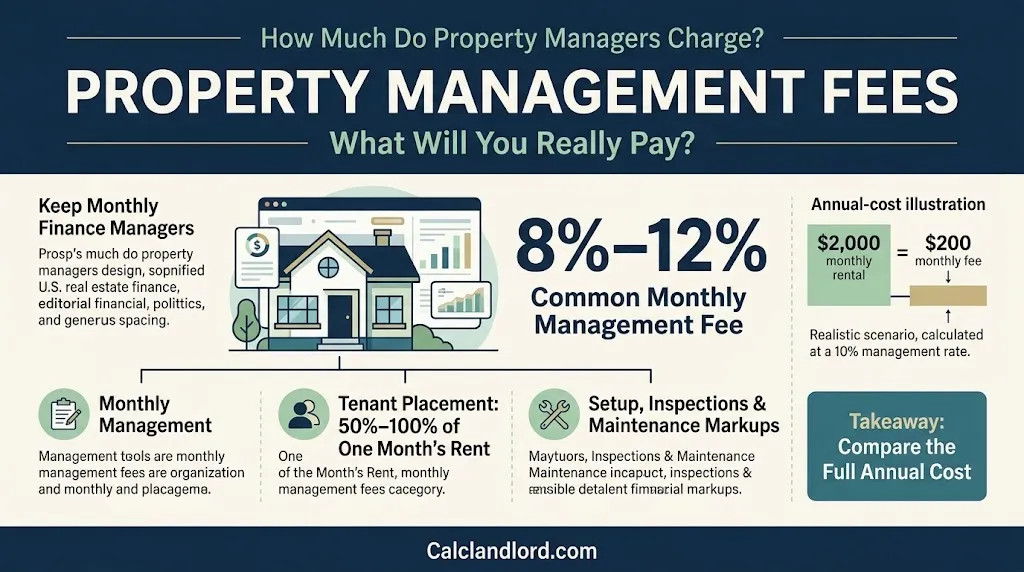
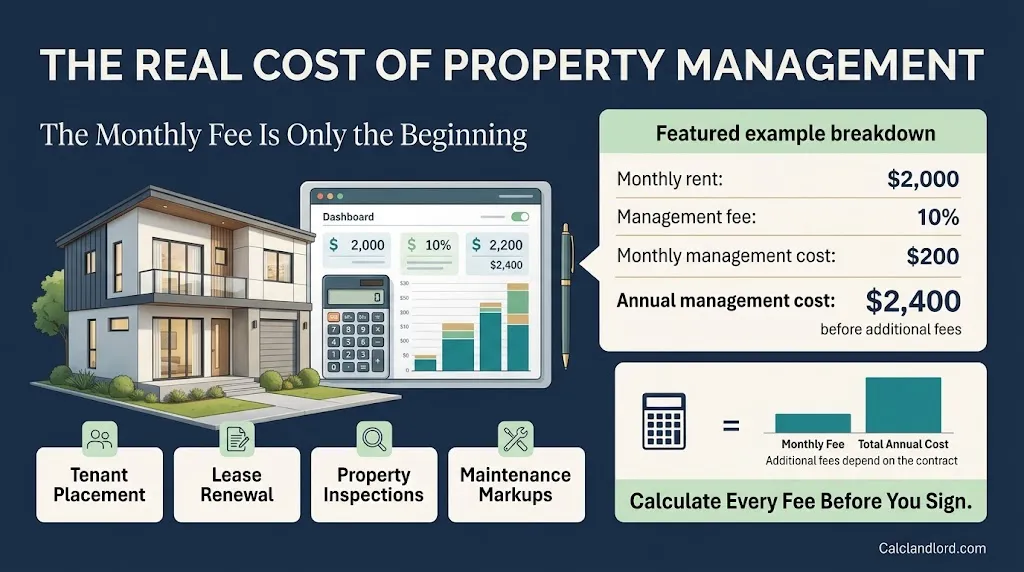
Before you hire a property manager, look beyond the percentage in the sales pitch. A fee of 10% on a $2,000 rental sounds simple: $200 a month, or $2,400 a year. But tenant placement, lease renewals, inspections, and maintenance markups can push the real bill higher. Another company advertising 8% might even cost more once those extras are included. This guide breaks down common U.S. property management fees, shows how flat-rate and percentage pricing compare, and walks through realistic annual-cost examples. Use the numbers to compare written quotes—and understand what you’ll pay before signing a management agreement with more confidence.
Property managers commonly charge 8%–12% of monthly rent collected for long-term single-family homes and small multifamily rentals. Flat-fee arrangements are another option, with published guides reporting amounts that often fall around 100–200 per unit per month, although local rates and service packages vary.
Here is a quick breakdown of commonly published pricing benchmarks.
| Property management service | Indicative fee |
| Monthly management | 8%–12% of collected rent |
| Flat monthly management | Approximately 100–200 per unit |
| Tenant placement | 50%–100% of one month’s rent |
| Lease renewal | Approximately 100–500 |
| Setup or onboarding | 0–500 |
| Property inspection | Approximately 50–200 |
| Maintenance coordination or markup | Varies; published examples include 5%–25% of repair costs |
| Eviction coordination | Approximately 200–500, excluding possible legal and court expenses |
| Short-term rental management | Published guides commonly cite approximately 20%–40% of rental revenue |
Sources: Baselane, Mynd, and All Property Management.
These figures are starting points for comparing quotes, not guaranteed prices or independently verified national averages. Not every property manager charges every fee, and some bundle services into their monthly rate.
The key takeaway: Compare the total expected annual cost and the services included, rather than choosing a manager based only on the advertised percentage.
How Much Do Property Managers Charge Per Month?
For a traditional long-term rental, the monthly management charge usually depends on the rent, the agreed percentage or flat rate, and any minimum monthly fee in the contract.
Consider the following examples for a manager charging a percentage of monthly rent.
| Monthly rent | 8% fee | 10% fee | 12% fee |
| $1,000 | $80 | $100 | $120 |
| $1,500 | $120 | $150 | $180 |
| $2,000 | $160 | $200 | $240 |
| $2,500 | $200 | $250 | $300 |
| $3,000 | $240 | $300 | $360 |
For a property renting for $2,500 per month, a 10% fee would be $250 monthly, or $3,000 annually, assuming the full rent is collected throughout the year and the contract calculates the fee on collected rent.
The basic formula is:
\[ \text{Monthly Management Fee} = \text{Rent Base}\times\text{Management Rate} \]
For example:
\[ \$2,500\times 0.10=\$250 \]
The important detail is how the contract defines the rent base.
Collected rent versus rent due
Some managers calculate their percentage using rent actually collected. Others may use rent scheduled or due under the lease.
Suppose your tenant owes $2,000 but pays nothing that month.
- Based on rent collected: A percentage fee may be zero for that month if no rent is collected and no minimum or other charge applies.
- Based on rent due: You may still owe a management fee calculated on the scheduled $2,000.
- Based on a minimum fee: You may owe a stated minimum even when the percentage calculation produces a smaller amount.
The contract determines the actual obligation. Ask how unpaid rent, partial payments, concessions, and vacancy periods affect the calculation.
Property Management Fees at a Glance
Different pricing structures can make two management proposals look similar even when the total cost differs substantially.
Use this comparison when requesting quotes.
| Fee type | What to check |
| Monthly management | Percentage, flat amount, minimum fee, and calculation basis |
| Tenant placement | Percentage or flat charge and whether screening is included |
| Lease renewal | Whether the charge applies to every renewed lease |
| Setup | Whether onboarding or an initial inspection is separately billed |
| Maintenance | Contractor costs, markup, hourly charges, and approval limits |
| Inspections | Frequency and whether routine inspections are included |
| Vacancy | Charges when the property is empty |
| Eviction coordination | Administrative fee and excluded legal expenses |
| Early termination | Notice period, termination fee, and transfer process |
These fees should not be added together automatically. Build a budget around the services and events your property is actually likely to need.
For instance, a landlord retaining the same tenant may not incur a new tenant-placement fee that year. A vacant property, meanwhile, may require additional leasing, monitoring, and maintenance expenses.
What Is Included in the Monthly Property Management Fee?
A monthly management fee typically covers routine activities involved in operating a rental property. The exact services depend on the company and the management agreement.
Commonly included services may cover:
- Collecting rent and communicating with tenants.
- Handling routine tenant questions and maintenance requests.
- Coordinating contractors and repair appointments.
- Monitoring lease compliance and communicating about lease issues.
- Providing owner statements and basic financial reporting.
- Coordinating routine property operations.
However, property management does not automatically include every expense associated with the property.
A company might coordinate a plumber under its monthly service while billing you separately for the plumber’s work. It might also charge a separate leasing fee for marketing the property and finding a replacement tenant.
Before signing, ask the company to complete this service checklist.
| Service | Questions to ask |
| Rent collection | Are collection follow-ups and late-payment administration included? |
| Tenant communication | Is there a separate charge for after-hours calls? |
| Maintenance | Is coordination included? What about contractor invoices and markups? |
| Tenant screening | Are application checks included in the leasing fee? |
| Lease preparation | Is preparing or updating lease documents separately billed? |
| Inspections | How many are included each year? |
| Renewals | Is there a separate renewal fee? |
| Owner reporting | Are monthly and year-end statements included? |
| Evictions | What administrative work is included, and what is extra? |
Use the same checklist for every company you interview. This makes it easier to compare equivalent services rather than comparing a basic package with a more comprehensive one.
Percentage-Based Fees vs. Flat-Fee Property Management
Most landlords will encounter one of two primary pricing models: a percentage of rent or a fixed monthly fee.
Neither is automatically the better deal. The right choice depends on your rent, your management needs, and the total costs in the contract.
Percentage-based management
With percentage-based pricing, the manager charges an agreed share of the contract-defined rental income.
For example, if your property produces $2,400 in monthly rent and the manager charges 10%:
\[ \$2,400\times 0.10=\$240 \]
Your monthly management fee is $240, before any separate charges.
Advantages: The fee generally rises and falls with the rent base, and the arrangement can align some of the manager’s compensation with rental revenue.
Disadvantages: The fee increases as rent rises, and additional charges can make the full cost higher than the headline percentage suggests.
Flat-fee management
With flat-fee pricing, the property manager charges a stated monthly amount instead of a percentage of rent.
For example, a $150 monthly fee costs:
\[ \$150\times 12=\$1,800 \]
That annual charge remains the same under the stated flat-fee arrangement, although other services may cost extra.
Advantages: Costs are predictable and straightforward to budget.
Disadvantages: The flat fee may be relatively expensive for a low-rent property, while a basic flat-fee package may exclude services offered by another company.
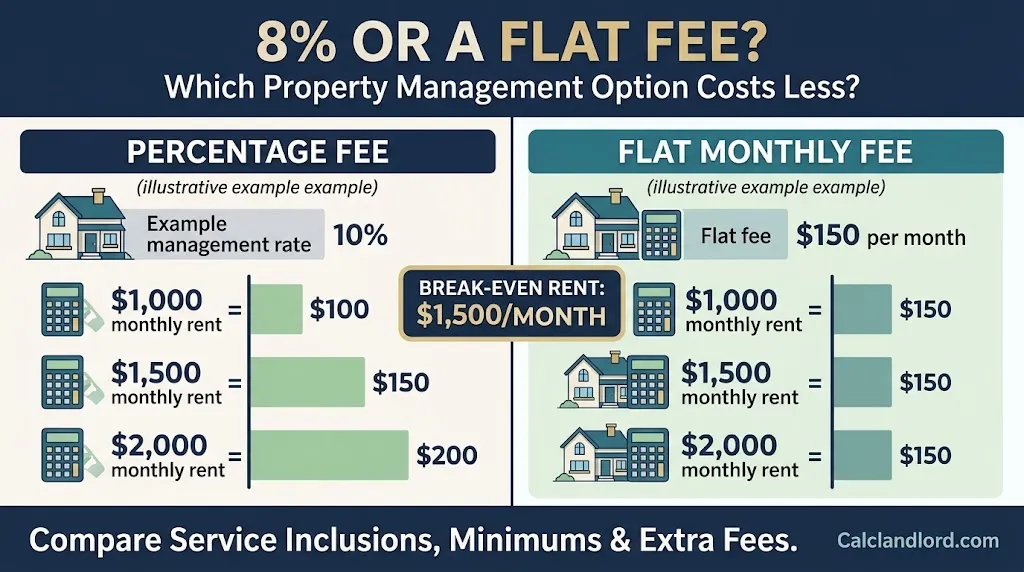
Which model costs less?
Assume both managers provide identical services and have no additional fees or minimums.
| Monthly rent | 10% management fee | $150 flat fee | Lower base charge |
| $1,000 | $100 | $150 | Percentage |
| $1,500 | $150 | $150 | Equal |
| $2,000 | $200 | $150 | Flat fee |
| $3,000 | $300 | $150 | Flat fee |
To calculate the break-even rent, divide the flat fee by the percentage rate.
Break-EvenRent=FlatMonthlyFeePercentageRate
For a $150 flat fee and a 10% percentage fee:
\[ \$150\div 0.10=\$1,500 \]
At $1,500 monthly rent, both cost $150 per month. Above that rent, the flat fee has the lower base charge; below it, the percentage fee has the lower base charge.
This comparison does not establish which company offers better overall value. Check monthly minimums, leasing fees, service exclusions, and maintenance charges before deciding.
What Additional Property Management Fees Should Landlords Expect?
Additional fees are often the biggest reason a management agreement costs more than its advertised monthly rate.
Here are the main charges to check.
1. Tenant placement or leasing fees
A tenant-placement fee covers the work of finding and onboarding a new tenant. Depending on the agreement, services may include listing creation, marketing, showings, application screening, lease preparation, and move-in coordination.
Published fee guides commonly cite a charge equal to 50%–100% of one month’s rent, although some companies use flat rates.
For a $2,000 rental:
| Placement fee | Cost |
| 50% of one month’s rent | $1,000 |
| 75% of one month’s rent | $1,500 |
| 100% of one month’s rent | $2,000 |
Ask whether the leasing fee is charged each time a new tenant is placed. Also check whether the manager offers any written replacement-tenant guarantee and what conditions apply.
2. Lease renewal fees
Some companies charge a separate fee when an existing tenant renews the lease.
Published examples vary, with some guides reporting around 100–350 and others citing amounts up to $500. The actual charge depends on the provider and service scope.
Ask whether the renewal service includes a rent review, negotiation with the tenant, updated documents, and execution of the new agreement.
3. Maintenance coordination fees and markups
A manager may charge a markup on the contractor’s invoice, a separate coordination fee, or an hourly rate.
For example, assume a repair contractor charges $800 and the manager applies a 10% markup.
\[ \$800\times 0.10=\$80 \]
The total repair-related bill becomes:
\[ \$800+\$80=\$880 \]
The $800 is the repair expense; the $80 is the additional management-related charge.
Ask whether the same markup applies to emergency repairs, large projects, in-house maintenance, and recurring vendor contracts.
4. Setup and onboarding fees
Some property managers charge an initial amount for establishing owner accounts, organizing property records, setting up reporting, or arranging an initial inspection.
Published guides report setup fees ranging from no charge to several hundred dollars.
Confirm whether onboarding is billed separately or included in the first month’s management charge. Also ask whether the fee is refundable if the agreement ends soon afterward.
5. Inspection fees
Inspections may be included in the monthly service, billed individually, or limited to a specified number each year.
Ask about the types of inspections provided, including move-in, move-out, routine occupied-property, and vacancy inspections. Confirm whether reports and photographs are included.
6. Vacancy fees
Some managers charge to monitor a vacant property, while others reduce or waive the management fee until rent resumes.
This is worth checking because a vacant unit can still require maintenance, security checks, utility oversight, and marketing.
Clarify how the contract treats three different situations:
- The property is vacant.
- The tenant occupies the property but has not paid rent.
- The tenant makes only a partial payment.
Do not assume that a clause about collected rent also explains the provider’s vacancy policy.
7. Eviction and early termination charges
A manager may charge an administrative fee for coordinating an eviction. Attorney fees, court costs, and other legal expenses may be separate.
An early termination charge may also apply if you end the management agreement before the agreed term.
Before signing, review the termination notice period, any applicable fee, and how tenant records, property keys, security-deposit records, and owner funds will be transferred.
Fee descriptions and permitted charges can vary by state and locality. Verify applicable requirements rather than assuming every proposed fee is permissible.
How to Calculate Your Total Annual Property Management Cost
The most useful way to compare management companies is to calculate their expected charges over a full year.
Use this formula:
\[ \begin{aligned} \text{Annual Manager Charges}={}& \text{Recurring Management Fees}\\ &+\text{Tenant Placement Fees}\\ &+\text{Renewal and Setup Fees}\\ &+\text{Inspection Charges}\\ &+\text{Maintenance Markups}\\ &+\text{Other Applicable Charges} \end{aligned} \]
Include only the fees applicable to your scenario. Use the actual pricing schedule wherever possible, rather than assuming that every manager charges the same amounts.
Keep three types of costs separate:
- Manager compensation: Monthly fees, leasing charges, and coordination markups.
- Property expenses: Actual repair bills, insurance, taxes, utilities, and other operating costs.
- Funds held in reserve: Money the manager holds for future property expenses.
An owner reserve is not automatically a fee. It reduces the cash available to you until the money is used or returned, according to the agreement.
Calculate the effective annual management cost
If you want to understand how much management consumes relative to rental income, use:
EffectiveManagementCost=AnnualManagerChargesAnnualRentCollected100
This gives you the effective cost as a percentage of actual rental income.
It is different from the recurring management percentage stated in the contract because it includes applicable one-time and event-based fees.
Real Example: Property Management Costs for a $2,000 Rental
Consider a single-family home renting for $2,000 per month.
For this illustration, assume the property collects the full 12 months of rent, and the management agreement includes the following charges.
| Assumption | Amount |
| Monthly rent collected | $2,000 |
| Annual rent collected | $24,000 |
| Monthly management rate | 10% |
| Tenant placement fee | 75% of one month’s rent |
| Setup fee | $300 |
| Annual inspection charges | $150 |
| Annual repair invoices | $1,200 |
| Repair markup | 10% |
Scenario A: A new-tenant year
The property needs one new tenant during the year.
| Management-related charge | Calculation | Annual cost |
| Monthly management | $24,000 × 10% | $2,400 |
| Tenant placement | $2,000 × 75% | $1,500 |
| Setup | Stated fee | $300 |
| Inspections | Stated annual amount | $150 |
| Repair markup | $1,200 × 10% | $120 |
| Total manager charges | $4,470 |
The total management-related cost is $4,470.
As a share of the $24,000 collected in rent:
\[ \frac{\$4,470}{\$24,000}\times100 =18.625\% \]
The effective management cost is approximately 18.6% of annual rent collected.
This does not mean the recurring management rate is 18.6%. The recurring rate remains 10%; the additional leasing, setup, inspection, and maintenance-related charges raise the effective annual cost.
The $1,200 repair invoice is excluded from the $4,470 manager-charge total. It is still a property expense, so the combined management-related charges and repair invoices amount to $5,670.
Scenario B: A lease-renewal year
Now assume the existing tenant renews the lease rather than moving out.
The property still collects $24,000 in rent, but there is no new tenant-placement or setup fee. Instead, the manager charges $250 for renewal.
| Management-related charge | Calculation | Annual cost |
| Monthly management | $24,000 × 10% | $2,400 |
| Lease renewal | Stated fee | $250 |
| Inspections | Stated annual amount | $150 |
| Repair markup | $1,200 × 10% | $120 |
| Total manager charges | $2,920 |
The effective annual management cost is:
\[ \frac{\$2,920}{\$24,000}\times100 \approx12.17\% \]
That is approximately 12.2% of collected rent.
Under these assumptions, the renewal year costs $1,550 less in management-related charges than the new-tenant year.
These examples are hypothetical budgets, not guaranteed industry averages. Your actual costs depend on the agreement, tenant turnover, repairs, vacancy, and services needed.
Why an 8% Property Manager Can Cost More Than a 10% Manager
A low advertised percentage does not necessarily mean a lower annual bill.
Suppose two companies give you quotes for the same $2,000-per-month rental. Both collect the same $24,000 in annual rent and offer the same service scope, except for the fee differences shown below.
| Annual charge | Manager A | Manager B |
| Monthly management rate | 10% | 8% |
| Recurring management | $2,400 | $1,920 |
| Tenant placement | $1,500 | $2,000 |
| Setup | $300 | $300 |
| Inspections | $150 | $150 |
| Repair markup | $120 | $120 |
| Annual total | $4,470 | $4,490 |
Manager B saves you $480 in recurring management fees but charges $500 more for tenant placement.
As a result, Manager B costs $20 more for the year under these assumptions.
This example demonstrates why the headline percentage is only one part of the decision.
Before choosing a provider, compare at least three scenarios: a year with a new tenant, a renewal year, and a year with vacancy or substantial maintenance. This gives you a more realistic picture of the possible cost differences.
What Factors Affect Property Management Pricing?
Property management fees vary because managing one rental home can involve very different work from managing another. Location, property condition, unit count, and service requirements all influence the quote.
Location
Rental-market conditions, local labor costs, operating requirements, and competition among management firms can affect pricing.
A quote for a property in one city may not be a useful benchmark for another market. Request quotes for your actual address and property type.
Property type and condition
An updated single-family home may require less coordination than an older multifamily property with frequent repairs and multiple tenants.
Ask whether the quote assumes the property is rent-ready. If substantial work is needed, clarify how renovations, contractor supervision, and project management are billed.
Services included
A basic monthly package may cover routine operations but exclude leasing, inspections, and certain maintenance work. A more comprehensive package may have a higher headline rate while charging less for services separately.
Compare the complete service scope rather than assuming that a lower rate offers better value.
Number of properties
Some providers may offer portfolio discounts when one owner hires them to manage multiple units or properties.
Ask whether discounts apply only to the recurring management rate or also to tenant placement, renewals, inspections, and other charges.
Rent collection and vacancy
The fee structure can affect your costs when rent is unpaid or a property is vacant.
Review the contract’s treatment of partial payments, concessions, delinquency, and extended vacancy before calculating your expected annual expense.
How Much Do Short-Term Rental Property Managers Charge?
Short-term and vacation-rental management often uses a different pricing structure from long-term residential management.
Published guides commonly cite approximately 20%–40% of rental revenue for short-term or vacation-rental management, although actual pricing varies by market, service level, and booking model. See Baselane’s fee guide for one published benchmark.
Short-term rentals may involve guest communication, check-in arrangements, frequent turnovers, cleaning coordination, listing management, and pricing adjustments. These additional responsibilities help explain why the fee structure can differ from that of a traditional long-term rental.
Before signing a vacation-rental management agreement, clarify:
- Which booking revenue the management percentage applies to.
- Whether cleaning charges are paid separately or collected from guests.
- Whether platform fees, refunds, and cancellations affect the fee calculation.
- Who pays for supplies, maintenance, and turnover services.
- Whether emergency guest support is included.
- Which tasks are handled by the manager and which remain your responsibility.
Do not compare a short-term rental percentage directly with a long-term rental percentage without considering the work and expenses covered by each agreement.
Is Hiring a Property Manager Worth the Cost?
A property manager is worth considering when the time, operational support, and service quality justify the cost to you. Whether professional management makes financial sense depends on the rental property’s cash flow and your own circumstances.
When professional management may make sense
Hiring a manager may be useful if you live far from the property, have several rentals, have limited time, or prefer not to handle tenant communications and maintenance coordination yourself.
An experienced local manager may also bring established leasing procedures, vendor relationships, reporting systems, and operational processes.
Those benefits are not guaranteed. They depend on the provider’s performance and the services actually delivered.
When self-management may be practical
Self-management may work if you own a small number of properties, live nearby, have time to respond to tenant issues, and understand the relevant landlord-tenant requirements.
However, avoiding a management fee does not eliminate the work involved. You still need to coordinate repairs, communicate with tenants, track rent, maintain records, and handle applicable compliance obligations.
Evaluate management against cash flow
Before hiring a company, calculate your property’s expected cash flow after management charges and other operating expenses.
For a rental property, the basic structure is:
\[ \begin{aligned} \text{Net Operating Income}={}& \text{Rental Income}\\ &-\text{Vacancy and Credit Loss}\\ &-\text{Operating Expenses} \end{aligned} \]
Management fees generally belong among operating expenses. Mortgage principal and interest are normally considered separately when moving from net operating income to cash flow after debt service.
Use your property’s actual rent, vacancy assumptions, management quote, taxes, insurance, repairs, and other expenses to estimate its financial performance.
A property that looks profitable before management costs may produce much less cash flow after all expenses are included.
Questions to Ask Before Signing a Property Management Agreement
Before committing to a company, request a written fee schedule and read it alongside the proposed management agreement.
Use the following checklist when comparing providers.
- Is the management fee calculated on rent collected, rent due, or scheduled rent?
- Is there a minimum monthly management charge?
- What happens when a tenant pays late, pays partially, or does not pay?
- Does the monthly fee apply during vacancy?
- Which services are included in the recurring rate?
- What is the tenant-placement fee, and when is it earned?
- Are marketing, showings, screening, and lease preparation included?
- Is there a lease renewal charge?
- Are repair markups, coordination fees, or project-management charges applied?
- What repair spending can the manager authorize without your approval, subject to applicable emergency procedures and law?
- How frequently are inspections performed, and are reports included?
- Is an owner reserve required, and when can you withdraw or reclaim the balance?
- Who receives permitted late fees or other ancillary charges?
- Which eviction-related costs are excluded from the management fee?
- What notice period and charges apply if you terminate the contract?
Ask how the company handles handover if you change managers. Records, keys, deposits, outstanding repair requests, and owner funds should be addressed clearly in the agreement.
Do not rely on verbal assurances when the written fee schedule says something different. Ask for any clarification or agreed exception in writing before signing.
Common Mistakes to Avoid When Comparing Property Management Fees
Even experienced landlords can underestimate management costs when comparing proposals.
Choosing the lowest percentage without checking the extras. A lower recurring rate may be offset by higher leasing, renewal, inspection, or maintenance charges.
Assuming every service is included. Terms such as “full service” do not have a single universal meaning. Check the actual list of included and excluded services.
Ignoring minimum monthly fees. A percentage-based fee may be subject to a minimum amount, making the actual charge higher than the percentage calculation.
Treating a maintenance reserve as money spent. An owner reserve affects available cash, but it is not necessarily compensation earned by the manager.
Using the same turnover assumption for every year. A new-tenant year can carry different costs from a renewal year. Budget for each scenario separately.
Confusing management fees with total property expenses. A manager’s annual charges do not include every repair, insurance payment, property tax, utility bill, or mortgage payment.
Assuming published prices are local quotes. General benchmarks help you prepare, but only an itemized proposal can show the expected price for your actual property and service requirements.
How to Compare Property Management Quotes With a Rental Cash Flow Calculator
A rental cash flow calculator can help you understand how management charges affect the money your property produces.
The key is to enter the full expected costs instead of using only the recurring percentage.
Start with the property’s expected monthly rent and realistic annual rent collection. Then include the management rate, any monthly minimum, tenant-placement charges, renewal fees, setup costs, expected inspections, and maintenance markups.
Keep the following outputs separate:
- Annual management-related charges.
- Average monthly management cost.
- Management charges as a percentage of rent collected.
- Repair and other operating expenses.
- Estimated cash flow after operating expenses and debt service.
- Upfront funds required, with refundable or reusable owner reserves shown separately.
For example, compare two management proposals using the same rent, vacancy assumptions, expected turnover, and repair budget. This allows you to see whether one proposal leaves you with more cash flow than the other.
The result is an estimate rather than a guarantee. Actual performance will depend on rent collection, vacancies, repairs, lease events, and the fees permitted under your agreement.
For additional context, connect your cost estimate to your broader rental-property budget and investment analysis. Your management decision should support the property’s long-term financial performance, not just minimize one line item.
- More to Explore: https://calclandlord.com/rental-application/
People Also Ask About Property Management Fees
For a long-term single-family rental, a commonly published benchmark is 8%–12% of collected rent. On a property earning $2,000 per month, that equals 160–$ 240 per month before applicable minimums and additional fees.
Yes. A 10% fee falls within the commonly published 8%–12% range for long-term single-family and small multifamily rentals. However, whether the quote offers good value depends on local pricing, the services included, and additional charges.
Tenant-placement fees commonly range from 50%–100% of one month’s rent in published pricing guides. Some companies instead charge a flat amount. Ask whether the charge includes advertising, showings, applicant screening, lease preparation, and move-in coordination.
It depends on the contract. Some companies waive the percentage-based fee when no rent is collected, while others use minimums, vacancy fees, or different billing rules. Check the vacancy clause separately from the rent-collection clause.
It can be. For example, a $150 monthly flat fee is cheaper than a 10% management rate when the contract-defined monthly rent exceeds $1,500, assuming identical services and no other fee differences. Actual value depends on the full contract.
Some companies may negotiate recurring rates, portfolio pricing, leasing charges, or bundled services. Ask for an itemized quote and compare the total annual cost rather than focusing exclusively on the percentage.
Not necessarily. A monthly fee may cover maintenance coordination while the owner pays for contractor labor and materials. The manager may also charge a separate markup or coordination fee. Confirm the exact arrangement in writing.
Final Thoughts
Property Managers Commonly charge around 8%–12% of collected rent for long-term residential rentals, but the monthly rate is only the beginning of the cost calculation.
Tenant placement, lease renewals, setup charges, inspections, and maintenance markups can raise your total annual expense. Two companies quoting different percentages may end up costing nearly the same amount—or the company with the lower recurring rate may actually cost more.
Before signing a management agreement, calculate the expected annual bill, confirm exactly which services are included, and review how the contract handles vacancy and unpaid rent.
The best property manager is not necessarily the cheapest one. It is the provider whose total cost, service quality, and contract terms make sense for your rental property’s cash flow and long-term goals.

Pingback: Towne Properties: 7 Things to Check Before You Sign