
Commercial Real Estate Valuation Methods: 2026 Guide
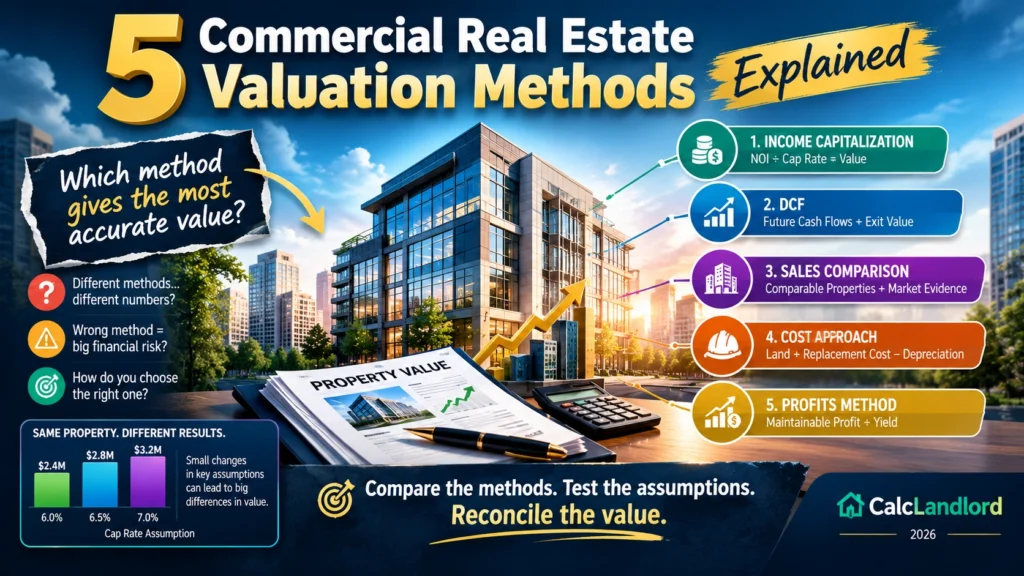
A commercial property can look like a great deal—until you value it using the wrong Assumptions. A small change in NOI, cap rate, vacancy, or future rents can move the estimated value by hundreds of thousands of dollars. That is why experienced investors do not rely on one formula alone. In this guide, you’ll learn 5 key commercial real estate valuation methods: income capitalization, DCF, sales comparison, cost, and profits. You’ll see how the numbers work, when each method makes sense, where valuations can go wrong, and how to reconcile different results before making a major investment decision.
Commercial real estate can look simple from the outside: estimate the rent, subtract the expenses, apply a cap rate, and you have a value.
In practice, valuation is rarely that simple.
The same office building can produce different indications of value depending on its lease rollover, tenant quality, operating expenses, comparable sales, replacement cost, future cash flows, and the assumptions used by the analyst. That is why professional valuation is better understood as a process than as one formula.
Quick answer: The three broad commercial real estate valuation approaches are the income approach, market/sales comparison approach, and cost approach. Within those approaches, investors and valuers may use methods such as direct capitalization, discounted cash flow, comparable sales, profits, depreciated replacement cost, and residual analysis. The appropriate method depends on the property, valuation purpose, available evidence, and quality of the assumptions.
For U.S. landlords and investors, the practical goal is not to find a magical formula. It is to build a valuation that is transparent, supportable, and useful for a real decision.
What Are Commercial Real Estate Valuation Methods?
Commercial real estate valuation methods are techniques used to estimate what a commercial property is worth under a defined valuation purpose and set of assumptions.
The most familiar approaches answer three different questions:
- Income: What is the property worth based on the income it can generate?
- Market: What have similar properties sold for?
- Cost: What would it cost to recreate the property’s improvements and acquire the underlying land, adjusted for depreciation where applicable?
These approaches are not interchangeable.
A stabilized apartment building with reliable rental income may be strongly analyzed through the income approach. A unique owner-user property may have better evidence from comparable sales. A specialized building with little market evidence may make the cost approach more useful.
The valuation purpose also matters. An acquisition underwriting exercise is different from a lending appraisal, tax assessment, estate valuation, litigation assignment, or financial-reporting assignment.
That distinction is important because “What is this property worth?” is incomplete without asking “Worth for what purpose, as of what date, and based on what assumptions?”
Professional valuation standards emphasize defining the problem and selecting an approach appropriate to the asset and assignment rather than assuming one method works universally. RICS describes the appropriate approach as depending on factors such as the asset type, valuation purpose, and available evidence.
For investors, this leads to a useful rule:
A valuation method is only as useful as its fit with the property and the evidence behind it.
What Are the Three Core Approaches to CRE Valuation?
Commercial real estate valuation is commonly organized into three broad approaches: market, income, and cost. JPMorgan describes cost, sales comparison, and income as the three main CRE valuation approaches, while RICS and IVS use the broader terms market, income, and cost.
The terminology becomes clearer when you separate approaches from methods.
| Broad approach | Common methods | Main valuation question |
| Market | Comparable sales | What are similar properties selling for? |
| Income | Direct capitalization, DCF, profits | What are the property’s present and future income benefits worth? |
| Cost | Depreciated replacement cost, residual analysis | What would it cost to recreate the property or develop the site? |
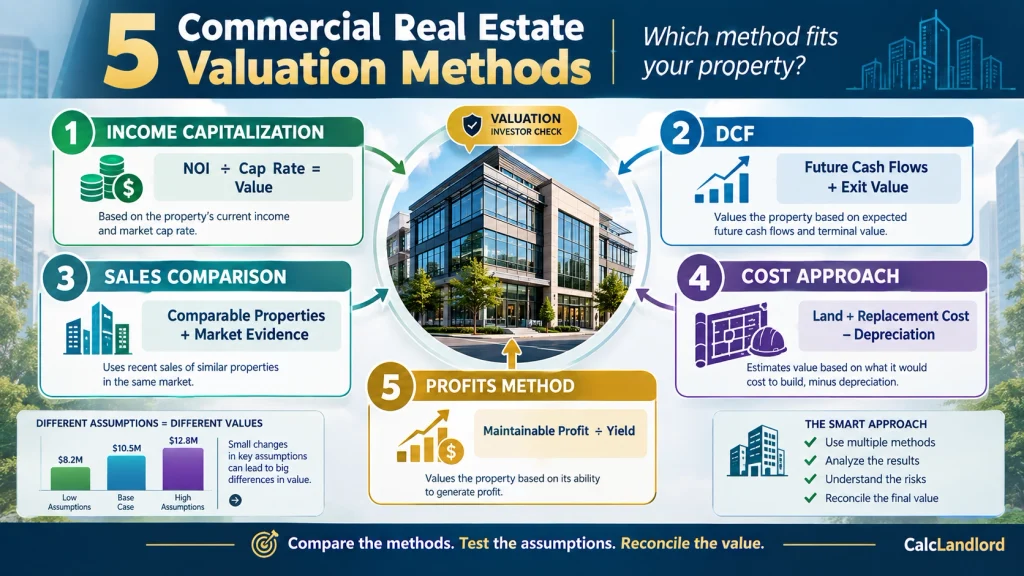
For everyday commercial investment analysis, five methods deserve special attention:
- Direct capitalization
- Discounted cash flow
- Sales comparison
- Cost approach
- Profits method
The first two are particularly relevant to income-producing investment property. The profits method becomes more relevant when the property’s value is closely tied to the trading performance of the business operating from it, such as certain hotels or restaurants. RICS specifically describes the investment and profits methods within the income approach and the depreciated replacement cost and residual methods within the cost approach.
This distinction prevents a common mistake: presenting DCF as a completely separate valuation philosophy when it is generally an income-based modeling technique.
How Does the Income Capitalization Approach Work?
The income capitalization approach estimates property value from the income an investor could reasonably expect the property to produce.
For stabilized income-producing commercial property, the most familiar version is direct capitalization.
The basic formula is:
Property Value = NOI ÷ Cap Rate
Where:
- NOI = Net Operating Income
- Cap Rate = Market capitalization rate
JPMorgan identifies the income approach as a major method for properties such as office, retail, and multifamily, while noting that the analysis requires attention to income, operating efficiency, and property condition.
The difficult part is usually not the division.
The difficult part is creating a credible NOI and selecting a market-supported capitalization rate.
Step 1: Estimate potential gross income
Start with contractual rent and other legitimate property income.
Review:
- Current leases
- Contractual rent increases
- Market rent
- Parking or storage income
- Reimbursements
- Other recurring income
Do not automatically assume the current rent equals market rent.
A tenant paying below-market rent can make a property’s current NOI look weaker than its normalized future income. A tenant paying above-market rent can create the opposite problem.
Step 2: Account for vacancy and collection loss
Even a fully occupied property deserves careful consideration of income risk.
A building with 100% current occupancy but several major leases expiring next year is not necessarily as secure as another building with similar occupancy and staggered lease expirations.
Step 3: Subtract operating expenses
Typical operating expenses can include:
- Property taxes
- Insurance
- Repairs and maintenance
- Utilities paid by the owner
- Property management
- Landscaping
- Janitorial services
- Administrative expenses
- Certain recurring operating costs
Debt service is normally not part of NOI.
Neither is depreciation.
Step 4: Normalize NOI
Normalization is one of the most important steps in commercial valuation.
Suppose the property owner paid an unusually large one-time repair during the trailing twelve months. Treating that extraordinary expense as though it will recur every year could understate sustainable income.
Likewise, ignoring a recurring expense because the owner has historically under-budgeted it could overstate NOI.
The goal is to estimate a sustainable income level that a market participant would reasonably expect.
Example: Direct capitalization
Assume a commercial property has:
- Normalized forward NOI: $180,000
- Market cap rate: 6.5%
Then:
Value = $180,000 ÷ 0.065 = $2,769,231
That is an indicated value, not a guaranteed sale price.
The result is highly sensitive to the cap rate.
| Cap Rate | Indicated Value |
| 6.0% | $3,000,000 |
| 6.5% | $2,769,231 |
| 7.0% | $2,571,429 |
The same NOI can therefore support materially different valuations depending on the market-supported cap rate.
This is why “What is a good cap rate?” cannot be answered with one universal number.
How Do You Calculate Commercial Property Value With NOI and Cap Rate?
The cap-rate valuation formula is simple:
Value = NOI ÷ Cap Rate
Or, solving for cap rate:
Cap Rate = NOI ÷ Value
Or, solving for NOI:
NOI = Value × Cap Rate
The mathematical relationship is powerful because small changes in either variable can materially change the value indication.
Example 1: Finding value
Suppose:
- NOI = $240,000
- Cap rate = 7%
Value = $240,000 ÷ 0.07 = $3,428,571
Example 2: Finding the implied cap rate
Suppose:
- Purchase price = $4,000,000
- NOI = $260,000
Cap Rate = $260,000 ÷ $4,000,000 = 6.5%
This is especially useful when analyzing an asking price.
Instead of asking only:
“Does $4 million sound reasonable?”
you can ask:
“What NOI would a $4 million purchase imply at the market cap rate?”
At a 6.5% cap:
Required NOI = $4,000,000 × 0.065 = $260,000
Now the investment question becomes much more practical:
Can this property realistically produce and sustain approximately $260,000 of normalized NOI?
The biggest trap: using the wrong NOI
A cap-rate calculation can look precise while still being wrong.
Common problems include:
- Using gross rent instead of NOI
- Ignoring vacancy
- Ignoring owner-paid utilities
- Excluding management because the owner self-manages
- Ignoring recurring maintenance
- Treating temporary expense reductions as permanent
- Using historical NOI when forward income has materially changed
- Ignoring upcoming lease rollover
A good valuation therefore starts with a good income statement.
Cap rate is not the same as cash-on-cash return
Cap rate evaluates the property on an unlevered basis.
Cash-on-cash return evaluates the cash return on the equity you actually invested.
That distinction is important when you move from property valuation to personal investment return. CalcLandlord already covers this difference in its ROI and cash-on-cash resources.
For a quick cap-rate sensitivity check, CalcLandlord’s Cap Rate Calculator can help you test NOI and property-value assumptions.
When Should You Use Discounted Cash Flow (DCF) Valuation?
DCF becomes especially useful when the property’s future cash flows are expected to change materially rather than remain stable.
Direct capitalization takes a snapshot.
DCF builds a timeline.
That distinction matters for properties with:
- Significant lease rollover
- Planned renovations
- Lease-up periods
- Below-market or above-market rents
- Contractual rent escalations
- Major future CapEx
- Changing occupancy
- Expected disposition within a defined holding period
RICS notes that DCF is an increasingly relevant valuation tool for appropriate property investments and emphasizes professional judgment in deciding when and how it should be used.
The simplified DCF formula is:
Value = Present Value of Future Cash Flows + Present Value of Exit Value
Or:
Value = Σ [CFₜ ÷ (1 + r)ᵗ] + [Exit Value ÷ (1 + r)ⁿ]
Where:
- CFₜ = cash flow in year t
- r = discount rate
- n = holding period
- Exit Value = terminal property value
DCF is powerful, but it is not automatically more accurate.
A model can be mathematically flawless and still produce a poor valuation if its assumptions are unrealistic.
How Do You Build a Commercial Real Estate DCF Model?
A useful commercial real estate DCF model begins with assumptions that can be explained and defended.
Step 1: Establish the starting NOI
Assume:
Year 1 NOI = $150,000
Step 2: Project NOI growth
Assume NOI grows 2% annually.
| Year | NOI |
| 1 | $150,000 |
| 2 | $153,000 |
| 3 | $156,060 |
| 4 | $159,181 |
| 5 | $162,365 |
These are hypothetical assumptions, not market forecasts.
Step 3: Estimate the exit value
Assume the property is sold after Year 5 at a 6.5% exit cap rate.
Because a terminal capitalization normally uses the following year’s stabilized NOI:
Year 6 NOI = $162,365 × 1.02 = $165,612
Then:
Exit Value = $165,612 ÷ 0.065 = approximately $2,547,879
Step 4: Select a discount rate
Assume a 9% discount rate for this hypothetical illustration.
The discount rate represents the required return for the risk being modeled.
It should not be chosen simply because it “looks reasonable.”
A serious model should connect the discount rate to the asset’s risk, market evidence, investment strategy, financing environment, and expected return.
Step 5: Discount the annual cash flows
Using the 9% discount rate:
- Year 1 PV ≈ $137,615
- Year 2 PV ≈ $128,777
- Year 3 PV ≈ $120,507
- Year 4 PV ≈ $112,768
- Year 5 PV ≈ $105,526
The present value of the exit value is approximately:
$1,655,946
Therefore:
DCF Value ≈ $2,261,139
This is a hypothetical unlevered valuation illustration based on the stated assumptions.
Why the DCF result can differ from direct capitalization
Suppose the same property has Year 1 NOI of $150,000.
A direct-cap valuation at a 6.5% cap rate would be:
$150,000 ÷ 0.065 = $2,307,692
The DCF result is approximately $2.26 million.
The difference is not necessarily an error.
The methods are answering slightly different questions.
Direct cap effectively capitalizes a representative income level.
DCF explicitly models the timing and growth of future cash flows plus the property’s terminal value.
What should you stress-test?
At minimum, test:
- NOI growth
- Vacancy
- Rent growth
- Operating expenses
- CapEx
- Discount rate
- Exit cap rate
- Holding period
- Selling costs
For example, moving the exit cap rate from 6.5% to 7.0% can materially reduce terminal value even with identical NOI.
This is one of the strongest reasons to show assumptions instead of presenting a single DCF value without context. RICS materials emphasize that DCF inputs should be supported and that appropriate valuation methods depend on the circumstances of the assignment.
How Does the Sales Comparison Approach Work?
The sales comparison approach estimates value using recent transactions involving comparable properties.
The core idea is straightforward:
If similar properties are selling for around $X per square foot, unit, door, room, or acre, what does that evidence suggest about the subject property?
The challenge is finding genuinely comparable transactions.
A useful comparable should be similar in:
- Location
- Property type
- Size
- Building quality
- Age
- Condition
- Occupancy
- Lease profile
- Tenant quality
- Transaction timing
JPMorgan notes that the sales comparison approach works particularly well when sufficient comparable sales exist and becomes less useful when properties are highly unique.
Example: Price per square foot
Suppose the subject property contains:
12,000 square feet
Three verified comparable sales indicate adjusted prices of:
- Comp A: $205/sq. ft.
- Comp B: $195/sq. ft.
- Comp C: $210/sq. ft.
A simple average is:
($205 + $195 + $210) ÷ 3 = $203.33/sq. ft.
Then:
12,000 × $203.33 ≈ $2,440,000
That is an initial market indication.
But you should not blindly average the comps.
A newer property with better tenants may deserve a different adjustment from an older property with shorter leases.
What makes a commercial comp weak?
Be cautious when:
- The sale is too old
- The asset is in a different submarket
- The property has materially different tenants
- The building has a different highest and best use
- The transaction was not arms-length
- The sale involved unusual financing or conditions
- The property was distressed
- The property was substantially renovated after purchase
A low-quality comp set can create false confidence.
The goal is not to find three numbers.
The goal is to find relevant evidence.
How Does the Cost Approach Value Commercial Property?
The cost approach asks a different question:
What would it cost to acquire the land and recreate the improvements, after considering depreciation and related adjustments?
A simplified formula is:
Value = Land Value + Replacement Cost New − Depreciation
This approach can be useful when a property is relatively new or specialized and reliable comparable sales or income evidence are limited.
JPMorgan identifies the cost approach as particularly useful when comparable properties are difficult to locate, including properties with unique improvements.
Example
Assume:
- Land value = $600,000
- Replacement cost new = $2,000,000
- Accrued depreciation and obsolescence = $500,000
Then:
Value = $600,000 + $2,000,000 − $500,000
Value = $2,100,000
Again, this is a hypothetical illustration.
When is cost approach particularly useful?
It can be informative for:
- New construction
- Schools
- Hospitals
- Specialized industrial buildings
- Certain civic or institutional properties
- Properties with limited comparable evidence
RICS describes depreciated replacement cost as relevant for specialized properties where normal market evidence is limited.
What can go wrong?
The cost approach becomes weaker when the analyst:
- Uses stale construction costs
- Underestimates current labor or material costs
- Misjudges land value
- Ignores functional obsolescence
- Ignores external obsolescence
- Fails to reflect current building standards
- Assumes replacement cost automatically equals market value
A building may cost $3 million to recreate without being worth $3 million in the marketplace.
Cost is therefore an important valuation lens, not a guarantee of market value.
When Is the Profits Method Appropriate for Commercial Property?
The profits method is useful when the value of the real estate is closely tied to the business that operates from it.
Examples can include certain:
- Hotels
- Restaurants
- Pubs
- Care facilities
- Entertainment properties
- Other trade-related properties
The key concept is that the property is not simply generating rent.
Its value may depend on the trading potential of the business using the property.
RICS describes the profits method as appropriate for trade-related properties where value is derived from the trading potential of the business for which the property is designed.
A simplified illustration might look like:
Value = Adjusted Maintainable Profit ÷ Yield
Suppose:
- Adjusted maintainable profit = $900,000
- Applied yield = 10%
Then:
Value = $900,000 ÷ 0.10 = $9,000,000
That does not mean every hotel with $900,000 of profit is worth $9 million.
The difficult part is establishing maintainable profit and an appropriate yield.
Business performance can be affected by:
- Management quality
- Labor costs
- Revenue trends
- Occupancy
- Local competition
- Brand strength
- Operating efficiency
- Lease structure
For a conventional leased warehouse or apartment building, the profits method may be far less relevant than an income or market approach.
How Do You Choose the Right Valuation Method for Each Property Type?
The right method depends on the relationship between the property and the evidence available for valuing it.
| Property type | Often useful primary approach | Useful cross-check |
| Stabilized multifamily | Income | Sales comparison |
| Stabilized office | Income | DCF / sales comparison |
| Retail property | Income | Sales comparison |
| Industrial / warehouse | Income | Sales comparison |
| Owner-user commercial property | Sales comparison | Cost/income |
| Hotel | Income/profits | DCF / market evidence |
| New construction | Cost/income | Sales comparison |
| Highly specialized property | Cost | Income or market evidence where available |
| Development site | Residual/development analysis | Market evidence |
These are use-case examples, not universal rules.
The most important questions are:
1. Is the property primarily an income-producing investment?
If yes, income-based methods may deserve substantial attention.
2. Is there strong comparable-sales evidence?
If yes, the market approach can provide a valuable independent check.
3. Is the property unusual or specialized?
If yes, the cost approach may become more relevant.
4. Are future cash flows unusually uncertain?
If yes, DCF can provide a more explicit way to model the timing and risk of those cash flows.
5. Does business profitability drive the property’s value?
If yes, consider whether a profits method is appropriate.
The key is to match the technique to the property rather than forcing every property into the same formula.
How Do You Reconcile Different Commercial Property Valuations?
Different valuation methods frequently produce different indications.
That is normal.
The goal of reconciliation is not to make all the numbers identical. The goal is to determine what the differences mean and decide how much reliance each indication deserves for the specific assignment.
A useful reconciliation process is:
Step 1: Calculate at least two relevant indications
For an income-producing property, that might include:
- Direct capitalization
- DCF
- Sales comparison
A third method can be added where useful.
Step 2: Compare the assumptions
Ask:
- Did each method use the same market rent?
- Is the vacancy assumption reasonable?
- Was NOI normalized?
- Are CapEx requirements reflected?
- Are the comparable transactions truly similar?
- Is the discount rate supported?
- Is the exit cap rate reasonable?
Step 3: Evaluate data quality
A method supported by strong, recent, relevant market evidence may deserve greater reliance than one built largely from uncertain assumptions.
Step 4: Evaluate property-specific fit
A cost approach may be informative for a specialized building but less persuasive for a stabilized multifamily asset with abundant market evidence.
Likewise, sales comparison may be difficult for an unusual property with few truly comparable transactions.
Step 5: Stress-test the biggest variables
At minimum, test:
- Cap rate
- NOI
- Vacancy
- Rent growth
- Expense growth
- Exit cap rate
Step 6: Reconcile rather than mechanically average
Professional reconciliation is not necessarily a simple mathematical average.
The Appraisal Foundation’s current USPAP framework emphasizes credible assignment results and appropriate appraisal development, while current Foundation guidance specifically addresses technology within appraisal and review assignments.
Illustrative reconciliation example
Suppose the analysis produces:
| Method | Indicated Value | Illustrative Weight |
| Direct Cap | $2,770,000 | 50% |
| DCF | $2,610,000 | 30% |
| Sales Comparison | $2,700,000 | 20% |
The weighted result would be:
- Direct Cap: $1,385,000
- DCF: $783,000
- Sales Comparison: $540,000
Illustrative reconciled indication = $2,708,000
The 50%/30%/20% weighting is only a hypothetical example, not a standard rule.
In a real assignment, the appropriate reliance would depend on property type, assignment purpose, quality of data, market conditions, and the specific evidence available.
The important information gain for investors is this:
The reconciliation step should explain why the methods disagree, not simply hide the disagreement behind an average.
What Factors Can Change a Commercial Property’s Value?
Commercial property value can move even when the building itself has not physically changed.
The biggest drivers often include the quality and durability of income, risk, market evidence, physical condition, and expected future cash flows.
Net Operating Income
Because direct capitalization uses NOI, a change in NOI can directly change the indicated value.
At a 6.5% cap rate:
A $20,000 annual increase in NOI adds approximately:
$20,000 ÷ 0.065 = $307,692
That illustrates why expense control and sustainable rent growth can have a large valuation effect.
Cap Rate
Cap rate is equally important.
At $180,000 NOI:
- 6.0% = $3,000,000
- 6.5% = $2,769,231
- 7.0% = $2,571,429
A modest change in the market yield assumption can therefore create a substantial difference in value.
Lease Rollover
A building with several major leases expiring soon may carry more income uncertainty than an otherwise similar building with longer contractual commitments.
Investors should review:
- Lease expiration dates
- Renewal options
- Rent steps
- Tenant improvement obligations
- Leasing commissions
- Occupancy costs
- Tenant concentration
Tenant Quality
The quality and financial strength of tenants can affect the perceived durability of income.
Two properties with identical rents can still carry different risk profiles if their tenant bases are materially different.
Market Rent
A property may be under-rented or over-rented relative to the current market.
That difference can affect both direct-cap valuation and DCF projections.
Capital Expenditures
Deferred roof, HVAC, parking, façade, plumbing, or other major capital needs can materially affect an investor’s real economic return even when they are not part of standard NOI.
They should therefore be addressed somewhere in the investment analysis and valuation reconciliation.
Location and Market Conditions
Submarket quality, accessibility, supply, demand, zoning, employment patterns, and competing inventory can all matter.
Interest Rates and Capital Markets
Interest rates do not mechanically enter the basic unlevered cap-rate formula, but the broader capital market environment can influence investor required returns, financing conditions, transaction volume, and pricing.
CBRE’s H1 2026 U.S. Cap Rate Survey found that cap-rate expectations had become more varied amid interest-rate uncertainty. The survey was based on 3,600 cap-rate estimates across more than 50 U.S. markets and emphasized that cap rates vary materially by property type, market, location, quality, and property-specific characteristics.
2026 market context
The important takeaway for a landlord is not a single national cap-rate number.
Current U.S. market evidence shows substantial dispersion between markets and asset classes. CBRE’s H1 2026 survey reported an essentially flat all-property average cap rate while also showing meaningful differences across sectors, markets, and property quality.
That makes a local, property-specific cap-rate analysis more useful than copying a generic “good cap rate” from the internet.
What Are the Most Common Commercial Real Estate Valuation Mistakes?
Many valuation mistakes do not come from difficult mathematics.
They come from using the wrong inputs.
Mistake 1: Using gross rent instead of NOI
Gross rent is not profit.
Operating expenses and vacancy can materially reduce the income available to the property owner.
Mistake 2: Using stale NOI
Historical NOI may not represent sustainable future performance.
Review current leases, upcoming expenses, market rent, and known operational changes.
Mistake 3: Ignoring lease rollover
A fully occupied building is not automatically a low-risk building.
Look at when leases expire and what it may cost to retain or replace tenants.
Mistake 4: Choosing a cap rate from a generic online article
Cap rates vary by:
- Market
- Property type
- Class
- Quality
- Tenant risk
- Lease structure
- Transaction conditions
CBRE explicitly notes that its cap-rate ranges can vary outside stated ranges based on location, quality, and property-specific characteristics.
Mistake 5: Treating DCF as automatically superior
DCF is not “better” merely because it has more formulas.
A DCF is extremely sensitive to assumptions such as:
- NOI growth
- Discount rate
- Exit cap
- Holding period
- CapEx
- Selling costs
A poorly supported DCF can create false precision.
Mistake 6: Picking weak comparable properties
Three poor comps are not better than two excellent comps.
Mistake 7: Ignoring CapEx
A property can produce attractive NOI while requiring substantial near-term capital investment.
Mistake 8: Failing to reconcile
If direct cap says $2.8 million and sales comparison says $2.4 million, the answer is not automatically “split the difference.”
Find out why.
Mistake 9: Confusing assessed value with market value
A government property-tax assessment serves a different purpose from an investor’s market-value analysis.
Mistake 10: Treating an online estimate as a professional appraisal
An investor calculator is useful for analysis and screening. It does not automatically become a formal appraisal simply because it produces a number.
For U.S. federally related real estate appraisal work, the Appraisal Foundation states that USPAP compliance is required for state-licensed and state-certified appraisers performing those assignments.
How Are AI and Automated Valuation Models Changing CRE Valuation?
AI and Automated Valuation Models, or AVMs, are changing how valuation data can be collected, analyzed, monitored, and updated.
But technology does not eliminate the need for valuation judgment.
Current RICS guidance discusses AI use in real estate valuation and emphasizes professional judgment, transparency, accountability, and verification of information obtained through AI tools.
The Appraisal Foundation also adopted Advisory Opinion 41 on April 23, 2026, specifically addressing technology used in appraisal and appraisal review assignments, including automated valuation models, regression and statistical software, and generative AI.
Where AI can help
AI-based tools can potentially assist with:
- Comp screening
- Data organization
- Lease-data extraction
- Market monitoring
- Scenario analysis
- Regression analysis
- Property-level forecasting
- Anomaly detection
- Portfolio monitoring
That can make valuation workflows faster.
Where AI can go wrong
AI can also amplify bad inputs.
For example:
- Incorrect lease information can produce incorrect projections.
- Poor comparable selection can distort a market model.
- Incomplete transaction data can create misleading patterns.
- An outdated model can miss market changes.
- A generated assumption may look plausible without being properly supported.
The important distinction is:
AI can assist the valuation process; it does not turn unsupported assumptions into reliable evidence.
For investors, a practical approach is to use technology for screening, monitoring, and scenario analysis while verifying the underlying evidence before relying on a valuation for a major transaction.
What Should Investors Check Before Accepting a Commercial Property Valuation?
Before accepting a commercial property valuation, work through the valuation from the inputs upward.
Do not start with the final number.
Start with the evidence behind the number.
Commercial Property Valuation Checklist
Property information
- Is the property description accurate?
- Is the size correct?
- Is the property type correctly identified?
- Are zoning and use assumptions accurate?
- Is the physical condition represented correctly?
Income
- Is the rent roll complete?
- Are current rents verified?
- Is market rent supported?
- Is vacancy realistic?
- Are reimbursements and other income properly treated?
Expenses
- Are property taxes current?
- Is insurance realistic?
- Are maintenance costs reasonable?
- Is management included?
- Are recurring operating costs missing?
Lease risk
- When do major leases expire?
- Which tenants represent large concentrations of income?
- Are there renewal options?
- Are tenant improvements or leasing commissions coming due?
NOI
- Was NOI normalized?
- Are unusual one-time expenses identified?
- Are recurring expenses being ignored?
- Does forward NOI make sense?
Cap rate
- What evidence supports the selected cap rate?
- Is it relevant to this asset type?
- Is it relevant to this market?
- Is it consistent with property quality and lease risk?
DCF
- What is the discount rate?
- Why was that rate selected?
- What is the NOI-growth assumption?
- What is the exit cap rate?
- Are selling costs included?
- How sensitive is the value to these assumptions?
Comparable sales
- Are the sales recent enough?
- Are they genuinely comparable?
- Were meaningful adjustments made?
- Were unusual or distressed transactions considered appropriately?
Cost approach
- Are current replacement costs used?
- Is land value supported?
- Has physical depreciation been considered?
- Has functional or external obsolescence been considered?
A simple investor workflow
For an income-producing commercial property, a practical first-pass workflow is:
This is much stronger than relying on one number from one website.
- More to Explore: https://calclandlord.com/apartment-investing/
People Also Ask
The three broad approaches are the income approach, market (sales comparison) approach, and cost approach.
A commonly used direct-capitalization formula is Value = NOI ÷ Cap Rate. The quality of the valuation depends heavily on how NOI and the cap rate are established.
Not automatically. Direct capitalization and DCF answer different analytical needs. Direct cap is useful for stabilized income, while DCF becomes particularly useful when future cash flows, lease changes, CapEx, or exit assumptions need to be modeled explicitly.
There is no universal commercial cap rate. The appropriate market range depends on property type, location, quality, income stability, lease risk, and market conditions. CBRE’s 2026 U.S. survey shows substantial variation across property types and markets.
You can perform your own investment analysis using income, market, and cost techniques. However, a self-created valuation should not automatically be treated as a formal appraisal for a transaction, lending assignment, tax matter, or legal dispute.
No. Calculators can help investors screen properties, test assumptions, and understand valuation mechanics. Formal appraisal requirements depend on the assignment and transaction.
There is no universal interval for every investor. Revaluation becomes more important after significant changes such as major lease rollover, material NOI changes, refinancing, major CapEx, substantial market movement, or a planned sale.
Final Takeaway
The most useful commercial real estate valuation method is the one that fits the property, purpose, and evidence.
For many income-producing properties, direct capitalization and DCF provide the core financial analysis. Sales comparison provides market evidence, while the cost approach can be valuable when replacement economics or specialized improvements matter. The profits method can be relevant when the property’s value is closely connected to the trading performance of the operating business.
The real skill is not memorizing five formulas.
It is knowing:
- Which method fits the property
- Which assumptions drive the result
- Which inputs need verification
- Why different methods produce different values
- How sensitive the result is to cap rates, NOI, rents, expenses, and future cash flows
- When a professional appraisal is appropriate
For an investor doing an initial screen, start with the property’s Normalized NOI and Market Evidence, then use direct capitalization, DCF, and comparable sales as appropriate.
CalcLandlord’s existing Cap Rate, Cash Flow, ROI, and related investment tools can help turn those assumptions into numbers you can test before making a property decision.
