

Complete Guide to Investing in Apartment Buildings
Apartment Investing means putting capital into a property with multiple residential rental units with the goal of generating rental income, building equity, and potentially benefiting from property appreciation.
For a beginner, however, apartment investing is more than simply buying a building and collecting rent. A successful investment requires you to understand the market, purchase price, rental income, operating expenses, financing, vacancy, property condition, management, taxes, risk, and exit strategy.
This guide takes you through the entire apartment-investing process—from deciding whether multifamily real estate fits your goals to finding a property, analyzing the numbers, financing the purchase, completing due diligence, managing the asset, and stress-testing the investment.
Important: This guide is educational information, not individualized legal, tax, accounting, lending, or investment advice. U.S. rules can vary by state, locality, property type, loan program, ownership structure, and individual circumstances.
What Is Apartment Investing and How Does It Work?
Apartment investing is a form of multifamily real estate investing in which an investor acquires or participates in a property containing multiple residential rental units.
The basic business model is:
Buy or invest → operate the property → collect rental and other income → pay operating expenses and debt → preserve or improve the asset → hold, refinance, or sell.
A small multifamily property may contain two to four units, while larger apartment properties can contain dozens or hundreds of units. The distinction matters because financing, underwriting, management, and operational complexity can change substantially as properties become larger. Current multifamily guidance commonly distinguishes 2–4-unit properties from 5+ unit properties for financing and investment-analysis purposes.
The four financial layers of an apartment investment
A useful way to understand apartment investing is to separate the investment into four layers:
| Layer | What it tells you |
| Revenue | How much money the property can generate |
| Operations | How much it costs to operate |
| Financing | How debt affects cash flow and risk |
| Equity/Value | How ownership value can change over time |
Suppose a hypothetical 20-unit property generates $600,000 of effective annual income and has $240,000 of operating expenses.
Its simplified NOI would be:
$600,000 − $240,000 = $360,000 NOI
If annual debt service were $240,000, the simplified cash remaining before other applicable cash items would be:
$360,000 − $240,000 = $120,000
Those numbers alone do not establish whether the property is a good investment. You would still need to verify the income, expenses, financing, physical condition, market, reserves, taxes, insurance, capital expenditures, and exit assumptions.
That is the central principle of apartment investing:
The property must work on realistic numbers, not just attractive projections.
Why Invest in Apartments? Benefits, Trade-Offs, and Risks
Apartment investing can offer advantages that are different from owning a single rental home, but those advantages come with additional responsibilities and risks.
Current multifamily-investing resources identify potential benefits such as multiple income streams, scalability, cash-flow opportunities, and operational efficiencies, while also highlighting higher initial capital requirements and greater operational complexity.
Multiple rental income sources
A 20-unit apartment building has 20 potential rental units rather than one.
If one unit becomes vacant, the property may continue producing income from the remaining occupied units.
That does not mean vacancy risk disappears. It means vacancy is distributed across multiple units.
Portfolio scalability
Buying one apartment property can add multiple rental units to an investor’s portfolio through one acquisition.
For an investor focused on scaling, this can be operationally different from purchasing dozens of individual single-family houses.
Potential operational improvements
Apartment properties can provide opportunities to improve performance through:
- Better leasing
- Reduced unnecessary expenses
- Improved tenant retention
- Renovations
- Utility-management changes
- Better property management
- Additional permitted income sources
- More efficient maintenance
But projected improvements should be supported by evidence.
Do not assume that raising rents, renovating units, or cutting expenses will automatically produce the projected result.
Potential appreciation
Apartment values can increase when market conditions support higher values or when the property’s income-producing performance improves.
For income-producing real estate, a simplified valuation relationship is:
Value = NOI ÷ Cap Rate
For example:
- NOI = $300,000
- Market cap rate = 6%
Then:
$300,000 ÷ 0.06 = $5,000,000
This is a simplified illustration, not a guarantee of market value.
Actual sale prices depend on market conditions, property quality, financing conditions, comparable transactions, buyer demand, and many other factors.
The trade-offs
Apartment investing can also mean:
- Higher purchase prices
- Larger financing requirements
- More complex operations
- More tenants
- More maintenance
- More capital expenditures
- Greater exposure to property-level operational problems
- More complicated underwriting
The bigger property is not automatically the better investment.
The correct question is:
Does the property’s risk, required capital, operational complexity, and potential return fit your investment plan?
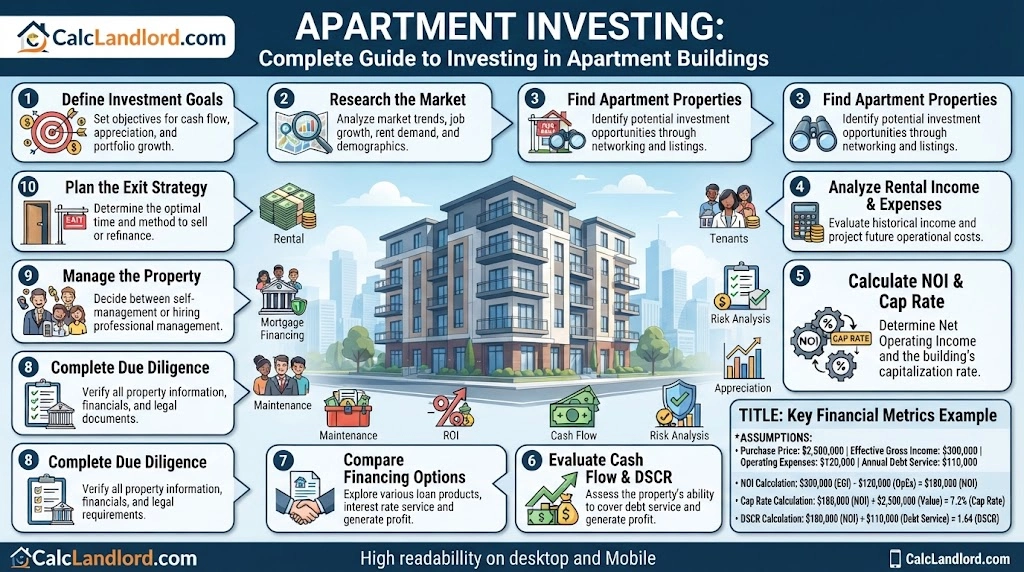
Apartment Investing vs. Single-Family Rental Investing
Apartment investing and single-family rental investing can both produce rental income, but the economics and operating model are different.
| Factor | Apartment / Multifamily | Single-Family Rental |
| Units per property | Multiple | Usually one |
| Revenue sources | Multiple tenants | Usually one tenant |
| Vacancy impact | Spread across units | Can eliminate most property income |
| Management | Often more complex | Usually simpler |
| Financing | Depends on size and property | Often residential financing |
| Scaling | Multiple units per acquisition | Usually one unit per acquisition |
| Underwriting | Often more detailed | Usually simpler |
| Capital needs | Can be substantial | Can be lower |
| Maintenance | More systems and units | Fewer units |
| Operations | More business-like | Often simpler |
Small multifamily is an important middle ground
A duplex, triplex, or fourplex can sit between a single-family rental and a large apartment complex.
For some investors, this structure provides:
- Multiple rental units
- More diversified rental income
- Potentially manageable property size
- A path into multifamily ownership
The financing treatment can also differ from larger apartment properties. Current multifamily guidance distinguishes 2–4-unit properties from 5+ unit properties, with larger properties generally moving into commercial multifamily financing territory.
Which should you analyze?
Rather than asking whether apartments are universally better than single-family rentals, compare:
- Required capital
- Expected cash flow
- Financing terms
- Management requirements
- Vacancy exposure
- Capital expenditure requirements
- Market demand
- Your available time
- Your risk capacity
- Your long-term portfolio objective
The best structure for one investor may be inappropriate for another.
How Much Money Do You Need to Start Apartment Investing?
There is no universal dollar amount required to start apartment investing.
Your capital requirement depends on the property price, financing structure, equity requirement, closing costs, repairs, reserves, lender requirements, and whether you invest directly or through a partnership.
Do not budget only for the down payment
A more realistic acquisition budget may include:
- Down payment or required equity
- Closing costs
- Loan fees
- Appraisal
- Inspection
- Environmental reports where applicable
- Legal and title costs
- Insurance
- Initial repairs
- Renovation capital
- Operating reserves
- Replacement reserves
- Working capital
Commercial/multifamily acquisition guidance similarly emphasizes budgeting for expenses beyond the initial equity contribution, including financing, appraisal, environmental, legal/title, and insurance costs.
Example capital requirement
Imagine a hypothetical apartment property priced at:
$4,000,000
Suppose the investment requires:
- 25% equity = $1,000,000
- Closing and financing costs = $100,000
- Initial capital improvements = $150,000
- Operating reserves = $150,000
Estimated initial capital requirement:
$1,000,000 + $100,000 + $150,000 + $150,000 = $1,400,000
The exact amounts would depend on the transaction.
The lesson is more important than the example:
Apartment investing requires enough liquidity to own and operate the property—not merely enough money to close.
Direct vs. passive capital requirements
You can participate in apartment investing through:
- Direct Ownership
- Joint ventures
- Partnerships
- Syndications or other investment structures
Passive structures may reduce the operational burden, but they do not eliminate investment risk. Investors should review the offering documents, fees, ownership structure, debt, distribution mechanics, liquidity restrictions, conflicts, and exit assumptions before committing capital.
How to Start Apartment Investing: A Step-by-Step Roadmap
A repeatable process can help prevent emotional or rushed acquisitions.
Step 1: Define your investment objective
Decide what you are actually trying to accomplish.
Possible objectives include:
- Current cash flow
- Long-term equity growth
- Appreciation
- Portfolio expansion
- Diversification
- Passive real estate exposure
- Value creation through improvements
Your objective should influence the type of property you investigate.
Step 2: Establish a buy box
A buy box defines what you will and will not consider.
For example:
- Target city or metro
- Neighborhoods
- Unit count
- Purchase-price range
- Property age
- Minimum occupancy
- Minimum projected DSCR
- Renovation budget
- Maximum leverage
- Target hold period
A buy box saves time because you can quickly reject properties that do not fit.
Step 3: Choose a target market
Analyze the market before becoming emotionally attached to a property.
Look at:
- Population trends
- Employment
- Major employers
- Household formation
- Rental demand
- Rent levels
- Competing properties
- New construction
- Property taxes
- Insurance costs
- Local regulations
- Neighborhood infrastructure
Step 4: Build your professional team
Depending on the transaction, your team may include:
- Multifamily broker
- Lender
- Property manager
- Real estate attorney
- CPA or tax professional
- Inspector
- Contractor
- Insurance professional
- Environmental consultant
- Appraiser
Larger multifamily transactions can require substantial third-party analysis. Fannie Mae’s multifamily underwriting materials, for example, describe review of property financial and physical quality, sponsor, market conditions, and third-party reports such as appraisals, environmental reports, physical-needs assessments, and borrower financial information.
Step 5: Build deal flow
Find properties through:
- Commercial brokers
- Online marketplaces
- Direct-to-owner outreach
- Local networking
- Property managers
- Investor relationships
- Referrals
- Off-market opportunities
Do not make the first property you see the benchmark for every property that follows.
Step 6: Screen quickly
Before spending significant money on due diligence, review:
- Asking price
- Unit count
- Current rents
- Occupancy
- Gross income
- Operating expenses
- Estimated NOI
- Financing assumptions
- Major repairs
- Location
Step 7: Underwrite
Build your own financial model rather than blindly accepting the seller’s pro forma.
Step 8: Perform due diligence
Verify the property’s financial, physical, legal, environmental, and market condition.
Step 9: Negotiate
If your verified information differs materially from the initial underwriting, reassess price and terms.
Step 10: Close and operate
After acquisition, compare actual performance against the original business plan.
Your investment analysis should continue after closing.
How to Find and Evaluate Apartment Investment Properties
Finding an apartment property is only the beginning. The real work is deciding whether the property deserves further investigation.
Start with the market
Ask:
- Who rents in this area?
- What types of units do they want?
- What competing properties are nearby?
- What rents are actually being achieved?
- What new supply is coming?
- Are major employers expanding or shrinking?
- Are insurance and taxes becoming more expensive?
Recent multifamily research guidance emphasizes analyzing both macro and micro-market conditions before evaluating individual properties.
Compare properties on normalized metrics
A property with 50 units and a $10 million price cannot be evaluated meaningfully by price alone.
Calculate:
Price per unit = Purchase Price ÷ Number of Units
For example:
$10,000,000 ÷ 50 = $200,000 per unit
But price per unit should not replace income-based analysis.
Two properties can have identical price-per-unit figures while producing very different NOI.
Use a property-screening checklist
| Question | What to verify |
| Occupancy | Physical and economic occupancy |
| Rent | Current rent roll vs. market rents |
| Expenses | Actual historical operating expenses |
| NOI | Recalculated from verified figures |
| Condition | Roof, HVAC, plumbing, electrical, structure |
| Market | Demand, supply, jobs and rents |
| Financing | Loan amount, rate, DSCR, LTV and term |
| Insurance | Current quote and coverage |
| Taxes | Current and potential future liability |
| Capital needs | Immediate and future replacements |
Use CalcLandlord for initial screening
CalcLandlord currently provides a Market Comparison Tool for comparing market-level cap rates and metrics, as well as a Unit Economics Calculator designed for multi-unit properties.
These tools can help organize preliminary comparisons, but they should not replace property-specific due diligence.
How to Analyze an Apartment Building Before You Buy
Apartment underwriting converts property information into an investment model.
The purpose is not to make a property look profitable.
The purpose is to determine what happens if your assumptions are correct—and what happens if they are wrong.
Step 1: Verify rental income
Review:
- Current rent roll
- Lease terms
- Occupancy
- Delinquencies
- Concessions
- Other income
- Historical collections
Do not assume every occupied unit is producing full contractual rent.
Step 2: Estimate effective gross income
A simplified calculation is:
Effective Gross Income = Potential Rental Income − Vacancy/Collection Loss + Other Income
Suppose:
- Potential rent = $500,000
- Vacancy/collection loss = $25,000
- Other income = $15,000
Then:
EGI = $500,000 − $25,000 + $15,000 = $490,000
Step 3: Verify operating expenses
Common operating expenses include:
- Property taxes
- Insurance
- Repairs
- Maintenance
- Property management
- Utilities
- Payroll
- Landscaping
- Marketing
- Administrative costs
- Legal/professional costs
Step 4: Calculate NOI
NOI = Effective Gross Income − Operating Expenses
If EGI is $490,000 and operating expenses are $190,000:
NOI = $300,000
Step 5: Analyze financing separately
Do not mix operating performance with financing performance.
A property can have strong NOI but poor leveraged cash flow because the debt is too expensive or too large.
Step 6: Stress-test the model
Run alternative assumptions for:
- Vacancy
- Rent growth
- Expense growth
- Insurance
- Taxes
- Interest rates
- Renovation costs
- Exit cap rate
- Sale price
This is one of the most useful information-gain steps because it shows how dependent your projected return is on assumptions.
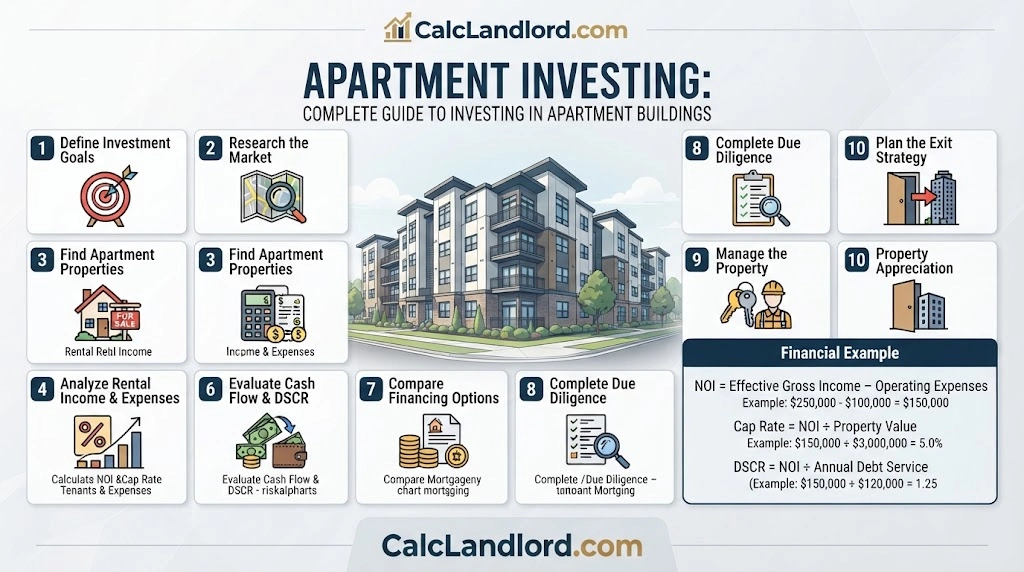
Apartment Investing Metrics: NOI, Cap Rate, DSCR, ROI & More
No single metric can fully describe an apartment investment.
Use several metrics together.
Net Operating Income
NOI = Effective Gross Income − Operating Expenses
NOI measures property-level operating performance before financing costs and income taxes.
Cap rate
Cap Rate = NOI ÷ Property Value
Suppose:
- NOI = $300,000
- Property value = $4,000,000
Then:
$300,000 ÷ $4,000,000 = 7.5%
Cap rate is useful for comparing income relative to property value, but it does not account for financing or the investor’s exact cash contribution.
Cash flow
A simplified leveraged calculation is:
Cash Flow Before Tax = NOI − Debt Service − Other Applicable Cash Costs
If:
- NOI = $300,000
- Debt service = $220,000
- Other applicable cash costs = $20,000
Then:
Cash flow = $60,000
Cash-on-cash return
Cash-on-Cash Return = Annual Pre-Tax Cash Flow ÷ Total Cash Invested × 100
If annual cash flow is $60,000 and total cash invested is $1,000,000:
$60,000 ÷ $1,000,000 = 6%
CalcLandlord currently provides a Cash-on-Cash Return Calculator that is designed to measure annual cash return against actual cash invested.
DSCR
A simplified DSCR formula is:
DSCR = NOI or Underwritten Net Cash Flow ÷ Annual Debt Service
For example:
- NOI/underwritten cash flow = $300,000
- Annual debt service = $240,000
DSCR = 1.25
Lenders can use DSCR as part of multifamily underwriting. Fannie Mae’s current guide defines underwritten DSCR in relation to underwritten net cash flow and annual debt service.
Importantly, there is no universal DSCR threshold for every loan. Requirements vary by lender, product, property, borrower, and transaction.
LTV
LTV = Loan Amount ÷ Property Value × 100
A $2.5 million loan against a $4 million property gives:
62.5% LTV
LTV and DSCR interact with financing risk. Lower leverage generally means more equity is required, while higher leverage can increase sensitivity to changes in property performance and financing conditions.
ROI
ROI can combine multiple sources of return, depending on how the calculation is defined.
CalcLandlord’s current ROI tool considers cash flow, appreciation, and principal paydown in its model.
Always check what a calculator includes before comparing two ROI figures.
IRR
Internal rate of return incorporates the timing of cash flows over an investment period.
IRR can be useful for comparing long-term investment models, but it is highly dependent on assumptions about:
- Future cash flow
- Holding period
- Refinancing
- Sale price
- Exit cap rate
- Timing of capital contributions and distributions
A projected IRR is therefore not a guaranteed return.
How to Finance an Apartment Building
Apartment financing depends heavily on the property’s size, financial performance, location, borrower, loan program, leverage, and business plan.
Potential financing sources include:
- Banks
- Credit unions
- Agency multifamily programs
- Commercial lenders
- Private lenders
- Bridge lenders
- Equity partners
- Joint ventures
Small multifamily financing
Two-to-four-unit properties may have access to residential financing options that are different from larger apartment properties.
Larger apartment financing
Five-or-more-unit properties generally require more commercial-style analysis and financing.
Lenders may examine:
- Property NOI
- DSCR
- LTV
- Property condition
- Market
- Sponsor/borrower experience
- Liquidity
- Net worth
- Credit
- Business plan
For example, Fannie Mae’s published conventional multifamily credit-risk material describes typical core underwriting standards including a minimum DSCR of 1.25x and maximum LTV of 80%, while also noting that individual loan products can have different requirements.
That should not be interpreted as a universal requirement for every apartment loan.
Financing terms to compare
Do not compare loans only by interest rate.
Review:
| Loan factor | Why it matters |
| Interest rate | Affects debt service |
| Loan amount | Determines leverage |
| LTV | Measures debt relative to value |
| DSCR | Measures debt-service coverage |
| Amortization | Affects payment and principal reduction |
| Term | Determines when financing must be refinanced or repaid |
| Prepayment | Can affect exit/refinancing flexibility |
| Recourse | Determines potential borrower liability |
| Reserves | Affects required cash |
| Fees | Increase acquisition cost |
| Rate structure | Affects interest-rate exposure |
Use a mortgage calculator
CalcLandlord currently provides a Mortgage Calculator that models monthly payment, total interest, and total amount paid.
For an apartment acquisition, however, the calculator should be only one component of the underwriting model.
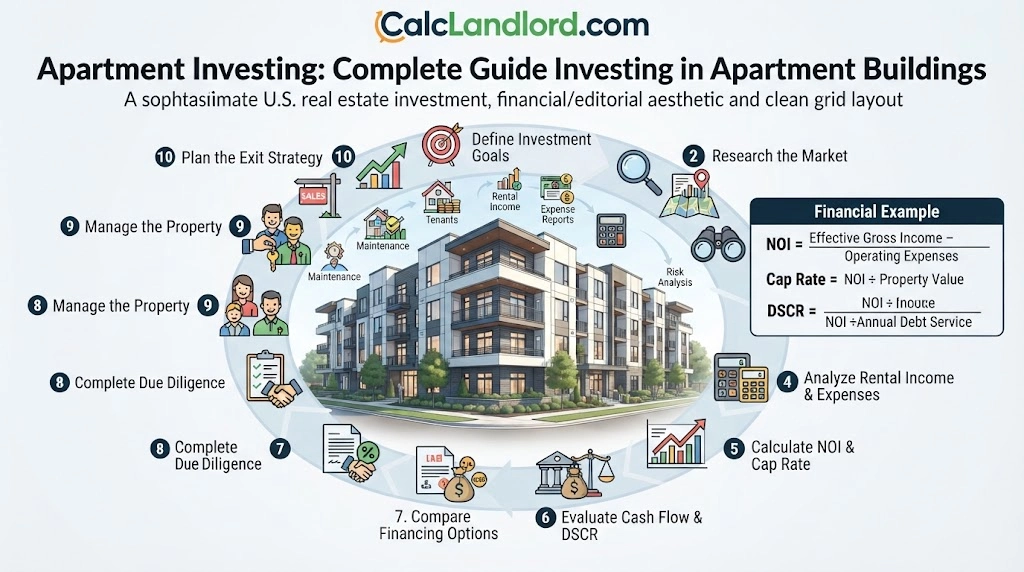
Apartment Building Due Diligence: What to Check Before Closing
Due diligence is the process of verifying the assumptions behind your investment before completing the acquisition.
Current multifamily due-diligence guidance commonly emphasizes financial records, rent rolls, physical inspections, market research, environmental matters, legal issues, and tenant/collection information.
Financial due diligence
Request and analyze:
- Current rent roll
- Historical operating statements
- T-12 operating statement
- Historical rent collections
- Delinquency reports
- Lease information
- Utility bills
- Property tax bills
- Insurance information
- Service contracts
- Capital expenditure history
Where practical, compare multiple years of information rather than relying exclusively on one recent statement.
Rent-roll verification
Compare:
Rent roll → leases → payment history → bank deposits/financial records
The goal is to determine whether reported income is actually being collected.
Physical due diligence
Inspect:
- Roof
- HVAC
- Plumbing
- Electrical
- Foundation
- Exterior
- Windows
- Parking
- Common areas
- Unit interiors
- Life-safety systems
- Appliances
- Landscaping
- Drainage
A building with attractive financials can become a poor investment if major capital systems require immediate replacement.
Environmental due diligence
Depending on the property and financing, environmental assessments may be relevant.
Do not assume a property is environmentally clean because it appears well maintained.
Legal due diligence
Review:
- Title
- Zoning
- Permits
- Code compliance
- Leases
- Service contracts
- Pending litigation
- Existing violations
- Local rental requirements
Landlord-tenant and property regulations vary by state and locality, so local legal review may be necessary.
Market due diligence
Study:
- Nearby competitors
- Asking rents
- Achieved rents where available
- Concessions
- Vacancy
- New construction
- Employment
- Population trends
- Neighborhood changes
A recent BiggerPockets discussion also emphasizes the importance of micro-market analysis because performance can differ substantially even within the same ZIP code.
The most important question
At the end of due diligence, ask:
What did I discover that was different from my original underwriting?
If the answer is “a lot,” update the model before deciding whether to proceed.
Active vs. Passive Apartment Investing: Which Structure Fits Your Goals?
Apartment investing can involve direct ownership or passive participation.
Active apartment investing
An active investor may be involved in:
- Finding deals
- Negotiating
- Financing
- Raising equity
- Renovations
- Property management
- Budgeting
- Leasing
- Refinancing
- Selling
The major advantage is control.
The major trade-off is responsibility.
Passive apartment investing
A passive investor contributes capital while another party handles much of the acquisition and operation.
Potential advantages include:
- Less day-to-day management
- Access to larger properties
- Professional operating teams
- Portfolio diversification opportunities
Potential risks include:
- Sponsor/operator risk
- Limited control
- Fees
- Illiquidity
- Debt risk
- Property risk
- Conflicts of interest
- Distribution uncertainty
Questions to ask before investing passively
Review:
- Who controls the investment?
- What is the fee structure?
- How is cash distributed?
- What happens if the project needs more capital?
- What debt is being used?
- What is the expected hold period?
- What are the exit assumptions?
- What rights do investors have?
- How can an investor exit?
- What happens under the downside case?
Passive investing is not the same as risk-free investing.
Apartment Investing Strategies: Buy-and-Hold, Value-Add & More
Different investors use different operating strategies.
Buy-and-hold
The investor acquires a property and holds it for an extended period.
The investment thesis may depend on:
- Rental income
- Long-term appreciation
- Principal reduction
- Moderate rent growth
- Stable occupancy
Value-add
A value-add strategy seeks to improve property performance through physical or operational changes.
Examples may include:
- Unit renovations
- Better management
- Improved tenant retention
- Common-area improvements
- Utility changes
- Expense management
The important question is:
What specific change will create measurable additional NOI or improve the property’s marketability?
Core
Core properties are generally stabilized assets with established operations.
Core-plus
Core-plus properties may have stable characteristics while offering some opportunity for improvement.
Opportunistic
Opportunistic investments may involve substantial renovation, redevelopment, repositioning, or other significant changes.
These strategies can carry materially different levels of operational and financial risk.
Strategy selection framework
| Strategy | Main focus | Potential challenge |
| Buy & hold | Long-term ownership | Slow value creation |
| Value-add | Improve operations/property | Renovation and execution risk |
| Core | Stabilized income | Higher acquisition pricing can reduce yield |
| Core-plus | Moderate improvement | Requires disciplined execution |
| Opportunistic | Major transformation | Greater complexity and risk |
No strategy should be selected solely because it promises a higher projected return.
How Apartment Investors Make Money: Cash Flow, Appreciation & Equity
Apartment investment returns can come from several sources.
1. Rental cash flow
If property income exceeds operating expenses and debt service, the property may generate positive cash flow before applicable taxes and other owner-level items.
2. Appreciation
The property’s market value may increase.
However, future appreciation is uncertain.
Do not build an acquisition thesis around guaranteed appreciation.
3. NOI growth
If an investor legitimately increases NOI, the property’s income-producing value may increase.
For example:
Initial NOI:
$250,000
New NOI:
$300,000
Increase:
$50,000
At a hypothetical 6.25% cap rate, the simplified value contribution of that additional NOI would be:
$50,000 ÷ 0.0625 = $800,000
This is a mathematical illustration, not a guarantee that the property will actually sell for $800,000 more.
4. Principal reduction
With amortizing debt, part of the debt payment may reduce principal.
That can increase owner equity over time, although the investor is using cash flow to service the debt.
5. Tax considerations
Rental real estate can involve deductions and depreciation under federal tax rules, subject to applicable limitations and circumstances.
The IRS’s current Publication 527 covers rental income, deductible expenses, depreciation, passive-activity rules, at-risk rules, and reporting considerations for residential rental property.
Tax treatment should be evaluated with a qualified tax professional.
Think in terms of total return
A property might have:
- Moderate cash flow
- Principal paydown
- NOI growth
- Appreciation
- Tax effects
But these sources should not be double-counted.
Build your model carefully so every return component is accounted for once.
Apartment Investing Risks, Common Mistakes, and Stress Testing
Apartment investing involves financial and operational risks.
The objective is not to eliminate every risk.
The objective is to understand which risks exist, estimate their impact, and decide whether the investment remains workable.
Vacancy risk
Higher vacancy reduces rental income.
Stress test: Model vacancy higher than the base case.
Rent-growth risk
Projected rent growth may not materialize.
Stress test: Use flat rents or slower growth in your downside scenario.
Expense risk
Insurance, repairs, utilities, taxes, payroll, and maintenance can increase.
Stress test: Increase operating expenses and see how NOI changes.
Interest-rate risk
Variable-rate debt or refinancing can create higher future debt costs.
Stress test: Model a higher refinancing rate where relevant.
Property-condition risk
Major systems can require expensive replacement.
Stress test: Build realistic capital expenditure assumptions.
Insurance risk
Insurance costs and availability can significantly affect apartment operating expenses.
Obtain property-specific insurance information rather than relying entirely on historical expenses.
Leverage risk
Debt can magnify both gains and losses.
A highly leveraged property may become difficult to operate if NOI falls.
Market risk
Rental demand, employment, new supply, regulations, and local economic conditions can change.
Management risk
Poor management can result in:
- Higher vacancy
- Slow collections
- Excessive maintenance costs
- Tenant turnover
- Poor tenant experience
- Lower NOI
Common mistakes
Mistake 1: Trusting the seller’s pro forma
Build your own underwriting.
Mistake 2: Ignoring T-12 financials
Historical operating data helps establish what the property has actually been doing.
Mistake 3: Assuming all rent increases are achievable
Verify rent comps and tenant demand.
Mistake 4: Underestimating insurance
Obtain current quotes where possible.
Mistake 5: Ignoring capital expenditures
Roof, HVAC, plumbing, electrical, parking, and other systems can require significant capital.
Mistake 6: Using only one scenario
Create base, downside, and upside cases.
Mistake 7: Confusing projected returns with guaranteed returns
A spreadsheet is not a guarantee.
A simple three-scenario model
| Assumption | Downside | Base | Upside |
| Vacancy | Higher | Expected | Lower |
| Rent growth | Lower | Moderate | Higher |
| Expenses | Higher | Expected | Controlled |
| Repairs | Higher | Expected | Lower |
| Financing | More expensive | Expected | Favorable |
| Exit value | Lower | Expected | Higher |
The most useful question is:
Does the investment remain manageable when reasonable assumptions become less favorable?
If the entire investment depends on the upside case, investigate the deal much more carefully.
People Also Ask
A: Apartment investing can be learned by beginners, but larger multifamily properties involve more complicated underwriting, financing, management, and due diligence than many single-family rentals.
A beginner can reduce the learning curve by studying underwriting, working with experienced professionals, starting with smaller multifamily properties, or partnering with experienced operators.
A: There is no universal amount. Required capital depends on the purchase price, financing structure, equity requirement, closing costs, renovations, reserves, and lender requirements.
A: Yes. Passive investment structures can allow an investor to contribute capital while another party handles operations. However, passive investments still carry property, market, financing, sponsor, liquidity, and structural risks.
A: There is no single metric that answers every investment question.
NOI helps measure property operations. Cap rate relates NOI to value. DSCR measures debt-service coverage. Cash-on-cash return measures cash return relative to invested cash. IRR incorporates the timing of cash flows.
Use them together.
A: NOI, or net operating income, is generally the property’s effective operating income minus operating expenses, before debt service and income taxes.
Apartment Investing Decision Checklist
Before buying or investing in an apartment property, work through this checklist.
Market
- Is there sustainable rental demand?
- Are employment and population trends supportive?
- What competing properties are nearby?
- What new supply is coming?
Property
- What condition is the building in?
- What major capital projects are coming?
- Are the units competitive?
- Are there deferred-maintenance issues?
Income
- Does the rent roll reconcile?
- Are collections consistent?
- Are projected rents supported by comparable properties?
- Are other income sources legitimate and sustainable?
Expenses
- Are taxes accurate?
- Is insurance current?
- Are repairs realistic?
- Is management properly budgeted?
- Are utilities correctly allocated?
Financing
- What is the loan amount?
- What is the LTV?
- What is the DSCR?
- Is the interest rate fixed or variable?
- What happens at loan maturity?
- Are there prepayment provisions?
Due diligence
- Have financials been verified?
- Has the property been inspected?
- Have legal issues been reviewed?
- Have environmental requirements been considered?
- Have market assumptions been tested?
Risk
- What happens if vacancy increases?
- What happens if expenses rise?
- What happens if rents remain flat?
- What happens if refinancing costs more?
- What happens if a major system fails?
Exit
- Is the planned hold period realistic?
- Could the property be refinanced?
- Who might buy it later?
- Are the exit assumptions conservative enough?
If you cannot explain the investment clearly after answering these questions, continue researching before committing capital.
Final Thoughts
Apartment Investing is best understood as a property-level business decision, not simply a search for a building with high rent.
The core process is:
Choose your strategy → select a market → define your buy box → source deals → screen properties → underwrite → arrange financing → perform due diligence → close → operate → monitor → refinance, hold, or sell.
The most important numbers to understand include:
- Effective gross income
- NOI
- Cap rate
- Cash flow
- DSCR
- LTV
- Cash-on-cash return
- IRR
- Capital expenditures
- Vacancy
- Operating expenses
- Total cash invested
But numbers only become useful when they are based on verified information.
Before making an apartment investment, compare the seller’s claims with actual financial records, inspect the physical property, verify market rents, understand the financing, investigate insurance and taxes, and stress-test the investment against less favorable assumptions.
For tax matters, the IRS’s current Publication 527 provides federal guidance on rental income, expenses, depreciation, passive-activity rules, at-risk rules, and reporting.
For financing, lender requirements vary. Current Fannie Mae multifamily materials demonstrate why DSCR, LTV, property quality, market conditions, sponsor characteristics, and third-party reports can all matter in underwriting.
The goal is not to make every apartment deal look profitable.
The goal is to determine which assumptions drive the investment, what could cause the numbers to fail, how much capital you could need, and whether the potential outcome justifies the risks you are taking.
