
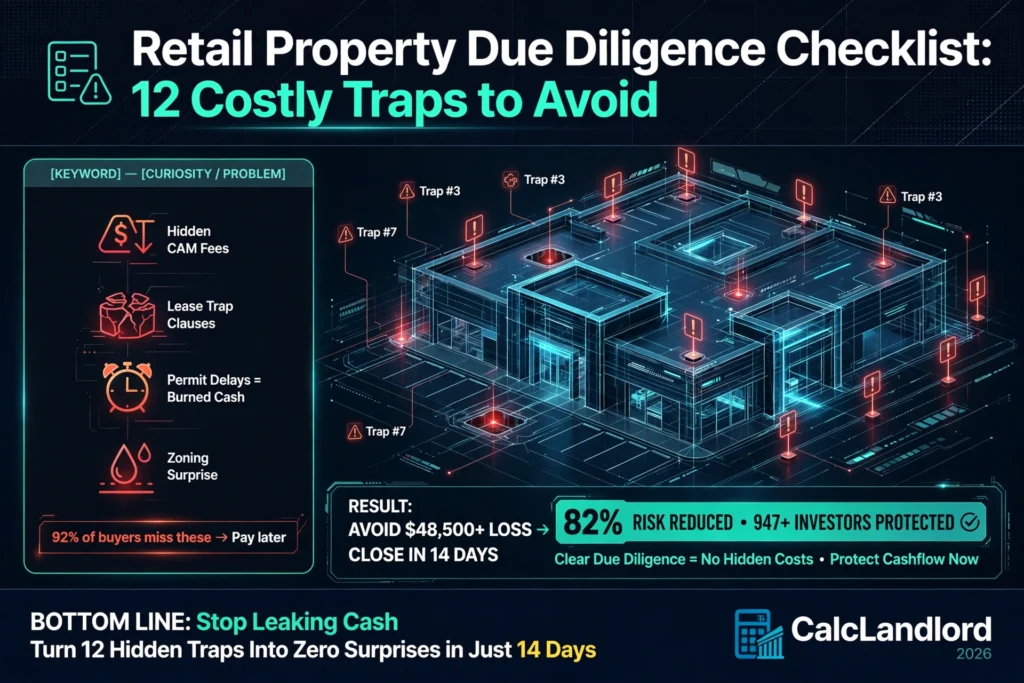
Retail Property Due Diligence Checklist: What to Verify Before You Buy
Retail deals look straightforward on paper: a stable rent roll, a seller’s net operating income figure, and a building that appears in good shape. Then the diligence begins. A grocery anchor’s lease turns out to contain a co-tenancy clause that could reduce rent for five smaller tenants if it leaves. A CAM cap means the owner recovers far less than the offering memorandum assumes. A parking agreement quietly limits the expansion you planned. Most of these problems are discoverable before closing, but only if you know exactly what to check and when. This guide shows you how to verify each lease, expense, and legal right against the documents, and how to turn every finding into a clear decision: proceed, renegotiate, seek more time, or walk away.
A Retail Property Due Diligence checklist helps you confirm that the property you agree to buy matches the leases, income, physical condition, legal rights, and environmental profile the seller described. Retail deals are unusually interdependent. One anchor departure can trigger rights for other tenants, an exclusive-use clause can limit your replacement options, and a CAM cap can stop you from recovering costs the seller’s model assumes tenants will pay.
This guide follows the order most U.S. buyers should work through a retail acquisition: set deadlines, request documents, verify leases and income, rebuild expenses, inspect the building, review environmental and title issues, and then decide whether to proceed. It is educational information, not legal, tax, engineering, environmental, or investment advice.
What Retail Property Due Diligence Means
Due diligence is the investigation a buyer completes between signing a purchase agreement and closing. It answers four questions:
- What exactly am I acquiring?
- Do enforceable leases and actual collections support the income?
- What liabilities, restrictions, and capital costs will I inherit?
- Does the investment still meet my goals after accounting for those findings?
Collecting documents is not enough. The records must agree with each other and with the physical property. If the rent roll matches the offering memorandum but conflicts with the executed leases, that is a problem to resolve, not a confirmation.
Why Retail Deals Carry Risks Generic Checklists Miss
A general commercial checklist will tell you to review leases, financials, and the building. It may not explain why a grocery anchor’s lease terms can affect five smaller tenants, or why shared parking and access rights determine whether a planned expansion is possible.
Retail risk tends to cluster in four areas: tenant interdependence, shared operating costs, shared physical infrastructure, and the legal rights that let tenants and owners use common areas. Start your review there.
The Core Retail Checklist at a Glance
Assign one responsible person and one deadline to each item.
| Workstream | What to request or inspect | What to verify | Typical lead |
| Contract | Purchase agreement and amendments | Diligence, objection, and closing dates | Attorney |
| Title and survey | Title commitment, survey, easements | Boundaries, access, recorded restrictions | Attorney, surveyor |
| Leases | Executed leases, amendments, side letters, guaranties | Actual rights and obligations | Attorney, acquisitions |
| Income | Rent roll, collection history, aged receivables | Rent billed versus rent collected | Underwriter |
| Expenses and CAM | Operating statements, reconciliations, invoices | Recoverability, caps, exclusions | Accountant |
| Physical condition | Property condition assessment, roof and system reports | Repair and replacement timing and cost | Engineer |
| Environmental | Phase I ESA and prior reports | Findings, gaps, and any further investigation | Environmental professional |
| Zoning and permits | Approvals, certificates of occupancy, violation notices | Current and intended use | Attorney, land-use specialist |
| Insurance | Policies, loss runs, buyer quotes | Coverage and premium assumptions | Insurance broker |
| Market | Comparable leases, competing centers | Rent levels, downtime, replacement tenants | Leasing specialist |
| Closing | Estoppels, assignments, prorations | Conditions and transfer requirements | Attorney, closing team |
Keep an exception log. An item is complete only when the question it addresses has been answered, not when a document arrives.
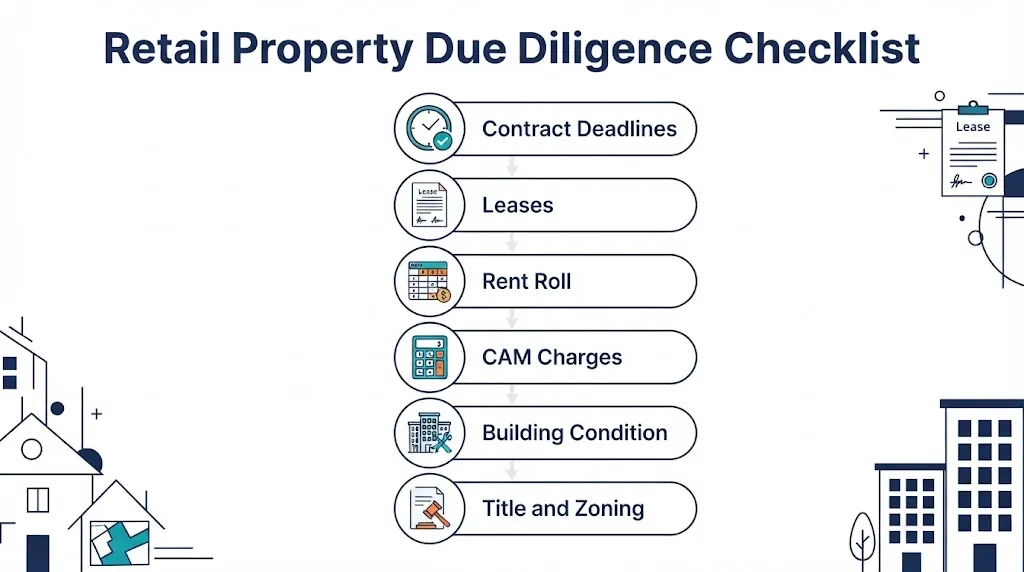
Setting Your Deadlines and Deal Protections
Before ordering reports, have counsel review the purchase agreement and record:
- When the diligence period begins and ends
- The deadline for title and survey objections
- What inspection access the seller allows
- Whether contacting tenants requires seller consent
- When the earnest money becomes nonrefundable
- Any extension or termination rights
Do not assume missing documents automatically extend your review period. If you need that protection, negotiate it into the agreement, for example by starting the diligence period only after specified seller deliverables are delivered. That is a negotiated term, not a default right.
The First-Week Document Request List
Send a complete request early. Missing documents often signal a larger problem.
Ownership and legal: Title policy or commitment, legal description, existing surveys, easements, covenants, zoning approvals, certificates of occupancy, and any violation or litigation notices.
Leases and tenants: Every executed lease, plus amendments, extensions, assignments, guaranties, and side letters. Also request a certified rent roll, collection and delinquency history, security-deposit records, and any default or dispute notices.
Financial and operating: Operating statements and general ledger for the historical period the seller can provide, current-year results, property tax bills, utility bills, CAM reconciliations, insurance records, capital expenditure history, and service and management contracts.
Physical and environmental: Prior condition reports, roof and HVAC records, warranties, and any prior Phase I or Phase II reports.
The appropriate look-back period depends on the transaction and the lender’s requirements. Confirm it with your team rather than assuming a fixed number of years.
Reading Retail Leases as Income Documents
Retail income depends on what the leases say, not on the occupancy percentage. For each tenant, create a lease abstract recording:
- Tenant legal entity and guarantor
- Premises and rentable area
- Term, commencement, and expiration dates
- Base-rent schedule
- Free rent, credits, and concessions
- Renewal and termination rights
- Percentage rent, if any
- CAM, tax, and insurance obligations
- Repair and replacement responsibilities
- Assignment and subletting rules
- Permitted use and exclusive-use protection
- Co-tenancy provisions
- Outstanding landlord work or allowances
Check each abstract against the executed lease and every amendment. Side letters and amendments often change the economics, and a rent roll often omits them.
Co-Tenancy, Exclusive-Use, and Anchor Risk
These clauses create some of the most important retail-specific risks.
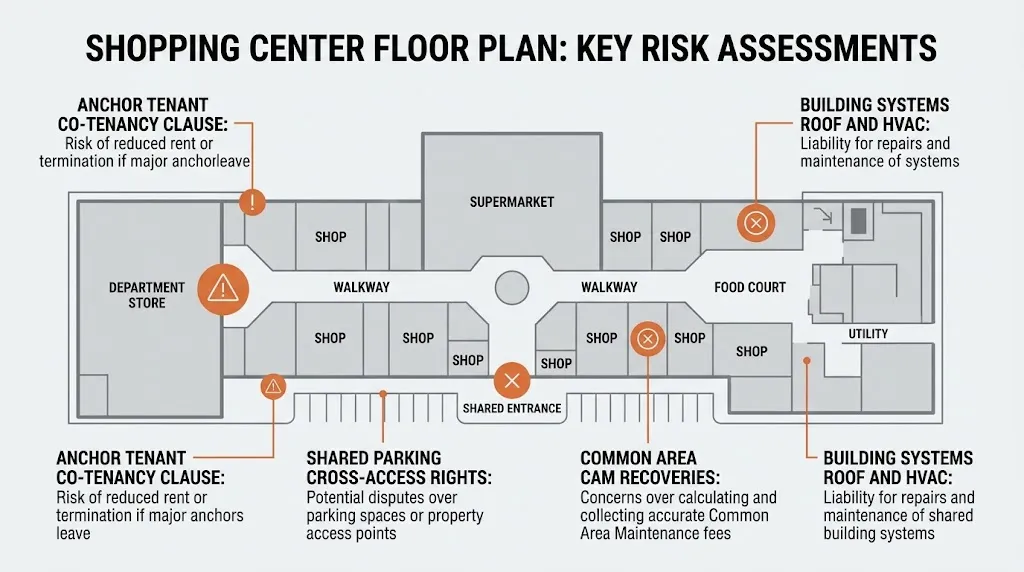
Co-tenancy provisions can condition a tenant’s obligations on the presence of specified anchors or on minimum occupancy levels. If the condition fails, the remedy may include reduced rent, alternative rent, or termination rights, depending on the lease.
For each relevant clause, record:
- The triggering condition
- Whether the condition exists now or is close to occurring
- Any notice and cure requirements
- The remedy available to the tenant
- Which other tenants and income streams could be affected
Exclusive-use clauses can restrict you from leasing space to businesses that compete with a protected tenant. Before underwriting a replacement tenant, confirm the proposed use fits every restriction. A vacant unit is not automatically available for every commercially attractive use.
Verifying the Rent Roll Against Collected Cash
For each tenant, compare four figures:
- Rent shown on the rent roll
- Rent required by the executed documents
- Amounts billed
- Amounts actually collected
Investigate every difference. A scheduled rent increase is not cash in hand if a concession, amendment, or collection problem changes the result.
Also review tenant concentration. If one tenant produces a large share of income, its credit, lease expiration, and guaranty deserve close attention. Payment history and financial information are stronger evidence than a seller’s description of tenant health.
Testing CAM Recoveries and Reconciliations
Common area maintenance (CAM) provisions determine which shared operating costs tenants reimburse. Review each lease for:
- Recoverable and excluded expenses
- Each tenant’s allocation percentage
- Expense caps
- Administrative or management fees
- Reconciliation timing and procedures
- Audit rights
- Open disputes
Do not assume every tenant pays the same share of every expense. If the seller’s model assumes full recovery but several leases cap recoveries or exclude certain costs, the model overstates income. Recalculate the most recent reconciliation and compare it with what was actually billed and collected.
How Verified Findings Change NOI and Value
Net operating income (NOI) is generally property income minus operating expenses, before debt service and most capital costs.
Formula: NOI = Effective Gross Income − Operating Expenses
Hypothetical example (illustrative figures, not market benchmarks):
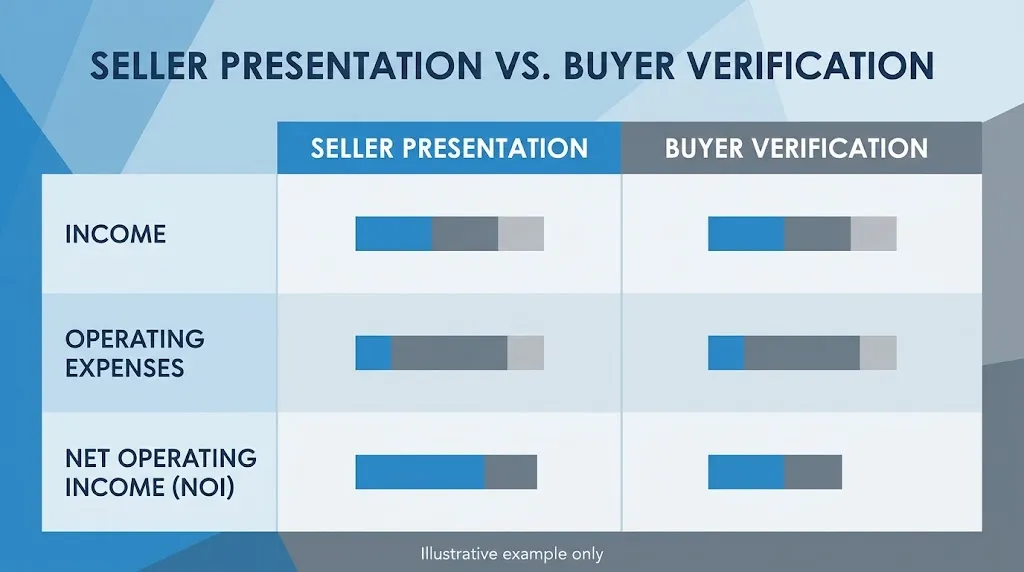
| Item | Seller presentation | Buyer verification |
| Annual property income, including reimbursements | $720,000 | $700,000 |
| Annual operating expenses | $240,000 | $280,000 |
| NOI | $480,000 | $420,000 |
Verified NOI is $60,000 lower than the seller presented. Using a simplified illustrative capitalization rate of 7.5%, held constant for comparison:
- Seller-presented value: $480,000 ÷ 0.075 = $6,400,000
- Verified value: $420,000 ÷ 0.075 = $5,600,000
- Indicated difference: $800,000
This is a sensitivity exercise, not an appraisal. Real cap rates depend on market evidence, property quality, lease terms, and financing. If CalcLandlord offers a cap rate or NOI calculator, readers can test their own assumptions there, provided the calculator is live and its inputs match this formula.
Reforecast buyer-specific costs too. Property taxes may be reassessed after sale, insurance quotes may differ from the seller’s policy, and management costs may change. Model capital expenditures and re-leasing costs separately so they do not disappear simply because they fall outside the NOI line.
Inspecting the Building and Shared Infrastructure
Commission a property condition assessment and specialist reviews where warranted. Key areas include:
- Roofs and drainage
- Structure and exterior envelope
- HVAC
- Electrical capacity and distribution
- Plumbing and sewer systems
- Fire and life-safety systems
- Parking, paving, curbs, and sidewalks
- Exterior lighting and signage
- Accessibility
- Vacant-unit condition
Shared infrastructure deserves particular attention. A roof, parking lot, or main sewer line may serve several tenants, so one failure can affect multiple leases and cost allocations.
An inspection identifies a defect, but the lease determines who pays for it. Do not assume a tenant’s routine maintenance duty includes replacing a failed system. Read the actual repair and replacement allocation, then turn each finding into a capital schedule showing scope, cost range, timing, disruption, recoverability, and supporting contractor or engineer evidence.
Environmental Review: Phase I and Historical Uses
Retail sites may carry environmental exposure from current or former uses, such as dry cleaning, automotive service, or fuel storage, and from neighboring properties.
For U.S. acquisitions, the Phase I environmental site assessment (ESA) is the standard starting point. EPA’s All Appropriate Inquiries rule sets the framework, and ASTM E1527-21 is a widely used standard that EPA recognizes as meeting that rule. Under these standards, certain components must fall within set time windows before acquisition. Have your environmental professional confirm the dates rather than relying on the report’s cover date.
Two shortcuts to avoid:
- “The property looks clean, so no further review is needed.” A visual inspection cannot identify many subsurface conditions.
- “A former dry cleaner always requires a specific test.” Historical use warrants careful evaluation, but the next step depends on the Phase I findings and the site’s circumstances.
Ask the environmental professional to explain findings, uncertainties, and recommended additional work in writing. Also determine whether asbestos, lead-based paint, mold, or other building-related concerns require separate investigation, since these often fall outside a standard Phase I.
Title, Survey, Zoning, and Access Rights
A functioning retail site can still have legal restrictions that limit its use, financing, or future plans. Review the title commitment, survey, zoning records, and recorded agreements together, because each reveals different risks.
Confirm the rights your business plan depends on:
- Legal access to public roads
- Cross-access with neighboring parcels
- Parking rights and required parking ratios
- Signage rights
- Utility and drainage easements
- Encroachments
- Restrictions on construction or redevelopment
- Permitted uses and existing approvals
Where reciprocal easement or shared-property agreements exist, have counsel explain the approval rights, cost-sharing obligations, and default remedies. A visible driveway or parking area does not prove you have the legal right to use it as planned.
1Estoppels and Pre-Closing Deliverables
Before closing, confirm the conditions and deliverables in the purchase agreement, including:
- Updated rent roll and collection information
- Tenant estoppel certificates, with review of any exceptions
- Assignments of leases, guaranties, contracts, and warranties
- Security-deposit and prepaid-rent accounting
- Tax, expense, and CAM prorations
- Title and survey objection resolution
- Required insurance
- Lender conditions
- Agreed repairs, credits, and escrow holdbacks
- Management transition plan
Estoppel certificates help confirm lease facts and tenant positions. They supplement your lease review rather than replacing it. Any qualification, discrepancy, or unexpected claim in an estoppel should be investigated before closing.
Common Mistakes and the Buy, Renegotiate, or Pass Decision
Buyers often make these mistakes:
- Treating the offering memorandum as the rent roll
- Assuming a “triple-net” label means the landlord has no repair or cost obligations. Read the actual repair, recovery, and exclusion language.
- Ignoring side letters, amendments, and oral concessions
- Failing to connect inspection findings to the financial model
- Letting diligence deadlines pass before critical evidence arrives
- Assuming a vacant unit can be leased to any tenant type
A practical decision framework:
- Proceed when material issues are understood, quantified, and acceptable.
- Renegotiate when a measurable issue changes the economics but remains manageable. Options may include a price adjustment, seller repairs, credits, or escrow holdbacks, depending on the agreement.
- Seek more time when critical evidence is outstanding and an extension is available.
- Decline or terminate when the investment no longer meets your requirements, and the agreement permits exit.
Record every finding in an exception log with its evidence, economic effect, and resolution, so the decision rests on documentation rather than memory.
Key Takeaways
- Verify documents against each other and against the physical property.
- Lease terms, co-tenancy clauses, and CAM provisions can change income more than occupancy rates suggest.
- Translate every material finding into NOI, capital cost, or timing impact.
- Environmental, title, and zoning questions need qualified professionals and written conclusions.
- Protect your deadlines. Missing a diligence date can remove your leverage.
Important Factors to Remember
- Verified NOI drives value, not the seller’s presentation.
- Each co-tenancy trigger should be mapped to the tenants it could affect.
- Phase I timing requirements are specific, so confirm them with your consultant.
Practical Next Steps
- Review the purchase agreement with counsel and record every deadline.
- Send the full document request list in week one.
- Build lease abstracts and a co-tenancy map before finalizing your model.
- Rebuild NOI from verified records and run a sensitivity analysis.
- Commission the property condition assessment and Phase I ESA promptly.
People Also Ask
Start with the purchase agreement, current rent roll, executed leases and amendments, operating statements, title documents, existing survey, tax bills, prior environmental reports, and building condition records. These reveal the biggest income, ownership, and timing questions early.
There is no universal timeline. The purchase agreement controls the deadline, and the work depends on the property, document quality, specialist availability, lender requirements, and unresolved issues.
No. Review the actual lease for repair obligations, recoveries, exclusions, concessions, and other landlord duties. The label alone does not establish who bears a cost.
It warrants careful environmental evaluation. The environmental professional determines whether further investigation is appropriate based on the Phase I findings and site conditions.
It depends on the asset. Interconnected lease risk is often critical: an anchor departure or occupancy change can affect other tenants’ obligations through co-tenancy clauses, so map those dependencies before relying on the current rent roll.
Conclusion
A retail property due diligence checklist is only as useful as the decisions it supports. Before you close on a shopping center or retail property, the goal is to confirm that the income, leases, building condition, legal rights, and environmental profile match what the seller described, and that the investment still works after every verified finding is included.
Retail deals reward disciplined verification. A rent roll is a summary, not proof of income. Leases, amendments, and side letters determine what is actually owed. Co-tenancy and exclusive-use clauses can turn one tenant’s departure into a wider income problem, and CAM provisions decide how much shared cost you can recover. Each of these findings should flow into your NOI, your capital budget, and your offer decision.
Protect your timeline as carefully as your numbers. Diligence deadlines often expire before critical evidence arrives, and once they pass, your leverage to renegotiate or exit may be gone. Record every deadline with counsel, track every open item in an exception log, and make the proceed, renegotiate, seek more time, or walk-away decision on documented evidence rather than optimism.
For readers who want to test their own assumptions, CalcLandlord’s cap rate and NOI tools can help with sensitivity analysis, once those tools are confirmed live on the site.

Pingback: Income vs. Sales Comparison: 10-Unit Value Showdown