

Moving out of a house you own forces a six-figure question: sell it, or keep it and rent it out? Both answers can be right — for different houses, different mortgages, and different owners. What settles it is not a gut feeling about the housing market. It is two numbers: what you would actually walk away with from a sale, versus what the house would really earn as a rental. It is also one tax deadline most owners have never heard of. And it is an honest look at whether you can — and want to — be a landlord.
Here is the short version. Renting can build more wealth than selling if three things hold. The house produces positive cash flow after every cost, not just the mortgage. Your mortgage rate is low. And you could still sell within about three years of moving out. If the rent barely covers the payment, selling is usually the better answer. The same applies if you need the equity for your next home. It also applies if the thought of tenants and repairs genuinely bothers you. This guide walks you through the four tests that decide it. They are the numbers, the tax timing, your next-home financing, and landlord readiness. It uses a full five-year worked example of one house taken down both paths. So you can rerun the same math on your own home using CalcLandlord’s free calculators.
Should I Sell or Rent My House? The Quick Answer
There is no universal answer, but there is a reliable way to reach yours. Compare these two figures:
- Net sale proceeds: the sale price, minus selling costs (commission, closing costs, prep), minus your mortgage payoff. That is the cash a sale actually puts in your hand — not the headline price.
- True rental cash flow: the rent, minus vacancy, the full mortgage payment, property taxes, landlord insurance, maintenance and management. Not rent minus mortgage — that shortcut flatters almost every house.
Then apply three checks. Tax timing: if you have lived in the home for at least two of the last five years, you can usually exclude up to $250,000 of gain ($500,000 married filing jointly). But that protection starts expiring roughly three years after you move out. So renting is not an open-ended trial. Financing: if you are buying your next home, lenders will count only part of this home’s rent against its payment. And the shortfall can hurt your approval. Readiness: renting is a small business, not a mailbox check. That alone can justify selling if you do not want the job.
If the house cash-flows after all costs and you can keep the sell-by deadline, renting often wins on total wealth. If it loses money monthly, needs its equity released, or fails the readiness test, sell. The rest of this guide shows you exactly how to run each test.
Start With Your Situation: Why You’re Moving Shapes the Answer
The same house can be an obvious “sell” for one owner and an obvious “rent” for another. The reason for moving changes the math and the deadlines.
Relocating for work. Your timeline is set by someone else, and you may move back — or not. Renting preserves the option to return, but only inside the tax window described later. If the move is permanent and cross-country, weigh the cost and friction of managing a rental from a distance against a clean sale. A manager typically takes a percentage of rent, so get local quotes.
Military and government moves
Military and government moves. Frequent moves are exactly how accidental landlords are made. One tax point matters here. If you are on qualified official extended duty, the five-year look-back period for the home-sale exclusion can be suspended for up to 10 years (IRS Publication 523). That can protect your exclusion far beyond the normal window. Verify your situation against Publication 523 or a tax professional before relying on it.
Inheriting a house. Sentiment and logistics usually dominate the first months. Financially, the questions are the same two numbers: net proceeds versus true cash flow. There is one extra question. Do you actually want to own a rental in a place you may not have chosen? An inherited house you would never have bought as an investment is often a sell. That changes only if its numbers are unusually strong.
Upsizing or downsizing
Upsizing or downsizing. Move-up buyers face the tightest version of the decision. The equity in this house is usually the down payment for the next one. Lenders also apply specific rules to a departing residence (covered in the financing section below). If keeping this house means you cannot qualify for the next one, it may decide the matter for you. The same is true if you cannot comfortably afford the next one.
The condo or HOA owner. Before any math, check whether you are even allowed to rent. Many HOAs and condo associations cap rentals, require approval, or ban them outright. A rental ban ends the debate instantly.
Whichever situation is yours, run the same sequence: price the sale honestly, price the rental honestly, check the tax clock, check your next loan, then check yourself.
Path One — Selling: What You’d Actually Walk Away With (Net Proceeds)
The first number to build is your net sale proceeds — the cash a sale actually delivers:
Net sale proceeds = sale price − selling costs − mortgage payoff
Selling costs are the part owners underestimate. They typically include:
- Agent commission. Historically a combined figure in the mid-single digits as a percentage of price, but commissions are negotiable and vary by market and by what each side agrees to pay. Treat any percentage as a planning range and replace it with real quotes from local agents.
- Seller closing costs: title, escrow, transfer taxes and similar charges — often around 1% of price, varying by state.
- Prep and repairs: the cleaning, fixes and presentation work that gets the house sold at the price you are assuming.
Then subtract the full mortgage payoff (your remaining balance, not your original loan amount). What is left is your true “sell” number — the benchmark the rental path has to beat. Two warnings before you fall in love with it. First, if your assumed price is optimistic, every downstream comparison is too. A realistic price from recent comparable sales is the foundation of this whole decision. Second, selling costs are not tax-deductible the way some owners expect. Instead, they reduce your amount realised on the sale, and therefore your gain. That is how the worked example below treats them.
Path Two — Renting It Out: What the House Would Really Earn (True Cash Flow)
The second number is true rental cash flow — what the house keeps each month after everything it costs:
Monthly cash flow = rent collected − vacancy allowance − mortgage payment (principal, interest, taxes, insurance) − landlord insurance uplift − maintenance reserve − management
Work through it line by line:
Realistic rent. Not the highest listing in your neighbourhood — the rent supported by comparable rented homes nearby. Later, you may use the rent to help qualify for a mortgage on your next home. Then an appraiser will establish market rent from comparable rentals. So an inflated estimate fails twice.
Vacancy allowance. Houses sit empty between tenants and occasionally collect late. Budget a percentage of gross rent (5% is a common planning assumption) rather than pretending at 12 perfect months.
The full mortgage payment. Principal and interest, plus the taxes and insurance escrowed into it. Then add the difference between a homeowner policy and a landlord policy. A standard homeowner policy is not designed for a tenant-occupied home. And the upgrade costs money.
Maintenance reserve. Things break whether you budget for them or not. Express the reserve as a percentage of rent. Again, 5% is a common planning assumption. That turns surprise repairs into a planned cost.
Management. Even if you self-manage at first, price the option of a manager. A manager commonly costs a percentage of collected rent, so get local quotes. If the house only works when your labour is free, that is a real finding about the house, not a detail.
Run your own figures through the Annual Cash Flow Calculator on CalcLandlord’s homepage. It models rent against mortgage, tax, insurance, vacancy and management in one place. If the result is negative, do not stop there. A modestly negative cash flow can still build wealth through principal paydown and appreciation. That is why the worked example compares five years, not five minutes. A deeply negative result means rent does not come close to covering the payment plus basic costs. In that case, the market is telling you this house is a home, not an investment.
The Costs Owners Forget: Vacancy, Maintenance, Management and Insurance
First-time landlords rarely lose money on the line items they expected. They lose it on the four they forgot.
Vacancy is not just an empty month. Every turnover also brings cleaning, repainting, minor repairs, and re-leasing effort. One empty month a year plus turnover costs can quietly consume 8–10% of a year’s gross rent. The 5% vacancy allowance in a careful budget is a floor, not a cushion.
Maintenance is lumpy, not smooth. Roofs, water heaters and HVAC systems do not fail in neat monthly instalments. A reserve fund only works if you actually leave it untouched in the good months. A $4,000 repair in year one should not force you to sell in a hurry. If it would, the house is too fragile to hold. That is a readiness finding, not bad luck.
Management is a real cost even when it’s you. Self-managing saves the fee and spends your evenings: advertising, screening, lease paperwork and maintenance calls. It also brings the legal duties that come with holding someone’s deposit. Price your own time honestly. If you would pay to make the phone stop ringing, the management line belongs in your math from day one.
Insurance must match the use. A tenant-occupied home needs a landlord (dwelling fire) policy, not a homeowner policy. An insurer can deny a claim on the wrong policy outright. There is usually an uplift over your current premium. Put it in the cash-flow build from the start. Talk to your insurer before the first tenant moves in, not after the first claim.
Many landlords use a quick sanity check: the so-called “50% rule”. It is the rough shortcut that about half of gross rent will go to operating expenses before the mortgage. Treat it as exactly that. It is a first-pass screening shortcut, not a statistic. And it is not a substitute for the itemised build above. If a house fails even the shortcut, itemising will rarely save it. If it passes, itemise anyway.
The Worked Examp..le: One House, Both Paths, Side by Side

This example is hypothetical and simplified for teaching. Every assumption is stated so you can swap in your own numbers. It is not a prediction about any real property.
Meet the house. A single-family home worth $420,000 today. The owners bought it six years ago for $300,000 (their adjusted basis, before any rental use) and have lived in it as their main home ever since. The remaining mortgage balance is $260,000 at a low fixed rate of 3.5%, with about 24 years left; payment is $1,336/month for principal and interest. Comparable homes rent for $2,250/month. The owners are moving out now.
Other stated assumptions: selling costs = 5.5% commission + 1% other closing costs + $3,000 prep (replace with local quotes); property taxes $4,200/year and landlord insurance $1,800/year, each rising 3%/year; vacancy 5% of gross rent; maintenance reserve 5% of gross rent; management 8% of collected rent; rent rises 3%/year; the land is 20% of value/basis. Where growth is modelled, appreciation of 3%/year and an investment return of 5%/year are assumptions, not forecasts.
Path One — Sell now
| Line | Amount |
|---|---|
| Sale price | $420,000 |
| Agent commission (assumed 5.5%) | −$23,100 |
| Other closing costs (assumed 1%) | −$4,200 |
| Prep and repairs (assumed) | −$3,000 |
| Mortgage payoff | −$260,000 |
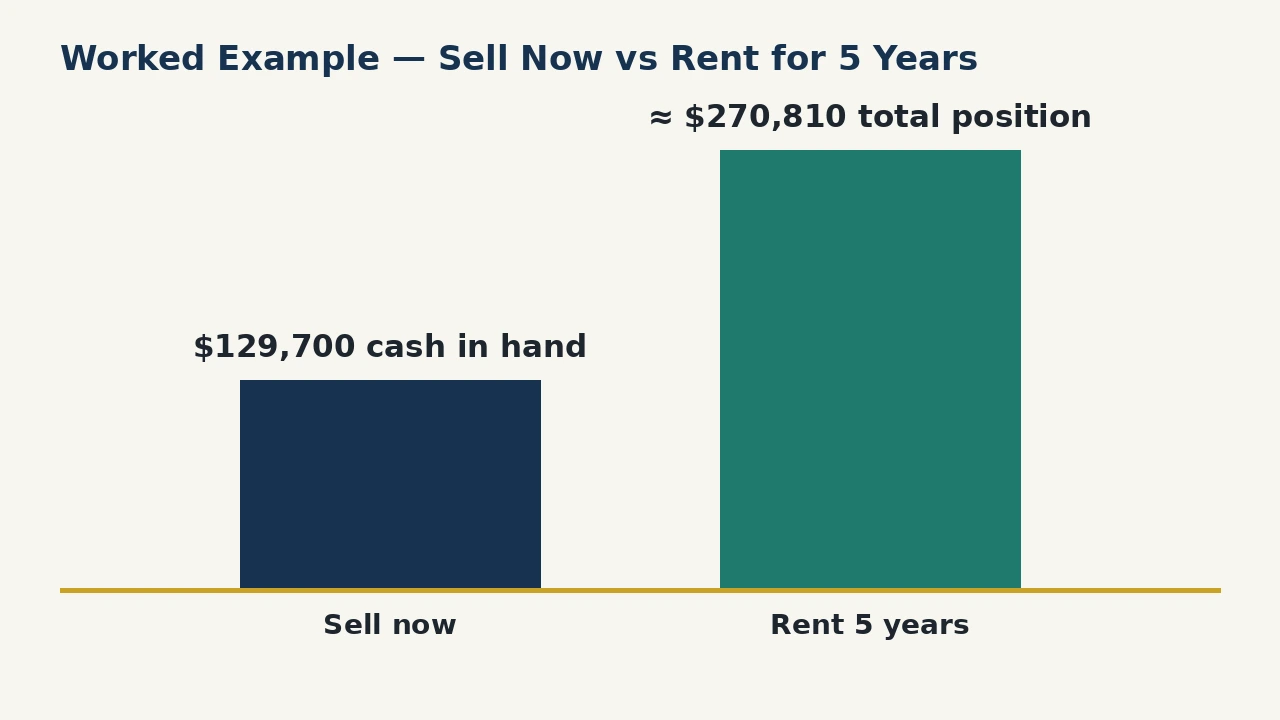
| Net sale proceeds (cash in hand) | $129,700 |
Tax check: the gain is $420,000 − $30,300 selling costs − $300,000 basis = $89,700. The owners have owned and lived in the home for two of the last five years (in fact, six), so the gain fits under the $250,000 / $500,000 home-sale exclusion caps and the federal capital-gains tax on this sale is $0 (state tax varies — check yours). Selling today converts the house into $129,700 of unrestricted cash.
Path Two — Rent it out: Year 1 in detail
| Line (Year 1) | Amount |
|---|---|
| Gross rent ($2,250 × 12) | $27,000 |
| Vacancy allowance (5%) | −$1,350 |
| Rent collected | $25,650 |
| Mortgage principal & interest ($1,336 × 12) | −$16,032 |
| Property taxes | −$4,200 |
| Landlord insurance | −$1,800 |
| Maintenance reserve (5% of gross rent) | −$1,350 |
| Management (8% of collected rent) | −$2,052 |
| Year 1 cash flow | +$216 (≈ +$18/month) |
This is the most common real-world result for a converted home: roughly break-even in cash, not a money machine. The tax picture is kinder than the cash picture. On Schedule E, the deductible expenses (mortgage interest of about $8,987 — the principal portion is not deductible — plus taxes, insurance, maintenance and management, totalling $18,389) and depreciation of $8,727 (worked out in the tax sections below) turn that thin cash profit into a paper loss of about $1,466 for tax purposes — subject to the passive-activity limits that can defer rental losses. In other words: slightly positive cash, no current tax on it.
Both paths over five years
| Year | Rent collected | Total costs* | Cash flow |
|---|---|---|---|
| 1 | $25,650 | $25,434 | +$216 |
| 2 | $26,420 | $25,716 | +$703 |
| 3 | $27,212 | $26,007 | +$1,206 |
| 4 | $28,028 | $26,306 | +$1,723 |
| 5 | $28,869 | $26,614 | +$2,255 |
| 5-year total | $136,179 | $130,077 | ≈ +$6,103 |
*Total costs = mortgage P&I (fixed) + taxes, insurance, maintenance, and management (rising with the stated assumptions). Figures are rounded; totals may differ by a dollar or two.
Cash flow is only one of three engines on the rent path. Over the same five years, the tenants’ payments also retire $37,812 of mortgage principal (balance falls from $260,000 to $222,188), and at the assumed 3% annual appreciation the home would be worth about $486,895. Equity at year 5: $486,895 − $222,188 = $264,707. Add the cumulative cash flow and the rent path’s five-year wealth position is ≈ $270,810 — before the selling costs and taxes of an eventual sale.
The sell path, for a fair comparison: $129,700 invested at the assumed 5% average annual return would grow to ≈ $165,524 over five years (an illustration of opportunity cost, not a promise — investments can fall as well as rise). On these assumptions, renting comes out roughly $105,000 ahead — almost entirely because of leverage: 3% growth on a $420,000 asset you control with $160,000 of equity, plus $37,812 of tenant-funded paydown. Change the appreciation assumption to 0% and the gap nearly vanishes; that sensitivity is the real lesson, and it is why the Cap Rate Calculator test matters: this house’s year-1 net operating income is $16,248, a cap rate of only about 3.9% at today’s value. As a pure investment bought at $420,000, it would be mediocre. It is the cheap existing mortgage and the equity already in place that make holding it defensible here.
The deadline box — read this before choosing “rent for now.” The owners moved out at the start of Year 1. Because they had already banked far more than two years of living in the home, they can keep the home-sale exclusion if they sell by roughly move-out date + 3 years (the mechanics are explained in the tax sections below). Selling at the end of Year 3, at the assumed value of $458,945: selling costs $32,831, mortgage payoff $238,103, net proceeds $188,011, plus three years of cash flow of about $2,125 — roughly $190,136 in hand, with $126,114 of the gain still excluded from federal tax (only the $26,182 depreciation portion can never be excluded — see the selling-later section).
Wait until Year 5 instead, and the exclusion is gone entirely: the same sale would expose a gain of about $195,883 to tax. The middle path — rent now, sell by the deadline — is a legitimate strategy. Drifting past the deadline by accident is the most expensive version of this decision.
What would have to change for the other path to win? If rent were $1,950 instead of $2,250, year-1 cash flow drops to roughly −$3,400 and the five-year rent advantage mostly evaporates. And if the mortgage rate were 7% instead of 3.5%, the payment alone would sink the rental. If the owners needed the $129,700 for their next home’s down payment, there would be no decision left to model. Run the same table with your numbers — the ROI Calculator and the Appreciation vs Mortgage Paydown Calculator on the CalcLandlord homepage do the five-year hold math for you.
Equity Growth vs Cash in Hand: .Paydown, Appreciation and Opportunity Cost
Owners arguing for renting usually point at three engines: cash flow, principal paydown and appreciation. Owners arguing for selling point at one thing: money you can actually use. Both are describing real effects — the skill is counting all of them once, and none of them twice.
Principal paydown is real but illiquid. In the worked example, $37,812 of the loan disappears over five years without the owners writing a cheque. That is genuine wealth. It is also locked inside the house until a sale or refinance releases it, and a forced sale at a bad moment can hand some of it back in selling costs.
Appreciation is leverage working — in both directions. A 3% rise on a $420,000 house is $12,600 in year one, earned on roughly $160,000 of equity. The same leverage multiplies a fall. Appreciation is the largest and least reliable term in the whole comparison, which is why honest models label it an assumption and test 0%.
Cash in hand has an opportunity cost too. The $129,700 from a sale does not sit idle by default: it can fund the next home’s down payment (avoiding mortgage insurance and a higher rate on a bigger loan), clear expensive debt, or be invested — the example illustrated it growing to about $165,524 at an assumed 5%. If your alternative use of the money earns little and costs you nothing, keeping the house looks better; if the equity is the difference between a comfortable and a stretched next purchase, selling looks better.
A sharp test cuts through the nostalgia: would you buy this exact house today, at today’s $420,000 price, purely as an investment? At a ~3.9% cap rate, many investors would say no — they would rather redeploy. There are honest reasons to hold anyway (the below-market mortgage, the tax window, a planned return), but name them explicitly. “It was a good home” is not one of them. The Appreciation vs Mortgage Paydown Calculator on CalcLandlord’s homepage separates the two equity engines year by year, so you can see how much of your projected gain is paydown (contractual) versus appreciation (hoped for).
The Tax Rule That Can Decide It for You: The $250,000/$500,000 Home-Sale Exclusion
Federal tax law gives homeowners one of the largest tax breaks in the code — and it is the reason the sell-or-rent decision has a clock on it. Under the Section 121 exclusion, if you meet the ownership and use tests, you may exclude up to $250,000 of gain on the sale of your main home, or $500,000 if you are married filing jointly (IRS Topic No. 701 and Publication 523).
Three things owners routinely misunderstand:
It is about gain, not price. Gain is roughly your amount realised (sale price minus selling costs) minus your adjusted basis ( broadly, what you paid, plus certain costs and improvements). A $420,000 sale can easily contain under $100,000 of gain — as in the worked example, where $89,700 of gain fits comfortably inside the exclusion and is taxed at $0 federally.
The exclusion does not cover everything. The part of the gain equal to depreciation you claimed — or were entitled to claim — while the home was rented out can never be excluded (detail in the selling-later section). And the exclusion generally cannot be used again if you already excluded gain on another home sale within the prior two years.
It is a federal rule only. States set their own capital-gains treatment; some follow the federal exclusion closely, others do not. Check your state before treating “tax-free” as literal.
If your gain is far above the caps — a long-held home in a high-appreciation market, say — the exclusion’s expiry matters less in percentage terms, and holding gets relatively more attractive. If your gain sits just under the cap, as in the example, the exclusion is worth tens of thousands of dollars and its deadline should drive the plan.
The 2-out-of-5-Years Test andYour 3-Year Window After Moving Out

the five yearsion, you must pass two tests measured over the five-year period ending on the sale date (IRS Topic No. 701 / Publication 523): the ownership test — you owned the home for at least 24 months (two years) in that window; and the use test — you lived in it as your main home for at least 24 months (730 days) in that window. The two periods do not have to overlap or be continuous. On a joint return, either spouse can meet the ownership test, but both must meet the use test.
Follow the arithmetic and the famous “three-year window” appears on its own. If you lived in the home right up until you moved out, then every month you are away eats into the look-back period. At three years after moving out, exactly two years of qualifying use remain inside the five-year window — the minimum. Sell after that point, and the use test fails and the exclusion is gone. That is why “rent it for a few years, then decide” is really “rent it for at most about three years, then decide” — a derived deadline from the tests, not a separate grace period. (Publication 523’s own worked examples show owners who moved out, rented the home, and sold inside the window keeping their exclusion.)
One subtlety protects the standard move-out-then-rent path, and almost no competitor explains it. Gain allocated to nonqualified use — periods after 2008 when neither spouse used the property as a main home — normally cannot be excluded. But the rule contains an explicit exception: nonqualified use does not include any portion of the five-year period that falls after the last date you used the property as your main home. So renting the home after you move out, inside the window, does not chip away at the excluspro ratarata. The trap runs the other direction: periods when the property was rented before it became your main home (after 2008) do count as nonqualified use and do reduce the excludable gain proportionally. If you bought a rental first and moved into it later, your exclusion math is different — and needs a professional’s worksheet, not a rule of thumb.
Practical step: the day you move out, write the deadline on a calendar — move-out date plus three years, minus a safety margin for a slow sale. Every rent-versus-sell review you do should be checked against that date.
Life as a Rental: Taxable Rent, Deductions and Depreciation on a Converted Home
From the day the home becomes a rental, a different tax regime applies. Rental income is taxable and is generally reported, with expenses, on Schedule E (IRS Topic No. 415). Deductible expenses include mortgage interest, real estate taxes, insurance, maintenance and utilities you pay — and depreciation. Rental losses are not automatically usable against your other income: the at-risk and passive-activity rules generally limit them, so a paper loss may shelter this property’s income yet be suspended rather than refunded in the year it arises. (A special case from Topic 415: if you rent a residence for fewer than 15 days in a year, the income is not reported and no rental expenses are deducted — relevant to almost nobody making this decision, but often confused with the main rules.)
Depreciation on a converted home has its own basis rule, and it surprises people. When you change your home to rental use, you do not calculate your depreciation on what the home is worth today, nor simply on what you paid. Under Publication 527, the basis for depreciation is the lesser of the property’s fair market value on the date of the change, or your adjusted basis on that date. First, strip out the land, because land is never depreciable. Then depreciate the building portion straight-line over 27.5 years.
Run it on the worked example: fair market value at conversion $420,000; adjusted basis $300,000. The lesser figure is $300,000. Land at 20% is $60,000, leaving a depreciable building basis of $240,000. Annual depreciation: $240,000 ÷ 27.5 = $8,727. Notice what the rule did: because the owners’ basis is lower than today’s value, their depreciation is smaller than a fresh investor buying the same house at $420,000 would get. Two identical houses on the same street can legitimately produce very different rental tax results. (In the first, partial year of rental, depreciation is prorated under the mid-month convention; the example uses a full year for simplicity.) CalcLandlord’s Depreciation Calculator runs the 27.5-year schedule for your own figures, and our fuller guide to rental property depreciation walks through the mechanics.
Keep records from day one: the conversion date, the value evidence, the land allocation and every year’s depreciation will all be needed the day you sell.
Selling Later: Depreciation Recapture and Nonqualified Use, Without the Jargon
Rent for a while and sell later, and three tax mechanics decide what you actually keep. In plain language:
The depreciation carve-out (“allowed or allowable”). When you sell a home that has been rented, the part of your gain equal to the depreciation deductions for periods after May 6, 1997 cannot be excluded under Section 121 — even if the rest of the gain qualifies. Here is the part that stings: it applies to depreciation allowed or allowable — the deduction you could have claimed counts against you whether or not you actually claimed it. Skipping depreciation on your rental returns does not dodge the carve-out; it just gives up the yearly benefit while keeping the later cost. This portion of gain is called unrecaptured Section 1250 gain and is taxed under the capital-gains worksheet rules rather than excluded — confirm your exact treatment at filing or with a tax professional.
In the worked example, three rental years produce about $26,182 of depreciation (3 × $8,727). In the deadline sale, the remaining $126,114 of gain is excluded, but that $26,182 slice is not. Over five rental ye,ars the slice grows to about $43,636 — one more reason the deadline sale beats drifting.
Nonqualified use, revisited. As the previous section explained, renting after your last main-home use, inside the window, is protected. Rental periods from before the home becapro ratamain home are not, and they reduce the excludable gain pro-rata. If your history with the property is mixed — rented first, lived in later, renting again now — treat the exclusion as a calculation to be done properly, not a headline to assume.
The keep-it-for-years path: 1031 exchanges. If you hold the home as a rental long past the exclusion window, it becomes a straightforward investment property, and a later sale is a straightforward taxable event — unless you exchange into another investment property under Section 1031 and defer the gain. That is a different strategy with its own strict timelines, and it suits committed investors rather than reluctant landlords; our guide to the 1031 exchange for rental property covers how deferral works when selling a rental.
Buying Your Next Home While Keeping This One: What Lenders Actually Count
For move-up buyers, this section can decide the question before the calculators come out. When you apply for a conventional mortgage while keeping your current home as a rental, Fannie Mae’s Selling Guide (section B3-3.8-05, updated by Announcement SEL-2026-08) sets how the departing home’s rent is treated — and it is stricter than most buyers expect:
- Your lease does not set the number. An appraisal or Form 1007 establishes market rent, or a market analysis using at least three comparable rentals does. Lenders do not use a signed lease to document the rent for this purpose.
- Only 75% of market rent counts. The standard lender haircut for vacancy and expenses means lenders ignore a quarter of the rent entirely.
- It can only offset, never add. The counted rent can offset the departing home’s full monthly payment (principal, interest, taxes, insurance and related charges — PITIA). Any surplus does not become qualifying income. Any shortfall counts against you in your debt-to-income ratio.
- New landlords need reserves. If you have under 12 months of property-management experience, expect to show six months of reserves for the departing home.
Put the rule on the worked example. Market rent $2,250 → 75% counts = $1,687.50. The departing home’s PITIA is $1,336 (P&I) + $350 (taxes) + $150 (insurance) = $1,836. Offset $1,687.50 against $1,836. Lenders still charge a $148.50 monthly shortfall against the buyers in their new-loan qualification. That applies even though the house’s actual rent covers its payment. If your next purchase is near your affordability ceiling, that shortfall plus the reserve requirement can decide approval or denial. It can also mean the difference between a comfortable payment and a stretched one.
Two cautions. These are the conventional-loan rules; FHA, VA and portfolio lenders treat departing-residence rent differently, so ask your lender which framework your loan uses. And rules in this area change — the framework above is the one published in Fannie Mae’s Selling Guide as of this guide’s research; confirm the current version with your lender before you rely on it for a purchase timeline.
Before You Rent It Out: Mortgage, HOA, Insurance and Local-Rule Checks
If the numbers say “rent”, four checks decide whether you legally and safely can. Do them before advertising the property, not after a tenant applies.
Your mortgage. Read your loan documents for occupancy requirements and any clause restricting renting the property out, especially if the loan is recent (loans taken as an owner-occupant commonly require a period of living in the home). If anything is ambiguous, ask your servicer — in writing — rather than assuming silence means permission. Our overview of landlord legal compliance covers the wider duty landscape this sits inside.
Your HOA or condo association. Rental caps, minimum lease terms, waiting periods before renting, application and approval requirements — all live in your CC&Rs and rules, and violations can mean fines or a forced end to the tenancy. Get the current rental policy in writing.
Your insurance. Tell your insurer the home will be tenant-occupied and switch to a landlord policy before the tenancy starts. Confirm what is covered (dwelling, loss of rent, liability) and what your tenants should carry themselves.
Your local rules. Cities and states variously require rental registration or permits, set security-deposit limits, impose notice and eviction procedures, and mandate habitability standards that go beyond “the house was fine for us.” These vary too much for any national guide to list: your city/county landlord-tenant guidance is the authoritative source, and a local landlord association or attorney is the fastest route through it.
If any of the four checks comes back “no” — a rental ban, a loan restriction, uninsurable use — the decision flips to selling regardless of what the calculators said. And once the decision is made, the execution is its ow,n project: setting rent, screening lawfully, the lease, deposits and move-in condition. That is exactly what our step-by-step guide to how to rent your house is for — this guide decides whether; that one covers how.
The Decision Checklist..: When Selling Wins, When Renting Wins

Everything above compresses into four tests. Score your house honestly on each.
The four tests
- The numbers test. After every cost, does the house cash-flow at or above break-even, and is its return on the equity you’d leave in it respectable? (Itemised build + cap rate at today’s value.)
- The tax-timing test. How much exclusion do you hold, and what is your move-out + 3-year deadline? Can you realistically sell by it if renting disappoints?
- The next-home financing test. Under lender rules — 75% of market rent, offset-only — does keeping this house still let you buy the next one comfortably, reserves included?
- The readiness test. Do you have the cash buffer for a bad year, the temperament for tenants, and the legal groundwork done? “I don’t want to be a landlord” is a complete and valid answer to this entire article.
Renting it out vs selling it: the pros and cons side by side
| Renting the house out | Selling the house | |
|---|---|---|
| Pros | Keeps a low mortgage rate working for you; tenants fund principal paydown; you keep exposure to appreciation on a leveraged asset; rent can offset the payment and shelter income via depreciation deductions; preserves the option to move back | Immediate, certain cash (net proceeds) for the next home or other goals; locks in the home-sale exclusion while it is definitely available; no tenants, repairs, vacancy or landlord legal duties; clean break — one transaction and the decision is over |
| Cons | Cash flow is often near break-even once all costs are counted; your equity stays illiquid; vacancy, repairs and problem tenants are real risks; the exclusion expires ~3 years after move-out and depreciation is recaptured at sale; lender rules may complicate your next purchase | You give up the low-rate loan forever and any future appreciation on the asset; selling costs (commission, closing, prep) are paid now and are gone for good; the proceeds may sit idle or be spent rather than invested; if you later want rental property, you rebuy at tomorrow’s prices and rates |
When selling wins
Sell when two or more of these hold: the itemised cash flow is clearly negative with no realistic fix; you need the equity for your next home and lender maths is against you; your gain sits well inside the exclusion and the deadline is uncomfortably close or already passed; the house needs major capital work (roof, systems) you do not want to fund; you would have to manage from far away and do not want to; or, simplest of all, you look at the readiness test and know you do not want the job. Selling is also the default when the cap-rate test fails badly — a house that yields ~2–3% at today’s value is a savings account with tenants.
When renting wins
Rent when most of these hold: after all costs, cash flow is break-even or better and you have a cash buffer for the lumpy years; the mortgage rate is well below today’s market, making the loan itself an asset; the house is in an area and condition where you’d buy it again as an investment; you can buy your next home without this equity, under the 75%-offset rule; and you have a diarised sell-by deadline inside the tax window, with a genuine intention to review against it. Renting with a deadline is a strategy. Renting by inertia is how owners wake up in year four with the exclusion gone and a house they never chose as an investment.
The middle path, stated plainly: rent now, review the numbers every year against the deadline, and sell by move-out + 3 years if the plan is not clearly beating the sell path. It is the path the worked example rewards — and it only works if the deadline is treated as real.
Decided to rent? Go straight to the execution guide: how to rent your house in 10 steps. Decide to analyse the house purely as an investment first? The method in how to analyze a rental property before buying applies the same rigour investors use on a purchase — and a lawful, structured rental application process is what protects the cash flow you just modelled.
People Also Ask
Usually yes — within limits. If you owned the home and lived in it as your main home for at least two of the five years before the sale, gain up to $250,000 ($500,000 married filing jointly) can be excluded. Because the test looks back five years, moving out starts a countdown: sell within about three years of moving out and the exclusion generally survives. Two parts are never tax-free: the depreciation portion of the gain, and — in states that tax capital gains — whatever your state takes. “Tax-free” here means the federal exclusion; confirm your state position.
Possibly — but not on the strength of the full rent. For conventional loans under Fannie Mae’s departing-residence rules, only 75% of appraised market rent counts, it can only offset the old home’s full payment (never add income), a shortfall counts against your debt-to-income ratio, and new landlords may need six months of reserves. Other loan types treat it differently. Get your lender to run the numbers with the actual rule before you commit to keeping the house.
Often yes — most standard mortgages do not ban renting after any required owner-occupancy period has passed — but your own loan documents govern. Check for occupancy clauses and renting restrictions, and if in doubt ask your servicer in writing. An HOA or condo association ban is the more common blocker.
A small monthly loss is not automatically a “sell”: principal paydown and appreciation can outweigh it, as the worked example’s five-year table shows. But a loss you cannot comfortably fund, on a house with a poor cap rate at today’s value, usually is a sell. Model all three engines (cash flow, paydown, conservative appreciation) over your realistic holding period — and be honest about whether you’d buy this house today as an investment at its current price.
From evidence, not hope: recently rented comparable homes nearby (same size, condition, area), rental listings that actually let rather than linger, a property manager’s rental evaluation, or — if a lender is involved — the appraiser’s market-rent schedule based on comparable rentals. Use the conservative end of the range in your cash-flow build.
A rough screening shortcut suggesting about half of gross rent will be consumed by operating expenses (taxes, insurance, maintenance, vacancy, management) before the mortgage payment. It is a heuristic some landlordsuse for a ten-second first pass — not a statistic, law or substitute for itemising your own costs, which is what this guide’s cash-flow build does.
Yes, houses are bought and sold with tenants in place; the lease generally transfers to the buyer, who must honour its terms. The practical effects are a smaller buyer pool (mainly investors), showings complicated by the tenancy, and state/local notice rules to follow precisely. Some owners wait for a natural lease end; others sell tenanted at a small discount for speed. Either way, your obligations to the tenant run to the closing date and beyond — take local advice.
Yes, subject to the lease: you generally cannot move back mid-term, but you can decline to renew at the term’s end, following your state/local notice rules (and any stricter local protections). Note the tax effect of the sequence: renting after your last main-home use is protected for the exclusion, but moving back in restarts your use clock in ways that need care — Publication 523’s examples cover several move-out/rent/return patterns and are worth reading before you rely on a plan.
Key Takeaways
Selling converts your house into a certain, spendable number today, and locks in a tax exclusion that is at its maximum right now. Renting keeps a leveraged asset, a possibly cheap loan, and three engines of wealth building — at the price of a job, real risks, and a tax deadline roughly three years out. Run the two numbers honestly (net proceeds versus true cash flow), test them against the tax window, your next loan and your own readiness, and then commit: if you rent, rent deliberately, with reserves, paperwork and a sell-by date on the calendar; if you sell, sell while the exclusion and your negotiating position are strongest.
The calculators on CalcLandlord’s homepage — Annual Cash Flow, ROI, Appreciation vs Mortgage Paydown, Cap Rate and Depreciation — will rerun every model in this guide with your figures in minutes. Your next step is simply to gather your real inputs: a realistic sale price, your mortgage payoff, three rental comparables, and quotes for insurance and management. With those four things in hand, this decision stops being a worry and becomes arithmetic.
Disclaimer: This article is for educational and informational purposes only and does not constitute legal, tax, accounting or financial advice. Tax laws, lender rules, and landlord-tenant regulations vary by state, locality, and individual circumstances, and change over time. Consult a qualified professional — such as a tax adviser, attorney, lender or accountant — about your specific situation before making a decision.
