

How to Use a 1031 Exchange to Defer Capital Gains Taxes When Selling a Rental Property
If you’re selling a rental property. The IRS may be entitled to a third of your gain — unless you act before you close. A 1031 exchange lets landlords defer capital gains tax. You can avoid depreciation recapture and the Net Investment Income Tax by rolling. Sale proceeds into another investment property instead of cashing out. It’s not automatic: you have exactly 45 days to identify a replacement and 180 to close. And you can’t take the money out. This guide walks through how the process actually works, what it costs, when it’s worth it, and the mistakes that quietly void an exchange.
If you’re selling a rental property and expect a large capital gains bill. A 1031 exchange lets you defer federal (and often state) capital gains tax and depreciation recapture by reinvesting the sale proceeds into another “like-kind” investment property . As long as you follow strict deadlines and use a neutral third party called a Qualified Intermediary. Done correctly, you don’t pay the tax now; you carry it forward into your next property and keep more capital working for you.
That’s the short answer. The details — the deadlines, the paperwork. The traps that turn a clean exchange into a taxable sale are where landlords get into trouble. This guide walks through exactly how the process works, what it costs. when it makes sense, and when it doesn’t. Using the rules currently in effect as of 2026.
This article is educational information, not legal, tax, or financial advice. 1031 exchanges are unforgiving of small mistakes, and your specific numbers, state, and entity structure change the calculus. Work with a Qualified Intermediary and a CPA or 1031 tax attorney before you list your property.
What Is a 1031 Exchange, and Why Does It Matter to Landlords?
A 1031 exchange — named for Internal Revenue Code Section 1031 — allows an investor to sell business or investment real estate and roll the proceeds into a new property without immediately recognizing the capital gain for tax purposes. The gain isn’t forgiven; it’s deferred, and your original (lower) cost basis carries over into the new property.
For a landlord, this matters because a rental property sale can trigger three layers of tax at once: federal long-term capital gains tax (up to 20%), the 3.8% Net Investment Income Tax (NIIT) if your income is above the threshold, and depreciation recapture (taxed at up to 25%) on every dollar of depreciation you claimed while renting the property out. On a property held for 10–15 years, that combined bill can easily reach 25–35% of your gain. A 1031 exchange defers all of it, letting you reinvest 100% of your equity instead of handing a third of it to the IRS.
The trade-off is that a 1031 exchange isn’t a shortcut — it’s a structured legal process with hard deadlines, and it only defers tax; it doesn’t eliminate it unless you hold the replacement property until death (more on that later).
How a 1031 Exchange Works: The Core Mechanics
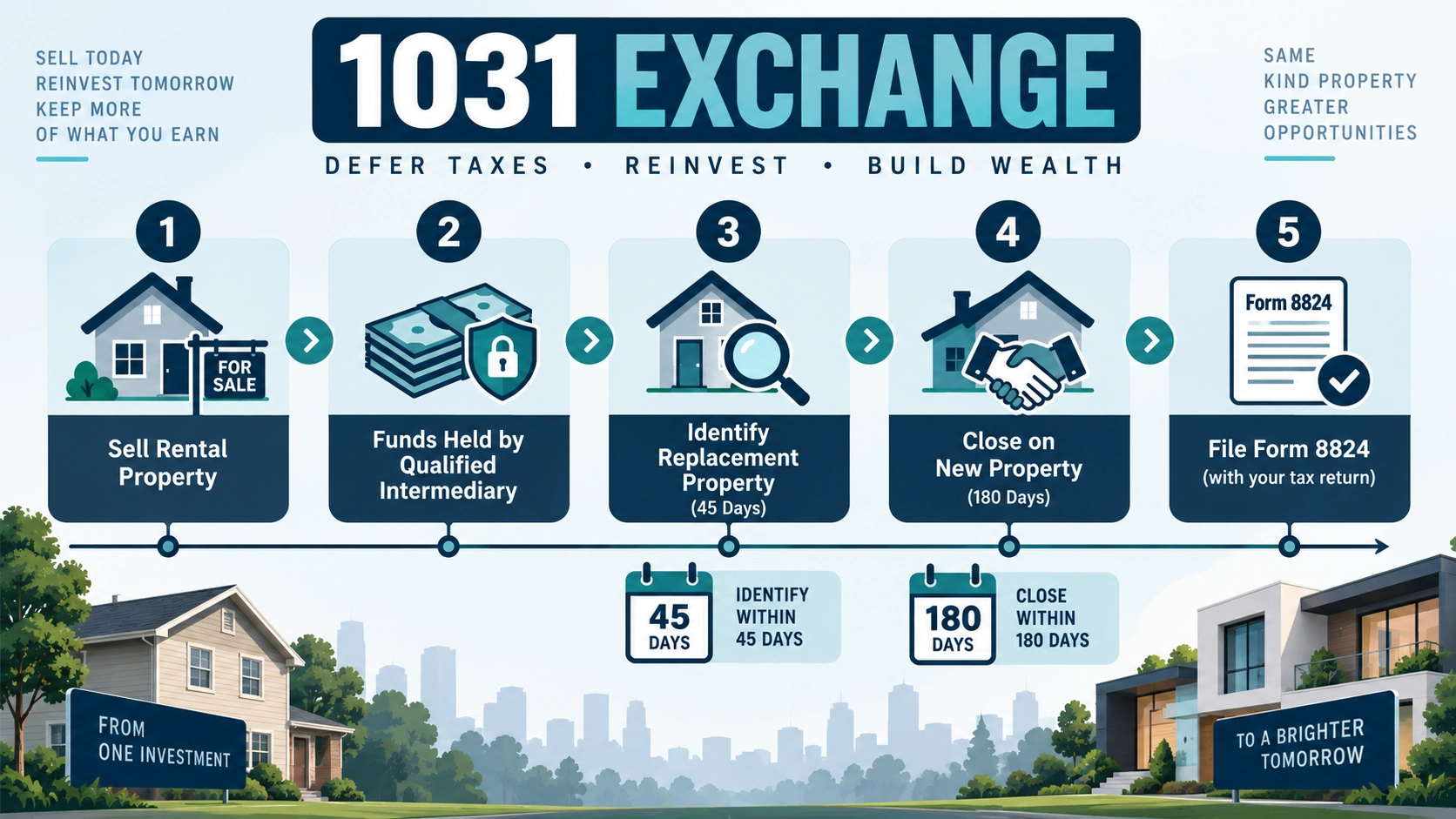
At its simplest, a 1031 exchange has five moving parts:
- You sell your rental (the “relinquished property”), but you never personally receive the sale proceeds.
- A Qualified Intermediary (QI) — a neutral third party — holds the funds in escrow so you never have “constructive receipt” of the money, which is the single most important rule in the entire process.
- You identify replacement property within 45 calendar days of closing on the sale.
- You close on the replacement property within 180 calendar days of the original sale (not 180 days from identification).
- You report the exchange to the IRS using Form 8824 with that year’s tax return.
Miss any one of these and the transaction can collapse into a fully taxable sale. There’s no partial credit for “almost” completing an exchange on time.
Table: The 1031 Exchange at a Glance
| Requirement | Rule |
| Property use | Held for business or investment, not personal use or resale (flipping) |
| Like-kind test | Any real property for any other real property (very broad since 2018) |
| Identification deadline | 45 calendar days after closing on the sale |
| Closing deadline | 180 calendar days after closing on the sale |
| Funds handling | Must go through a Qualified Intermediary — you can never touch the cash |
| Reinvestment target | Equal or greater value and equal or greater debt to fully defer gain |
| IRS filing | Form 8824, filed with the tax return for the year of the sale |

Step-by-Step: Executing a 1031 Exchange on a Rental Property
- Line up your Qualified Intermediary before you accept an offer. The QI agreement has to be in place before closing — you cannot set this up after the fact.
- Add exchange cooperation language to your purchase and sale agreement. Your closing attorney or title company typically handles this.
- Close on the sale. Proceeds go directly from escrow to the QI, never to you.
- Identify replacement property in writing within 45 days. This is delivered to your QI, not just decided in your head — verbal or informal identification doesn’t count.
- Negotiate and close on the replacement property within 180 days total (not 180 days after identification — the clock starts at the original closing).
- Match or exceed value and debt. To defer 100% of the gain, the replacement property’s purchase price must be equal to or greater than the sale price, and you generally need to replace any mortgage debt you paid off (with new debt, additional cash, or both).
- File Form 8824 with your federal return for the tax year the original sale closed, even if the replacement closing happened the following calendar year.
A common beginner mistake is treating the 45-day window as “time to think it over.” In practice, you should already have candidate properties lined up — ideally before you even close on the sale — because 45 days moves fast once financing, inspections, and due diligence are added in.
The Two Deadlines That Make or Break an Exchange (45 & 180 Days)
These deadlines are calendar days, not business days, and the IRS does not extend them for weekends, holidays, financing delays, or a deal falling through — with rare exceptions for federally declared disasters.
The 45-day identification rule lets you name replacement properties under one of three methods:
- 3-Property Rule: Identify up to three properties of any value.
- 200% Rule: Identify more than three properties, as long as their combined value doesn’t exceed 200% of what you sold.
- 95% Exception: Identify unlimited properties of any value, but you must actually acquire 95% of the total value identified.
Most landlords use the 3-Property Rule because it’s the simplest to satisfy — name your top choice plus two backups, in case financing or inspection issues sink your first pick.
The 180-day closing rule runs concurrently with the 45-day window, not after it — so if you use all 45 days to identify a property, you have 135 days left to actually close. If your tax return due date (including extensions) falls before the 180th day, that earlier date becomes your effective deadline unless you file an extension.
If you miss a deadline, the exchange fails and the sale becomes fully taxable in the year it closed. In some cases, if the failure happens late in the process, structuring the remaining payment as an installment sale under IRC Section 453 can spread the tax liability over more than one year — but this is a fallback, not a substitute for planning, and requires a CPA’s involvement before the sale closes, not after.
Choosing a Qualified Intermediary: What to Check Before You Sign
You legally cannot act as your own intermediary, and neither can your spouse, employee, attorney, real estate agent, or anyone who has acted as your agent in the two years before the exchange (with a narrow exception for the attorney or accountant who prepared the exchange documents). The IRS calls these “disqualified persons,” and using one voids the exchange.
Because a QI holds all of your sale proceeds — sometimes for months — vetting them matters as much as vetting a lender. Before you sign an agreement, check for:
- Segregated, qualified escrow or trust accounts for your funds specifically, not commingled with the QI’s operating funds or other clients’ exchange funds.
- Fidelity bond and errors & omissions insurance covering employee theft and mistakes.
- Independent audits of their trust accounts.
- Membership in the Federation of Exchange Accommodators (FEA) and, ideally, a Certified Exchange Specialist (CES) on staff.
- How long they’ve operated — QI failures and fraud, while uncommon, have happened at newer or thinly capitalized firms.
QI fees for a straightforward exchange typically run a few hundred to around $1,500; reverse and improvement exchanges (discussed below) cost significantly more because of the added legal structure required.
Boot: When You Still Owe Some Tax Even in a “Successful” Exchange
“Boot” is any value you receive in the exchange that isn’t like-kind real property — and it’s taxable even if the rest of the exchange qualifies. The two most common forms:
- Cash boot: Any sale proceeds you keep instead of reinvesting (including money used to pay non-exchange closing costs).
- Mortgage boot: If you pay off a $200,000 mortgage on the property you sell but only take on $150,000 of debt on the replacement property, that $50,000 reduction in debt is treated as boot — even if you didn’t receive a dollar in cash — unless you offset it with additional cash invested.
Boot is taxed up to the amount of your realized gain; it doesn’t create tax beyond what you would have owed on a full sale.
Worked example (hypothetical, for illustration only):
A landlord sells a rental for $500,000. Their adjusted basis is $260,000 (original purchase price minus $90,000 of depreciation claimed over the years, plus improvements). That’s a $240,000 total gain, of which $90,000 represents depreciation recapture.
| Item | Amount |
| Sale price | $500,000 |
| Adjusted basis | $260,000 |
| Total realized gain | $240,000 |
| — of which depreciation recapture (taxed up to 25%) | $90,000 |
| — of which remaining gain (taxed at long-term capital gains rates, up to 20%) | $150,000 |
| Potential NIIT (3.8%) if income exceeds the threshold | Applies to some or all of the $240,000 |
Without a 1031 exchange, this landlord could owe roughly $22,500 in recapture tax, up to $30,000 in federal capital gains tax, and potentially another $9,000+ in NIIT — depending on their bracket and other income — before any state tax. A fully qualifying exchange defers all of it, as long as the landlord reinvests at least $500,000 into the replacement property and replaces any debt paid off at closing. (These figures are simplified, top-rate illustrations — your actual bracket, state taxes, and NIIT threshold will change the real number. A CPA can run your exact figures.)
Like-Kind Property: What Qualifies (and What Doesn’t) in 2026
Since the 2017 Tax Cuts and Jobs Act, only real property qualifies for a 1031 exchange — the old rules allowing exchanges of equipment, vehicles, or other business personal property were eliminated. Fortunately, “like-kind” for real estate is interpreted broadly: virtually any real property held for investment or business use can be exchanged for any other, regardless of type or location within the U.S.
What qualifies:
- A single-family rental for a multifamily building
- A commercial property for raw land
- A rental house for a fractional interest in a larger property (see DSTs below)
- Mineral, oil, or water rights that constitute a real property interest under state law
What doesn’t qualify:
- Your primary residence (Section 121’s home-sale exclusion is a separate benefit)
- Property held primarily for resale (flips)
- Real estate located outside the United States
- Stocks, bonds, partnership interests, or REIT shares
- Personal-use vacation homes, unless they meet specific rental-use safe harbor thresholds
One frequently overlooked detail: if you sell a property that includes some personal property (like furniture in a furnished rental) that isn’t separately valued, the IRS generally treats a small amount of incidental personal property (up to 15% of the total replacement property’s value) as not disqualifying the exchange — but larger amounts of unstated personal property can create taxable boot.
Advanced Strategies: Reverse Exchanges, Improvement Exchanges, and DSTs
Most landlords use a standard “forward” exchange — sell first, then buy. Three variations solve specific problems:
Reverse exchange: You buy the replacement property before selling the relinquished one — useful in a competitive market where you don’t want to lose your next property while waiting to close a sale. Because you can’t hold both properties in your own name during the transition, a QI-affiliated Exchange Accommodation Titleholder (EAT) holds title temporarily. Reverse exchanges are more expensive (often $6,000–$15,000+ in legal and QI fees) and must still be unwound within 180 days.
Improvement (build-to-suit) exchange: Lets you use exchange funds to make improvements to the replacement property, with the improved property needing to be substantially complete within the same 180-day window — a tight timeline for any real construction work.
Delaware Statutory Trusts (DSTs): A DST lets you exchange into a fractional, passive ownership interest in institutional-grade real estate (like an apartment complex or industrial portfolio) instead of managing another property directly. DSTs count as like-kind real property under IRS Revenue Ruling 2004-86, making them popular with landlords who are tired of tenants, toilets, and turnover but still want to defer their gain. The trade-off is illiquidity (DST interests typically can’t be sold quickly), no control over property decisions, and sponsor fees that reduce returns.
Related-Party Exchanges: The 2-Year Rule
Exchanging property with a family member, an entity you control, or another related party is allowed, but Section 1031(f) requires both parties to hold their respective properties for at least two years after the exchange. If either party sells (or otherwise disposes of) their property before the two-year mark, both parties’ deferred gain becomes taxable retroactively — with limited exceptions for death, involuntary conversion, or proof the transaction wasn’t primarily tax-motivated. This rule closes an obvious loophole (families trading properties to “reset” basis) and trips up investors who don’t realize a parent-to-child or LLC-to-owner transfer counts as related-party.
State Tax Considerations: Withholding and “Clawback” Rules
A 1031 exchange defers federal tax, and most states follow the federal treatment for state income tax purposes — but a handful of states add their own compliance layer:
- California requires withholding of 3.33% of the total sales price at closing on real estate sales, including exchanges, unless the seller files Form 593 claiming the 1031 exemption. Separately, if a California property is exchanged for a replacement property located outside California, the state requires an annual informational filing (Form FTB 3840) to track that deferred, California-source gain until it’s eventually recognized — commonly called the “clawback” rule, because California wants the ability to tax that gain later even after you’ve left the state.
- Other states — including Oregon and several others — impose their own nonresident withholding requirements on real estate sales generally (not specific to 1031s), typically calculated as a percentage of the sale price or of the includable gain, with exemptions available for qualifying exchanges. Rates and exemption procedures vary and change periodically.
Because state withholding and reporting rules shift and aren’t uniform, confirm the current requirements for the state where your property is located (and any state you’re exchanging into) with that state’s tax authority or your CPA before closing.
1031 Exchange vs. Other Tax-Deferral Strategies
| Strategy | How It Defers Tax | Best Fit | Key Trade-Off |
| 1031 Exchange | Rolls gain into new real property | Landlords staying in real estate | Strict deadlines, must reinvest in real estate |
| Installment Sale (Sec. 453) | Spreads gain over the years you receive payments | Sellers open to owner financing | You carry buyer credit risk |
| Qualified Opportunity Fund (QOF) | Defers gain from any asset by investing in a QOF | Investors wanting to diversify out of real estate | New OBBBA “OZ 2.0” rules apply a rolling 5-year deferral and a standardized 10% basis step-up for investments made after 2026 — richer than a simple cash-out, but the underlying investment is illiquid and geographically restricted |
| Just pay the tax | None — you pay in full | Small gains where exchange costs and constraints outweigh the tax savings | Full liquidity, no reinvestment requirement |
As of 2026, it’s worth being specific about the current law: the 2025 One Big Beautiful Bill Act (OBBBA) left Section 1031 completely unchanged — like-kind exchanges for real property remain fully intact with no caps. The OBBBA did overhaul the Opportunity Zone program, making it permanent with rolling 10-year zone designations and replacing the old fixed 2026 deadline with a rolling five-year deferral and a standardized 10% basis step-up (30% for new Qualified Rural Opportunity Funds) for investments made after 2026. That makes QOFs a more predictable — though still separate and illiquid — alternative for gains you don’t want to keep in direct real estate ownership.
Depreciation, Cost Segregation, and Your 1031 Exchange
Every year you depreciate a rental property, you reduce your basis and set up future recapture tax — which is exactly what a 1031 exchange defers, not eliminates. Two points landlords frequently miss:
- Depreciation restarts are limited. Your replacement property doesn’t get a fresh, fully steppable depreciation schedule on the entire purchase price. Instead, the carried-over basis from your old property continues depreciating on its original schedule, while only the additional amount you paid above that basis (if any) starts a new depreciation schedule.
- Cost segregation studies remain available on the replacement property, allowing you to accelerate depreciation on components like flooring, fixtures, and site improvements — and with 100% bonus depreciation restored under the OBBBA for qualifying assets, this pairing can meaningfully improve near-term cash flow even though you’re carrying forward deferred gain from the prior property.
Because these interactions get technical fast (and the IRS has issued specific guidance on how cost segregation interacts with exchanged basis), this is a section where a CPA experienced in real estate — not a general preparer — earns their fee.
Converting a 1031 Replacement Property Into Your Primary Residence
Some landlords eventually want to move into the property they acquired through a 1031 exchange. The IRS allows this, but only if you first satisfy a safe harbor under Revenue Procedure 2008-16:
- Rent the property at fair market rent for at least 24 months after the exchange.
- During each of those 24 months, limit your personal use to the greater of 14 days or 10% of the days it’s rented at fair value.
Only after meeting this safe harbor can you convert the property to personal use. Later, if you sell it as your primary residence, you may qualify for the Section 121 exclusion ($250,000 single / $500,000 married filing jointly) on the post-conversion appreciation — but the deferred gain and depreciation recapture from the original 1031 exchange remain taxable and don’t get the Section 121 exclusion.
Common 1031 Exchange Mistakes Landlords Make
- Waiting until after closing to look for a QI or replacement property. By the time some landlords start searching, they’ve already burned days off the 45-day clock without realizing it — the clock starts at the sale closing, not when you decide to do an exchange.
- Touching the sale proceeds, even briefly. Constructive receipt disqualifies the entire exchange; the money must go straight from escrow to the QI.
- Reducing debt without replacing it with cash or new financing, creating unexpected mortgage boot.
- Assuming any real estate qualifies as “like-kind” and later finding out a personal-use property, flip, or foreign property doesn’t.
- Moving into the replacement property too soon, before satisfying the 24-month safe harbor.
- Skipping Form 8824, which is both an audit flag and, in some cases, a requirement to preserve the deferral.
- Underestimating exchange costs — QI fees, potential reverse-exchange financing, and state filing requirements can erode the benefit on smaller transactions.
Is a 1031 Exchange Right for You? A Decision Framework
Run through these questions before committing:
- How large is your actual gain? If depreciation recapture plus capital gains tax plus NIIT would be a modest amount (a few thousand dollars), the deadlines, QI fees, and reduced flexibility of an exchange may not be worth it.
- Do you want to stay in real estate? A 1031 only works if you’re reinvesting in more real property. If you want out of landlording altogether, paying the tax (or using a DST for a passive exit) may fit better than forcing a new active rental purchase.
- Can you realistically identify and close on a replacement within 180 days? In a competitive or slow market, this is the single biggest practical risk.
- Do you need liquidity from this sale — for retirement income, a business, or another goal? A 1031 locks your equity back into illiquid real estate.
- What’s your long-term plan? If you intend to hold real estate until death, the “swap till you drop” strategy lets your heirs receive a stepped-up basis, potentially eliminating the deferred gain entirely rather than just postponing it.
More to Explore : https://calclandlord.com/how-high-mortgage-interest-rates-affect-investor-cash-on-cash-returns/
People Also Ask 1031 Exchange for Rental Property Owners
Generally yes, as long as both properties are held for investment or business use rather than personal use. The distinction that matters to the IRS is investment intent, not the specific rental strategy — but a short-term rental with substantial personal use by the owner could complicate qualification, so document your rental activity carefully.
The sale becomes taxable in the year it closed. Depending on timing and how the sale was structured, an installment sale under Section 453 may allow you to spread the resulting tax liability over the years you actually receive payment — but this requires proper structuring before closing, not after the fact, so involve your CPA the moment it looks like the exchange may not close on time.
There’s no explicit statutory holding period. But the IRS looks at your intent — properties bought and flipped quickly look more like inventory than investment. Many practitioners informally suggest holding at least one to two years to strengthen your position. Though this isn’t a bright-line legal rule.
Yes, but the taxpayer that sells must be the same taxpayer that buys the replacement property. If you want to change ownership structure around the exchange (a “drop and swap. Where partners in an LLC split off before or after an exchange). This requires careful, advance legal planning — done incorrectly, it can jeopardize the exchange for some or all partners.
Key Takeaways and Next Steps
A 1031 exchange can defer a substantial capital gains tax bill. NIIT and depreciation recapture tax bill — but only if you line up a Qualified Intermediary before you close. Identify replacement property within 45 days. Close within 180 days, and reinvest at an equal or greater value and debt level. The rules are unforgiving of timing mistakes. Boot, related-party sales. And premature personal use of the replacement property is the trap. That most often turns a clean exchange into a taxable one.
Before you list your rental property:
- Estimate your actual gain and potential tax bill using a capital gains or 1031 exchange calculator. So you know what you’re actually deferring.
- Interview at least two Qualified Intermediaries and check their bonding, insurance, and account segregation before signing.
- Talk to a CPA about how depreciation recapture, NIIT, and your state’s withholding rules apply to your specific numbers.
- If you’re unsure whether to stay in active rental ownership. Compare a direct replacement property against a DST or simply paying the tax and reinvesting elsewhere.

Pingback: STR Calculator: The Number Most Hosts Get Wrong