
How Landlords Can Stay Compliant With Rental Property Laws and Avoid Costly Legal Mistakes
Most landlords don’t lose a legal dispute because they broke the rules on purpose — they lose because they didn’t know which rules applied. Rental law isn’t one law; it’s three layers stacked on top of each other: federal, state, and local. Miss one, and a routine eviction, deposit return, or tenant denial can turn into a costly claim. This guide breaks landlord legal compliance into a repeatable system — covering tenant screening, security deposits, habitability, entry rights, and eviction — so you know exactly what’s required at each stage of a tenancy, and what mistakes create the most legal exposure.
Owning a rental property is a business, and every business has compliance obligations. For landlords, those obligations touch nearly every decision you make: who you rent to, how much you charge, how you handle a security deposit, when you can enter the unit, and how you end a tenancy.
Most landlords don’t get into legal trouble because they’re careless. They get into trouble because rental law is layered — federal rules sit on top of state rules, which sit on top of city or county rules — and a process that was fine in one state can be a violation in another. A single missed notice period or an inconsistent screening decision can turn a straightforward eviction into a months-long, expensive dispute.
Important: This article is educational, not legal advice. Landlord-tenant law varies significantly by state and even by city, and it changes over time. Always confirm current requirements with your state housing agency, a local landlord-tenant attorney, or a HUD-approved housing counselor before making a legal or financial decision.
Quick Answer: The Compliance Framework
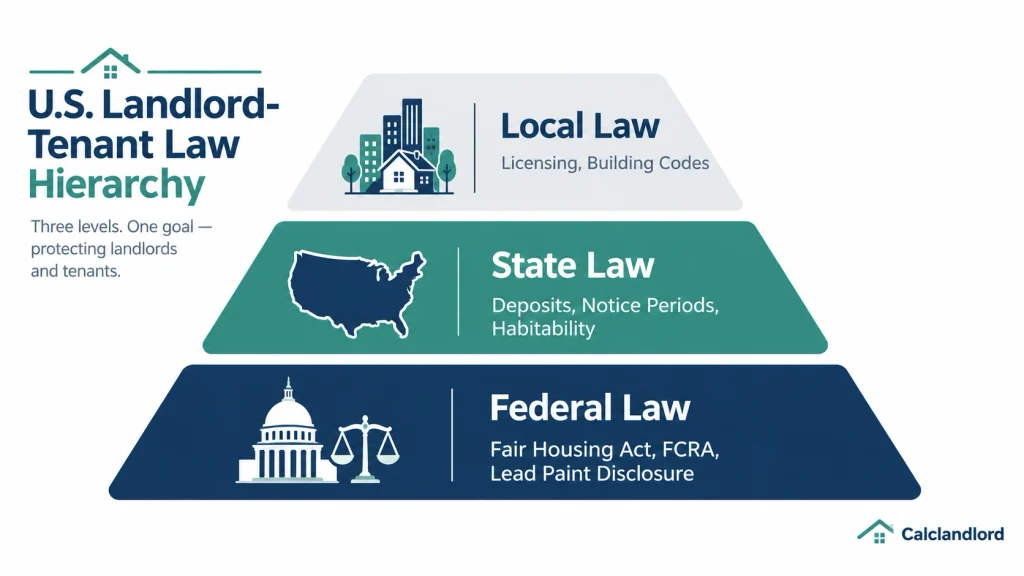
Every landlord obligation in the U.S. falls under one of three layers:
- Federal law — sets a floor that applies everywhere. This includes the Fair Housing Act (discrimination), the Fair Credit Reporting Act (tenant screening and adverse-action notices), the lead-based paint disclosure rule for pre-1978 housing, and IRS rules for reporting rental income.
- State law — governs the mechanics of the landlord-tenant relationship: security deposit limits and return deadlines, notice periods, habitability standards, eviction procedures, and rent-increase rules where applicable.
- Local law — adds rental licensing, registration, building and fire codes, and sometimes local rent-stabilization or just-cause eviction rules.
You cannot comply with “landlord law” in the abstract. You comply with the specific combination of federal, state, and local rules that apply to your exact property. Building that framework once — and updating it — is the foundation of everything below.
1. Build a Property-Specific Compliance File Before You Advertise
Before you list a unit, create a single reference file (digital is easiest) that answers:
- What state and municipality is the property in?
- Is it a single-family home, a duplex, or a larger multifamily building? (Unit count often changes which rules apply.)
- Does the city require rental registration or a business license?
- What does state law require for security deposits — limits, holding rules, and return deadlines?
- What is the required notice period for entry, and for ending a tenancy?
- Does local law require specific habitability inspections or certificates (smoke detectors, carbon monoxide detectors, lead-paint disclosure, bedbug disclosure, etc.)?
- Is the property subject to rent stabilization, just-cause eviction, or source-of-income protections?
Update this file whenever you acquire a new property, whenever you expand into a new city or state, and at least once a year, since state legislatures frequently amend landlord-tenant statutes.
2. Get the Property Habitability-Ready Before Move-In
Habitability isn’t a courtesy — in nearly every state, landlords have an implied or statutory “warranty of habitability” that can’t be waived in the lease. At minimum, this generally means the property must have:
- Working plumbing, heating, and hot water
- Sound structural elements (roof, walls, floors, stairs, railings)
- Functioning electrical systems without hazards
- Working smoke alarms and, where required, carbon monoxide detectors
- Doors and windows that lock securely
- No active pest infestation or serious mold
- Compliance with any local occupancy limits
Walk the property with a written checklist before the first showing, not after a tenant complains. Fix what fails the checklist, and keep receipts and photos as proof the work was done.
Create a Move-In Condition Report
Before handing over keys, document the unit’s condition with:
- Dated, timestamped photos or video of every room
- Meter readings
- A written inventory of appliances and their condition
- Existing damage, no matter how minor
- Smoke/CO alarm test confirmation
- The tenant’s signature or written acknowledgment
This single document does more to prevent security-deposit disputes than almost anything else you can do.
3. Use a Lease Written for Your State — Not a Generic Template
A lease pulled from a generic internet template or copied from a friend’s property in another state can contain clauses that are unenforceable, or worse, illegal, in your jurisdiction. At a minimum, a compliant lease should cover:
- Names of all parties and the property address
- Term, rent amount, due date, accepted payment methods, and late-fee terms (must be within any state-imposed limits)
- Security deposit amount and handling
- Who pays which utilities
- Maintenance and repair-reporting process
- Entry and notice procedures
- Occupancy limits and guest policy
- Pet, smoking, and alteration policies
- Required state or local disclosures (lead paint, bedbugs, mold, flood zone, etc., where applicable)
- Renewal and termination terms
Avoid these clauses, which are void or risky in most states even if a tenant “agrees” to them in writing:
- Waivers of the implied warranty of habitability
- “Self-help” eviction language (allowing you to remove a tenant or their belongings without a court order)
- Unlimited or unrestricted landlord entry
- Automatic forfeiture of the entire security deposit
- Retaliation clauses tied to complaints or code enforcement calls
If your lease was last reviewed more than two or three years ago, or before you started renting in a new state, have it reviewed again.
4. Screen Every Applicant the Same Way
Tenant screening is where landlords most often run into Fair Housing Act problems — usually unintentionally. The Fair Housing Act prohibits discrimination based on race, color, national origin, religion, sex, familial status, and disability. Many states and cities add protected categories such as source of income (including housing vouchers), sexual orientation, gender identity, age, or marital status.
Before you review a single application, write down:
- The minimum income-to-rent ratio you require
- What counts as acceptable proof of income and employment
- What rental history or references you require
- Your credit-score or credit-history standard
- How (and whether) criminal background history factors in, and how it’s weighed
- How you notify applicants of a denial
Then apply that same standard to every applicant, in the same order, without exception. Documenting a neutral, written policy — and following it exactly — is your best defense if a denied applicant alleges discrimination.
Federal Screening Rules to Know
- Fair Credit Reporting Act (FCRA): If you use a credit report, background check, or tenant-screening service to deny an application or charge different terms, you generally must provide the applicant an “adverse action” notice, including the name of the reporting agency and the applicant’s right to dispute the report.
- Lead-based paint disclosure: For housing built before 1978, federal rules generally require landlords to disclose known lead-paint hazards, provide the EPA pamphlet, and keep signed disclosure records.
Screening Mistakes That Create Legal Exposure
- Asking different applicants different questions
- Advertising language that signals a preference (“perfect for a young couple,” “no children”)
- Rejecting a voucher holder in a jurisdiction that protects source of income
- Using a “gut feeling” standard instead of written criteria
- Sharing an applicant’s personal information carelessly
5. Handle Rent and Security Deposits by the Book
Rent
Keep a rent ledger for every unit showing the amount due, amount received, date received, payment method, and any late fees applied. If you ever agree to a payment plan or partial payment, put it in writing and state clearly whether it changes the tenant’s underlying obligation — an undocumented verbal deferral is one of the most common sources of eviction disputes.
Security Deposits
State law typically controls:
- The maximum deposit you can collect (often expressed as a multiple of monthly rent)
- Whether the deposit must be held in a separate or interest-bearing account
- What notice or receipt you must give the tenant
- The deadline to return the deposit (or an itemized deduction statement) after move-out — commonly somewhere between 14 and 30 days, depending on the state
- What counts as normal wear and tear versus chargeable damage
Example: Deposit Documentation Workflow
| Step | What to Record |
| Deposit received | Amount, date, payment method, receipt given |
| Move-in | Signed condition report with photos |
| During tenancy | Any pre-approved deductions (e.g., damage repaired mid-lease) |
| Move-out | Move-out inspection compared against move-in report |
| Deductions | Itemized list with invoices or repair estimates |
| Return | Balance returned within the state’s statutory deadline |
Never deduct for ordinary wear and tear (faded paint, worn carpet from normal use, minor nail holes). Courts and tenant agencies scrutinize these deductions closely, and improper withholding can expose you to statutory penalties in many states — sometimes multiples of the deposit amount.
Fees
Before charging an application fee, administrative fee, or “convenience” fee, check whether your state caps or restricts it. A fee that seems reasonable from a business standpoint can still be unlawful if it exceeds a statutory limit.
6. Maintain the Property and Respond to Repairs Promptly
Habitability is not a one-time, move-in obligation — it continues for the life of the tenancy. Set up a simple, repeatable process:
- Give tenants a clear way to report issues (in writing, ideally through a portal or email so there’s a timestamp).
- Acknowledge the request quickly.
- Classify it: emergency (gas leak, no heat in winter, flooding, no working lock), urgent (major appliance failure, significant leak), or routine.
- Send a qualified contractor and keep the invoice.
- Give proper notice before entering, except in a genuine emergency.
- Confirm the repair with the tenant and keep the paper trail.
Prioritize anything involving gas, electrical hazards, heat during cold weather, structural safety, or sanitation. Delaying these repairs is one of the fastest ways to turn a minor complaint into a habitability lawsuit, a rent-withholding claim, or a defense that defeats an otherwise valid eviction.
7. Respect Entry and Privacy Rules
Owning the property doesn’t give you unrestricted access to it once it’s leased. Most states require advance written notice before non-emergency entry — commonly 24 to 48 hours — along with a legitimate purpose (repairs, inspection, showing the unit to prospective tenants or buyers).
Build a simple entry policy:
- State the required notice period and put it in the lease
- Always provide the reason and approximate time window in writing
- Only enter without notice in a genuine emergency
- Never use repeated inspections to pressure a tenant to leave
8. Respond to Complaints — Don’t Retaliate
A tenant complaint about repairs, habitability, discrimination, or privacy should trigger a documented investigation, not defensiveness. Most states prohibit retaliatory eviction or retaliatory rent increases following a legitimate complaint or code-enforcement call — even if you had an unrelated, legitimate reason to act, the timing alone can create a legal presumption of retaliation that you’ll have to overcome.
When a complaint comes in:
- Log the date, issue, and requested remedy
- Investigate and respond within a reasonable time
- Fix urgent safety issues immediately
- Confirm the resolution in writing
- If the complaint touches on discrimination or harassment, get legal advice before taking any adverse action against that tenant
9. Keep a Complete Compliance Record
If a dispute ever reaches a housing agency, mediator, or court, the landlord who can produce organized records almost always fares better than the one who “remembers it that way.” Maintain folders (digital works well) for:
- Property ownership, insurance, and licensing
- Lease and required disclosures
- Screening records and adverse-action notices
- Security deposit documentation
- Rent ledger
- Maintenance and repair history
- Entry notices
- Tenant communications
- Move-out inspection and deposit return
- Tax records
Use a consistent naming convention, such as Property-DocumentType-Date, and set access permissions so sensitive tenant data (SSNs, credit reports, income documents) isn’t broadly accessible. Retain records for as long as your state’s statute of limitations for landlord-tenant claims requires, then securely delete them — don’t keep sensitive applicant data indefinitely “just in case.”
10. Follow the Lawful Eviction Process — Every Time
Eviction is the area where a procedural mistake does the most damage, because courts require strict compliance with notice and filing rules. Before serving any notice, confirm:
- The correct legal ground (nonpayment, lease violation, end of term, etc.)
- The exact notice form and required language for your state
- The correct notice period
- Proper delivery method (personal service, posting, certified mail — states differ)
- That your deposit handling and disclosures were compliant (a deposit violation can undermine an otherwise valid case in some jurisdictions)
- Whether local “just cause” rules limit your grounds for ending a tenancy
Never use self-help eviction. Changing locks, removing belongings, shutting off utilities, or otherwise forcing a tenant out without a court order is illegal in every U.S. state and can expose you to significant statutory damages, regardless of how clearly the tenant was in the wrong. The only lawful path is the notice-and-court process your state provides.
11. Check Insurance, Taxes, and Licensing
Compliance extends beyond housing law:
- Insurance: Confirm your policy covers rental use — a standard homeowner’s policy often doesn’t. Unauthorized letting or unlicensed contractor work can jeopardize a claim.
- Mortgage and lender terms: Some loans restrict renting the property; check before you list it.
- Taxes: Rental income and expenses are generally reported on IRS Schedule E, and depreciation, repairs, and improvements are treated differently for tax purposes. A landlord tax calculator or a CPA familiar with real estate can help you avoid misclassifying expenses.
- Licensing: Many cities require a rental license, registration, or periodic inspection — confirm requirements before you advertise.
Common Legal Mistakes Landlords Make
| Mistake | Why It’s Costly |
| Using an out-of-state lease template | May contain void or illegal clauses, wrong notice periods, missing disclosures |
| Screening applicants inconsistently | Creates fair housing exposure and makes denials hard to defend |
| Verbal rent or repair agreements | No proof of what was actually agreed if a dispute arises |
| Entering without proper notice | Can trigger a privacy or harassment complaint even during a legitimate repair visit |
| Delaying repairs | Turns a small issue into a habitability claim or eviction defense |
| Mishandling the security deposit | Can trigger statutory penalties, sometimes multiples of the deposit |
| Serving the wrong eviction notice | Case gets dismissed or delayed, costing weeks of lost rent |
| Assuming a property manager removes all liability | The landlord is generally still accountable for the manager’s compliance failures |
| Not updating practices after a law changes | What was compliant last year may not be compliant today |
People Also Ask
Habitability and safety come first — the property must be legally occupiable, with essential systems working and hazards addressed promptly. After that, fair and consistent tenant treatment, proper deposit handling, and a lawful eviction process carry the highest legal risk if mishandled.
There’s no universal number — it depends on your state’s notice requirements and your lease. Inspections should be infrequent enough to respect tenant privacy but regular enough to catch maintenance issues early, always with proper advance notice.
No. A tenant can typically be charged for damage they or their guests caused, but structural, safety, and essential-system repairs are generally the landlord’s legal responsibility regardless of what the lease says.
Keep the lease, disclosures, screening records, deposit documentation, rent ledger, repair history, notices, and move-out records. Retention periods vary by state; a common practical baseline is to keep records for several years after the tenancy ends, matching your state’s statute of limitations for related claims.
Retaliatory eviction is prohibited or presumed unlawful in most states when it follows closely after a legitimate complaint. Investigate and address the complaint first, and get legal advice before ending a tenancy in a way that could appear retaliatory.
No. A property manager can reduce day-to-day errors, but the landlord typically remains legally accountable. Choose a manager carefully, define responsibilities in writing, and periodically review their screening, deposit, and maintenance records.
No. Federal law (Fair Housing Act, FCRA, lead-paint disclosure) sets a nationwide floor, but security deposit limits, notice periods, habitability standards, and eviction procedures vary significantly by state, and sometimes by city.
Final Landlord Compliance Checklist
- [ ] Identified the federal, state, and local rules that apply to this specific property
- [ ] Confirmed rental licensing or registration requirements
- [ ] Completed a documented habitability inspection
- [ ] Prepared a state-specific, legally reviewed lease
- [ ] Written a consistent, non-discriminatory screening policy
- [ ] Collected deposits and fees within legal limits
- [ ] Set up a rent ledger and deposit documentation system
- [ ] Created a written repair-request and entry-notice process
- [ ] Organized a complete compliance record-keeping system
- [ ] Learned the correct notice and eviction procedure for the state
- [ ] Confirmed insurance, lender, and tax requirements
- [ ] Scheduled an annual review of leases and local law changes
Strong landlords don’t wait for a dispute to find out whether their process works. They build compliance into every stage — before advertising, during the tenancy, and at move-out — document their decisions, and check local rules before acting. That’s what turns rental property ownership from a legal liability into a durable, defensible business.
