
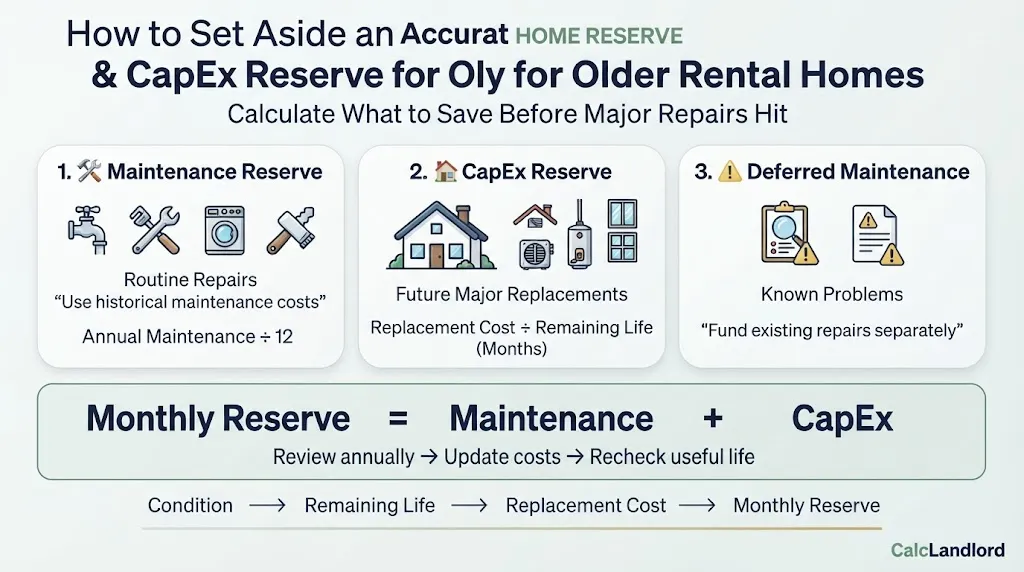
How to Set Aside an Accurate Monthly Maintenance and CapEx Reserve for Older Rental Homes
An older rental property can look profitable every month—until the roof fails, the HVAC quits, or a major plumbing problem drains your cash reserve. The real danger isn’t that these expenses are impossible to predict. It’s that many landlords underestimate them by relying on a Generic Percentage of rent. Older homes require a more precise approach based on the age and condition of individual systems, their remaining useful life, current replacement costs, and known deferred maintenance. In this guide, you’ll learn how to calculate a realistic monthly maintenance and CapEx reserve, separate immediate repairs from future replacements, and build a reserve strategy that better reflects your property’s actual financial risk.
Older rental homes can produce excellent cash flow—but only if you prepare for the costs that eventually arrive.
A rental property can look highly profitable on paper while its roof, HVAC system, plumbing, water heater, or electrical components quietly move closer to expensive replacement.
The biggest problem is not that these expenses are completely unpredictable.
The exact timing may be uncertain, but many major expenses are foreseeable.
That is why landlords should not rely entirely on a generic rule such as saving a fixed percentage of monthly rent. For older rental homes, a more accurate strategy is to examine the property itself: its systems, condition, remaining useful life, replacement costs, deferred maintenance, and local risks.
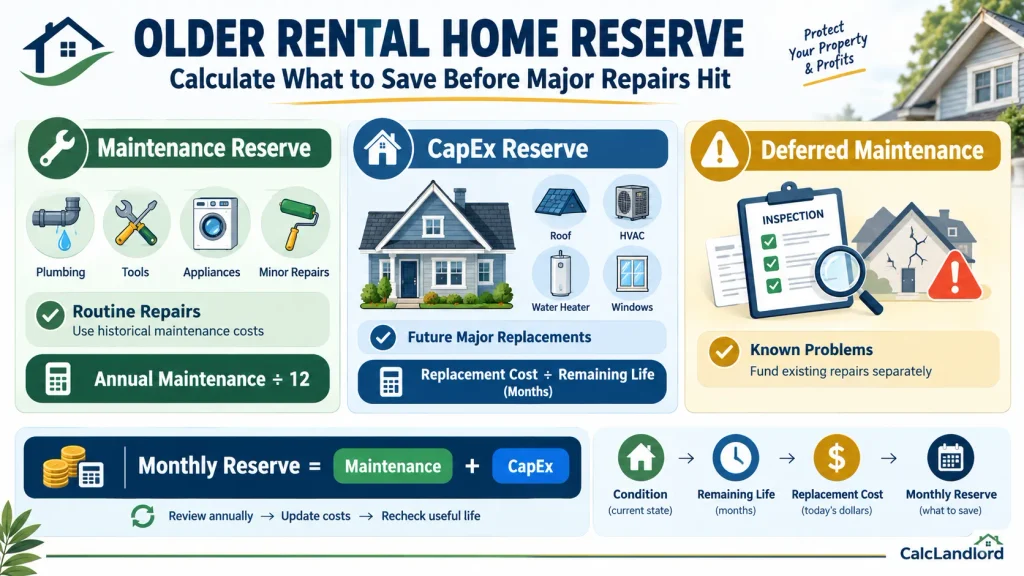
The most practical approach is to separate your money into three categories:
- Routine maintenance reserve
- Future CapEx reserve
- Deferred maintenance or catch-up fund
This guide explains how to build a property-specific monthly reserve strategy that helps U.S. landlords make better cash-flow and investment decisions.
1. How Much Should You Set Aside Each Month for Maintenance and CapEx on an Older Rental Home?
There is no single percentage that accurately works for every older rental property.
Two homes built in the same year can require dramatically different reserve amounts. One may have a new roof and a recently replaced HVAC system, while the other may still have aging original systems and years of deferred maintenance.
The most accurate approach is property-specific.
Start by separating your reserve planning into different categories.
Maintenance Reserve
Money set aside for recurring and routine repairs.
CapEx Reserve
Money set aside for major future replacements and capital expenses.
Deferred Maintenance Fund
Money needed for known problems that already exist or are likely to require near-term attention.
For the CapEx portion, a practical starting formula is:
Monthly CapEx Reserve = Current Replacement Cost ÷ Remaining Useful Life in Months
You can calculate this for major components individually and then add the monthly amounts together.
For maintenance, historical spending is usually more useful when available.
Monthly Maintenance Reserve = Average Annual Maintenance Expense ÷ 12
The final reserve target should reflect the property’s actual risks—not simply a universal percentage of rent.
2. Why Older Rental Homes Need a Different Reserve Strategy
An older rental home is not automatically a bad investment.
In fact, an older property that has been carefully renovated may require less near-term capital spending than a newer property with neglected systems.
The key question is not simply:
How old is the house?
A better question is:
How old are the systems inside the house, what condition are they in, and how much useful life remains?
Consider two properties.
Property A: Built in 1955
But it has:
- A recently replaced roof
- A newer HVAC system
- Updated plumbing
- Updated electrical
- Renovated bathrooms and kitchen
Property B: Built in 2005
But it has:
- Original HVAC equipment
- An aging roof
- An older water heater
- Deferred maintenance
- Increasing repair issues
Property B could require a larger near-term reserve even though the building itself is newer.
The key principle is simple:
Property age is a starting point. System age and condition are more important for reserve planning.
Older homes can also create additional uncertainty because previous repairs may vary in quality, original building materials may be different, and some infrastructure may be difficult or expensive to access.
That makes inspection, maintenance history, and component-level planning especially important.

3. Maintenance Reserve vs. CapEx Reserve: What’s the Difference?
One of the most common landlord budgeting mistakes is putting every future property expense into one general savings account.
That can make cash-flow planning less clear.
So Maintenance and CapEx expenses behave differently and should generally be tracked separately.
Maintenance Reserve
Maintenance includes expenses required to keep the rental property functioning and address normal repairs.
Examples may include:
- Fixing a leaking faucet
- Minor plumbing repairs
- Appliance repairs
- Drywall repairs
- Small electrical repairs
- HVAC servicing
- Minor exterior repairs
- General wear-and-tear repairs
These expenses tend to occur irregularly but more frequently.
CapEx Reserve
Capital expenditures usually involve larger, less frequent replacements or major improvements to significant property components.
Examples may include:
- Roof replacement
- HVAC replacement
- Water heater replacement
- Major plumbing replacement
- Electrical upgrades
- Flooring replacement
- Window replacement
- Major exterior work
Why separate the two?
Imagine that a landlord uses one general repair fund.
A $15,000 roof replacement could consume most of that money, leaving little available for routine repairs.
Separating maintenance from CapEx makes it easier to understand:
- Your recurring operating risk
- Your long-term replacement obligations
- Your true property cash requirements
- Whether your rental’s cash flow is genuinely sustainable
4. Why Generic Percentage Rules Often Fail for Older Rental Properties
Landlords often use rules of thumb when estimating maintenance and repair costs.
Common approaches include:
- Percentage-of-rent methods
- Property-value percentages
- Per-square-foot estimates
- General maintenance rules
- Broad reserve percentages
These methods can be useful during early property screening.
For example, when comparing several potential investments quickly, a simple estimate may help you identify properties that deserve deeper analysis.
But a rule of thumb has an important limitation:
It does not know your property’s actual condition.
A percentage cannot tell you:
- How old your roof is
- Whether your HVAC is near replacement
- Whether plumbing is original
- Whether the property has hidden deferred maintenance
- What replacement costs are in your local market
Use rules of thumb for screening—not as your final reserve calculation.
A Landlord Evaluating a Property can start with a broad estimate.
But before making a serious investment or long-term budget decision, the reserve should become increasingly property-specific.
That is especially important for older rental homes because their individual systems can have very different replacement timelines.
5. The 6-Factor Method for Calculating an Accurate Rental Property Reserve
A practical reserve strategy should evaluate the factors that actually change financial risk.
The 6-Factor Reserve Method uses:
- Property age
- Current condition
- Remaining useful life
- Current replacement cost
- Deferred maintenance
- Local risk factors
Factor 1: Property Age
Older construction can indicate potential infrastructure risks, but age alone should never determine your reserve amount.
Use it as a starting point for investigation.
Factor 2: Current Condition
A recently renovated property and a neglected property should not receive the same reserve treatment.
Consider whether the property is:
- Excellent condition
- Average condition
- Aging but functional
- High-risk
- Burdened by deferred maintenance
Factor 3: Remaining Useful Life
The most important question is often not how long a component normally lasts.
Ask:
How much useful life does this specific component realistically have left?
Factor 4: Current Replacement Cost
Use realistic current prices.
Do not calculate a future replacement using a contractor invoice from ten years ago.
Factor 5: Deferred Maintenance
Known problems should not simply disappear inside a long-term reserve formula.
They may require separate funding.
Factor 6: Local Risk Factors
Climate, labor costs, weather exposure, property location, and other local conditions can change long-term expenses.
Together, these six factors create a more realistic reserve plan than blindly applying one universal percentage.
6. How Property Age, System Age, and Condition Affect Your Reserve
Construction year and system age should be evaluated separately.
A 40-year-old house can have a relatively low near-term CapEx requirement if its major systems were recently replaced.
Meanwhile, a newer property can face substantial near-term risk if several expensive systems reach the end of their useful lives at the same time.
Review each major component individually.
Your inventory may include:
- Roof
- HVAC system
- Furnace
- Water heater
- Plumbing system
- Electrical system
- Appliances
- Flooring
- Windows
- Siding
- Driveway
- Gutters and drainage
- Kitchen components
- Bathrooms
For every component, ask:
- How old is it?
- What condition is it in?
- How well has it been maintained?
- How much useful life may remain?
- What would replacement cost today?
This creates a much clearer financial picture.
A useful landlord mindset
Do not ask:
“How old is my property?”
Ask:
“Which expensive systems are closest to requiring major work?”
That question directly connects property condition with future cash requirements.
7. How to Calculate Your Monthly CapEx Reserve Step by Step
CapEx planning becomes easier when you break a large problem into individual components.
Step 1: Create a Major Component Inventory
List the significant systems and components that could eventually require major spending.
For example:
- Roof
- HVAC
- Water heater
- Plumbing
- Electrical
- Flooring
- Windows
- Appliances
- Exterior components
You do not need to predict every possible future expense perfectly.
The goal is to identify the major foreseeable replacement risks.
Step 2: Estimate Current Replacement Cost
Determine what each component would realistically cost to replace in your market.
Better information may come from:
- Contractor estimates
- Recent local replacement quotes
- Property inspection information
- Recent invoices for similar work
Remember that replacement costs can change over time.
Your reserve plan should be reviewed periodically.
Step 3: Estimate Remaining Useful Life
Use available information such as:
- Inspection reports
- Installation records
- Maintenance history
- Contractor opinions
- Visible condition
Do not confuse original expected lifespan with remaining useful life.
Step 4: Calculate the Monthly Reserve
Use:
Monthly CapEx Reserve = Replacement Cost ÷ Remaining Useful Life in Months
Example
Suppose an HVAC system may cost $9,000 to replace.
Estimated remaining useful life:
6 years
Six years equals:
72 months
Calculation:
$9,000 ÷ 72 = $125
Estimated monthly HVAC reserve:
$125 per month
Step 5: Repeat the Process
Calculate the estimated monthly reserve for other major components.
Then add them together.
Total Monthly CapEx Reserve = Sum of All Component-Level Monthly Reserves
This gives you a property-specific starting point.
8. How to Calculate a Separate Monthly Maintenance Reserve
Maintenance is different from CapEx because routine repairs are usually harder to schedule precisely.
A faucet may leak unexpectedly.
An appliance may stop working.
A tenant may report a minor plumbing or electrical issue.
For an existing rental property, your best starting information may be the property’s actual maintenance history.
Review previous maintenance expenses
Look at:
- The last 12 months
- The last 24 months
- The last 36 months
If reliable records exist, calculate:
Average Annual Maintenance Cost ÷ 12
Example
Suppose your property spent:
- $2,400 on maintenance in Year 1
- $3,000 in Year 2
- $2,100 in Year 3
Total:
$7,500
Average annual maintenance:
$7,500 ÷ 3 = $2,500
Monthly maintenance reserve:
$2,500 ÷ 12 = approximately $208
What if you just bought the property?
New owners may not have reliable historical records.
In that situation, start with a temporary estimate based on:
- Inspection findings
- Property condition
- System age
- Local repair costs
- Previous maintenance records
- Property type
- Climate and weather exposure
Then adjust your reserve after collecting actual operating data.
Your first estimate does not need to be permanent.
9. How to Estimate Remaining Useful Life and Replacement Costs
This is where reserve planning becomes more realistic—and where many generic budgeting methods become weak.
Total lifespan is not the same as remaining lifespan.
Suppose a roof has an expected service life under ideal conditions of several decades.
That does not mean every roof will perform identically.
Maintenance quality, weather exposure, installation quality, and current condition can all affect actual performance.
Instead of assuming a standard lifespan, investigate:
- Installation date
- Maintenance history
- Inspection findings
- Current physical condition
- Evidence of deterioration
Estimating replacement cost
Use today’s realistic market cost as your starting point.
The goal is not to predict the exact invoice years into the future.
The goal is to understand the approximate financial obligation and avoid pretending that a major replacement will cost what it did years ago.
Use a range when uncertainty is high.
If a component could cost significantly more or less depending on conditions, consider planning scenarios.
For example:
- Conservative scenario
- Expected scenario
- Higher-cost scenario
This is particularly useful for older homes where opening walls, accessing old plumbing, or discovering additional problems can increase project costs.
10. Deferred Maintenance vs. Future CapEx: The Cost Difference Landlords Must Understand
This distinction is critical.
A reserve is generally intended to prepare for future expenses.
Deferred maintenance may represent a problem that already exists.
Example
Suppose an inspection identifies:
- A roof close to failure
- Major plumbing problems
- Unsafe or outdated electrical issues
- Significant water damage
These are not simply distant possibilities.
They are known risks that may require action.
Do not hide known expenses inside a long-term reserve plan.
Instead, separate them.
Future CapEx
A predictable future replacement that may occur years from now.
Deferred Maintenance
A known issue that already requires catch-up spending or near-term planning.
This distinction helps landlords avoid a dangerous mistake:
Spreading an existing major problem across a long timeline and pretending the property is financially prepared.
If a property needs substantial work soon, the investor should evaluate whether the necessary cash is available now or how it will be funded.
This can significantly affect:
- Cash flow
- Purchase decisions
- Investment returns
- Financing needs
- Renovation budgets
- Property valuation decisions
11. The Three-Bucket Reserve System for Older Rental Homes
A practical system for older rental properties is to use three separate financial buckets.
Bucket 1: Maintenance Reserve
Used for:
- Routine repairs
- Minor emergencies
- Wear and tear
- Ongoing property upkeep
Bucket 2: CapEx Sinking Fund
Used for predictable long-term major replacements such as:
- Roofs
- HVAC systems
- Water heaters
- Flooring
- Major property components
Bucket 3: Deferred Maintenance or Catch-Up Fund
Used for:
- Known inspection problems
- Existing major defects
- Immediate repairs
- Necessary catch-up work
Why this system works
It prevents three completely different financial obligations from being mixed.
A landlord can clearly see:
What might happen soon?
So what needs funding over time?
What problem already exists today?
That makes property-level financial planning more accurate.
12. Worked Example: Calculating Maintenance and CapEx Reserves for an Older Rental
Consider this hypothetical property.
Property Profile
- Older single-family rental home
- Monthly rent: $2,500
- Roof is aging
- HVAC system has several years of estimated remaining life
- Water heater is approaching replacement
- Flooring will eventually require replacement
- Windows may need future work
The following example is hypothetical and is intended only to demonstrate the calculation method.
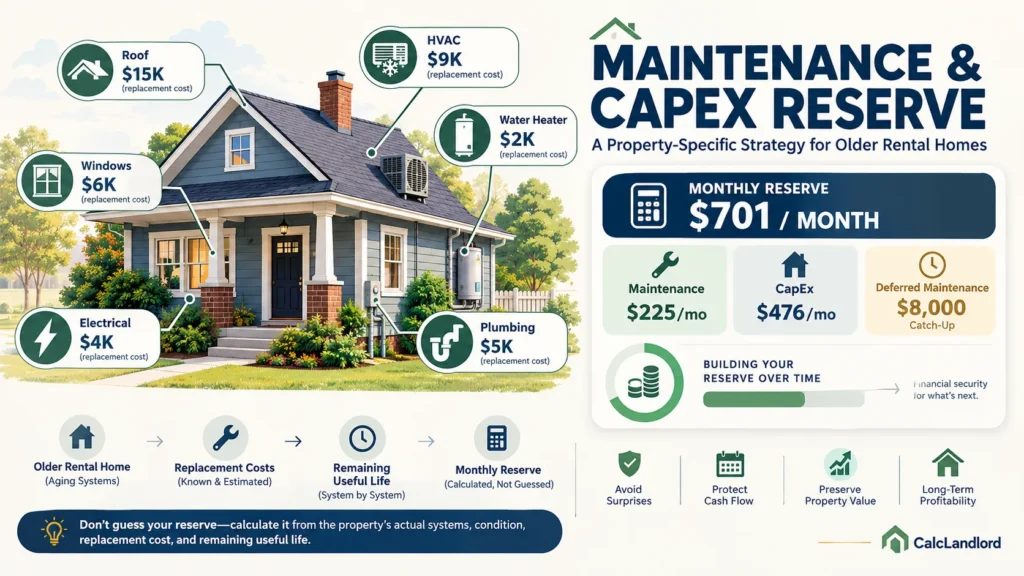
| Component | Estimated Replacement Cost | Estimated Remaining Life | Estimated Monthly Reserve |
| Roof | $15,000 | 8 years / 96 months | $156 |
| HVAC | $9,000 | 6 years / 72 months | $125 |
| Water Heater | $2,000 | 3 years / 36 months | $56 |
| Flooring | $7,000 | 7 years / 84 months | $83 |
| Windows | $10,000 | 15 years / 180 months | $56 |
Estimated Monthly CapEx Reserve
$156 + $125 + $56 + $83 + $56 = $476 per month
Now suppose the landlord’s historical maintenance analysis suggests:
Monthly Maintenance Reserve = $225
The basic combined monthly reserve contribution becomes:
Total Monthly Reserve Contribution
$476 CapEx + $225 Maintenance = $701 per month
However, suppose an inspection also identifies $8,000 of known deferred maintenance.
That $8,000 should not automatically be treated as part of the normal future reserve.
It requires its own funding strategy.
The key lesson
A property may have:
- A monthly maintenance requirement
- A monthly CapEx funding requirement
- An immediate deferred maintenance requirement
These are three different financial obligations.
13. How Local Climate, Labor Costs, and Property Risks Change Your Reserve Target
The same property can have different long-term maintenance risks depending on location.
Cold climates
Potential concerns may include:
- Frozen pipes
- Heating system stress
- Ice-related damage
- Seasonal weather exposure
Heavy-rain environments
Potential risks may include:
- Roof wear
- Drainage problems
- Gutter issues
- Moisture intrusion
- Foundation water concerns
Hot climates
Potential concerns may include:
- Higher HVAC usage
- Cooling system stress
- Roof deterioration
- Heat-related material wear
Coastal environments
Potential concerns may include:
- Corrosion
- Salt exposure
- Moisture
- Weather-related damage
Local labor costs also matter
A repair that costs one amount in one market may cost substantially more in another.
This is why replacement costs should be researched locally whenever possible.
Other risk factors include:
- Property accessibility
- Contractor availability
- Property type
- Tenant turnover
- Landscaping requirements
- Local weather exposure
- Construction quality
A reserve formula should reflect the property and its environment.
14. When Should You Increase or Recalculate Your Monthly Reserve?
A reserve plan should not remain unchanged forever.
Your property changes.
Its systems age.
Replacement prices change.
Maintenance history develops.
A practical approach is to review your reserve plan at least annually.
You should also consider reviewing it after:
- Buying the property
- Completing a major renovation
- Replacing a major system
- Receiving important inspection findings
- Experiencing unusually high maintenance costs
- Significant changes in local contractor pricing
- Major property deterioration
Update three important things
1. Replacement Costs
Are your previous estimates still realistic?
2. Remaining Useful Life
Every year, your systems become one year older unless major work changes their condition.
3. Maintenance History
Actual property expenses can provide better information than assumptions.
A simple principle
Your reserve plan should evolve as the property evolves.
15. Common Maintenance and CapEx Reserve Mistakes Older-Rental Owners Should Avoid
A strong reserve system is not just about calculating a number.
It is also about avoiding common planning mistakes.
Mistake #1: Using One Percentage Forever
A broad percentage may help with initial screening.
It should not automatically become a permanent property-specific reserve strategy.
Mistake #2: Combining Maintenance and CapEx
Routine repairs and major replacements create different financial risks.
Track them separately when possible.
Mistake #3: Ignoring Remaining Useful Life
A component’s original expected lifespan does not tell you how much life remains today.
Mistake #4: Ignoring Deferred Maintenance
Known problems may require immediate or near-term funding.
Do not hide them inside a distant future reserve calculation.
Mistake #5: Using Old Replacement Prices
Replacement costs should be periodically updated.
Mistake #6: Assuming Every Component Will Last Its Maximum Possible Lifespan
Real-world performance depends on condition, maintenance, installation quality, and environmental exposure.
Mistake #7: Never Reviewing the Reserve Plan
A reserve calculation created years ago may no longer reflect the property’s actual risks.
Mistake #8: Confusing Monthly Contributions With Total Cash Available
These are different questions.
Monthly reserve contribution asks:
How much should I add each month?
Cash reserve balance asks:
How much money do I need available today?
An older property with near-term replacement risks may require a larger starting cash balance than monthly contributions alone can build quickly.
More Explore: https://calclandlord.com/rental-property-finance/
Key Takeaways: Building a More Accurate Reserve for an Older Rental
The most accurate maintenance and CapEx reserve is not based on a magic percentage.
It is based on understanding the property.
Start by separating:
- Routine maintenance
- Future capital replacements
- Existing deferred maintenance
Then create a major component inventory.
For each significant system, estimate:
- Current condition
- Remaining useful life
- Current replacement cost
Use the basic formula:
Monthly CapEx Reserve = Replacement Cost ÷ Remaining Useful Life in Months
Calculate maintenance separately using actual historical expenses whenever reliable records are available.
Most importantly, remember this:
An older rental home is not automatically more expensive simply because of its year of construction. The condition, age, and remaining useful life of its individual systems determine much of its real financial risk.
A property-specific reserve plan takes more effort than applying a generic percentage.
But it can give landlords a much clearer picture of:
- Future cash requirements
- True rental property expenses
- Sustainable cash flow
- Investment risk
- Long-term ownership costs
The goal is not to predict the exact day when something will fail.
The goal is to make sure your rental property is financially prepared when it does.
People Also Ask
There is no universal amount that fits every older rental. A practical starting point is to review the property’s actual maintenance history and adjust for condition, inspection findings, and local repair costs.
CapEx reserves are more accurate when calculated component by component. Estimate the replacement cost of major systems and divide each cost by its estimated remaining useful life in months.
Yes, separating them can improve financial planning. Maintenance covers recurring repairs, while CapEx generally covers major replacements and larger long-term expenses.
It can, but construction age alone does not determine costs. The condition and age of major systems often provide more useful information.
It can be useful as a quick screening estimate, but it cannot account for the actual condition, remaining life, or replacement costs of individual systems.
Deferred maintenance refers to maintenance or repairs that have been postponed and may represent existing property problems rather than future long-term expenses.
A practical approach is to review it at least annually and after major inspections, replacements, renovations, or significant changes in property condition.
Conclusion
Accurate maintenance and CapEx Reserves start with understanding the property—not relying on a single percentage. By separating routine maintenance, future CapEx, and deferred maintenance, then estimating replacement costs and remaining useful life, landlords can build a more realistic monthly reserve. Review and update the numbers regularly as the property, systems, and costs change so your rental remains financially prepared for unexpected expenses.
Estimate Your Monthly Maintenance & CapEx Reserve👉 Calculate Your Reserve

Pingback: Stop Guessing: 7 Formulas to Calculate Per-Unit Economics
Pingback: Rental Yields by State: The Comparison Investors Miss
Pingback: Fair Market Value: The NOI + Cap Rate Formula (2026)
Pingback: Landlord Legal Compliance: Avoid Costly Rental Mistakes