
CCIM Designation: Requirements, Cost, Courses & Career Guide
If you work in commercial real estate—or regularly evaluate commercial investment properties—you may have come across the CCIM Designation. But what does CCIM mean, how do you earn it, how much does it cost, and does it fit your career goals?
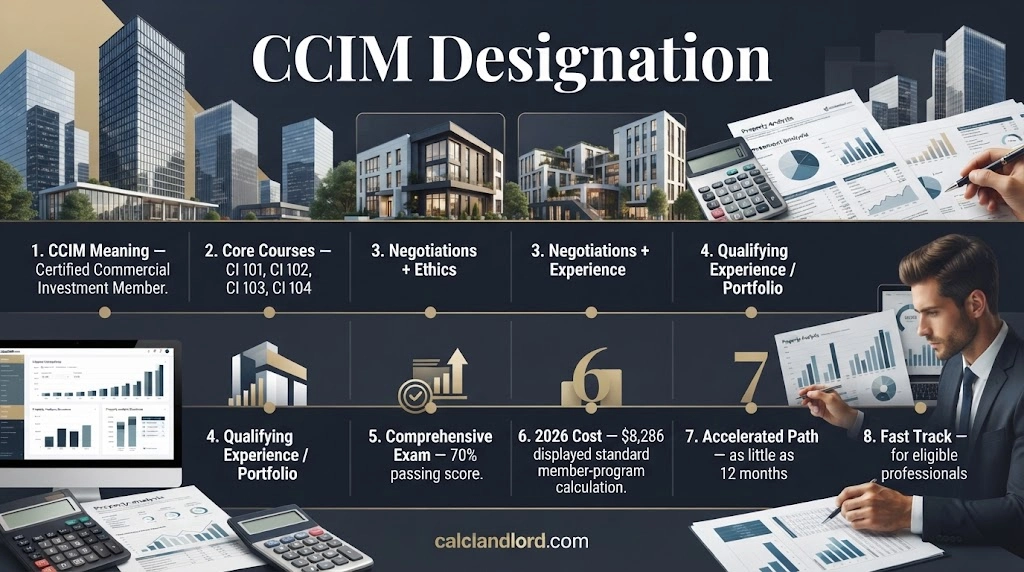
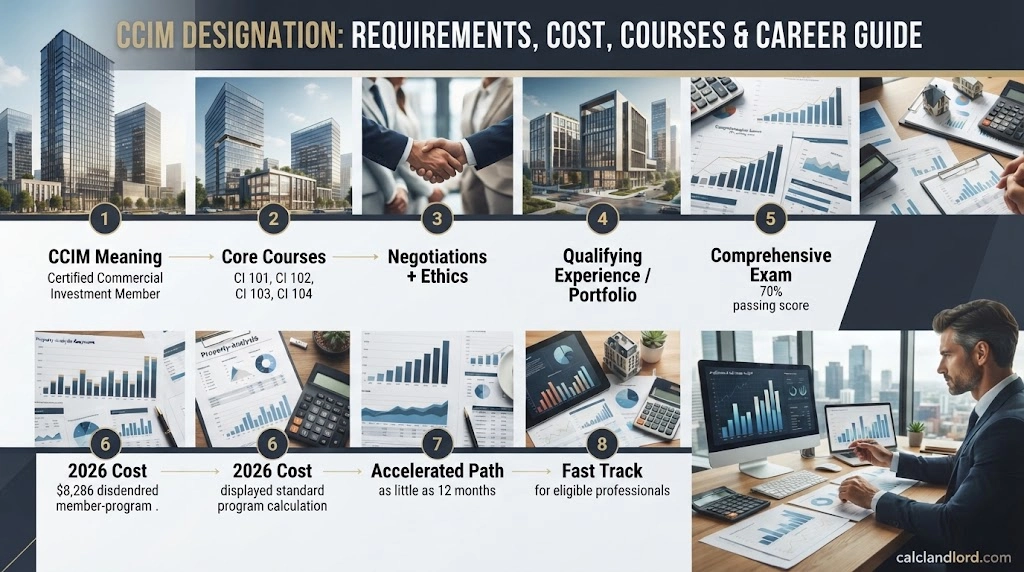
The CCIM designation stands for Certified Commercial Investment Member. It is a professional commercial real estate designation awarded by The CCIM Institute. Its curriculum focuses on financial analysis, market analysis, user decision analysis, investment analysis, negotiation, ethics, and practical commercial real estate experience.
The standard pathway combines four designation courses, negotiation training, ethics education, elective requirements, a qualifying-experience portfolio, and a Comprehensive Exam. Certain professionals can use Fast Track or University Fast Track pathways with modified requirements.
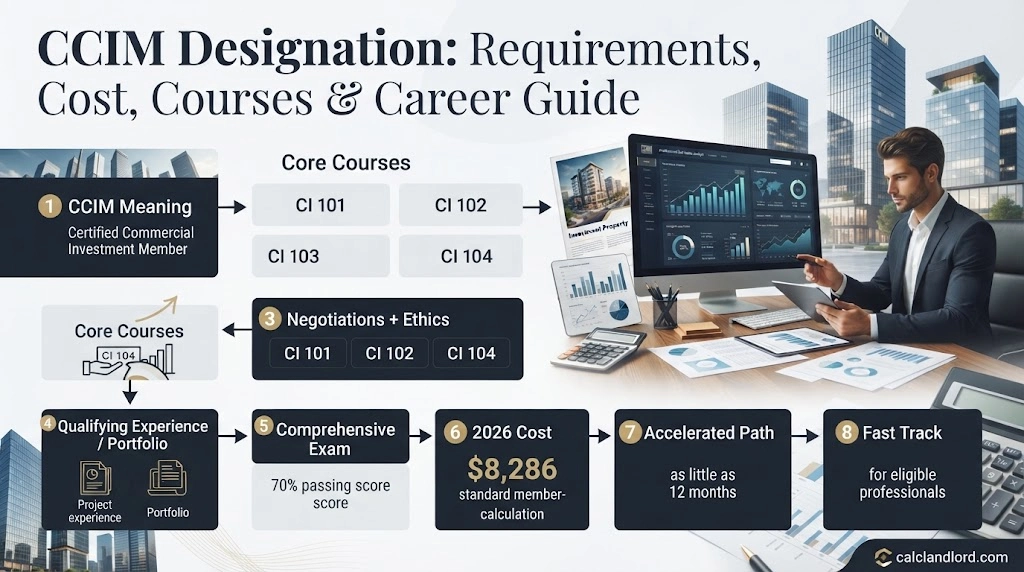
For 2026, the CCIM Institute lists a standard member-program calculation of $8,286, although the actual amount can vary by pathway, electives, membership timing, and course choices. The Institute also offers an accelerated 12-month route.
This guide explains the CCIM designation from start to finish so commercial real estate professionals, investors, landlords, property managers, and other real estate professionals can determine what the credential involves before committing time and money.
What Is the CCIM Designation?
The CCIM designation is a professional credential for commercial real estate practitioners who complete the applicable CCIM education, experience, and examination requirements.
CCIM’s educational program is built around four major analytical areas:
- Financial analysis
- Market analysis
- User decision analysis
- Investment analysis
The program also incorporates negotiation training and ethics education. Depending on the candidate’s pathway, experience and elective requirements may also apply.
Unlike a state real estate license, CCIM is not primarily a regulatory authorization. A license generally determines whether someone may legally perform regulated real estate activities in a particular jurisdiction, while CCIM is a professional designation demonstrating completion of a specific commercial real estate education, experience, and examination pathway.
For someone involved in commercial property investment, brokerage, development, lending, asset management, or property management, the distinction is important.
What makes CCIM different?
The curriculum is strongly centered on analyzing commercial real estate decisions.
Instead of focusing only on how to transact property, the program teaches analytical concepts that can help professionals evaluate:
- Property financial performance
- Market conditions
- Leasing versus ownership decisions
- Investment returns
- Risk
- Commercial real estate negotiations
The CCIM Institute describes the designation as a professional mark associated with expertise, trust, and professionalism in commercial real estate.
What Does CCIM Stand For?
CCIM stands for Certified Commercial Investment Member.
The designation is awarded by The CCIM Institute after candidates complete the requirements applicable to their membership pathway.
The name reflects the program’s historical connection to commercial investment real estate, but the designation can be relevant to professionals working in several areas of commercial real estate.
Potentially relevant professionals include:
- Commercial real estate brokers
- Investors
- Developers
- Lenders
- Asset managers
- Property managers
- Appraisers
- Banking professionals
- Commercial real estate consultants
- Other professionals involved in commercial investment decisions
The Institute identifies professionals from a range of commercial real estate and related backgrounds within its membership and designation ecosystem.
CCIM vs. CCIM certification
You will sometimes see people searching for “CCIM certification.”
Technically, CCIM is a professional designation, not simply a short certification course.
That distinction matters because earning the designation involves more than completing one class. Depending on the pathway, candidates may need education, negotiations training, ethics training, experience documentation, elective credits, and a Comprehensive Exam.
Who Is the CCIM Designation For?
The CCIM designation can be relevant to professionals whose work involves commercial real estate transactions, investment analysis, financing, property decisions, or development.
Commercial real estate brokers
Brokers may use financial and market-analysis skills when evaluating investment opportunities, transactions, leasing decisions, and property performance.
Real estate investors
Investors can use commercial real estate analysis to compare potential acquisitions, evaluate projected returns, and understand investment risk.
For example, an investor comparing two commercial properties might examine:
- Purchase price
- Net operating income
- Financing
- Cash flow
- Cap rate
- Projected returns
- Market conditions
- Exit assumptions
CCIM education can provide analytical frameworks for this type of work.
Developers
Developers may encounter decisions involving land, market demand, financing, users, project economics, and investment performance.
Lenders and financial professionals
Commercial lending and finance professionals routinely evaluate property economics, borrower assumptions, market conditions, and investment risk.
Property and asset managers
Commercial property managers and asset managers can encounter decisions involving leasing, operating performance, capital improvements, market conditions, and asset strategy.
Landlords and rental-property investors
For a residential landlord with a small rental portfolio, CCIM may be more specialized than necessary.
However, an owner moving toward multifamily, retail, office, industrial, or larger commercial investments may find the curriculum more directly relevant.
That distinction is important: CCIM is primarily a commercial real estate designation, so its usefulness depends heavily on the type of real estate work you actually perform.
What Are the CCIM Designation Requirements?
The exact requirements depend on your membership pathway.
For a standard candidate, the designation process generally includes:
- CI 101: Financial Analysis
- CI 102: Market Analysis
- Negotiations Training
- CI 103: User Decision Analysis
- CI 104: Investment Analysis
- Online Ethics Course
- Two elective credits
- Portfolio of Qualifying Experience
- Comprehensive Exam
The CCIM Institute confirms that the education component consists of the four designation courses, ethics training, negotiation training, and applicable elective courses.
Not every candidate follows exactly the same sequence because Fast Track and University Fast Track pathways can modify certain requirements.
Candidate membership
Candidate Membership is an important part of the standard designation process.
The CCIM Institute currently lists U.S. candidate membership at $695 annually. Candidate status is required for activities including submitting the qualifying-experience portfolio, taking the Comprehensive Exam, qualifying for Fast Track, and ultimately receiving the designation.
Experience requirement
Standard candidates generally need to demonstrate qualifying commercial real estate experience through the Portfolio of Qualifying Experience.
Fast Track candidates with qualifying existing designations can have the traditional portfolio requirement waived.
Examination
Candidates must also complete the Comprehensive Exam unless a specific program rule provides otherwise.
The exam tests concepts covered throughout the designation curriculum.
What Are the CCIM Courses and Curriculum?
The CCIM curriculum consists of four core designation courses, plus negotiation and ethics requirements and applicable electives.
| Course | Main Focus |
| CI 101 | Financial Analysis |
| CI 102 | Market Analysis |
| Negotiations Training | Commercial real estate negotiation |
| CI 103 | User Decision Analysis |
| CI 104 | Investment Analysis |
| Ethics Course | CCIM Code and Standards of Practice |
The current CCIM curriculum can be completed through different learning formats, including classroom, instructor-led online, self-paced online, and virtual options.
CI 101: Financial Analysis
CI 101 provides the financial-analysis foundation for the later courses.
It is a prerequisite for CI 103 and CI 104.
For a property investor, this part of the curriculum is particularly relevant to understanding the financial characteristics of commercial investment real estate.
CI 102: Market Analysis
CI 102 focuses on market analysis across four major property categories:
- Office
- Industrial
- Multifamily
- Retail
The objective is to understand how market conditions and property characteristics influence commercial investment decisions.
Negotiations Training
Candidates must complete eight hours of negotiation training before moving on to CI 103 and CI 104.
The Institute offers several ways to satisfy this requirement depending on the applicable program and format.
CI 103: User Decision Analysis
CI 103 applies financial and market-analysis concepts to user-space decisions.
It includes concepts related to cost of occupancy and ownership-versus-leasing decisions.
CI 104: Investment Analysis
CI 104 focuses on investment performance and risk.
It is particularly relevant to professionals who need to evaluate projected investment returns and quantify real estate risk.
Ethics
The online ethics course covers the CCIM Institute Code and Standards of Practice.
It is part of the designation pathway.
What Is the CCIM Portfolio of Qualifying Experience?
The Portfolio of Qualifying Experience is the mechanism used to document qualifying commercial real estate experience for candidates who are required to submit one.
It is not simply a résumé.
The portfolio is intended to verify the quality of a candidate’s commercial investment work and demonstrate that the candidate has achieved the required level of experience.
Who needs a portfolio?
Standard candidates generally need to submit a portfolio.
Fast Track members do not need to submit the traditional portfolio because their qualifying industry designation is used as the basis for the Fast Track pathway.
When can you start?
Candidate members can begin compiling their portfolio after completing CI 101.
The Institute’s portfolio information identifies different portfolio types depending on professional experience and activity.
The traditional portfolio route requires at least two consecutive years of full-time experience before submission, while certain streamlined routes have five-year experience requirements.
Why should candidates plan early?
Waiting until the end of the education process to organize your experience documentation can make the process unnecessarily difficult.
A practical approach is to maintain records of qualifying transactions, projects, activities, and work products as you progress through your career.
What Is the CCIM Comprehensive Exam?
The CCIM Comprehensive Exam is the final examination component of the designation pathway.
It tests knowledge from the CCIM designation curriculum.
The current exam is conducted in person and lasts one day. Candidates can use printed or digital CCIM course materials, but internet access is prohibited during the exam.
What score do you need to pass?
The current passing score is 70% or higher.
Is the exam open book?
Yes.
Candidates may use their permitted printed or digital CCIM course materials during the examination, but they cannot use the internet.
Do you have to take the Core Concepts Review?
The Core Concepts Review is not mandatory for every candidate, but the Institute states that most test-takers attend it.
The in-person review lasts two days and is designed to reinforce material covered by the exam.
What happens if you fail?
The Institute currently provides retake opportunities under its exam rules, including a following-day opportunity in certain circumstances and additional retake options. Candidates should verify the current exam policy before scheduling.
How Much Does the CCIM Designation Cost in 2026?
The cost of the CCIM designation depends on membership status, course format, electives, timing, and the pathway you use.
For 2026, the CCIM Institute lists the following standard costs:
| Component | 2026 Member Cost |
| Candidate membership | $695 |
| CI 101 | $1,299 |
| CI 102 | $1,529 |
| Negotiations Training | $370 |
| CI 103 | $1,499 |
| CI 104 | $1,499 |
| Ethics Course | Included |
| Portfolio submission | $175 |
| Comprehensive Exam + Two-Day Review | $1,220 |
| Two elective credits | Varies |
| Displayed member total | $8,286 |
The Institute’s displayed non-member calculation is $11,810, compared with $8,286 under the member calculation. The Institute says the member route can therefore produce substantial savings.
- Explore More: https://calclandlord.com/sior/
2026 CCIM bundle
The CCIM Institute also currently promotes a designation bundle.
Its 2026 bundle document lists:
- Individual non-member course pricing: $11,584
- Individual member-course pricing: $8,695
- Bundled price: $7,695
Because bundles and program offerings can change, prospective candidates should verify the current terms before purchasing.
The real cost is more than tuition
When budgeting for CCIM, consider:
- Candidate membership
- Course tuition
- Negotiations training
- Electives
- Portfolio fee
- Exam and review
- Travel, if applicable
- Time away from work
- Additional membership years if the program takes longer
This is especially important for professionals who are comparing CCIM with another designation or professional-development program.
How Long Does It Take to Earn the CCIM Designation?
There is no single timeline that applies to every candidate.
The CCIM Institute says candidates can complete the designation in as little as one year, while others can spread the process across several years.
The current accelerated CCIM curriculum is designed around a 12-month pathway.
Your actual timeline can depend on:
- Existing commercial real estate experience
- Membership pathway
- Course availability
- Course format
- Portfolio preparation
- Elective requirements
- Exam schedule
- Work commitments
- Whether you use Fast Track
- Whether you qualify for University Fast Track
A simple planning example
A candidate following an accelerated route might organize the year around:
Months 1–3: Core financial and market-analysis education
Months 4–7: Negotiations and additional designation coursework
The Months 8–10: Complete remaining educational requirements and prepare qualifying-experience documentation
Months 11–12: Exam preparation and Comprehensive Exam
This is an illustrative planning framework, not a guaranteed CCIM schedule. Actual course and exam dates must be confirmed with the Institute.
What Is the CCIM Fast Track?
The CCIM Fast Track pathway is designed for professionals who already hold certain qualifying commercial real estate designations.
The current qualifying designation list includes credentials such as:
- AACI
- ALC
- CLO
- CMB
- CFA
- CPM
- CRE
- CRF
- FRI
- MAI/SRPA
- RICS
- RPA
- SIOR
Specific eligibility conditions can apply to individual credentials.
What does Fast Track waive?
Fast Track members do not need to complete the traditional:
- Two elective credits
- Portfolio of Qualifying Experience
They still complete the applicable CCIM core courses, negotiations and ethics requirements, and Comprehensive Exam.
The Institute currently gives Fast Track members 24 months from joining to complete the listed designation requirements.
Example: CCIM and SIOR
SIOR is among the designations listed for the CCIM Fast Track pathway.
That means an eligible SIOR holder can potentially avoid the traditional elective-credit and portfolio requirements while completing the remaining applicable CCIM requirements.
Eligibility should always be confirmed with CCIM before assuming a particular credential qualifies.
What Is the CCIM University Fast Track?
University Fast Track is designed for eligible graduates of approved undergraduate and graduate real estate programs.
Undergraduate pathway
Eligible graduates within the previous five years of approved undergraduate real estate programs can receive credit toward the first designation course requirement.
The current undergraduate University Fast Track pathway gives eligible members 72 months to complete its requirements. Candidates must still complete the applicable remaining coursework, negotiations, ethics, portfolio, and Comprehensive Exam requirements.
Graduate pathway
CCIM also has a University Fast Track graduate membership for eligible graduates of approved real estate master’s programs.
The current graduate pathway gives eligible members 48 months to complete its applicable requirements, with the exact remaining courses depending on the qualifying university program.
Why this matters for new real estate professionals
A recent graduate should not automatically assume the standard CCIM pathway is the only option.
If your university program qualifies, University Fast Track may change the amount of coursework you need to complete.
The important first step is verifying whether your specific degree program and graduation date qualify.
What Are the Benefits of the CCIM Designation?
The benefits depend on the individual’s career, market, experience, and objectives.
Rather than treating the designation as an automatic career guarantee, it is more useful to examine what the program actually provides.
1. Commercial real estate analysis
The curriculum develops knowledge in financial, market, user-decision, and investment analysis.
2. Investment-analysis skills
CI 104 specifically focuses on investment performance and risk.
This can be relevant when comparing commercial investment opportunities.
3. Market-analysis knowledge
CI 102 examines office, industrial, multifamily, and retail property markets.
4. Negotiation training
The program includes dedicated negotiation education, including an eight-hour requirement before CI 103 and CI 104.
5. Professional network
CCIM membership provides access to a commercial real estate professional network and member resources.
6. Professional credential
Completing the designation demonstrates that the candidate has completed the applicable CCIM education, experience, and examination requirements.
7. Practical application
The program is structured around commercial real estate decisions rather than only theoretical academic concepts.
For an investor or commercial property professional, that distinction can be useful when deciding whether the curriculum aligns with daily work.
CCIM vs. Other Commercial Real Estate Designations
There is no single commercial real estate credential that fits every professional.
Different designations emphasize different areas of the industry.
| Credential | General Area of Focus |
| CCIM | Commercial investment analysis |
| SIOR | Commercial/industrial brokerage |
| CPM | Property management |
| RICS | Broad professional real estate standards and disciplines |
| MAI | Real estate valuation/appraisal |
| CRE | Real estate counseling/advisory expertise |
| RPA | Commercial property operations and management |
| ALC | Land consulting |
These are broad descriptions, not substitutes for reviewing each organization’s current eligibility and curriculum.
CCIM vs. SIOR
CCIM’s curriculum centers on financial analysis, market analysis, user decision analysis, investment analysis, and negotiation.
SIOR is associated more specifically with commercial and industrial brokerage.
A professional whose daily work is heavily investment-analysis oriented may have different educational priorities from a specialist focused primarily on brokerage.
CCIM vs. CPM
CPM is associated with property management, while CCIM’s education emphasizes commercial investment analysis.
A property manager deciding between credentials should therefore examine whether their primary professional objective is asset/property management or commercial investment analysis.
CCIM vs. RICS
RICS covers a broad range of professional real estate disciplines and standards.
CCIM has a more focused commercial investment-analysis curriculum.
Qualifying RICS holders are currently included among CCIM’s Fast Track candidates, subject to the Institute’s applicable conditions.
The practical question is not which credential has more letters after someone’s name. It is which program’s education, requirements, network, and professional positioning match the work you actually want to do.
Is the CCIM Designation Right for Your Real Estate Career?
The answer depends on your professional situation.
Instead of asking whether CCIM is universally “worth it,” evaluate the credential against your own career and investment goals.
Consider CCIM if you:
- Work primarily in commercial real estate
- Analyze commercial investment opportunities
- Work with commercial transactions
- Want structured financial-analysis education
- Evaluate market conditions
- Work in investment, brokerage, development, lending, or asset management
- Want a formal commercial real estate designation
- Can commit the required time and cost
- Already have qualifying commercial real estate experience
Consider the fit more carefully if you:
- Primarily own one or two residential rental properties
- Have little involvement with commercial real estate
- Do not regularly perform investment or market analysis
- Are primarily interested in residential property management
- Cannot currently justify the education cost and time commitment
For a residential landlord, practical tools such as a cash flow calculator, cap rate calculator, ROI calculator, mortgage calculator, or property comparison model may provide more immediate value for a specific acquisition decision.
For someone moving toward commercial investment real estate, however, a deeper commercial-analysis curriculum may be more directly aligned with their professional development.
A simple decision framework
Before enrolling, ask:
| Question | Why It Matters |
| Do I work in commercial real estate? | CCIM is a commercial-focused designation. |
| Do I analyze investment properties? | Much of the curriculum centers on investment analysis. |
| Do I need deeper financial-analysis skills? | CI 101 and CI 104 address financial and investment analysis. |
| Do I have qualifying experience? | Standard candidates may need a portfolio. |
| Do I already hold a qualifying designation? | You may qualify for Fast Track. |
| Does my university qualify? | University Fast Track may change requirements. |
| Can I afford the total cost? | Tuition is only one part of the investment. |
| Can I commit the required time? | Completion can take one year or several years. |
| Is the credential relevant to my market? | Professional value can vary by role and market. |
The goal is to match the designation to your actual career path rather than assuming the credential automatically produces a particular financial or career outcome.
How Do You Start the CCIM Designation Process?
A practical starting process looks like this:
Step 1: Determine your pathway
First determine whether you should pursue:
- Standard Candidate Membership
- Fast Track
- University Fast Track Undergraduate
- University Fast Track Graduate
Your existing credentials, education, and professional experience can change the requirements.
Step 2: Review the current requirements
Check the current CCIM curriculum, membership requirements, portfolio rules, exam information, and tuition before registering.
Program rules and pricing can change.
Step 3: Become a candidate
For the standard pathway, candidate membership is an important part of the designation process. The current U.S. annual candidate fee is $695.
Step 4: Plan your courses
Map out CI 101, CI 102, negotiations training, CI 103, CI 104, ethics, and applicable electives.
If you want an accelerated schedule, check the current 12-month pathway and course availability.
Step 5: Document experience
If your pathway requires a portfolio, start organizing qualifying activities and supporting documentation early.
The Institute allows eligible candidates to begin compiling their portfolio after CI 101.
Step 6: Prepare for the exam
Use the CCIM course materials and consider the Core Concepts Review as part of your preparation.
The current Comprehensive Exam requires a score of at least 70% to pass.
Step 7: Verify the final costs
Before making the financial commitment, confirm:
- Current membership fee
- Current course prices
- Elective costs
- Portfolio fee
- Exam fee
- Review cost
- Bundle availability
- Travel expenses
- Any additional membership costs
The CCIM Institute’s current 2026 pricing should be treated as the final authority for enrollment decisions.
People Also Ask
A: CCIM stands for Certified Commercial Investment Member. It is a professional commercial real estate designation awarded by The CCIM Institute.
A: The CCIM Institute currently lists a standard member-program calculation of $8,286 and a non-member calculation of $11,810. Actual costs can vary depending on electives, pathway, membership timing, and other choices.
A: The program can be completed in as little as one year through an accelerated route, while candidates can also spread the requirements over several years.
The CCIM Designation is a specialized commercial real estate credential built around financial analysis, market analysis, user decision analysis, investment analysis, negotiation, ethics, experience, and examination.
For 2026, the main numbers to remember are:
- CCIM meaning: Certified Commercial Investment Member
- U.S. candidate membership: $695 annually
- Displayed standard member-program calculation: $8,286
- Displayed non-member calculation: $11,810
- Accelerated pathway: about 12 months
- Comprehensive Exam passing score: 70%
- Fast Track completion window: 24 months
- University Fast Track undergraduate window: 72 months
- University Fast Track graduate window: 48 months
The right pathway depends on your existing credentials, education, experience, career objectives, and budget.
For a residential landlord focused primarily on individual rental properties, CCIM may be more specialized than necessary. For a professional moving deeper into commercial investment real estate, the curriculum is much more directly aligned with commercial analysis.
If you’re evaluating a commercial acquisition, CalcLandlord’s ROI Calculator, Cap Rate Calculator, Cash Flow Calculator, Mortgage Calculator, and Cash-on-Cash Return Calculator can complement the educational concepts discussed here by helping you analyze the financial side of an individual property.
Important: CCIM requirements, prices, course formats, exam schedules, and eligibility rules can change. Always verify the current requirements directly with The CCIM Institute before enrolling.

Pingback: SBA 504 Loan: 7 Rules Every Borrower Must Know