

Ramsey Invest Calc for Rental Property Investors
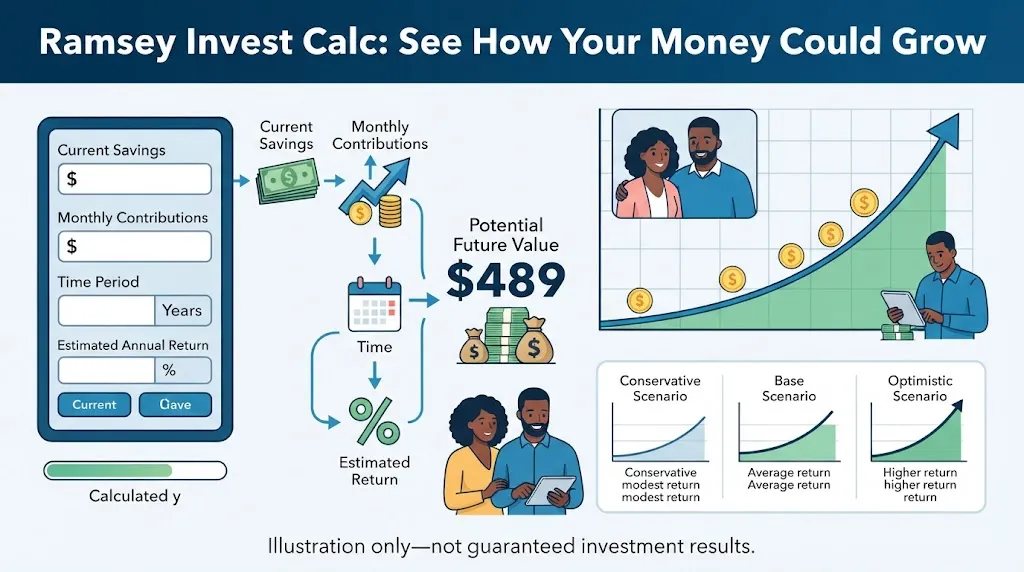
What could your money become if you invested consistently for the next 10, 20, or 30 years? The Ramsey Invest Calc helps turn that question into a practical estimate by combining your starting balance, monthly contributions, expected return, and investment timeline. But one projected number does not tell the whole story. Results depend on fees, inflation, taxes, market volatility, and whether your assumed return is realistic. In this guide, you’ll learn how the calculator works, which figures to enter, how to compare conservative and optimistic scenarios, and how to use the results to make a more informed investing decision—not a guaranteed promise.
A Ramsey invest calc usually refers to a Ramsey-style investment calculator that estimates how an initial balance and recurring contributions may grow over time. For a landlord, however, that calculation is only one part of the decision: rental property returns also depend on cash flow, financing, vacancy, maintenance, taxes, equity growth, appreciation, and selling costs.
This guide explains how to use a Ramsey-style investment projection correctly, where it falls short for rental properties, and how to combine it with CalcLandlord tools to evaluate whether a property is actually worth buying.
What Does “Ramsey Invest Calc” Mean?
The phrase “ramsey invest calc” is an abbreviated search query rather than a formal financial term. Most users mean the Dave Ramsey or Ramsey Solutions investment calculator, which estimates the potential future value of investments using inputs such as current savings, regular contributions, investment period, and assumed return.
Ramsey Solutions’ official investment calculator is designed to estimate future retirement-portfolio growth. Its related retirement calculator uses current savings, contributions, annual return, and other assumptions to estimate a future balance.
For rental-property investors, the important distinction is this:
A traditional investment calculator estimates portfolio growth. A rental-property calculator evaluates an operating business, financed asset, and investment portfolio at the same time.
A rental property may produce returns through several channels:
- Monthly cash flow.
- Principal repayment by the tenant’s rent.
- Property appreciation.
- Tax benefits or tax liabilities.
- Loan amortization.
- Possible refinancing.
- Sale proceeds after transaction costs.
A basic Ramsey-style calculator usually does not model all of these items.
What Can the Calculator Tell a Landlord?
A Ramsey-style investment calculator can answer questions about the opportunity cost of investing money elsewhere.
For example, you can estimate what a down payment might become if it were invested in a diversified portfolio instead of used to buy a rental property. You can also compare regular rental-property contributions with regular investments in a retirement or brokerage account.
It is useful for:
- Estimating compound growth.
- Comparing investing timelines.
- Testing different contribution amounts.
- Showing the effect of starting earlier.
- Comparing conservative and optimistic return assumptions.
- Measuring the opportunity cost of a down payment.
- Planning long-term wealth accumulation.
It is not sufficient for calculating:
- Rental cash flow.
- Net operating income.
- Cap rate.
- Cash-on-cash return.
- Debt service coverage ratio.
- Vacancy losses.
- Repair reserves.
- Property-management fees.
- Local landlord compliance costs.
- Sale proceeds after debt and transaction costs.
Use the investment calculator for the alternative investment case, not as the complete rental-property underwriting model.
How Do You Use It for a Rental Property?
Use the calculator in two stages: first for the property, then for the alternative investment.
Stage 1: Analyze the rental property
Collect these figures:
- Purchase price.
- Down payment.
- Closing costs.
- Initial repairs and improvements.
- Monthly rent.
- Other income, such as parking or laundry.
- Property taxes.
- Insurance.
- HOA fees.
- Property-management fees.
- Repairs and maintenance.
- Capital-expenditure reserves.
- Vacancy and credit-loss allowance.
- Mortgage payment.
- Leasing and turnover costs.
Then calculate:
\text{Net Operating Income} =
\text{Effective Gross Income} – \text{Operating Expenses}
\text{Cash Flow Before Tax} =
\text{Net Operating Income} – \text{Debt Service}
Use the CalcLandlord Cash Flow Calculator for this stage.

Stage 2: Analyze the alternative investment
Enter the following into a Ramsey-style or compound-growth calculator:
- The down payment that would otherwise be invested.
- Closing costs and initial renovation money.
- Monthly cash-flow difference.
- Expected investment return.
- Investment period.
- Fees and inflation assumptions.
The comparison must be consistent. If the rental property requires an additional monthly contribution, include that same amount in the alternative investment scenario.
What Formula Does a Ramsey-Style Calculator Use?
A common future-value formula for an initial investment plus monthly contributions is:
FV = P(1+r)^n + PMT \times \frac{(1+r)^n-1}{r}
Where:
- FV is the future value.
- P is the starting investment.
- PMT is the recurring monthly contribution.
- r is the monthly return.
- n is the number of monthly periods.
If the assumed annual return is R and the investment period is Y years:
r = \frac{R}{12}
n = 12Y
This is a simplified model. Results may vary depending on whether contributions occur at the beginning or end of each month, how returns are compounded, and whether fees and taxes are included.
Investor.gov provides a compound-interest calculator that includes regular additions or withdrawals, making it a useful reference for understanding this type of projection.
How Should Landlords Compare a Rental With Stocks?
Do not compare rental-property cash flow with investment-account growth as if they were the same metric. A fair comparison should compare total wealth over the same period.
| Return source | Rental property | Diversified investment portfolio |
| Ongoing income | Rent after expenses and debt service | Dividends, interest, or withdrawals |
| Capital growth | Appreciation and principal paydown | Price growth and reinvested distributions |
| Leverage | Usually significant | Usually none unless margin is used |
| Liquidity | Low to moderate | Usually higher |
| Management | Tenant, repairs, compliance, vendors | Portfolio monitoring and rebalancing |
| Concentration | Often one property or market | Can be broadly diversified |
| Transaction costs | Purchase and sale costs can be substantial | Usually lower, depending on account and fund |
| Tax treatment | Rental income, depreciation, interest, and sale tax rules | Depends on account type, distributions, and gains |
A rental property can produce a strong leveraged return even when its unleveraged cap rate is moderate. Leverage can also magnify losses, negative cash flow, refinancing risk, and exposure to falling property values.
What Should You Include in Rental Cash Flow?
Gross rent is not cash flow. A realistic rental-property model should begin with effective gross income and subtract operating expenses.
Effective gross income
\text{Effective Gross Income} =
\text{Scheduled Rent} + \text{Other Income} – \text{Vacancy Loss} – \text{Credit Loss}
Other income might include:
- Parking.
- Storage.
- Laundry.
- Pet rent.
- Utility reimbursements.
Operating expenses
Common operating expenses include:
- Property taxes.
- Landlord insurance.
- Repairs.
- Routine maintenance.
- Landscaping.
- Pest control.
- Utilities paid by the owner.
- Property management.
- Accounting and legal services.
- Licensing or inspection fees.
- HOA or condominium charges.
- Advertising and tenant-placement costs.
Capital expenditures, such as a roof or HVAC replacement, should not be ignored simply because they do not occur every month. Create a reserve based on the property’s age, condition, and expected replacement cycle.
Which Rental Property Returns Should You Calculate?
A complete rental-property review should use several metrics because each answers a different question.
Cap rate
\text{Cap Rate} =
\frac{\text{Net Operating Income}}{\text{Property Value}}
Cap rate evaluates the property’s operating return before financing. It is useful for comparing properties but does not measure the investor’s actual cash invested.
Cash-on-cash return
\text{Cash-on-Cash Return} =
\frac{\text{Annual Pre-Tax Cash Flow}}{\text{Total Cash Invested}}
Total cash invested may include:
- Down payment.
- Closing costs.
- Initial repairs.
- Furnishing.
- Loan fees.
- Initial reserves.
Cash-on-cash return is especially useful for leveraged rental properties because it focuses on the investor’s actual cash contribution.
Return on investment
A broader rental-property ROI model may include:
- Annual cash flow.
- Principal reduction.
- Appreciation.
- Tax effects.
- Selling costs.
- Initial and ongoing capital invested.
Because ROI definitions vary, explain exactly what is included before comparing two properties.
Debt service coverage ratio
\text{DSCR} =
\frac{\text{Net Operating Income}}{\text{Annual Debt Service}}
Lenders may use different formulas and thresholds. Confirm the lender’s definition before relying on a DSCR result for financing.
How Does Leverage Change the Result?
Leverage allows an investor to control a property with less cash than the full purchase price. It can increase the return on invested cash when the property performs well, but it also increases risk.
Suppose a property costs $250,000 and produces $15,000 of annual NOI.
\text{Unleveraged Cap Rate} =
\frac{15,000}{250,000} = 6\%
If the investor uses a mortgage, the property’s cash flow and equity growth must be evaluated after debt service. The interest rate, loan term, amortization schedule, lender fees, insurance requirements, and refinancing terms all matter.
Leverage can help when:
- Rent comfortably covers expenses and debt service.
- The property has stable demand.
- The investor maintains adequate reserves.
- The loan terms are sustainable.
- The investor can tolerate vacancies and major repairs.
Leverage can hurt when:
- The property has thin cash flow.
- Expenses rise faster than rent.
- Vacancy lasts longer than expected.
- The loan has a variable rate or large balloon payment.
- The investor has insufficient liquidity.
- Property values decline when refinancing or selling is necessary.
A Ramsey-style growth projection does not automatically capture these risks.
Is the 12% Return Assumption Safe?
A 12% return should not be treated as a guaranteed annual result. It is better used as an optimistic scenario, alongside lower assumptions.
The debate exists partly because historical arithmetic averages can differ from the compound annual growth rate actually experienced by investors. Volatility, fees, inflation, taxes, and the sequence of yearly returns all affect realized outcomes. Financial commentators have criticized the use of 12% as a default planning return for this reason.
Use a scenario table instead:
| Scenario | Investment return | Use |
| Conservative | 4%–5% | Stress test |
| Base case | 6%–8% | Planning comparison |
| Optimistic | 10%–12% | Upside illustration only |
These ranges are modeling examples, not forecasts. The appropriate assumption depends on the asset mix, investment fees, tax treatment, time horizon, and whether the rate is nominal or inflation-adjusted.
How Do Inflation and Taxes Affect Results?
A projected future balance is usually a nominal amount unless the calculator specifically adjusts it for inflation.
The approximate real return is:
\text{Real Return} \approx \text{Nominal Return} – \text{Inflation}
The more precise relationship is:
\text{Real Return} =
\frac{1+\text{Nominal Return}}{1+\text{Inflation}} – 1
Rental properties also have tax considerations that are different from ordinary investment accounts. Depending on the facts and applicable rules, landlords may need to consider rental income, deductible operating expenses, depreciation, interest, passive-activity rules, and taxes when property is sold.
Federal tax treatment can change, and state rules vary. Use current IRS guidance and consult a qualified tax professional rather than relying on a generic calculator for a filing position.
A calculator should show at least two outcomes:
- Pre-tax nominal return.
- After-tax or inflation-adjusted estimate, if the assumptions are reliable.
If the tax model is not detailed enough, label the output as pre-tax.
What Is a Realistic Rental Property Example?
Consider this hypothetical single-family rental:
- Purchase price: $250,000.
- Down payment: $62,500.
- Closing costs: $7,500.
- Initial repairs: $5,000.
- Initial reserves: $5,000.
- Total initial cash invested: $80,000.
- Monthly rent: $2,100.
- Vacancy and credit-loss allowance: 5% of scheduled rent.
- Operating expenses excluding debt: $800 per month.
- Monthly mortgage payment: $1,250.
Annual income
2,100 \times 12 = 25,200
Vacancy allowance:
25,200 \times 5\% = 1,260
Effective gross income:
25,200 – 1,260 = 23,940
Annual operating expenses
800 \times 12 = 9,600
Estimated NOI
23,940 – 9,600 = 14,340
Annual debt service
1,250 \times 12 = 15,000
Estimated annual cash flow before tax
14,340 – 15,000 = -660
This property appears slightly cash-flow negative under the stated assumptions. That does not automatically make it a bad investment, because principal paydown and appreciation could contribute to total return. But the investor must have sufficient reserves to cover the negative cash flow and unexpected expenses.
This example also shows why a Ramsey-style investment-growth calculator cannot replace a rental cash-flow model.
How Do You Stress-Test a Rental Property?
A property that works only under perfect assumptions is not a robust investment. Test how the result changes when one or more assumptions move against you.
Run at least these scenarios:
| Variable | Base case | Stress-test question |
| Vacancy | 5% | What if vacancy reaches 10%? |
| Repairs | Planned reserve | What if a major system fails? |
| Rent | Market rent | What if rent is 5% lower? |
| Insurance | Current quote | What if the premium rises at renewal? |
| Taxes | Current bill | What if reassessment increases the bill? |
| Mortgage | Current payment | What if refinancing costs more? |
| Management | Self-managed | What if professional management is needed? |
| Sale value | Appreciation assumption | What if the property value is flat? |
The most important output is not just the average return. It is whether the investment remains financially survivable under a bad but plausible scenario.
What Are the Main Landlord Risks?
Rental properties can build wealth, but the risks are more operationally complex than a basic investment account.
Vacancy risk
A vacant unit produces no rent while many expenses continue. Local demand, property condition, pricing, tenant screening, and turnover speed affect vacancy.
Repair risk
Major systems such as roofs, HVAC units, plumbing, electrical equipment, and appliances can create large unexpected costs.
Liability risk
Landlords may face claims involving property conditions, injuries, security deposits, discrimination, habitability, or lease enforcement. Rules vary by state and locality.
Financing risk
A high loan balance increases the effect of vacancies, repairs, rate changes, and declining property values.
Regulatory risk
Rental registration, inspections, rent restrictions, security-deposit rules, notice requirements, and habitability standards can vary by jurisdiction.
Liquidity risk
A rental property cannot always be sold quickly without discounts, repairs, commissions, closing costs, and tax consequences.
Obtain local legal guidance for state and municipal requirements. A national article should not tell readers that one landlord rule applies everywhere.
When Should You Use CalcLandlord Tools?
A Ramsey-style investment calculator is best for estimating the growth of money invested outside the property. CalcLandlord tools should handle the property-specific analysis.
Use a Cash Flow Calculator when you need to know whether rent covers operating costs and debt service.
Use a Cap Rate Calculator when comparing properties before financing.
So use a Cash-on-Cash Return Calculator when evaluating the return on your actual cash invested.
Use an ROI Calculator when combining cash flow, appreciation, principal reduction, and other return components.
Use a Depreciation or Tax Calculator only as an educational estimate unless the assumptions are detailed enough for your tax professional to review.
A practical workflow is:
- Estimate rent conservatively.
- Add vacancy and credit loss.
- List every operating expense.
- Add reserves for repairs and capital expenditures.
- Calculate NOI.
- Add financing and calculate cash flow.
- Calculate cap rate and cash-on-cash return.
- Estimate equity paydown and appreciation separately.
- Compare the required cash with an alternative investment.
- Stress-test the result before making an offer.
What Mistakes Should Investors Avoid?
Comparing gross rent with investment returns
Gross rent is revenue, not profit. Subtract vacancy, operating expenses, capital reserves, and debt service.
Using appreciation as guaranteed income
Appreciation is uncertain and may not be realized until a sale. Do not use projected appreciation to cover recurring negative cash flow unless you fully understand the risk.
Omitting the investor’s time
Self-management is not free. Include the value of leasing, inspections, maintenance coordination, bookkeeping, tenant communication, and court-related time.
Ignoring selling costs
A property’s sale price is not the investor’s net proceeds. Account for commissions, closing costs, repairs, loan payoff, and applicable taxes.
Using inconsistent assumptions
Do not compare a pre-tax, inflation-adjusted stock-market return with a pre-tax, nominal rental-property return. Make the comparison consistent.
Treating calculator results as advice
A calculator can organize assumptions, but it cannot inspect a property, verify local rents, evaluate a tenant, interpret a lease, or provide legal or tax advice.
How Should a Landlord Make the Final Decision?
Use this five-question framework:
- Cash-flow test: Does the property generate acceptable cash flow after realistic expenses and debt service?
- Resilience test: Can you fund vacancies, repairs, insurance increases, and legal costs?
- Return test: Are cap rate, cash-on-cash return, and total-return assumptions reasonable?
- Opportunity-cost test: Is the expected result attractive compared with investing the same cash elsewhere?
- Lifestyle test: Are you willing to manage tenants, vendors, compliance, and operational problems?
A property may be financially attractive but unsuitable for an investor who lacks liquidity or does not want landlord responsibilities. Conversely, a modest-cash-flow property may fit an investor who values long-term equity growth and has a strong reserve fund.
The best decision is based on realistic numbers and personal constraints—not the highest projected number.
People Also Ask About Ramsey Invest Calc
No. A Ramsey-style investment calculator generally estimates compound growth from an initial balance and recurring contributions. It does not usually model the full economics of a rental property, including vacancy, maintenance, property taxes, debt service, and sale costs.
Yes, but only as one part of the comparison. Use it to model the alternative investment portfolio, then use a rental-property calculator to estimate property cash flow, equity growth, and total return.
Run multiple scenarios rather than relying on one number. Label each assumption as conservative, base case, or optimistic, and account for fees, inflation, taxes, and investment risk.
No. Rental income is revenue. Investment return may include net cash flow, principal reduction, appreciation, and tax effects after expenses and financing.
Principal repayment increases the owner’s equity, so it can be included in a total-return model. It should be shown separately from cash flow because the tenant’s rent may be paying down debt without creating spendable cash.
No. Results depend on purchase price, rent, expenses, financing, market performance, taxes, leverage, management effort, and selling costs. Compare both strategies using consistent assumptions.
No. A historical average or planning assumption is not a guaranteed future return. Volatility, fees, inflation, taxes, and the sequence of returns can materially change the outcome.
Yes, but multifamily analysis requires additional inputs such as unit mix, lease rollover, utility billing, payroll, common-area expenses, concessions, commercial insurance, and property-management costs.
Key takeaways and next steps
A Ramsey-style investment calculator can help a landlord understand compound growth and compare the opportunity cost of investing money elsewhere. It should not be used as a standalone rental-property underwriting tool.
Before making a rental-property decision:
- Calculate effective gross income.
- Include vacancy and credit loss.
- Estimate realistic operating expenses.
- Reserve for repairs and capital expenditures.
- Calculate NOI, cap rate, cash-on-cash return, and cash flow.
- Model principal paydown separately.
- Test appreciation, rent growth, insurance, and financing assumptions.
- Compare the result with an alternative investment using consistent assumptions.
- Verify tax and landlord-law issues with current authoritative sources.
Start with the CalcLandlord Cash Flow Calculator, then use the ROI, Cap Rate, and Cash-on-Cash Return tools to create a complete property view.
