
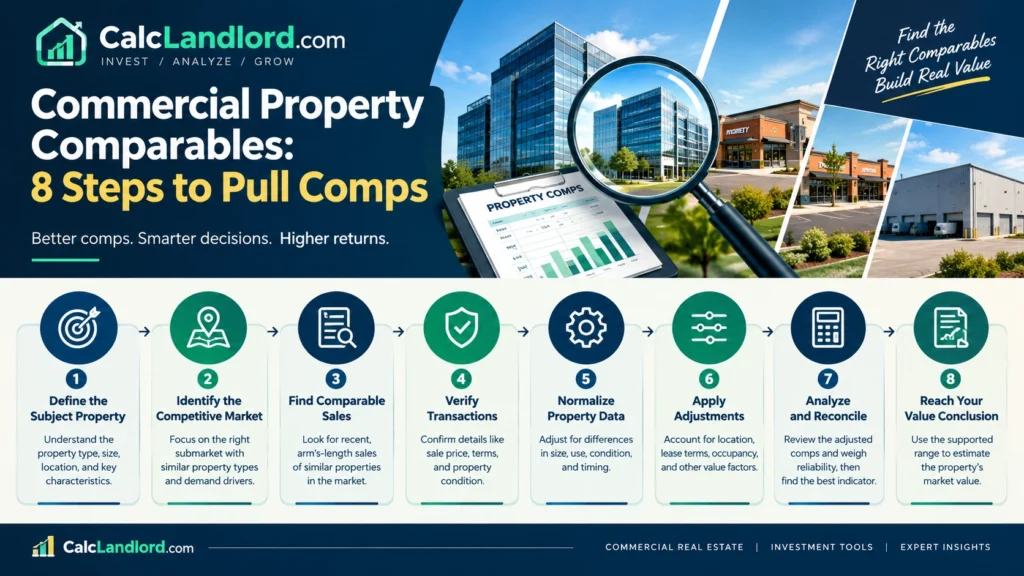
Commercial Property Comparables: How to Pull and Adjust Comps
Commercial property comparables help investors, landlords, and property owners understand what similar Commercial Properties have sold or leased for. However, finding nearby properties with similar square footage is not enough to establish a reliable value.
A meaningful commercial comp analysis requires more than collecting sale prices. You must identify genuinely competing properties, verify transaction details, compare property conditions, adjust economic differences, and evaluate the resulting indications.
Quick answer: To pull and adjust commercial property comparables, define your subject property, research similar closed transactions, verify their prices and terms, calculate comparable price per square foot, adjust for material differences, and reconcile the adjusted indications into a supported value range.
This guide explains how to perform each step using practical commercial real estate examples, sales comparison tables, lease calculations, and a reusable comp analysis template.
The examples use hypothetical U.S. commercial property transactions. Actual market values and adjustments must be supported by relevant local transaction evidence.
What Are Commercial Property Comparables?
Commercial property comparables, commonly called commercial real estate comps, are sales or executed lease transactions involving properties that compete with the commercial property being analyzed.
Investors use these transactions to estimate market value, evaluate asking prices, negotiate acquisitions, and understand achievable rental rates.
There are two primary types of commercial property comparables:
| Type | Description | Main purpose |
| Commercial sales comps | Completed sales of comparable commercial properties | Estimate property market value |
| Commercial lease comps | Executed commercial property lease agreements | Estimate market rental rates |
For example, suppose you own a 20,000-square-foot commercial warehouse in Dallas, Texas.
Three similar warehouses in competing locations recently sold for $2.8 million, $3 million, and $3.2 million.
These transactions may provide useful valuation evidence, but only after you examine their locations, sizes, building conditions, occupancy, transaction circumstances, and other differences.
Why Commercial Property Comps Matter
Commercial real estate investors use comparable transactions for several important decisions.
Property acquisition: Before purchasing an investment property, buyers can compare the seller’s asking price with verified sales of competing properties.
Rental pricing: Commercial landlords can examine executed leases to determine whether their proposed rents are competitive.
Property valuation: Owners can develop a supported indication of market value using comparable transactions.
Investment analysis: Investors can assess whether a property’s expected income and acquisition price make financial sense.
Negotiation: Verified transactions can help buyers and sellers explain their proposed prices using actual market evidence.
A property located nearby is not automatically a good comparable. Similarity in location, physical characteristics, property rights, and economic conditions matters more than distance alone. The Appraisal Institute’s guidance also emphasizes selecting transactions based on the characteristics that influence market participants.
Appraisal Institute+1
Which Commercial Properties Qualify as Comparable Sales?
Not every commercial building should be included in a commercial property comp analysis.
A good comparable should compete with the subject property for similar buyers, tenants, or investment purposes.
For example, comparing a neighborhood retail center with a large industrial warehouse would generally provide little meaningful valuation information, even if both properties have similar building areas.
Match the Commercial Property Type
Begin by identifying the property’s specific commercial category.
| Property type | Important comparison characteristics |
| Office Buildings | Location, building quality, occupancy, tenant mix |
| Retail centers | Visibility, traffic, tenant mix, access |
| Industrial warehouses | Clear height, loading facilities, access, building condition |
| Multifamily properties | Unit mix, occupancy, rental income, operating expenses |
| Mixed-use properties | Residential and commercial income, layout, location |
| Commercial land | Zoning, development potential, utilities, site conditions |
A similar property type provides a useful starting point, but it does not eliminate the need for additional adjustments.
Compare Physical and Economic Characteristics
Examine the following characteristics before accepting a candidate transaction:
- Building size and land area.
- Construction quality and age.
- Property condition and renovations.
- Parking and accessibility.
- Location and competing market.
- Occupancy and vacancy.
- Tenant quality and lease duration.
- Contractual rental income.
- Operating expenses.
- Property rights transferred.
Consider two hypothetical office buildings.
| Characteristic | Subject Property | Comparable |
| Building size | 20,000 SF | 19,500 SF |
| Location | Business district | Nearby business district |
| Occupancy | 95% | 96% |
| Condition | Good | Good |
| Tenant mix | Multiple tenants | Multiple tenants |
| Parking | Available | Available |
This property may provide useful comparable evidence because its physical and economic characteristics are reasonably similar.
However, you should still verify the transaction and investigate differences that could influence its sale price.
Understand the Property Interest
Property rights can also affect whether two transactions are comparable.
For example:
- Fee simple: Ownership of the property without a leasehold interest restricting the owner’s rights.
- Leased fee: Ownership subject to existing lease agreements.
A property with long-term contractual rents above market may have different economics from an otherwise similar vacant property.
Do not treat these interests as automatically interchangeable.
How to Define the Subject Property Before Pulling Comps
Before searching commercial real estate databases, create a detailed profile of the property you want to evaluate.
Your subject property is the property against which all selected comparable transactions will be measured.
Without a clearly defined subject, you can easily select properties that appear similar but represent different investment opportunities.
Build a Subject Property Profile
Record the following information:
| Property information | Details to collect |
| Property address | Full location and parcel identification |
| Property type | Office, retail, industrial, multifamily, etc. |
| Building area | Square footage and measurement basis |
| Land area | Total site area |
| Year built | Original construction year |
| Property condition | Excellent, good, average, or poor |
| Occupancy | Current occupied percentage |
| Tenant information | Tenant mix and lease characteristics |
| Rental income | Current contractual rental income |
| Operating expenses | Taxes, insurance, maintenance, management |
| Net operating income | Current or normalized NOI |
| Property rights | Fee simple or leased fee |
| Valuation date | Date for which value is being estimated |
Define the Valuation Purpose
You should also determine what question the analysis needs to answer.
For example, are you evaluating:
- The current as-is market value?
- The potential value after renovations?
- The value of a fully occupied property?
- The value of an income-producing property with existing leases?
- The market rent for vacant commercial space?
These are different valuation questions.
A vacant commercial property and a fully leased commercial property may have different economic characteristics even when their physical features are identical.
Practical advice: Keep the valuation purpose consistent throughout your analysis. Do not compare stabilized properties with vacant properties without examining the income and occupancy differences.
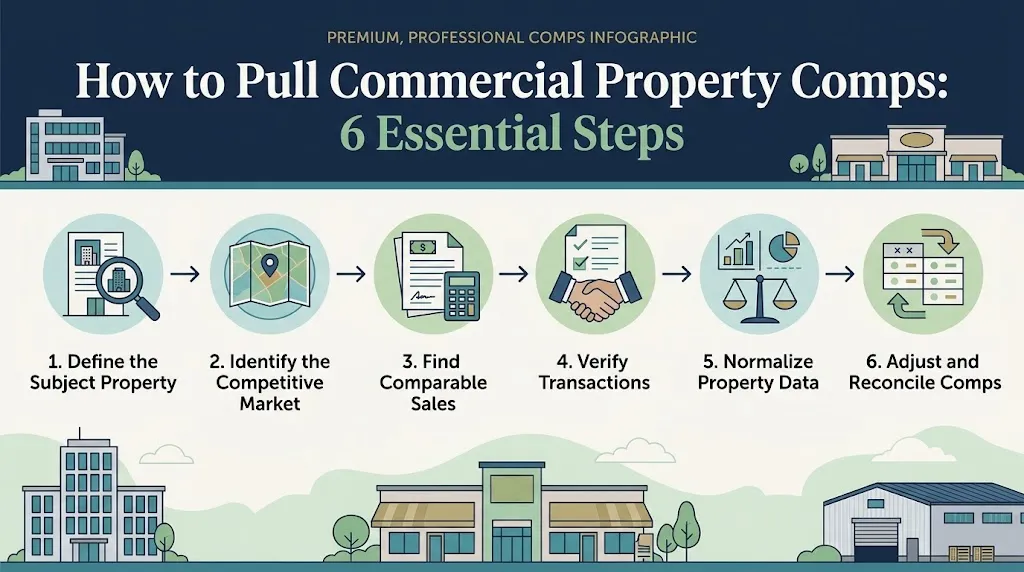
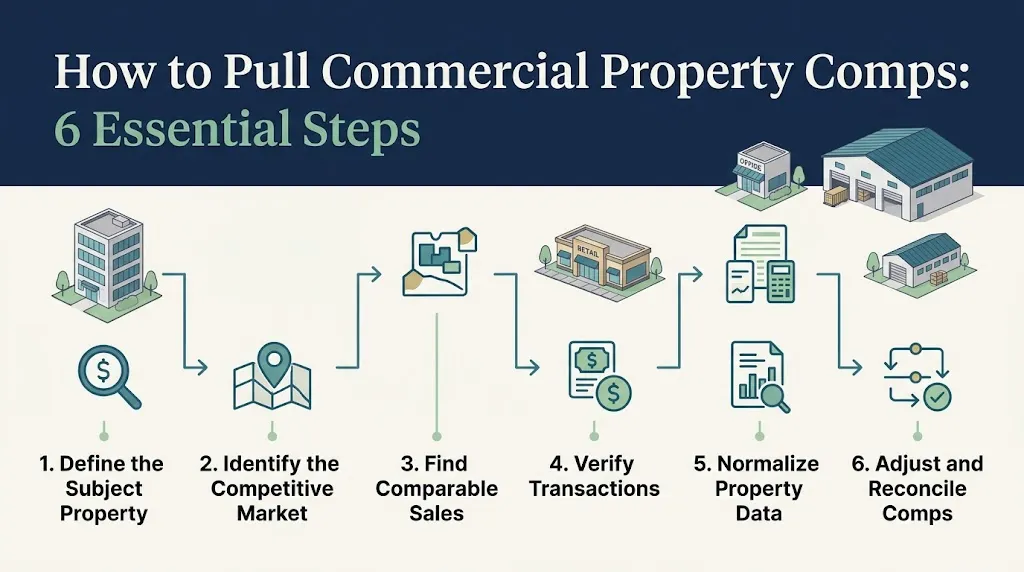
How to Find Commercial Real Estate Comps Step by Step
Finding commercial real estate comps involves more than entering a property address into a search platform.
You need a repeatable process that identifies relevant transactions and removes weak candidates.
Follow these eight steps.
Step 1: Start With the Subject Property’s Market
Search the same competitive submarket first.
Look for properties serving similar tenants and buyers.
For example, if your subject is an industrial warehouse, prioritize industrial properties with comparable transportation access, building features, and tenant demand.
Step 2: Set an Initial Search Radius
Start with the immediate competitive market.
You can expand your search to nearby submarkets when there are insufficient transactions.
However, geographical proximity should not replace economic similarity.
Step 3: Select a Relevant Transaction Period
Start with recent closed sales and examine whether market conditions changed between each transaction date and your valuation date.
A recent sale is not automatically better than an older sale if the older property is significantly more comparable.
Step 4: Apply Property-Type Filters
Separate office, retail, warehouse, industrial, multifamily, and other commercial property categories.
Avoid combining unrelated assets just to increase the number of results.
Step 5: Compare Building and Land Areas
Look for similar property sizes and comparable measurement methods.
For example, rentable area and gross building area should not be treated as equivalent measurements without understanding their differences.
Step 6: Examine Occupancy and Lease Characteristics
Review tenant occupancy, remaining lease terms, rental income, vacancy, and expense responsibilities.
These characteristics can influence the financial attractiveness of income-producing property.
Step 7: Verify the Transaction Information
Determine whether each transaction represents an actual completed sale and whether the reported price accurately reflects the property interest transferred.
Step 8: Create Your Initial Comparable Set
Keep only the strongest candidates.
You can retain weaker transactions separately as secondary market evidence, but clearly explain why they were not given significant weight.
This process helps prevent a large but unreliable collection of commercial property comps from influencing your valuation.
Where Can You Find Commercial Property Sales and Lease Data?
Commercial property comparables come from several research sources.
No single source provides every detail needed for a complete analysis.
The best approach combines transaction records, property information, lease information, and verification from knowledgeable transaction participants.
| Data source | What you can find | Limitations |
| County recorder offices | Recorded deeds and transfer information | May not explain full transaction economics |
| County assessor offices | Property characteristics and assessments | Assessments are not confirmed market sale prices |
| Commercial real estate databases | Candidate sales and property details | Data coverage and verification vary |
| Commercial brokers | Transaction details and market context | Information access varies |
| Listing platforms | Current asking prices and available properties | Asking prices are not closed-sale evidence |
| Authorized transaction documents | Closing information and lease details | Access and permissions may be restricted |
Can You Find Commercial Property Comps for Free?
Yes. Investors can begin with publicly accessible property records and other available transaction information.
County recorder and assessor websites can help identify ownership transfers, parcel characteristics, and available transaction information.
However, free records may not explain important details such as:
- Special financing arrangements.
- Portfolio sale allocations.
- Seller concessions.
- Lease obligations.
- Tenant improvement allowances.
- Buyer or seller motivations.
You may need additional verification before relying on a recorded transaction.
Use Commercial Research Platforms Carefully
Commercial databases can help identify potential comparable sales and lease transactions.
Platforms such as Reonomy and other commercial property research services can help organize property information.
However, a database result is a research starting point, not proof that a transaction is suitable for your valuation.
Important: Keep actual closed sales, executed leases, and active listings in separate categories. This prevents asking prices from being mistaken for completed transactions.
How to Verify Commercial Property Transactions
Transaction verification is one of the most important parts of commercial property comp analysis.
A reported sale price may not represent the actual economic consideration for the property.
Before accepting a transaction, investigate its circumstances.
Commercial Sale Verification Checklist
Ask the following questions:
- Did the property actually sell?
- What was the closing date?
- What was the recorded or confirmed consideration?
- Was the transaction between independent parties?
- Which property rights were transferred?
- Did the sale include multiple properties?
- Were unusual financing arrangements involved?
- Were there seller concessions?
- Was the buyer aware of major property defects?
- Was the property occupied at the time of sale?
For example, suppose a commercial building reportedly sold for $4 million.
However, the transaction also included two additional parcels.
Using the entire $4 million as the sale price of the individual building could substantially distort your analysis.
You would need to investigate the allocation of the overall consideration before using that transaction.
Verify Commercial Lease Transactions Too
Commercial lease comps require their own verification process.
Collect:
- Lease execution date.
- Lease commencement date.
- Contractual base rent.
- Rent escalation schedule.
- Lease term.
- Free-rent period.
- Tenant improvement allowance.
- Expense responsibilities.
- Renewal and termination options.
For example, a lease advertising $32 per square foot may look more attractive than one advertising $29.
However, the first lease may include several months of free rent and a substantial tenant improvement allowance.
Its effective economics may therefore be less favorable.
Document Your Verification Evidence
Record how the information was confirmed.
| Verification status | Meaning |
| Closing documents reviewed | Transaction information supported by documents |
| Broker confirmed | Information confirmed with a transaction participant |
| Public-record information | Information obtained from available public records |
| Database reported | Information reported by a commercial database |
| Asking terms only | No completed transaction verified |
These are suggested documentation labels for your own research, not official appraisal grades.
The OCC’s commercial real estate lending guidance emphasizes reviewing whether sales are genuinely comparable and whether adjustments and valuation assumptions are adequately supported.
OCC.gov+1
How to Calculate Price Per Square Foot and Normalize Comps
Once you have selected relevant transactions, normalize the data so the properties can be compared consistently.
Price per square foot is one of the most useful starting metrics for commercial property comparisons.
Commercial Property Price Per Square Foot Formula
PriceperSF=TotalSalePriceBuildingArea
Example:
Suppose a commercial building sells for $4,800,000.
Its building area is 40,000 square feet.
\[ \frac{\$4,800,000}{40,000} =\$120 \]
Calculated result
The property’s sale price is $120 per square foot.
Compare Multiple Commercial Properties
Consider the following hypothetical transactions:
| Property | Sale price | Building area | Price/SF |
| Property A | $2,800,000 | 20,000 SF | $140 |
| Property B | $3,150,000 | 21,000 SF | $150 |
| Property C | $3,600,000 | 24,000 SF | $150 |
The initial comparison suggests a price range of 140–150 per square foot.
However, this is an unadjusted range.
You must still investigate building condition, location, tenancy, and other important differences before concluding that the subject property should receive a similar indication.
Calculate Price Per Unit for Multifamily Properties
For multifamily commercial properties, investors may also examine price per unit.
PriceperUnit=TotalSalePriceNumberofUnits
For example, an apartment property selling for $2,400,000 with 24 units has a price of:
\[ \frac{\$2,400,000}{24} =\$100,000 \]
This equals $100,000 per unit.
However, unit size, occupancy, property condition, rental income, and operating expenses still matter.
Normalize the Area Measurement
Before comparing properties, confirm whether the reported measurements represent:
- Gross building area.
- Rentable building area.
- Net rentable area.
- Usable tenant area.
- Land area.
Using different area definitions can produce misleading price-per-square-foot comparisons.
- Explore More: https://calclandlord.com/income-vs-sales-comparison/
How to Adjust Commercial Property Comparables
Adjustment analysis accounts for material differences between each comparable and the subject property.
The general principle is to adjust the comparable transaction toward the characteristics of the subject property.
- If the comparable is superior, generally make a downward adjustment.
- If the comparable is inferior, generally make an upward adjustment.
For example, suppose a comparable building has significantly better accessibility than your subject property.
If market evidence indicates that the better accessibility increases buyer willingness to pay, its price may require a downward adjustment when estimating the subject’s value.
Common Commercial Property Adjustments
| Adjustment category | Examples | Potential direction |
| Location | Better access or visibility | Up or down |
| Building condition | Renovated versus outdated | Up or down |
| Size and utility | Different functional layout | Up or down |
| Market conditions | Changes between sale and valuation dates | Up or down |
| Property rights | Different ownership or lease interests | Requires careful analysis |
| Financing and concessions | Unusual financing or seller incentives | Cash-equivalent adjustment |
| Occupancy | Different vacancy levels | Up or down |
| Lease economics | Above-market or below-market rents | Up or down |
The direction depends on how the difference affects the comparable relative to the subject.
1. Location Adjustment
Location can influence commercial property demand and pricing.
Factors may include accessibility, surrounding businesses, transportation facilities, visibility, and the competitive market.
A property in a demonstrably stronger location may require a downward adjustment when compared with a weaker-location subject.
2. Condition Adjustment
A recently renovated property may command a different price from an older property requiring substantial repairs.
Review the actual condition difference and the market’s reaction to it.
Do not simply assign a standard percentage to every renovation or repair.
3. Market Conditions Adjustment
A commercial property sold several months before your valuation date may have experienced a different market environment.
Examine transaction evidence and market changes to determine whether a time adjustment is justified.
An older comparable is not automatically unusable, but its relevance must be explained.
4. Occupancy and Lease Adjustment
A fully occupied commercial building with stable tenants may have different economics from a building with substantial vacancy.
Review tenant quality, contractual rents, lease expiration dates, and the cost of attracting replacement tenants.
5. Financing and Transaction Adjustments
Unusual seller financing or concessions may affect the effective price.
Investigate whether the reported consideration represents a cash-equivalent transaction before using it as a straightforward market comparison.
How Should You Calculate Adjustments?
Use market-supported evidence wherever possible.
Potential evidence includes:
- Comparable transactions with relevant differences.
- Paired or grouped sales analysis.
- Local market research.
- Income analysis.
- Supported repair or replacement costs.
- Credible commercial transaction information.
There is no universal 5%, 10%, or 15% adjustment that should automatically be applied to every commercial property.
The Appraisal Institute emphasizes analyzing relevant transaction differences and supporting adjustments with appropriate market evidence and reasoning.
Appraisal Institute+1
How to Calculate Adjusted Property Value: A Three-Comp Example
Now let’s put the commercial property adjustment process into practice.
Assume you are evaluating a 20,000-square-foot flex commercial building.
You have identified three hypothetical comparable sales.
The following percentages are illustrative assumptions designed to demonstrate the calculations. They are not actual market-derived adjustment rates.
Step 1: Review the Initial Comparable Transactions
| Details | Comp A | Comp B | Comp C |
| Original price/SF | $150.00 | $145.00 | $160.00 |
| Market adjustment | +2% | +4% | 0% |
| Time-adjusted price/SF | $153.00 | $150.80 | $160.00 |
| Location adjustment | -5% | 0% | -5% |
| Condition adjustment | 0% | +5% | -5% |
| Size/utility adjustment | +2% | 0% | 0% |
| Combined property adjustment | -3% | +5% | -10% |
| Adjusted price/SF | $148.41 | $158.34 | $144.00 |
Step 2: Calculate Comp A
Original price:
\[ \$150 \text{ per SF} \]
Apply the hypothetical market-conditions adjustment:
1501.02=153
Combine the property adjustments:
\[ -5\%+0\%+2\%=-3\% \]
Calculate the adjusted price:
\[ 153\times0.97=\$148.41 \]
Comp A indicates approximately $148.41 per square foot.
Step 3: Calculate Comp B
Apply the market adjustment:
1451.04=150.80
Its combined property adjustment is positive 5%.
\[ 150.80\times1.05=\$158.34 \]
Comp B indicates $158.34 per square foot.
Step 4: Calculate Comp C
Comp C has no market adjustment.
Its combined property adjustment is negative 10%.
\[ 160\times0.90=\$144 \]
Comp C indicates $144 per square foot.
For simplicity, this example adds the property adjustment percentages together before applying them to the time-adjusted price. Actual appraisal analyses may use different calculation methods and sequences, which should be clearly explained.
Step 5: Reconcile the Three Adjusted Comps
Not every comparable deserves equal consideration.
Suppose your analysis supports these illustrative weights:
| Comparable | Adjusted price/SF | Weight |
| Comp A | $148.41 | 50% |
| Comp B | $158.34 | 30% |
| Comp C | $144.00 | 20% |
Comp A receives the greatest weight because, under our hypothetical assumptions, it has the strongest combination of similarity and verification.
Calculate the weighted indication:
(148.410.50)
+(158.340.30)
+(1440.20)
\[ =\$150.507 \]
The weighted indication is approximately $150.51 per square foot.
Step 6: Estimate the Subject Property’s Indicated Value
The subject property contains 20,000 square feet.
20,000150.507
\[ =\$3,010,140 \]
Illustrative commercial property valuation
$3,010,140
Weighted indication
$150.51/SF
Adjusted comp range
144–158.34/SF
Subject building area
20,000 SF
Implied value range
2.88M–3.17M
Hypothetical calculation, not an appraisal or verified market valuation.
Why You Should Explain Your Weighting
A weighted average does not automatically make a valuation reliable.
You should document why each comparable received its particular weight.
Consider:
- Transaction verification quality.
- Similarity to the subject property.
- Location and competitive market.
- Magnitude of adjustments.
- Reliability of the available information.
- Differences in property rights and income characteristics.
The purpose is to identify the strongest evidence, not to make an Commercial Property Comparables uncertain valuation look mathematically precise.
How to Compare Commercial Lease Comps and Effective Rent
Commercial lease comps help property owners understand what tenants are actually agreeing to pay for similar commercial space.
However, comparing only advertised or contractual base rents can produce misleading results.
Two landlords may offer similar face rents but provide very different concessions.
Important Commercial Lease Comparison Factors
| Factor | Why it matters |
| Base rent | Contractual rental payment |
| Lease term | Duration of the agreement |
| Rent escalations | Future rent increases |
| Free rent | Period without base rent payments |
| Tenant improvements | Landlord-funded improvements |
| Operating expenses | Expenses paid by each party |
| Lease structure | Gross, modified gross, or NNN |
| Renewal options | Potential future lease duration |
Example: Calculate Net Effective Rent
Suppose a commercial landlord offers the following lease:
- Lease term: 5 years.
- Face rent: $30 per square foot annually.
- Free base rent: 6 months.
- Tenant improvement allowance: $10 per square foot.
- No rent escalations.
First, calculate total scheduled base rent.
\[ 30\times5=\$150 \]
Next, calculate the free-rent concession.
\[ 30\times0.5=\$15 \]
Calculate average annual base rent after free rent:
\[ \frac{150-15}{5} =\$27 \]
The tenant receives an average base-rent equivalent of $27 per square foot annually over the lease term, before considering other lease costs.
Now account for the landlord’s tenant improvement allowance:
\[ \frac{150-15-10}{5} =\$25 \]
Simplified lease economics
Face rent
$30
Per SF/year
After free rent
$27
Per SF/year
After TI allowance
$25
Per SF/year
Lease duration
5 years
60 months
The $25 figure is a simplified, undiscounted landlord-side base-rent measure after the stated concessions. It does not include leasing commissions, other landlord costs, expense recoveries, financing, or the time value of money.
For a more detailed lease analysis, compare the timing of all Commercial Property Comparables concessions and payments using a consistent methodology.
Compare Gross Leases With Triple-Net Leases
A gross lease generally places more operating expense responsibility on the landlord.
A triple-net (NNN) lease typically requires the tenant to pay its share of property taxes, insurance, and maintenance expenses, subject to the agreement.
Therefore, a gross lease at $30 per square foot may not be economically equivalent to a triple-net lease at $27.
Normalize operating expense responsibilities before deciding which lease offers the stronger rental economics.
How to Cross-Check Sales Comps With NOI and Cap Rate
For income-producing commercial property, comparable sales should not be examined in isolation.
You should also evaluate the property’s earning potential using net operating income (NOI) and capitalization rates.
Understand the Cap Rate Formula
CapRate=AnnualNOIPropertyValue100
NOI represents property operating income after operating expenses, before debt service.
The calculation excludes mortgage principal and interest payments.
Commercial Property Valuation Example
Assume a commercial building produces:
| Financial item | Annual amount |
| Effective property income | $300,000 |
| Operating expenses | $90,000 |
| Net operating income | $210,000 |
Now assume the supported comparison suggests a capitalization rate of 7%.
Calculate indicated value:
\[ \frac{210,000}{0.07} =\$3,000,000 \]
The income approach indicates a value of $3 million.
This is reasonably close to the illustrative sales comparison indication of approximately $3.01 million calculated earlier.
However, agreement between two approaches does not independently prove that either analysis is correct.
What Should You Investigate if the Results Differ?
Review:
- Whether NOI represents actual or stabilized income.
- Whether vacancy and credit losses are realistic.
- Whether all recurring operating expenses are included.
- Whether the comparable properties have similar lease structures.
- Whether major capital expenditures are required.
- Whether the selected cap rate reflects the property’s income risk.
- Whether the same property interest is being valued.
Remember that the income approach and sales comparison approach answer related but different valuation questions. Use the approaches appropriate to the asset and the evidence available.
OCC.gov
What Should You Do When There Are No Reliable Commercial Comps?
Some commercial markets have limited transaction activity.
This can happen with specialized properties, unusual buildings, rural locations, or properties with uncommon tenancy and operating characteristics.
When strong comparable sales are unavailable, do not force unrelated properties into your analysis.
Instead, broaden your research carefully.
Expand Your Search Strategically
Expand the geographic area. Search other locations that genuinely compete for similar buyers or tenants.
Consider older transactions. Examine previous sales when more recent comparable transactions are unavailable, and assess relevant changes in market conditions.
Evaluate different property sizes. Consider somewhat larger or smaller properties only when the differences can be meaningfully analyzed.
Investigate additional transaction sources. Contact knowledgeable commercial brokers and seek authorized transaction documents where possible.
Use other valuation approaches. Depending on the property, the income approach or cost approach may provide additional evidence.
Explain the Limitations
Suppose you find only two reasonably comparable industrial properties.
You should not invent a third comparable or present unrelated sales as strong evidence.
Document:
- Why the transaction market is limited.
- Which properties were excluded.
- Why the remaining transactions were selected.
- What assumptions require additional verification.
- How uncertainty affects the conclusion.
The OCC’s commercial real estate guidance recognizes that comparable-sales evidence may be limited in certain markets and that other appropriate valuation information and methods may be needed.
OCC.gov
What to Include in a Commercial Property Comps Template
A commercial property comps template helps organize your information and makes it easier to identify differences between transactions.
You can build one in Excel or Google Sheets.
The following is a practical starting structure.
Commercial Property Comparison Template
| Field | Subject | Comp A | Comp B | Comp C |
| Property address | ||||
| Property type | ||||
| Building area | ||||
| Land area | ||||
| Year built | ||||
| Property condition | ||||
| Property rights | ||||
| Occupancy | ||||
| Transaction date | N/A | |||
| Confirmed sale price | N/A | |||
| Price per SF | N/A | |||
| Annual rental income | ||||
| Annual operating expenses | ||||
| NOI | ||||
| Cap rate | N/A | |||
| Lease information | ||||
| Market adjustment | N/A | |||
| Property adjustment | N/A | |||
| Adjusted price per SF | N/A | |||
| Verification source | ||||
| Assigned weight | N/A |
Add an Adjustment Evidence Column
Do not just write an adjustment percentage in your spreadsheet.
Record the reason for the adjustment and where the supporting evidence came from.
For example:
| Adjustment | Amount | Supporting explanation |
| Location | -5% | Supported difference in competitive position |
| Condition | +5% | Subject has inferior condition |
| Size and utility | +2% | Supported functional difference |
The explanations should be based on actual research for the property and market you are analyzing.
Maintain an Exclusion Log
Your template should also record transactions you considered but rejected.
For example:
| Excluded transaction | Reason for exclusion |
| Property A | Different property type |
| Property B | Unverified transaction price |
| Property C | Portfolio sale without reliable allocation |
| Property D | Significantly different property rights |
An exclusion log helps explain why your final comparable set is more reliable than a simple database search.
What Common Commercial Real Estate Comp Mistakes Should You Avoid?
Even a detailed commercial comp spreadsheet can produce misleading results when the underlying information is weak.
Avoid these common mistakes.
1. Using Asking Prices as Closed Sales
An asking price represents what a seller hopes to receive.
It does not prove what a buyer actually paid.
Keep active listings separate from completed transactions.
2. Selecting Properties Only by Distance
A nearby commercial property may serve a completely different market.
Choose economically comparable properties rather than automatically selecting the closest addresses.
3. Ignoring Property Condition
Two buildings with identical square footage may require very different levels of maintenance and capital investment.
Examine their physical condition before comparing prices.
4. Ignoring Tenant and Lease Economics
Contractual rents, vacancy, tenant quality, and lease expiration dates can significantly influence an income-producing property’s economics.
5. Applying Arbitrary Adjustment Percentages
Do not automatically apply 5% for condition or 10% for location.
Each material adjustment should have a defensible explanation and appropriate supporting evidence.
6. Comparing Inconsistent Building Measurements
Always check whether the reported square footage uses the same measurement basis.
An incorrect denominator can distort the entire price-per-square-foot analysis.
7. Double-Counting Property Differences
For example, deferred maintenance may affect property condition, expected repair costs, vacancy, and rental income.
Be careful not to apply multiple full adjustments for the same underlying issue without analyzing their separate effects.
8. Giving Every Comparable Equal Weight
A highly similar and well-verified transaction may deserve more consideration than a weakly verified sale requiring several substantial adjustments.
Explain your reconciliation instead of relying entirely on an average.
9. Confusing an Informal Comp Analysis With a Professional Appraisal
An investor’s spreadsheet can be useful for acquisition research, but it is not automatically a compliant appraisal.
Certain lending and other assignments require professional valuation work under applicable rules and standards.
People Also Ask
A:Start by searching for at least three strong closed sales when the available market data supports that number. The OCC’s commercial real estate lending handbook describes comparing at least three recently sold similar properties as typical practice. However, three weak transactions are not necessarily better than two highly relevant transactions with clearly documented limitations.
A:There is no universal age limit that makes every commercial transaction suitable or unsuitable.
Evaluate the sale date relative to your valuation date and determine whether market conditions, property characteristics, or economic circumstances have changed.
An older transaction may still be useful when recent sales are limited, provided its continued relevance is explained and necessary adjustments are supported.
A:Start with county recorder and assessor websites, public property records, available transaction information, and commercial broker resources.
These sources can help identify candidate properties, but you may need additional information to verify actual sale prices, concessions, lease terms, and transaction circumstances.
A:For the sales comparison approach, adjustments are generally applied to the comparable sale to reflect the characteristics of the subject property.
A superior comparable typically receives a downward adjustment, while an inferior comparable typically receives an upward adjustment.
A:There is no universal price per square foot that represents good value for every commercial property.
Pricing depends on property type, location, condition, income, tenant quality, lease characteristics, and market conditions.
Compare properties with similar characteristics and examine their adjusted indications rather than relying on a national average.
Key Takeaways: What Should Commercial Property Investors Do Next?
Before relying on a Commercial Property Valuation, remember these important principles:
- Select properties based on genuine market and economic comparability.
- Verify completed sales and executed leases.
- Normalize building measurements and transaction prices.
- Adjust comparable sales using supported market evidence.
- Compare lease concessions and expense responsibilities.
- Reconcile multiple adjusted indications rather than relying on a single transaction.
- Cross-check income-producing properties using supported NOI and cap-rate assumptions.
- Document limitations and explain uncertainty.
The best commercial property comp analysis is not necessarily the one with the most transactions. It is the one in which every selected transaction has a clear purpose, every material adjustment has a defensible explanation, and the final value indication follows logically from the available evidence.

Pingback: Industrial Property Due Diligence Checklist: 12 Key Checks